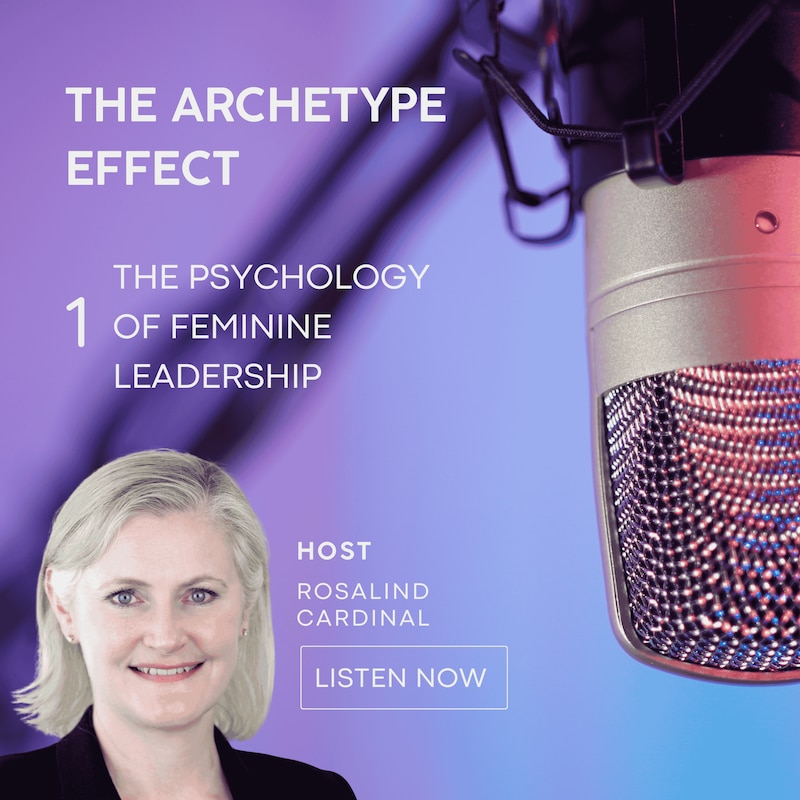
Leadership was never meant to feel like performance.
In this opening episode of The Archetype Effect, Ros Cardinal explores why so many women feel out of place inside traditional leadership models — and why the problem isn’t confidence, competence, or ambition.
This episode introduces a new way of understanding leadership through a feminine psychological lens — one grounded in connection, intuition, and wholeness rather than control and hustle. It’s an invitation to stop adapting yourself to the system, and start understanding how you already lead.
This is the beginning of a journey into archetypes, nervous system awareness, and power that feels aligned — not exhausting.
In this episode, we explore:
Why many leadership models were never designed with women in mind
The hidden cost of performing leadership rather than inhabiting it
What “feminine leadership” really means (and what it doesn’t)
Why burnout is often about misalignment, not workload
A preview of the archetypal framework that will shape the season
Reflection prompts:
Take a moment to reflect on these questions after listening:
Where in your leadership do you feel most authentic and at ease?
Where do you feel like you’re performing a version of leadership that doesn’t quite fit?
What parts of yourself feel most alive when you’re leading?
What parts feel tired, muted, or overused?
There are no right answers. Curiosity is enough.
What’s next:
🎧 Next episode:Meet the Four Empowered Archetypes — Sovereign, Warrior, Wise Woman, and Tribe Builder — and discover which energies already shape how you lead.
Stay connected:
Follow The Archetype Effect for new episodes and reflections on feminine leadership, power, and presence.
[00:00:24] Ros Cardinal: When women talk to me about leadership, they rarely start with power or strategy or KPIs. They talk about feeling responsible for everyone. They talk about being exhausted from holding the emotional weight of their team. They talk about wanting to be taken seriously without feeling like they have to harden themselves to do it, and again and again, they tell me I feel like I'm supposed to lead in a way that doesn't feel natural to me.
[:
[00:01:29] But inside. Inside I was editing myself every sentence, every facial expression, every instinct. If my intuition nudged me to question the direction of a project, I'd reframe it in more acceptable language. If a conversation needed empathy, I'd offer it, but in a controlled and measured way, because too much would look soft.
[:
[00:02:19] Women weren't struggling because they lacked confidence or competence. They were struggling because they were trying to lead inside frameworks that were never designed with them in mind. We're operating in centuries old models built on competition, separation, emotional distance, and linear decision making. Models shaped in military structures, industrial workplaces, and environments where emotional complexity was considered a liability.
[:
[00:03:15] I've coached women who are brilliant strategists, but felt compelled to downplay their ideas until someone else validated them. I've coached leaders who could feel the emotional weather of a meeting before the meeting even began, but didn't trust that insight because it wasn't data. I've worked with women whose natural collaborative instincts were misread as indecision while their male counterparts unilateral decisiveness was praised as leadership.
[:
[00:03:54] Now when I use the word feminine, I'm not talking about gender. I'm talking about a psychological and energetic orientation. One available to all humans, but one that women both culturally and biologically tend to access more readily. Here's the feminine leadership values, connection over control, collaboration over dominance, intuition, alongside analysis, meaning over metrics, wholeness over hustle.
[:
[00:04:44] The subtle shifts in mood, power, safety, belonging. But here's the twist. When the environment doesn't honor this intelligence, it turns inward. What could be intuition becomes self-doubt. What could be attunement becomes overthinking. What could be empathy becomes emotional overload. One of my coaching clients, let's call her Anna, once told me, I can feel everything that everyone in my team is feeling, but instead of knowing what to do with it, I just absorb it.
[:
[00:05:44] Women with generous hearts who were drowning in the emotional labor of everyone around them. And it dawned on me these weren't personality quirks. These were archetypes, symbolic patterns that capture something true about how women move through the world. Out of thousands of coaching hours, two years of reflection, research and pattern tracking, four empowered archetypes emerged.
[:
[00:06:26] She sees possibility long before others do. She creates, she imagines, orchestrates, she speaks in futures, not instructions. And yet she can retreat when she's overwhelmed. Drawing back into the castle and closing the gates. The warrior, she's courage, direction, protection. She sees what needs to be addressed and she cannot rest until she moves towards it.
[:
[00:07:10] Her challenge, she can become the lone wolf, withdrawing, holding everything in her mind, believing that she needs to carry the insight alone. The tribe builder, she's connection, belonging, community. She fosters psychological safety. People thrive around her, but her shadow is overgiving losing herself in meeting everyone's needs.
[:
[00:08:04] Whenever I teach this model, women say, Ros, this explains everything. Because once you see these archetypes, you also see the patterns that push them into their shadows. A sovereign retreats when her ideas are dismissed, a warrior becomes controlling when she's expected to prove herself again and again. A wise woman withdraws when no one else sees what she sees.
[:
[00:08:49] I remember coaching a senior leader who said, I feel like every day I'm choosing between being who I am and being who the system wants me to be. And that is the heart of feminine leadership psychology. It's not a question of capability, it's a question of congruence. Women thrive when their leadership expression aligns with their internal truth.
[:
[00:09:36] Here's the most important insight I can offer you today. You don't become a stronger leader by doubling down on your dominant archetype. You become a stronger leader by integrating all four. A sovereign with a touch of warrior becomes a visionary who executes. A warrior with a touch of wise woman becomes strategic instead of reactive.
[:
[00:10:17] It's steadier, quieter, more powerful. Women often tell me, Ros, for the first time in my life, I don't feel like I'm too much or not enough. I feel balanced. That's the effect of integration, that's the effect of archetypes. Before we close today, I want to offer you a moment to reflect. Where in your leadership do you feel most authentic?
[:
[00:11:12] Because the more you understand the patterns within you, the more powerful and grounded your leadership becomes. This season, we're going to explore each archetype in depth, the empowered expression, the shadow, the nervous system patterns, and how to use each one in your coaching or your leadership. Next week you'll meet all four archetypes, sovereign, the warrior, the wise woman, and the tribe builder.
[:
[00:11:52] Thanks for joining me on The Archetype Effect. If this episode sparked an insight, share it with a woman who leads or leave a review so more women can find these conversations. Until next time, lead with purpose and power that feels like you