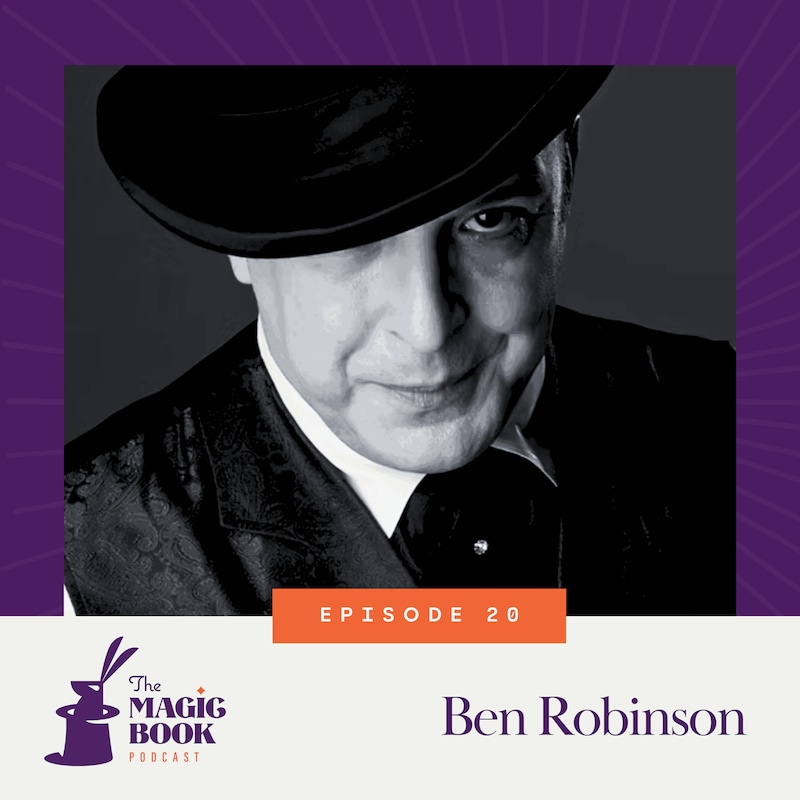
Shownotes
Master magician and historian Ben Robinson reflects on his fifty-year journey from watching Fred Kaps on television to uncovering John Mulholland's secret CIA work. Discover what drove his three-decade obsession with researching one mysterious file, why the bullet catch became legendary, and his philosophy: magic's greatest power lies not in tricks but in the artfulness of performance. Learn how legendary mentors shaped him and why transcendence through wonder remains the ultimate goal.
Transcripts
Coming up in this episode of The Magic Book Podcast.
Ben Robinson [:One of my goals as a magician is to give the audience a sense of wonder, which can also be called a sense of transcendence. This is why we entertain, right? The history of magic is not tricks, it's not people; it is the artfulness with which people deploy these things.
Adrian Tennant [:You're listening to The Magic Book Podcast, conversations about classic and contemporary books that teach, illuminate, and celebrate the art of magic. I'm your host, Adrian Tennant, a lifetime student of magic and mentalism, occasional performer, and longtime book collector. Thanks for joining me today. My guest is Ben Robinson, a master magician, author, and historian who has captivated audiences worldwide for five decades. Since his debut in 1974, Ben has performed nine different one man shows in 25 countries, entertaining over 3 million people. His remarkable career spans from performing for Frank Sinatra to entertaining mountaineers at the base camp of Mount Everest. As an author, Ben has written 15 books, including the cult classic "Twelve Have Died," about the infamous bullet catch illusion, "The MagiCIAn, about John Mulholland's secret work for intelligence agencies, and his autobiography, "The Outlaw Hero." Ben's most recent book is "MAJIKAL: 40 Stories of True Wonder," exploring themes of strength, integrity and creativity.
Adrian Tennant [:Ben also serves as an associate editor for VANISH Magazine, contributing articles on magic, history, theory, and performers. His work has received awards from the International Brotherhood of Magicians, the Society of American Magicians, and the Milbourne Christopher Foundation. Ben, welcome to The Magic Book Podcast.
Ben Robinson [:Thrilled to be here, Adrian. I've heard every single one of your podcasts up til now. Hit me!
Adrian Tennant [:Well, Ben, what first sparked your interest in magic?
Ben Robinson [:July of 1968, I saw a rerun of the Beatles first appearance on 'The Ed Sullivan Show'. The Beatles were not my focus of interest. It was the man who followed the Beatles and his name was Fred Kaps: K-A-P-S. Anyone who knows magic should or does know Fred Kaps. I was watching, sitting on the floor. My mother was sitting on a bed behind me and I saw what he did. I turned to my mother.
Ben Robinson [:It sounds like PR, but it's not. It's the truth. And I said, "That's me." I just had a vision very far in the future. We'll get into this later of my, dare I say orientation. Everyone has visions. It's whether you recognize it or not is the question and what you do with it.
Ben Robinson [:And in my case, I'm a magic crazy kid. I see a magician, three-time world champion, much less following the hottest act in show business, bar none. I mean, Beatlemania had consumed the Western world at this point. And this is a magician following him. And he was more exciting to me than The Beatles. So that was my first inspiration.
Adrian Tennant [:So how did that initial spark develop into a serious pursuit? Or as you put it, an 'orientation.'
Ben Robinson [:Right, the orientation. Let's define that immediately. I was a kid bitten by the magic bug, and I said, "That's me, and that's what I'm gonna do." Now, I don't want to get into all the darkness in my life, but the point is, I was at the time looking for something that was happiness or pleasing or not hard or anything, but where I was. And magic did that for me because it was cool and you could make something happen. And I didn't know how. And I was a little kid, and so my mother always told me, "If you want to learn about something, read a book." So I went to the library and said, "Do you have any books on magic?" And this is 1968.
Ben Robinson [:And they said, "Why, yes, we do. We have a book by a man named John Mulholland." And it was John Mulholland's 1963 book, his "Book of Magic," and his name was all over the cover. I mean, if you see the original dust jacket, the name Mulholland is written, like, 50 times. So that was somewhat intriguing to me of why did he have his name repeated so many times? And I would say it took about three years for me to read the entire book, from starting at age 7 until I was 10. But by then I knew, "Yeah, this is exactly right. This is what I do."
Adrian Tennant [:Interesting that it was that book by John Mulholland, which is obviously a name that would resonate with you, really, throughout your life, but we'll definitely get to that.
Ben Robinson [:We will.
Adrian Tennant [:Ben, I'm curious, who were some of the most significant mentors in your development as a magician?
Ben Robinson [:Okay, let's define magician first. And this is a crucial question. What is magic and what is a magician? So a magician is somebody who does magic. And when I first got into magic, like everybody else, it's about, "Wow, how do they do that? Now I know." Then the next step is, "Maybe I want to do that." So the first books that I read as a young amateur, not even standing on a stage magician, were by absolutely 100% professional magicians. And they were John Mulholland, Milbourne Christopher, Jean Hugard, and John Scarne. And that's it. I mean, I started off really, really right.
Ben Robinson [:If you read anything by any of those authors, good stuff, you're on your way. And what was intriguing to me about their writing was it wasn't just, "Here's a trick and how you do it." All of them would say, "Oh, this is the Four Ace effect. I performed for the Meyer Lansky crowd and half the crowd was armed." You know, there was drama to the performance. So that's performing magician. But because I was always interested in those stories that I alluded to a moment ago, I really cottoned to Mulholland talking about Long Tack Sam's Ice Trick in Peking, it was called at the time, and the geography involved.
Ben Robinson [:And Christopher, in his bio said he performed in 72 countries. Mulholland's bio said 40 countries. It was really 43. But you're not allowed to know about where those three were. He wasn't really there. And then really good friends. And I can say that because I have letters from all these people. I've been to their houses, in some cases, I've stayed over.
Ben Robinson [:Some of them have been here. But Bob Lund, Bob Parrish, Bob Weill, David Price, Milbourne Christopher Eddie Dawes, certainly John Booth, certainly. And when you just take one of those guys, for instance, I just found out the other day again, I mean, I knew this, but I forgot it. Dariel Fitzkee's "Magic by Misdirection," 1945, is dedicated to Bob Weill. You really gotta think about what was going on in 1945 and for this to happen for Fitzkee to write it. What was Fitzkee's relationship with Weill that he should dedicate that seminal book to him? You know, part of 'The Fitzkee Trilogy' now, it's a classic, but at the time, maybe not. So I met these guys, and for the listener who does not know who. Robert K.
Ben Robinson [:Weill, also Bob Weill. And when you got a letter from this guy, he also always signed it "Bob" or "Bob Weill." But then he wrote in "Robert K. Weill" in handwriting, so it was his identity. Well, who was this character? Well, let's start with the fact that his father was the marksman for Annemann's 1938 bullet catch. Oh, okay. Now we are dealing in outdoor theatrics. His name was Armand Weill.
Ben Robinson [:You'll see pictures of him in The Linking Ring in 1938. So Bob Weill was a master showman, but I don't know too much about his stage career, even if there is one. But I did a bullet catch with him in Canada. The only other guy he did a bullet catch with was Ted Annemann. So I don't want to use the doggerel term of associative power, meaning standing next to somebody so you're cool too. I'm not saying I'm Annemann. I'm not saying my bullet catch was anything but what it was.
Ben Robinson [:What I am saying is the same guy who directed Annemann directed me, period. And he told me the ins and outs of -- I don't really call it a trick. I call it more of a stunt or a feat because it only works if people believe you're doing it for real. Otherwise it's, you know, what are you selling there? So, Bob Weill, and then let me just rant on John Booth and Eddie Dawes for five seconds. John Booth, where do you begin? Unitarian reverend, went behind geopolitical lines into Tibet, nearly causing an international incident. But they couldn't throw him out because he was a Unitarian reverend. So he penetrated the country that was closed to Westerners because of his title and no one did anything.
Ben Robinson [:And he made it through. And you read his book "Fabulous Destination," which by the way, a film director named George Lucas read and then matched to the serials and said, "This is the real Indiana Jones!" He fought famine with Albert Schweitzer in Africa. He developed the lecture platform show with movies. John Booth is in the Photographer's Hall of Fame at Town Hall, two miles from me. He wrote 20 books, he visited 198 countries, and he was the only Westerner at Gandhi's Assassin's trial, reporting for the Chicago Tribune and the Boston Globe. But this is a giant career. This is a guy defining terms for Encyclopedia Britannica, just like Mulholland did.
Ben Robinson [:Eddie Dawes. Okay, move it over to him. Biological chemist working on extremely futuristic stuff, still futuristic when I met him in 1984. And that was by post. Then I spent considerable time with him in England in '86, and then every year thereafter we probably saw each other a little bit, except during 9/11 and COVID. But, you know, your audience doesn't need me to tell them who Eddie Dawes was. And the point that I'm getting to is: here I am, a complete nobody, just taking up the mantle as all in hardcore, full time professional magician, New York City, "Okay, let's do this, people!" And I'm gigging in bars and in clubs and, you know, wherever I can pick up some money.
Ben Robinson [:And I get this crazy idea to do this book about the bullet catch. And I think, "Well, you know, I'm nobody, but these are the best historians I know of and it doesn't hurt to ask, 'Hi, would you take a look at my manuscript?'" And that was two years before it became a book. And I think in both cases, they said, "Wow, what a peculiar idea." And Eddie told me years later, he said, "The only reason I said 'yes' Ben, was because you'd already done your own research. You weren't just asking me for mine." Because Eddie has a whole chapter called 'The Great Gun Trick' in "The Great Illusionists." So he didn't want me to just simply hand that over and say, "Hey, can I use that?" I had already done original research and said, "Okay, guys, this is where I am."
Ben Robinson [:"Correct me if I'm wrong, and if I'm right, I need to know that too." And when Eddie introduced me in England at the Eastbourne 50th Golden Anniversary, the International Brotherhood of Magicians, he somewhat chastised me from the podium. And he said, "Well, if I had known Dr. John Booth was involved, I certainly wouldn't have joined up." So both of them -- I don't think this was conscious -- they were very good friends, but I think they avoided each other's turf if one was doing a book, "layoff" you know, not that they were asked or anything, but mine was the only book where they are both on the masthead as editor. And I was thrilled by it. You know, my feet were held to the fire like no others because both of them said to me, "Ben, you print anything in here that I'm not good with, take my name off it."
Adrian Tennant [:Well, this was your first major book, "Twelve Have Died," which was published in 1986.
Ben Robinson [:Yep.
Adrian Tennant [:And of course, this was the pre-Internet era. So can we talk about what research challenges you might have faced during the writing of the book?
Ben Robinson [:Great question. I think about this a lot. It's just a teeny timeline: 1984, Apple comes out with their computer, and there had been, you know, lots of laptops and CompuServe and all these computers before then, but I have, and even today, zero interest in computers. I just, I'm more of a tactile guy from the 19th century. Anyway, I didn't know anything about computers, but I did have this idea of writing a book and how to do research. Well, I am a good student.
Ben Robinson [:I have a degree in Asian Studies. I speak several languages. And when you study languages, you study meaning, and when you study meaning, you study history. And when you study history, you find out what happened. And I already knew how to do that because my college had nominated me for a Watson grant. And that's a somewhat laborious process, but you basically jump through a couple of intellectual hoops of, "Here's my paper. What do you think?" And they say, "Okay, do it again" or "No" or "Yeah, go further." The end prize is that the IBM company, Thomas Watson president, would give you 10 grand, $10,000 in 1982, to go do whatever you wanted, tax-free.
Ben Robinson [:And I wanted to go to India and study street magic. So the way I parlayed this -- this does answer you about research for Twelve Have Died. It goes right into it because I did all this research on Indian magic. It was my senior thesis. It was published in The Linking Ring, December '82 through March of '83. I had nothing to do with that except that Milbourne Christopher said that I should send it into them. And Howard Bamman, who was the editor at the time, said, "This is great, but it's too big. We have to run it over four issues."
Ben Robinson [:Turned out that's where Dawes saw me the first time, and he liked it and he mentioned that. So it's now 1984 and I'm Xeroxing my Linking Rings to show everybody, "See everybody, I got published!" And if I say I'm going to do a book about a bullet catch or the bullet catch, everyone thought I was crazy. "Why would you write about that? You're going to do this? Holy mackerel, man. You really are out to sea." And I had no support whatsoever. And even, you know, it sounds great now, 40 years later.
Ben Robinson [:Sure, me and Eddie Dawes. Sure, me and John Booth. Let's rewind the clock and remind ourselves these guys are major figures in the magic field and other fields and they don't need me. I need them. So I have to prove myself to them. And Ray Goulet and Harry Anderson and Larry White and Jay Marshall and Orville Meyer, all the people that contributed to that book over really 26, 28 months. And it was kind of like email today. You know, you go to your mailbox and you say, "Oh, there's a letter from Ben, and we're doing the show tonight."
Ben Robinson [:And "da, da." And there's this thing. Well, every day I would get a stack of letters from David Price, Bob Parrish, Eddie Dawes, John Booth, Jay Marshall. You know, I knew I had the creme of magic performance and history in my corner for this project. And no success. You're not going to make money, you're not going to become famous, but you will have a book. But that was how I did the research.
Adrian Tennant [:If you're enjoying this episode of The Magic Book Podcast, please consider leaving a rating on Spotify or a review on Apple Podcasts. You can also follow The Magic Book Podcast page on Facebook. Thanks. Ben, your biography, "The MagiCIAn: John Mulholland's Secret Life," involved three decades of research. How did you first discover John Mulholland's CIA connection?
Ben Robinson [:Very simply, in 1977, when the Church Committee, which was part of the Rockefeller Commission. I'm being very emphatic about it because there are people in the intelligence business who don't like that. I use the name Rockefeller, which, if you go to the Library of Congress, you open the binder, it says Rockefeller Commission. So I didn't misstate anything. Everything in the book has been checked, rechecked, and verified by three sources. So how? Well, the reason I mentioned the three sources and all of that is because the original story, when it came out, Congress was investigating in 1975, a death that happened in 1953. The New York Times covered the hearings and Mulholland's name came up.
Ben Robinson [:And a reporter named Joe Treaster, who I've never met. I did write to him initially, but he never responded. So he told the boy very bare bones of the story. And the article is in the bibliography of the book. I think it simply says "Magician was hired as consultant to CIA." And that article, when I read it, was 1977, and again, like "Twelve Have Died," although this is 11 years earlier, I again had a vision, somewhat in my head of "There's a much larger story here." You know, here's nine column inches about it.
Ben Robinson [:But I saw volumes of information, and the research was done over three decades, for sure. And I have the notebooks to prove it. I keep a daily diary. So sitting to my left are 16,000 handwritten pages, which I am now digitizing. So that will take a weekend. But I wrote about Mulholland every day and this story and what I wanted to find. Because here's a good tip for all you researchers out there. Make goals.
Ben Robinson [:Just say in your head, you know, gee -- You have an idea that your subject may have been to London, but you're not sure. Well, follow that and see if they did. Even if you have absolutely no justification. My publisher of The MagiCIAn: John Mulholland's Secret Life," Chris Wasshuber, was on your show, I think, second guest, right after Julie Eng.
Adrian Tennant [:Correct.
Ben Robinson [:And I had said to my oldest friend in magic, Richard Hatch, "Would you please find me a publisher for this?" I was just exhausted by the research. And a couple of days later, I got a call from Chris, and he said, "Hi, I'm a friend of Dick Hatch's. Would you like to meet? I do this e-book thing." And this was like 2007 or 2006, and I had heard of an e-book. But I had no facility. I'd never seen it. And I said, "Well, a book to me is something you hold in your hand that's made out of paper that has ink on it." And he said, "For this project, I'll do that."
Ben Robinson [:And then he had the reach of the Internet and blah, blah, blah. Now it's 20 years later where that's very common. But at the time, it wasn't. On top of that, this was not an easy book to do because you're writing about stuff maybe people don't want to have written about. And those that you should be able to talk to. And the word 'should' is my desire, not the way the world works. There's a flat, "No, buddy, I'm not talking to you about anything."
Ben Robinson [:However, from 1977 to 1997, I was on my own, pulling every Mulholland book, library, article, magazine. I mean, this is a guy, Adrian, he wrote, let's start just conveniently, let's even, you know, just say 1930. Even though he was 32 years old at the time, he'd written lots. But let's just start in 1930. He dies in 1970. That's 40 years I have found -- absolutely true -- over 2,000 different titled articles that Mulholland wrote. Think about that.
Ben Robinson [:That's a lot. Now the joke and the criticism of Mulholland is that he only wrote really one book and he only wrote really one article. You know, it's like, "Okay, we're going to hear these tropes rolled out yet again." It's not true, but if you're a magician, you have a good story, you do repeat it, which he does. And no fault of that. You want to know, however, how did I get this story right?
Adrian Tennant [:Yeah.
Ben Robinson [:And what happened in 1997 was one of these, I call it droplets that race down the window pane during a storm, right? You just don't know which way that droplet is going to go. And in this case, the droplet was Mulholland's personal file from the Central Intelligence Agency. Every bank note, every invoice, every letter, every this, every that. And these are reports of things he would do. And this, of course, had never been seen before. And what happened was this.
Ben Robinson [:I found in the Christopher Collection notes by Christopher interviewing Mulholland. So it was December and January of '69 were these notes. There's Christopher talking to Mulholland, writing pencil on paper, little paper, like a little pad. And I found these notes. And at the end of the notes it says, "John gives me government file." And I had seen those notes, but I'd never seen or understood what the words "government file" meant. It kind of went to the side. And then I remembered, "Wait a minute, there was this story." So I did nothing about it.
Ben Robinson [:And in 1997, I was the curator of the second Christopher sale, because I worked for Mrs. Christopher for 26 years, succeeding her husband's death, who I worked with for as an admiring student, really, for five years prior. I met him in 1979. And basically we set up the second Christopher sale. The auction was at Swann’s, a big sale. I think it was the first magic auction to gross a million dollars or more. And I was not paid for over a year's worth of sifting through old paper and saying, "This is valuable, this is not."
Ben Robinson [:"This is valuable. This is not." And I was also the delivery service for all this to the auction house. So you're carrying, you know, Horace Goldin poster crumbling from Berlin in 1930. I was like, "Oh, my God, the onus is on me to preserve this!" And I had gone through that whole process. Well, finally the auction ends, and we threw the party for Mrs. Christopher at our apartment, which was not far from the auction house, it turned out. And there were maybe, I don't know, 20 lots, I'm just going to guess, did not sell at that auction.
Ben Robinson [:And Maureen called me and she said, "Ben, whatever didn't sell is yours if you want it. And I can have it delivered to your apartment." So they did and over came about maybe five or six file boxes that we all have in our closets. And in one of those file boxes was Mulholland's CIA file.
Adrian Tennant [:Wow.
Ben Robinson [:And it wasn't sexy at all. Most of the paper did not have even a header on it, like, you know, letterpress, nothing. It was just a piece of paper with stuff written on it. And it was a puzzle. It was, "What is this?" And then I figured it out, and a lot of the correspondence that's in that file is reprinted in the book. So that was 1997. The book didn't come out for 11 years later because now I had to chase all that down. I had to find out who these people were.
Ben Robinson [:And that was the real hard part. I was talking to my friend Keith Melton, who started the Spy museum in Washington, D.C. which everybody should go to because it's a $250 million building with a half a billion dollars worth of great stuff in it. Go, go, and go! Well, anyway, Keith is working on a book about magic and spy tradecraft. And he said, "You know, they really share a great deal." And I said, "Yes, they do." But I'm not a spy, so I had to learn the spy business. And he is facile with the spy world.
Ben Robinson [:And he has used me and other magicians to learn about the magic world. And when he saw me at The Magic Castle about a year and a half ago, we sat down after my show, and he said, "You know, I found a Robert Nelson thing that predates the agency using wireless communication by 20 years."
Adrian Tennant [:Gosh.
Ben Robinson [:So when you do research on this kind of thing, as you've done, as people do ... There's a famous tennis shot by Andre Agassi where the ball comes over his head and he has to run toward the back of the court and swing his racket over his shoulder to connect with the ball to return the play. Now he can't see where he's going to place the ball. He just knows that he has to try to return it. And that's the metaphor I look at in the last 11 years doing research for this, because I did know people in law enforcement, and I did know people who were in sort of think tanks. I have commerce with Brookings Institute, the Rand Corporation, the Rockefeller Foundation, couple of the Ivys, MIT for sure. And I kind of made the association that, "Oh, it's not just one building in Washington that's running this thing. They've got people everywhere."
Ben Robinson [:So that was where I went. I went to people that could guide me through the forest of. I will very loosely call 'intelligence,' because that's what this is. This is not James Bond. May I give you a story about intelligence to describe it for the listener?
Adrian Tennant [:Absolutely.
Ben Robinson [:This does support, certainly, Keith Melton's statement, intelligence ends when you pick up a gun. So all the violence in spy films, that's fantasy. That's to sell tickets to ticket buyers. The CIA once had a need to know how many people were in China. Well, how do you figure that out? Interestingly enough, they hired a think tank. I won't mention their name. And they said, "Oh, we know what to do. Let's figure out how much rice is consumed in the country."
Ben Robinson [:"If we can figure out that, we can figure out how many people there are." And these problems, well, magicians are really good at this stuff because we make the elephant disappear. We catch the bullet in our teeth. We pull the rabbit out of the hat, we deal four aces. And bringing this back to Mulholland, the agency and the Cold War, they had a problem. They had a real problem. You have to read the book to find out the timetable and what they were doing and why they involved a magician.
Ben Robinson [:But my point in introducing the book and Mulholland's work is to show that what was going on was the search for a solution to a problem. There's been more misinformation about Mulholland and the CIA than there has been correct information. So that's that.
Adrian Tennant [:Well, the book certainly is very enlightening about the intersection of magic and intelligence work, and I highly recommend listeners, if you haven't read it, to read it.
Ben Robinson [:Thank you.
Adrian Tennant [:Just a reminder that you can be notified when new episodes of this podcast are published by subscribing to the email alerts. You'll find all the details on the podcast website at TheMagicBookPodcast.com which is also where you can find transcripts plus accompanying blog posts with summaries, timestamps, and links to resources mentioned in each episode. Ben, your autobiography, "The Outlaw Hero," explores your long career in magic. In it, you develop the concept of an outlaw hero who operates outside conventional norms but in service of a greater ideal. How does the concept relate to your own philosophy of magic and life?
Ben Robinson [:Ah, let's start with Picasso's statement, "We do the work that must be done." Not "that I want to do," but "must be done." And if you are applying the word 'must' - why must? And the answer is usually because it's never been done before, but we think we can do it. I'll give you a few examples. Evel Knievel jumping across 19 double-decker buses. Never done before. He did it. He got hurt, but he did it.
Ben Robinson [:Edmund Hillary going to the top of Mount Everest with Tenzing Norgay. They always say "We went there to go to the top but you don't know what you're going to find up there." But they did it. My personal philosophy, very Outlaw Hero. We just finished a film. This is what I'm doing with my life these days, making movies. And I played Zorro and I threw three knives patterned in a Z pattern. And this is no kidding around filmmaking with an iPhone; this is a director of photography, makeup people.
Ben Robinson [:It's just, it's insane what you go through to make a film professionally. Well, there's no insurance company in the world -- I've looked at all of them -- that will insure knife throwing. You can't do it. They're like, "Are you crazy? We're not gonna. Oh, you're gonna throw at a person? Forget it. We're not."
Ben Robinson [:But nevertheless, we did it. When you see the film, it'll be out eventually. I am throwing knives dangerously close to a woman's face who is also dressed as Zorro. And my personal philosophy is, just like Picasso said, we need to do the work that must be done. So you could say, "Well, why do you have to throw knives close to a woman's face as Zorro? What's that about?" And the answer is, because if you look at all the representations of Zorro in the serial, in the movies, and Doug Fairbanks and all of it, there are no knives thrown. Not one. And I think that character would throw a knife and do it really well. So I'm simply adding my spin to a classic character.
Ben Robinson [:Now, that's in terms of knife throwing. In terms of philosophy, I've been to Mount Everest. I've done a show at the base camp at 18,000ft, roughly, for I don't know how many nationalities were there. I was told there were 12 different languages going around the dinner table. But I wanted to do magic as pure and simple as possible. "Hi!" "We don't have a show announced. We don't even know who this guy is." Even though my reputation had preceded me because I'd done magic along the trail for the American Everest team, 1989, prior to that.
Ben Robinson [:So my answer is that I've met lots of magicians who say, "Oh, I'm a birthday party magician." "I'm a school show magician." "Oh, I'm an opening act magician." "I'm a review show magician." "Oh, I do my own show." "I have a big show." And they slot into a market. Paul Daniels was a very close friend of mine. He said, "Ben, you're like me."
Ben Robinson [:"I'm a jobbing magician." And I've loved that because every show is different, every situation is different, but the same illusions, tricks, feats inhabit the same show. Like I did the Handkerchief through the Arm right out of the Mark Wilson course at 18,000ft. And when I met Mark, he couldn't believe it. It was like, "Whoa! You did that?" Mike Skinner, house magician at the Golden Nugget, Las Vegas, student of [Dai] Vernon. Amazing. Did 21 shows at The Magic Castle Close Up Room.
Ben Robinson [:Never repeated a trick. Mike and I met and I told him that I had done 'The Professor' Dai Vernon's Penetration of Thought at 18,000ft for sherpas and people who didn't speak English. And they got it. And he had done it. And he said, "Well, I changed the traveling card to the heart because women always pick the heart." If I have something to contribute to an art form, it's only going to be by taking that art form somewhere it might not have been. And then reporting back what happened, even if it's a big failure.
Ben Robinson [:Believe me, I've had my share.
Adrian Tennant [:Ben, your book, "MAJIKAL: 40 Stories of True Wonder," and for everyone listening, that's MAJIKAL, spelled M-A-J-I-K-A-L. Now, the book explores connections between seemingly disparate fields like art, film, intelligence, and magic. What inspired this interdisciplinary approach?
Ben Robinson [:Anytime I've written a book, there are always pieces left over that didn't fit in the book. For instance, I have a file on my computer, probably has 50 articles I've read in the last six months. And I will read something about charisma, or I will read something about misinformation, disinformation, outright lying, it's all the same. And I'll file that away for a sentence, a description of a sentence. Anyway, you publish and as Eddie Dawes said, "Live forever damned!" And then you have all these pieces left over. And now it's 2020. Just a little bit about "The Outlaw Hero" into "MAJIKAL." I was super busy from 2010 to 2020, and when COVID hit and when my sixth book, from Paul Romhany, editor of VANISH magazine, impresario, Vortex Press.
Ben Robinson [:Paul does everything. Paul and I had been working together for 15 years. And he said, "How about your autobiography?" And I said, "No, off limits, I'll just get sued. Forget it." And I said, "You know, I lived it, I wrote it, my wife can profit by it when I'm dead," so, you know, that's that. And he said, "Well, you owe me a book." And it's a serious commitment. We're friends, but he's got a timetable and he's investing his money and time. And I said, "Well, you know, I've got all this stuff, and I've always loved this character."
Ben Robinson [:So we did that. And a book to us is not just a book. It's a film or stage show or a song or it's supported by some other media because I am an interdisciplinary kind of guy. So "MAJIKAL," they were pieces that were left over and they were kind of stories that didn't fit in any other book. “Outlaw Hero” is 2020, "MAJIKAL," M-A-J-I-K-A-L, which is, by the way, a real word. I did not invent that word. If you look it up in the dictionary, it means "beyond the beyond," to be simplistic about it. And one of my goals as a magician in general, as an artist in general, is to give the audience a sense of wonder, which can also be called [a] sense of transcendence.
Ben Robinson [:This is why we entertain, right? You go to see the magic show or the comedian or the opera singer or the acrobat or the circus. Why? To, you know, maybe take the heat off of all those bills you have to pay for an hour or two, you can revel in artistic perfection. And I have met a great amount of people in a great amount of areas. One of your guests, Neil Tobin, talked about the magician character in detective fiction as being employed by law enforcement because he had access to many different groups. And this is a really important point, because the magician in mythology, the archetype, is the trickster. He's Hermes. The magician is the traveler between many different professions. If you really look at the archetype, you will see that the magician appears in all sorts of different places.
Ben Robinson [:Just to that point, I had the occasion to meet Robert Altman, the director, and he did the movie "Nashville" with Shelley Duvall and several others, Keith Carradine. Well, what a lot of people don't know is that there's a magician character in that movie. He's riding on a motorcycle. He just shows up every now and then in the movie. And Altman told me. He said, "He's the glue." And I thought, "Wow, you know, he's using the traveler as the glue, and every time the magician appears, he does something." And in fact, I don't know who the magician was.
Ben Robinson [:I should probably look at the credits. But I met a guy who looked like him in Tannen’s in 1973, and he had a helmet and a motorcycle. And he said, "Yeah, I studied coins with Slydini for 10 years. I studied cards with a guy for 10 years. I'm ready to go. I got a deck of cards and 10 coins. Hit the road with my motorcycle." And I wonder, it's like, “Was that the guy?” But anyway, there were a lot of leftover pieces, and we knitted them together, and I really hope people like it.
Adrian Tennant [:You've been writing for VANISH magazine for many years. In your March 2025 article about magic books, you highlight works by Maskelyne and Devant, Robert Houdin, Houdini, Fitzkee and Henning Nelms. Ben, which authors have most influenced your thinking about magic and why?
Ben Robinson [:Okay, super-easy question, because I thought about this. Absolutely John Scarne. Absolutely Jean Hugard and Fred Braue, who is often left off of the titles of the masterworks both of them created. You know, the modern world said, "Oh, yeah, by Hugard." Well, actually, there was another guy there, too, who wrote "Expert Card Technique."
Ben Robinson [:I made a film recently. We licensed the image of Harpo Marx. And one of the things that was said by the people that control the image was "Don't make the mistake the British made." I'm not beating up the British. But when Harpo's autobiography came out in England, they left the co-author off the dust jacket. Oops. And that's really terrible because if you worked on a movie or a book or something, and all you're going to get. Forget money, but all you're going to ... I think Roland Barber was paid for "Harpo Speaks," but he was the co-author whose name was left off.
Ben Robinson [:That's all you're going to get - is credit.
Adrian Tennant [:You believe in the importance of books in preserving magic's history and traditions. In your view, what responsibility do historians and writers have in documenting that legacy?
Ben Robinson [:Really super good question. Another one of your guests, [Judge] Gary Brown, who wrote the wonderful biography of Al Flosso. The same year that Jack Flosso engaged Gary to write "The Coney Island Fakir," Jack also engaged me to write two stories about the Flosso dynasty - "The world's oldest magic shop" that ran in The Linking Ring, and then "Al Flosso: An American Original, revisited at 100." And the reason I mention Gary is he brought up the fact that when you're researching a magician, you're going to get a lot of hype there. You know, I forget the exact familial relation, but I think it's Hardeen's nephew came to see me with another magician. They were making a little TV thing, and he handed me a clipping from the Sphinx.
Ben Robinson [:Now, this was, I don't think it was while Houdini was still alive. I think somebody was recounting Houdini talking at an SAM meeting in 1931. So this is five years after Houdini's death. And in the recounting of what Houdini is saying, he says, "Oh, yes. And then when I caught the bullet in my teeth in the ..." And he goes into this story, and I know absolutely, positively, Houdini never did the bullet catch. But if you look at the Adrien Brody movie, there you go.
Ben Robinson [:He's catching a bullet. The point is that you talked about responsibility and what we know and how to do it. Here's the riot act, everyone. We are living in an age of unprecedented access to information. It's that simple. If you really want to make a mark for yourself as a writer, if that's your goal, or simply to learn the truth and relate that truth to others. In the Conjuring Arts Research Center, in their amazing magazine, somebody found them and reprinted Pinetti's handwritten letters, and it blew my mind. I mean, Pinetti is one of the, he's one of the first people to ride in a hot air balloon ever on the planet Earth! And here his written letters and he's getting into a snit with some guy about he hired some guy and the guy didn't do the job, or Pinetti says he didn't do the job and he didn't pay him.
Ben Robinson [:Then he sues Pinetti and Pinetti brings in all these very aristocratic types and the charges are dismissed. And you know, what are we talking about? 1795, the original letters, ignorant exist, 1802, whatever it was. And that's the kind of research that we need and can do. I've heard so many of your guests on here say, "Well, you know, pre-Internet, I just can't imagine how they did it. Did you have to go somewhere and pull out a book? Now you're sitting at home on your laptop." My belief is that the responsibility of the researcher and the writer and the historian, not necessarily the collector, because they collect to collect and look at their nice things and they share and they do do history. But a historian is an entirely different thing. And a historian is a pallbearer of what happened.
Ben Robinson [:And two heroes of mine, did they get it right all the time? No. But I do make the point in "The Outlaw Hero" that if you look, if you really look at who Henry Ridgely Evans was and what he did and when he did it, well, everyone, my vote goes to him for capturing the golden age of Magic, 1880-1920. He was there. He read "The Secrets of Conjuring" in Magic, published 1878, posthumously to Robert Houdin. Then the Golden Age of Magic happens. Now it's 1920 and 1928. He publishes "The History of Conjuring." So first was "The Secrets" 50 years ago.
Ben Robinson [:Now here's "The History" -- here's what happened, and that's the goal. In my opinion. Everybody could say, "Oh, well, you know Gibson, right. You know, take only the biggest stories. Those are the only stories that matter." However, David Price makes a very good point in "Magic: A Pictorial History of Conjurers in the Theater," that the 40-Milers are as important as Thurston and Okito and Herrmann. And John C. Green. You read his history.
Ben Robinson [:It's, you know, this guy never traveled. That's why they're called 40-Milers, really not far from their base of operations, but they were full-time magicians. And Augustus Rapp is another one. Houdini was a huge Augustus Rapp fan. Augustus Rapp published a very slim and very beautiful, I think - is it called "Small Town Showman"? Anyway, autobiography, and Bob Parrish reissued it. Another point your previous guests have made is that magic -- doing a little bit of a timeline -- prior to 1800, magicians were not somebody you might invite home for dinner.
Ben Robinson [:They were scallywags and you know, kind of bordering on the criminal. And then in the 1800s magic moves into the theater. And Robert-Houdin was not the first. There was a theater in Austria, but Robert-Houdin did it bigger, better, wiser, smarter and was a genius and a great magician. And now it's 1900 and Eric Weiss is enthralled with Robert Houdin and he adds an 'I' to the name and becomes Houdini, what Ricky Jay called "the first superstar." And I think he was because he perfectly melded with industrialization. You really couldn't come up with a better act for the industrial age than Houdini.
Ben Robinson [:And this is why when he said he wanted to be paid in gold just to go to Australia, he was. He had that kind of leverage. So now we've gone in a mere hundred years from somebody you wouldn't invite home for dinner, much less introduced to your wife or daughter, to a man being paid in gold to travel to your country. It's a very significant shift. Harry Blackstone Jr. said that "Houdini legitimized magicians," and I thought that was a really interesting comment. So getting back to the historian, don't just tell us the bells and whistles. And "this guy was great and this is what he did. And did you know Adelaide Herrmann's show ran for 50 years? There was a female heading a magic show for 50 years."
Ben Robinson [:That's good. I wanna know what she wore. I wanna know exactly what Buster Keaton tells us. Have you ever read Keaton's autobiography?
Adrian Tennant [:I have not.
Ben Robinson [:Ah, well, he begins the first eight pages talking about Madame Herrmann and that she had an unfortunate experience with a duck hidden underneath her dress. And you know, that's really important stuff. When I lectured to the Keaton, I'm not self-promoting but I was able to explain Keaton as a magician because I have B.F. Keith Vaudeville programs that Nate Leipzig is on, and so are the three Keatons. And you're going to tell me little eight-year-old Buster Keaton is not in the wings watching Nate Leipzig? Of course he is. I mean come on, an eight-year-old watching the greatest manipulator of billiard balls and everything. And by the way, I found, and I can prove it, Bruce Cervon took notes. They're called "The Castle Notebooks."
Ben Robinson [:They're written at the feet of Vernon. So Vernon's saying, "Here's what Leipzig did." And Cervon's writing it down. He's drawing pictures. So I worked on one of those volumes. I wrote a Foreword to it. Linda Cervon sends me the whole volumes, and she says, "Ben, thank you for your work. Here's what we did."
Ben Robinson [:And I'm going through it, and I see something called Leipzig's Cigar Move. And shortly thereafter, I ran into a piece of color film shot of Buster Keaton in Italy doing that move with a cigarette. So I can't exactly prove that, you know, Keaton saw Leipzig, but here's Keaton doing Leipzig's move, as recorded by Cervon. So that's the kind of historical intrigue I really love. Okay, so Margaret Steele spoke a great deal about Herrmann's show and the Boomsky character, which I know nothing about. And I've met her, but she was so delightfully passionate about this. And I understand she's now got a book about all this that's great, because it tells us something about the Herrmann show that's not Herrmann. And now the picture forms of this is a theatrical entity. Wrapping this up, bringing it to today.
Ben Robinson [:So here we are, 2025, and there's some college student listening to this, going, "Yeah, man, I always dug magic, and maybe I should try to find something about magic and write about that." Please, please, please do. There's so many untold stories which we are now uncovering. If you looked at the New York Times, they found a Egyptian ruler's tomb that no one ever knew about. And apparently this guy ran half of Egypt for, you know, however long he ran it. But it's a completely untouched Egyptian crypt. Well, let me tell you, Bob Lund gave me a private tour of the American Museum of Magic. This is 1993.
Ben Robinson [:I recorded the whole thing. He says, "Ben, have you ever seen one of these?" And he holds up this wretched piece of metal with tongs coming out of it, and I have no idea what this thing is. I go, "No, Bob, I've never seen one of those. What is that?" And he goes, "I don't know either, but Pete Bouton made it for the Blackstone show, and it's part of their working gear." So my point is, somebody could go to the American Museum of Magic and pull out the entire Blackstone kit, which is there, the traveling workshop, and then go back to the Blackstone show and go, "Alright, here's what the Blackstone traveling tool case was used for." And that would take an engineer and it would take an enormous amount of research. But one last thing on this, I was hired ... it didn't happen because 9/11 stopped that.
Ben Robinson [:I was hired to make a pyramid of top hats appear for companies that had hired people that had gotten off welfare and gotten job skills when back into the workplace. And the show was supposed to be done September 12th in Albany with Governor Pataki handing out the top hats the more clever magician just made appear. And the way it would work is there'd be three top hats on the bottom, then two, and then one: a pyramid of top hats. Well, I said to the promoters, and this took months to create, "You can't just pull top hats out of a big box. It's not amazing."
Ben Robinson [:"That's like pulling a piece of lint out of a bathtub. It's stupid. It doesn't impress anybody." I said, "But if you show the box completely empty and then all of a sudden there's a pyramid of top hats there..." They said, "Ah, yeah, okay, let's do that." Well, the solution to what I wanted to do was, in magician terms, a Tip Over Trunk that had all four sides fall flat. I'd never seen one. I just figured out how to do it. And you also have to account for the top. So it's a six-sided box that you have to collapse to nothing instantaneously while not upsetting your inner chamber load.
Ben Robinson [:And this is not easy to do. So we did it and it worked. But the show was canceled. I gave the illusion to Mark DeSouza for his museum. About 10 years later, I saw that there was exactly that in the Harry Blackstone show.
Adrian Tennant [:Wow.
Ben Robinson [:From 1932, he makes Felix the cat, or if it's not Felix, it's a giant cat. That's how the giant cartoon cat appears. They show a Tip Over Trunk. Bam! Exactly the same solution I came up with. The history of magic is not tricks, it's not people. It is the artfulness with which people deploy these things. Right.
Ben Robinson [:The word 'meaning' comes to mind. I study this constantly and I strive for it because when I was engaged by The Magic Castle in their 60th year, which was a really giganto honor because Jack Goldfinger, the entertainment director, said to me, "Ben, we only booked the best of the best this year and it's delight to have you." And I felt so honored because I'm still that 14-year-old kid reading "Scarne On Card Tricks." I really am. And here I am, you know, and every night we're sold out 21 shows, and you don't know who's in your audience. It could be Cher, it could be not Cher, but it's ... it would not be a far stretch.
Ben Robinson [:One night, the singer Usher was in with his retinue of people, you know, so my point is, before I got there, somebody called me and said, "It's like the Academy Awards 24/7 around here. Be prepared." And so I got through that, and it was delightful, and it was really something. But what really carried it was my act. My act was not. "Okay, here's a trick. Applaud. Here's a trick. Applaud."
Ben Robinson [:It was, "Ladies and gentlemen, tonight on the 60th anniversary, you are seeing history unveil." Because they now had the record, they had exceeded Maskelyne's Egyptian Hall. We are post-COVID. But it was at this time and place that I wanted the audience to appreciate history. I told them in an illusion I did of John Elder Blackledge's for Roosevelt in the White House in 1939, which I unearthed. That only took four years.
Ben Robinson [:But it's such a really good question because I want who's ever out there, who's ever listening, I want you to really excel with what you're doing, and all the tools are there. You could look up any magician on the Internet and come up with 10 references and then say, "Okay, I'm going to chase all those down now. I'm going to find out hard copy of what's true." I know people who -- Eddie Dawes certainly did this with Bertram. He went to where he was born and he photographed it. "This is what the boy saw growing up," you know, and that's how we're going to go further.
Ben Robinson [:And last highfalutin statement. That's how we will be recognized as an art.
Adrian Tennant [:Well, this is The Magic Book Podcast. I have to ask you, what magic book or books do you most cherish in your personal collection and why?
Ben Robinson [:Okay, I've thought about this. I knew it was coming, and I wrestled with this and lost sleep over this. But the winners are in not second place, but in a different category. So first, magicians' autobiographies. Thurston's "My Life of Magic." I read "My Life of Magic," written in 1929, largely by John Northern Hilliard, and I'm sure Thurston had a hand in it. But 1929, Howard Thurston was a very busy guy.
Ben Robinson [:I don't think he was sitting down writing a book. Nevertheless, nothing could pry that book out of my hands. When you're reading about, "And there I was on the docks of Macau, leaving for Shanghai, and my white pith helmet, the pirates staring at my gleaming silver pistol ..." You know, it's, I just said, "Give me that! That's, that's what I want!"
Ben Robinson [:"I want that life! Give me the gleaming pistol on the dock facing pirates taking my show from Macau to Shanghai. I could do that. 24-seven-and-a-half!." So Thurston's "My Life of Magic," 1929. Everybody go out and get a copy and read it. The next book, however, is 1902, David Devant's "Woes of a Wizard," which, don't tell me you can't find it because there was a reprint.
Ben Robinson [:And what's so beautiful about that book is it's done before he joins Maskelyne. And there are many conjectures. I'm not a historian of Maskelyne. I am a huge Devant fan. Only because what he illustrates in that, what they called "first autobiography," is woes. It is the tribulations of what a magician has to go through. One story, he appears at a very, very beautiful English townhouse somewhere in London, and he goes in, he's got all his stuff, and he looks like a million bucks. And he gets set up in the other room.
Ben Robinson [:An hour passes and he says, "Where's the audience?" And the butler says, "Oh, they'll be in." And two hours passes and finally Devant just says, "I'm not going to stay here." And he leaves. The next day he gets a note and they said, "You never showed up." And he goes, "Never showed up? I was there." The butler never told the host the magician had arrived. And that happened to me.
Adrian Tennant [:Oh.
Ben Robinson [:So Devant's tribulations, the woes are real. And that's again, this historian, but the all time number one winner of Ben's favorite magic book. And why has to be Henry Hay's "The Amateur Magician's Handbook." Henry Hay's real name was June Barrows Mussey. He was John Mulholland's secretary and librarian. He then went on to found Mussey & Company, which had offices at 12th street and 5th Avenue. And flash forward to 1950, he writes "The Amateur Magician's Handbook," which I'm not sure about this, but may have been in a series from the original publisher. There may have been "The Amateurs Carpenter," "The Amateur Dancer."
Ben Robinson [:You know, it was like "Idiot" texts today. "Idiots For" you know, whatever. But anyway, this book, the original volume, had very beautiful black and white photographs that you could really see what the author wanted you to do with your hands. Not so much in the later paperbacks. However, if you talk to any nutball who loves this book as much as I do, you will hear the words, "Most influential book in the latter half of the 20th century as far as magic goes." I've talked to John Booth, Walter Gibson, Milbourne Christopher, probably Eddie Dawes, anybody who has an interest in books. I've talked to them about that book, and they all said, "Yep, he did it." In one book, you have a technical treatise where you're really learning the right way to do a French Drop or a Shuttle Pass or De Manche Change or the Ash Pass.
Ben Robinson [:Oh, my God. I have seen performers devastate audiences with that. It's in the back of the book. And he even says, he goes, "Yeah, this is usually passed over. People don't think much of it."
Ben Robinson [:Whereas it's also in L.H. Branson's 1922 "Indian Conjuring," as a staple of the Jadoo Wallah. So what Hay did, what Mussey did, was he took the best of the best. He put it in a book, he wrote it well. And then I don't know how many editions it's been through, at least five or six, I'm sure. It's a guide. It's a wonderful bibliography too. It's where I learned of "Neo Magic," by Sam Sharpe. It's where I learned of those books he mentioned in my article, Henning Nelms' "Magic and Showmanship."
Ben Robinson [:And it was such a treatise on, "Okay, you want to be a magician? Here's the whole world." And in the paperback, you know, you can carry it in your back pocket. It's amazing. So I love that book. And recently, I forget where I was. I think I was in the Pacific Northwest, and I just said, "I need a book to read on the airplane." And I just grabbed it off my shelf and went, I just fell in love all over again.
Adrian Tennant [:That's lovely.
Ben Robinson [:That's it.
Adrian Tennant [:Well, Ben, looking ahead, what's next?
Ben Robinson [:For me? Ha, life, aging, mature pursuits. I have now been a professional magician, and when I say 'professional' of course, from 1974, 1984, I was an amateur, but I was making money. And I did pay for my college education as a magician. But let's just say from the first time I stepped on stage, December 15, 1974, to yesterday, I have 50 years in the game. And the reason I mention that is not to stack up years, but to simply say, I did what I set out to do. So I can understand not retirement, but I can understand you don't have to keep doing what you've been doing.
Ben Robinson [:And what I Have been doing for the last at least 40 years is somebody calls me on the phone, makes an arrangement to have my show, and then they pay me and then I go and do the show. And that means carrying bags all over the world, which I have. And I was surprised to find out that I have. Do you know what an Anvil case is?
Adrian Tennant [:I don't.
Ben Robinson [:Oh, it's what you see on Rock 'n' Roll stages. They're all silver-edged, black big cases, you know, real heavy gear-type cases. Well, I have 20 of those. And the reason I have 20 is because every time you need a new show and a new prop, you gotta build a new case. Paul Newman and I were friends, and we became friends first as he saw my show, and second, because we saw the same back doctor for bad bags from carrying, in my case, carrying cases all over the world. In his case, driving racing cars. So I doubt I'll be taking out an hour show.
Ben Robinson [:And that breaks my heart to some degree. Not that I need a big case to do an hour show. I can do an hour show with what I have on me. But I had the experience today where I was walking in Central Park and I saw a group of maybe 10, 15 girls from a school, and they were all wearing the same uniform. And I thought of myself as a younger guy and I thought if I were hustling school shows, I would hit it right there and start doing a show right there on the sidewalk or in the park and then pass those girls each a card and split. And all that would happen in three minutes and I would be hustling. And I walked by today, enjoying the sunlight and knowing I'm excited to talk to you tonight. I thought, "You know what? I don't need to do that."
Ben Robinson [:"I don't need to perform." What I've luckily found that I've a talent that John Booth mentioned to me that I did not take seriously when he mentioned it, but I do now. So John was 30 years ahead of the class, of course, was that I have a unique facility for putting things together. What does that mean? Well, we've just completed a primer of this film. We have to take it to the lawyers now and get permission that what we've shot, we can show. I'm really good at the film business. Somebody said to me, another lawyer, they're like, "Oh, we want your thing and I can help you with connections." And I said to them very politely, and they were very well meaning, but I said, "No, these dominoes have to fall in exactly the pattern they were set up."
Ben Robinson [:Like "I cannot deviate from this path at all." So as far as projects go, I don't want to sound jaded, but I've already caught bullets in my teeth. I've been to Mount Everest. I think I've worked with some really great people. I don't want to forget Harry Anderson's contribution to "Twelve Have Died," or John Booth's contribution to the book about Mulholland. It's been so gratifying to do those things. And unfortunately, everybody who worked on "Twelve Have Died," is no longer with us. I'm the last one left, and I'm the guy that started it.
Ben Robinson [:It's wholly peculiar. So I'm sorry, my answer is long-winded. It's just that I'm in a new place. I'm in a place of having done what I have done and I hope to work more in film because I think I'm good at it and I think there's interest. Live shows, I don't know. Writing, what did Fitzgerald say? "We love having written. We hate writing."
Ben Robinson [:I admit it. I'm a compulsive writer. I'm a workaholic to some degree. But Paul Romhany and VANISH magazine has accepted me as editorial guide and author. So I'll do that.
Adrian Tennant [:Ben, it's been a great conversation. Thank you so much for being my guest on the Magic Book Podcast.
Ben Robinson [:You're very welcome. I've been thrilled to do it.
Adrian Tennant [:You've been listening to The Magic Book Podcast. In this episode we explored Ben Robinson's remarkable journey from his early fascination with magic to becoming a respected author and historian. We discussed his groundbreaking works on the bullet catch illusion and John Mulholland's CIA connections, examined Ben's concept of "The Outlaw Hero," and gained insights into his book, "MAJIKAL", and of course, Ben's ongoing contributions to magic, literature and filmmaking. You'll find the transcript accompanying this episode on the website at TheMagicBookPodcast.com plus a blog post with a summary, timestamps, and links to the books that Ben mentioned. Now, if you have a question or would like to suggest a topic for a future episode, please contact me: [email protected]. Thanks again to Ben Robinson for being my guest for this last episode of the year. And thanks to all the guests who joined me on The Magic Book Podcast in 2025:
Adrian Tennant [:Judge Gary Brown, Charles Green, Neil Tobin, Rebecca Josephy, Mike Rose, Jim Kleefeld, Matt Tompkins, Jim Hagy, Alex, Arnold-Lee, and Stuart Palm. But most of all, thank you for listening and supporting The Magic Book Podcast. I've been your host, Adrian Tennant. Until next time, goodbye.
