Shownotes
Audio • Season 1 • Episode 9 • Series 1 Episode 9 - An Admonition to the Parliament.
© 20 26 The Rise of the Protestants., Author, Shaughan Holt.
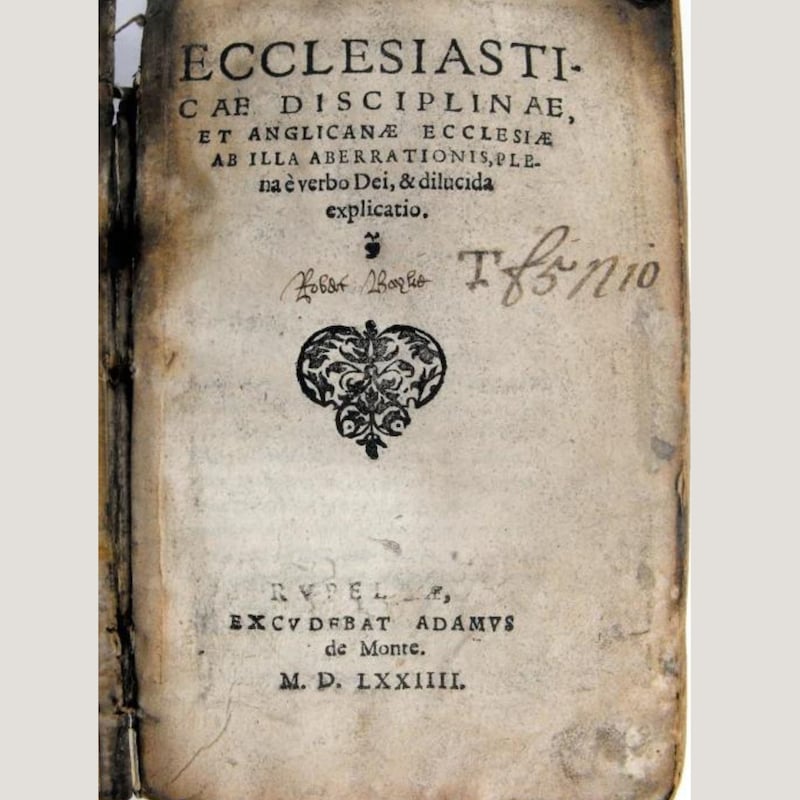
The Artwork is The title page of Travers’ Ecclesiasticae Disciplinae. Located in the University of Glasgow library.
The Music is John Dowland. Now, O Now Our Needs Must Part, Lute Song by Les Canards.
From The First Book of Songs or Airs. A collection of songs by John Dowland, which includes one instrumental piece. The book was published in London in 1597 and was reprinted four times during the composer's lifetime.
The Admonition Controversy.
The Admonition Controversy of the early 1570s marked the start of the first organised attack on the government of the established Church in protestant England.
The Admonition to Parliament demanded the elimination of the Episcopal hierarchy of the Church of England, replacing it with the system of Church government ordained by God -Presbyterianism.
The publication of this, the first open manifesto of the Puritan party, set the stage for the most important literary and religious duel in the Elizabethan period.
English Presbyterianism.
In early 1573, the first phase of the Presbyterian offensive reached its peak.
Ecclesiastical authorities struggled to shut down Presbyterian presses and halt the spread of a message that threatened the Church's theological and organisational foundations.
“Ecclesiasticae Disciplinae",
Walter Travers wrote "A Full and Plain Declaration of Ecclesiastical Discipline" in 1574.
Originally written in Latin, this small volume argued that the English church should abolish governance by bishops and instead adopt a Presbyterian model.
“Prophesying”.
The Puritan clergy had started organising prayer gatherings known as "Prophesying," which Elizabeth found troubling.
During these meetings, the Puritans embraced a more liberal prayer style that did not align with Elizabeth’s guidelines.
Elizabeth and her advisers were concerned about the potential spread of this practice, which they feared would undermine her Religious Settlement.
Modelled on Zwingli’s utopian vision, namely the “Prophezeit”, Puritans learnt of the practice through contact with the congregations of the Zurich refugees, who had settled in London.
© 20 26 The Rise of the Protestants., Author, Shaughan Holt.
"All rights reserved. No part of this podcast may be reproduced, translated, distributed, or transmitted in any form or by any means, including photocopying, recording, or other electronic or mechanical methods, without the prior written permission of the copyright holder, except in the case of brief quotations embodied in critical reviews and certain other non-commercial uses permitted by copyright law".
Requests regarding translation, licensing, or republication should be directed to: [email protected]
Your feedback matters, send me an email at [email protected], with any comments, suggestions, or criticisms.I read every message.
Transcripts
© 20 26 The Rise of the Protestants., Author, Shaughan Holt.
"All rights reserved. No part of this podcast may be reproduced, translated, distributed, or transmitted in any form or by any means, including photocopying, recording, or other electronic or mechanical methods, without the prior written permission of the copyright holder, except in the case of brief quotations embodied in critical reviews and certain other non-commercial uses permitted by copyright law".
Requests regarding translation, licensing, or republication should be directed to: [email protected]
Your feedback matters, send me an email at [email protected], with any comments, suggestions, or criticisms.I read every message.
Series 1.
Episode 9.
An Admonition to the Parliament.
The year is 15 72.
The Admonition Controversy.
When Queen Elizabeth ascended England's throne in 15 58, a significant number of dissenters and nonconformists returned from exile on the continent.
Several members of this group had been in Geneva and were determined to bring Calvinist reforms to the Church of England.
Known collectively as Puritans, these groups were the precursors to what would eventually become the Baptists, Congregationalists, Presbyterians and Separatists.
In 15 70, Thomas Cartwright gave a series of lectures, based on the Acts of the Apostles, drawing attention to the election and equality of ministers.
In them, he proposed a reshaping of the Church of England, using the apostolic model as its blueprint, declaring that Presbyterianism was the only form of Ecclesiastical governance ordained by God in Scripture.
The first Presbytery was established in 15 72 at Wandsworth, and its leaders were Thomas Cartwright (15 35-16 03) and William Perkins (15 58-16 02).
In 15 72, an anonymous pamphlet titled "An Admonition to the Parliament" was published, aiming to rally public support for the Presbyterian style of governance.
This document was authored by a group of Puritans, which included notable figures such as Cartwright, Sampson, John Field, and Thomas Wilcox, along with possibly others.
The release of this pamphlet signalled a shift, from the earlier Vestments debate, to what became known as the Admonition Controversy, exposing the deep divisions among Episcopalians in a more public sphere.
These differing viewpoints would significantly influence English Church history for over a century.
Following the approach of those involved in the Vestiarian debate, the Presbyterians turned to the new print media, to promote their reform agenda.
The publication of the Admonition, set off a pamphlet war, in which Cartwright and Whitgift emerged as the main opponents.
The Admonition Controversy of the early 15 70s, marked the beginning of a concerted challenge, to the governance of the established Church in Protestant England.
Debates over ministerial attire and rituals, that had preoccupied the 15 60s, were now overshadowed, as the Church's very foundations and governance, faced serious scrutiny.
Whitgift, championed Royal supremacy and the Episcopalian system, while Cartwright's vision of Presbyterian Church governance, directly contested this.
Cartwright pushed for equality among ministers, urging congregations, to establish a body of elders and pastors.
These leaders, chosen by the congregation, would be entrusted with the responsibilities, of teaching and maintaining order, within the church community.
The governance of the Church was just one, of the critical issues at play.
Presbyterian thought, also advocated for a restructuring of civil society, seeing civil governance as inherently temporary.
For Cartwright, the state should be modelled after the body of Christ, and ultimately serve the Church's interests.
While he maintained that interference in civil matters should be avoided, he acknowledged, that authorities had the right to enforce moral behaviour, among unrepentant sinners.
Whitgift, who took pride in being called the "Defender of the Peace," was correct in concluding, that embracing Presbyterianism, would threaten the stability of the civil state.
In contrast to Scotland, Presbyterianism emerged in England as a defiant response to the oppressive religious policies, imposed by the Queen and her bishops.
It would not be long, before these suppressed religious tensions, erupted into a controversy that was far more radical than anyone, even the early Puritans, had anticipated.
This simmering discord was about to evolve, into an unprecedented dispute that exceeded the expectations of even the initial Puritans.
The earlier Vestiarian crisis had stifled moderate calls for reform, forcing the more radical Puritans to seek refuge in Parish Lectureships and the City Liberties.
Parish lectureships, often served as the sole source of income, for ministers who lacked an official clerical position or benefice.
The financial security, enjoyed by officially licensed preaching curates, stood in stark contrast to the poverty, faced by their less-qualified and often nonconformist counterparts.
In London for example, Liberties were often in suburban districts, or locations that were not under the jurisdiction of the City of London.
In 12 15, London actively participated in the events that led to the creation of the Magna Carta, appointing barons and a mayor to ensure its implementation.
The document specifically mentions London, affirming that the city will retain all its ancient liberties, by both land and water.
The, "Admonition to Parliament", called for the abolition of the Episcopal hierarchy of the Church of England, and advocated for its replacement with a system of church governance ordained by God - Presbyterianism.
The release of this pamphlet marked the Puritan party's first open manifesto, paving the way for a significant literary and religious conflict during the Elizabethan period.
It is widely believed that two London clergymen, Thomas Wilcox and John Field, authored this pamphlet, which is recognized as the first classic expression of Puritanism.
The term "Admonition to Parliament", refers to a firm warning or reprimand, and served as a Puritan manifesto, demanding a non-Episcopal constitution for the Church of England.
The document condemned The Book of Common Prayer, both generally and on specific issues, due to its similarities to Catholic practices.
It advocated for a radical transformation within the Church of England, and demanded the removal of its corrupt leadership, which was often characterised by absenteeism the accumulation of multiple positions a hierarchical structure, and excessive authority.
The Admonition, proposed replacing this leadership with a Presbyterian system that would include ministers, elders, and deacons.
In part, it was a response to Archbishop Parker's efforts, to promote uniformity in the church, and to Queen Elizabeth’s repression, of Parliament's attempt, to modify the PrayerBook.
The Admonition consisted of two treatises.
The first, titled, "An Admonition to the Parliament," was written by Thomas Wilcox in a clear and concise style, featuring many biblical references and with minimal harsh language.
Wilcox argued, that the Church had not fully reformed, as it did not adhere to the biblical model of appointing elders and maintaining proper discipline.
The second part, titled "A View of Popish Abuses Yet Remaining in the English Church," was written by John Field and expressed a far more bitter tone, employing deliberately offensive language.
Field strongly opposed any association between the Prayer Book, the vestments of the English Church, and the Papacy, labelling cathedrals as "Popish dens".
Field criticised the Church services for lacking discipline, noting that parishioners were often distracted and disengaged.
He claimed that the noise from kneeling at the name of Jesus disrupted readings, a practice he considered blasphemous.
Additionally, Field remarked that priests rushed through their sermons, suggesting they might be involved in questionable activities during the afternoons.
Finally, he was deeply troubled by the congregation's limited knowledge of the Bible, particularly noting their preference for the Gospels over the Old Testament.
The Admonition was not presented to Parliament but was instead published separately in June 15 72.
It was ultimately abandoned, when the House learned, that the Queen would not permit its presentation.
Despite this, the Admonition gained significant popularity, quickly going through three editions.
Wilcox and Field were promptly apprehended, and sentenced to one year of imprisonment for its publication, and for violating the Act of Uniformity.
The year is 15 73.
In 15 73, Archbishop Parker enlisted John Whitgift, along with the assistance of other bishops, to prepare a defence of the Church of England's governance, in response to the Admonition.
As a result, John Whitgift wrote, "An Answer to a Certain Libel", in which he denounced the Admonition.
Although Thomas Cartwright was not the original author of the Admonition, he quickly became its advocate for the Presbyterian viewpoint - through his rebuttal "The Reply to an Answer Made by Doctor Whitgift, Against the Admonition to the Parliament”.
In his response, Cartwright argued that a properly restructured church should include the four ministerial roles outlined by Calvin, that is: instructors of faith, governing elders, charitable workers, and theological scholars.
Cartwright also visited the two imprisoned London clergymen, John Field and Thomas Wilcox, to lend them support.
Later, he would publish his "Second Reply to Whitgift's Defence," in which he proposed a Presbyterian framework for the Church.
The Admonition Controversy was not the first time that Whitgift and Cartwright faced each other, regarding the polity of the Church of England.
While at Cambridge, Cartwright's popular lectures earned him a considerable following among both faculty members and students.
By mid-15 70, the University, Church, and government, concerned about Cartwright's criticism of the Church's polity, ordered his arrest.
As the new Vice-Chancellor, Whitgift took on this responsibility and, in December 15 70, summoned Cartwright before a jury of Doctors of Divinity and Law.
When Cartwright refused to retract his earlier statements, Whitgift, with the unanimous consent of the judges and citing a technicality, removed Cartwright from his professorship and prohibited him from preaching at Cambridge.
Cartwright's response, called for a greater emphasis on the authority of Scripture, and the governance of the Church by ministers and elders - instead of being controlled by higher clerical ranks such as bishops.
He urged Queen Elizabeth, to restore the purity of New Testament worship in the Church of England, advocating for the removal of the remaining Roman Catholic elements and practices.
In 15 74, Whitgift replied with, "The Defence of the Answer to the Admonition, Against the Reply of Cartwright".
In turn, Cartwright published a two-part "Second Reply" in 15 75 and 15 77, to which Whitgift did not respond.
These pamphlets characterised the Presbyterian system, as the only acceptable form of church governance, and gained significant publicity.
In effect, they declared war not against the responsible Queen, but against the bishops who enforced conformity on her behalf.
The Queen and her clergy predictably opposed this document, sparking a significant controversy in Anglican England.
This controversy revealed, the extensive Presbyterian influences, that now existed among the Puritans.
Outraged by Thomas Cartwright's disrespectful behaviour, the Archbishop of Canterbury, Matthew Parker, issued a warrant for his arrest.
Feeling thoroughly intimidated by this experience, Cartwright fled to the continent, first to Heidelberg, - then serving as a clergyman for the English residents in Antwerp, and finally to Middelburg.
English Presbyterianism.
In early 15 73, the first phase of the Presbyterian offensive, reached its peak.
Ecclesiastical authorities struggled to shut down Presbyterian presses and halt the spread of a message that threatened the Church's theological and organisational foundations.
Anglican bishops faced challenges, in filling city pulpits with preachers who advocated for the conformist position, while some Presbyterians emerged as some of London’s most celebrated and sought-after preachers.
A notable example was Edward Dering, a young and charismatic English priest.
A Cambridge academic, puritan, and newly appointed divinity reader at St. Paul's, Dering was known as a classical scholar, a controversialist, and a supporter of Thomas Cartwright.
He was also a fiery preacher who often spoke out against his fellow clergy.
Despite Whitgift's attempts to curb Cartwright's growing influence, the period following the Admonition saw the publication of numerous religious pamphlets, promoting Presbyterian views and their anti-Episcopal stance.
This surge in publications only intensified public interest in their messages.
Robert Harrison was married in Aylsham, Norfolk, and in July 15 73, he applied for the position of Master of the local grammar school.
The mayor and several councillors from Norwich supported his application, recommending him to Bishop John Parkhurst.
However, Bishop Parkhurst had strong reservations about Harrison’s appointment.
He was critical of Harrison's confrontational preaching style, and his previous refusal to use excerpts from the Book of Common Prayer during his own wedding ceremony.
Parkhurst also noted that Harrison engaged in inappropriate conduct and liturgical transgressions, which continued despite numerous warnings.
After receiving a direct plea from the residents of Aylsham, Bishop Parkhurst was ultimately compelled to approve Harrison’s appointment, though he made his disapproval very clear beforehand.
Despite Dering, and several other Presbyterian ministers being prosecuted for their role in distributing Cartwright's reply, influential figures like the Dowager Duchess of Suffolk, the Earl of Leicester, and Sir Nicholas Bacon continued to protect them.
Consequently, Parker and the church officials faced ongoing challenges in their attempts to curb their influence.
The controversy surrounding the Admonition, coupled with the widespread support for the imprisoned authors Field and Wilcox, and the influx of nonconformists at Saint Paul's Cross, ultimately compelled the authorities to recognise the need for a campaign of disciplinary action.
It was not until Elizabeth intervened in 15 74, that they were able to effectively counter the rising tide of the Presbyterian movement.
On 11 October 15 73, Peter Birchet, a deranged lawyer with questionable connections to the Presbyterians, attempted to assassinate Sir Christopher Hatton who was suspected of being a crypto-Catholic and one of the Queen's favoured privy counsellors.
In a tragic mistake, Birchet ended up stabbing the renowned sea captain and Treasurer of the Royal Navy, Sir John Hawkins, instead of Hatton.
Birchet later demonstrated his insanity by initially professing adherence to the Presbyterian faith and then recanting it, before ultimately murdering his jailer.
His only connection to the Presbyterians was his attendance that morning, at a lecture delivered by the veteran Presbyterian Thomas Sampson at Whittington College.
Despite sustaining severe injuries from the attack, Hawkins survived.
Unfortunately for Birchet, he was hanged near the site of the assault.
The Birchet incident and the discovery of other plots, ultimately convinced Elizabeth that Presbyterianism posed a dangerous and destabilizing threat.
Responding to the bishops' appeals for assistance, Elizabeth granted them the authority to suppress the Presbyterian movement.
As a result, the bishops reissued directives, instructing London's clergy and lay members to adhere to Parker's Thirty-Nine Articles.
This action sparked a rebellion, leading to the arrest of several members of the Presbyterian community, including both clergy and laity.
Tragically, at least four-Presbyterian ministers lost their lives in various city jails.
Field and Wilcox eventually completed their prison sentences and were released from Newgate.
However, the continued threat of re-imprisonment by the still-hostile ecclesiastical authorities, forced them to maintain a low profile while awaiting a more favourable climate before resuming their reformist activities.
Despite Cartwright's ability to publish his later Admonition replies and rebuttal tracts from a distance, his absence from London significantly weakened the Presbyterian cause.
While these setbacks did not end the Presbyterian movement, they ushered in an Anglican resurgence, forcing the Presbyterians to bide their time until they could more effectively resume their push for Reformation.
Walter Travers was born in Nottingham in 15 48.
He was an English Puritan and theologian, who initially studied at Christ's College Cambridge, before transferring to Trinity College.
As a Senior Fellow, Travers became increasingly frustrated with ongoing debates about his religious views with the college master, John Whitgift. His strong Puritan beliefs ultimately led him to leave the university in 15 70.
In 15 74, he decided to leave England and relocate to Geneva, a city known as the home of John Calvin and a sanctuary for Presbyterians.
Once in Geneva, he was joined by his friend and fellow Puritan, Thomas Cartwright, both men quickly becoming friends with Theodore Beza, Calvin's successor and the leader of the Genevan Reformation.
In response to John Whitgift's "An Answer to a Certain Libel", Travers began working on his major work, which became known as the Ecclesiasticae Disciplinae.
This book was intended to serve as a model for restructuring the Church of England's governance, according to Presbyterian principles, using the Bible as its sole authority.
In the Ecclesiasticae Disciplinae, Travers presents his Scheme of Reform in greater detail than what Cartwright had previously published.
Once the manuscript was ready for publication, Travers entrusted it to his intellectually gifted and influential friend, Thomas Cartwright--whom Theodore Beza regarded as unmatched in learning.
Cartwright approved Travers's plans and agreed to write a preface and oversee the work's publication process.
Cartwright was not a popular figure in England.
His outspoken criticism of the established church, had led to an arrest warrant being issued for him in 15 73.
As a result, he decided to relocate to the German town of Heidelberg, where he could keep a low profile.
It was from Heidelberg that he published the "Ecclesiasticae Disciplinae", also known as "The Full and Plain Declaration of Ecclesiastical Discipline".
To make it difficult to trace Cartwright and Travers back to Heidelberg, they used a false imprint location of La Rochelle and a fictitious printer named Adam de Monte.
In 15 78, Thomas Cartwright ordained Walter Travers, as a priest in Antwerp.
An original copy of William Travers's book "Ecclesiasticae Disciplinae” has been part of the University of Glasgow's library collection, since at least the 16 00s.
The university principal, Robert Baillie, signed the title page, which features a 17th-century press-mark.
This book, meticulously hand-penned in 16 91, is listed in the oldest surviving catalogue of the Glasgow Library.
The title page of this manuscript clearly shows the location of a false imprint.
An imprint is typically found at the bottom of a book's title page.
It serves, as a declaration from the publisher and printer, indicating their accountability for the work.
Initially, the Glasgow catalogue contained an error, - its imprint, listing La Rochelle as the printing location.
However, doubts raised by a reader or librarian, led to questions about the legitimacy of this imprint location.
Additionally, historical records suggest, that even though the publication doesn't have a listed author, many important figures in the English Church believe that William Travers played a significant part in writing it.
In a similar vein, there were suspicions among early readers about La Rochelle being the printing location.
Multiple copies of the work, in which the imprint location has been deliberately obscured, like in our copy, support this.
However, the actual production location remained hidden for a long time.
It wasn't until 19 48 that the bibliographer A. F. Johnson, uncovered the truth, through an extensive study of the typeface and printing ornaments used.
The unique combination of size 86 Roman type and specific fleurons--especially the one on the cover page--pointed to a printer named Michael Schirat, who was located in Heidelberg.
Walter Travers, wrote "A Full and Plain Declaration of Ecclesiastical Discipline" in 15 74.
Originally written in Latin, this small volume argued that the English church should abolish governance by bishops and instead adopt a Presbyterian model.
Mary Mildmay 15 27/28 to 15 77, owned an English translation of this controversial manuscript, and prominently inscribed her name on the cover page, to assert that it belonged to her, not her husband.
The book's complex themes, combined with her high-quality handwriting, suggest that she was an exceptionally educated individual, likely among the elite of society.
Mary's brother was Sir Francis Walsingham, the so-called Spymaster General of Queen Elizabeth the First, and, like-him, she was a staunch supporter of Protestantism.
Within a month of his appointment at Aylsham Grammar School, and despite previous warnings about his conduct, Robert Harrison requested that the officiating deacon at baptisms omit the sign of the cross and make additional changes to the baptismal service.
In January 15 74, the school board reported his actions of nonconformity to the authorities, which resulted in him being removed from his position.
Bishop Parkhurst took further action against him, stripping him of all parish duties.
Having lost his board and lodging, Harrison returned to Cambridge.
The year is 15 75.
Matthew Parker, Archbishop of Canterbury, died on 17 May 15 75, aged 70.
As he approached the end of his life, he noted with regret and disappointment, that "these Puritan ideas of Governance", could in future, undo the Queen and all that depended upon her.
His conduct set the ideal example for Anglican priests.
He was buried in Lambeth Palace Chapel, and later gave his name to Matthew Parker Street, located near Westminster Abbey.
The Church of England, led by Matthew Parker, formulated the Thirty-Nine Articles during the Convocation of 15 63.
These articles serve as the foundation of the Anglican Church's doctrine.
On 26 July 15 75, the church authorities appointed Edmund Grindal as Archbishop of Canterbury, replacing Matthew Parker.
There is no evidence that the new Archbishop ever visited Canterbury, not even for his enthronement.
To appease and collaborate with the moderate Puritans, William Cecil advised Grindal to soften the strict measures that had characterized Parker's approach to nonconformists.
Thomas Helwys was born in Gainsborough in 15 75.
His parents, Edmund and Margaret Helwys, were descendants of an old Norman family.
Edmund had sold the family's land in Lincolnshire and Northamptonshire and taken a lease on Broxtowe Hall, located in Bilborough parish, about four miles west of Nottingham, where he moved his family.
The year is 15 76.
Richard Bancroft attended Jesus College Cambridge, where he earned his Master of Arts degree in 15 76.
After completing his studies, the university selected him to become one of its twelve preachers.
Previously he was ordained as a priest in 15 74 by Bishop Richard Cox, of the Diocese of Ely.
In 15 76, Bancroft was appointed to his first pastoral role, taking on the position of rector in Teversham, a quaint village just outside Cambridge.
Ely is a cathedral city in Cambridgeshire, approximately 14 miles northeast of Cambridge and 80 miles from London.
It serves as the seat for the Bishop of Ely, and its cathedral has a rich history that dates back to AD 06 72, when Saint Etheldreda established Ely Abbey.
Today's magnificent structure was built starting in 10 83, and officially became a cathedral in 11 09.
Until the Reformation, it was known as the Church of St Etheldreda and St Peter.
After the Reformation, it was refounded as the Cathedral Church of the Holy and Undivided Trinity of Ely, and continued to serve as the principal church of the Diocese.
The City of Ely is situated on a 23-square-mile island of Kimmeridge Clay, which, at 85 feet, is the highest land in the Fens.
The term "Isle of Ely" originated, because the area was only accessible by boat, until the waterlogged Fens were drained in the 17th century.
Still prone to flooding today, these wet surroundings gave Ely its original name, "The Island of Eels", which is a translation of the Anglo-Saxon word “Eilig”.
In 15 76, Henry Barrow enrolled at Gray's Inn, where he attended court sessions and became familiar with legal procedures, skills that would later benefit him.
In the same year, Thomas Cartwright visited the English Channel Islands and assisted in reorganising the Huguenot churches there.
After revising the Rhenish version of the New Testament, Cartwright took on the role of pastor in Antwerp, declining an offer for a teaching position at the University of St Andrews, in Scotland.
The Rhenish-Bible, also known as the Rhine-Bible, was a large-format Bible, printed between 14 78 and 14 79.
Often referred to as "The Cologne Bible," it was published in two variants of German: Low Saxon and Low Rhenish.
All pre-Lutheran German Bible translators, based their work on the Latin Vulgate, a version of the Bible authorised for use by the Roman Catholic Church.
The two volumes are illustrated with 113 and 123 woodcuts, respectively.
The woodcuts, which illustrate scenes in the Old Testament and the Book of Revelation, introduce historical figures such as King David and the Evangelists to their readers.
However, the most striking illustration is that of the creation scene.
The decoration in both volumes was hand-coloured, in a style that influenced all subsequently embellished productions, in Germany and throughout Europe.
John Coppin was a Puritan minister in Bury Saint Edmunds, and a Browne's, Norwich Congregation member.
He enthusiastically embraced Robert Browne's teachings, preaching his doctrines in his hometown of Bury Saint Edmunds, and selling and distributing books written by Browne and his associates.
As a result of his actions, the commissary of the Bishop of Norwich, imprisoned him in 15 76 for holding false and malicious opinions.
Remarkably, Coppin remained in prison for seven years.
During this time, he was not subjected to strict supervision or close surveillance; his family even lived with him for a while.
While in prison, Coppin found a fellow disciple in Elias Thacker, another inmate.
The intense discussions between the two men caused such chaos in the prison, that the magistrates requested the Bishop of Norwich, and the Assize judges to relocate them.
However, both the Bishop and the judges denied this request.
Robert Browne was born into a wealthy Northamptonshire family at Tolethorpe Hall in Rutland Northamptonshire.
He is a significant figure in American history for advocating Church-State separation.
As a prominent separatist during the Elizabethan era, Browne founded the Brownists, who were among the early defectors from the Church of England.
He established his Congregational church, where the members elected their preachers.
However, despite his earlier separatist stance, Browne rejoined the Church of England later.
The year is 15 77.
Power rests with Archbishop Edmund Grindal, who held his position from 15 75 to 15 83.
William Cecil, had urged Grindal to initiate a reformation of the judicial authority, held by the ecclesiastical courts.
However, a falling out with the Queen caused her to stop Grindal's proposed reforms.
The Puritan clergy had started organising prayer gatherings known as "prophesying," which Elizabeth found troubling.
During these meetings, the Puritans embraced a more liberal style of prayer that did not align with Elizabeth’s guidelines.
Elizabeth and her advisers were concerned about the potential spread of this practice, which they feared, would undermine her Religious Settlement.
Modelled on Zwingli’s utopian vision, namely the “Prophezeit”, Puritans learnt of the practice, through contact with the congregations of the Zurich refugees, who had settled in London.
These Puritan ministers would gather weekly to discuss what they called “profitable questions”.
The topics of discussion included: - the proper observance of the Sabbath; advocating for Sunday as the day of rest in Christianity in accordance with the Ten Commandments.
Queen Elizabeth was opposed to the growth of the conventicle movement, which she viewed as secret and unlawful religious gatherings, of people holding nonconformist beliefs.
As a result, she ordered Archbishop Grindal to put an end to "prophesying", -meetings that had gained popularity among Puritan clergy for sermon training and discussion.
She even sought to discourage their preaching altogether.
Instead of following the Queen's instructions, Grindal responded with a lengthy letter defending prophesying.
He cited Paul's letters in Corinthians 14, as supporting evidence and concluded by declaring, that he would rather offend the earthly Majesty, than the heavenly Majesty of God.
Unfortunately for Grindal, the Queen took offence at his stance.
In June 15 77, she suspended the Archbishop from all his jurisdictional functions due to disobedience, though he was not yet stripped of his spiritual duties.
In another turn of events, Queen Elizabeth again ordered Archbishop Grindal to take all necessary measures to suppress prophesying.
Despite being under house arrest, Grindal, the Archbishop of Canterbury, remained resolute and refused to comply with the Queen's demands.
Ulrich Zwingli was born in January 14 84 in Wildhaus, part of the Swiss Confederation.
He had resigned as a priest, aiming to dedicate himself to transforming the city’s religious life, emphasising the importance of Scripture as the ultimate authority, rather than the Pope.
While delivering sermons in Zurich in 15 25, Zwingli asserted that the roles of prophets encompassed the cultivation of goodness, the resistance of evil, and the public interpretation and explanation of Scripture.
In the summer of 15 25, Zwingli’s vision began to take shape, by establishing regular meetings among scholars committed to the public interpretation of the Old Testament.
This movement came to be known as the Prophezei, embodying a collective representation of Zwingli’s ideal vision for the church and its pastors—a blend of scholarship and prayer.
The term "Prophezei" is derived from 1 Corinthians 14, where the Apostle Paul expresses a strong desire for individuals to engage in prophesying.
The initiative held significant symbolism, marking the establishment of the first organisation dedicated to higher learning during the Reformation.
The sessions commenced on 19 June 15 25, in the Grossmünster, Zurich’s main church, with a clear directive to combine study and worship.
The symbolism was profound; this represented the first organisation dedicated to higher learning during the Reformation.
By gathering in the Grossmünster, the scholars asserted the authority that had traditionally belonged to the medieval church replacing hierarchical structures with an emphasis on learning and prayer.
The event was distinctly ecclesiastical, as the interpretation of the Bible took place within the sacred space of the church, but was conducted by a new form of priesthood.
The Prophezei aimed to avoid confusion in interpretation, by meeting in the church, which ensured that discussions stayed under church authority.
For Zwingli, prophecy was not merely a matter of delivering secret knowledge; instead, it involved incisive and insightful teaching of the Scriptures, which needed to be guided by the church's teaching pastors.
The Prophezei organized regular meetings, where scholars could interpret the Old Testament in various languages.
Zwingli believed pastors' roles, were to connect the original texts, with translations that the congregation could easily understand.
On that first morning, the Prophezei began their work at eight o'clock, starting with the Book of Genesis, examining the text in Hebrew, Greek, Latin, and German.
These sessions occurred daily, except on Fridays and Sundays, and the Canons, City Clergy, and Latin School students were required to participate.
The plan was straightforward: to work through all the books of the Old Testament.
The line-by-line method, echoed Zwingli’s practice of continuous reading in his preaching, throughout the Bible.
This approach aimed to counteract the tendency among many radicals, to disregard the Old Testament, and demonstrated Zwingli's vision, of combining scholarship with prayer, in pastoral ministry.
The year is 15 79.
In January that year, Secretary Wilson, notified William Cecil, that Queen Elizabeth intended to dismiss Archbishop Grindal for failing to follow her directives.
Thankfully, Cecil persuaded Elizabeth to reconsider this severe decision, granting Grindal a reprieve.
During this period, Robert Browne was preaching across Cambridgeshire when he fell ill, likely succumbing to the plague.
With no other options, he returned to his father's home in Tolethorpe, Rutland, hoping to recover.
While Browne was resting and recuperating, the Church council officially prohibited him from preaching.
Meanwhile, Edwin Sandys completed his BA at Corpus Christi College Oxford, in 15 79, and was accepted as a fellow the same year.
He was born on 9 December 15 61, in Hartlebury Worcestershire, as the second son of Edwin Sandys, who
