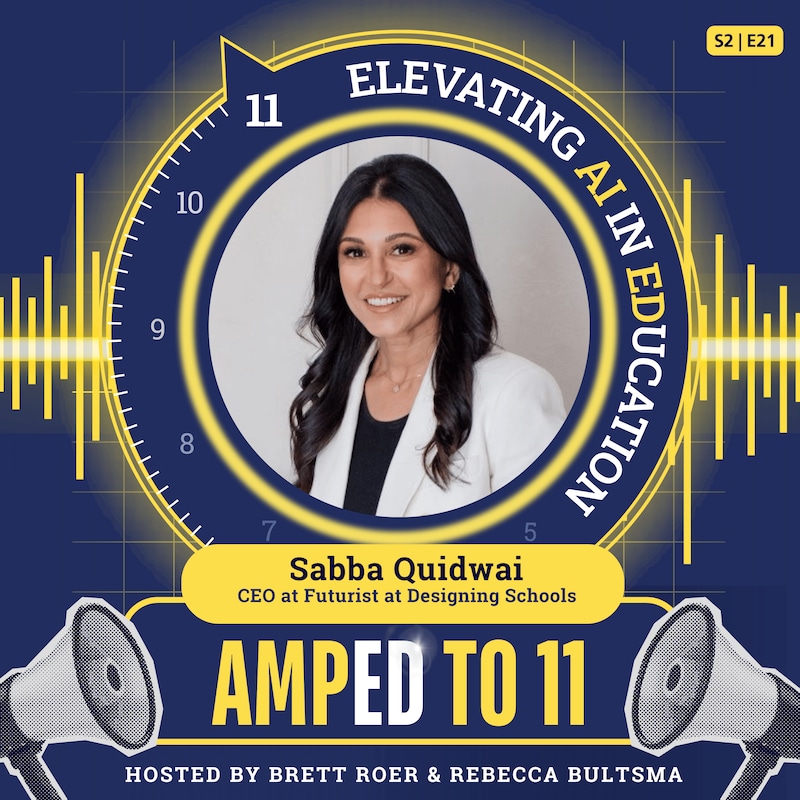
Shownotes
What if the solution to the education crisis isn’t another new tool—but a radically different way of thinking?
In this episode of AmpED to 11, Brett and Rebecca sit down with Sabba Quidwai—futurist, researcher, and founder of Designing Schools—for a conversation that’s equal parts AI-infused optimism and bold truth-telling. Sabba doesn’t hold back. From calling out the systemic failures that led to widespread teacher burnout, to critiquing the bandaid tech culture that treats symptoms rather than root causes, she’s here to shake up the status quo with humanity and clarity.
Sabba’s journey from a disconnected student in 2007 to one of today’s most influential voices in AI and education is both deeply personal and powerfully relevant. With stories of leaders transforming entire districts, insights from global travels, and a gut-check on America’s distraction problem, she challenges educators and decision-makers to stop tolerating broken systems—and start designing the future we actually want.
You’ll also hear about Desert Sands’ visionary approach to AI guidance for students, learn why Canva and Google might just be the AI Dream Team for schools, and get a front-row seat to the spark that ignites real change.
Here’s what you’ll learn:
- Why imagination—not just information—is your most powerful asset
- How to shift from AI tools to AI teammates**
- What teachers and leaders are missing about student AI use (and how to fix it)
- A powerful mindset framework that reframes burnout and empowers agency
- What the U.S. education system can learn from schools abroad
- The AI literacy that truly matters (hint: it’s not just prompt engineering)
🎧 Tune in, subscribe, and share if you’re ready to turn up the volume on what’s possible in education.
Transcripts
We absolutely knew this was on the radar. We ignored it. Stop tolerating things that you shouldn't be tolerating the solution to teacher burnout isn't Magic School. The solution to teacher a burnout is why are you burnt out in the first place? Let's solve for those systemic issues versus giving you a bandaid to make you feel like you've got a solution.
When in the long run, not only is it probably gonna make you obsolete, it's going to make you poor.
EO and futurist at Designing [:It's, we've had you on our radar. Sabba has been traveling around the world for our listeners, and we have been playing scheduling Tetris for months and it's. Really an honor that this is finally coming to, uh, to fruition because Sabba, you are one of the leading voices in AI innovation, the future of education.
And so, uh, audience members, you'll see soon enough that this was worth the wait. Sabba, would you be willing to share with our audience? You know, we love to frame my kind of like, what is your narrative? What is your journey? What's your hero story? How did you get to the point where you are right now and kind of share with our audience?
ways say take that challenge [: always say how I graduated in:And the reason I make that distinction is I actually had every single technology available to me personally. Like my dad was very into technology. So like, you know how most people are like, oh, we have our phones recorded now, like when we're growing up because of the iPhone. Our dad was like really into like videography.
sure to at all. And you know,: realizing, wait a minute, in:Why, like how did these people on the flip side launch iPhones, like Steve Jobs build the entire app economy, which we can't even imagine our lives without today. And how did we get to a place where some people get access and exposure to these ideas and get to be a part of this and other people don't?
finally settled down in about: first manifested as kind of [:Fascinating work. So what does a typical day or week, or month look like for you in the work that you do? Sabba. That's so funny. There is no typical anything. I'd say the only common theme is that I get to meet incredible people doing incredible things, and I, the reason I highlight that is I think this is such a hard time where we have such a leadership void from policymakers, you know, in so many different areas that when you go across the country, you know, especially in the United States, I will say, compared to other places where you do perhaps have more governance and whatnot, but I think especially in the United States.
of our favorite things to do [:We like to do this thing. Where we talk well about people behind their backs and how that's something that's kind of great. That doesn't happen enough. But you mentioned you're working with amazing people. Wondering if you wanted to take a minute and tell us about some of those people tell us some great things about them behind their backs when they find out it makes their day.
Oh my gosh, I find this so hard because there are so many people. So I always timeframe it as people that perhaps I've seen in the last one month, or people that I have actually seen in the last like two weeks. So let's just do, let's just do the last one month. And I would say some of the most incredible things I've seen, one would be Lake County in Illinois.
at ASA when they did like an [:Like, you know, there's just like some leaders right now, very ready to go all in. And he was one of those people. And so, you know, we've been working together for the last year and a half. But I love it because you know how people always say like, it just takes one person to create like momentum and a movement.
He not only did it for his district, but he brought all the superintendents together from Lake County and they do these like monthly sessions. But it's been incredible to see how that one person created that one community group of people and then went on. And those people are now taking it back to their teams.
And it's just like. How things can spread in that way within community when people like share with each other and do those things. So I'd say that's one. I would say another. Oh my God. Okay. This one is amazing. Okay, so his name is Warren Apel. Okay. And he is from the, oh my God, I wanna say the international school in Japan.
cause I'll tell you, I did a [:And what I loved about his presentation was not, it was practical. It was great. He was giving great tips, but there was an enthusiasm in his leadership and his messaging that I wish we saw more. Of when people share about this work and just, you know, the, the access he had given people to tools, the strategies he was giving, it, just those, those are probably my two highlights in the last one month.
Rebecca is obviously doing this work on an international level, right? She's getting her, her master's in Europe. She lives and does great work in Canada and then also here in the United States. You've talked about the work you're leading even beyond those spheres globally. Where are you seeing like the best levers, um, in terms of utilizing your positions that are having the biggest impact in changing mind shifts?
eople try to like. Lean into [:And I would say if I look at the United States, we are just so distracted right now by so many things that it, it's almost shocking that people are even bringing things like that to the forefront at a time when we're experiencing what we do. So I would say the first thing you'll notice anytime you step outside, our people are just not as distracted.
They can actually put their focus, their energy and attention. On what matters most in this moment and they're able to kind of build and leverage that work. I also say that context also matters in terms of like the social systems I think that you have established. So for example, people like you're gonna have a totally different experience when you are talking to people, say in like.
e's so many other factors at [:And when, and it's a really big part of like all of my keynotes and everything that I do, is we teach this like spark prompting framework, which is basically just an empathy interview, but the whole purpose behind it is be more ambitious about what you wanna solve, what you wanna create, what you wanna build, what you wanna ask.
s probably that. I love that [:I spent the weekend, uh, exploring some of the new AI browsers. That have come out and the a agents within the browsers, which are problematic on a ton of levels, but I, I was trying to find ways that they could be actually helpful. You know, we go back to that central idea of how do we use AI in ways that save us time so we have more time to do the things we wanna do.
And I do see a lot of great possibilities. It was able to, for example, I've had probably, like you, I have hundreds of research. Papers and documents and PDFs scattered throughout my Google Drive and I actually used an agent to go through and put them all on a spreadsheet in a database with their annotations and file them into an organization system for me.
ways hopefully that that can [:There's something new coming at you all the time, so I'll share the answer to the question, but I'll also share the strategy 'cause I think it's really helpful. One of the big shifts we made this past summer, you know, as I was reflecting on just like. Everything that I'd been doing and where I wanted, where was the white space that I wanted to spend my time and energy.
It was sort of the difference between individual use of AI and organizational use of ai. It's actually a huge difference, and I think a lot of times when people talk about ai, they're talking about what great, what works great for individuals, not what works great for an organizational deployment and what's actually practicable and feasible and scaling that sense.
with a ton of tools in depth [:However, green are you. Can I grow with you? It's great that I can do this with you today, but as I become more ambitious, as my skillset build. Are you gonna grow with me and can I keep growing with you or am I gonna hit a bar and now I've gotta go start over square one somewhere else. So this is one of the first criteria I look for.
So we also look for longevity. We look for so many different pieces, and so the two that I go really deep with are Gemini, from Google and Canva. Not only do I like these two as tools and what the quality at which they are giving people sort of output and just ways of being able to actually do things.
eek, came out with something [:Like this is our vision for the future and what we think and where we're headed. And then Canva with the. Beautiful keynote I've heard probably in like, I can't even remember when talking about the Imagination Age. So when you take sort of Google's learning sciences, practicality, all these pieces with Gemini and the fact that they're getting better and better and better by the day, then you take Canva and the idea like, Hey, we're gonna give you every single possible design tool to help you bring that imagination, to nurture that imagination.
This to me is what we call your AI dream team and what we love about these two, even more free for education. And I just, I don't, I don't understand why right now you could get 90% of done what you need. I wish more people would go deep, deep, deep, deep, deep, throw out all the other garbage you're using your magic schools, your Bri, your all this other nonsense go so deep with these tools and I think we could solve.
But then I would say like on [:I think for anybody who did anything creation wise prior to ai. Podcast, YouTube creation show notes. I mean, you name it, whether you are outsourcing it and paying money. You know how expensive that was to get people to just write, show notes for you and edit things and do all that kind of stuff to watch AI tools now do that.
I think that. Probably the thing that has left me most in awe is editing. I'm a hu. I've been video editing like ever since I can remember. And to watch an AI tool now do it with the type of precision that it does. It also, watching how quickly the capabilities have advanced, just on a personal level is, is probably one of the most like eye-opening.
And then in terms of the ones that I think is the scariest, what I, what I usually say, and honestly I don't know enough about this space, but. The way I kind of look at it is I like to be within an ecosystem, and I think I have this experience because, you know, we use WordPress on the backend for our website and all the things we do.
gs that I find, you know, if [:And the moment you open up that connection, you're vulnerable. One thing goes wrong, a ton of things can happen along the way, and systems break and things like that. So I think of AI tools in a very similar way. I like to stay with it in an ecosystem because every time I have to connect something to something, I always say there's like a little, like if, if I'm in a bubble, so for example with Google Gemini, it connects to my drive, it connects to this.
You know, I wouldn't be surprised if what you said you did with the agent. You wouldn't be able to do with Gemini itself. Maybe not a hundred percent to that degree yet, but once they bring the agent in, you will be. So when I have to connect a third party to something, to me there's a little gap in the middle, and that gap to me is the vulnerability.
don't use this one as much, [:We listen to a lot of founders and their talks and things that they do as a way of determining where are we gonna put our effort, because there's no doubt there's a learning curve. It doesn't matter how good you are, how long you've been using something. There is a learning curve involved. Great advice.
Great advice. Those are all great tools, and you're right. I'm sure those agents will end up coming, but the big problem with is exactly what you mentioned, those gaps that then can let malicious actors in cause violations and security risks. Um. Something kind of on the ethics side with EdTech and things that we talk about a lot are sometimes the concerns of locking into an ecosystem.
from a security standpoint, [:One thing you mentioned that coincidentally, I really actually had like a long drive yesterday and I thought a lot about this analogy. You know, you've mentioned that you're very creative and you're an artist, and I was thinking about how teachers are true artists, right? Like you're constantly building and it's like.
You're building with constraints, right? So we know that's one type of art. Like what can you make when you have this much time and you know, it has to meet this goal. And, and teachers do it daily. They're truly artists. And I think most teachers don't even recognize how brilliant they are. And like the daily creation, they come up with literally, uh, every night for the students they're gonna see the next day.
ng certain constraints. Like [:Now you have to create within that frame, literally frame or framework. And so I'd love to hear from you, you know, you're working with some innovative leaders. I'm sure there's times when you're working with teachers or leaders where they're not seeing it yet. Like how are you. Meeting people where they are and bringing them along.
What are some of your like first steps that you do to get people to kind of unlock and feel like they're on a journey with you? Kind of like you're mentioning a journey with a tool. Okay. So I'll give you a very honest answer, but I'll also caveat it with, it's not for everybody, so like I am not for everybody at all.
And I will tell you also the value where this comes from. One of the things that I think about a lot that I don't think we talk enough about in this space at all is wealth inequity. I hate it. I hate looking around in our world and seeing the insane inequity like right now, like I had no idea, and maybe this is just my ignorance, I don't know.
on snap for food. Like that [:And I think that's wild. Like, I think that's wild in a world. Where we have so much access and exposure to opportunity to make money, to do so many different things. So I am not one of those people that believes like, it's okay, you can take your time. Oh, we'll just meet you where you are. No, you are behind.
And in a country like the United States where your job is, your healthcare is, your childcare is basically your whole life. You don't get that luxury. You don't. And I think we hurt people more than help them. So I will say, I really preface this for people like, look, this isn't easy and you're also behind, right?
e have dancing with robots in:We absolutely knew this was on the radar. We ignored it, and when you ignore a challenge for a decade and then all of a sudden you're forced into a corner to now adapt. There is no way to tell anybody this work is now gonna be easy for you. It's a very hard thing you now have to do. However, one of my mentors said, when you raise the level of expectation, you must raise the level of support.
So when I go in there and I frame this up for people personally, I find they respect and appreciate. The frankness and the honesty about the moment. Then we say the best part about this moment is we don't have to do this work alone. This is really probably the biggest differentiator when I look at. Who were the people that were doing this work?
I literally now say it was a [:Whereas now within minutes with the right approach and the right tools you can solve for what most people weren't able to solve for in tenure. And so the next thing we do is, once I frame that up, the good news is we don't have to do this work alone. Don't think of AI as a tool. Think of it as a teammate.
These days we're going in with Gemini and Canva and we teach the Spark framework. The hardest part that I find about this moment is so many people have become used to those constraints. They don't question them anymore. Right? So that's why we go back to like human agency a lot like. What do you not like?
Like what do you not wanna tolerate anymore? Stop tolerating things that you shouldn't be tolerating the solution to. Teacher a burnout isn't magic school. The solution to teach a burnout is why are you burnt out in the first place? Let's solve for those systemic issues versus giving you a bandaid to make you feel like you've got a solution.
And I think this is really, [:If you're happy and you believe what you're doing is gonna get you the outcomes in life that you want, great go down that path. But I think there's a lot of people that don't know, and I think we should tell them, and it's our job to tell them, if we know that and we're gonna be in this space, not just to be like, here's a prompt that's gonna help you work a little bit faster.
For things that we probably shouldn't even be doing in the first place. And so I find that that conversation, it just ignites, like that's why it's called Spark, we call it. We ignite that human spark within yourself. What do we want the world to look like? What do you want your job to look like? And that's why I really love the Canva keynote because when you think about imagination.
day, my niece, she's like a [:And one day she hit something in my nephews and he woke up and he was so sad. He's like, I just wish I had an app where I could just tell it what it was and it could find it for me. And so today, the idea that we can open up like Canva code, right? And be like, okay, tell me what you want your app to do.
This is what it could look like. The idea that we could go into chat GPT, type a couple sentences, put it into Miro and get a literal prototype. These are things that people weren't even able to do before or had to spend so much money doing. So I think like. Putting that confidence and thinking about imagination as a muscle that we build over time is, is something really, really, really important.
So that's what we do. And we do this in 60 minutes. We do this in 60 minutes. We go from, here's the problem, here's where we're currently at. Let's be super blunt and honest about it. Then let's look at what we can do to solve for this. Because we can do things. And I think if you couldn't do something, then it's hard to do the first part.
we haven't gone as ambitious [:It's super interesting to watch. We're always panicking about how are we gonna get kids ready for the future? And the truth is these. A lot of the kids, at least the ones I work with, I have four kids, they're, they're kind of figuring it out. They aren't as worried about it as we are necessarily. And they also have more creative ideas than we do.
I know Brett's kids are always coming up with like really creative ideas. You know, his kids are younger than mine and I feel like you have a story that about that, don't you Brett? Yeah. So this morning, um, you know, just before we started, I just was in a local school district near here and I'm gonna shout him out.
hem in other districts is we [:And so we ask, you know, similar questions, but we also literally just get consent. We tell them, don't say anything that could be a violation of PII or FERPA and just have a conversation. And so today we had, uh, 10 students from sixth grade to 12th grade and like really diverse in number of ways, but especially like.
They, they were just like randomly picked, which made it so authentic, and both myself and my colleague Sia, we, as soon as the kids left, we were like. That was the most interesting interviews we've ever had. And we immediately told the, the superintendent and their team, they're in there. But here's what made it like such a full circle moment.
y brother, your brother, uh, [:We probably spent more of our childhood together than anyone else in my life. And I've never met this girl. And this girl is brilliant and she's, you know, slightly older than like, we broke up, you know? 'cause she's like a now in high school. But she's so brilliant. All of them are. I'm sitting here thinking of things that happened like 30 something years ago in like her grandmother's basement and we didn't have anything with AI and like how creative we were as kids.
Just making stuff up on the fly. We're gonna start a band we're gonna do, and she's like next level thinking. But the cool part was how like. Thoughtful these students were, and so much of it was actually like, and we came up with like some phrases there, like they don't, not only did they like, were so much like, I wish we had less ai or like, we just wish we had more rules.
pt in the email or the text. [:So I was teaching these kids like, you're be vulnerable and tell your friends, like, I have so many feelings. I had to use ai, but like, here's my brain dump if you really wanna read it. And now they were like, oh yeah, if my friend did that, I would like, that would be awesome if they like shared when they used AI with me and we talked about like an AI etiquette course on like just how to do this with your friends.
And then this girl was like, yeah, sometimes I wish my mom wouldn't use AI for stuff. Like she, she like asks any tool of question and then I'm like, mom, that's not right. And I don't know if she knows how to check that. So it was just like super interesting to hear from their perspective what they actually need help with.
know, so sometimes at night [:And he is like saying this in front of the superintendent. And by that point they'd lost like, you know, they were like, no filters anymore. But even them mentioning that, and then another student being like, I'm like, so is that cheating? And they're like. I mean, he's going back and learning it. So I think that's cool.
But I wish there was a rule like, don't do that or do that. And it's just, anyway, real time warp of the day and a real full circle moment. And these kids are brilliant as we know. They're, they're the ones you gotta be asking these questions to. I'm curious what SAB is hearing from the as like the top concerns from students or from teachers or from education leaders specifically.
Brett and I are both speaking at a conference in Tennessee upcoming specifically to education leaders. And what are you hearing on your end? What advice are you giving to them? Because it's one thing to tell a room full of people, you just need to move, you need to get going, we need to move forward on this.
lding them back and what are [:There is a feeling of uncertainty and I think that's also really dangerous. That also in other parts of the world, like there's always gonna be uncertainty, but when you create a dynamic where like, I have no idea what your mood is gonna be tomorrow, and who's gonna be fighting with who and who's gonna be doing what, it really, really, really moves consumers and so economically of a problem in all areas.
You have a challenge, and I think I see this weigh so heavily on people, and you pair that with. I'm too afraid to even say something because I have no idea how someone's gonna react. So you pair like uncertainty, loneliness in your field with not enough safe spaces for people to come together on a regular basis because I don't know how someone else is gonna react to something.
emotionally difficult place [:Just I think emotionally we have to understand that landscape for people. So I think. One thing that I find that works really well for people is they need a narrative and they need a box. They need, they need a package. Like, look, I'm coming to you because I trust you. I'm investing my time, coming to this conference, coming to this space, coming to do whatever.
I need it all packaged up for me so that I can go back, fix it up, make it my own, and basically gimme a box of ingredients so I can put together my own meal, right? Like meal prep. This for me, basically, and I, that's one of the things that we try to do, people like, here are the five things you should do in this moment before like X, Y, Z, that will help you over the next year.
nyone can use the tools, the [:This is the easiest part of the whole equation, is how to use the tool. I think the hardest part for people is the framing. Of how do I go back and communicate this to people when I can barely wrap my head around what's happening? And I think once they get a little bit of that confidence, they're even a lot, they just need a little bit of that confidence.
They also realize, oh, this actually is very much connected to a lot of what I already do and a lot of what I already know. And I always tell people. It's the biggest advantage we have in education, right? Like take a concept, for example, like AGI, whereas if you are in industry or you're like in that space, maybe every single day, uh, maybe it's gonna be there, maybe it's not this date, that date, this, this, this, this, this.
eed to care, right? It can be: [:And it was actually the most. Mentioned part of the conversation, what people mentioned more than anything else was how you build teams. This was actually probably by far the most important thing. And I think even right now, one of, because now you're not just talking about human teams, now you're talking about human and digital teams.
So you've got like a whole other species now that you've gotta learn to collaborate and like work with now. So I think this idea of how do we build trust amongst people? How do we build human agency imagination? These are all things that. You don't necessarily need AI for, can it help you? Yes, absolutely.
at Masters of Scale with the [:He goes, we should be getting these young people into our organizations, because they're the ones who are going to shake things up. They're gonna come along and they're gonna be like, these are your processes. There's a better way to do this. One of the things I do is I ask leadership teams, when you think about shaking something up in your organization, what skills do you need?
So lemme just ask you guys like, let's just do this right now for people. If you think about walking into a bureaucracy, let's just think, let's just say you are a new teacher, 22 years old, walking into a school, and let's just say you did go to a university that gave you some AI skills and whatnot, and you're like, there's a better way to do this.
t are the top two skills you [:Absolutely. So you got confidence, creativity, Brett, add your ulu list. Definitely curiosity. Okay. Curiosity. And the other one might be, we got all the C's, like I'm gonna say like innovation or ideation, some version of that. I'm maybe make a new word outta that Id, innovation or something, but like making sure you wanna move forward, but you're willing to do the the cycles of refinement as well.
, but those are actually all [:So for example, like when I was at Apple and that resilience is the biggest piece you have to know, first of all, basic communication. Chain of command, right? You don't just walk in as an organization, as a 22-year-old, go straight to the CEO of whatever and bypass everybody in between and be like, I think we should do this a better way.
Right? Like, that's not how things are done. There's etiquette, there's chain of command. There's just certain things that you have to do the right way to be able to get what you want forward. So for example, that's one I have to also have an understanding of like being able to pitch my idea. I think that's that ideation piece and that creativity piece that you both bring in.
I have to know, okay, here's what the problem is. Here's the gaps that I see. But here's an entry point that I see for where we might be able to pilot something, to do something a different way. I'm gonna put together a pitch deck. I'm gonna put together, you know, a short five minute presentation. I'm gonna send an email requesting a 15 minute meeting, asking to come in and share and present this idea.
experience. You wanna get an [:50 people like in the middle that we go through that are, that manage this and are responsible for these choices. And so to me a lot of that human work is probably gonna be the most important for our kids going in, creating, doing things, building things, not so much can I talk to George Washington on a chatbot to learn about.
X, Y, ZI just, I just don't see that. So I think those are the things that we talk about, and I think when people realize, okay, wow, we don't need to just throw AI everywhere, throw more technology everywhere. In fact, we can actually do the opposite in many scenarios, and then use it in the right ways to amplify these human skills that we know matter.
I think people's confidence skyrockets in what it is that they believe they can achieve. And do I just wanna also highlight, you know, I mean, I think one of the. Luxuries that both Rebecca and I get to have is meeting people like you in person at conferences and then literally getting to just sit and listen to you share this wisdom with us.
ou know, it's a, it's a true [:Like we're kind of, I'm kind of everywhere. I experiment everywhere. I can't say, if you join my newsletter list, you're gonna get something every Monday at this time. Da, da, da. I'm like, not like, I'm more like if I'm creative and I'm feeling something and I wanna share something, I will. I would say it's like choose your own adventure.
If you like YouTube, I'm all over YouTube. If you like podcasts, I have a podcast for you. If you like being on Instagram, that's probably the place where you can be the most intimate because of stories. So you'll get a lot more of like my behind the scenes you'll get a lot more of like, if I'm randomly reading something and I have an opinion that I know is gonna be disappear in 24 hours, you'll get a lot more of like my rawness over on Instagram.
e a book too. Yeah, I have a [:So all the ideas in the book, you can literally jump on one of my chat bots and you can be like, okay, I have no idea how to do this. Like help me. And it will literally help you implement the ideas in the bugs. I love books. I love reading. I think books change your life and one of the hardest things, I think most people go to books because they want to change something or do something.
But the hardest part is implementation. So I love the idea that we can compliment books today with these AI tools to be like, okay, I read this idea, this is my goal. This is what I wish I could do, but I have no clue how to do that middle piece. Help me. Right? And I think that's just like I such a beautiful empowering thing that we have in the world today.
ople, like let's just humble [:Like the last 20 years tells us we are not capable of redesigning systems, of overcoming our constraints. The first thing you hear from anyone when you have an idea is, yeah, but maybe next month, maybe next meeting. Let's have 10 meetings for this and blah, blah. And your AI tool could care less. You can go constraint after constraint after constraint, and it just delivers, delivers, delivers.
And I think that's a really empowering feeling when you learn to interact with it in that way. I, I've never heard, uh, I just wanna give credit where it's due here. I've never heard of that idea of like a book with the accompanying chatbots and like as an educator, the media, I. Like why I hope textbook companies are hearing this and doing that.
Like that's such a brilliant idea. So just credit to you for coming up with that or incorporating it. That's such a fun engage, like that makes me want to read your book because that part's even equally as fun. I love reading and I love ai. Like no one is, I've never heard of anyone putting it together.
awesome. Great job. I'm out, [:I, I am curious, you know, because, you know, like you said, you meet so many people and you see so many things and I think this is. I always say, I just wish everybody could see everything. I see. That's why I try to share as much as I do about everywhere I am online because I think when you start to see, oh my God, wait a minute, it's not just me.
s say you had last year or in: en you go to so many spaces, [:Are you on the right track? Are you this? And that podcast is one of my pulse checks for, okay, I can go into a keynote and say this like, I'm. Super off over here. There are people that believe this too, and so I love them. So, but here's the thing though, very few people are in that space and very few, especially in education.
So we're thinking about an education audience in particular, and we're thinking, okay, you know what? I used to think this, but now I really need everybody to kind of have this opinion or see things this way because I've shifted my mindset now after this much exposure in this many places. What is that message maybe you would wanna give to your audience or to people who are listening?
h and through what I do like [:Now think we need to be very, very cautious and we need to go in with our eyes wide open and. We also, I've realized, can't wait for anyone to come and save us. Like you mentioned, we can't wait for someone to finally getting around to giving us PD or to give us permission and say It's time, you know, now for you to learn about ai.
I think I feel way more strongly now about taking personal ownership over our AI learning and understanding and. Making the effort to see not only the bright and shiny, but also the risks so we can protect ourselves and people around us and hopefully advocate for better. So it's not like super great because I used to be like super optimistic and now I am a little more balanced.
I think when I started my AI [:So trying to stay, like, like getting to interview students and teachers from around the nation has been so helpful to be like, well, we were talking about two years ago, a year ago, a month ago. Isn't what's front and center in their lives right now. So you, you have to stay current and have these conversations, um, with key stakeholders.
ying the same rules and it's [:It's creating fears where there shouldn't be and not putting enough emphasis on the areas you should be afraid of, like, like what Rebecca is, uh, an expert in and, and you're leading work in this field. So I think that's an area that I've like become hyperfocused on, which is. Just getting people to a certain stage of this and really thinking about what does that mean, to be fair, like down to like just what would a student need to see on an assignment in order for this to really feel like you, they know what they can and can't do today.
And then more importantly, pushing the pedagogues to be like. Why? Why is that the most important thing right now about either using ai, not using ai, alignment to skill? Getting them to think of like having that metacognition of like the same way you have to think about all these other skills and aspects when you create a lesson, a unit, something for students.
rea I've shown the most like [:And I think there, there's so many, I would say this is such emotional work, you know, more than technology work. It's, it's really like it's human work, it's emotional work, and. I always tell people if you're only excited and you're not scared, you actually have no idea what's going on. And one of the hardest things is being able to balance both emotions together and when you can, I think you can make, you know, to Brett's point, better decisions.
Tiffany Norton, who I worked [:And the reason I bring that to people's attention is. You know, there's this quote, I forget who says it. It's like hard decisions now. Easy life later. Easy decisions now, hard life later. And I feel like at that time it was a really hard decision to make. Like most people were giving people stoplights, telling people what they could and couldn't do and this and that.
And because she made that hard decision, because as a team, they made that hard decision. No, we are not going to do this. We are going to prioritize decision making. We are going to prioritize. Helping young people understand how to leverage what they have around them to give them the best opportunity.
This year, it's been incredible to watch their student rollout Gemini for all students on little postcards, what their, their framework is called Rise. And it's a mantra, you know, we, we tell everybody to make their own. Theirs is how will you rise to the occasion when using ai? And they did that a year and a half ago.
d this year, in January, the [:They wanna hear a beginning, a middle, and an end, right? What, what sparks your curiosity and your interest? Like how do you get interested in something? How do you deal with the messiness of the middle? How do you make decisions? How do you make choices? Who do you involve? Do you involve anybody? And then what's the impact and the result?
And what did you learn at the end? Because that is the only way for somebody to know. I can trust you. That's why ethics and integrity are such used words today. And the reason I bring this up is I hear way too many people wanting to monitor kids. And I understand it. I understand the need, I understand the safety.
for kids, [:Because our kids are most vulnerable outside of school, not inside, no one's going home and using magic school, everyone's going home and using character ai. Everyone's going home and using chat, GPT. Everyone's going home to Instagram and Snapchat where AI tools are embedded within there, where there's no monitoring, there's no nothing whatsoever, and there likely won't be, right.
There likely won't be. So I just really wanna give Desert Sands a shout out because they have the most beautiful AI guidance. It's a beautiful framework for helping people make decisions, because I think that's one of the biggest things that workplaces are looking for. And just in life, people are looking for how do we make decisions about leveraging technology in a way that's gonna be human centered?
nd on a really positive note [:Turn my mind often to what happens if we get it right? What if it all goes right because we're so programmed to automatically go to what if it all goes wrong? So I'm curious, in your mind, if we get it all right, if we end up in an 11 out of 10 society with ai, what does that look like? What is the dream?
What is the vision for how schools operate in that future where everything goes right. So I'll give you two. I'll give you one like philosophical and then I'll give you one super practical that I hope everybody who listens to this podcast goes and like switches on like right away. So maybe we'll put a link in there for them.
I think the one that I think about often is there's so much hatred in today's world, right? But there's that quote, right? Like United, we stand, divided, we fall. And I really hope forget schools because I think this is another challenge. Like you can't just see schools a siloed entity anymore. Schools are connected to politics, they're connected to economics, they're connected to everything in life, and I really hope that.
have for each other, you are [:When you go to Pakistan, unbelievable amount of wealth for small fraction of people. But that small fraction of people, they can't live because they go outside. They're worried about this. Their houses have walls that are built up like all around. So even if you're doing well in society, but the people around you aren't.
You don't live the best possible life that you can live because the moment you step outside of that little circle, you're stuck, right? So you can't, you have to live in this like little bubble. So everybody benefits when we take care of everybody. And I hope we get to a place where we don't even need you anymore to like each other.
We don't even need to like get there. Like let's just agree to disagree. But we know that if we don't unite around human rights and human values, this other little species that we now have here on Earth with us. Is gonna take us all over and we're all gonna suffer in some way. And I think a really great example of that is the, I didn't really think about this, but like I guess like grocery stores, a huge part of their revenue obviously comes from people who have SNAP benefits.
So it's not [:We center human rights. The way they would, should be centered and we say we need to all get it together. Otherwise this, and then my second one, I actually think the person who has just the best vision for like what can be an 11 and 10 for you today is Melanie Perkins. I was so inspired by her talk at Canva.
I just think she has such a beautiful heart. She has such a history of being human-centered. I love her commitment to education. But just the, you just have to watch the first five minutes. Like don't even watch the whole thing if you can't at a k like that much time. But her vision for how we move from the information age to the imagination age, and here's every single tool to help you do it.
hen you hear her speak, it's [:So like that's a really, that's actually, this might be how we close out the show because this allows you, and I'm gonna, I'm gonna put in the asterisk and the preference and give you ground cover here. There's so many people in your network that obviously you can't possibly name all of them. I won't even allow you to.
So if you could just name a one or two people that get you equally as excited in this space that you wanna shout out, that's gonna help you reach that, you know, if we get it all right moment in, uh, education with AI and innovation. I think that'd be a great closing. Who else fills your cup and gets you feeling as energetic as you just made us feel?
nd if she had like a little. [:If Jennifer Womble could create a little shot that we could all take to infuse within us her energy and her abundance mindset, I can't imagine how the world would be. I have never met a person who so selflessly gives and gives, and gives, and gives and empowers. You are in this space. I'm gonna get you in this space.
You don't know this person. I'm gonna make sure you meet this person. And I think, you know, I actually think this is a problem in education because you know, people who are in education, who stay in education, they have a, they have a huge scarcity mindset because you've been taught from day one, only a certain number of people can get a's only one person's valedictorian, only X, Y, Z people.
one of the most challenging [:Um, in fact, I don't like most people's messaging and I'm very honest about that. Online. I really admire. His ability to bring people on a journey. He's one of the few people I'm like, okay, I, I wish I could be like you. I, I don't have that patience, but I wish I could be like you because he's, he has such a soft tone in this, like really, like bring you along demeanor.
But he's a really great collaborator. He's, he's again an abundance mindset individual. And so these two people are, their values are great, their work is great, their vision is great, and they truly are dedicated to like a better world. So like, those are my two. Oof. Well, you are talking about one of our first AmpED to 11 guests, Dan Fitzpatrick and Rebecca is the same thing.
guest. [:You just, you just. Encapsulate in two people who present themselves very differently, but have very similar core values to I think three of us as well. Jen Womble, the Times I'm in person with her, she puts an arm around you. She will make sure everyone in that room that you should know just just to know that they exist and what kind of work they do.
And I can't tell you the amount of people who, she's like, you gotta come on Brett's podcast. You gotta come on AmpED to 11. And I'm also like, if Jen is doing that, she's not doing it. Except that she actually believes that would be a good podcast. Like, she's not doing it for any reason other than like, you two should talk and people should hear you two talk about education.
but that's my take at least.[:Yeah, you are our kind of people. Sabba, we love having you here. We have the same thoughts. I'm inspired by you online constantly. I remember the first time you actually commented on one of my posts, I was so excited. So I'm so glad to be connected and learn from you today in this space and, uh, we've been really looking forward to this.
So thank you so much for taking the time to be here today. Oh my God, no. Thank you for having me. Like I said, I'm, I'm a listener, so it's like so fun to be on the other side, so thanks for having me. Yeah, absolutely. We can't wait for our, uh, audience to hear it. Thank you as always for tuning into the AmpED to 11 podcast.
Thank you again to our amazing guest, Sabba, and on behalf of myself and Rebecca, thank you to our AmpED to 11 audience. Have a wonderful day and we'll speak to you soon.