Shownotes
This episode I talk to Hugo and Nebula award-winning author Charlie Jane Anders! In this chat, we discuss her work, including how she gets inside her characters' heads, challenging the traditional ideas of protagonist and antagonist, and writing your way through personal challenges. We discuss examples from her work including All the Birds in the Sky, City in the Middle of the Night, as well as her latest book, Lessons in Magic and Disaster.
Chapters:
- 00:00 - Intro
- 04:30 - Leading the Reader into the Darkness
- 10:52 - Character Perspectives
- 14:40 - Protagonists and Antagonists and Neither
- 16:49 - Points of View and Structure
- 26:11 - Young Adult Perspectives
- 32:52 - Defamiliarization in Science Fiction
- 41:11 - Finding the Perspective
- 46:04 - Writing Through Personal Challenge
- 51:53 - Outro
Charlie Jane's Information:
Charlie Jane Anders is the author of Lessons in Magic and Disaster, coming August 2025 from Tor Books. Her other novels include All the Birds in the Sky, The City in the Middle of the Night and the young-adult Unstoppable trilogy. She's also the author of the short story collection Even Greater Mistakes, and Never Say You Can't Survive, a book about how to use creative writing to get through hard times.
She's won the Hugo, Nebula, Sturgeon, Lambda Literary, Crawford and Locus Awards. She co-created Escapade, a transgender superhero, for Marvel Comics and wrote her into the long-running New Mutants comic. And she's currently the science fiction and fantasy book reviewer for the Washington Post. With Annalee Newitz, she co-hosts the podcast Our Opinions Are Correct.
Charlie Jane's Books Mentioned:
- All the Birds in the Sky
- City in the Middle of the Night
- Victories Greater than Death (first in the Unstoppable Trilogy)
- Never Say You Can't Survive
- Even Greater Mistakes
- Lessons in Magic and Disaster
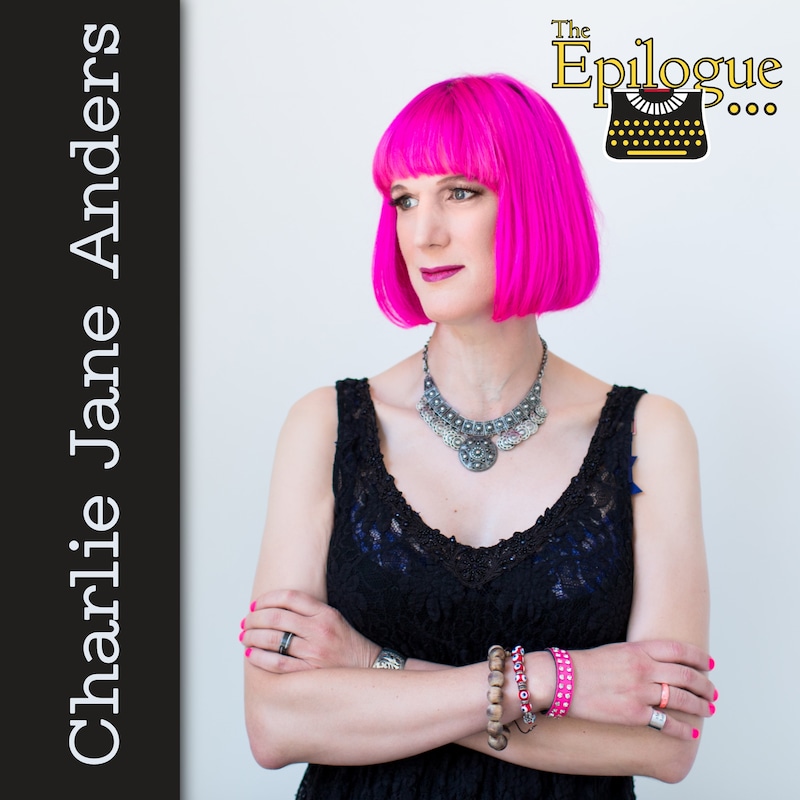
Charlie Jane Anders Photo credit: Sarah Deragon/Portraits to the People
Visit theepilogue.net to view our interviews, sign up for our newsletter, and watch for upcoming member bonuses such as extended interviews and full video.
Transcripts
Let's make this clear. You are not just wading into the story alone.
You have an entire cast of characters going with you, each of them coming with their own baggage, their own goals, their own toolbox. That one's the main character. That one's a sidekick, mentor, comic relief, skeptic, villain.
Of course you want to do the best for your story, the best for your characters. What do each of these characters need?
Michael:Welcome to the epilogue. I'm Michael, and I'm lucky enough to be joined today by Charlie Jane Anders. Charlie, Jane. Hi. Right here is a celebrated writer.
We're celebrating her today.
Charlie Jane:Of the.
Michael:Well, lots of. Several novels. All the Birds in the Sky, City in the Middle of the Night, the Young Adult Unstoppable Trilogy.
Is that going to remain a trilogy or is that.
Charlie Jane:Yeah, I think so. Yeah.
Michael:Okay. The non fiction. Never say you can't survive. Probably more relevant today than just a couple years ago when that was published.
Charlie Jane:Yeah, I guess so. It's. It's a little weird. I don't know. It's. It's weird that that book remains so relevant.
Michael:Let's see. Let's keep going. Too many short works to count. Notably six Months, three days, which was, I think, the first time I encountered her work.
Creator of a superhero, winner of. Okay, first of all, the Lamb Literary Award, the Hugo Locus Nebula Crawford Award, Theodore Sturgeon, nominated for several others.
I think my favorite reference in the nameplate jewelry I found in Science Fiction Fantasy Magazine mentioned the Emperor Norton Award for extraordinary invention and creativity unhindered by the constraints of paltry reason, which is great.
Charlie Jane:Thanks.
Michael:Also a podcast with Annalee Newitz. All our opinions are correct, which is why she's here today, because we need some good ones in the midst of all that.
Thanks so much for finding the time to stop by and talk word slinging with us. That's an awesome.
Charlie Jane:More.
ave a novel coming out August: Michael:Is that one going to be in the young adult or.
Charlie Jane:Oh, no, it's. It's very much an adult novel. It's very much for adults. Yeah.
Michael:Very nice. Okay, I'm looking forward to that because.
Charlie Jane:Oh, yeah, thanks.
Michael:As. As. As mentioned, already a fan, so.
Charlie Jane:Oh, well, thank you. Appreciate it.
Michael:I really like, though, your podcast. This is not in the notes, but your podcast. You and Annalee do an awful lot of pop culture discussion, which.
It's great as artists being fans, and it helps with the making, you know, of all of this. There's an awful lot of reference self referential stuff in science fiction these days. I can definitely recommend the podcast.
Charlie Jane:Oh, thank you. Appreciate it.
Michael:Speaking of just the wordsmithing stuff, which is really the focus of our show. Right. Given the chaos storm that's been around us.
Well, your work can go into some dystopian and subversive places, but I was reading someone's review of your work and your writing was described as safe feeling. And I don't mean that like the cozy mystery, cozy fantasy, which has been kind of a popular thing lately, trending.
But you explore deep and dark themes, you have real drama. I think it's a compassion for your readers. Well, I was just wondering what's your.
Charlie Jane:Wow, sorry I didn't let you finish your question. I'm sorry.
Michael:Yeah, that's okay. I don't think I'm feeling this one. Well, I was just wondering what your thoughts were on that.
Charlie Jane:That's such an interesting question though. I appreciate it. Yeah. You know, I mean, I think the word safe can have many different meanings.
Like, I feel like one thing that I as a reader really appreciate is when I start reading a book and the author just has kind of a level of, I don't know, control over the story and over, over what's happening with the characters and everything, that you kind of know that you're in, quote, safe hands.
Like you kind of feel like the author knows what they're doing and is kind of, you know, is not going to just let things fall apart on you or is not going to just like jump the shark in some way. And like, I feel like it's just a vibe that you get from, from authors.
Like if you just feel like, okay, I, I, this book is making an effort to make itself understandable to me.
And also it's setting up situations in a way that feel like very thoughtful and measured and like, I don't know, like I feel like that was a thing when I was younger. When I was reading books, I would kind of notice that some authors were really good at making me feel like I was in safe hands.
And that was the thing I thought about a lot about how to, how you accomplish that. And like it's like actually I should probably write about for my newsletter at some point because it's, it's such a vibes based thing.
It's hard to like nail down. But I feel like you either have it or you don't.
And like I think a lot about how to achieve that and mostly about how to like kind of take the reader by the hand and bring them into the story a little bit. And I get a little grumpy when I'm reading a book and it's not doing that.
It's kind of like, you know, it's, it's not letting me get to know the characters in a way that's satisfying. It's kind of just. I've.
I often, I sometimes read books where I'm like, okay, I feel like this author could be doing a better job of making me feel like I'm in safe hands.
But then there's also just like safety of like this book isn't going to just, you know, be not going to promise me one thing and deliver something else. It's not going to like make the, it's not going to throw the characters under the bus. And I think that when people say that I'm.
I've never heard that before, that people say that I'm. That my writing is safe, which, you know, I feel like that's a double edged sword.
I don't want to be constrained by this sense of like, oh, you know, you always know what's going to happen in a Charlie Jane Anders book. Or you always kind of know what you're going to get. Like that feels like that's not safe, that's just boring.
And I do reserve the right to kind of go to some really dark places, like you said, and just bring some nasty surprises. Like, I think that art should surprise people. I think that I do write stories where really upsetting stuff happens on a pretty regular basis.
Lessons in Magic and Disaster is a fairly cozy book, but there are a few moments where things get really dark and it gets kind of darker as it goes along because that's kind of a thing I like to do is kind of slowly lead you into the darkness, I guess, and then bring you out the other side and show that, yeah, we can go through the darkness and it's okay.
But I think that one thing I really, really, really think about a lot and try to bear in mind is kind of at least having some sympathy for most of my characters or having some like, not necessarily sympathy, but like understanding that they're people and that people deserve a certain amount of care and respect and that, you know, they deserve to like, they, they have a point of view or whatever, you know. And obviously I have characters who I don't really love who are like just horrible people. And that's a separate.
That I still even the situation I try to Give them a legitimate point of view and a legitimate standpoint. But I also, yeah, I like, I feel like when you.
You can kind of tell if an author just doesn't like their characters or thinks their characters are trash. And that can be fun sometimes for like satire. But if you're going to do that, it has to be really sharp satire for it to work for me personally.
So I, you know, I feel like actors. Sorry, I'm almost done. I know I give long answers. I feel like actors will. Actors will talk about how they have to kind of like their characters.
Not all actors, but I've seen actors say this, that like, I have to kind of like this character that I'm playing in order to portray them properly. And I feel like I always say that writing is a.
Is kind of acting, that you're in your writing, you're kind of being an actor, you're inhabiting the characters you're writing about. And I think you have to, at least on some level, like, you have to like them or kind of feel like you kind of understand them.
And like, so that's something that I work hard on, that I think that makes me safe in one way, because if an author doesn't care about their characters or just sees their characters as cannon fodder or as just like, oh, these, these people suck. Let's just look at how they suck. I. It's harder for me to feel like I'm actually.
The author is going to take me someplace and I'm going to feel good about that journey. I don't know.
Michael:You have like all the birds in the sky. There's really world ending type of stakes in the city in the middle of the night. You have entire culture, actually multiple cultures at risk.
And they're really high stakes and the conflicts are really personal. Whenever I'm seeing, for example, in city, your characters will be heading towards a collision in a way.
And we'll see this coming up to it from one character's point of view. And in the midst of this conflict, we can see some glimpses, some compassionate readings of the other character, like Bianca, for example.
We see some. Something that helps us to feel a little bit on that side, which adds some understanding. And it's not just purely a situation that's there to hurt.
It's really about people doing, trying to do for what they think is right. And sometimes this might play against what we expect, which is great writing because, you know, playing against expectation. It's the switch, right?
You get something that somebody's not expecting and that often will take that conflict in a different direction than I think that I'm seeing as I'm reading up to it. So it's definitely difficult to do. It's so definitely done, though.
Charlie Jane:Well, thank you. Yeah, thank you so much. I mean, with Bianca, that was a situation where.
I actually am working on a newsletter about this because I think it's really interesting. I wanted Bianca to be, on some level, kind of a sympathetic character who goes to a really bad place and makes some really bad choices.
And one thing I learned from that, from, like, the responses that readers had to that, is that it's. It's hard to pull that off. And, like, a lot of. I mean, Bianca makes unsympathetic choices from the beginning of the book.
Like, she kind of lets Sophie take the fall for her, like, right at the start of the book. And, you know, I think she feels like garbage about that. Like, I think that's something that really tortures her and eats away at her.
But I think that, you know, it's. I feel like, you know, one thing I chose to do with that book was not give Bianca a pov.
And I think that, you know, it's harder to create sympathy for a character who. You never go into their pov and with Lessons in Magic and Disaster.
My book that comes out in August, we have, like, jb, the main character is teaching her mom magic, and her mom, Serena, ends up making some really bad choices at various points in the book because the mom is really traumatized and really, you know, has. Has been through some stuff.
And one of the things that I really worked on as I revised that book was just making sure that you, like, giving enough of Serena's POV and enough of Sarina's backstory that people could really understand where Sarina's coming from.
And Sarina is not in the same league as Bianca in terms of, like, making, like, Sarita's never selfish, like Bianca often is, and never, like, doesn't justify, like, terrible, destructive behavior to herself the way that Bianca does. But there is that same thing of, like, just making some really messed up choices.
And I feel like I'm interested in characters who make terrible choices or who make choices that are kind of harmful. And, you know, I think that that's one of the things that I always want to explore in my writing, but at the same time, it's more interesting.
It's more kind of satisfying to me if you can't just dismiss those characters or hate those characters for it.
And that's the thing that I'm constantly trying to, like, find ways to make, you know, understandable to the reader or, like, try to force the reader to grapple with. I guess.
Michael:I mean, good. Good characters in general are difficult, but especially the villains. Not. Not that we necessarily.
I wouldn't characterize all of these situations as villainous, but it's hard to do.
Charlie Jane:Yeah.
Michael:Sympathetically or really believably is. A lot of this is different than the traditional idea of a protagonist antagonist relationship. It is the same.
There's a big fixation on, like, the hero's journey type of stories. And, like, it's over. Those. Those stories have their place that's overused. And people try to apply the same kind of idea to everything.
That is not at all what either of those two works. But especially, I think all the Birds in the sky is. Is completely separated from that sort of.
You don't have a. Antagonist, like, there's the misunderstanding is almost the antagonist of this. The gap between people, the emotional distance that needs to be struggled against.
Charlie Jane:Yeah.
Michael:There's nothing to heroically defeat. Yeah.
Charlie Jane:I mean, that's interesting.
And like, when I wrote all the Birds in the sky, this is something I really agonized over because I really wanted it to be a book without, like, a clear antagonist where Lawrence and Patricia, the main characters, are in a lot of ways responsible for the problems that they're trying to solve. Like, they're. They make the choices that they make. Like, you know, Lawrence is building a doomsday machine that could destroy the planet.
Patricia gets roped into this scheme to, like, you know, turn humanity into, like, monsters kind of. And, you know, they're. They.
But they have, like, really good intentions and they're just really messed up people who are trying to do the right thing and just kind of not because they want to belong to these communities that demand these things of them. And it's. I don't know. I felt like that was something I really wanted to do.
And so, yeah, I struggle with that book is that we do have that character Theodolphus Rose, who appears for the first, like, 80 or 100 pages and is kind of an antagonist at first. And I was like, oh, should I just not have him in there? Because that kind of destroys the purity of them not really having an antagonist.
But I felt like it actually, in a weird way, it just felt right for them as teenagers or as, like, you know, early teenagers to have this, like, monster that they're facing who kind of turns out to not really be, like, he kind of eventually turns into kind of a paper tiger or whatever.
Michael:Let's. Let me, let me talk about the point of view. Because you brought up point of view.
You often use multiple points of view to explore several different angles of the, of the story. All the birds of the sky. It's a, it's a direct character dynamic, whereas.
And again, I'll compare in City in the Middle of the Night, they're not, they don't have the same direct starting out, the direct character dynamic like Lawrence and Patricia, almost a, almost kind of a romantic but conflict kind of interest. It's more. It's like their story. Whereas in City, they're two aspects that are kind of.
They're intersecting and each of those storylines has their own kind of partner story. Why is, and I think you kind of touched on it already, though.
But why is that such a big part of your writing style, this exploring the multiple points of view?
Charlie Jane:Yeah, I mean, I think that's interesting to think about. Like, actually, again, I'm working on a newsletter about pov, which I should finish up soon, actually, because this is such a fun topic.
But I mean, so, you know, actually writing a young adult trilogy was really good for me in terms of thinking about this stuff because, you know, I feel like YA and to some extent, some of the other up and coming, you know, I don't know what you want to call them, sub genres or formats or whatever. Like Romantasy, I guess, is a subgenre that's like, become really huge recently.
I feel like a lot of the books that are more popular recently play more fast and loose than with pov than what I was used to. Like, you know, there are a few models for how you handle POV that I had kind of seen in the past.
from like, before about, like:The narrator is going to tell you what different characters are thinking at different times. The narrator is going to withhold information, but also provide information.
And like, is going to kind of that thing I mentioned before of taking you by the hand and leading you into the story. There's a voice, there's a narrator doing that. And like, you know, the classic.
One classic example of a novel with omniscient POV that works really well is Hitchhiker's Guide to the Galaxy, where it's like, yeah, yeah, you are.
You know, the, the Douglas Adams is kind of telling you stuff and there's, you're getting to like, have a lot of information that, that maybe Arthur Dent doesn't know and you get to know other people's points of view in a scene where it's mostly from Arthur Dent's pov.
But, you know, when I started really seriously writing sci fi and fantasy novels, the kind of dominant mode that I was familiar with was like the George R.R. martin mode, where, like, which I don't think George R.R.
martin invented this, but he really kind of popularized it and was very kind of intense about it, where you have certain characters who are given a POV in the story and we don't get the POV of any other characters. And you know, any character who gets a pov, there's a lot of investment in that, in building that up.
Like, you know, it's very economical in terms of, like, if a character gets a pov, they're a major character and we're going to spend a lot of time kind of delving into their view of the world and how they see things and making sure that they stand apart from all the other POVs and that they are. And you know, famously, George R.R.
martin, the reason why, apparently it took him as long as it did to write his most, the most book he published most recently, which was Dance of Dragons or Dance With Dragons, you know, finish.
The reason why he got stuck finishing that book was because there were some events that happened in Meereen and he didn't have a POV that could witness them.
And it took him like a long time to decide that this one character who hadn't previously been a POV in his books, Sir Barristan Selmy, I think, God, my brain is coughing up pieces of information. It's, you know, anyway, could have a POV in this final. In this fifth or sixth book. Fifth book.
And so, and for him to do that, he had to really delve into that character and build him up in a way that he hadn't before. He couldn't just be like, oh, well, now we're going to see stuff from this guy's pov. We have to really invest in that.
But I'm reading a lot more books now in ya and like I said, also romantasy, I think, a little bit.
And I think I've seen some cozy fantasy books that do this too, where we'll just occasionally jump into this one character's POV, or there's a character who gets a POV once in the entire book, we'll have 10 pages for the POV of this character who, who doesn't get a POV before, doesn't get a POV after just one time for 10 pages. We're in this one character's POV and it's just like, oh, you know, we're dropping in now. We're never going to see from that person's POV again.
And that is something that, like, felt like. And you know, that's something that felt like it was forbidden kind of.
Back when I was starting to write sci fi and fantasy novels as a serious thing, it felt like something that you couldn't do. Like if you were going to have a pov, you had to really, like, develop them.
And so, you know, I think it's been very freeing to kind of realize that, yeah, I mean, obviously all this stuff is fake anyway. It's all made up. But you can, whatever you could pull off, you could do.
It does annoy me when I'm reading a book and there are five different characters who have POVs, one after the other, and they all feel like the same person.
And there's no effort to kind of distinguish how they think or what, how they view the world, because that just feels like, why are we doing all these different POVs if we're not going to get different actual perspectives? But yeah, I mean, all the Birds of the sky is technically like, has technically has an omniscient narrator.
It's just very kind of low key and very like, I, I.
There was a version of all the Birds in the sky where the narrator was much more kind of aggressively omniscient, where we would really just like get thrown lots of pieces of information that the charact couldn't possibly know or where we would dip into, like, lots of different viewpoints within a scene. And the version I ended up with, the omniscience is very, very subtle and very kind of slight.
And you just occasionally kind of pull back and you just occasionally get, you know, a little extra information. And there are parts towards the end, there's a part which I was actually nervous about. I was worried people were going to, like, get mad.
There were actually the parts of the book where I play with POV the most are the parts where I was, like, nervous that I was going to get screamed at on the Internet. And in many cases, those turned out to be people's favorite parts of the book, which was very gratifying.
But like, early on, there's a part where Patricia and Lawrence are in the mall, they're sitting under the escalator. They're speculating about people based on their shoes. And Theodolphus Rose goes by and they speculate about him based on his shoes.
And it turns out they've guessed correctly and that they've just somehow randomly identified this guy as an assassin based on his shoes. And so there's a part where, like, we're in.
I forget if we're in Lawrence's POV or Patricia's POV or just neither, but we're tight on the two of them. And then suddenly the narrator pulls back and is like, actually, they're correct, and, like, this is Theodolphus Rose and blah, blah.
And I'm like, people are gonna get so mad that I just suddenly break out of POV and start telling you stuff. And nobody ever complained about that.
People always said that they really liked that, which there's a lot of stuff in that book that I just did to throw up a whole middle finger to people who tell you that you can't do things. And nobody was upset. I was like, I wanted to piss people off. And nobody got pissed off.
This is really disappointing, but actually also gratifying, obviously.
And then later in the book, there's a part where we just cycle through a bunch of random POVs, including Patricia's sister, and Theodolphus Rose gets a brief POV and, like, three or four other people, and it's just like, yeah, I'm going to do this, because why not? And, like, again, nobody minded. Nobody complained at all.
I was, like, kind of shocked because I think I'd gotten in my head that this was some kind of, like, live wire, that if I touched this, I'd be electrocuted. And, like, literally nobody cared. Which was a good lesson in how little the kind of writing.
You know, the people who tell you that you have to do things a particular way or you're in trouble, how little they actually really matter. But, yeah, sitting in the middle of the night. I actually started out as only from the POV of Sophie. Like, it was just a single POV story.
First person, just Sophie's pov. And I finished writing it, and I was like, this really needs something else. This feels very kind of.
I feel like we're going to get sick of Sophie's pov and we're going to really want some other perspective. And so I went back and created the character of Mouth.
Like, basically, there were these smugglers who turned up in the book who we didn't really get to know them that much. They just helped people cross the wasteland. That was all they were there for.
And I was like, well, one of those smugglers is now being promoted to being a major character and is going to have a pov. And that ended up being like, I think the best decision I made in that book because Mouth added a lot.
And like, Mouth was originally going to be like the fun counterpart to Sophie's kind of angst ridden pov. And of course that didn't entirely pan out because Mouth has some problems of her own. But. Yeah, so I feel like that was. I was, you know.
h I'm hoping will come out in:But I can't really talk about it yet because it hasn't been announced.
Michael:Oh, okay. Well, thanks for the preview, you. Young Adult Victories Greater Than Death. The Unstoppable Trilogy. There's a lot of playing there.
It's a fun space opera kind of story, space opera, but it's definitely kind of a space serial.
Charlie Jane:It is space opera. It's totally space opera.
Michael:Yeah. And you do a lot of playing with what's alien. And you do this in City as well. In this case, you used.
I love the way that you're addressing social issues, but rather than going into the dark kind of way of looking at it, you're exploring them by normalizing the ideal state in, in some cases here, ex.
Like when, when your, your character Tina's going into space and you're seeing all of these societies that are, they don't have expectations of other people, you know, or, or their own ideas of identity. They're. They're allowing people to define themselves in a way and it's just completely normalized because that's how it is.
Charlie Jane:Oh, are you talking about the pronouns or are you talking about. Yeah, yeah, yeah.
Michael:Like there's, there's a. Everybody identifying. That's. Which I think is a great way that we usually see people struggling with the, the opposite.
What happens when things go off the rails. But you're, you're giving an example of how things could be good.
And obviously you have the primary conflict going on with the compassion coming in as well. But, you know, that's outside the world that she's immediately taken to.
Charlie Jane:Yeah.
Michael:Is that, is that something that you found intentionally trying to. Because young readers in particular or.
Charlie Jane:Yeah, I mean, you know, I, I'm trying to remember, like, it was obviously a While ago. But I feel like I was having a lot of fun with that stuff.
Like, the pronouns specifically and like, having, like, in the first book where we're in Tina's POV only, like, we get, like, we. People will tell us, like, every time we meet a new character, they'll. They'll announce their pronouns. Even if they're about to try to kill you.
They're like, these are my pronouns, and now I'm gonna try to kill you. And like, I. I basically just decided at a certain.
Like, that was something I kind of fell into doing, but I just really enjoyed it and it felt fun and it felt like, you know, I mean, you made an alien, like, real talk. When you meet a human being, you can't really know what, what their gender is by looking at them. Like, you might have.
There's a lot of clues that we pick up on we' society.
As, you know, human societies all over the world have developed like, signifiers that are like, if someone has this, this, and this, we use these pronouns for them.
But if someone has this other stuff we use, and those are culturally determined and like, obviously change over time and are, you know, but we sort of have all this stuff that maps onto the world for us, that tells us when we look at someone, what pronouns we think we should use for them.
But, you know, part of the reason why human beings have tried to, in recent years have tried to push the idea of, like, asking someone's pronouns is because you don't always know. And like, if you get it wrong, it can be really awkward and really kind of, you know, unpleasant for the person whose pronouns you got wrong.
And, you know, there are non binary people and gender queer people and everything. And so it's, it's complicated. And so, you know, but you meet an alien and they are, you know, they look like a blob with tentacles.
And it's like, what pronouns does this person use? And, you know, it's sort of like how, you know, an ancillary justice and Lecky just decides everybody's gonna have she her pronouns, no matter what.
That's one, obviously, one solution.
In Ursula K. Le Guin's the Left out of Darkness, Genli AI just decides everybody's gonna have he him pronouns no matter what, because that's just like the default according to Genli. And so, you know, you could do that. But I, I like the idea of just having like, it sort of became like, it was definitely not.
It was definitely inseparable for me, for me from the concept of the universal Translator. And this idea that, like, you would have a device that into.
That allows perfect communication, or not perfect, because later in the series, we actually explore how it's not perfect and how communication is always inherently flawed, but we have communication between different cultures with different languages, and you can just instantly speak any language.
And I felt like this was an extension of communication, getting people's pronouns right, understanding what people's pronouns were, what pronouns actually mean in their culture.
Because, like, when you meet aliens, they might have something that grammatically does the work of a pronoun, but it doesn't necessarily contain the same information it would in a lot of human languages. And so, you know. Yeah, And I just. I think that it's. I like the idea of, like, exploring that as part of communication.
And then, like I said later in the series, later in the trilogy, we kind of get into the downsides of. Or the. The things that can crop up when you think that you're communicating perfectly. And pronouns are definitely part of that.
Like, I think it's complicated. But one of my favorite bits of the first book is when Tina meets Wang Yiwei, who comes from China.
And, you know, because she's gotten used to the thing of, like, the translator kind of automatically announces people's pronouns whenever she meets them, she just, like, proactively tells Wang Yiwei her pronouns.
And because what she's saying is being translated Mandarin, it doesn't make any sense to him because in Mandarin, everybody has the exact same pronoun ta.
And until, like,: Michael:But anyway, we hang a lot on our assumptions of language.
Charlie Jane:Yeah.
Michael:Speaking of playing with words, in City in the Middle of the Night, you used language to explore alien and normal in a way, because you. You took a bunch of words that are familiar to the reader and you, like, redefined them. Like crocodiles, for example, or bison.
Like, things that we think, oh, I have a picture in my head of what that is. And then you use that word in the context of this extraterrestrial settlement in a different way.
And that the dissonance of that kind of, I thought, was a neat trick of. Of underlining the alienness of this because it's completely normal to them. But. Yeah. How did you. Come on. Come across that?
Charlie Jane:Yeah, I mean, I feel like that was. That was something that I did partly because it was fun and partly because it was a way of avoiding a lot of annoying stuff.
Like, I think it was Isaac Asimov, who wrote like a billion years ago that, like, if you're describing some distant future world and you have a thing that has wheels that moves around, you know, even if it looks really different, even if it's like, doesn't run on gasoline, even if it's like, whatever, don't call it like a hyper tubular transporter machine. Just call it a car. Just call it a car.
Don't like, you know, don't introduce new vocabulary just for the sake of, like, showing, showcasing that it's something different or that it's, like, different in some way. Just if you could use a familiar term, use a familiar term. I feel like that was Asimov who said that. And I'm probably misquoting, but I.
That really struck me. And I feel like that is good advice in a lot of ways. And so, you know, I didn't want.
One of the things that was intimidating to me about writing a book set on an alien planet with, like, all alien flora and fauna and all this other alien stuff was just the.
The weight of, you know, coming up with words for, like, every thing that was, like, different and strange and just giving myself permission to be like, nope, we're going to call this a cat. Even if it, like, has acid vomit and spikes coming out of it and, like, you know, tentacles and, you know, like. And I thought that that was.
But also, you know, it was an exercise in defamiliarization, which is a technique that I really love. I love the technique of defamiliarization.
I think that it's one of the powerful things that science fiction and fantasy can do really well, of taking something that we know and are used to and making it strange and kind of making you kind of stop and realize, oh, these things that I take for granted in my everyday life are actually really weird or would look really weird if I was coming at it from a different POV and like, you know, the master of defamiliarization in some ways was Kurt Vonnegut, who. He would do this thing in a bunch of his books.
I feel like, was it Cat's Cradle or, I don't know, Merry Christmas, Sister Rosewater, One of those books. He does this a lot, but I feel like he's.
It's a thing that he does where he'll be like, you know, the United States of America was a bunch of people who got together and decided that they would blah, blah, blah, and they had a flag that had a bunch of, like, lines on it and like, these weird pointy things. And he would describe Things that everybody already knew about, but he would describe them as though you'd never heard of them.
And he would make them sound just subtly, like, very odd and like, oh, you've never heard of the United States of America, but here's what it is, and it's this weird thing. And like, you know, he did that with a bunch of stuff, and it was just.
I feel like Kurt Vonnegut was interested in making the familiar seem strange in a way that was, like, you know, really gratifying to me. Like, I feel like Vonda gets a huge influence on my work.
Michael:That's one of the great things about science fiction and science fiction adjacent, I guess, genres, is being able to explore that. I could definitely see Vonnegut in your. Your kind of metafictional introduction to that, where you were introducing in City.
Oh, the translator's note idea of things as. As if you were kind of an alien anthropologist sometime in the future history of that book, looking back on how those words were used, which.
Yeah, actually, which was really interesting, I'm.
Charlie Jane:Going to correct you slightly, which is that the translator's note kind of isn't just talking about how those used words were used. It's actually kind of explaining why we're seeing that vocabulary.
Because this is a book that was written in some future language, which I can't remember exactly how I described that. And then it's been translated into what we called peak English.
And peak English is a thing that, like, my editor and I went back and forth for a while about what the term should be, because, you know, the idea that English kind of reached this point where it was, like, at its peak of influence, and then it was sort of close to the version of English we speak now. And then it kind of declined influence, but it's still like a lingua franca that people read but don't speak. And so this is.
This book has been translated from some other language into English. Also, the translator's note.
Gosh, like, you know, that was me being really cheeky because the translator's note kind of gives away the ending of the book. It tells you what happens, like, a hundred years after the book ends, which is that Sophie's.
These hybrids that Sophie is starting to create are going to basically take over.
They're going to swarm across the galaxy and become like a. I don't want to say a dominant species, but they're going to become very, like, prominent in a lot of parts of the galaxy. And we're going to be these. You know, Sophie is starting Something that's going to become huge.
And so that translator's note tells you a lot of information.
And I kind of almost wish people who get to the end of the book would flip back to the first page and just reread the translator's note, because it tells you a lot of stuff about where things end up. I mean, I feel like you get that from the ending of the book, too.
And I did write a short story that takes place after the book that kind of goes even further in spelling that stuff out. But, yeah, the book originally actually ended with a translator's afterword where the translator comes back and is like, okay, so I fucked this up.
And, like, I'm. You know, everybody's mad at me now because I did a bad job translating this book. And, like, whatever. You try and do better.
And, like, basically just is yelling at the reader. And my editor was like, no, let's just. This is. I. We had. I. She was totally right. I think Miriam was right. It was like it was going to be too much.
Like, it was just like.
I thought it was funny to have the translator come back at the end and be really whiny about, like, oh, everybody hates me now because I did such a bad job translating this book. But, you know, I think it was probably. It was definitely the right choice to take that out. Like, I feel like it was. It would have. It was just.
It was going to be too jarring to have that at the end. But I. I thought it was. There was just like. That. I was very amused by, like, the. The translator being super whiny at the end.
Michael:I think that's fantastic, personally. But I guess I could see that undermining maybe some of the series.
Charlie Jane:I mean, I think it just was like, you know, I feel like it was just something that was going to be too much, you know, like, you kind of have to sometimes know when to quit.
Michael:Well, speaking of which, we're coming kind of close on the clock.
Charlie Jane:Yeah.
Michael:I want to make sure. Oh, well, I want to make sure you get. If there's anything that you feel like you would like to. To include. I want to talk about your. Never.
Never say you can't survive. But if there's anything else that you would like to talk about before we kind of dip into, like, final question here.
Charlie Jane:Yeah, I don't know. I mean, you know, lessons in magic and disaster.
We were kind of talking about POV and, you know, never say youy Can't Survive has a whole chapter where I talk about POV and tone and How I think that they're kind of connected. And Lessons in Magic and Disaster was an interesting one because I was writing that.
The first draft of that at the same time that I was writing Never say youy Can't Survive. And the. Originally, that book was also like first person from the POV of Jamie, who is teaching her mother how to do magic.
the secrets of this book from:And I was just, you know, I got to a place where I was like, I love Jamie. I think Jamie's. You know, Jamie's a very. JB feels very personal to me.
Like, in some ways she's closer to me than some of my other protagonists I've written. Most of my other protagonists I've written.
But I had kind of given her this very arch, like, she's a PhD student, she's teaching some classes, she's very steeped in academia. She's a little bit kind of. She's very ironic. She's very kind of like, I felt like first person was not serving the narrative well.
I felt like it was going to be really hard for people to sympathize with JB the way I really needed them to and to like, really buy into her pov, ironically. And I feel like I've encountered this in the past as well, ironically. I feel like sometimes first person can be more alienating than third person.
Like, it's really interesting to see that. Like, I found that in some of my YA stuff as well, but also just other. Some of my short fiction.
Sometimes when it's first person, you have to be very careful because a first person narrator can seem too whiny. They can seem too kind of grumpy, too kind of architectural.
And you know, all the stuff that makes a first person narrator great can also make them kind of like too much. And like, where first person works really well is like, when you see a YA first person narrator offed, you are just. You're in it with them.
And like, they are like you do. You do not question their take on anything.
You are just like completely buying into their perspective and completely, like, they feel strongly about things, and so you feel strongly about the things that they feel strongly about.
But a first person narrator who has more of a sense of irony and distance and, you know, archness and, you know, just kind of like ambient resentment can be very hard to get into. And so I actually, I. It was actually very. Logistically, it's harder than you think to do this.
I went through and changed it from first person to third person. And of course, for like, months afterwards, I would still find bits where I missed something and it was still.
There was an I where it should be a she.
And like, that was the beginning of starting to kind of work on making the narration, like, stay close to Jamie's emotions and Jamie's perspective and keep that kind of like slightly, you know, academic kind of. Because I liked that tone and I thought it went well with the dark academia vibe of the book. But keep it kind of.
Keep it kind of like at a place where you can buy into what Jamie is thinking and feeling without getting overwhelmed by her kind of her perspective in a way that would actually. You'd bounce off of. So that was a tough process, actually, and I'm really happy with how it turned out.
My editor and I both took several cracks at rewriting the first chapter to make you just like, understand where Jamie's coming from, but also just be like, really, like, instantly, like, able to.
It's that thing that we were talking about earlier about like, feeling safe, like where the characters you like, you know that the author cares about these characters and likes these characters on some level, or is like, wants, is in. Is invested in these characters and is inviting you to be invested.
And it's always a tough process, especially the opening chapter, but also just in general. So. So that was very blah, blah, blah. So, yeah, let's talk about never see you can't survive. And then I do have to bounce pretty soon.
Michael:That's still fantastic. It gives me everybody an awful lot to look forward to.
So, okay, Never take, never say you can't survive, I think would obviously be the sort of book that anybody, regardless of whether they've read any of your other work, who's listening to this probably should be reading because it's got a lot of good messaging about how to take the world that you are dealing with and put it in your writing and to work through the problems, working through things with your writing and. And some very, very good technical information as well about writing process and things that you have gone through.
Do you want to talk more about the book and. And how. How writing in general has just kind of helped you with that sort of thing.
Charlie Jane: There was this. I wrote it in:Like, it was a way for me to think about, like, backing up slightly. I wanted to do a book of writing advice. I'd had.
I had wanted to do a book of writing advice for a long time because I used to do these writing advice columns or like, I used to do articles of writing advice at io9, this website I used to work for. And it was always really fun to kind of geek out about writing. Even I was doing those long before anybody had read any of my fiction.
Like, I was just, you know, my. My fiction writing was very kind of obscure in a way. Although, I mean, I'd already won the Lambda Literary Award.
But I felt like I wasn't recognized as much as a fiction writer. But it was like. It was just really fun to geek out about.
And the thing I discovered very quickly was that there's a lot of books of writing advice out there. Like, it's. Writers love to talk about writing, and every writer has their own thoughts about writing and wants to share them with the world.
And so there's just a hundred thousand books about of writing advice out there.
And so I realized I needed something that was a little bit, you know, that kind of had its own perspective, that had like, a different angle, I guess. And so that was where that came from. But it ended up being like a really. I thought.
I felt a powerful lens through which to view the kind of process of writing and to get into a lot of the stuff I wanted to talk about with regards to writing, because that process of kind of getting imaginatively swept up in the story you're telling. And the thing I was.
I've been talking about a lot throughout this interview of, like, kind of like understanding your characters, inhabiting your characters, like, acting out your characters in your own head, like, believing in your characters. That's a way of kind of having your.
Like, getting lost in your own world inside your mind, which is something that you can do even when things are just really tough and scary. You have this, like. The human mind is just really powerful in its ability to create.
Construct things imaginatively and build imaginary worlds to, you know, disappear into. It's why reading is so pleasurable, but it's also why writing is so pleasurable. And, you know, that was something that I really strongly believed in.
And I guess the good news is, since I wrote that book, I found it even more to be true. Like, the last five years have been really hard.
They've been really challenging and really tough, and it's easy to get swept up in dread and anxiety and just, like, dooba scrolling.
But the times right now when I'm happiest and most kind of, like, most kind of comfortable in my own skin are the times when I am writing my own fiction and kind of getting lost in my own kind of, like, imaginary world and these characters that I've dreamed up. And that's just truer and truer.
Like, I feel like writing is just making me really happy and is something that I'm just, like, getting a lot of joy out of and getting a lot of fulfillment out of. And it's just. I'm really grateful for that because it's. You know, sometimes it does take.
You know, I feel like it does take a lot of effort sometimes to kind of get into that space when the world is just coming, bearing down on you like that. But the more you do it, the easier it gets, and the more you do it, the more fulfilling it gets.
And so it's just one of those things that, like, just keeps getting better the more you do it. And, like, so I'm just really grateful for that in my own life.
And I'm grateful that people are finding this book and are, you know, that they're still getting something out of it. That it's still. That's something I came up with, that I wrote, like, almost five years ago, is still speaking to people and being helpful to them.
Like, it's just really great to, like, have done that work and be done with it, but it's still doing stuff out there in the world. I think that's. That's kind of a. That's really magical.
Michael:I know that's the goal for most books, is you want it to be meaningful for somebody. This one being kind of directly meaningful for people who are wrestling with the world in the same way that you. You are, I think so.
Thank you so much for being here today. This has been a special writerly treat, I think, for.
Charlie Jane:Well, thanks for having me. If.
Michael:If people wanted to find you, where do you want them to look for you? Online. I know.
Charlie Jane:Yeah. I mean, button down, dot, email, forward slash, Charlie, Jane. That's my email. That's my newsletter. Happy Dancing.
It comes out once a week, not always on the same day of the week. I talk about writing. I talk about you. Know a little bit about politics. I talk about like life. I talk about.
I have personal essays that I publish sometimes. Every week it's something different.
But it's always a lot of fun and you know, I, you know, it's I'm having a lot of fun doing it and I'd love it if anybody would subscribe.
Michael:Well, as a subscriber to that newsletter, I can definitely vouch for it. It's been topical and comforting sometimes to to see the way that you're dealing with some of the same sort of mental issues in the world.
So definitely subscribe to the newsletter everybody. You can of course hear the our opinions are correct.
The podcast also has Annalee Newitz Lots of pop culture going through there, so all of us of a certain age can can feel very vindicated listening to that. And of course at the bookstores.
Charlie Jane:Yeah.
Michael:Well, so thank you once again.
Charlie Jane:Thank you so much for having me. This has been just such a delight and it's just been so great getting to talk to you and you know, hope to run into at a convention sometime soon.
Michael:Yeah, I hope so.
Michael:Your characters live in the world of your strange story. It's their home making your story not just one thread, but many, each of them winding and intersecting with the others.
They have their own struggles, their own truths. They need you to believe in them.
Stay true to each of those threats, to each character's journey, and ask yourself, how do you show compassion for their story?
Michael:I would like to thank Charlie Jane.
Michael:Anders once again for joining us to talk about craft. If you'd like to check out more.
Michael:Of her work, you can visit charliejaneanders.com.
Michael:Or visit the links in the show notes.
One thing which has changed since the recording of this episode is that her brand new book Lessons in Magic and Disaster, which she had described during the interview, has been released.
So if you already enjoy Charlie Jane Andrews work, or if you just liked what you heard in this interview and would like to support the author, run out and pick up a copy today. You will find links to Lessons in Magic and Disaster as well as other works we talked about in the show notes.
The shared links go to bookshop.org in order to help support independent bookstores. Clicking the links may also help to support this show in a small way.
Michael:If you enjoyed this interview, you can.
Michael:Subscribe or follow this podcast in your favorite podcast player.
Michael:Also visit theepilogue.net and sign up for.
Michael:The newsletter to be informed of news, events and other fantastic future guests. Thank you.






