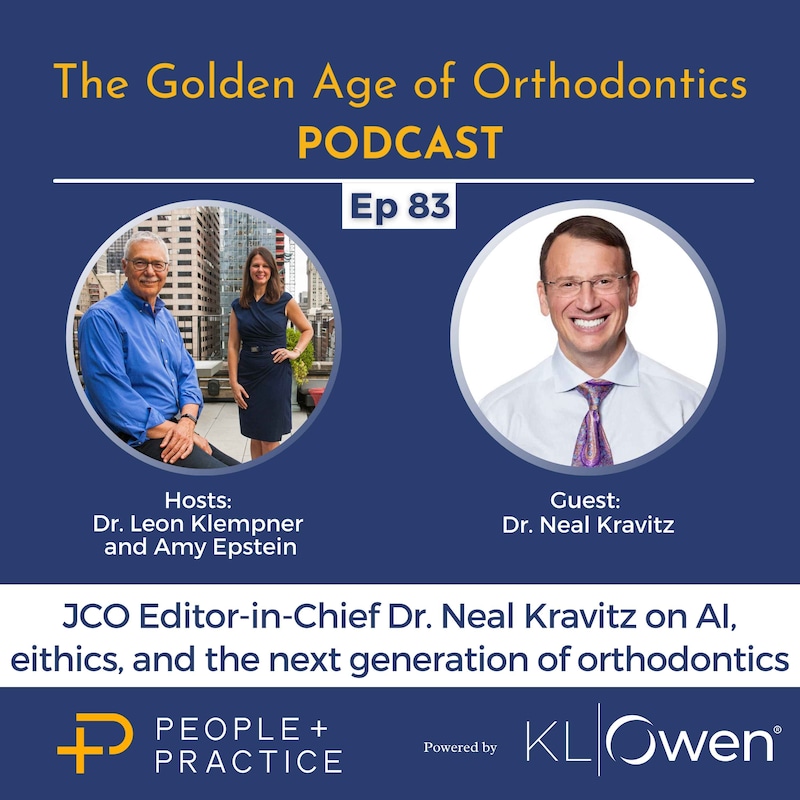
Shownotes
What does the editor-in-chief of the Journal of Clinical Orthodontics really think about orthodontic AI, corporate orthodontics, and research bias? Dr. Neal Kravitz pulls no punches in this candid conversation with Dr. Leon Klempner and Amy Epstein. A practicing orthodontist, educator, and past AAO Technology Committee chair, Dr. Kravitz shares why evidence-based orthodontics still needs room for clinical judgment, why overtreatment is the specialty's quiet problem, and why young orthodontists have more reasons for optimism than anxiety. Honest, direct, and deeply practical.
What You Will Learn In This Episode:
- How orthodontic AI is best used as a diagnostic and records automation tool rather than a replacement for clinical judgment, and why evidence-based orthodontics still requires the experienced eye of a trained specialist to catch what algorithms miss.
- Why research bias in orthodontic literature comes not only from industry-funded studies but also from reviewers and authors themselves, and how understanding this helps orthodontists read the Journal of Clinical Orthodontics and other publications more critically.
- How the philosophy of conservative orthodontic treatment planning and doing less rather than more protects young patients from iatrogenesis, and why this principle should guide practitioners from their very first cases in private practice orthodontics.
Subscribe to the Golden Age of Orthodontics and our sister podcast, Practice Talk, hosted by Lacie Ellis, wherever you listen to stay updated on orthodontic innovation and real-world practice strategies. Visit People and Practice for more insights and to connect with our team for practice growth solutions.
TIMESTAMPS:
- 00:00 Introduction to orthodontic AI, corporate orthodontics, and specialty pressure with guest Dr. Neal Kravitz
- 05:27 Dr. Kravitz explains how orthodontic AI supports diagnosis and records automation without replacing specialist judgment
- 09:41 Discussion of underrepresented topics in the Journal of Clinical Orthodontics and what evidence-based orthodontics research needs more of
- 14:29 Balancing evidence-based orthodontics with clinical experience and why residents need room to develop sound orthodontic treatment planning
- 24:41 How research bias from companies, authors, and reviewers shapes what orthodontists read and how the JCO editor manages this challenge
- 28:29 Advice for new graduates on private practice orthodontics, finding mentors, and navigating corporate orthodontics with confidence
KEY TAKEAWAYS:
- Orthodontic AI is a powerful adjunct tool for diagnostics and workflow automation. Still, it will not replace the clinical judgment that distinguishes a trained orthodontist from a general dentist who uses Invisalign treatment without oversight or expertise.
- Research bias is not limited to industry-sponsored studies. Reviewer bias and author bias are equally real, which means every orthodontist must approach the literature, including the Journal of Clinical Orthodontics, with informed skepticism and critical thinking.
- The philosophy of doing less protects patients. Dr. Kravitz argues that overtreatment, not under-treatment, has driven his most regrettable cases, and that conservative orthodontic care built around humility and honest self-evaluation defines what ethical practice looks like across an entire career.
ABOUT THE GUEST:
Neal Kravitz, DMD, MS | Ashburn South Riding, VA Orthodontist
RESOURCES MENTIONED:
Transcripts
[00:00:40] One thing we know is that the future of orthodontics is digital For me, the KLOwen custom solution checks off all of the boxes, takes the guesswork out of treatment planning, reduces treatment time, and appointments, and lets the team best support the orthodontist. If you haven't already, I suggest you check them [00:01:00] out.
[:[00:01:10] Welcome to the Golden Age of Orthodontics. Fiona already know me. My name is Leon Klempner. I am a retired, proud board certified orthodontist. I'm also the director of orthodontics at Mount Sinai Hospital here in New York, part-time faculty at Harvard and Montefiore, and I am the new current president of the New York State Society of Orthodontists, as well as of course, the CEO of people in practice.
[:[00:01:47] Amy Epstein: Thank you. Always good to be here. This is always a really good episode. You'll be listening to this episode right ahead of the AAO. So, uh, as you're gearing up and making your plans, please include a visit to [00:02:00] People in Practice's booth, uh, on your list of places to visit.
[:[00:02:21] Kinda like a highlight for me. Feel famous for a hot second there. So, um, so we look forward to meeting with you. I'm Amy. Uh, and, and by way of background, I have an MBA in marketing in 25 years. Now I have to update my, my, uh, bio that, um, 25 years of marketing and public relations experience. We got together.
[:[00:03:11] We have Dr. Neal Kravitz with us. If you don't know, he obviously, he's, he's a practicing orthodontist and, uh, you know, but he's the editor in chief of the JCO. He is an associate editor of the American Journal of Orthodontics and Dental Facial Orthopedics. Um, he serves on editorial boards like the Angle Orthodontist and seminars and orthodontics.
[:[00:04:03] In clinical practice to being conservative, ethical, and offering affordable care. Um, so Neil, thank you so much for being here. We really appreciate it.
[:[00:04:16] Dr. Leon Klempner: All right. All right. Neil are ready. So lets start. I ready? Start off. Yeah. Yeah. Uh, first of all, let me, let me just, uh. Also state that Neil's a really nice guy, as I mentioned in the, in the opening, and he is extremely well respected for his authenticity and ethics.
[:[00:05:01] So, you know, it's, it's been a delight. But as AI is getting better from your perspective. How are we going to differentiate ourselves from gps as more and more, um, vendors begin incorporating AI into things like treatment planning? So where, what do we do as a, as a specialty?
[:[00:05:28] AI is the, is the topic in, in orthodontics and in medicine. I think, uh, I think the first part is. What I wanna see from ai, we're all talking about how AI can, uh, be used with Invisalign and, and treatment and maybe even making products. But what I really wanna see AI do, um, is two parts. One, diagnostics. I think you're gonna see it in hospitals with reading radiographs, uh, right away.
[:[00:06:20] I also wanna see AI in terms of records, automation. You know, I would love a day, this is my whole theory, and we, we always talk about products, but I would love a day where you can take yourself and it automatically goes to the insurance company. And it's, uh, the Salzman index is al already, um, computated.
[:[00:06:55] In terms of separating from general dentists, I think this goes back [00:07:00] to maybe like the night tie wire argument, you know, you know, 50 years ago or so. I, I think we're always gonna be able to differentiate ourselves. AI is just an assisted tool. It will not replace doctors. But with that said, um, you need to incorporate it.
[:[00:07:38] We're just simply, um, it's gonna be used as an adjunct.
[:[00:08:02] And, you know, in, in AI data is the king.
[:[00:08:05] Dr. Leon Klempner: And they've got. You know, 20 plus years of, of data and you know, in his eyes it's like AI can make things so much easier, but I'm concerned that, you know, you push a button and AI is gonna give you the treatment plan and you know, or the staging and all the things that, that, you know, we use in terms of our own clinical judgment.
[:[00:08:39] Dr. Neal Kravitz: could be we're already there. You're, you, you could put on, uh, brackets and put on a, a straight eye tie wire and let it ride. You can do Invisalign assist and never look at the case.
[:[00:09:17] We'll be the non orthodontists. Mm-hmm. Um, and, um, I, I don't, I, I think the difference in care will always be there.
[:[00:09:36] Um, and I think you've published something like 200, you know, uh, papers. In your role at the JCO, you see what's coming through and what gets published and also what doesn't get published. What clinical topics or what questions do you think are, um, underrepresented in the literature? Essentially, I'm asking what topics [00:10:00] should be explored more deeply, um, through research that aren't currently being explored.
[:[00:10:32] Everything that I'm learning, uh, to the clinic. I didn't want weird cases. I didn't want heroic cases. Mm-hmm. I didn't cases with 20 mini screws. Mm-hmm. Um, I, I, I reject those cases right away. I didn't want cases where people were naming things after themselves. Um, I wanted to, I kind of wanted to simplify it.
[:[00:11:05] You can't just show before and after cases and show off your work. You need to walk me through why you thought about that attachment and what you were doing. Um, and we really are kind of hard on our authors, uh, because of that. Um. So I think what we are looking for, and it does change. I mean, now I, I would argue that I, I really am, I wanna see, uh, mark the expansion cases.
[:[00:11:47] Um, we have some articles coming out on SAP positioning Tom Pitt's, uh, you know, smile arc protection position. I want authors to explain how they're doing it now and where they're applying it, because when I do it, you know, [00:12:00] sometimes I don't love the, the denture like aspect of the way the teeth look.
[:[00:12:30] Um, and that's what we want more of. So we went from, um, a, a. Having a journal that really tried to cover a lot to really trying to cover, uh, a residence curriculum.
[:[00:12:53] So, you know, I go back a long way. I always looked to the JCO as what I [00:13:00] can practically use Yeah. In my hands, in my office. That's the value to me. I mean, I get the a JO and I read those articles and, you know, the studies and the, the mitochondria and uh, whatever. But, you know, the bottom line is that, you know, I'd, I'd look at the tips and, you know, the, you know, the, the little things that say, oh my God, you know, that's gonna save me so much time and
[:[00:13:22] Dr. Leon Klempner: And whatever. So.
[:[00:13:42] Easy to read, uh, easy to just, uh, uh, graze through if you wanted to. Uh, we put some key summarizing keys in there. So, uh, we've included a digital aspect. So all those things, um. I mean, we are focused on it.
[:[00:13:55] Dr. Leon Klempner: Yep. So, uh, let me ask you this question. Uh, 'cause you and I are both [00:14:00] involved with a lot of, uh, ortho residents.
[:[00:14:29] And I'm a little concerned that our residents are coming out without too much of that. And when that happens, I think innovation gets squelched and Yeah. And I'm wondering, you know, uh, how do you feel, uh, how do you feel that we should adapt to that balance between. Evidence-based, um, issues and. At the same time, open up to new ideas and trying new things and, and what works in your hands or my hands, et [00:15:00] cetera.
[:[00:15:18] I think the way to be, uh, is to not be dogmatic. And I think it's very easy to form opinions, uh, very quickly when you don't know much. I mean, uh, think about, you said you've been pr, you know, you practiced for over 40 years, um, and how much. Better of an orthodontist. You were every five years or so, I love retreating my cases.
[:[00:15:54] So I think, uh, you're right, uh, because, you know, you can, um, [00:16:00] you can, uh, have an article, uh, that, um, you know, we talked a little bit beforehand about Biasness. Yeah. You could, you could, you could be biased, uh, going into a new idea. And, um, you can not be open to what is out there. And the perfect example, we talked about this right now is, is expansion and airway.
[:[00:16:44] The journals, and in many ways, that's where the JCO uh, fits in. You know, I, I still don't want Harrell cases. I still don't want cases that in the, um, discussions, deviate from the, the, the A BO reading list. I, I wanna [00:17:00] make sure you know the material and you are following the rules. But there is that wiggle room of I wanna see a beautiful work.
[:[00:17:28] And, um, you, when you do your heroic cases, you're doing them few and far between. That's fine. I'm fine with that.
[:[00:17:49] And, um, and my, uh, my classmate said to me, he said. I do everything exactly the way I was taught when we were in training. Yeah. And I said, and in my mind I [00:18:00] said, oh my God, this is, this is not a good day.
[:[00:18:08] I have this great case where. Was an Invisalign patient where we treated with class two elastics who had severe overjet. And the mom looked me in the face and said, my daughter will do everything she needs to do to get a great smile. And she did a case that really blew my mind. It wasn't me. I, I wasn't a great orthodontist.
[:[00:18:40] Amy Epstein: Mm-hmm. Yeah, I mean, you have a very specific, um.
[:[00:19:00] Some of it goes through and, and gets published, but you're seeing it all. Has being the editor of the JCO influenced you? In terms of your own clinical practice based on all everything you're evaluating all the time, it's just a lot of, a lot of material.
[:[00:19:17] 'cause I get access to it. I, I think what I would say is, um, maybe the reverse Okay. In the sense that the JCO is gonna be. Me, uh, I'm not saying I, I, uh, that is if you, that is, that is me on paper. Right. So what I mean by that is, um, I, it's not that I won't let some unique cases go by. Mm-hmm. Um, I have a case that I really am thinking about publishing where it is a phase one.
[:[00:20:16] Mm-hmm. That there is some value to know how to do this if you're doing this on every class, two. 8-year-old, you're, you're doing it for business. But I think there's some value here. But I, I would say what I try to do, and the only really way I know how to do this is to make the JCO kind of the way I would practice.
[:[00:21:01] Um, but I definitely will say that, um, my experience, um, treating a case, uh, definitely has broaden in my, my applications of different types of orthodontic treatment. So, um, I'm still a little bit. It still a little bit rigid, but I've tried to be, again, open-minded.
[:[00:21:28] That you can speak to?
[:[00:21:50] I, I, I never had a case that turned out poorly because I waited too long. Mm-hmm. It was cases where I started too early and did too much with great intentions. [00:22:00] Um, but I, I, I did not quite, uh, know what I needed to do. So I am a huge believer that, um, not just in orthodontics, but in dentistry and in medicine, we are overtreating.
[:[00:22:33] I need something different. Uh, and that's the cost of doing business. I never charge, and it's just part of it. So, um, I think. Orthodontist sometimes, and I, maybe it's the financial success we have sometimes do not look closely at their own mistakes and, and perhaps, uh, stand too far away from humility. And I think it causes them to make changes.
[:[00:23:13] You're making changes quicker. Uh, the hardest thing about orthodontics is. Mistakes is that you had made those mistakes so many times before you were able to self-correct. Um, and I've had cases where parents were like, wow, this, this case turned out great and we did it so quickly. Boy, let me tell you about the cases where I, I I, I failed on.
[:[00:23:54] Dr. Leon Klempner: So you and I align on probably 95% of, of issues [00:24:00] on the phase one, phase two, we're probably on operas end.
[:[00:24:06] Dr. Neal Kravitz: sour cream and applesauce with the lact. So I, uh, for sour cream
[:[00:24:33] But, so from, from your vantage point now you, I'm asking you to put your JCO, um, editor hat on now. Uh, how do we maintain independence and literature and avoid. Like the bias that could be shaping how orthodontists practice. Are there any guardrails, uh, against that?
[:[00:24:55] Every company is gonna do their own internal, uh, studies. Even 3M you know, [00:25:00] when you start looking at material sciences, I've, I've done research on, on composites, uh, for my angle, um, application, you know, 15 years ago, you know, they had internal research, which was very helpful by the way. Um, you know, I think.
[:[00:25:35] If I want to reject your article and I'm being unethical, I can reject it by sending it to people that I know are gonna reject your article. And I know that goes on, like I know that happens. Uh, um, like I, I, you know, somebody can write an incredible article. Let's just talk about Invisalign for a second with an a beautiful Invisalign biomechanics.
[:[00:26:17] There's only so many reviewers I have access to. So I can't keep sending them articles. I have to send them to other articles. And it's hard 'cause I, I can't keep hitting up the same reviewers, right? Mm-hmm. Uh, I have so many articles in the pipeline that I need to get reviewed, and I know some of these papers are being reviewed perhaps by a doctor who does not know or understand Invisalign and Invisalign research.
[:[00:27:03] Claim. My Invisalign is not blinded. My research is blinded. I painted. Now she's also a part-time nanny, so I get a little double dip for my, the seller. But I, I have an employee that I basically have as a research assistant to make sure I have blinded research, uh, 'cause I want these papers to get published.
[:[00:27:45] You have to. I can't see that data. Or like, I have to be careful that I don't go down that path. Don't, don't temp me down to look at things. Uh, otherwise things will start getting skewed. So it goes. Everybody could be guilty, uh, of it. [00:28:00] And you just have to be aware. And it's scary when you start thinking about it in terms of medicine too.
[:[00:28:10] Amy Epstein: Yep. Well if you take all that one step further, it, you know, we have to talk about how all of this is shaping the next generation of orthodontists that are coming into the specialty and today with AI and corporate influence and biases and the research.
[:[00:28:39] Dr. Neal Kravitz: Yeah, I, I think, listen, I would not worry, uh, first and foremost, I, I, I, I kind of chuckle a little bit when someone, uh, is, is anxious about, you know, it's, it's kind of like the, the climate change, uh, you know, anxiety.
[:[00:29:17] Three mile radius and we're all as busy as we wanna be. No one is struggling for patients. You get to have the life you want to live and you'll hate to talk about money, but you can make as much money as you wanna make, depending on how hard you wanna work, and everyone is doing fine. Um, so I think what I would tell orthodontists to do is to one.
[:[00:30:01] Uh, and if they pay half as much, that's fine. You're gonna learn so much. You know, my great failure is I started my career at A DSO and I learned a lot about business, but I had to relearn about, uh, clinical care, and I had to kind of almost like redo my career, uh, after a few years. So I, I'm, I was great at business, maybe not so great at orthodontics and, um, so I, I tell people, um, be humble.
[:[00:30:41] There's always gonna be something out there and you just adapt. You know, you just adapt to the rule set and everyone will be fine.
[:[00:31:02] And, uh, so it's nice to be able to hear from someone who has, uh, uh, likewise a positive outlook on what's to come.
[:[00:31:26] Yeah. I know. I got into teaching initially because of that. I practiced by myself and I, I, you know, I, I volunteered at the school just because I could be around some others and I could bring those, I'd bring the records in and say, well, you know, what do you think about this? What would you do here? You know, you, you need that type of thing in New York State.
[:[00:32:05] Yeah. AI's not gonna help you that much
[:[00:32:22] Uh, you have to bat a thousand percent. You have to get this right. Uh, 'cause nobody needs orthodontics. So you cannot make mistakes. You cannot not in terms of not having a perfect occlusion, but I'm talking about iatrogenesis, you know, I'm talking about, you know, really, uh, erroring and, and so, um, yeah, I agree with you.
[:[00:33:00] And I think, don't worry about the business. Even if the bills are incredible and they're incredible. They're incredible. You know, this, you know the, you know, when you write those initial checks, your hands are shaking. Now that's just a Tuesday. You get used to these numbers mm-hmm. Pretty quickly. So just, just do good work and you'll become fine at running a business.
[:[00:33:22] Amy Epstein: Well, listen, thank you so much for all of your insight today. It's been a pleasure talking with you. I'm sure that our listeners are going to take a lot away from the conversation if they may have questions for you or, uh, would like to follow up, can they reach out to you in some way?
[:[00:33:58] Amy Epstein: Very good. And
[:[00:34:00] Amy Epstein: I. Great. Well, thanks again for being here. Uh, it was a pleasure having you. Hope to see you again. Will you be at the a, a o? Will we see you there? I'll
[:[00:34:07] Amy Epstein: I'll be here. Great. I look forward to meeting you there.
[:[00:34:10] Amy Epstein: and say hello.
[:[00:34:11] Amy Epstein: very good. Yep.
[:[00:34:14] Amy Epstein: You can subscribe or download other episodes of the Golden Age of Orthodontics on Apple Podcast, Spotify, SoundCloud. You YouTube if you'd like to see our faces, uh, or wherever you get your podcasts. And if you enjoyed it, we'd appreciate it. If you tell a colleague.
[:[00:34:33] Dr. Leon Klempner: or you can email me directly [email protected]. If you're looking for a good deal, we have partners. Uh, go to our [email protected] and remember, especially for our residents, for forward thinking orthodontists, it has never.
[:[00:35:05] Thank you for listening to the Golden Age of Orthodontics podcast. Subscribe to our podcast on YouTube, apple Podcasts, Spotify, or visit our [email protected].


