Shownotes
Audio • Season 2 • Episode 5 • Series 2 Episode 5 - A Vengeful Archbishop.
© 20 26 The Rise of the Protestants., Author, Shaughan Holt.
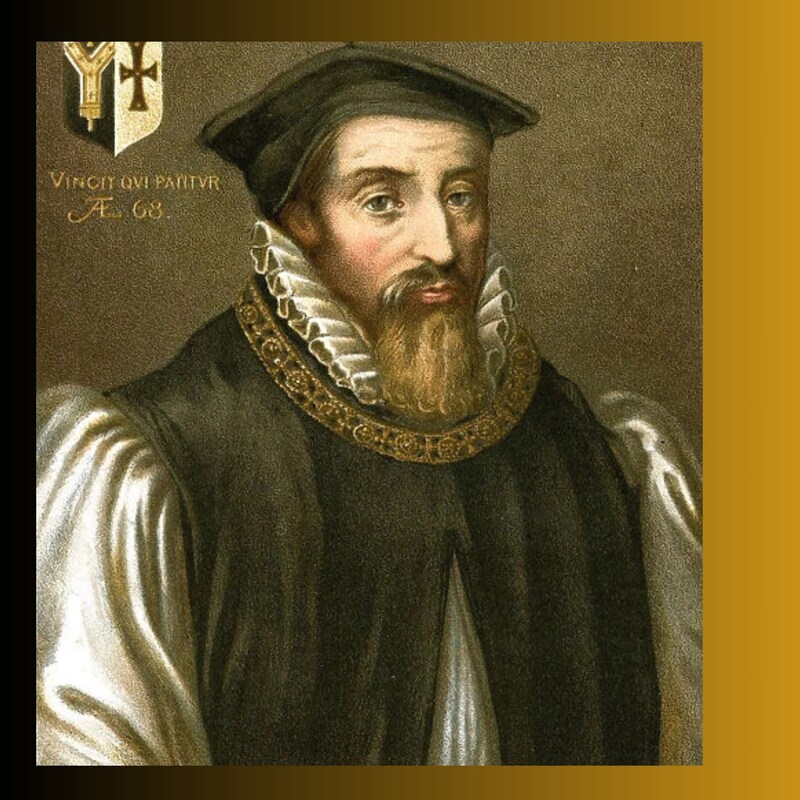
Artwork • John Whitgift, Archbishop of Canterbury, 1602.
John Whitgift (c1530-1604) was Master of Trinity College, Cambridge from 1567-1576. He became Archbishop of Canterbury in 1583. He attended Elizabeth I on her deathbed and crowned James I.
Music (1) • Hela'r Dryw (Hunting the Wren).
An Ancient Welsh folk song, sung by the band Fernhill.
Hunting the Wren’ in Wales usually took place between the 6th of January and the 12th which was Twelfth Night. It was a custom connected with luck-visiting and formed part of the celebrations around the winter solstice.
Music (2) • The Passionate Shepherd to His Love (1599). Read by @thebardscz
A pastoral poem from the English Renaissance (1599). Written by Christopher Marlowe (1485–1603).
Marlowe composed the poem in iambic tetrameter (four feet of one unstressed syllable followed by one stressed syllable) in six stanzas, and each stanza is composed of two rhyming couplets; thus the first line of the poem reads: "Come live with me and be my love".
© 20 26 The Rise of the Protestants., Author, Shaughan Holt.
"All rights reserved. No part of this podcast may be reproduced, translated, distributed, or transmitted in any form or by any means, including photocopying, recording, or other electronic or mechanical methods, without the prior written permission of the copyright holder, except in the case of brief quotations embodied in critical reviews and certain other non-commercial uses permitted by copyright law".
Requests regarding translation, licensing, or republication should be directed to: [email protected]
Your feedback matters, send me an email at [email protected], with any comments, suggestions, or criticisms.I read every message.
Transcripts
© 20 26 The Rise of the Protestants., Author, Shaughan Holt.
"All rights reserved. No part of this podcast may be reproduced, translated, distributed, or transmitted in any form or by any means, including photocopying, recording, or other electronic or mechanical methods, without the prior written permission of the copyright holder, except in the case of brief quotations embodied in critical reviews and certain other non-commercial uses permitted by copyright law".
Requests regarding translation, licensing, or republication should be directed to: [email protected]
Your feedback matters, send me an email at [email protected], with any comments, suggestions, or criticisms. I read every message.
Series 2.
Episode 5.
A Vengeful Archbishop.
The year is 15 93.
Thomas Helwys, travelled to London, and enrolled at Gray's Inn on 29 January 15 93.
Gray's Inn, which still exists today, is one of London's ancient law schools, where barristers qualify for the bar.
Geoffrey, Thomas's uncle and a London-based merchant, chose this institution for his nephew's education.
During this time, universities were overly focused on theology, making them unsuitable for young Thomas.
Situated, on the Westminster side of London, were the Four, Inns, of Court, which primarily catered to the legal profession, but also educated the sons of the nobility and gentry.
Gray's Inn was the largest and most fashionable of these institutions.
It's important to note that Gray's Inn is not a university; it is one of the four Inns of Court, which serve as the professional association for barristers and judges.
Located in central London, the Inn is both a professional body and a provider of office accommodation and chambers for many barristers.
On Sunday, 4 March 15 93, Francis Johnson, and his father and brother George, were arrested for the third time in Islington.
While in custody, Francis continued to serve as the pastor of his exiled congregation from within his Clink Prison.
After graduating from Cambridge, George Johnson had settled in London and found employment as a teacher.
In his court deposition, he was identified as a schoolmaster, from Saint Nicholas Lane London.
His age was recorded as twenty-nine, confirming that he was three years younger than his brother Francis.
On 2 April 15 93, John Nicholas, a Glover believed to be around thirty-six years old, testified that the Separatists used George Johnson's schoolhouse on Nicholas Lane, as their meeting place.
Before Francis joined him, George had already built a solid reputation among the Separatists in London.
His recent release from the Wood Street Prison, allowed Francis to reunite with his brother, further boosting George's standing within the group.
George played a vital leadership role among the Separatists, highlighted by his sermon on 4 March 15 93, during which fifty-six members were captured.
Although Francis had a significant influence, George credited his conversion to the teachings of Stephen Egerton and the divine word of God, choosing not to attribute it to his brother.
Stephen Egerton was born in London around 15 55, and received his education at Peterhouse College Cambridge.
He obtained his M.A. degree in 15 79 while already ordained as a clergyman.
Egerton played a key role in forming the first Presbyterian Church in England, located in Wandsworth.
In 15 84, he was suspended for refusing to support Archbishop John Whitgift's articles.
Additionally, Egerton would later promote- "The Book of Discipline."
During the imprisonment of Barrow and Greenwood in 15 90, the Bishop of London decided to send Egerton to confer with them, highlighting the importance and urgency of the situation.
The prisoners and Egerton exchanging several letters.
Later that year, Egerton's participation took an unexpected turn, when he, along with several other clergy members, was called before the High Commission.
As a result, Egerton was confined in the Fleet Prison, for almost three years.
By 15 98, Egerton had become the minister at St. Anne's Blackfriars in London.
He was important in advocating for church reforms, notably being selected to present the Millenary Petition, to the newly crowned, King James in 16 03.
The following year, he submitted a proposal to the lower house of Convocation, seeking amendments to the prayer-book.
He remained in his position at Blackfriars until his death around 16 21.
Created during the Scottish Reformation, "The Book of Discipline" comprises two significant works from the Church of Scotland.
The first part, written in 15 60, by a committee known as the "Six Johns," including John Knox, proposed a Presbyterian system inspired by Geneva. However, it faced challenges due to a lack of funding, which led to many of its plans being set aside.
In 15 78, the second part was enacted, following the abdication of Mary Queen of Scots.
This version adopted a stronger Presbyterian approach, granting church leadership to elected presbytery groups.
In a separate but related story, George Johnson was arrested in Islington and imprisoned until 15 97.
He had a good relationship with his brother, Francis, until 15 94, but as incidents unfolded in the following years; their bond would eventually fall apart, threatening to split the congregation.
On 22 March 15 93, Whitgift's efforts finally paid off, when the authorities caught Penry at a house owned by Mr. Lowes in Ratcliff.
Anthony Anderson, the vicar of Stepney, had become a target of ridicule from Martin Marprelate.
Wanting revenge, Anderson decided to tell the authorities where Penry was hiding.
Penry was at Lowes' house, meeting with George Knyviton, Edward Grave, and Arthur Bellot.
However, their gathering was interrupted when the authorities showed up, and all four of them were taken to the jail at Poultry Compter.
Poultry, like nearby roads Milk Street and Bread Street, derives its name from the various produce that was once sold in Cheapside, which means "market-place" in Old English.
The magistrates, brought Penry in for a preliminary examination, and it was while he was in prison, that he wrote his "Declaration of Faith and Allegiance".
This document was a statement of his faith in God, and his allegiance to Queen Elizabeth, despite being in conflict with the Archbishop of Canterbury and other authorities.
Penry's declaration was a response to accusations of sedition and heresy, and it served as a plea for justice and a defence of his religious views.
His public examination occurred at the Old Bailey on 5 April 15 93, followed by a cross-examination on 10 April, conducted by Sir Henry Fanshawe, MP, and Richard Young.
Penry's first appearance before the King's Bench was on 21 May, after which he was sent back to prison.
Later, he reached out to William Cecil and even arranged a meeting, but unfortunately, it didn't lead to any positive outcomes.
While Penry was in prison, the authorities sought a reason to impose a more severe capital charge against him.
While searching through his documents, they found a draft petition addressed to Queen Elizabeth.
Although this petition contained strong and offensive language, it was never submitted or made public.
Nevertheless, its discovery was sufficient to charge Penry with sedition.
Four-days later, a new indictment was issued, incorporating additional evidence from excerpts of one of his published works.
This book, widely recognized by its running head titled "Reformation is No Enemy," served as the primary source for this new evidence.
In 15 93, the English Parliament enacted two significant pieces of legislation: the Religion-Act and the Popish-Recusants-Act.
These laws, targeted religious dissenters, particularly those who refused to conform to the Church of England.
Under these acts, non-conformists were given an ultimatum: they had a three-month grace period to either accept the official state religion or face exile.
Those who chose to leave were forced to forfeit all their properties and belongings to the Crown, effectively stripping them of their assets before departure.
The Church of England initially aimed these two policies at non-conforming Roman Catholics.
However, they soon expanded the scope of the acts to include many Puritans.
Although no Puritans were executed under these laws, they remained a constant source of anxiety for the Puritan community.
In 15 93, Henry Barrow and John Greenwood were remanded again to the Clink prison; - this time, awaiting the court's verdict.
On 11 March 15 93, Judges Popham and Anderson had Barrow and Greenwood brought before them, despite Barrow's impassioned plea for a more open hearing where the public could be present.
The church authorities decided to prosecute both men, for the serious capital offence of "writing and disseminating seditious-books".
The courts quickly established the authorship of the books, citing passages which proved that the two accused men had publicly stated that both her majesty and the government were anti-Christian.
All the time, the Lord Treasurer was carefully watching the proceedings and reporting back to Elizabeth.
On 23 March, the court found Greenwood, Barrow and four others guilty, and condemned them all, as felons; however, no date for their execution was set.
On 24 March, Barrow and Greenwood were brought out of their cells and had their iron restraints removed. Just as they were preparing to be bound to a cart, a messenger arrived from the Queen with some surprising news: they had received a last-minute reprieve.
Academic leaders and doctors visited them in prison, attempting to persuade them to retract their statements.
However, their extended imprisonment, and exhaustion from disputes, led them to declare, "Our time was too short in the world".
On 31 March, they were secretly taken out, very early, to the place of their execution.
However, while they awaited their fate with ropes around their necks, a reprieve came, and they were returned to Newgate, amidst the joyful cries of the crowd.
Meanwhile, the bishops aimed to push through a more stringent measure, in the Lower House against Brownists and Barrowists.
Parliament, initially responded with impatience and distrust, nearly rejecting the proposal.
However, on 5 April, the bishops' bill was allowed to pass, albeit significantly reduced.
Cecil, Lord Burghley, irritated with Whitgift, strongly warned him against shedding the blood of those who held the faith professed in England.
With the utmost secrecy, and to spite the Lower House of Parliament, the bishops set out to hasten the execution of the two men.
On the morning of 6 April 15 93, two aged widows carrying shrouds accompanied Barrow and Greenwood to Tyburn, where they were hanged, then drawn and quartered.
That they were both judicially murdered is not in doubt.
After learning of the two men's deaths, Elizabeth asked the educated Dr Reynolds what he thought of Barrow and Greenwood.
He replied, "If they had lived, they would have been God's worthy instruments".
A few days later, whilst out riding, she asked the Earl of Cumberland about their final minutes.
"They made their peace with God", he replied, adding, "And prayed for Your Majesty and England".
The Emmanuel United Reformed Church in Cambridge, a Congregational church, became part of the United Reformed Church in 19 72.
It has had different names throughout history, starting as the Hog Hill Independent Church and later becoming the Emmanuel Congregational Chapel or Church.
The congregation was established in 16 87, as the Cambridge "Great Meeting" at Hog Hill.
The original building was located, where the Old Music School now stands on Downing Place.
Before its reopening, the church underwent reconstruction in the late 18th century and was renamed Emmanuel Congregational Chapel in 17 90.
In 18 74, the congregation moved to its current location on Trumpington Street, and changed its name to Emmanuel Congregational Church.
The current building, designed by James Cubitt, in a Modified Early English style, was constructed in 18 75 and is a Grade II listed structure.
Joseph Hussey, served as the minister from 16 91 onwards, and is honoured in the stained glass of the apse in the current building, alongside the figures of Henry Barrow, John Greenwood, Oliver Cromwell, John Milton, and Francis Holcroft.
As Archbishop of Canterbury, John Whitgift took a strong line against the Brownist movement, and their Underground Church in London, which Henry Barrow and John Greenwood led.
Under his instructions, the Authorities repeatedly raided their services and imprisoned their members, while Whitgift relentlessly interrogated them, through the High Commission and Privy Council.
When William Cecil asked Barrow his opinion of Archbishop Whitgift, he responded:
"He is a monster, a miserable compound; he is neither ecclesiastical nor civil".
Whitgift, played a key role in enacting the Act against Seditious Sectaries in 15 93, which classified Separatist Puritanism as a criminal offence.
He was also largely influential in determining the timing of their executions.
Some Puritans began to follow Robert Browne's lead, and withdrew from the Church of England. While Browne and Barrow shared many opinions, there were notable differences between them.
Both men, believed in the church's right and responsibility to make necessary reforms, without waiting for permission from civil authorities, and both supported the idea of congregational independence.
However, Browne favoured a form of spiritual democracy, viewing separation as a means to an end.
In contrast, Barrow saw the existing church structure as tainted by remnants of Roman Catholic practices, believing that separation was essential, for maintaining pure worship and discipline.
Barrow's views on church governance differed from those of Robert Browne.
While Browne supported a system, where power was shared among the entire congregation, Barrow advocated for a model that concentrated authority, in the hands of just a few elders.
During a difficult period, the Separatists had lost three of their leaders in just two months, with many others imprisoned.
The laws in England offered little hope for the survivors, with the only outcomes being imprisonment followed by banishment.
For those true believers, who wanted to avoid the risk of imprisonment or worse, the only viable option was to go into exile, similar to what the Norwich Separatists had done, eleven years earlier.
Christopher Marlowe, baptised in 15 64, is a prominent figure in English Renaissance literature and is widely recognised as one of its most significant writers.
As a playwright, poet, and translator, Marlowe revolutionised Elizabethan drama with his powerful use of blank verse and larger-than-life protagonists.
His plays, including the groundbreaking "Tamburlaine", set a new standard for theatrical writing and are believed to have significantly influenced William Shakespeare, who was also baptised in 15 64.
Marlowe's literary legacy is marked by innovative language use, and his approach to character development.
He was the first to gain critical acclaim for mastering blank verse--unrhymed iambic pentameter--which became the gold standard for English drama and poetry for centuries.
Marlowe's life was often as dramatic and mysterious as the plays he wrote.
His untimely death at the age of 29 in 15 93, remains shrouded in mystery, with conflicting accounts and theories surrounding it.
Some suggest he died in a bar fight, while others hint at high-level political intrigue.
This aura of mystery, combined with his undeniable talent and influence, has solidified Marlowe's place as one of English literature's most fascinating and enduring figures.
The authorities arrested Marlowe on 20 May 15 93, regarding a manuscript he had written.
Although the specific reason for the warrant was not disclosed, it was believed to be related to allegations of blasphemy.
It was reported that a manuscript, believed to have been written by Christopher Marlowe, contained, "vile heretical conceits."
On 20 May, Marlowe was summoned to court to appear before the Privy Council for questioning.
He was ordered to attend council meetings daily, until he received permission to stop.
Ten days later, Marlowe was fatally stabbed by Ingram Frizer.
It remains unresolved, whether the stabbing was related to his arrest.
John Penry now began to publicly express his view that England had failed to bring about meaningful religious reforms, which the Privy Council interpreted as a criticism of Queen Elizabeth.
As a result, he was charged with publishing seditious and scandalous remarks, likely under the Act of Uniformity.
However, it could also have been under the act against "Seditious Words and Rumours".
Targeted initially at Catholic recusants, this legislation, had led to the execution of Separatists Henry Barrow and John Greenwood, just a month earlier.
On 21 May 15 93, the Queen's Bench charged and convicted Penry under the Uniformity Act.
Although the charge was questionable, a vengeful Archbishop Whitgift, placed his name first on the deathwarrant, marking him as a principal signatory.
Penry, aged 30, was hanged, drawn and quartered at St. Thomas a Watering, on 29 May 15 93, at the unusual hour of 4 p.m.
Tragically, he was denied the opportunity to say goodbye to his wife Eleanor, and their four- daughters; "deliverance", "comfort", "safety", and "sure-hope".
As was customary, his head was displayed on a post as a warning to others.
During the Commonwealth under Oliver Cromwell, Penry was celebrated as a martyr.
In the 16th century, the authorities regularly hanged, religious dissenters and those convicted of treason at St Thomas a Watering.
The bridge at St Thomas, over the River Neckinger was at the junction of the Old Kent and Shorncliffe Roads; it marked the boundary, of the Archbishop of Canterbury's authority, over the areas of Southwark and Walworth.
In 15 50, a charter was ratified, establishing the legal boundaries of the City of London's jurisdiction.
A boundary stone was placed, in the wall of the former fire-station, which later served, as a resting place for pilgrims, on their journey to Canterbury.
In 14 15, at this very spot, Henry V greeted his soldiers, as they returned from the Battle of Agincourt.
St Thomas a Watering, on the principal route up from the southeast to London, became a place of execution for criminals, whose bodies were left hanging from the gibbets.
On 8 July 15 39, Griffith Clerke, the Vicar of Wandsworth, was hanged, drawn, and quartered at this location, along with his chaplain and two others for refusing to acknowledge the Royal Supremacy of King Henry VIII.
Additionally, the Catholic martyrs John Jones and John Rigby were executed here in 15 98 and 16 00, respectively.
John Penry was not officially executed for being Martin Marprelate.
This was because his indictment did not mention the tracts, and no evidence related to them was presented during his trial.
However, many of Penry's contemporaries strongly believed that his involvement with the project, had an unspoken influence on the decision to sentence him.
During his interrogation, William Cecil informed Penry that the ecclesiastical authorities firmly believed he was Martin Marprelate.
Penry, imprisoned then, replied, "If that statement is indeed accurate, then accuse me of this crime and let it be settled."
In 15 93, a comprehensive summary of evidence was compiled for Sir Thomas Egerton, the Attorney General, to interpret the "seditious" writings of Penry during his time in Scotland.
This evidence sought to establish a link between Penry's Scottish works and his alleged involvement in the controversial Marprelate publications.
The hanging of Penry, often referred to as the hanging of Martin Marprelate, would be cited in official correspondence and other writings for many years to come.
The executions of Penry, Barrow, and Greenwood marked the conclusion of Separatist executions on English soil.
Despite the authorities' efforts to suppress the Separatist movement by executing or imprisoning its leaders and devoted followers--including pastors and teachers--the movement was far from defeated.
A new phase in the Separatists' story was about to unfold, as emerging leaders stepped in to fill the void left by their predecessors.
By this time, Richard Bancroft had become the Canon of Westminster Cathedral, and he viewed Brownism, as more than just a religious movement.
Instead, he regarded it as a well-organized and unlawful form of political action, which aimed to bring about social change.
The Seditious Sectaries Act of 15 93, had outlawed the Brownist church, banishing its members from England, under the threat of death.
As a result, many church members from London relocated to Amsterdam; among them were former prisoners who had gained their freedom, while others remained hidden in London.
Although Francis Johnson remained locked in his Clink prison cell, he continued to lead and minister to various Separatist groups, including Henry Ainsworth.
After leaving London, Ainsworth found a job as a bookstore porter in Amsterdam.
The shop owner recognised Ainsworth's knowledge of Hebrew and introduced him to other Hebrew scholars in the city.
Ainsworth had received his education at St. John's College Cambridge, where he specialised in Hebrew.
Born in 15 71 to a farming family in Swanton-Morley, Norfolk, he became an English Nonconformist clergyman and scholar.
William Brewster's son Jonathan, was born on 12 August 15 93, the same year Parliament passed a repressive act against Puritans.
Parliament now prohibited the Separatists from conducting their own religious services.
Those who chose not to attend the established church for forty days, and instead, participated in private meetings, were deemed to be breaking the law.
They could be imprisoned, without bail or release, until they agreed to attend a church service.
In the Parliament summoned in 15 93, the Speaker, Edward Coke, presented the usual petition to the Queen, asking for the liberty of speech, freedom from arrest, and access to Her Majesty.
In response, the Queen informed him that he did have the right to speak, but it was limited to answering "Yea or Nay".
Furthermore, Members of Parliament could access Her Majesty at convenient times, but only when she was free from other important matters concerning the realm.
Considering this a rude and sharp rebuke, Peter Wentworth shocked both Parliament and the Queen, by introducing a bill aimed to settle the succession to the Crown.
As a result, he was promptly taken to the Tower for further proceedings.
The 15 93 Act against Recusants was enacted, and effectively enforced against the Puritans.
Initially, the Church of England had used the Recusancy Law against Roman Catholics who refused to attend its services; however, in practice, it was extended to include other religious groups, such as the Separatists.
Recusant derives from the Latin word "recusare," which means "to refuse".
The year is 15 94.
The drive to create a preaching ministry.
Sir Walter Mildmay, born before 15 23 in Moulsham Essex, was a prominent statesman who served as Chancellor of the Exchequer under Queen Elizabeth the First.
In 15 84, he founded Emmanuel College Cambridge, to advance the training of Puritan ministers.
Mildmay personally selected the highly regarded Puritan preacher and scholar, Laurence Chaderton, to be the college's first principal.
Born near Oldham in Lancashire, Mildmay was a close friend and associate of notable figures, such as Thomas Cartwright, Richard Rogers, Richard Greenham, John Dodd, and William Perkins, all of whom played significant roles in the rise of English Puritanism.
One of the key aspects of the Puritan movement was its insistence on establishing a preaching ministry across the country.
During the Elizabethan Religious Settlement, the authorities issued preaching licenses to fewer than 10% of the 40,000 English parish clergy.
After the repression of the Lollards in the 14th century, ordained parish priests were strictly prohibited from preaching to their congregations, without obtaining a license from their bishops.
John Wycliffe was the leader of the Lollard movement, a proto-Protestant Christian religious movement that was active from the mid-14th century, until the 16th-century English Reformation.
As a Catholic theologian, Wycliffe was dismissed from the University of Oxford in 13 81, due to his criticism of the Catholic Church.
The Lollards, primarily sought to reform Western Christianity, articulating their beliefs in the "Twelve Conclusions of the Lollards," a Middle English religious text written by their leaders.
Queen Elizabeth, preferred church services, centred on the Prayer Book liturgy, rather than sermons, which she often viewed as self-serving.
However, some of her bishops advocated for establishing a preaching ministry, and with the support of wealthy laypeople, they were able to increase the number of qualified preachers across the country.
In 15 94, while still in prison, Francis Johnson married Thomasine, a flamboyant haberdasher and recent widow of Edward Boyes.
Edward Boyes and his wife, Thomasine, had been prominent figures in their community for a long time.
Johnson and Greenwood had previously been arrested while meeting in their house.
Johnson's brother, George, strongly objected to Thomasine's clothing choices and disapproved of the marriage, eventually leading to a breakdown in their relationship.
In 15 94, James Brewster was responsible for appointing curates to the church in Scrooby.
Due to their controversial decision to appoint nonconformist curates, James, his brother William and several other notable members of the Scrooby congregation, were called to appear before the ecclesiastical court.
The year is 15 95.
While studying in London, Thomas Helwys experienced the bustling city's vibrant sights and sounds, all under his Uncle Geoffrey's watchful eye.
At 21, after spending two years in London, Thomas received his inheritance and returned to Broxtowe Hall to manage his estate.
Shortly after his return, on 3 December 15 95, he married Joan Ashmore, a local woman, at St. Martin's Church in Bilborough, Nottinghamshire.
Since their wedding was unconventional, Joan Helwys likely shared her husband's religious beliefs, which led them to bypass several rituals of the Church of England.
This non-traditional ceremony, later provided grounds, for his adversaries to challenge the validity of their marriage.
After their wedding, the couple settled into the life of rural squires, managing their estate.
They had seven children over the next twelve years, living comfortably at Broxtowe Hall.
John Smyth, was born in 15 70 in Sturton le Steeple, a small village in Nottinghamshire with Puritan leanings, and was educated at the grammar school in Gainsborough, located seven miles away.
As a young man, Smyth studied at Christ College Cambridge, and at about the age of 25, he was ordained by William Wickman, Bishop of Lincoln, in 15 94.
Smyth joined Christ's College at sixteen to begin his studies for the Anglican priesthood.
While there, he studied under Francis Johnson, who would later become a separatist pastor.
During his time at university, Smyth was introduced to Separatist ideologies, but he initially chose to remain with the Church of England.
Later, he would join with other Puritan ministers, who were dedicated to reforming the national church from within.
In 15 95, John Smyth was appointed a life fellow at Cambridge.
Although he was already an ordained Anglican priest, by the time he earned his MA, Smyth realised he could not align himself with the prevailing Anglo-Catholic majority within the church.
Like many of his fellow Puritans, he believed the English Reformation needed further progress.
Those who sought to "purify" the church of all unscriptural "papist" traditions became known as Puritans, and several colleges at Cambridge University became hotbeds of Puritan sentiment.
For these dissenters, the Church of England was still considered "too Catholic".
