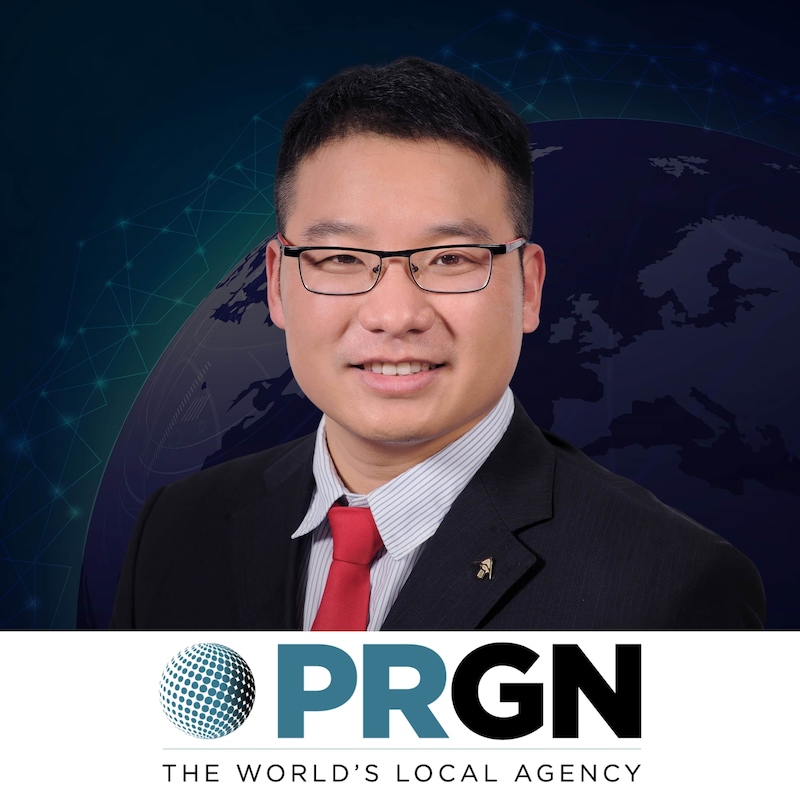
Shownotes
Shawn Jiang discusses the intricacies of doing business in China and the evolving dynamics of public relations in the region. He shares valuable insights into the current landscape of the Chinese market, highlighting recent shifts, government strategies, and the role of communication firms in navigating these changes.
Shawn emphasizes a noticeable shift from rapid growth to a more moderated pace due to global economic pressures. He notes that local Chinese companies are increasingly looking to expand globally, while American firms are becoming more hesitant to make new investments. In contrast, he observes a distinct rise in interest from investors in the Middle East and Europe, reflecting a diversified business landscape that communication agencies must adapt to.
Shawn also discusses China’s Five-Year Plan, a unique strategic framework focused on innovation, high-technology, and a green transition. He explains that navigating this plan is critical for foreign companies looking to enter the Chinese market, advising that they align their business strategies with national priorities to unlock opportunities for growth and support.
About the Guest
Shawn Jiang Xiaofeng is Founder & CEO of China Advocate and Regional Vice President for Asia-Pacific for the Public Relations Global Network (PRGN). With 25 years of experience in public affairs, strategic communication, and marketing across the Asia-Pacific region, Shawn specializes in aligning policy environments, media dynamics, and business goals via targeted strategic communication. As leader of Beijing-based boutique consulting firm China Advocate, he has advised Fortune 500 companies and leading domestic enterprises across advanced manufacturing, tech, healthcare, and Chinese firms pursuing global expansion. Shawn develops policy-aligned communication strategies to build trust with official stakeholders and advance clients’ policy advocacy goals and has provided policy briefings and counseling to C-suite executives. He has managed 20+ crisis incidents and delivered more than 50 training sessions. He is a sought-after public speaker to organizations such as the China International Public Relations Association (CIPAR), the UK Embassy, European Chamber of Commerce in China, American Chambers of Commerce in China, and local Chinese business chambers. Shawn has authored 12 essays and hosted China Watch salons for in-depth public affairs and communications dialogues. He has earned many industry accolades for the agencies including B2B Communications Awards and Gold Standards for Public Affairs Awards. Shawn holds a bachelor’s degree from Wuhan University and an EMBA from China Europe International Business School (CEIBS).
About the Hosts
Abbie Fink is president of HMA Public Relations in Phoenix, Arizona and a founding member of PRGN. Her marketing communications background includes skills in media relations, digital communications, social media strategies, special event management, crisis communications, community relations, issues management, and marketing promotions for both the private and public sectors, including such industries as healthcare, financial services, professional services, government affairs and tribal affairs, as well as not-for-profit organizations.
Dr. Adrian McIntyre is a cultural anthropologist, media personality, speaker, and strategic communications consultant for PR agencies and marketing firms. He's lived in over 30 countries and spent more than a decade in the Middle East and Africa as a researcher, journalist, communications adviser, media spokesperson, and storytelling consultant. He earned a PhD from the University of California, Berkeley, where he was a Fulbright scholar and National Science Foundation fellow. Adrian helps agency leaders strengthen their positioning, sharpen their messaging, boost their visibility, and win new clients by replacing impersonal, intrusive and ineffective marketing tactics with authentic human conversations.
PRGN Presents is brought to you by Public Relations Global Network, the world’s local public relations agency. Our executive producer is Adrian McIntyre. The show is produced by the team at Speed of Story, a B2B communications firm in Phoenix, AZ.
Follow the Podcast
If you enjoyed this episode, please follow PRGN Presents in Spotify, Apple Podcasts, or any other podcast app. We publish new episodes every other Thursday. To have them delivered automatically and free of charge, just choose your preferred podcast player from this list, open the app, and click the button to “Follow” the show: https://prgnpodcast.com/listen
Need to hire a PR firm?
Leading a business effectively in today's fast-paced world requires expert guidance and a strong communications strategy. No matter where you do business, PRGN has a member agency in your region with the deep industry expertise, international experience, and local market knowledge you need to connect with your target audience and achieve your goals. Find a PR firm near you »
Transcripts
From the Public Relations Global Network, this is PRGN Presents. I’m Adrian McIntyre.
Abbie Fink:And I’m Abbie Fink, president of HMA Public Relations in Phoenix, Arizona and a founding member of PRGN. With public relations leaders embedded into the fabric of the communities we serve, clients hire our agencies for the local knowledge, expertise and connections in markets spanning six continents across the world.
Adrian McIntyre:Our guests on this biweekly podcast series are all members of the Public Relations Global Network. They will discuss such topics as workplace culture, creative compensation and succession planning, the importance of sustainability and environmental, social and governance programs, crisis communications, and outside of the box thinking for growing your business.
Abbie Fink:For more information about PRGN and our members, please visit prgn.com. And now let’s meet our guest for this episode.
Shawn Jiang:Hello, everybody. My name is Shawn Jiang Xiaofeng. I'm the founder of China Advocate, a Beijing-based communications firm.
Abbie Fink:Shawn, you know, the first place I'd like to start our conversation today is really having you share a little bit with us about working in China. And you've got 25 years of experience in public affairs and strategic communication and across the region, working with businesses and organizations that are looking to operate in your country. And I'd really like to learn a little bit about, you know, what the business dynamic looks like there and how you have become a leader in this environment, advising clients on a variety of different things, both in and around the China and the APAC region.
Shawn Jiang:Okay, thank you, Abbie. I think over the past several years, as everybody knows, China has experienced a very rapid growth. Right now, as the world economy actually is becoming kind of weak, so is China. We see the growth may not be as fast as before, but we still see the rapid growth, especially coming from local Chinese companies going to global. And also we see where American companies in China not doing so much new investment, but there are investors from Middle East or Europe. So we see the business landscape in China is changing and that actually also affects the business of the agencies. So our client is no longer just American companies, but right now more dynamic and mixed with companies from different parts of the world.
Abbie Fink:Who are all looking to grow in China, to expand their operations throughout the country, come into the country for the first time. Is that kind of the makeup?
Shawn Jiang:I think so. I think most of them are like what you have said.
Abbie Fink:Okay. So one of the messages that we were talking about before we got on into the recording mode was really this, the five-year plan that you are aware of. And, you know, here in the States, we may not necessarily think about that from a government perspective. We think about it in our own businesses. Certainly, we project and put plans together. But this is something that is pretty commonplace in your country. So what are some of the priorities? What are some of the things that are embedded in that five-year plan? And how does that impact enterprise and their intent to do business there in China?
Shawn Jiang:That's a very good question, Abbie. I think just to make one thing very clear, like you said, every company probably makes their own three-year plan or five-year plan, but the country may not do it. But here in China, just treat China as big multinational companies. It does its own three-year or five-year plan. So that is very important for all the strategic setting and also the resources mobilization for the whole country. And right now, at this year, we're entering the first year of the 15th Five-Year Plan. It actually signals a decisive pivot from the previous debt-field growth model to a new model called the Innovation-led High-Technology Industrial Model. To China, this is not just an economic plan. It is actually a national security and also geopolitical strategy in the context of global geopolitical tensions.
Shawn Jiang:I think if we talk about the five-year plan, there are several sectors we have to notice. For example, for the advanced manufacturers, that means technologies for digitalization, automization, and also the green transition of China's massive industrial base. So the government is directing state and private capital here, more to a technology-based and also green model. But in the medical or bio manufacturing, it is something different. Here, actually, the government looks more for their innovation systems, not just the suppliers to its market, which means that for US or even EU pharmaceutical companies through China, it's no longer just sell drugs that you made in the US or in Europe, but you have to do some innovation, R&D or innovation hub here as well. And so I think for multinational companies, the five-year plans just give you a direction about where you should invest and where you should not invest. In which area you will see a huge market opportunity, in which area you probably even receive the government-funded subsidiaries for your financial growth. And clearly, for some multinational companies, Chinese are not that welcome them anymore. If your business model is just to sell product, and this is new value products, there's not much green, not much technology, not much innovation, the government will not see you as the best guest they want to embrace the Chinese market. So I think this is the whole point.
Adrian McIntyre:Shawn, I have a question about that because one of the interesting dynamics, as I understand it, is of course, many countries in the world rely on Chinese imports of all kinds, from basic commodities all the way through to advanced manufacturing, semiconductors, etc. Hopefully, someday even electric vehicles here in the United States will be very welcome, in my personal opinion. And at the same time, within China, there is a very selective approach to allowing multinational companies to have their products enter the Chinese market. Can you speak to this sort of, it's not a paradox, but there's a little bit of a tension there. There's some pressure for domestic substitution. In other words, Chinese people want to buy Chinese products. Why should we buy that laptop when we can get this one? Let me put the question this way. If I'm a multinational company trying to enter the Chinese market, how do I navigate that tension? And how do you think from a Chinese perspective about this openness versus a “buy Chinese” kind of a mindset?
Shawn Jiang:Okay. I think one, that's a very good question, Adrian. I think one signal is very clear. China actually is expanding the sectors to open instead of being more conservative or protectionist. Right now, basically, the list for foreign companies to do business in China is covering everything what we call the open-up list actually is getting bigger than before.
Shawn Jiang:Of course, there are still certain areas that multinational companies cannot fit in. But right now, even the finance business, telecommunications is open for foreigners. So I think the whole point is more about the confidence of multinational companies in China instead of what kind of business they can do or cannot do. I think there are two things we have to consider. The first thing is that the next China is still China. I'm quoting the CEO of McKinsey to say that because the sheer market size is still irreplaceable for any multinational companies. Just to ignore this huge potential. The second one is that we are still here to do business. We are not here to deal with the politics. So if the companies are confident of the potential political pressure from their home country, I think they can do business in China. The third one, I think from the Chinese government side, their message to foreign companies is very strong because right now the Chinese economy is not as strong as before. and we all understand that the Chinese.
Shawn Jiang:China's success in the past 30 years are built upon openness and global trade. So right now, the government actually gives more international companies than before. And I think from the normal Chinese people's point of view, I think the majority of Chinese people does not really care about is this product made in China or is this product a brand from other parts of the world. I think we are quite open for that. I think the competition for multinational companies are actually from Chinese private ones, like my own firm, against Edelman, our industry. We don't receive any subsidiaries. It's pure market competition. I think in most of the sectors, there are not really government behind that. It's purely a market competition between multinational company ones and the Chinese local ones.
Abbie Fink:Well, and that does lead me into the question about the role that a communications firm like yours plays in this. So, first of all, the knowledge and understanding of the priorities of that five-year plan and what's important to the country and how you can advise clients that are making that, trying to get a foothold into the country. So, what does it look like for agencies in your country, and how are you advising? What are those kind of conversations that are taking place with, you know, companies large and small, right? I mean, it doesn't really matter. You know, they still want to be successful and can benefit from having strategic communications. Obviously, your knowledge and expertise comes into play. But, you know, what are those dynamics in those client relationships?
Shawn Jiang:Okay, that's a good one. I think, first of all, the clients or the companies has to under the policy and also the national priority, as I have said. There are certain areas governments want to encourage and grow than other areas. So client has to make sure that their business strategy somehow in alignment with a national strategy. This is number one. Number two, that I think in China, to do your business, it has to be more than your own, which means that, I mean, for example, the U.S. or Europe is more like individualism, but here we are more like collectivism. So you have to be successful, but you also have to prove your value to the industry, to the nation, and to the society. And communication-wise, you have to align your communication theme or narratives
Shawn Jiang:to be the interest of also the nations. That is why many multinational companies, they are taking a narrative of “in China, for China,” which means I'm here, I'm also contributing here. This type of narrative. To go further from there, that if you can prove your value, that you are not only successful by yourself, not only successful to your partners, but you are also advancing Chinese industries, certain industries, to have one step forward. To be even successful to compete with other countries, that actually will be even more companion to the government. So, for example, like AstraZeneca, they put their stories in China for global. They said, we are here, we also help Chinese pharmaceutical industry grow. And the drugs we research, develop, and manufacture in China are supplied for the global market. So these type of narratives are actually very effective for the communications to tell a good story.
Abbie Fink:What platforms are there in your country for this type of communication strategy? We're seeing here in the States the shrinking newsroom, multi-brand names under one parent company. So there's a lot of editorial challenges, if you will, in terms of what the content looks like and what is coming out of the different newsrooms and such. And it's something that those of us that deal in media relations, traditional earned media, are really challenged with, because we don't have as many things to at our disposal and we're looking at a variety of different ways to be able to continue to communicate. So what is the market there in terms of media outlets, media platforms, the role of social and digital? How is that incorporated into the work that you're doing?
Shawn Jiang:I think the Chinese media are facing similar yet different challenge or situation like the one in the U.S. I think the similarity is that everybody's facing the financial difficulties, becoming more like advertorial advertisement and then there's pitching and original contents. And there's so much and so many social media platforms to compete for attention and budget. So I think this is similar. And I think the difference that the media and the social media platform are all different in China. You have Instagram, we don't have that. You have Facebook, we have WeChat, we have Douyin. And we have Zhihu, you have Quora. So this is all different. But I think the fundamental difference is that in China, we have something called a state media, or national mainstream media, which you don't have. It's kind of like Wall Street Journal or New York Times, but it's more recognized by everybody for their credibility, and also has a government behind that.
Shawn Jiang:So the so-called state media actually play a dominant role in China to affect everything, including business communications. So one advice we always give to our clients that to build up a very good relationship with the top state media, that is good for your reputation, that is good to protect you from potential crisis, and that is also good to endorse you in front of your customers. So this the number one advice we give to them about media communications. Number two is that if you are successful on that, you can expand on your social media, like your own WeChat platforms. That is what you call owned media. So most clients do their own media by themselves right now these days. And where we see social media has experienced a fast growth in the past 15 years, or in the very recent years, we see their room in China actually getting smaller. The state media actually even dominate in the social media platforms. Just to give you an example, on Douyin, or the Chinese version of TikTok, the number one, number two, number three social media account is most likely CCTV News or Xinhua news agency.
Shawn Jiang:Very interesting. It's not some sports or movie celebrities. It's Chinese traditional media on a social platform. So this is one very funny fact. Having said that, I don't think that a multinational company should be very sensitive about the party or the government, that they are doing something that could be potential sensitive to companies. It's not. I mean, for most of the business, I don't think they're big enough for the government actually to spend their attention or energy on this type of stuff. The Chinese media is like, I don’t know, there are certain boundaries you cannot touch, but beyond that it’s a free competition.
Shawn Jiang:What are the certain boundaries you cannot touch? One China policy, South China Sea, China or Chinese mainland and Taiwan issues, Xinjiang or Tibet human rights issues. These are the certain red line principles that we advise businesses certainly not to touch or close. But other than that, it's a free market.
Shawn Jiang:And think, we have over the years, yeah, over the years, we have seen multinational companies saying something inappropriate in their home countries. But actually, that will cause them a big trouble back in the Chinese market. So we have to stay away from the geopolitical sensitive issues. And beyond that, we're fine.
Adrian McIntyre:Just to clarify there, you're saying that these red line issues are not just within the boundaries of Chinese media, but they affect communications happening anywhere in the world. So if a company takes a position on one of these issues that is not aligned with the government view, that could cause them a problem in their relation with China. That makes sense. I just want to clarify that's what you're saying.
Shawn Jiang:Yeah. Just to give you one example, I think a couple of years ago, Siemens, the previous CEO commented about Xinjiang on labor human rights issues in Germany. I think that is probably something like a political correctness in German, but when that news actually spread over to China, that caused a lot of tensions between the Chinese media, the Chinese government, and the company itself. So the CEO eventually actually stand out and apologize. So this is something we are talking about.
Abbie Fink:Well, and that comes, I think, with trust and transparency and authentic communication, which is kind of a global platform. I think I don't believe that's unique to any one of us. But there's different dynamics at play here in terms of how companies and enterprises need to not only build trust with their buying audience, but really with the Chinese authorities and understanding policy and such. It's more than just, you know, understanding the narrative, but really how to gain that trust. So, you know, what are some of that strategy that you're employing with your clients in terms of being able to truly understand the impact of that trust component when you're talking about effective communications, localized communications in the market?
Shawn Jiang:This is a tough question. We are trying very hard to help our clients to do that, and it will take time. I think the trust probably is threefold. The first one is the trust towards the government, which is very important. And by talking about the trust towards government, I think it's more like prove it, the contribution you have brought to the country, the revenue, the tax, the employment, the ability to empower your local suppliers. So by doing that, we actually create like a government—not create, more like contribute or participate—in government-business dialogues or platforms. For example, in China, there are like a China Development Forum or our forum. If the mayor of Beijing and Shanghai, they have their own mayor council for multinational company CEOs to become their advisors for the city to develop. So we help the client to do the research and develop white papers and submit these white papers to the government as a thought piece to advise how they should develop industry A, how they should grow industry B. So the government actually put a lot of attention to these white papers and they trust these multinational companies as an advisor.
Shawn Jiang:So this is number one. I think the number two is that the communications towards the media, to build the trust with the media, it relies on content, which as you guys done in the U.S. Market for sure, but it also relies on connections or "guanxi" in the Chinese way. So you have to meet these people, talk to these reporters, and help them to do their reporting work better and easier. So we do that as well. So for example, in China, some of the companies actually do like small gatherings purely for social networking or during the Christmas day in the U.S. or Chinese New Year, we do very small gifts. This gift is not corruption or bribery, it's just a goodwill and build up connections. So this is something we do in China.
Shawn Jiang:I can say the third one is about trust towards the general public or the society. I think to do that, you can use your social media very well. For example, for one of our clients in the medical equipment, we are shooting a documentary about how their technology actually helps a normal Chinese family to live a better life. So we took state media, People's Daily, to come to the hospital for three or five days, just a documentary, all everything from the very beginning to the very end. It's a before and after contrast. I think this kind of stories of ordinary people can also help to convey this kind of trust.
Shawn Jiang:Oh, just to add one last point, sorry. Just add one last point. In general, the trust parameter, the trust level of China towards the government and the media I think is higher than the Western countries. I think probably this is more like a tradition or cultural thing.
Abbie Fink:Great. I think the measurement tools that we have, and some of the research that's been out lately, continues to talk about the trust being such an important thing, building trust with stakeholders and such, and how we are still being challenged here in the States on where our trust is and where it should be and our lack of trust in certain institutions. And the government is certainly one of them. But, you know, from a communications perspective and I think from, you know, the knowledge that we bring to our clients, that's one of these things, and you've spoken about it so eloquently in this conversation, is that our role with the organizations that we represent is to be a trusted advisor. This is what our responsibility to our clients is, to help them navigate the market wherever that happens to be, to understand what it means to operate a business in, and how we bring that knowledge and expertise, not only about their business in particular, but about how to do it within, you know, the organizational structure, the Five-Year Plan, or, you know, the media market, whatever it might be. And so thinking about that in terms of, you know, how that universal component of trust, I think, is we could be having this conversation with virtually anyone that trust is such an important part. And you've spent, you know, certainly parts of your career has been in maybe where trust has been compromised a bit in a crisis communications and other things. And so, thinking about that, what are some of the maybe final kind of thoughts you have regarding, you know, that establishing trust with your stakeholders, with your community, with the government, and as you are thinking about potentially doing business in the country, whether you are looking at breaking in or you've been established business, what are some of the things and potential pitfalls that organizations need to be thinking about?
Shawn Jiang:I think probably like every other part of the world for build a reputation and also prevent from a crisis, there is a so-called "attack and defense" system. Attack means that you have to build up your reputation and your brand very aggressively or very proactively. And defense means you have to have the crisis SOPs, scenario planning, statement, and spokesperson ready once the crisis happens. I think that goes without saying. I think particularly for one thing about multinational companies right now in China, for them to succeed, I personally do not think the biggest trust issue is with the Chinese government or Chinese media. Or I think the trust issue is more like internal. What does that mean? First of all, the trust between the Chinese headquarters or Chinese local management with their overseas-based headquarters. That how the U.S. or Europe-based headquarters trust the local Chinese management of making business decisions, trust the future of the market size or also the market space. And are they still willing to spend money and time and energy to invest in the Chinese market as they have done before? Actually, from our observations, especially U.S.-based multinational companies, they are very hesitant in this front. So for Chinese management to get endorsement from the headquarters is becoming more and more difficult. So in the past two years, we actually as an agency have helped some clients to do briefings, China briefings, quarterly meetings with their global headquarters, just to brief what's going on in China and help them to align, understand and also make alignment.
Shawn Jiang:So I think this is number one. Number two is that the consequence of such mistrust between headquarters and local actually makes the local employees feel unsafe. Their job security, their confidence over the company, their confidence over their own career future, actually think are kind of like in jeopardy. So they are worrying about themselves. You can understand that in that situation, this is not very high morale. So even people are worrying about their own job. I can give you some examples. We are a member of American Chamber of Commerce in China. This year, I personally have been invited to give talks to AmCham members for a couple of times. And sometimes I observe the dynamics of the meeting rooms of the people. It's not high spirit, let's put it in this way.
Shawn Jiang:So if the world economy is in a weak situation and your local employees are not in a high morale, I think we are going to have trouble. So we would advise that while we look at the outside for challenges and opportunities, let's do our own housekeeping and unite our own team together and make them confident about the future. That makes everybody fully aligned and trying to make the best efforts to achieve the business goal.
Adrian McIntyre:Thanks for listening to this episode of PRGN Presents, brought to you by the Public Relations Global Network.
Abbie Fink:Episodes are also available on our website, along with more information about PRGN and our members, at prgn.com.





