Shownotes
Automotive manufacturing leaders have no shortage of data, but only those who turn it into action are winning, and AI is the accelerator.
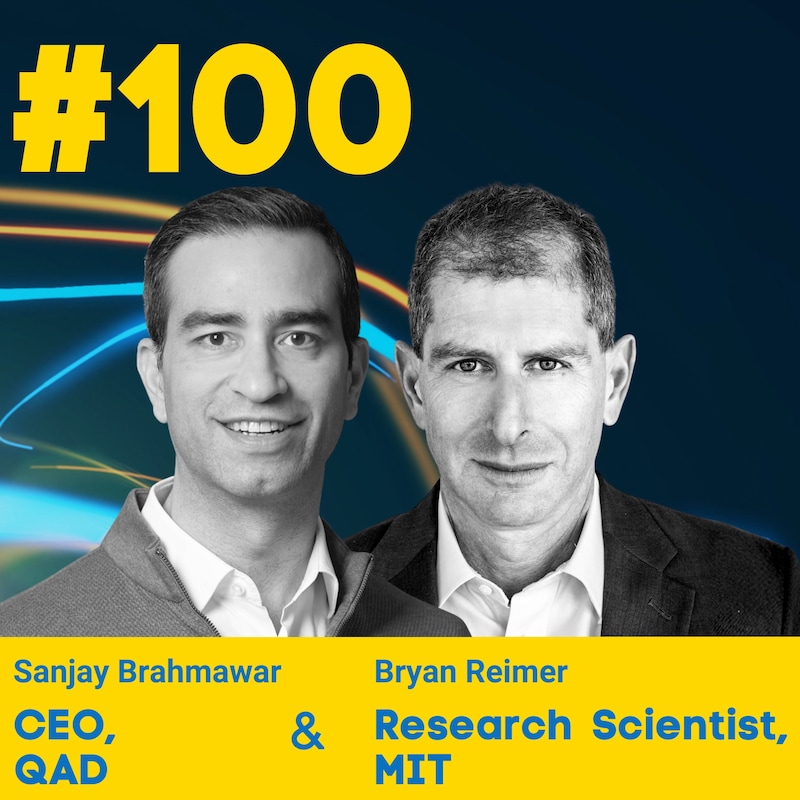
In this milestone episode, Jan Griffiths is joined by Sanjay Brahmawar, CEO of QAD, and Dr. Bryan Reimer, MIT Research Scientist and author of How to Make AI Useful, for a grounded conversation about how AI is creating real advantage in automotive manufacturing.
The challenge facing automotive manufacturing leaders is not visibility. Leaders know where problems exist. The issue is that action often stalls between insight and execution. Dashboards explain what happened. They do not decide what happens next.
Sanjay and Bryan draw a clear distinction between systems of record and systems of action. Systems of record observe. Systems of action decide, execute, and learn. Agentic AI belongs in the second category. It creates value when it removes friction from work, accelerates routine decisions, and gives people better context at the moment action is required.
Frontline teams in automotive manufacturing do not resist AI. They adopt it when it respects their expertise and helps them do their jobs better. Adoption follows usefulness, not mandates. When AI amplifies human judgment instead of supervising it, execution speed improves and results follow.
This episode challenges automotive manufacturing leaders to stop treating AI as a reporting layer and start using it as an execution engine. The organizations pulling ahead are not waiting for perfect conditions. They are starting small, learning fast, and letting action build confidence.
Themes Discussed in this episode:
- Why data visibility alone does not drive performance in automotive manufacturing
- Systems of record vs systems of action
- How AI removes friction from automotive manufacturing operations
- Frontline-first AI adoption in plants
- Agentic AI as an execution multiplier
- Leadership ownership of decisions
- Building momentum with 60 to 90-day wins
Featured Guests:
Name: Sanjay Brahmawar
Title: CEO of QAD
About: Sanjay Brahmawar is the CEO of QAD, a cloud software company delivering cloud-based solutions for manufacturers and global supply chains. With more than two decades of experience leading global technology businesses, he brings deep expertise in digital transformation, AI, IoT, and data-driven platforms, built through senior leadership roles at IBM and Software AG.
Connect: LinkedIn
Name: Dr. Bryan Reimer
About: Dr. Bryan Reimer is a Research Scientist at the MIT Center for Transportation & Logistics and a key member of the MIT AgeLab. He is also the author of How to Make AI Useful: Moving beyond the hype to real progress in business, society and life. His work focuses on how drivers behave in an increasingly automated world, using a combination of psychology, big data, and real-world testing to study attention, distraction, and human interaction with vehicle technology. He leads three major academic-industry consortia that are developing new tools to measure driver attention, evaluate how people use advanced driving systems, and improve in-vehicle information design, thereby guiding automakers and policymakers toward safer, human-centered mobility solutions.
Connect: LinkedIn
About Your Host – Jan Griffiths
Jan Griffiths is the host and producer of the Auto Supply Chain Prophets podcast and The Automotive Leaders Podcast, and is recognized as the Champion for Culture Change in the automotive industry. A former automotive manufacturing and supply chain executive, Jan focuses on leadership, culture, and execution, bringing practical, real-world conversations to the forefront of industry change.
Mentioned in this episode:
- QAD Champion AI
- How to Make AI Useful: Moving beyond the hype to real progress in business, society, and life
Episode Highlights:
[03:16] Data Isn’t Enough: Automotive manufacturers often have abundant data, but without ownership, trust, and decisive follow-through, insights fail to drive real results.
[06:28] Trust Through Action: Leaders in manufacturing must embrace experimentation and small steps, because confidence in AI and new systems grows only when action precedes certainty.
[10:53] 90-Day Mindset: Transformative leadership in manufacturing means challenging norms, leveraging AI, and rallying teams to achieve ambitious goals in record time.
[15:20] Sandbox Leadership: Automotive leaders stall by overthinking and seeking perfect solutions, while real progress comes from small experiments, empowering teams, and proving concepts before scaling.
[19:53] Manufacturing Love: Sanjay’s passion comes from his shop floor roots and belief that AI and modern tools can empower people, attract talent, and transform the future of manufacturing.
[22:20] Process Passion: Bryan’s focus is optimizing workflows, amplifying teams with AI, and shifting the narrative from fear to the positive impact of technology in manufacturing.
[24:46] Start Small, Win Big: Leaders can kick off AI adoption with role-based agents, targeted problem-solving, and rapid implementation to achieve meaningful 60–90 day wins.
[28:06] Empower to Optimize: True AI adoption starts by giving teams low-risk space to experiment, share insights, and amplify their work while leadership fosters trust and transparency.
Top Quotes:
[03:42] Sanjay: “Manufacturers are very good at dashboards. But dashboards they explain yesterday. They don't decide what happens next. And when no one owns the next move, any kind of insight just sits there and it will just wait. That’s the core difference between a system of record, where you store and you record and you have data to a system of action. While the system of record observes; a system of action actually decides, executes and learns.”
[16:11] Sanjay: “Champion AI doesn't supervise the operators, it amplifies them. Gives them early signals, better context. Allows them to execute faster. People trust automation when it respects their expertise.
[16:31] Sanjay: “Adoption always follows usefulness, not mandates. You tell somebody you have to use AI; that's not the way it's gonna work. You've gotta create and show them the usefulness. And I think then it's not a change management problem.”
[23:43] Dr. Reimer: “We are going to blame a lot of layoffs on AI, and that is gonna drive more fear into the market. And I think that's something that we need to move away from. We need to look at the power of AI to amplify, and we need to be honest with ourselves when we need to do workforce reductions. It's not because of AI most of the time. It's really because of other processes or other business outcomes that we need to be more transparent with.”
[31:27] Sanjay: “I firmly believe Agentic AI and AI is not about replacing people. It's actually about augmenting, empowering. It's about elevating the human judgment when it matters the most. I think there's so much potential here.”
Follow the Auto Supply Chain Prophets Podcast for more real discussions with leaders who are moving from insight to action and learning by doing.
And if you want to see how these ideas are being applied in manufacturing today, explore how QAD is helping teams remove friction, accelerate decisions, and turn AI into an execution advantage.
🎧 Follow the podcast: https://autosupplychainprophets.com/
🔗 Learn more about QAD: https://www.qad.com/
Transcripts
This is the Auto Supply Chain Prophets Podcast.
Jan Griffiths:We're on a mission to bring you the latest insights and thought leaders leading the
Jan Griffiths:charge on supply chain transformation in our beloved automotive industry.
Jan Griffiths:This podcast is powered by QAD RedZone.
Jan Griffiths:I'm Jan Griffiths, your host and producer.
Jan Griffiths:Let's dive in.
Jan Griffiths:Hello and welcome to the 100th episode of the Auto Supply Chain Prophets Podcast,
Jan Griffiths:and we are marking this episode — this milestone episode with a conversation
Jan Griffiths:that matters right here, right now.
Jan Griffiths:We are gonna be talking about why AI Is not just the
Jan Griffiths:future — we know it's the future.
Jan Griffiths:It is the difference between the winners and the laggards.
Jan Griffiths:The people that understand agentic AI, that understand how to implement AI
Jan Griffiths:and bring it into their lives, into their institutions will be the winners.
Jan Griffiths:The big question is how?
Jan Griffiths:How do we do this?
Jan Griffiths:Well, joining us for the conversation today, I couldn't think of two
Jan Griffiths:better guests to have on the show.
Jan Griffiths:First and foremost, we have Sanjay Brahmawar, CEO of QAD.
Jan Griffiths:He is the foremost thinker of technology in the manufacturing space today.
Jan Griffiths:Sanjay, welcome to the show.
Sanjay Brahmawar:Thank you, Jan. Thank you so much for having me.
Sanjay Brahmawar:I appreciate it.
Sanjay Brahmawar:And also would say congratulations on the hundredth episode of
Sanjay Brahmawar:Auto Supply Chain Prophets.
Sanjay Brahmawar:I guess this is a major milestone and you know, also a good sign
Sanjay Brahmawar:that these kind of conversations really matter in the real economy.
Sanjay Brahmawar:They're not just theory.
Sanjay Brahmawar:So look, I'm excited about being here.
Sanjay Brahmawar:Excited about talking to Bryan.
Sanjay Brahmawar:And, particularly Bryan, especially your work through AVT has
Sanjay Brahmawar:consistently shown the progress.
Sanjay Brahmawar:And I completely agree with this doesn't come from perfect
Sanjay Brahmawar:technology and perfect conditions.
Sanjay Brahmawar:It comes from systems that operate in kind of like a messy and real world
Sanjay Brahmawar:environments and with humans in the loop.
Sanjay Brahmawar:So, very excited about this conversation, Jan.
Jan Griffiths:Yes.
Jan Griffiths:And I know Sanjay, you're a big data person.
Jan Griffiths:Do you know a piece of data that only 7% of podcasts
Jan Griffiths:actually meet the 100th episode?
Jan Griffiths:Actually reach that?
Sanjay Brahmawar:Awesome.
Sanjay Brahmawar:Congratulations again.
Jan Griffiths:Yeah.
Jan Griffiths:And joining us on the mic is Dr. Bryan Reimer, research scientist at
Jan Griffiths:MIT and author of the newly released book, How to Make AI Useful: Moving
Jan Griffiths:Beyond the Hype to Real Progress in Business, Society, and Life.
Jan Griffiths:And that it is.
Jan Griffiths:Bryan, welcome to the show.
Bryan Reimer:Jan, Thanks for having me.
Bryan Reimer:Hundredth episode is a heck of an accomplishment.
Bryan Reimer:And Sanjay really excited to be here with you and learn a little bit about
Bryan Reimer:your rich history in manufacturing.
Bryan Reimer:As you mentioned, I come from a manufacturing engineering background.
Bryan Reimer:So I spent a lot of time studying that and really do see, as you mentioned,
Bryan Reimer:this messy space of where man meets machine being the future to optimize
Bryan Reimer:AI and really technology's evolution in supporting manufacturing automation
Bryan Reimer:in lots of different aspects of life.
Jan Griffiths:Let's dive right into it.
Jan Griffiths:We've said that manufacturers don't lack data, they lack action.
Jan Griffiths:This ability to take action.
Jan Griffiths:Why is that?
Jan Griffiths:Sanjay, you first, tell us.
Sanjay Brahmawar:Great question, Jan. Look, action, I think breaks
Sanjay Brahmawar:down the moment insight requires a certain amount of ownership.
Sanjay Brahmawar:When I talk to many manufacturers and C-level execs, I think manufacturers
Sanjay Brahmawar:are very good at dashboards.
Sanjay Brahmawar:But dashboards they explain yesterday.
Sanjay Brahmawar:They don't decide what happens next.
Sanjay Brahmawar:And when no one owns the next move, any kind of insight just sits
Sanjay Brahmawar:there and it will just — just wait.
Sanjay Brahmawar:So that is actually, I think the core difference between a system of record,
Sanjay Brahmawar:where you store and you record and you have data to a system of action.
Sanjay Brahmawar:While the system of record observes; a system of action actually
Sanjay Brahmawar:decides, executes and learns.
Sanjay Brahmawar:So, I think if you bring it down to the industry in automotive.
Sanjay Brahmawar:And I've seen that, your research shows this clearly.
Sanjay Brahmawar:Knowing something is wrong and not acting on it is not neutral, but at
Sanjay Brahmawar:some point, insight without action is kind of worse than ignorance.
Sanjay Brahmawar:So that's where I think AI gets frustrating.
Sanjay Brahmawar:And I would say frankly, irresponsible if it isn't empowered to move the system in.
Bryan Reimer:Sanjay, that's some great words.
Bryan Reimer:I think that a lot of the processes in which we want to automate, which
Bryan Reimer:we wanna leverage are just too unknown to make good, strong decisions.
Bryan Reimer:So I think that we are looking right now to the lure of AI to conduct that data
Bryan Reimer:action step, that is still a step that human expertise needs to sign off on.
Bryan Reimer:So if we are not willing to make that step and sign off on the data alone that's
Bryan Reimer:largely distilled by teams and engineers at this point, and we believe that just
Bryan Reimer:because an AI algorithm programmed by a different team and a different set
Bryan Reimer:of engineers is gonna produce an action or suggested action, you know, follow
Bryan Reimer:through is not necessarily gonna be there.
Bryan Reimer:I think the big piece really comes down to trust.
Bryan Reimer:We don't have trust in others enough.
Bryan Reimer:We often don't trust our teams as well as we should.
Bryan Reimer:Way too much micromanagement out there and poor leadership.
Bryan Reimer:We don't go down to our teams and say, they're recommending
Bryan Reimer:something, with a high success rate.
Bryan Reimer:If they're recommending it to me, it's probably something I
Bryan Reimer:should be taking under advisement.
Bryan Reimer:Okay, I'm gonna automate a bunch of the actions of my team with
Bryan Reimer:AI and lots of other agents.
Bryan Reimer:And all of a sudden I'm gonna believe it more.
Bryan Reimer:And I think the decision logic will collapse because the trust isn't gonna
Bryan Reimer:be there in the AI to be any better.
Bryan Reimer:So our belief that this investment will work, probably erode and
Bryan Reimer:manufacturing is so special because the margins are so small.
Bryan Reimer:Automotive manufacturing in particular is such an interesting case study because
Bryan Reimer:we often look at giants like Ford, GM for the vehicles they produce and the
Bryan Reimer:beautiful designs we see on the road.
Bryan Reimer:But the art of these manufacturers is less than the design.
Bryan Reimer:It's in the ability to mass produce these complex systems at low margin.
Bryan Reimer:And that's truly where companies like GM, Toyota, Honda, and
Bryan Reimer:the likes really do excel.
Jan Griffiths:Is it Sanjay?
Jan Griffiths:Is it in the leadership?
Jan Griffiths:Is it trust?
Jan Griffiths:Is that a huge part of it?
Sanjay Brahmawar:I think Bryan's got a really good point here.
Sanjay Brahmawar:I think leaders in manufacturing are still asking AI to prove
Sanjay Brahmawar:itself before they trust.
Sanjay Brahmawar:And they continue to just, trust human only decisions that are, I guess, in some
Sanjay Brahmawar:ways demonstrably flawed, under pressured.
Sanjay Brahmawar:So they weren't certainly upfront in the environments where there is
Sanjay Brahmawar:some sort of inherent uncertainty.
Sanjay Brahmawar:I don't think the real bottleneck is algorithms.
Sanjay Brahmawar:It's basically the institutional mindset.
Sanjay Brahmawar:It's that fear of being wrong, the approval layers somewhat
Sanjay Brahmawar:of belief that learning must be complete before action starts.
Sanjay Brahmawar:So you know, in manufacturing that will show up as delays, manual
Sanjay Brahmawar:overrides, missed learning cycles.
Sanjay Brahmawar:And I think, leaders who win to accept a hard truth: confidence
Sanjay Brahmawar:doesn't come before action.
Sanjay Brahmawar:It comes from action.
Sanjay Brahmawar:I think that's really important.
Sanjay Brahmawar:So I think that's what it is.
Sanjay Brahmawar:And, yeah, absolutely, leadership is so crucial in this transition to be
Sanjay Brahmawar:able to leverage this technology in it.
Bryan Reimer:Sanjay, that's a really great point because I think that as we
Bryan Reimer:look at the transformative change in new technology, AI, in the ability for new
Bryan Reimer:data systems to support manufacturing.
Bryan Reimer:We really look to an environment where we need to unlearn
Bryan Reimer:as much as we really learn.
Bryan Reimer:We gotta get rid of some of the handcuffs of history to move forward,
Bryan Reimer:stay flexible, use the data in new and innovative ways, and really
Bryan Reimer:cultivate that man machine interaction.
Bryan Reimer:Look, the machine can interpret and manage data in ways that
Bryan Reimer:man could never have dreamed of.
Bryan Reimer:But at the end of the day, the foundation of garbage in
Bryan Reimer:to garbage out still applies.
Bryan Reimer:And human-based decision making is really critical to building trust
Bryan Reimer:in what comes out of the machine.
Bryan Reimer:Well that's simple statistics and regression, or that's complex neural
Bryan Reimer:networks, the same really applies.
Bryan Reimer:So, I think we need to really begin to reward those who begin to
Bryan Reimer:actionize decisions in many senses, starting small, piloting narrow
Bryan Reimer:and then accelerating from there.
Bryan Reimer:Does this seem to be working?
Bryan Reimer:Great.
Bryan Reimer:Let's dive in with two feet
Jan Griffiths:now.
Bryan Reimer:We got to trust a little bit.
Bryan Reimer:We gotta try a little bit before we're actually gonna succeed
Bryan Reimer:in actually finding the system optimizations that we're looking for.
Jan Griffiths:It reminds me a lot of the days of business process outsourcing.
Jan Griffiths:Remember that?
Jan Griffiths:Back in the nineties where it was a race to get your business process,
Jan Griffiths:define it, and then throw it over the wall to a low cost country?
Jan Griffiths:And what happened?
Jan Griffiths:Many companies failed because they failed to do the work.
Jan Griffiths:The basic foundational work of mapping the process and understanding
Jan Griffiths:the decision making loops and how all that needed to work, and then
Jan Griffiths:streamlining it and then putting it out to another low-cost country.
Jan Griffiths:I think the same is true for AI.
Jan Griffiths:You better understand your processes and how decisions
Jan Griffiths:are made before you apply AI.
Jan Griffiths:Is that a good analogy?
Bryan Reimer:It is really a good analogy, Jan. And I think that's why
Bryan Reimer:in many senses a lot of the Chinese manufacturers are succeeding is because
Bryan Reimer:they are making authoritarian decisions based upon good data, not perfect data.
Bryan Reimer:And they're actualizing them, and they're moving forward here in the
Bryan Reimer:United States, and to some degree in Europe, maybe not quite as bad as
Bryan Reimer:Europe as it is here in the States.
Bryan Reimer:Decision paralysis is the name of the game.
Bryan Reimer:We can't make a decision, and that is costing us critical in
Bryan Reimer:markets of accelerated change.
Sanjay Brahmawar:I fully agree.
Sanjay Brahmawar:I think, you have to change the ways of working.
Sanjay Brahmawar:You're right, Jan. It's not about just throwing the process across.
Sanjay Brahmawar:It's actually, fundamentally the way you do things becomes different.
Sanjay Brahmawar:And that requires a different mindset.
Sanjay Brahmawar:It requires an ability to think.
Sanjay Brahmawar:How things will be different, and then go and act upon that.
Sanjay Brahmawar:Manufacturing needs to think a little bit around what we
Sanjay Brahmawar:call in software industry, MVP.
Sanjay Brahmawar:It's like a Minimum Viable Product.
Sanjay Brahmawar:Now, you would never manufacture a product and like send it
Sanjay Brahmawar:out 90% working or something.
Sanjay Brahmawar:But, as you're starting to use new things and new ways of
Sanjay Brahmawar:working, one has to iterate.
Sanjay Brahmawar:You cannot wait for perfection and it'll be too late.
Sanjay Brahmawar:People would've gone, you would've lost the competitive
Sanjay Brahmawar:edge and the moment is gone.
Sanjay Brahmawar:So it's important to start.
Sanjay Brahmawar:Start small, start experimenting, allow the teams build that different
Sanjay Brahmawar:mindset and then, go and act up on it.
Jan Griffiths:When you talk about mindset, it's something
Jan Griffiths:that struck me about you, Sanjay.
Jan Griffiths:Many months ago we did an interview at an event, at a user group event.
Jan Griffiths:And you had, I think, just come out with launching an ERP in 90 days.
Jan Griffiths:Is that correct?
Jan Griffiths:90 days.
Sanjay Brahmawar:Yes, indeed.
Jan Griffiths:And at the time, you know, I've been in this a long time.
Jan Griffiths:I've been in manufacturing automotive a long time.
Jan Griffiths:And I looked at you and I'm thinking, "Is this guy nuts?" But that's exactly
Jan Griffiths:the kind of thinking that we need.
Jan Griffiths:We need people — leaders to challenge the norm to say, you know what?
Jan Griffiths:This is happening.
Jan Griffiths:We're doing it.
Jan Griffiths:We're doing it.
Jan Griffiths:And then you rally a whole team around a mission like that, and guess what?
Jan Griffiths:It happens.
Jan Griffiths:And I believe it's happening.
Jan Griffiths:Is that right?
Sanjay Brahmawar:Yes.
Sanjay Brahmawar:You know, Jan, that's the whole point.
Sanjay Brahmawar:We said, look, we can either bury our heads in the sand and just say, "Oh,
Sanjay Brahmawar:you know, nothing's gonna happen." Or we can leverage AI and actually
Sanjay Brahmawar:take it to the advantage of our mid manufacturers and our clients.
Sanjay Brahmawar:And so what we've done is we've build Champion Pace, which is effectively
Sanjay Brahmawar:working backwards and saying, "Hey, gone are the days where it used to
Sanjay Brahmawar:take two years or 18 months to deploy an ERP. No, mid-market manufacturers
Sanjay Brahmawar:got 18 months to 24 months to wait." So what if we change that to 90 days?
Sanjay Brahmawar:90 days is the benchmark.
Sanjay Brahmawar:And so let's work backwards and say, "How can AI help us to do things
Sanjay Brahmawar:like data migration, configuration, custom extensions, all of that much
Sanjay Brahmawar:faster?" And the reality is that the technology exists to be able to do that.
Sanjay Brahmawar:And I can tell you we've done exactly that and you can see that we just announced
Sanjay Brahmawar:together with our client tentacle.
Sanjay Brahmawar:They went live last week.
Sanjay Brahmawar:And, we can show that these things can be done in 90 days soon.
Bryan Reimer:Sanjay, what I love about that is you're starting with the problem
Bryan Reimer:and saying, "Here is the problem we need to solve." Okay, what tools are out there?
Bryan Reimer:And AI is a tool that can help with lots of problems.
Bryan Reimer:But too often we are looking with this enormous technology that we dream
Bryan Reimer:of in Jetsons, like science fiction, is a solution looking for a problem.
Bryan Reimer:And leadership today, needs to make some strategic decisions on where do we invest,
Bryan Reimer:which means that we have to downplay some priorities to make those investments work.
Bryan Reimer:And, things that draw out and take 18 months or two years to occur.
Bryan Reimer:Create more complexities along the way than saying, "Okay, we are going
Bryan Reimer:to figure out how to get back to Mars or the moon in the next two years.
Bryan Reimer:We don't have three, we don't have four. We are doing it in two years."
Bryan Reimer:And look, that's how the modern space race started.
Bryan Reimer:But too often in manufacturing and in many other areas fell to have
Bryan Reimer:that leadership and that vision.
Bryan Reimer:Today leadership really means observing, seeing the reality clearly,
Bryan Reimer:and then making a decision to act.
Bryan Reimer:And we just see that too infrequent in today's, day and age.
Jan Griffiths:What is the biggest blockage in manufacturing leadership
Jan Griffiths:thinking in automotive, right now, to prevent them from thinking
Jan Griffiths:like a tech CEO, like Sanjay.
Jan Griffiths:What's blocking the thinking?
Jan Griffiths:Is this a myth?
Jan Griffiths:Is there a lie they're telling themselves?
Jan Griffiths:What is it from your experience?
Bryan Reimer:In my experience, we're looking for solutions without action.
Bryan Reimer:We hate to be held accountable for bad decisions, so we end up
Bryan Reimer:delaying, delaying and delaying.
Bryan Reimer:Usually we know what we should do.
Bryan Reimer:And we think about it for too long, and that's not days and hours.
Bryan Reimer:That's Months and years.
Bryan Reimer:So if we wanna make change, we need to really think about our microcosms and
Bryan Reimer:dividing that up and enabling teams to prove, "Okay, we can walk in a new
Bryan Reimer:way." And then worry about running.
Bryan Reimer:But too often we are so stuck on, we have to solve everything
Bryan Reimer:and find a new way to run.
Bryan Reimer:No, build a sandbox.
Bryan Reimer:Enable a subset of your team to figure out how to optimize that sandbox and
Bryan Reimer:when you feel like you can begin to move your progress from that sandbox
Bryan Reimer:outside, make the decisions to do it.
Bryan Reimer:But it doesn't mean recharting and rebuilding the entire
Bryan Reimer:assembly line overnight.
Bryan Reimer:Yeah, there's going to be lots of hurdles.
Bryan Reimer:Supply chain challenges over the last few years, who would've predicted?
Bryan Reimer:Those are gonna continue to come.
Bryan Reimer:And flexible, resilient organizations, strong leadership is gonna overcome that.
Bryan Reimer:Great, I can't get the supply or the microchips I need today, we're
Bryan Reimer:gonna figure out how we have to overcome that, and we are gonna
Bryan Reimer:solve this problem tomorrow.
Bryan Reimer:And that's not right now.
Jan Griffiths:Sanjay, what do you think blocks the thinking?
Sanjay Brahmawar:I think the biggest, I would say, and As you were saying, what
Sanjay Brahmawar:is true and what's not true, I think what's not true is that the frontline is
Sanjay Brahmawar:resisting AI because they're afraid of it.
Sanjay Brahmawar:I don't think so.
Sanjay Brahmawar:You know, I'm going to meet my clients almost every week,
Sanjay Brahmawar:and I go onto the shop floor.
Sanjay Brahmawar:I really wanna walk the shop floor.
Sanjay Brahmawar:I want to talk to the people on the front line.
Sanjay Brahmawar:I want to discuss with them, how they use capabilities.
Sanjay Brahmawar:And the reality is they don't resist AI.
Sanjay Brahmawar:What they do resist, Jan, is actually, they resist tools that slow them down,
Sanjay Brahmawar:second guess them or create more work.
Sanjay Brahmawar:So I think the whole point is, when AI removes friction, you get rid of
Sanjay Brahmawar:manual data entry, firefighting, rework.
Sanjay Brahmawar:Then, adoption is not a change management problem.
Sanjay Brahmawar:It's actually quite automatic.
Sanjay Brahmawar:And so this is why, when in QAD RedZone when we start,
Sanjay Brahmawar:we start from the front line.
Sanjay Brahmawar:Champion AI doesn't supervise the operators, amplifies them.
Sanjay Brahmawar:Gives them early signals, better context.
Sanjay Brahmawar:Allows them to execute faster.
Sanjay Brahmawar:So you are kind of almost, people trust automation when
Sanjay Brahmawar:it respects their expertise.
Sanjay Brahmawar:And I think in plants and in vehicles, I think adoption always
Sanjay Brahmawar:follows usefulness, not mandates.
Sanjay Brahmawar:You tell somebody you have to use AI, that's not the way it's gonna work.
Sanjay Brahmawar:You've gotta create and show them the usefulness.
Sanjay Brahmawar:And I think then it's not a change management problem.
Jan Griffiths:Yeah.
Jan Griffiths:And what I love about the way that you've approached that, Sanjay, with connected
Jan Griffiths:workforce is, you're all about putting the data in the hands of the individual,
Jan Griffiths:but you used essentially like an iPhone, iPad technology that's user friendly.
Jan Griffiths:And I can't tell you how many years I've spent on shop floors where, people just,
Jan Griffiths:either the data is on some manual board, and then somebody wipes up against the
Jan Griffiths:whiteboard and you've lost the data and then, "Oh yeah, but that was yesterday's.
Jan Griffiths:We just haven't updated the board yet."
Jan Griffiths:And it's so on and so on and so on.
Jan Griffiths:But when you actually put technology in the hands of the people and
Jan Griffiths:you use a system that they're already familiar with, genius.
Jan Griffiths:Adoption will follow.
Sanjay Brahmawar:Absolutely.
Sanjay Brahmawar:I mean, I think you can see them feeling proud about, not
Sanjay Brahmawar:having to use paper again.
Sanjay Brahmawar:They just talk about they can use their iPad in front of them and show you,
Sanjay Brahmawar:"Hey, look, I'm working on this line.
Sanjay Brahmawar:I can show you what are the things that I have to do before the
Sanjay Brahmawar:changeover, after the changeover.
Sanjay Brahmawar:What are the issues that I'm gonna have during the production run?
Sanjay Brahmawar:How do I prevent those issues?"
Sanjay Brahmawar:And there's a certain sense of pride of being empowered that the frontline
Sanjay Brahmawar:worker says they don't need the supervisor to tell them what to do.
Sanjay Brahmawar:I think this is where, in our words, the magic happens, that's when you
Sanjay Brahmawar:get 26% more productivity is when the individual feels that they kind of almost
Sanjay Brahmawar:are so enabled to do their job better.
Sanjay Brahmawar:And I think that is where AI plays such an important role.
Sanjay Brahmawar:I personally believe this whole thing is around making the frontline
Sanjay Brahmawar:three to four x more powerful.
Sanjay Brahmawar:To me, Champion AI has gotta be their, in some ways, their Iron Man suit.
Sanjay Brahmawar:It should allow them to be really able to perform at three to four x.
Bryan Reimer:You know, Jan, just listening to this, it is so synergistic
Bryan Reimer:with the framework around "How to Make AI Useful," in my new book and
Bryan Reimer:really looking at AI as the amplifier.
Bryan Reimer:Building trust that you are upskilling your workforce, empowering them with
Bryan Reimer:data to make decisions, to carry out their roles more efficiently.
Bryan Reimer:People like being part of the process and, the hard part of AI is so much of
Bryan Reimer:the show and below trying to oversell its capabilities, the fear of job loss,
Bryan Reimer:the feel of an organization trying to automate away my employment opportunities.
Bryan Reimer:That is not the path that I see is one of value to AI on automation today.
Bryan Reimer:I think what Sanjay's really talking about is the real true value point, the
Bryan Reimer:utility of AI in making us as humans.
Bryan Reimer:Better employees, socially, better personal lives, all the
Bryan Reimer:things that we want to improve.
Bryan Reimer:Using a little automation to move away the boring activities just a little
Bryan Reimer:bit and using a lot of amplification to make us better structured and better
Bryan Reimer:positions to make stronger decisions.
Bryan Reimer:And that's, to me, the true value of AI.
Bryan Reimer:And it's really fun to see it being implied that way,
Bryan Reimer:in the manufacturing world.
Bryan Reimer:And we will see if, which way it seems to go in the driving world
Bryan Reimer:where we seem to be back to trying to prioritize AI as being able to drive a
Bryan Reimer:little bit too much for us right now.
Bryan Reimer:So, it just see different sectors balancing this so differently right
Bryan Reimer:now, but I think the true value proposition is around making us, as
Bryan Reimer:humans, better parts of the system.
Jan Griffiths:I have a question for both of you.
Jan Griffiths:I gotta ask you this question 'cause there's burning a hole in me.
Jan Griffiths:I'm gonna go to Sanjay, first.
Jan Griffiths:Why are you so passionate about manufacturing?
Jan Griffiths:You are a tech guy.
Jan Griffiths:Why are you so passionate about manufacturing?
Jan Griffiths:There's far more sexier areas in the business to be in, and it doesn't
Jan Griffiths:get a lot of love or attention.
Jan Griffiths:So why Sanjay?
Jan Griffiths:Why are you so focused on manufacturing?
Sanjay Brahmawar:Oh, great question, Jan. I mean, look, I started my career on the
Sanjay Brahmawar:shop floor, in Honda assembling engine.
Sanjay Brahmawar:So, I just had that love for manufacturing where people are
Sanjay Brahmawar:actually building, engineers come together to really design and build
Sanjay Brahmawar:real products and real technology.
Sanjay Brahmawar:So, that love has been there for some time.
Sanjay Brahmawar:But most importantly, I like the interface of technology and manufacturing.
Sanjay Brahmawar:And I like to see how technology can play a role in helping and supporting
Sanjay Brahmawar:manufacturing with delivering these amazing products to the end users.
Sanjay Brahmawar:Now, one thing I would say, which connects with Bryan's work is
Sanjay Brahmawar:actually I think we, and when I say 'we', I say, I think you know.
Sanjay Brahmawar:All parts — the academia, the manufacturing sector and all.
Sanjay Brahmawar:And us as software, we need to do a better job at actually helping manufacturers
Sanjay Brahmawar:and the people who work in manufacturing, understand the impact of AI.
Sanjay Brahmawar:I think today, this whole fear mongering and, this constant conversation
Sanjay Brahmawar:around job losses, and all, this is the only news that is gets covered.
Sanjay Brahmawar:This is the only conversation that happens.
Sanjay Brahmawar:Where the truth is what we have just been discussing.
Sanjay Brahmawar:The power to create a three x and a four x. The power to be able to enable people
Sanjay Brahmawar:and make them a lot more empowered.
Sanjay Brahmawar:And I think the most importantly, as I said today in manufacturing,
Sanjay Brahmawar:US manufacturing, there's a deficit of half a million jobs.
Sanjay Brahmawar:By 2033, this deficit's gonna be 2 million.
Sanjay Brahmawar:Where are we going to get these amazing people to work in manufacturing today?
Sanjay Brahmawar:Well, we've gotta excite young generation to come into manufacturing, and I
Sanjay Brahmawar:think AI plays an amazing role there.
Sanjay Brahmawar:When you create, systems like for example, RedZone that we have
Sanjay Brahmawar:created, which are based on iPads and the new ways of working.
Sanjay Brahmawar:That's how you excite the young generation to come in and work in manufacturing.
Sanjay Brahmawar:You can't offer them blue screens, green screens, and the old ERPs and excite
Sanjay Brahmawar:them to come and do those mundane tasks.
Sanjay Brahmawar:So I think that's also a very important part and I guess that's where my
Sanjay Brahmawar:passion comes out also because I feel that we can do a great job here.
Sanjay Brahmawar:Tech sector and software sector can do a great job.
Jan Griffiths:Yeah.
Jan Griffiths:Bryan, same to you.
Jan Griffiths:You are very passionate about manufacturing.
Jan Griffiths:Why?
Bryan Reimer:It's process improvement.
Bryan Reimer:It's just taking a process that could be optimized and using the
Bryan Reimer:tools that we have to implement that.
Bryan Reimer:It's learning about the experience, learning from the teams that are actually
Bryan Reimer:doing the work and saying, "Okay, here's a better approach that we can try to
Bryan Reimer:adopt. Now, we need to listen to the boots in the ground, especially with AI."
Bryan Reimer:Often I think the best strategy is much like Sanjay's described, is packaging
Bryan Reimer:it into existing workflows, not trying to reinvent workflows at the same
Bryan Reimer:time, introducing it as small add-ons.
Bryan Reimer:That can, you know, this is gonna get me a one x know, 1.1
Bryan Reimer:%. Okay.
Bryan Reimer:Then we'll add to that.
Bryan Reimer:Rewarding accuracy in performance of these systems, and ensuring that our workforces,
Bryan Reimer:are listening to the positive aspects of what we can accomplish as opposed to being
Bryan Reimer:shaded by the fear that unfortunately the media seems to drive it in the market.
Bryan Reimer:Again, negative news sells.
Bryan Reimer:I think that is a problem that we need to move beyond.
Bryan Reimer:I think we need to be talking about the positive attributes
Bryan Reimer:of what AI is to bring.
Bryan Reimer:We need to ensure that our workforces understand what we're investing in
Bryan Reimer:those, so that they are along and bought into the process improvements
Bryan Reimer:and contributing as part of that engine.
Bryan Reimer:I think one of my fears moving forward is we look at economic
Bryan Reimer:slowing in certain sectors.
Bryan Reimer:We are gonna blame a lot of layoffs on AI and that is gonna
Bryan Reimer:drive more fear into the market.
Bryan Reimer:And I think that's something that we need to move away from.
Bryan Reimer:We need to look at the power of AI to amplify and we need to be
Bryan Reimer:honest with ourselves when we need to do workforce reductions.
Bryan Reimer:It's not because of AI most of the time.
Bryan Reimer:It's really because of other processes or other business outcomes that we
Bryan Reimer:need to be more transparent with.
Jan Griffiths:Yeah, as our audience is listening to this, they're probably
Jan Griffiths:thinking, "Well, this is great", and I'm sure it's resonating, and they're
Jan Griffiths:saying, "Yep, agree, agree, agree." But in the back of their mind, they're
Jan Griffiths:going, "Oh, but where do I start?
Jan Griffiths:What do I do first?"
Jan Griffiths:So if you're leader.
Jan Griffiths:In the automotive supply chain, and we use supply chain in the broadest
Jan Griffiths:sense, encompassing operations, purchasing, logistics, all of it.
Jan Griffiths:But if you are a leader, listen to this right now and you wanna get,
Jan Griffiths:I dunno, a 60-day, 90-day win.
Jan Griffiths:Where do you start?
Jan Griffiths:A few little stepping stones just to start.
Jan Griffiths:'Cause we all know, that's the tough part is just starting, right?
Jan Griffiths:Is whether it's going to the gym, whatever you're doing, it's that first step.
Jan Griffiths:What's that first step look like?
Jan Griffiths:Sanjay, I go to you first.
Sanjay Brahmawar:I think that's the right mindset, Jan. First,
Sanjay Brahmawar:thinking these 90-day sort of sprints or 90-day spans is really good.
Sanjay Brahmawar:Now, this is the way we've designed, example, Champion AI.
Sanjay Brahmawar:We've thought about offering agentic capabilities in three buckets.
Sanjay Brahmawar:Bucket number one is what we call role-based personas.
Sanjay Brahmawar:And in fact, what we've done is we've actually mapped out all the personas
Sanjay Brahmawar:in manufacturing, whether you are a logistics scheduler, a planner, shift
Sanjay Brahmawar:supervisor, or a plant operator.
Sanjay Brahmawar:Whatever your role is.
Sanjay Brahmawar:Each of these person, they have a certain set of tasks, or let's say
Sanjay Brahmawar:a certain set of, I would call them mundane activities that they do
Sanjay Brahmawar:in the ERP or any kind of system.
Sanjay Brahmawar:And what we've done is we've created agents that help these particular
Sanjay Brahmawar:personas do the job much more efficiently or much more effectively.
Sanjay Brahmawar:And so, they can, for example, tell the agent to overnight create five views that
Sanjay Brahmawar:they need to start the job in the morning.
Sanjay Brahmawar:Normally they would come in the morning, they would spend a lot of time
Sanjay Brahmawar:in the system creating these views.
Sanjay Brahmawar:Well, overnight the agents done the job, it's ready.
Sanjay Brahmawar:They can come in, they can start working and making decisions.
Sanjay Brahmawar:Working on things that have real value and impact.
Sanjay Brahmawar:And I think that's a very good place to start, because it's also really
Sanjay Brahmawar:helps the employee, the shop floor worker, truly get the value of AI or
Sanjay Brahmawar:start seeing what's the value of AI.
Sanjay Brahmawar:So that's number one.
Sanjay Brahmawar:Number two, bucket is where we attack some complex problems.
Sanjay Brahmawar:For example, you've gotta think about what has true impact to
Sanjay Brahmawar:the working of a mid-market manufacturer, or let's say their P&L.
Sanjay Brahmawar:And so we chose inventory carrying costs.
Sanjay Brahmawar:It's sort of the top three cost categories in in for a mid-market manufacturer.
Sanjay Brahmawar:And as Bryan said, these manufacturers are working on very low margins.
Sanjay Brahmawar:Automotive tier one, tier two are working on literally, 5 to 6% margins.
Sanjay Brahmawar:So if you can cut down inventory carrying costs by like, say, 15 to 20%, that's
Sanjay Brahmawar:a big impact to their profitability.
Sanjay Brahmawar:And what the agent does, it looks across the entire supply chain.
Sanjay Brahmawar:It thinks about your inbounds, your inventory at hand, your different
Sanjay Brahmawar:schedules, production schedules.
Sanjay Brahmawar:And it starts recommending adjustments to the replenishment levels.
Sanjay Brahmawar:Things where a human being would be more cautious because they're
Sanjay Brahmawar:so concerned about stockouts and so they overcompensate.
Sanjay Brahmawar:And the system measures all of that and comes up with the recommendations.
Sanjay Brahmawar:And we've run these with our clients for over three, four months now to see,
Sanjay Brahmawar:"hey, on an average the agent could save 30% inventory carrying costs." Major
Sanjay Brahmawar:impact to the P&L of the manufacturer.
Sanjay Brahmawar:So that's bucket two.
Sanjay Brahmawar:And then the last one I would say is the implementation agents, where you
Sanjay Brahmawar:can implement things much faster.
Sanjay Brahmawar:Data migration, this is the 90-day champion pace, where you can do things.
Sanjay Brahmawar:So I think, organizations start with the persona based agents.
Sanjay Brahmawar:Use one or two very important agents that can actually help you with specific
Sanjay Brahmawar:problems that you wanna solve, and then, you go into the implementation sphere.
Sanjay Brahmawar:I think that's a good way to start.
Jan Griffiths:I love that.
Jan Griffiths:It's a very comprehensive answer.
Jan Griffiths:Thank you.
Jan Griffiths:And when you talk about persona based agents, if I can just bring
Jan Griffiths:it down a level, simply think about what your people are doing.
Jan Griffiths:What processes are they following and what decisions are they making?
Jan Griffiths:And when you actually map that out as a very, very basic starting point,
Jan Griffiths:the results might surprise you.
Jan Griffiths:Right?
Sanjay Brahmawar:Absolutely.
Jan Griffiths:Bryan, where would you recommend people start?
Bryan Reimer:I think it's about empowering your organization, to
Bryan Reimer:find the points of optimization.
Bryan Reimer:Allowing them to leverage the modern AI tools.
Bryan Reimer:Obviously within corporate governance, but creating the low risk
Bryan Reimer:environments for teams to experiment.
Bryan Reimer:I mean, the best experts, the folks doing the work.
Bryan Reimer:So the more we allow them to experiment in low risk environments with modern
Bryan Reimer:tooling and, Sanjay's talking about some phenomenally interesting tooling,
Bryan Reimer:without fallout or repercussions.
Bryan Reimer:The more we can find where this works for my organization, your
Bryan Reimer:organization, and so forth.
Bryan Reimer:When we find things that do make sense and we need, as we talked about earlier,
Bryan Reimer:make those decisions to spin this off into larger product directions.
Bryan Reimer:Using AI where possible as the equalizer.
Bryan Reimer:Amplifying the team's capabilities, the team is going to be much more invested in
Bryan Reimer:amplifying itself than replacing itself, that's gonna help when the leadership
Bryan Reimer:and frontline workers are fostering trust and transparency within the organization.
Bryan Reimer:They're gonna learn from each other and they're gonna be more
Bryan Reimer:forthcoming to improve the processes.
Bryan Reimer:And, the AI and data telemetry side is only a tool set that is
Bryan Reimer:helpful in improving the processes.
Bryan Reimer:Everybody on a team is going to have to work through their part to improve
Bryan Reimer:processes as efficiently as possible.
Jan Griffiths:Yeah.
Bryan Reimer:You gotta have buy-in from the entire system.
Bryan Reimer:Which means that in many senses, individuals in the organization
Bryan Reimer:can't protect information.
Bryan Reimer:They gotta democratize it, they gotta share it so other
Bryan Reimer:people can iterate from that.
Bryan Reimer:It is all about team based environments, where the team has gotta succeed.
Bryan Reimer:And then leadership, and when you move up in the organization, ensuring that
Bryan Reimer:they're there to support, encourage, and build transparency to make quick,
Bryan Reimer:rapid decisions to improve processes.
Bryan Reimer:I think that we will never make every decision perfect.
Bryan Reimer:But building the environment where we are trying, we are trying to make good data
Bryan Reimer:driven decisions, and when we make a bad decision, we correct paths and we move on.
Bryan Reimer:Blending the strengths of the data and forensics we have
Bryan Reimer:and our expertise as leaders.
Jan Griffiths:And I would close with a question to our audience,
Jan Griffiths:and it's this: Ask yourself this question about your own leadership.
Jan Griffiths:Are you ready to put data and decision making into the hands
Jan Griffiths:of your frontline employees?
Jan Griffiths:If there's some hesitation in that answer, then there's some
Jan Griffiths:work that needs to be done.
Jan Griffiths:But it is also clear to me that we need to bring more conversations like this
Jan Griffiths:across the airwaves where we are talking about real people, real pain points.
Jan Griffiths:Bryan, you said it many times, we're solving problems.
Jan Griffiths:Let's talk about problems that we're actually solving, using
Jan Griffiths:that approach, using AI and let's amplify these conversations
Jan Griffiths:so that people can hear them.
Jan Griffiths:So let's drown out the noise, the bad news cycle about AI and the fear about AI.
Jan Griffiths:And let's really amp up the positive stories about ai.
Jan Griffiths:I say we do that.
Jan Griffiths:Are you with me?
Bryan Reimer:Absolutely.
Jan Griffiths:Sanjay?
Jan Griffiths:You with me?
Sanjay Brahmawar:Absolutely.
Sanjay Brahmawar:Fully aligned and I love this conversation, Jan. Because think
Sanjay Brahmawar:about the work that Bryan's doing and how aligned it is with how
Sanjay Brahmawar:we see everyday in manufacturing.
Sanjay Brahmawar:I firmly believe Agentic AI and AI is not about replacing people.
Sanjay Brahmawar:It's actually about, augmenting, empowering.
Sanjay Brahmawar:It's about elevating the human judgment when it matters the most.
Sanjay Brahmawar:I think there's so much potential here.
Sanjay Brahmawar:And I think, perhaps the best way is to actually share some success stories.
Sanjay Brahmawar:Bringing some good examples to the table, but there's so much
Sanjay Brahmawar:positive to be able to share also.
Bryan Reimer:Jan, I think we got to remember that manufacturing reemerges
Bryan Reimer:as a success story and a competitive advantage across the automotive industry.
Bryan Reimer:It goes up and down over time.
Bryan Reimer:I think the modern revolution in AI has the potential to shape the next
Bryan Reimer:wave and the competitive advantage of the automotive industry using AI as a
Bryan Reimer:part of that manufacturing optimization to build the next wave in success.
Jan Griffiths:Yeah.
Jan Griffiths:And we are actually rebranding the podcast to Auto Supply Chain
Jan Griffiths:Champions podcast, to do exactly that.
Jan Griffiths:To focus on champions, people who are solving problems.
Jan Griffiths:And that's exactly what we're gonna continue to do.
Jan Griffiths:So thank you both for joining me at the mic today.
Jan Griffiths:Bryan, always a pleasure.
Bryan Reimer:Thanks for having me.
Jan Griffiths:Sanjay, great to have you on the show.
Sanjay Brahmawar:Thank you so much, Jan, and congratulations
Sanjay Brahmawar:once again — a hundred episodes.
Sanjay Brahmawar:Awesome.
Jan Griffiths:Thank you.
Jan Griffiths:We want to hear from you, our listener.
Jan Griffiths:Tell us, what are your challenges right now?
Jan Griffiths:What conversations do you want to hear across the airwaves on this podcast?
Jan Griffiths:Drop us a comment on our podcast website.
Jan Griffiths:The link is in the show notes.

