Shownotes
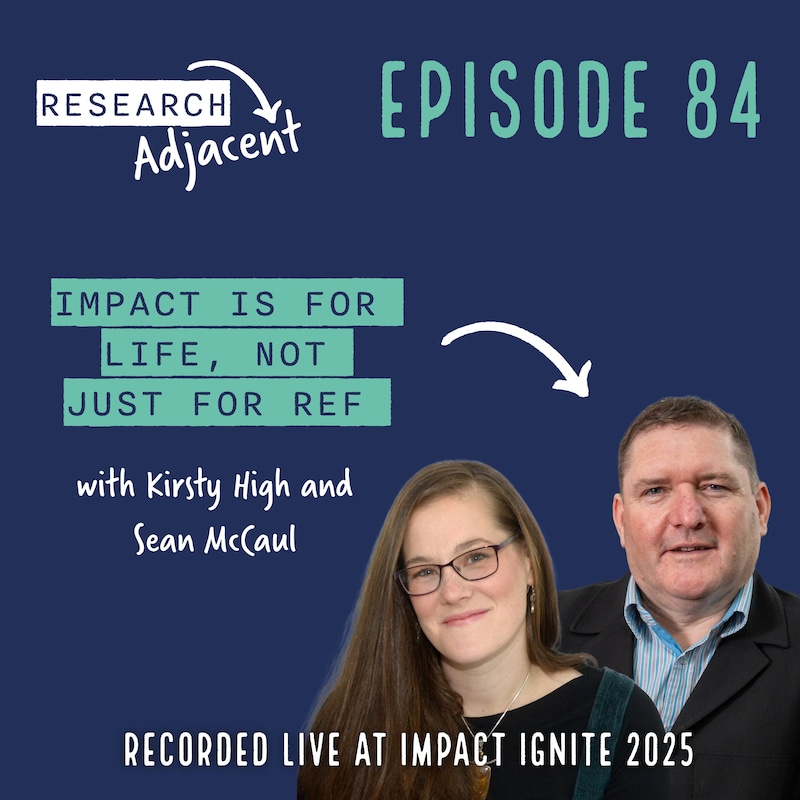
Kirsty High is Research Impact Manager at the independent research institution, the Centre for Ecology and Hydrology. Sean McCaul is a faculty impact officer at Ulster University. Both are responsible for overseeing and supporting impact, but with different drivers and priorities.
This episode was recorded live at the Impact Ignite 2025 conference, an event dedicated to sharing best practices and sparking new ideas among research impact professionals.
Sarah, Kirsty, and Sean talk about
- How supporting impact in a university compares to an independent research institute
- The power of embedding impact rather than seeing it as the ‘icing on the cake’
- Why trust and long-term relationships with researchers are key
- Practical ways to spark impact including seed funding and cross-disciplinary peer learning
Find out more
- Get the transcript and timestamps on the episode webpage
- Connect with Kirsty on LinkedIn
- Connect with Sean on LinkedIn
- Find out more about the Impact Ignite event, the Research Impact Academy and listen to Tamika Heiden’s podcast episode
- Listen to the Hidden REF podcast episode
- Thanks to All Parties and Events for recording this episode
About Research Adjacent
- Follow Research Adjacent on LinkedIn or Instagram
- Email a comment, question or suggestion
- Leave a voice note
- Post a review on Podchaser
- Sign up to the Research Adjacent newsletter
Mentioned in this episode:
Member of the Month: Duncan Yellowlees, DY Training
Let’s put rubbish presentations in the bin – where they belong. Get in touch with Duncan for specialist research presentation skills training www.duncanyellowlees.com
Come along to our Manchester networking event
Join host Sarah McLusky and fellow research-adjacent professionals on Thursday 12 March 2026 at 5.30pm. Find out more and register here https://researchadjacent.circle.so/c/open-events/manchester-research-adjacent-community-networking
Transcripts
The big issue can be when it comes to picking the best
Sean McCaul:stories, people feel left out.
Sean McCaul:And they feel left behind.
Kirsty High:Projects are finishing with no money left over, and the
Kirsty High:first thing that gets cut is the impact bit, and I think it's because
Kirsty High:it's seen as the icing on the cake.
Kirsty High:But no one wants to eat cake without icing
Sean McCaul:so these universities that bring in staff short term contracts,
Sean McCaul:it might get them over the line and they might do OK in REF but it's not
Sean McCaul:gonna help that impact environment, and it's not gonna help the next REF.
Kirsty High:And they learnt from each other by reviewing each others as well.
Kirsty High:Okay.
Kirsty High:This is how the arts talk about impact.
Kirsty High:That's really interesting.
Kirsty High:I think science can learn a lot from that and vice versa.
Sarah McLusky:Hello there.
Sarah McLusky:I'm Sarah McLusky and this is Research Adjacent.
Sarah McLusky:Each episode I talk to amazing research adjacent professionals about what
Sarah McLusky:they do and why it makes a difference.
Sarah McLusky:Keep listening to find out why we think the research adjacent space
Sarah McLusky:is where the real magic happens.
Sarah McLusky:Hello there, and if you're listening in real time, welcome to 2026.
Sarah McLusky:This month is also the birthday of the Research Adjacent podcast.
Sarah McLusky:We are turning three, as I put the first episode out in January, 2023, and I am
Sarah McLusky:genuinely amazed that what started is a 10 episode experiment is still going strong.
Sarah McLusky:And the reason it's still going is 'cause of people like you tuning
Sarah McLusky:in, putting the podcast together.
Sarah McLusky:It takes a lot of work, but what makes all the difference is
Sarah McLusky:knowing that it is appreciated.
Sarah McLusky:So if you want to show your support for the podcast, there are a
Sarah McLusky:few easy things that you can do.
Sarah McLusky:Number one is to subscribe, follow, or rate in whatever platform
Sarah McLusky:you're using to listen to this.
Sarah McLusky:If you would like to send a comment or review, you can email, send a
Sarah McLusky:voice note or leave a review on Podchaser, and you'll find links to
Sarah McLusky:all those things in the show notes.
Sarah McLusky:And finally, please do share posts on social media, screenshots of the episode
Sarah McLusky:you're listening to, anything like that.
Sarah McLusky:Send your favorite episode to somebody that you think would enjoy it.
Sarah McLusky:As they say, every little helps.
Sarah McLusky:So on with today's episode, we are kick-starting the new year with a
Sarah McLusky:special extended episode, which was recorded in front of a live audience
Sarah McLusky:at the Impact Ignite Conference.
Sarah McLusky:Impact Ignite was held in Southampton in November 2025, and was organised
Sarah McLusky:by the Research Impact Academy.
Sarah McLusky:To find out more about Research Impact Academy do listen back to
Sarah McLusky:episode 75 with founder Tamika Heiden.
Sarah McLusky:My guests are Kirsty High and Sean McCaul.
Sarah McLusky:They are both research impact leads, but for slightly different
Sarah McLusky:kinds of organizations with different priorities and pressures.
Sarah McLusky:Kirsty is Research Impact Manager at the independent research institution,
Sarah McLusky:the Centre for Ecology and Hydrology.
Sarah McLusky:While Sean is a faculty impact officer at Ulster University in Northern Ireland.
Sarah McLusky:The big difference is that Sean has to submit to REF, which is the
Sarah McLusky:UK research evaluation framework exercise while Kirsty doesn't.
Sarah McLusky:Now, if you want a bit of a refresher on REF and why it drives the UK impact
Sarah McLusky:agenda, do go back and listen to episode 80 from the Hidden REF Festival where I
Sarah McLusky:give a bit more background on it there.
Sarah McLusky:So despite having different drivers for impact, both Sean and Kirsty do work for
Sarah McLusky:organisations where supporting impactful research is considered a priority.
Sarah McLusky:In our conversation, we talk about the importance of building relationships,
Sarah McLusky:the challenges of stretching, time and resources to support as many
Sarah McLusky:researchers as possible, and why tracking and evaluating impact
Sarah McLusky:is often the biggest challenge.
Sarah McLusky:You'll also hear audience questions from Ged Hall at the University of
Sarah McLusky:Leeds, Saskia Gent from Insights for Impact, Jenny Lockett of Plymouth
Sarah McLusky:Marine Lab and Adam Lockwood from NIHR.
Sarah McLusky:Thanks also to Tamika Heiden for inviting me to come and record at the
Sarah McLusky:event, and a huge shout out to the tech guys from All Parties and Events who
Sarah McLusky:did the mics and the actual recording.
Sarah McLusky:So without further ado, let's listen on to hear Kirsty and Sean's story.
Sarah McLusky:So welcome to my guests also, welcome to you, to the audience,
Sarah McLusky:to the Research Adjacent podcast.
Sarah McLusky:I am joined today by Kirsty High, I'm gonna get them to introduce
Sarah McLusky:themselves in just a minute, Kirsty High and Sean McCaul, who are gonna
Sarah McLusky:tell us a bit about what they do and, their career journey to get there.
Sarah McLusky:Kirsty, first of all, could you tell us a bit about who you are and what you do?
Kirsty High:So I am Kirsty High and I'm the Research Impact Manager for the UK
Kirsty High:Centre for Ecology and Hydrology, which is an independent research institute.
Sarah McLusky:Fantastic.
Sarah McLusky:Thanks very much Kirsty and Sean?
Sean McCaul:I'm Sean McCaul.
Sean McCaul:I'm Faculty Impact Officer at Ulster University in Northern Ireland.
Sarah McLusky:Brilliant.
Sarah McLusky:So we've got a really nice contrast here, both people doing impact jobs, but
Sarah McLusky:for different kinds of organisations, and that's one of the things we're
Sarah McLusky:gonna dig into a little bit today.
Sarah McLusky:So I wonder if you could tell us, Kirsty, let's start with you.
Sarah McLusky:Tell us a bit about what does your job entail on a day-to-day basis?
Kirsty High:It's very good question.
Kirsty High:So the aim of my job is really to help our organisation and our scientists
Kirsty High:tell people how their research is important to society and the
Kirsty High:environment, and in our case as well.
Kirsty High:On a day-to-day basis, I guess that involves identifying examples of
Kirsty High:impact and helping people write those up into narrative stories
Kirsty High:that can be used for our comms team or for telling our funders about.
Kirsty High:And then I also try and support impact happening earlier on.
Kirsty High:People writing impact writing research proposals, I'll try and
Kirsty High:get involved in those and help them embed plans for delivering impact
Kirsty High:in them and to do training and also do things like look at our policy
Kirsty High:impact as a organisation as well.
Kirsty High:Lots of different things.
Sarah McLusky:It does sound like lots of different things.
Sarah McLusky:So do you work right across the whole organisation?
Kirsty High:I do, yeah.
Sarah McLusky:Yeah.
Sarah McLusky:So very much specialising.
Sarah McLusky:There's a clue in the name, but ecology and hydrology.
Sarah McLusky:Yeah.
Sarah McLusky:Environmental science, isn't it?
Kirsty High:We do the air as well, which isn't in our
Kirsty High:name, which upsets some people.
Kirsty High:Yeah, so all sorts of things.
Kirsty High:Biodiversity loss, climate change, mitigation, lots and lots of things.
Kirsty High:And so I've been in post for about a year and really a huge amount of that time has
Kirsty High:also been just trying to get to know what our researchers do and getting to know
Kirsty High:them as well because this job is all about relationships with researchers as well.
Kirsty High:It's really important.
Sarah McLusky:Yeah, I think we'll come to that in a little moment.
Sarah McLusky:But maybe, Sean, could you tell us a bit about what you do on a day-to-day basis?
Sean McCaul:Okay.
Sean McCaul:I'm part of a four person impact team.
Sean McCaul:So we have three faculty impact officers and one impact manager.
Sean McCaul:We were formed back in 2018, just right in before the last REF.
Sean McCaul:I suppose our remit is to create and cultivate an environment
Sean McCaul:where impact can thrive.
Sean McCaul:So we work across with 17 units of assessment.
Sean McCaul:I look after computing, engineering and the built environment, bits of
Sean McCaul:health sciences and bits of biomedical.
Sean McCaul:But the four of us work together in delivering support on an ongoing basis.
Sean McCaul:One thing we did do at the very start, we went and had a look at what the best
Sean McCaul:university's done in the UK and in Europe.
Sean McCaul:And what sort of impact activities they provided.
Sean McCaul:So we designed our own we copied it and pasted from other people as such,
Sean McCaul:but our impact development series.
Sean McCaul:So we run that from the 1st of August to the 31st of July each year.
Sean McCaul:And it entails seven main objectives.
Sean McCaul:The first one is impact funding.
Sean McCaul:So I manage the research impact fund.
Sean McCaul:So we invite academics to apply for pots of funding.
Sean McCaul:About 4,000 pound each time.
Sean McCaul:Now the funding must be used to advance impact from existing research.
Sean McCaul:It's not for new research activities.
Sean McCaul:We also run activity we called Impact 30.
Sean McCaul:So every two months we bring in a guest speaker from the university
Sean McCaul:who's an impact champion, who's done well on REF, or people know.
Sean McCaul:Impact 30 is called, they talk for 30 minutes in a lunchtime seminar.
Sean McCaul:And then there's 30 minutes Q and A that goes down really well because people can
Sean McCaul:hear best practice from their colleagues.
Sean McCaul:We just say six, six times a year, but we then bring in three or four
Sean McCaul:external experts like Saskia Wallcott.
Sean McCaul:Sometimes people are tired hearing the same voice, and bringing someone
Sean McCaul:with a better track record, can help just enforce our message as well.
Sean McCaul:We're a bit unusual in Northern Ireland and there's two universities in Northern
Sean McCaul:Ireland, us and Queens Queens are Belfast based, but Ulster University's
Sean McCaul:spread across three different campuses.
Sean McCaul:So the impact team spread across those locations.
Sean McCaul:So as part of our impact development series, we also run drop in clinics
Sean McCaul:where we just send all staff emails out saying, look, the impact team's
Sean McCaul:gonna be on this campus, on this day.
Sean McCaul:They're tea and coffee.
Sean McCaul:Come along for a chat.
Sean McCaul:Just get to know people or it's not about REF or about case
Sean McCaul:studies, just any questions.
Sean McCaul:It's about any impact.
Sean McCaul:Come and chat there.
Sean McCaul:So that, that works quite well.
Sean McCaul:So say the funding the external people come in to help is
Sean McCaul:definitely a big thing for us.
Sean McCaul:And then we also have an internal website where we provide
Sean McCaul:online training materials.
Sean McCaul:There's impact planners in there, there's engagement planners.
Sean McCaul:There's copies of presentations from previous impact authorities.
Sean McCaul:We do record some of our sessions too, where people can't make it.
Sean McCaul:Their external sessions, with permission of providers, we'll put that recording up.
Sean McCaul:So that's our core activity.
Sean McCaul:Yeah.
Sean McCaul:But every day we're, we be approached with different problems, different
Sean McCaul:queries, so it's wide and varied.
Sean McCaul:And because we're multi-campus and multi UOA.
Sean McCaul:You have no idea what you're gonna be asked from on the evidence.
Sarah McLusky:Yeah, that certainly seems the case.
Sarah McLusky:It's almost like impact people have to be little bit experts in lots and lots of
Sarah McLusky:different things, or at least know enough to be dangerous, I think, as they say.
Sarah McLusky:It sounds like a lot of the work that you do, Sean, is around this
Sarah McLusky:kind of upskilling and professional development side of things, whereas
Sarah McLusky:it sounds like the work you do is more that oversight and connection.
Sarah McLusky:Would that be fair or?
Kirsty High:I do some of that as well.
Kirsty High:But yeah it is actually a lot of what I do is also about connecting
Kirsty High:professional services teams.
Kirsty High:Which I think was slightly different to when I worked in a
Kirsty High:university just before this, and I think that's slightly different.
Kirsty High:We have a lot of project management staff, for example and people who
Kirsty High:look after our data, our data sets.
Kirsty High:Yeah.
Kirsty High:And coordinating and talking to those as well as the scientists.
Sarah McLusky:Yeah.
Sarah McLusky:And what sorts of support are you finding that the professional services teams need?
Kirsty High:Mainly how to track our impact as well.
Kirsty High:So there are lots of people trying to understand how what they do
Kirsty High:is relevant to the wider society, which is what impact's all about.
Kirsty High:And often people just need to help with that or just to talk it through
Kirsty High:with someone and just, have a chat about are we doing the right thing?
Kirsty High:What do you think?
Kirsty High:And just have a bit of a brainstorming session about what we should be doing.
Sarah McLusky:Yeah.
Sarah McLusky:Both of you have mentioned that you've said there about relationships and
Sarah McLusky:the importance of just being available and being, a sort of helpful voice.
Sarah McLusky:Is that relationship networking part of thing a big part of your role?
Kirsty High:I think often when we are in research impact you're asking people
Kirsty High:to do something extra to what their core, a lot of people are there to do
Kirsty High:research or to teach in university, and we're often asking them to just
Kirsty High:do something a little bit more.
Kirsty High:So the more we can help them with that instead of just going and
Kirsty High:saying, can you do this for me?
Kirsty High:It the more we can say, can I work with you to do this and be
Kirsty High:approachable and supportive, the easier it is for us and them.
Kirsty High:Yeah.
Kirsty High:So it's really important to build those relationships.
Sarah McLusky:Yeah.
Sarah McLusky:Making it feel like more of a collaboration.
Sarah McLusky:Yeah.
Sarah McLusky:And with a shared goal rather than just, I need you to do this thing.
Sarah McLusky:Yeah.
Sarah McLusky:So relationship building sounds like an important part of your work as well, Sean?
Sean McCaul:Yeah, a hundred percent.
Sean McCaul:We're always telling our staff, our researchers and academics when
Sean McCaul:they are going out to outside world building relationships is huge.
Sean McCaul:But it's the same internal as well, so one of the challenges we had a couple
Sean McCaul:years ago when the team was formed was people knew who we were in different
Sean McCaul:roles, but all of a sudden we were coming along to say, we're now impact people.
Sean McCaul:And just getting the trust and that took time.
Sean McCaul:It took year or two something, three years.
Sean McCaul:Because we were quite new the role.
Sean McCaul:So thankfully now I think we're seven, eight years into the role.
Sean McCaul:Our relationships are very good across the board.
Sean McCaul:People now trust us.
Sean McCaul:They probably like me more because I have money.
Sean McCaul:When I go looking for something off them, they say well, it's a two way street.
Sean McCaul:Yeah.
Sean McCaul:that kinda way but no, without good relationships, we would definitely
Sean McCaul:struggle to do our job now.
Sarah McLusky:Yeah.
Sarah McLusky:And I think that relationships are so important, but they're also, as you
Sarah McLusky:say, they really take time to develop.
Sarah McLusky:Yeah.
Sarah McLusky:It's often very time consuming and slow work and work that isn't always very
Sarah McLusky:visible and we talk about impact in terms of, things that you can evidence
Sarah McLusky:and that sort of stuff can be the hardest thing to evidence, can't it?
Sarah McLusky:Have you found that connective work is appreciated in your organisation?
Kirsty High:By some people.
Kirsty High:Yeah, I think I, I hope so.
Kirsty High:It's a really difficult thing to answer, isn't it?
Kirsty High:I think yeah.
Kirsty High:Lots of people understand that it's important and recognise it,
Kirsty High:but yeah, it isn't always visible.
Kirsty High:That's right.
Kirsty High:Yeah.
Kirsty High:Sometimes you'll end up with a finished case study, but it's not always
Kirsty High:obvious how long it's taken to get to that because it does take a long
Kirsty High:time and, yeah, it's finding those things to say, I've done this as well.
Kirsty High:Yeah.
Kirsty High:As you go along the way is difficult but important to do.
Sarah McLusky:Yeah.
Sarah McLusky:One of the biggest challenges we've got at the moment isn't it is identifying
Sarah McLusky:somebody who was talking about it yesterday, excellence in the process, not
Sarah McLusky:just excellence in the outputs as well.
Sarah McLusky:Yeah.
Sarah McLusky:So you both work, as you mentioned, in different kinds of organisations.
Sarah McLusky:So organisations doing research.
Sarah McLusky:I think a huge number of people just think research is something that
Sarah McLusky:happens in universities, but there are these independent, essentially
Sarah McLusky:research organisations, places like the UK Centre for Ecology and Hydrology.
Sarah McLusky:Obviously in universities, REF is a big driver of things.
Sarah McLusky:How is that different where you work Kirsty?
Kirsty High:So we, we don't submit to REF, but we, at CEH where we get
Kirsty High:a lot of funding from the Natural Environment Research Council.
Kirsty High:So they impose a mini REF on us.
Kirsty High:So we, we are just assessed against five other research centres and so we
Kirsty High:do have it and we have reason to develop case studies, but I don't think the,
Kirsty High:that evaluation is anywhere near as visible to our scientists as REF is.
Kirsty High:I think within a university, every academic knows what REF is and
Kirsty High:knows it's important and totally understands why they should engage.
Kirsty High:Hopefully they should do that anyway.
Kirsty High:But it is different I think.
Kirsty High:Yeah.
Kirsty High:And our scientists and I think a lot of the research institutes,
Kirsty High:they do deliver impact.
Kirsty High:They're absolutely delivering impact, but when we try to say.
Kirsty High:Can you evidence that?
Kirsty High:And could you tell us about the process and can you write
Kirsty High:it up and communicate it?
Kirsty High:There is a little bit more.
Kirsty High:Why should we do that?
Kirsty High:Why do we need to?
Kirsty High:You know we're doing it.
Kirsty High:So why do we need this process?
Kirsty High:And I think without REF telling us to have a process, it can
Kirsty High:be a little bit difficult.
Kirsty High:Although there are obviously people who really want to do it.
Kirsty High:There are scientists who really want to help with that.
Kirsty High:As well.
Sarah McLusky:Yeah, I think I mentioned to you before we started recording is
Sarah McLusky:that I noticed on the website that your organisation's tagline is Excellent
Sarah McLusky:Environmental Science with Impact.
Sarah McLusky:So I thought it was really interesting that impact is right up there in
Sarah McLusky:the mission of the organisation.
Sarah McLusky:Even if you say, as you say, some people are still not necessarily sold on the idea
Kirsty High:it's the nature of the research we do.
Kirsty High:I guess it's I say we do it as if I do it, but
Sarah McLusky:You're part of the team
Kirsty High:The nature of the research is to find solutions to these, the big
Kirsty High:environmental crises that are happening.
Kirsty High:So it has impact, but often research with a potential impact is
Kirsty High:interpreted as research with impact.
Kirsty High:And not always taking it to the next step.
Kirsty High:And looking at how that's gone to the next step is not always done.
Sarah McLusky:Ah, interesting.
Sarah McLusky:So Sean, you've said that your team, even when it was formed, it
Sarah McLusky:was formed for the purposes of REF.
Sarah McLusky:How does REF inform the work that you do?
Sean McCaul:So the university would argue that it wasn't formed for REF, it just
Sarah McLusky:happened to yeah.
Sean McCaul:And it's funny because we've been through a restructuring around 2017.
Sean McCaul:And they decided to create new posts and new roles.
Sean McCaul:So the impact team was formed in January, 2018.
Sean McCaul:But the message we were getting from the start, from the hierarchy
Sean McCaul:at the university was, REF just something we have to do every seven,
Sean McCaul:eight years as a league table.
Sean McCaul:We need to do it and do it well to make sure we get the certain amount of
Sean McCaul:funding from the UK government, whatnot.
Sean McCaul:But the argument was also was even if there was no REF.
Sean McCaul:We still must do impact.
Sean McCaul:There's no point in doing research for the sake of doing research.
Sean McCaul:There must be an end goal.
Sean McCaul:And Kirsty was saying there sometimes her guys might not
Sean McCaul:take it to the very last stage.
Sean McCaul:Our guys have to.
Sean McCaul:Yeah.
Sean McCaul:And that's where we come along, they do the great research they do a bit
Sean McCaul:of impact, wee bit of engagement.
Sean McCaul:But they aren't sure how to engage, who to engage with, stakeholder
Sean McCaul:engagement , who do you speak to?
Sean McCaul:How do they speak to them?
Sean McCaul:They aren't very good at tracking what they've done evidencing what they've done.
Sean McCaul:So we come in and do that then.
Sean McCaul:So I would like to think that if REF was to go away, the impact
Sean McCaul:team will still have a role.
Sean McCaul:We're not the hierarchy, but say, I'm not too sure.
Sean McCaul:We will say we're here not just REF.
Sean McCaul:I mean people used to approach me for funding too.
Sean McCaul:Say, look, you know what I understand you are all for REF.
Sean McCaul:I say, no we will fund any activities that promote impact.
Sean McCaul:So even if you aren't going forward as a case study, we'll still
Sean McCaul:talk to you and everything else.
Sean McCaul:Obviously I'd say from next year onwards, whenever we start getting close
Sean McCaul:to REF, our focus will be on those.
Sean McCaul:Developing those case studies.
Sean McCaul:But for now, we're here to help everyone across every UOA.
Sean McCaul:Whether or not they're an ECR, mid career or later stage.
Sarah McLusky:Yeah.
Sarah McLusky:Yeah.
Sarah McLusky:I, it is that sense of, I, I love what you said there about we're here
Sarah McLusky:even if it wasn't for REF, and as you say, I would hope that senior
Sarah McLusky:people in universities would see that.
Sarah McLusky:But I think there have always been researchers, haven't they?
Sarah McLusky:Yeah.
Sarah McLusky:Impact and REF has only become a big thing in the last 15 years really?
Sarah McLusky:And there's always been people wanting to get their research to
Sarah McLusky:the people who can benefit from it.
Sarah McLusky:It's just sometimes been formulated in different ways, and I think that possibly
Sarah McLusky:then speaks Sean to, to your career journey and how you've ended up, because
Sarah McLusky:you used to do another job, which was the predecessor of impact, wasn't it?
Sarah McLusky:Tell us a bit about your journey into this kind of work.
Sean McCaul:Okay.
Sean McCaul:I've been employed at Ulster since 1999.
Sean McCaul:Which is last century makes it seem really old.
Sean McCaul:God really old for this, but so for the first 10 years I was more involved in
Sean McCaul:incubator and business park development.
Sean McCaul:So we had incubators and science parks in the three main campuses.
Sean McCaul:So my job would've been to help startup companies get a foot in facilities.
Sean McCaul:We also encourage spin in companies that come in to university.
Sean McCaul:And I say my job is to make sure operational wise,
Sean McCaul:premises wise, everything else.
Sean McCaul:And then whenever these guys needed help, I would reach out to the business school
Sean McCaul:or whoever, that, that was my core remit.
Sean McCaul:Things changed.
Sean McCaul:2009, 2010. There was more demand in our space for research purposes.
Sean McCaul:The vice chancellor might have changed, and we said, look, we
Sean McCaul:shouldn't be doing this anymore because that's not our core remit.
Sean McCaul:So we moved the companies out of our three parks and the premises
Sean McCaul:then became our research facilities because we were in bad need of them.
Sean McCaul:I moved into what was called the Office of Innovation then.
Sean McCaul:They asked me to manage a three year EU funded programme.
Sean McCaul:It was called ICE Innovation for Competitive Enterprises.
Sean McCaul:So we worked with tri- regional, the six border countries.
Sean McCaul:In Republic of Ireland, Northern Ireland, and the west coast of Scotland.
Sean McCaul:And our job was to go out.
Sean McCaul:My job was to go out to find out where the weak points were in companies.
Sean McCaul:Bring the problem back in the university and try and find out who in the
Sean McCaul:university could go out and help them.
Sean McCaul:So that was quite good.
Sean McCaul:Quite challenging and rewarding.
Sean McCaul:Yeah.
Sean McCaul:That was a three year programme and then most people are probably familiar
Sean McCaul:with the KTP scheme in the UK.
Sean McCaul:So in Ireland there's a similar programme called Fusion.
Sean McCaul:They're called Innovation Boost, but it's the North South equivalent of KTP.
Sean McCaul:It's to encourage on all Ireland ecosystem o f business support and academic support.
Sean McCaul:So it's for, North universities work with South companies and were South
Sean McCaul:companies work with North universities.
Sarah McLusky:Yeah, interesting.
Sean McCaul:So I managed that for five years and again, I'd have to reach out
Sean McCaul:to companies in the Republic of Ireland.
Sean McCaul:Then find out what their issues were.
Sean McCaul:What their problems were.
Sean McCaul:And if you wanna come along with Ulster University, there's a very
Sean McCaul:good funding programme to do that.
Sean McCaul:So up until 2018 I was always working with external companies.
Sean McCaul:Yeah.
Sean McCaul:External providers.
Sean McCaul:And I was only, when I started the Impact role, I started looking
Sean McCaul:really more closely at our research, so that was is challenging.
Sarah McLusky:Yeah, but it's still that role of finding, it's
Sarah McLusky:like joining the dots, isn't it?
Sarah McLusky:Yeah.
Sarah McLusky:Between, like you say, businesses, whether it's between businesses and research or
Sarah McLusky:businesses and support needs, or now the researchers that you work with and what
Sarah McLusky:are their support needs around impact.
Sarah McLusky:Yeah.
Sarah McLusky:It's still that kind of connective role, isn't it?
Sarah McLusky:Joining everything up.
Sarah McLusky:It makes sense why it's the same skills and I've, I find, yeah, I think
Sarah McLusky:as you said KTPs for anybody maybe listening or here who doesn't know.
Sarah McLusky:Knowledge transfer partnerships is the all, so some of these things
Sarah McLusky:like public engagement and knowledge transfer partnerships and business
Sarah McLusky:innovation and spin in, never heard spin in companies before.
Sarah McLusky:That's a new term.
Sarah McLusky:I've heard of spin out companies and all this stuff that was going on,
Sarah McLusky:and it's almost just all been sucked together, into impact and and that
Sarah McLusky:kind of blanket term of how research connects with the wider world.
Sarah McLusky:So I think it, it makes sense to me at least Okay.
Sarah McLusky:Why those things came together.
Sarah McLusky:Kirsty, tell us about your journey into your job.
Kirsty High:Yeah, it's similar.
Kirsty High:Actually, I started in knowledge exchange as well.
Kirsty High:Out of my PhD, which is in analytical chemistry, I did a NERC funded knowledge
Kirsty High:exchange fellowship, which they don't, I don't think they exist anymore.
Kirsty High:A really amazing scheme.
Kirsty High:Where you basically just worked with, you did knowledge exchange to
Kirsty High:translate research into usable practice.
Kirsty High:So I worked with a Historic England my background was in the deterioration
Kirsty High:of archeology in wetlands.
Kirsty High:And how they're protected in archeological excavations.
Kirsty High:And I just really loved that experience.
Kirsty High:I did it for five years.
Kirsty High:Because I managed to squeeze in two maternities during that.
Kirsty High:And when I tried to go back to academia, I didn't really see
Kirsty High:a path that I wanted to do.
Kirsty High:I liked knowledge exchange so much.
Kirsty High:I liked that idea of getting the research out there that I don't think there is
Kirsty High:a space, I still don't think there's a space for that within academia to
Kirsty High:be a researcher and still do that.
Kirsty High:There's no, you can do a fellowship, you can do a postdoc, but a
Kirsty High:permanent position just isn't there.
Kirsty High:And I think it is actually something that would.
Kirsty High:Be really good in organisation, in universities in particular to
Kirsty High:have embedded knowledge exchange positions within departments.
Kirsty High:So I was faced with a decision whether to go back to being a researcher or
Kirsty High:find something else and I just didn't want to spend my life publishing
Kirsty High:papers and doing nothing else.
Kirsty High:So, I just happened to be living in North Wales.
Kirsty High:Loved living in North Wales and didn't really want to move, which is probably
Kirsty High:a familiar story to a lot of people.
Kirsty High:Yeah.
Kirsty High:You just think, okay, what can I do that fits my skillset?
Kirsty High:And I applied for a job, as an Impact Officer at Bangor University
Kirsty High:and I just absolutely loved it.
Kirsty High:I just I had an amazing team at Bangor University.
Kirsty High:I just walked into just this extremely warm, lovely team.
Kirsty High:And I still think research professionals are the nicest people.
Kirsty High:And yes, there's something about the skills that we all have, I think that
Kirsty High:just make us nice people to work with.
Kirsty High:And I did that for three years and just thought I found what I like doing
Kirsty High:is talking about research all day, telling people how great research is.
Kirsty High:And helping people get the best out there, what they do is just really fun.
Sarah McLusky:Yeah.
Sarah McLusky:It's amazing that you've found your place, but your story is so common with people
Sarah McLusky:that I've interviewed in the podcast, just people that I know personally as
Sarah McLusky:well of coming to a point, maybe after having children or that sort of thing,
Sarah McLusky:and either being this is where I live now and I don't want to move, so I need
Sarah McLusky:to find a job in the local community.
Sarah McLusky:And often there's that expectation with research jobs isn't there that
Sarah McLusky:you go where the research is and that an expectation of moving around.
Sarah McLusky:So sometimes it's that, and sometimes it's also I've got this other stuff in my life.
Sarah McLusky:I don't want that pressure or that, that publish or perish,
Kirsty High:It always felt like a bit of a fight to go back to academia.
Kirsty High:And I wasn't ready for it then.
Kirsty High:Yeah.
Kirsty High:And yeah, I found what I liked doing instead.
Sarah McLusky:Oh, perfect.
Sarah McLusky:I think on that positive note, perhaps leads nicely into if you could tell
Sarah McLusky:us maybe a one or two things you've worked on that you're really proud of.
Kirsty High:So I think the biggest thing that at Bangor University, I,
Kirsty High:I oversaw implementing a a fund just like Sean's described, actually.
Kirsty High:They'd never really had anything like that before.
Kirsty High:So I ran that for three, three rounds of funding where we gave some
Kirsty High:internal funding from the HEFCW.
Kirsty High:It was in Wales.
Sarah McLusky:Okay.
Kirsty High:Yeah.
Kirsty High:I can't remember what
Sarah McLusky:I trust your pronunciation more than mine
Kirsty High:To impact generating projects.
Kirsty High:And I think we gave a lot of opportunities to early career researchers in
Kirsty High:particular through that it was their first go at applying for funding
Kirsty High:and then we know that a lot of them went on to do other bigger projects.
Kirsty High:A lot of that funding led to a lot of our, the Bangor University's impact case
Kirsty High:studies that'll be submitted next time.
Kirsty High:And the other thing we saw in that process is that people getting involved
Kirsty High:in the reviewing of the applications and writing them and assessing them, actually
Kirsty High:raised the impact literacy a little bit.
Kirsty High:Certain departments in particular, just and also learning from other departments.
Kirsty High:So I worked across the university there as well as science,
Kirsty High:healthcare and arts and humanities.
Kirsty High:And they learnt from each other by reviewing each others as well.
Kirsty High:Okay.
Kirsty High:This is how the arts talk about impact.
Kirsty High:That's really interesting.
Kirsty High:I think science can learn a lot from that and vice versa.
Kirsty High:So yeah, I was really proud of that initiative.
Kirsty High:Yeah.
Sarah McLusky:Yeah.
Sarah McLusky:I think it is incredible.
Sarah McLusky:I learned more about doing funding applications from, I was, for a while
Sarah McLusky:I was on a panel, giving, it was grants for public engagement projects
Sarah McLusky:but just that process of reviewing, you learn so much from it, don't you?
Sarah McLusky:Yeah.
Sarah McLusky:Sean, tell us about some things you're proud of.
Sean McCaul:Yeah, again, probably a huge example of the impact funding there, you
Sean McCaul:see where we identified through projects and seeing those projects turning these
Sean McCaul:small ideas with little impact growing into more funding, developing impact
Sean McCaul:case studies from those small acorns.
Sean McCaul:So they see some people come along not knowing about impact much and between
Sean McCaul:getting funding from us and getting support from us and then over time
Sean McCaul:developing a top story for REF was key.
Sean McCaul:In terms of proud probably our REF results has been the biggest achievement,
Sean McCaul:to come in on the back of not a great 2014 for the university in general.
Sean McCaul:So we had, we submitted, I think it was 65 impact case studies,
Sarah McLusky:right?
Sarah McLusky:Yeah.
Sean McCaul:We had 97% were three and four star.
Sean McCaul:I had a hundred percent between my units.
Sean McCaul:Wow.
Sean McCaul:Which was a big, maybe a while.
Sean McCaul:Now the problem is how would I be that next time around?
Sean McCaul:That's,
Sarah McLusky:you've set the bar very high there.
Sean McCaul:But even to see how far the impact team has come along.
Sean McCaul:As a group, as a collective.
Sean McCaul:A colleague of mine, Karen, probably around here somewhere today, but we
Sean McCaul:started at the same time and we were asked to go out and speak to people within the
Sean McCaul:first three or four months about REF.
Sean McCaul:I had no idea REF was, and I had a winged for a long time.
Sean McCaul:Basically could like, so took us a year or so even they could up to speed
Sean McCaul:with what everything was all about.
Sean McCaul:Yeah.
Sean McCaul:We were coming to events like this, going to REF conferences, speaking
Sean McCaul:to academics in other universities who'd impact teams as well.
Sean McCaul:They learned from them.
Sean McCaul:I thought we, we hit the ground running once we got the basic
Sean McCaul:understanding of what it was all about.
Sean McCaul:But I would say so far it's definitely been the REF performance
Sean McCaul:has been our, our shining moment.
Sarah McLusky:Yeah.
Sarah McLusky:That is fantastic.
Sarah McLusky:You've said there though, one of the challenges was just
Sarah McLusky:understanding this new world.
Sarah McLusky:Yeah.
Sarah McLusky:The REF and all the acronyms and exactly what it meant.
Sarah McLusky:And obviously you've found your way through that.
Sarah McLusky:Are there any other particular challenges that you've faced
Sarah McLusky:along this career journey?
Sean McCaul:Yeah.
Sean McCaul:I would say the biggest issue I had to start was people knew who I was in
Sean McCaul:a tech transfer, knowledge exchange.
Sean McCaul:And who am I to come along and tell them what impact was.
Sean McCaul:So it goes back to that relationship building again.
Sean McCaul:And even for, because we come in two and a half or three years before REF,
Sean McCaul:we were giving people advice on how to prepare for REF and based on us reading
Sean McCaul:the guidance, which was not always holding clear what it meant as well.
Sean McCaul:So people in the main took our advice on board.
Sean McCaul:Some maybe didn't because they didn't think we were right and
Sean McCaul:we never done a REF before.
Sean McCaul:But thankfully the ones who took it on board done very well.
Sean McCaul:But the challenge was building that relationship and building that
Sean McCaul:trust and trying to show we were a source of expertise and knowledge
Sean McCaul:and what we were saying was true.
Sean McCaul:Now, whenever the re results come out, we were really nervous because we
Sean McCaul:thought if we've told these guys the wrong information, we're in trouble.
Sarah McLusky:Yeah.
Sean McCaul:But no, thankfully it came good.
Sean McCaul:But that was a big a challenge.
Sarah McLusky:Oh fantastic.
Sarah McLusky:As you say that you've overcome it, and I think a lot of people relate
Sarah McLusky:to that sense of being accepted as an expert in the thing that you are
Sarah McLusky:genuinely an expert in, up against people who see themselves as experts.
Sarah McLusky:And sometimes there is that pushback, isn't there?
Sarah McLusky:Yeah.
Sarah McLusky:Who are you to tell me what to do?
Sarah McLusky:Exactly.
Sarah McLusky:But yeah, well done.
Sarah McLusky:Kirsty tell us about challenges that you've faced on your journey.
Kirsty High:I guess this is a, a first world problem to have, but at CEH I
Kirsty High:think there's so much impact happening that sometimes I struggle to decide
Kirsty High:who to support and that you have to decide sometimes I've gotta support
Kirsty High:the strongest impact case study here and maybe feel like you are letting
Kirsty High:down someone who's just starting on an impact journey, and that's a real shame.
Kirsty High:So yeah, it's a nice problem to have but I wish there were more of
Kirsty High:me to give more support sometimes.
Sarah McLusky:Yeah.
Sarah McLusky:Maybe we can solve that with the infamous Research Adjacent magic wands.
Sarah McLusky:They have been primed, and anybody who doesn't know this from the podcast,
Sarah McLusky:I always ask my guests what would they do if they had a magic wand and
Sarah McLusky:if money and time were no object.
Sarah McLusky:Kirsty, what would you do with your magic wand?
Kirsty High:So I want more money and time.
Sarah McLusky:You get that.
Sarah McLusky:What you gonna do with it?
Kirsty High:So I, so ultimately I would like suddenly people
Kirsty High:to appreciate the impact is a fundamental part of the research
Kirsty High:process and it can't be separated.
Kirsty High:And the reason I say that is that what I'm seeing a lot
Kirsty High:lately is funding's getting cut.
Kirsty High:Projects are finishing with no money left over, and the first thing that
Kirsty High:gets cut is the impact bit, it's the impact delivery or the impact pathways.
Kirsty High:And I think it's because it's seen as the icing on the cake.
Kirsty High:But no one wants to eat cake without icing, so it needs to have icing on it.
Kirsty High:So I wish people would see that it's really important
Kirsty High:and you can't just cut that.
Kirsty High:Yeah.
Sarah McLusky:Yeah.
Sarah McLusky:I love that analogy.
Sarah McLusky:Who wants cake without icing?
Sarah McLusky:Yeah.
Sarah McLusky:Thanks Kirsty.
Sarah McLusky:Sean, what would you like to do with your magic wand?
Sean McCaul:Okay, probably controversial, right?
Sean McCaul:But
Sarah McLusky:go for it.
Sean McCaul:If I had a wand, I would convert half us all into men.
Sean McCaul:The joke was there.
Sarah McLusky:No, but it's, you.
Sarah McLusky:It's a good, it's a good point.
Sean McCaul:I've only realized from coming here last year to
Sean McCaul:the Research Academy with a cohort, we're 25 in the team.
Sean McCaul:And there's only five men.
Sean McCaul:I just realized, I'm part of, I, I'm one of four, there was three
Sean McCaul:women are Queens colleagues almost.
Sean McCaul:So I just find it a very female orientated, that's not a bad thing.
Sean McCaul:Just an observations.
Sean McCaul:So I take that back and we change these all day.
Sarah McLusky:No, but do you know, I think it's a really valid point.
Sarah McLusky:And the fact that you've said your team is 25% men is actually quite good.
Sarah McLusky:I think by some standards.
Sarah McLusky:I think some research that's been done, has said that this research
Sarah McLusky:adjacent world can be up to 90% female.
Sarah McLusky:Yeah.
Sarah McLusky:Yeah.
Sarah McLusky:And and if we take that idea of equality and diversity, seriously.
Sarah McLusky:And if we're saying that everybody's perspectives are important and that's why
Sarah McLusky:it's important to have a range then yeah, we need more male voices in the room.
Sarah McLusky:So I think you are allowed to say that.
Sarah McLusky:I don't think it's as controversial as you might.
Sarah McLusky:I don't think it's as controversial as you might think.
Sean McCaul:And again, I'm wishlist, I mean we're, we are
Sean McCaul:quite streamlined at the university, we are quite lean on what we do.
Sean McCaul:But as part of our role, there comes an awful lot of admin work.
Sean McCaul:So when I give out an impact fund setting up cost centre codes,
Sean McCaul:it's nominal codes, it's tracking the money, it's getting reports.
Sean McCaul:We do an awful lot of chasing paperwork and red tape and we had asked in the
Sean McCaul:past at last restructuring for an admin person that would help do that set up.
Sean McCaul:Now we never got it.
Sean McCaul:So magic wand, I would create a new person to be that person
Sean McCaul:that can do all that stuff.
Sean McCaul:They allow the impact team to go out and spend more time doing w hat we're good at.
Sarah McLusky:Yeah.
Sarah McLusky:Oh, that's definitely I do remember the pain of some of that.
Sarah McLusky:Yeah.
Sarah McLusky:Cost Centres and budget codes and forms and Yes.
Sarah McLusky:HR and all that kind of stuff.
Sarah McLusky:Yes.
Sarah McLusky:Excellent use of the magic wand there.
Sarah McLusky:I think now we will turn it over to the audience.
Sarah McLusky:If you have got any questions that you would like to ask to our team as
Sarah McLusky:we said at the beginning, if you have got a question you'd like to ask,
Sarah McLusky:please put up your hand and somebody will bring a microphone to you.
Ged Hall:So Sean this is to you and I'm just really interested.
Ged Hall:I think it comes from having Irish ancestry but I'm interested in
Ged Hall:terms of the different influences.
Ged Hall:So when you are working with colleagues in similar roles at southern universities
Ged Hall:without the REF and the REF plays a big influence in your working life,
Ged Hall:what do you notice that you can learn from them without that influence that
Ged Hall:you've brought into your practice?
Sean McCaul:Yeah, great question.
Sean McCaul:So about two years ago, they created an all Ireland impact forum for
Sean McCaul:people who are involved across Ulster, Queens and their six or seven
Sean McCaul:universities and in the south as well.
Sean McCaul:What I've learned from those guys is first of all, they don't have the pressures
Sean McCaul:of REF, but they use the REF guidance to drive their own systems internally.
Sean McCaul:They get a lot more money than we do.
Sean McCaul:That's a, the Irish government throw money.
Sean McCaul:Sometimes tens of millions compared to us how they tap into a small pot of money.
Sean McCaul:So I haven't learned too much from them, apart from, that I'm jealous
Sean McCaul:that they don't have the pressures of the REF and they more money.
Sean McCaul:It's all women, again, just an observation.
Sean McCaul:All women's happen to, but I think they learn more from us.
Sean McCaul:Because most of the impact roles at southern universities are relatively new.
Sean McCaul:We're seen as now almost veterans, even though we've only been here since 2018.
Sean McCaul:They tap into our networks and our expertise and we invite them along
Sean McCaul:to Ulster as well to participate in our in- person only workshops and
Sean McCaul:they pick up quite a bit from that.
Sean McCaul:And what's quite rewarding is I'll see like University of Galway recently have
Sean McCaul:launched their own impact seminar series.
Sean McCaul:And they've tailored along our lines, which is great to see.
Sean McCaul:So I think it's sharing best practice.
Giovanna Lima:I'm Giovanna Lima.
Giovanna Lima:I'm a confessed impact nerd, so I'll go back to Kirsty's point on choosing
Giovanna Lima:only the best teams or best stories because as impact nerds in the room,
Giovanna Lima:I feel sometimes we have a duty of care towards the whole community.
Giovanna Lima:And we worked really hard with the Erasmus University when we're doing an
Giovanna Lima:impact report to showcase the different maturity levels of impact, let's say.
Giovanna Lima:So it could we hear a little bit more perhaps of what we could do as a community
Giovanna Lima:to recognise the complexities of impact beyond the success stories, let's say.
Giovanna Lima:It's just to go deeper a little bit in that point because if we
Giovanna Lima:don't do it, I don't know who will.
Giovanna Lima:So that's a little bit of the complexity of impact, how can we deal with that and
Giovanna Lima:recognise maturity levels, timeframes, all of the things we know about impact things.
Kirsty High:I think it's a really important point and, I think it's one
Kirsty High:of the worst things about REF is that it makes us focus on the best examples and
Kirsty High:sometimes for early career researchers, they see us celebrating these people
Kirsty High:who've been doing it for 30, 40 years.
Kirsty High:Of course they've got more impact because they've been doing it longer, but it's
Kirsty High:not something that's unachievable.
Kirsty High:And if we don't also support them, then there's no one for
Kirsty High:that gap in future as well.
Kirsty High:So I think the best thing I did in to support it was this internal funding
Kirsty High:pot and making sure that a certain amount of that went to early career
Kirsty High:researchers to really help them.
Kirsty High:To help them kickstart, exploring their own ideas and building their own
Kirsty High:networks, that's really important as well.
Kirsty High:And making sure that there's space for them to do that is yeah,
Kirsty High:what I would say is critical.
Sean McCaul:Yeah.
Sean McCaul:And again, likewise when it came to our funding pot we do split the fund pot, 50%
Sean McCaul:ECRs and 50% non ECRs to make sure those early careers get, get a better chance.
Sean McCaul:The big issue can be when it comes to picking the best
Sean McCaul:stories, people feel left out.
Sean McCaul:And they feel left behind.
Sean McCaul:And I might need, for example, for UoA11 computing, I need five case
Sean McCaul:studies this time round, but I have nine potential case studies and they're all
Sean McCaul:almost fighting each other to find out who's gonna, who's gonna make the cut.
Sean McCaul:So where there is an opportunity for people to merge, especially bring on the
Sean McCaul:ECRs on board, who may be weak on their own they create a stronger case study.
Sean McCaul:But I think what's gonna help, we're still waiting on the REF guidance
Sean McCaul:to come out, as but what should help this time is the whole environment
Sean McCaul:and engagement narrative section.
Sean McCaul:We're still encouraging people.
Sean McCaul:Keep working on your stories, keep working on your impact.
Sean McCaul:If it's gonna be a good enough impact case study, it's gonna happen naturally
Sean McCaul:with a bit of effort and that'll help.
Sean McCaul:But even if your case study and your story is not selected as going forward for REF,
Sean McCaul:we can still use that engagement, that, that impact in our narrative statement.
Sean McCaul:So that appears to keep people on board as long as they, if it as if
Sean McCaul:we're left out and ignored here.
Sean McCaul:We keep telling people we don't give anyone guarantees
Sean McCaul:about who's gonna make the cut?
Sean McCaul:It will not be made near the time.
Sean McCaul:But for those who don't make it, we can still use their impactful work
Sarah McLusky:and so important to keep, to nurture those because they
Sarah McLusky:might not make the cut this time.
Sarah McLusky:Yeah.
Sarah McLusky:But they might be the ones that, that are the stand out for next time.
Sarah McLusky:Yeah.
Sarah McLusky:It's gotta start somewhere, hasn't it?
Sarah McLusky:Yeah.
Sarah McLusky:So
Kirsty High:I think it's also that a case study isn't the
Kirsty High:only way, isn't the only way.
Kirsty High:And I've talked in both of my institutions about how we reward and recognise in
Kirsty High:a formal way people who do impact.
Kirsty High:And often it comes back to, we'll promote people who, if
Kirsty High:they submit a case study, but.
Kirsty High:What about the people who don't but still do impact.
Kirsty High:Yeah it's really, it's, I think it's a very complicated issue.
Saskia Gent:Hi.
Saskia Gent:It's Saskia from Insights for Impact.
Saskia Gent:A question for both of you, but it was actually prompted by Sean's
Saskia Gent:observations about how long he's been in the business and in particular the
Saskia Gent:stability of the team because we know that short term contracts is a perennial
Saskia Gent:problem in sort of impact sector.
Saskia Gent:So I'd be interested in hearing from you both what you think the value
Saskia Gent:is of having that sort of stable long-term team, long-term connection
Saskia Gent:and what you think the challenges are about some of the sort of shorter
Saskia Gent:term contracts that we're seeing increasingly in the run up to the REF.
Sean McCaul:Yeah I'll go first Saskia.
Sean McCaul:Thank you.
Sean McCaul:Thankfully when the, when our impact team at Ulster was formed, we were
Sean McCaul:all given permanent contracts.
Sean McCaul:We weren't given two, three we weren't employed for REF.
Sean McCaul:That gives us as individuals much more stability that we're
Sean McCaul:gonna be around for a while.
Sean McCaul:Saying that, shortly after the REF results come out, there was a senior
Sean McCaul:conversation about do we keep the impact team together or do we split them up and
Sean McCaul:bring them back together again around now?
Sean McCaul:So we had that conversation saying, look, you need to keep us together as a team.
Sean McCaul:That if you're saying that impact is not just for REF,
Sean McCaul:it should happen all the time.
Sean McCaul:If we're going to create that environment where Impact thrives,
Sean McCaul:we need that sort of stability.
Sean McCaul:And if we were chopping and changing, if I was to leave tomorrow and a new
Sean McCaul:Impact officer come in, they would have to start building up all those
Sean McCaul:relationships, which I've built up over the last seven or eight years.
Sean McCaul:People like seeing familiar faces and people like seeing
Sean McCaul:you have a track record now.
Sean McCaul:And there was, I think it was girl called Louise Rutt, who
Sean McCaul:wrote an article last week.
Sean McCaul:It was in Times Higher and she was saying about, about, writing four
Sean McCaul:star case studies, no academics starts out at the start of a seven
Sean McCaul:year cycle saying, I want to write a case study and make the four star.
Sean McCaul:What they do is they go out and they engage, they do authentic, two way
Sean McCaul:impactful research that there's great impact and the story would come itself.
Sean McCaul:And she compared that with these universities.
Sean McCaul:Now, over the last couple days, I've seen numerous emails come
Sean McCaul:in for impact roles, for REF.
Sean McCaul:So these universities that, that, that bring in staff short term contracts,
Sean McCaul:it might get them over the line and they might do OK in REF but it's not
Sean McCaul:gonna help that impact environment, and it's not gonna help the next REF.
Sean McCaul:So we just find having that stability, having long term
Sean McCaul:contracts and people internally knowing we're here for long term.
Sean McCaul:I think it just helps the overall life cycle.
Kirsty High:Yeah.
Kirsty High:I just totally agree that it's, we, as we said right at the beginning,
Kirsty High:it's all about relationships.
Kirsty High:So every time you move or someone else comes in, it's all just gotta start again.
Kirsty High:Yeah.
Kirsty High:And it's really hard to help support a case study if you don't actually
Kirsty High:know the research behind it that well.
Kirsty High:So it takes so much time to get up to speed with that.
Kirsty High:And particularly if you're working across the whole organisation, you've
Kirsty High:got multiple people to support.
Kirsty High:It's just hard work.
Kirsty High:And I I actually left Bangor University, not it was, it became
Kirsty High:quite clear that one of us was gonna have to leave at some point.
Kirsty High:We were in a fairly big team and, noises were being made.
Kirsty High:I never wanted to be in a position where I was up against
Kirsty High:a colleague that I really liked.
Kirsty High:So I took the opportunity to leave when I could.
Kirsty High:And starting again is hard work for us.
Kirsty High:It is hard work and it is hard to leave people that you've built relationships
Kirsty High:with as well when you're in the middle of something and yeah, it's, it's
Kirsty High:bad for the sector, but it's also bad for us as individuals, I think.
Sarah McLusky:Yeah, and I think in these roles that are so much about
Sarah McLusky:relationship building, connections, we talk a lot about institutional
Sarah McLusky:knowledge, but often that institutional knowledge is actually in a person.
Sarah McLusky:It's not about the organisation, it's about that person and
Sarah McLusky:what's lost if they go.
Sarah McLusky:Yeah, so I'm sure a lot of people wish that, that their organisations were
Sarah McLusky:as committed to impact, perhaps as the ones that, that you're in at the moment.
Jenny Lockett:Hi, I'm Jenny Lockett.
Jenny Lockett:I'm Head of Impact at Plymouth Marine Laboratory.
Jenny Lockett:So similar organisation to Kirsty's, the way we're set up.
Jenny Lockett:And you both mentioned training, which we deliver as well.
Jenny Lockett:What do you focus on?
Jenny Lockett:What's the key skills you wanna train your researchers in to
Jenny Lockett:make them engage in impact?
Kirsty High:That's very good question.
Kirsty High:It, so it depends on the career stage, so some people just need
Kirsty High:to be introduced to the concept.
Kirsty High:I try and I don't run formal training at CEH yet.
Kirsty High:I do plan to next year, but I try to just go and talk to research
Kirsty High:groups instead, so a bit more informally, have you considered this?
Kirsty High:Is this something you're doing and I'm here?
Kirsty High:Basically, but I think the real thing that researchers tend to need training
Kirsty High:on is how to evaluate and track impact.
Kirsty High:I think that's the thing that, that is really time consuming for them.
Kirsty High:And it's something we probably all know should be done, hopefully.
Kirsty High:But it's not.
Kirsty High:It's actually not that easy to do as we all know.
Kirsty High:So I think that's the key thing that that is needed.
Kirsty High:Yeah.
Sarah McLusky:Sean, what have you found?
Sean McCaul:Yeah, what we've done is we've gone out and asked
Sean McCaul:researchers what do you want, what do you need, and as Kirsty said,
Sean McCaul:depends on what stage you're at.
Sean McCaul:It depends sometime on the units of assessment how research intensive
Sean McCaul:and how they perform in REF.
Sean McCaul:Some of the units you've always done well in REF, kinda say we're fine for now.
Sean McCaul:We don't need any help from you because we know what we're doing.
Sean McCaul:Other staff come back saying, we just don't know what impact is.
Sean McCaul:So we simply put on a workshop on what is impact.
Sean McCaul:That simple.
Sean McCaul:Our people want to understand what is impact for REF.
Sean McCaul:So they're, there's another workshop.
Sean McCaul:People are saying they don't understand the whole planning cycle.
Sean McCaul:So we bring in like Saskia again in the past there, we brought in
Sean McCaul:Mark Reid a number of years ago.
Sean McCaul:We, we've learned from those guys.
Sean McCaul:And then we build our expertise around that and deliver our own workshops.
Sean McCaul:But we just go out and ask.
Sean McCaul:It could be a session on pathways to impact.
Sean McCaul:There's people who are trying to change policy.
Sean McCaul:They have no idea where to go, where they start.
Sean McCaul:So we run a workshop on how to make an impact in policy.
Sean McCaul:So again we run several workshops a year.
Sean McCaul:During the summer period, we go back out to research directors and people who've
Sean McCaul:attended and people who haven't attended saying, look, we're about to programme
Sean McCaul:our impact development series for next year, what do you want and we ask them
Sean McCaul:the questions and normally when they have a, an input into it normally encourages
Sean McCaul:a better attendance at our workshops.
Adam Lockwood:Hiya guys, Adam NIHR.
Adam Lockwood:So Kirsty, I think you mentioned linking across professional services
Adam Lockwood:and working as a bit of a hybrid.
Adam Lockwood:I know as impact managers we wear numerous hats and play numerous
Adam Lockwood:roles within our organisations.
Adam Lockwood:Just wondered if you've got any reflections on the opportunities value
Adam Lockwood:gained from working across, comms, data services, and any potential
Adam Lockwood:challenges working across those systems.
Kirsty High:I think it's really important that we all work together for what the
Kirsty High:big reason is that otherwise scientists telling multiple people and they get
Kirsty High:really annoyed by that, and I understand why they get really annoyed by that.
Kirsty High:So they're telling the comms team about something and then they tell
Kirsty High:me about something and then they tell someone else about it, and why are
Kirsty High:you guys not talking to each other?
Kirsty High:So we are trying to do that, to talk to each other a lot better
Kirsty High:to minimize what we're asking for.
Kirsty High:I also think we, we can help each other better.
Kirsty High:So comms in particular, I think has a real role to play in communicating impact.
Kirsty High:So I think it's really important that we get those stories out there to bigger
Kirsty High:audiences than just REF or the funders.
Kirsty High:I think it's really important that we tell the public why research is important
Kirsty High:and that's what impact's all about to me.
Kirsty High:And yeah, comms have a huge role to play in that.
Sean McCaul:Yeah, and again, because our comms team are really
Sean McCaul:valuable they become more valuable.
Sean McCaul:They realise now that they've a big part to play for us, and we're now
Sean McCaul:in the middle of creating 30 short videos on current work that's going on.
Sean McCaul:It's not for REF, but the university believes that people in the general
Sean McCaul:public, whether that's across Northern Ireland, across our local areas,
Sean McCaul:or UK as a whole, aren't really aware about all the great work we're
Sean McCaul:doing and the impact we're making.
Sean McCaul:So I say we're we plan to roll out from the next April onwards every month short
Sean McCaul:videos gonna go out on LinkedIn, on Facebook and other social media channels.
Sean McCaul:I would also say about working internally, part of our team, we're
Sean McCaul:a small impact team, but we're part of the innovation and impact team.
Sean McCaul:So I work very closely with a, there's one startup manager
Sean McCaul:here, there's a commercialisation manager, there's IP manager.
Sean McCaul:So we do talk to each other quite regularly because sometimes there's
Sean McCaul:impact going on in different areas that I'm not aware of.
Sean McCaul:So the startup manager may say to me, are you aware that Joe
Sean McCaul:Blogs there has now started a company and we've invested in it?
Sean McCaul:And he's now employing 10 staff.
Sean McCaul:And I wasn't aware of that because this person was never on our radar.
Sean McCaul:So then we make that approach saying, look, can we support
Sean McCaul:you at all along the way?
Sean McCaul:And, you're making an impact there on the economy impact and employment
Sean McCaul:impact on whatever certain areas is.
Sean McCaul:So it's just making sure we have that open conversation between
Sean McCaul:ourselves internally as well.
Sean McCaul:I think that helps quite a bit.
Sarah McLusky:Thank you very much.
Sarah McLusky:And what a fantastic question to end on because this whole podcast is
Sarah McLusky:all about strength in numbers, all about profiling the amazing work that
Sarah McLusky:research professionals do and that they contribute to the research world.
Sarah McLusky:If people want to find you, get in touch, is there anywhere that you hang out or
Sarah McLusky:websites you would direct people to go to.
Kirsty High:On LinkedIn?
Kirsty High:Yeah, for me, yeah.
Sarah McLusky:So find Kirsty on LinkedIn.
Sarah McLusky:Sean?
Sean McCaul:And likewise.
Sean McCaul:Or the bar?
Sarah McLusky:Oh, the bar noted.
Sarah McLusky:Thank you so much to everybody who is here in the audience today.
Sarah McLusky:Thank you for your fantastic questions and for your attention.
Sarah McLusky:And thank you to people listening as well to future people listening online.
Sarah McLusky:And thank you so much to Kirsty and Sean for sharing your stories.
Sean McCaul:Thank you.
Sarah McLusky:Thanks for listening to Research Adjacent.
Sarah McLusky:If you're listening in a podcast app, please check your subscribed and then
Sarah McLusky:use the links in the episode description to find full show notes and to follow
Sarah McLusky:the podcast on LinkedIn or Instagram.
Sarah McLusky:You can also find all the links and other episodes at www.researchadjacent.com.
Sarah McLusky:Research Adjacent is presented and produced by Sarah McLusky, and the
Sarah McLusky:theme music is by Lemon Music Studios on Pixabay and you, yes you, get a big
Sarah McLusky:gold star for listening right to the end.
Sarah McLusky:See you next time.
