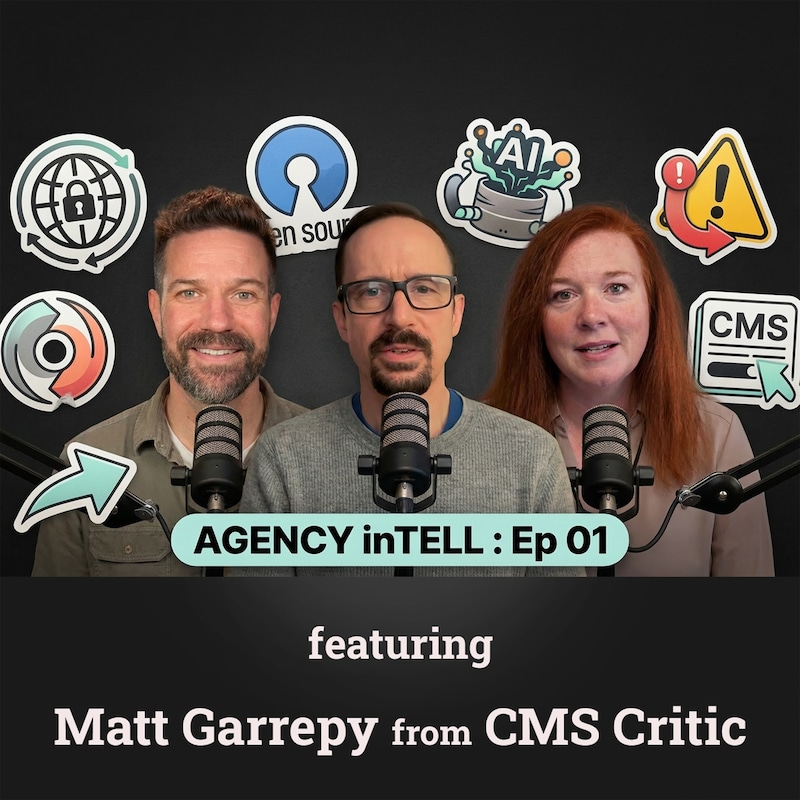
Shownotes
Episode 1: The Future of CMS, Open Source, and Agency Strategies in 2026
Welcome to the inaugural episode of Agency Intel, where we explore the evolving landscape of digital agencies, content management systems, and emerging AI tools. In this episode, hosts Roger and Robbie dive into the realities of open source dominance, CMS innovations, and practical advice for agencies navigating rapid technological change.
Key Topics:
- The rising prominence of open source CMS at enterprise levels in 2026, as predicted by industry expert Matt Garrapey.
- Insights from Matt on Drupal CMS 2.0, emphasizing AI integration, user-friendly prompting, and structured data benefits.
- The importance of agencies positioning themselves as field experts and trusted guides amid AI and digital sovereignty challenges.
- Practical strategies for local networking and face-to-face engagement to grow your agency’s presence.
- A deep dive into AI tools like Whisper Flow for improving productivity through voice-to-text dictation and correction.
- The shift in agency business models towards building practices around AI, content modeling, and UX customization.
- The significance of fundamental content management fundamentals, even amid noisy AI trends.
- The evolving role of agencies as creators, validators, and transformers in the AI-enabled digital ecosystem.
- Personal self-care tips including exercise and travel hacks for agency leaders to avoid burnout.
Timestamps:
- 00:00 - Welcome and podcast origins discussing agency tales
- 02:11 - Guest introduction: Matt from CMS Critic previews Joomla Conference insights
- 03:20 - The significance of open source in 2026, emerging trends
- 06:12 - The story behind JDAY USA and the open source community
- 08:00 - Matt’s journey from agency owner to CMS authority
- 13:45 - How CMS platforms are integrating AI: winners and laggards
- 17:00 - The evolution of content workflows with agents and AI models
- 21:13 - Practical agency strategies for AI adoption and client guidance
- 27:21 - Human judgment, opportunity, and agency evolution in AI era
- 30:20 - Regulatory landscapes, geo-targeting, and agency advising
- 33:50 - The importance of agency expertise in AI-driven content and experience design
- 37:20 - Strategy tips: starting with strategy, fundamentals, and internal advocacy
- 44:44 - Wrap-up, follow-up on Drupal 2.0, and future hot topics
Resources & Links:
- CMS Critic
- Drupal 2.0 Announcement Article
- Joomla Conference 2024
- Whisper Flow AI Tool
- Netlify apps & AI tools
- Greg Dunlop's Designing Content Authoring Experiences
Connect with Matt Garrapey:
Additional Notes:
- Emphasis on the importance of local networking — start low-cost, build trust face-to-face.
- The agency’s role as an innovator, guide, and technical partner in AI transformation.
- Self-care tips for agency leaders – exercise, travel, and purposeful downtime.
Enjoy this first look into the future of CMS and agency strategies. Stay tuned for upcoming guests and deeper dives into AI, web development, and entrepreneurship.
Transcripts
Hey, Robbie.
2
:Hey Roger, how are you doing?
3
:I'm doing fantastic.
4
:Um, I hear that we have a podcast called agency Intel.
5
:Tell me about this.
6
:Yes.
7
:So, yeah, so you and I were speaking at a conference recently going like, hey, one, we
were talking about all the podcasts that we love.
8
:And then we were like, we should do a podcast.
9
:And then we're like, what should we do a podcast about?
10
:And actually, think.
11
:question.
12
:What should we do a podcast about?
13
:And that's when we realized that you have an agency.
14
:All I do is talk to agencies.
15
:So maybe we should do a podcast about agencies.
16
:sounded like a good idea at the time.
17
:And we've actually recorded something now.
18
:So I think we have a podcast.
19
:Hopefully it's not just one podcast.
20
:think I might've blacked out in the hour since we recorded this.
21
:What did we just record?
22
:Well, for our first podcast out of the gate here, we actually have an amazing guest that
we're going to talk to.
23
:We like to call these our sources or our informants, not guest, because we're out there
gathering intel for all these agencies.
24
:If we don't know it, we probably can find someone who knows it.
25
:Absolutely, absolutely.
26
:So
27
:we talked with Matt from CMS critic and I think it's a pretty darn interesting
conversation We tried to shoot for 20 to 30 minutes.
28
:We definitely blew that the doors off of that uh But what I really thought was interesting
with this conversation was just Matt's uh
29
:Huge breadth of knowledge.
30
:He's been at this game for a long time.
31
:We covered a lot of ground and I'm just really excited for people to take a listen to it
and see what they think.
32
:What do you say?
33
:Should we play it for him?
34
:I say, let's hop into the interview.
35
:welcome to the Agency Intel podcast.
36
:We're here with an amazing guest, Matt from CMS critic.
37
:Matt, how are you today?
38
:I'm great.
39
:Amazing man.
40
:That's a I'm already on a pedestal.
41
:So I got to live up to that.
42
:uh
43
:So we're really excited to have you on the show.
44
:you know, kind of the motif of the Agency Intel podcast is we're a little bit in the
secret agent world.
45
:So you're not a guest, you're actually a source and we're diving into, oh, maybe, oh,
actually, yes, that's right.
46
:We're doing signals intelligence with this one because CMS critic is the resource for all
things CMS on the internet.
47
:And so today we're gonna be looking at
48
:how you have your eyes on every sector of the digital perimeter and kind of diving into
where you're seeing things in the CMS world, how agencies are kind of responding to these
49
:things.
50
:And we'll get into a lot of questions on that.
51
:One thing that's really interesting though that I wanted to kind of dive into a little bit
or at least highlight on is you're going to be talking at the Joomla conference here
52
:coming up.
53
:Tell us a little bit about that.
54
:Yeah.
55
:You know, it's kind of been organic.
56
:J-Day USA is happening in Delray Beach the end of April.
57
:I see Robbie nodding.
58
:So, you know, it's obviously some visibility around that.
59
:And, you know, it's an interesting year because, you know, Juma just celebrated 20th, its
20th anniversary.
60
:Interestingly, Drupal just celebrated 25.
61
:So there's, you know, we're we're at a point in history where
62
:A lot of these platforms and communities have been around for a long time.
63
:And with AI and the discussions we're having around digital sovereignty, uh this really
feels like the year of open source.
64
:I think a lot of eyeballs, particularly at the enterprise level, are really reassessing oh
the impact and value that open source brings to uh the equation.
65
:And we've seen that kind of play out.
66
:I've talked to lot of uh enterprises and lot of organizations that are uh adopting more
open source.
67
:And if we're honest about
68
:But open source is up and down our stack already, right?
69
:using base Linux, we're using Kubernetes, all of these things are open source on some
level.
70
:uh And I think there's a great heritage there.
71
:And I think in the CMS world, uh that's just been further crystallized by uh some of the
challenges we've seen over the last two years, obviously, some in WordPress and kind of
72
:the evolution of how those organizations are establishing a better foothold around their
digital sovereignty.
73
:How do we secure the software supply chain?
74
:So to go full circle, I've been having these conversations with a lot of open source
75
:uh leadership from typo three I did their impact awards uh at the end of last year saw
some really great projects a lot of adoption of AI and been talking to you know a lot of
76
:leaders in agencies about uh their open source practice and uh That kind of led to this
great opportunity with the people are organizing Jada USA uh And I think this is really
77
:going to be the kind of the substance and topic of what I'm to talk about is how I'm
seeing this sort of
78
:kind of bubble up and surface that as governments and organizations really tune into how
digital sovereignty is such an important consideration that they're looking to open
79
:source.
80
:mean, the country of Switzerland is only dealing in open source when it comes to uh
building out any kind of application for a service that they have.
81
:So I think you see it, the evidence is there.
82
:uh And at the same time, just dealing with the of the regulatory challenges that have been
surfacing as well.
83
:So maybe a long-winded way for me to get to why this happened with Joomla, but I'm excited
about it.
84
:I think it's great that we're putting more emphasis and more eyeballs on what's happening
with open source.
85
:Absolutely.
86
:yeah, Matt, so I was actually one of the founders of JDAY USA.
87
:It's a very good conference.
88
:We did that coming out of pandemic.
89
:It's like I used to be involved with JDAY Texas before that.
90
:And then a lot of us that were doing the JDAY, we were just like, hey, we need to combine
after.
91
:pandemic, right?
92
:I mean, was just, none of us could sustain on our own.
93
:And so that's why we combined it into the USA event.
94
:And I'm so glad that they're still doing it.
95
:I still get notifications.
96
:So yes, I saw it was coming up.
97
:Unfortunately, I have a work conflict, so I won't be able to be there.
98
:But I am so glad to see that they're still moving forward.
99
:And so you're going to talk about open source there.
100
:I'm just telling you, it be very well received at a Joomla conference.
101
:Yeah, yeah.
102
:it's interesting.
103
:I'm not going to tell you anything you don't know, but oftentimes, you people will ask,
where's Joomla?
104
:Like, where's Joomla today?
105
:And it's helpful, right?
106
:I think, you know, when I talked to type three, type 03 agencies, when I was in Frankfurt
last summer at our CMS summit event, there was a good contingent of type 03 agencies
107
:there.
108
:Many of them, as Roger would say, came over for our CMS kickoff as well.
109
:And having that representation in the room of bringing together the different communities,
110
:is something unique that we're doing.
111
:In fact, later this year in October, we'll be holding what we're calling Open Source CMS
Conference.
112
:And it's an opportunity to bring everyone to the table and really talk about the trends,
the challenges, and like I said, the opportunities that I think are surfacing for open
113
:source.
114
:So yeah, really excited.
115
:And that's great that you were involved with uh building the beachhead here in the US, but
it is a global phenomenon to like so many of these communities are.
116
:Absolutely.
117
:em And so I'm kind of interested, how did you get into your role that you are with CMS
Critic?
118
:How did it evolve that you got involved here?
119
:Yeah, how much time do we have?
120
:This is a big one.
121
:Ha ha ha ha.
122
:I'll give you the as a bridged version as possible.
123
:And then I'll kind of talk about, know, how my wife probably referred to WordPress as my
mistress for a period of time.
124
:But I started, so I came out of the agency business.
125
:I owned a digital agency for about 17 years.
126
:And I worked on a lot of really big transformation projects, everything from, you know,
sort of broader brand positioning all the way through the big technology considerations.
127
:at a time when content management systems were really in their infancy.
128
:Everything was big enterprise.
129
:It was a web sphere.
130
:It was SAP.
131
:uh I was working almost exclusively in Silicon Valley for an agency that I was a part
owner of.
132
:uh And we basically dealt in that channel, in that corridor of uh startups, all the way up
to the of the divisional level of the IBMs, Microsofts.
133
:uh And then, I'd say more niche types of technologies, but very well established players
in things like the
134
:video streaming video technology field.
135
:So I had this really crazy, well-rounded experience dealing with the mechanics of owning
an agency, which, you know, for basically the entire history of agencies in our uh
136
:contemporary culture has been challenging, right?
137
:We've been through a number of different, uh we'll call it, we'll call them economic
crucibles, where we've had to sort of navigate through recessions.
138
:uh That's been really hard, I think as an agency
139
:or kind of understanding where to squeeze money out of rocks and how to effectively bring
value to the table.
140
:And through the evolution of the internet and kind of the rise of more digital in
everything that we're doing day to day, I was there for the ride.
141
:And interestingly, I would say it was not quite a side hustle, but I was doing some
consulting for people kind of making the exit from uh like almost an enterprise or
142
:commercial leadership role into professional consulting.
143
:me up and say, you know, we work together at XYZ company.
144
:I'm leaving to start my own gig.
145
:I really need a website.
146
:So I'd spend nights and weekends making these cool little WordPress websites.
147
:And after a while, had like hundreds of these things.
148
:My partner and I would just hammer these things out and we got really good at it.
149
:um And I came to really love how the elegance of WordPress would enable me to feel like I
was in control of things.
150
:um And that, that translated into just like a mold.
151
:experience, I'll call it a dalliance with WordPress as sort of a go-to.
152
:And at the same time, I was working uh in my day-to-day with big platforms like HubSpot,
you know, that were demanding a lot of uh big enterprise types of considerations.
153
:Along with that, kind of along the trail, when I was consulting with IBM, I was doing a
lot of work on the cybersecurity practice at GTS.
154
:So I learned a lot about really complex subjects and how to
155
:write and run content operations in a big organization.
156
:They had their own homegrown CMS internally and everything had to run through that and it
was cumbersome.
157
:uh And there were lots of more efficient tools that I saw out there.
158
:And many times my customers would come to me and ask, hey, what are good recommendations
that you can make for tools to accomplish XYZ?
159
:And that was everything from marketing automation all the way through the bigger CMS types
hat uh we saw through the mid:
160
:And then I had the good fortune after selling my agency in 2016, 2017 to work on the
product side.
161
:So what you see today as CMSCritic.com is actually run on a fully React Native CMS.
162
:Now prior to that, it was run on WordPress.
163
:It was run on Ghost, which is a blogging platform.
164
:So it's kind of gone through this evolution.
165
:I started doing, in earnest, the CMS critic, call it Chief Critic, Chief
166
:editor role around 2017-2018.
167
:And I had inherited it from a guy named Mike Johnston who started it uh in 2008.
168
:So I had this really rich domain authority and history of tracking everything that was
happening in the market.
169
:uh given my cross-section with all this experience, and of course we hit COVID and there
were some challenging times, but also opportunities for us to embrace what was happening
170
:from a digital transformation perspective.
171
:uh
172
:And that kind of led us into this just...
173
:crazy ride of uh people coming to us, wanting to tell their stories, share their vision.
174
:And that's where we're at today is we really consider ourselves to be the domain authority
for content management.
175
:uh We pay attention to all corners of it.
176
:As Roger said, it's a big job.
177
:But I love the people aspect of it over products.
178
:I think products are what we deal in, but people, really represent the heart of what we
do.
179
:So having these conversations, doing this kind of work or talking to the communities,
180
:I'm on the ground at events talking to agencies, talking to customers.
181
:That's the work I really love.
182
:And I think that's what helps illustrate and demonstrate to buyers where they can place
their trust in their vets.
183
:Awesome.
184
:It's always interesting to talk to you because you're involved in so much more of the CMS
world than I am.
185
:Like I'm very WordPress focused.
186
:and so I'm curious to hear your thoughts on, you know, AI is a huge component in
everything of everything right now.
187
:But at the conference a couple of weeks ago, we were talking about how people are actually
implementing it and into their workflows.
188
:And I'm curious to hear your thoughts on
189
:which CMSs you feel are maybe catching this wave and which ones are maybe either playing
catch up or just totally missing out on.
190
:Yeah, so this is, uh you put me on the spot here.
191
:uh I'm not gonna pick winners.
192
:uh I think, uh you know, to be as objective as possible, I will say that the, everyone is
doing it, right?
193
:And has, I think, been doing it on some order of magnitude.
194
:uh Robbie, you've probably seen this too, that, you know, regardless of where you're at in
the market, uh you may be a small niche player, uh SMB focused.
195
:uh The large enterprises were the first, like,
196
:I think I talked to Dean Barker optimistically at the end of 22 and 23, and they were
adding an image generator, which was making really awful pictures.
197
:But it was novel.
198
:like Reid Hoffman, you just embrace the crudeness, you try things, and you throw it up
against the wall.
199
:And I've known Alex Asperger, the CEO there for a while now, and we've had some great
conversations along the way about the evolution.
200
:You can find the articles on the site.
201
:And I think the...
202
:The thing that I've seen consistently is that platforms have been trying to find their
footing around it.
203
:Where is the real value?
204
:And some were earlier to it, know, case in point, like Content Stack in my earliest
conversations in:
205
:composable DXP, which is already something that was kind of a novel concept in the
pantheon of DXPs, which there's an argument that, you know, DXP actually isn't a product.
206
:It's just an assembly of different components.
207
:and they're uh prefabbed for you, so to speak, with not adjacent integrations, but
purpose-built integrations.
208
:uh And analysts have kind of chimed in that it is a category, but at the core of it is
still CMS.
209
:still content management is kind of the authority within the stack.
210
:But I think that effort to try to find footing uh for content stack was closely associated
to their very uh robust at that time.
211
:uh
212
:uh what we'll call like an early agent system for being able to execute things and
automate things.
213
:uh They had this product called Launch that made it very easy for you to spin up things
inside of a preset hosted environment, uh which again kind of evolved them from being just
214
:a headless CMS into something more.
215
:And that made it maybe a little bit more difficult to categorize them, but what really
matters at the end of the day is what can the customer do with it?
216
:And they were always clear about that.
217
:uh So I saw the early work of, think Christine,
218
:was the person on their team that was kind of heading up the, the initiative with AI.
219
:And I saw how they were using it in workflows, you know, this development of brand kits of
components and elements that would instead of it, just generating content, which I think a
220
:lot of, um, is a sacred garden, so to speak, or a sacred wall around the generation or
creation part of what we do, uh, as practitioners, they understood that and heard that
221
:from their users.
222
:And I think there was this, they walked this, this really great line of how do we enrich
223
:the tool so it's able to solve some of these tasks, you know, the burdensome things that
content creators don't want to worry about uh while enriching the content itself with
224
:things like the guardrails for, you know, brand specific uh text formatting, things like
that.
225
:So I saw those things start to enter the equation in 2023.
226
:Other platforms started doing it.
227
:You know, I saw Akwae starting to do it.
228
:I saw other tools starting to embrace that.
229
:And if you kind of fast forward, if you look at 24 is kind of the year of reckoning around
composability that many of the headless players, which, you know, they were starting to
230
:wake up to this too at that time, you know, that AI was going to be important, but they
needed to solve this problem with visual editing first.
231
:So, you know, getting marketers to feel like their product, their platform serve them as
well.
232
:So there was this movement through 24 and then into 25 as ChatGPT and
233
:and the rest of the models out there in the ecosystem.
234
:became good enough to handle jobs for a few seconds that produced decent results, really
good summaries.
235
:And then could be applied to the mechanisms of AI could be applied to things like
workflows.
236
:That's about the time that agents really started to enter the equation.
237
:And I'd say end of 24 into 25, attending the mock alliances conference, they call it the
composable conference.
238
:I saw the really early frameworks of how an agentic system was gonna play out.
239
:So when I look at today, 25 into 26, I think we're really at this tipping point last year
of agents being things that are performant, that are reliable, they can actually deliver.
240
:At the same time, only 5 % of enterprises actually have agentic systems that are in
production.
241
:So it's a very small number.
242
:There's a lot of room for growth.
243
:And I've been working with a company called CleanLab oh to kind of take their data, kind
of cross-reference it with what I'm hearing in CMS.
244
:And you know, they're going to
245
:be challenges we're going to hit a wall with way agents can actually perform and what
they, what kinds of jobs they can handle.
246
:Um, but I would say tools like optimize, these, an example have purposefully abstracted
Opal, which is their AI sort of their AI system, um, which started as an assistant has
247
:evolved into something much more.
248
:And they've removed it from sort of the core considerations within the system so that it
can kind of live above it and enable agencies as
249
:example to build their own uh Opal based agent systems or task agents to uh utilize with
their customers, right?
250
:So they see an opportunity and this is from Kevin Lee, their product, VPO product.
251
:uh They see a world where agencies are able to take Opal.
252
:and build out a business practice on it.
253
:And I think this gets to the core of the real challenge for an opportunity for agencies in
26 is how do we work with these vendors that have great authority, right, that have great
254
:trust, many of them are FedRAMPed, HIPAA compliant, they do things that I would say the
SMB focused platforms are gonna struggle with.
255
:Okay.
256
:going to remain in market and they're going to have a strong business case to make around
that.
257
:But if they can provide an on-ramp for agencies to be able to harness those tools and be
creative and build a practice around it, know, again, Optimizedly has, you know, what they
258
:call a geo-ready CMS.
259
:Sitecore has Sitecore AI, which is sort of four component elements that allow a lot of
customization around how you use AI.
260
:There's some really great thinking.
261
:thing I'll say before I hand it back to you is uh in all of this right I've mentioned a
few brands by name but in all of this there are great
262
:really awesome examples of how uh maybe small niche players are innovating and doing
interesting things.
263
:So it's important to pay attention to what's out there.
264
:But I think the considerations for the buyer uh are going to, the biggest challenge is
going to be how do I see the forest through the trees in this?
265
:How do I cut through the noise and the confusion?
266
:And that's really what I think we're all trying to do.
267
:In fact, I just talked to Matt Reed on your team and one of the
268
:things we talked about was the challenge of understanding, particularly in WordPress, how
do we evolve this ecosystem in light of AI?
269
:How are we helping them to embrace concepts like geo?
270
:It's really hard, right?
271
:Because it's now additional work that they have to take on to understand and decrypt all
of this.
272
:that's why we have sources like, not just CMS Critic, but other sources out in the
marketplace that hopefully provide the guidance and help to kind of cut through that.
273
:So on CMS Critic, you're covering both SAS and uh open source CMS, is correct?
274
:pretty much everything's SaaS, uh but there are still traditional platforms that are
straddling.
275
:And in fact, I'd even say, Robbie, this push, like F5 Networks was talking about how
people are spinning up data centers on their own now, right?
276
:So this whole idea of maybe having your server back in your closet somewhere, which back
in Rackspace days, I mean, that's how we lived, right?
277
:We had to get on servers, we had to use Chef to update scripts manually.
278
:That's a lost art form.
279
:we're gonna have to do all that stuff again, but I think we're gonna go back to having a
hybrid model of owning our data for training purposes for our own LLMs, but also that
280
:digital sovereignty piece.
281
:So I think, yeah, we try to pay attention to everything commercially, oh what's happening
out there with the bigger proprietary platforms.
282
:But yeah, I think open source is...
283
:I mean, look, even those big platforms are using Linux and Kubernetes and whatnot.
284
:there's some blend of open or some editor component or something that's open source as
well.
285
:Yeah, open source is integrated pretty well at this point.
286
:I think it's just kind of that head-end product, the CMS itself or the SAS CMS itself or
the, you know, what I'm saying, this that end product, excuse me, that we're seeing where
287
:some is open source and some is not.
288
:And what you were talking about earlier where they're packaging in their AI tools, but
they're kind of almost making it, I'll call it modular, add on to a lot of their tools
289
:with these AI tools.
290
:Do you think that that is
291
:because it's easier to work that way?
292
:Do you think it's so that they'll be able to monetize separately or so that they would be
able to possibly sell out that piece?
293
:Because as we know, every time we get those little players in the AI space that are like
kind of starting to take off, they get bought.
294
:And so do you think that's part of the intention with keeping their AI tools as its own
little entity as it were?
295
:It's tough to say.
296
:think it's, um there may be some of that calculus in the equation.
297
:I think it's also kind of hedging bets.
298
:And one thing I really like about our CMS kickoff event this year is that we really
focused on fundamentals.
299
:You know, I have an article coming out hopefully this weekend that kind of wraps up uh
what I saw.
300
:And I think at a 50,000 foot level, I felt like there was more.
301
:attention being paid to content modeling, to ontology, to things that actually impact the
day-to-day work of content operations teams.
302
:And AI is important to them, right?
303
:But, you know, even in my conversations with Greg Dunlop, who wrote this great book last
year called Designing Content Authoring Experiences, we actually had him on a podcast
304
:episode.
305
:you know, he, he used to work for the Seattle Times and he wrote this book that reminded
us about all the things that are important in a CMS experience.
306
:You know, how do you make it the best possible
307
:experience for an editor to do his or her job.
308
:And the crazy thing is that at the end I said, okay, well, how do you see AI transforming
all of this?
309
:And he's like, you I'm not really paying attention to AI.
310
:It's just, it's very noisy.
311
:And he knew that that was a bit of a loaded thing to say, but at the same time, it's like,
you know, we're not even paying attention to these fundamentals.
312
:We're over here.
313
:you know, putting our eyes on this shiny thing and is it actually improving the quality of
what editors do on a day to day basis?
314
:And I thought that was so smart that he was able to say that this look, what let's get
this right.
315
:And if AI can help us do that, like solve accessibility problems, I see, um, and I, I
allude to this in a couple of articles, Domo just came out with a, a, a really great tool
316
:called app catalyst, which is
317
:a way to build apps with prompts, right?
318
:Inside their tool.
319
:Now there are basically dashboards that, you know, leverage the Domo data components.
320
:But what I'm seeing is this, is UX as being kind of the last mile, right?
321
:And this is what Greg was talking about.
322
:He's like, how do you make the editing experience, the flow experience better for people,
for humans?
323
:And I think for CMSs to differentiate in a, you know, vanilla sea of sameness,
324
:focusing on the ability to craft or curate that experience for users where it's dynamic,
you can focus on certain things, you can perhaps in the future craft custom app dashboards
325
:or components or elements that help you do your job better.
326
:I think that's the key.
327
:And uh Nicole France, who used to be at Contentful and Constellation, uh she's an analyst,
she at one of our conferences the year before,
328
:talked about how.
329
:uh
330
:Adaptability and usability were the key.
331
:Can these platforms that we're using right now, and WordPress being one of them, can any
of these platforms really achieve that?
332
:Can they enable adaptability for users?
333
:Can the user have more of a voice in being able to alter the fabric of their UX so they
can do their job better?
334
:And I think this speaks to specialization.
335
:If you have a very specific market focus, will be great to have a workflow that is
designed around
336
:academic experiences or designed around, uh you know, finance, or if you have a retail
digital commerce workload, being able to kind of conjure that, that customization is going
337
:to be a really powerful thing.
338
:I'm now starting to see the signs of that happening in the perimeter.
339
:And now I expect that we'll see more control over, over UX.
340
:In fact, I know of platforms I can't quite talk about right now, but some that are, that
are doing this, that are beginning to experiment with this.
341
:So it's an exciting time.
342
:It's scary.
343
:at the same time, right?
344
:uh But I think if what I found very encouraging at this year's event, uh the kickoff two
weeks ago is that.
345
:We're not talking so much about AI displacement like we did last year.
346
:I think people are feeling, I say this as Amazon just laid off 16,000 people.
347
:But the right sizing is going to continue uh and there's nothing we can do about that.
348
:But I don't think that the skill, the up-skilling that we've seen with people, the
limitations we run into with AI and the need for human judgment in all of this, right?
349
:That it is going to come down to making us better.
350
:equipped to do our job.
351
:It's not going to get us to a four day work week.
352
:I think that's the fallacy of all of this is that it's just creating more complexity.
353
:But I do see us shifting the conversation into opportunity instead of kind of, you know,
dragged down into the pit of hell that, know, AI is going to replace my job.
354
:Maybe someday, but I think we're a long way off from that.
355
:Excellent.
356
:Excellent insight, Matt, as always, you know, Carly Santi had a presentation talking about
where she kind of surveyed a bunch of agencies at the talk and there was still a lot of
357
:tension.
358
:There was still a lot of angst and uncertainty and existential dread, if you will.
359
:You know, it's called the Agency Intel Podcast.
360
:What would you tell an agency who is trying to navigate this in 2026 to
361
:you know, what should they be focused on and what can they kind of just let go by the
wayside at this point?
362
:Let me, I'm not gonna get into let go yet.
363
:Let me, let me, while I'll have the back of my brain working on that while the front is,
goes into some of the things I've actually talked to agencies about.
364
:When I was at Storyblocks JoyConf, it was their first big conference held in Amsterdam in
October.
365
:And, you know, again, 2025 was a mixed bag as Carla pointed out in her data.
366
:I talked to a lot of European agencies at that event
367
:and kind of cross-referenced it with what I'd heard in Montreal and also in Frankfurt over
the summer at our CMS Summit event.
368
:And uh from type 03, dealing with uh as a community, dealing with some of the compliance
challenges that are happening in Europe, which by the way are being softened.
369
:They're being retooled a little bit because there was a lot of uh animus and a lot of
concern about uh Europe being as competitive from a technology perspective.
370
:So we're seeing a little bit of softening around those requirements and that's gonna
create a reprieve.
371
:But I don't want us to dissuade from the fact that we have good
372
:good motion around creating policy.
373
:And if governments decide that, you know, they're representing the people and they decide
that this is a good policy around digital sovereignty, uh I think that finding a balance
374
:in there where technology can coexist with that and support the goals of, you know,
protecting people's data, giving them the choice to be able you know, dealing with cookies
375
:and things like that, I think that's all healthy.
376
:So I think that what I was hearing from agencies across that spectrum from summer to fall
uh was like loud and
377
:clear that they were seeing opportunities with their customers to make sense of where to
invest their dollars around things like uh GEO.
378
:And I know I say GEO, I said GEO at the event, I'm gonna stick with it.
379
:I'm gonna get goaded into saying GEO, but it just doesn't come naturally.
380
:Yeah, because we don't say CEO, right?
381
:We say SEO.
382
:Right, so I'm not doing it.
383
:I'm gonna die on the film.
384
:But I think that building practices around...
385
:these areas where an agency is not just executing, but they are the of the
prognosticators, the people who are reading the tea leaves, they're the outside resource
386
:that I think enterprises can rely on for guidance.
387
:And the fact that they have distributed better over the last couple of years, being sort
of multi CMS representative instead of having maybe a single platform they build on, gives
388
:them the opportunity to see how different tools work in different
389
:use cases, I think the tools got more competitive with their partner programs as a result.
390
:And I think that's better for agencies to kind of place their bets there.
391
:But I think out of all of it, they get the benefit of uh being able to learn from the
field, go to their customers and help them uh engineer better solutions to increase that
392
:AI visibility, right?
393
:To address the challenge of, how are we going to show up in the answer engines?
394
:And then I think the more they can stay on the
395
:edge with say, you know, a site core optimise, the obviously being at the top of the
market.
396
:they're doing a lot to enrich their partner communities around things like, you know, how
chat GPT is going to monetize, how they're going to enable web-like experiences inside the
397
:answer engines, introducing carousels for products, things like that.
398
:Um, these platforms are working on solutions that are going to enable brands to do this.
399
:Agencies are on the front line of being able to unpack how they can enable them.
400
:And again, the business model is going to change, right?
401
:And this is, I heard this back at Opticon the year before actually, you know, there was a
lot of pressure.
402
:think I talked to Horizontal and a few other agencies that were, you know, really
challenged by the, you know, how do we, it was, was a Hero Digital.
403
:There's an article on CMS critic.
404
:How do we, how do we unpack all the tools that are coming from the Opti as an example,
from their ecosystem?
405
:You need an agency.
406
:agency to do that, right?
407
:You may have an internal practice with a few people on your team, but odds are they're
spread thin running these programs, running these campaigns.
408
:A CMP is a very complicated thing to implement and manage.
409
:Having an agency that can support your implementation, that understands the intricacies
and has sort of a feed on what the vendor is doing, and they're able to kind of help you
410
:predict that.
411
:I think being as close to, from the partner community perspective, as close to their kind
of their horizon,
412
:is a really great way to enrich your agency and prepare for the future.
413
:And then the last thing is, again, Opal is just one example, but there are other ways.
414
:We saw over the last couple of years the rise of accelerators, where agencies were kind of
almost getting into the product business, right?
415
:How do we rapidly deploy and build out solutions for Adobe, as an example?
416
:I think the pivot is now in the direction of how can an agency better embrace the AI
frontier so that they're able to position
417
:themselves as not just being the consultant, but also to execute uh around some of these
newer techniques and strategies.
418
:So having your team be as smart as possible, uh investing in them to get the skills and
the training, and then knowing that AI literacy is an ongoing thing, right?
419
:It's not something, certainly not one and done.
420
:You're going to have to do it frequently, maybe even almost daily.
421
:But I think that's the future for agencies.
422
:There's still a great place and a great opportunity for them to build new practices.
423
:this.
424
:And Matt, I will say, I'll put on my agency hat, I've had an agency for 24 years.
425
:And I will say that is 100 % correct.
426
:And any agency that's been in business for a while, digital agency, website agency, media
agency, whatever they want to call themselves, if they've been in business for a long
427
:time, they've had to pivot many times anyway, as we know, as technology.
428
:I mean, when I started my agency 24 years ago, we were doing flash and action scripting.
429
:You know, obviously we're not doing that now, right?
430
:So, you know, and so as things change, CMS's came out and became more acceptable to use
for clients and things like that.
431
:And, and I, I feel like you're right.
432
:We are kind of agents, agencies are the, we're, we're the agents out there for our clients
that we're finding out what is, what, what should they be using?
433
:You know, and I will say,
434
:even if you don't want to do it as an agency, it's going to start to happen.
435
:I will be in meetings all the time with my clients and I'll mention something that I did
with an AI tool and they're like, wait, what did you do?
436
:could you do that for our business too?
437
:I mean, so use it to practice what you preach, right?
438
:So I say, use those tools, keep your people educated, educate yourself and do try to stay
on top of things because if your clients see you using it, they will trust you to help
439
:them use it too.
440
:It's a great point.
441
:Dogfooding your own stuff so that they can see it in action is a great way to kind of
demonstrate the sort of bleeding edge stuff that maybe you don't have customers that have
442
:invested in yet.
443
:And then I think, you know, if you look at AI 1 to Z, Bill Rogers, who was at our event as
well, he just, you know, started Ektron way back in the day, became part of Episerver and,
444
:you know, his great story about how now it's part of Optimizer, right?
445
:So there's still some workloads that run on Ektron.
446
:But I think, you know, his startup,
447
:up is solving a problem around, how do you, how do you sort of define uh the way an AI
assistant chat assistant can be hyper focused on uh website content so that can make that,
448
:that move much easier.
449
:But, you know, the way I approach AI as a practitioner.
450
:I'm to put that hat on kind of separate out, you know, I did a, a, a last July, a
hackathon out in San Francisco that was sponsored by AWS.
451
:And it was about enterprise.
452
:agents in MCP and so I try to stay very close to what's happening in from a technology
perspective but the way I approach it is that the the app should be the last stop right
453
:shouldn't be the first thing that you buy
454
:Hmm.
455
:of AI, need to understand from the AI literacy piece is so important.
456
:We need to understand what it is that we're building, uh the impact it's going to have.
457
:We so frequently hook stuff up without thinking about the consequences.
458
:This is why so many people have had to pull down chat bots because of, yeah, sure, prompt
engineering and things that we know about.
459
:But there are things happening behind the scenes that are even scarier, you know, from a
security perspective.
460
:So I think we start the journey with the
461
:plan strategy.
462
:Uh, and of course the pressure here is, well, everyone else is doing it.
463
:Can I just slap a chat bot on my site and we've, we've got AI and that's the wrong way to
think about AI.
464
:It's not a tool, right?
465
:It's, is a technology.
466
:It is a, it's not a feature of your product.
467
:is something that's enriching your product, but if that's all you've got, that's not, you
don't have value.
468
:So I think you start the journey with understanding, um, going through that process of
mapping and planning, and then you have to have internal advocates, right?
469
:which is again, think an opportunity for agencies to come in, work with their customers to
be those advocates, train them, get them up to speed, be the help desk service, Help desk
470
:service contracts are still going to be a thing.
471
:And the last stop should be.
472
:Create an app, right?
473
:Build an app now based on that solid foundation.
474
:And if we slowed down enough to do these things the right way, we would have better
stories to tell.
475
:But um again, Reid Hoffman would say, embrace the crudeness.
476
:You gotta go to market now and try things.
477
:And as long as it doesn't end up with uh a $50,000 AWS bill you didn't expect or a
security breach that gets all over the newspaper, then sure, have at it.
478
:uh
479
:things like blue-green deployments, good production strategies to make sure that we can
test things properly.
480
:And guess what?
481
:This is all the domain of agencies, right?
482
:Having those kinds of really smart strategies, if you guys invest in that, you're gonna
bring tremendous value to your enterprise customers.
483
:awesome.
484
:Wow.
485
:Wow.
486
:That was a lot.
487
:uh Matt, this has been great.
488
:Thank you so much.
489
:We're definitely at where we want to be on this.
490
:In terms of, we've mentioned the website, CMS critic a few times.
491
:We want to see people going there and catching all of your field reports.
492
:When can we expect to see something from the Joomla conference and where else can people
follow you on the line?
493
:Yeah, well, LinkedIn's a great place to get me.
494
:It's just Matt Garrapey, very easy to find.
495
:I think I'm the only one.
496
:I might be the only one.
497
:I have that advantage.
498
:And what it also means, I don't have a lot of redundancy, but we do have a team and we're
at a lot of events.
499
:I think you and I talked the other day about Meetups as being a place.
500
:We like to show up at Meetups.
501
:We want to have our fingers in the pulse in the open source community as well.
502
:Doing things like award shows.
503
:uh is just an opportunity for me to see the innovation that's happening.
504
:uh And so I'm definitely making the round circuits.
505
:Obviously, Yanis and I, Yanis Boy from Boy & Company have been partnering for a long time
on the big events that we're doing.
506
:And it's great that you were able to come to that as well.
507
:uh But CMScritic.com is a place to kind of get the story, the narrative.
508
:We don't do it like other platforms.
509
:We really try to dig into and understand what the leaders of companies are focused on.
510
:uh what CTOs, CIOs are thinking about, what is the roadmap?
511
:uh And we believe that the storytelling is such an important part of it.
512
:So we like to be the town square for a lot of the sort of vision hunting.
513
:uh then I think, uh so yeah, JDA USA is coming up.
514
:We'll have a couple of mock alliance conferences this year.
515
:I'm also on the board at the mock alliance, the executive advisory board.
516
:uh So I'll be there, I think in October and then yeah,
517
:just a bunch of vendor events that'll be happening this year as well.
518
:So very busy, but it's exciting.
519
:Cool.
520
:And I'm going to ask for one more little nugget of information from you.
521
:And that is you, when we were speaking before this, you mentioned you talked to Dries in
the Drupal world last week.
522
:And so maybe give us a few little things that we should look for in the Drupal world this
year.
523
:Okay, so for starters, you can go to CMScredit.com and one of the last articles we
published was an interview that I did with Dries about Drupal CMS 2.0, which is basically
524
:the biggest thing that they've done since, uh well, maybe in 25 years.
525
:uh I think there have been a lot of milestones along the way, but uh this big shift is
really embracing AI and bringing a lot more of, we'll call it the kind of marketer
526
:centricity to the way that Drupal is going to appeal, I think, to the future of the
development
527
:It's still going to be the go-to for developers who want to get their hands dirty.
528
:There's been a perception, I think, of Drupal being hard.
529
:In fact, the article is called hard hardly.
530
:Here's why Drupal CMS 2.0 is changing the game.
531
:And the way that it's approaching building now is more from that vibe coding perspective
of can I conjure a page with prompts?
532
:Obviously the role of development and being able to get into code is so important for
being able to enable
533
:apps that have production worthiness.
534
:This is something Matt Billman at Netlify and I have talked about frequently.
535
:He's actually going to be on with me here very soon.
536
:uh And that whole part of the journey, we still need really smart developers to help make
sure things are performant and they're going to be OK when they're alive in the wild.
537
:uh But making it easier to prototype, making it faster to build out web pages and
customize aspects of it, uh the tooling is now there in Drupal.
538
:So I think that's a kind of a
539
:signal what they're telegraphing for the rest of the open source world is, hey, we're
turning a corner where it's going to be more dynamic.
540
:You know, the, the expectations of the CMS user are evolving to be inclusive in these
communities of that type of user, that marketer who is low code, no code, and AI is
541
:becoming a real strength in all of that.
542
:And the last thing I'll say is because Drupal has been hard, right?
543
:For some people, because it's been so structured.
544
:It's now using that heritage of structure where it's, you know, had the strong content
modeling, strong uh structure data approach.
545
:uh That's now serving its ability to better enhance the AI output, right?
546
:So for the GEO oh and AEO uh focus that organizations have, this is going to benefit that.
547
:So I think there's a lot of exciting things coming.
548
:uh And I expect to see that innovation.
549
:This is going to light a fire under every community.
550
:now.
551
:They'll see Drupal doing it.
552
:Everyone's going to jump on board with evolving their platforms.
553
:And I don't know, I'm super excited to see what happens now that we've seen this big
change.
554
:Yeah, that's interesting.
555
:I didn't even think about you're right that this the structure data behind that is going
to make it so much easier.
556
:It's like it makes me cry when I think about we could have had XML out there so much more
and it just never would take off.
557
:But boy, wouldn't it be nice today with AI that if we had XML websites out there
everywhere, but anyway.
558
:but now everybody's like doing markdown.
559
:So it's like this weird cycle of things, you know, we're back to it's like, we're back to
the old stuff.
560
:And I don't know, wake up tomorrow and people using flashing it, you know, it would shock
me because it's kind of like retro, you know, it's, I don't know, flash sites are cool.
561
:They were very cool.
562
:They were awesome.
563
:I loved them.
564
:Maybe we could go back to frames and we'll have our menu on the side frame and we'll have
them.
565
:ah
566
:my.
567
:that.
568
:You and me are gonna work on that.
569
:Awesome.
570
:All right.
571
:Thank you so much, Matt.
572
:We really appreciate it.
573
:We will have to have you back on the show at some point.
574
:Thank you so much.
575
:It's been awesome guys.
576
:Thank you so much.
577
:Appreciate it.
578
:Awesome.
579
:Okay.
580
:So Roger, that was an amazing call talk that we just had.
581
:mean, who we, but let's debrief this for our agencies out there listening.
582
:Yes.
583
:For the agents listening, first of all, I hope that your brain hasn't completely melted
out of your ears.
584
:There was a lot that we covered there and I, know, there was, there's a lot of things to
pick apart.
585
:Robbie, I'm really interested to hear your thoughts about how much Matt was saying that
:
586
:He's even seeing it at the enterprise level.
587
:What's your take there as a long time open source advocate?
588
:I was going to say, which, you know, that just made my little open source heart very happy
to hear that.
589
:um And I hope that Matt is true with his predictions because that would be amazing.
590
:And I will say, being someone who has been in the open source world for 24 years here or
better, yeah, I kind of agree that things are, I mean, I work with a lot of, uh you know,
591
:government agencies or high level corporations.
592
:and they do incorporate open source already.
593
:And there has been even more talks of more tools that they want us to build for them using
open source.
594
:So, you know, he's onto something, I think.
595
:And so I hope, like I said, at the end of the year, we look at this and go like, yeah,
boy, he predicted that one.
596
:Absolutely.
597
:Drupal CMS 2.0 was mentioned because that's recently come out.
598
:um I have not dug into this at all, but from what I understand is it's focused on
marketers.
599
:It's got prompting built right into it.
600
:Have you played around with this at all?
601
:Have you dug into this?
602
:I haven't got to play around with it.
603
:I watched some of the presentations that they did on it and it looked pretty cool.
604
:And I will say, so, know, like if you looked at kind of your top three open source CMSs,
right?
605
:We've got WordPress, Drupal and Joomla, right?
606
:I mean, that's kind of been the top three for a long time.
607
:We have a lot of others that are doing great, but as far as percentage wise, those are
still our top three open source ones.
608
:um
609
:And with that being said, Drupal was always known to be the one that was the most
flexible, but also the most difficult, particularly for the end user.
610
:And that's partly because they have such a structured data back end.
611
:So you can't just have these wild, big open editors.
612
:You've got fields and things like that.
613
:So it's more structured on the back end, which is, it sounds like coming to be a good
thing for them for AI, which is great.
614
:um But what I was going to say is if they can use the AI tools to make this where it is
easier.
615
:So as an end user, I can go in there and go, I need to make a change on this page.
616
:And I'm basically just prompting an AI agent to do that work for me.
617
:And so it will be interesting to see.
618
:We are definitely going to have to try and get a Drupal person on here on the show this
year.
619
:Absolutely.
620
:Maybe we'll get Dries himself.
621
:I ran into him a couple of years ago.
622
:I got to say really down to earth, really nice guy.
623
:So if anybody's got any connections, let us know.
624
:Um, you know, another thing that was talked about was G E O or G O we're still not sure.
625
:Cause we don't say CEO, right?
626
:We say SEO.
627
:So what are we going to call this AI generated slop, uh, overviews?
628
:I don't know.
629
:you know, I did a lot of SEO work when I had my agency going, uh, of course this was like
16 years ago when all you had to do was put a YouTube video up and you were immediately
630
:number one for whatever keywords you put on that.
631
:Things have changed a lot since then.
632
:And it's really interesting to see, hear Matt's thoughts about how the enterprise is
approaching this and how agencies are trying to talk with their clients about all of this.
633
:I thought what was really fascinating though to kind of start trying to, you know, tie a
bow on this debrief ah was Matt's thoughts about how agencies are really the arbiters of
634
:all of this change that's happening.
635
:And that's what the clients hire an agency to do, right?
636
:To give them agency to handle stuff that they don't have time to deal with.
637
:The client needs to make widgets and sell them.
638
:They need the agency to help them market that and figure out how to interface into the
digital world.
639
:Uh, two last things to kind of throw in here.
640
:Um, there's, there's dog fooding and then the human layer.
641
:Um, so on the dog fooding perspective, you know, we're all using these AI tools in
different ways in our own workflows.
642
:It seems like it's just, you know, and it's kind of what we were just talking about there
is, you know, the, agencies are asking us about how to use these tools.
643
:we just need to start using them and then we can tell them, hey, either we can help you or
not help you.
644
:So I feel like the dog fooding part is pretty self-explanatory there.
645
:As far as the human layer and helping your own people maybe figure out how to be using
these tools and keep your own people motivated, um how are you guys approaching that uh
646
:inside of your agency?
647
:em And we're small.
648
:And so I think some agencies may do it a little differently, but we are more of, you know,
learning individually what we're interested in.
649
:Myself, I also listen to podcasts.
650
:You and I started talking podcast, you know, and because I listen to a lot of AI podcasts,
I get a lot of AI newsletters just trying to keep up.
651
:It's like drinking from a fire hose, though, trying to keep up with the data and all of
the new tools that are coming out.
652
:And so tools like podcast newsletters, I find those very valuable because they kind of
condense down the material for me.
653
:And then I can go, oh, that one really sounds interesting.
654
:Now let me dig my teeth into that one.
655
:And so that's kind of how.
656
:I've been training myself and then again, our people on the team, they're, they're like,
Hey, Robbie, there's this course.
657
:I think it might help me.
658
:I'm like, great, let's, let's try
659
:And so, you know, just digging into whatever tools you're using anyway, try to learn new
ones every week because it's weekly.
660
:You can learn new things and then pick the ones that you really think are valuable and dig
into those.
661
:And then those will be the ones that you'll wind up recommending to peers and clients.
662
:Wow, that was a heck of a debrief right there.
663
:I hope people are still with us.
664
:We've still got a couple more segments coming up.
665
:ah I think, should we wrap this debrief?
666
:I think we are a wrap on this one.
667
:All right, see you in the next segment.
668
:All right, team, this has been a heck of a first episode.
669
:I want to welcome you to a segment that we're calling Roger That.
670
:No surprise, I'm your guest, I'm your host for this one.
671
:And the whole point of this segment is really kind of to talk maybe about a business
aspect of running your agency and thinking through things.
672
:And I think, you know, we just had a really great conversation with Matt talking about AI.
673
:uh, agentic workflows, G E O or G O, however we're going to call that.
674
:And so for this segment, I really wanted to switch things up a little bit and talk about
field operations.
675
:And I, know, what we're seeing since COVID and especially since the rise of AI is there's
been a real push for in-person interactions.
676
:I'm witnessing this.
677
:I'm going to events, seeing people I haven't seen in years, which is always great.
678
:But then I'm also meeting a lot of new people and something that consistently comes up
again and again is how much people are valuing these in-person meetings now.
679
:And again, there's a combination of we're sitting behind our screens all day long, even if
we're on zoom calls, we're still behind the screen.
680
:And then now we're talking to these AI agents and they're giving us heaps of praise,
sycophants are, you know, just giving us what we want to hear all the time.
681
:And
682
:Instead we're really craving this face-to-face human interaction and so my biggest
suggestion in this Roger that is that we all need to be getting away from our screens We
683
:need to be getting out and meeting each other again and from a business perspective This
is gonna be how you grow your business.
684
:This is how you're gonna find new business.
685
:You're gonna make connections there's a saying your network is your net worth and I really
do believe in that
686
:That's how I find jobs.
687
:That's how I found clients.
688
:It's how I find friends.
689
:It's how I met my wife.
690
:I went out and I went to a bar and there she was and and now we've been married for 15
years coming up in March.
691
:So that's very exciting.
692
:So I wanted to give some tips here and kind of talk through this a little bit.
693
:I want us to focus on getting back into handshakes and actually meeting people face to
face.
694
:And so we want to look at from a couple of things.
695
:And the first thing I want to talk about is cost.
696
:You can go and spend a ton of money flying across the country, across the globe, going to
some big fancy thousand dollar a ticket event and not get any business.
697
:And now you're in the hole, right?
698
:Not only have you just spent a bunch of money, but you spend a bunch of time away from
working.
699
:So my advice is to start local.
700
:Go to meetup.com, find some local events that are happening right down the street.
701
:Go to a happy hour, go to a luncheon, go to
702
:you know, some very low level event that you can easily get to.
703
:And you can just start networking and start meeting people and talking about what's going
on, find out how people are using AI and things will start happening from that.
704
:And getting business from those is just as good as getting business from some really fancy
national event.
705
:So make sure you're doing some math, make sure you're looking at your costs, keep your
costs low.
706
:start practicing networking on the cheap, get good at it, and then start spending money on
that first class ticket and heading out and going to these events.
707
:Start doing some local reconnaissance, looking for these events.
708
:There's different types of events everywhere.
709
:Karaoke, maybe not the best for business networking, but who knows?
710
:You might find people, there's a lot of WordPressers that love to karaoke.
711
:So if you're looking for a WordPress developer, who knows, they might be there.
712
:But more specifically, there's WordPress meetups.
713
:Go to those to meet people that are either building with WordPress or have questions about
their WordPress website.
714
:That's an easy win.
715
:You can at least just give them some free advice, but they might end up hiring you.
716
:So look through all of that.
717
:Okay, so now we want to talk about not everybody's great at networking.
718
:I get that.
719
:Believe it or not, I am not a naturally extroverted person.
720
:I am very happy to stay home and sit on the couch and watch YouTube and hang out with my
dogs.
721
:It takes effort for me to go out and do these networking events.
722
:It can be very awkward for me sometimes.
723
:I have spent years getting over that by just doing it, by just jumping into the pool with
both feet first and taking that plunge and seeing what happens.
724
:And guess what?
725
:Not every time that I go up and talk to somebody, do they want to talk to me?
726
:And not every time that I go up and talk to somebody, do they become a customer?
727
:I'm okay with that.
728
:You have to understand that the first goal of networking is simply meeting people as
people.
729
:Then you take it from there.
730
:If you can get along and have a conversation together, then that might lead to a business
relationship.
731
:You never know.
732
:but you have to first start with just connecting with people.
733
:So start simple, go to these local events, say hi to people, make it a simple goal.
734
:I'm gonna talk to five people that I've never talked to today.
735
:Checklist, just get that done.
736
:Start with small, simple goals and learn to enjoy networking.
737
:So that's what I've got for you, Roger, that for today.
738
:Get out there, get into the field.
739
:meet some people, make some handshakes, make some connections, and grow your business.
740
:Hi, this is a segment called Robbie's Radar.
741
:And the idea is pretty simple.
742
:I'm constantly testing tools, platforms, apps, workflows, basically anything that has
promised to make my work life faster or smarter, or just maybe a little less chaotic.
743
:Because some of the tools that I've tried out have been flops, but some of them absolute
gold.
744
:So Robbie's Radar is where I'm gonna share the tech that's actually made it into my
day-to-day work.
745
:No sponsored fluff, no, yeah, I tried that once.
746
:These are tools that I'm actively using and that I think that other agency owners and
creators might also find beneficial.
747
:And since this is the first episode, I wanted to start with a tool that has already
changed how I work almost every single day, really.
748
:Let's talk about Whisper Flow.
749
:It's an AI tool and I've been using this one pretty regularly now, mainly on my desktop,
but I also have the mobile app installed.
750
:And now honestly, I think both are useful at different times.
751
:um
752
:So at a high level, whisper is a dictation tool, right?
753
:But calling it just transcription really does not do whisper justice.
754
:This thing doesn't just write down what you say, it fixes what you say.
755
:So as I'm talking, it's correcting grammar, it's adding punctuation, it's cleaning up
things, and even making smart adjustments on the fly.
756
:You know these moments where you're halfway through a sentence and your brain just kind of
changes direction.
757
:Yeah, well, whisper handles that like a rock star.
758
:And so, yes, you can even whisper into the mic so as not to disturb people around you.
759
:And it still hears you perfectly.
760
:For example, I might click into a Slack message to a team member and then hit the function
key to activate my whisper on the desktop.
761
:And then I just start talking.
762
:So let's just say that this time I'm going to say into the mic.
763
:Okay, that sounds good.
764
:Let's meet at...
765
:about that at 2 p.m.
766
:No, make that 3 p.m.
767
:And then we can sort out the next steps to actually take the site live.
768
:Actually, no, instead of take site live, say set the launch schedule.
769
:So now that sounded like a hot mess, right?
770
:But from that rambling, Whisper Flow will type out capital, okay, comma.
771
:That sounds good, period.
772
:Let's meet about that at 3 p.m., comma.
773
:And then we can sort out next steps to launch the launch schedule, to set the launch
schedule.
774
:period.
775
:Now, it not only punctuated and capitalized and did all those lovely things, spelled
everything properly, but then it also made those adjustments that I would have had to
776
:backspace, backspace, type again, backspace, type again.
777
:And it just did it.
778
:And it corrected it by my voice commands.
779
:So for me, this is huge.
780
:I am someone who thinks faster than I type by far.
781
:I form ideas out loud.
782
:I'll verbally brain up an email or a post or a script or a proposal.
783
:text message and a whole lot of slack messages.
784
:And Whisper turns that chaos into clean readable text, just like magic.
785
:So instead of staring at a cursor, I just talk.
786
:And when I stop, the text is already polished enough to use or at least very close.
787
:You probably will still have to touch it a little bit.
788
:But that alone, just getting to that point has saved me hours every week.
789
:And this is one of those tools that quietly upgrades your workflow.
790
:don't even notice it at first, and it's till you stop using it and then everything feels
slower.
791
:As a matter of fact, it tells you what your words per minute that you're typing, typing
with this, and mine usually average anywhere from 175 to 200 words per minute.
792
:No way I could ever type that fast.
793
:I'm just not that fast of a typist.
794
:So if you're curious about Whisper, I highly recommend you check it out.
795
:And yes, there's a free version.
796
:So you can kick the tires and you can see how it fits in, how you work.
797
:And uh you know, if there's any other tools that you swear by and you want me to test
those out, please send them my way.
798
:I would love to learn about the tools that you're using out there and anything that make
my day faster is great.
799
:So this has been Robbie's Radar and I've got more Intel coming soon.
800
:That was a big episode.
801
:That was, it was.
802
:I mean, but we have one now in the can.
803
:Love it.
804
:That's true.
805
:segment, a little segment we like to call R &R.
806
:And it doesn't just mean Roger and Robbie in this one.
807
:We really do mean R and R.
808
:We think that this is a very important part of running an agency, working for an agency.
809
:mean, this is important for everyone, obviously, but I find a lot of agency owners out
there, especially because you're hustling, you're just working, you're trying to get
810
:everything done.
811
:And what you don't do or take care of is yourself.
812
:And that's very important.
813
:So.
814
:And I think especially in this world now where we're working from home, uh, we've always
got our phones with us.
815
:We've got our watches with us.
816
:Like the notifications are always happening.
817
:It's absolutely critical that we're taking time away from the screens and we're taking
care of ourselves.
818
:And you know, I personally, one of the big things that I do is exercise.
819
:Uh, I have to exercise first thing in the morning.
820
:If I don't do that.
821
:Uh, the day's just not right for me.
822
:Um, and so, you know, I've got a routine where I get up pretty early and immediately I'm
in the gym.
823
:I'm lucky enough to have been able to set up my own personal gym.
824
:I know everybody does not have that, um, luxury, uh, but I would recommend try to, if
you've got some space in your house or your wherever you live, set up a little room so you
825
:can just quickly and easily get a little workout in.
826
:And if you don't have that.
827
:That's what gyms are for.
828
:Love them or hate them, but you really do need to take care of yourself physically.
829
:ah so, Robbie, I'm curious to hear your thoughts on mentally, how do you take care of
yourself?
830
:Well, so, and yes, I should be exercising more, Roger.
831
:So maybe you'll inspire me to get back on my exercise routine.
832
:Cause we all know we feel better while we're doing it, right?
833
:But then it's so easy to start working and be busy and be like, well, I can't today.
834
:I'll do it tomorrow.
835
:And I don't.
836
:um The other, the other thing that I do try to do that's my mental break, I feel like is I
travel so much for work.
837
:Cause we do video production.
838
:I speak at conferences.
839
:mean, you too, you travel a lot.
840
:And so what I try to do because
841
:when you travel that much, then you're like, I don't want to go take vacations, right?
842
:I don't want to go travel again for my vacation.
843
:I want to stay at home with my dog and watch TV.
844
:But so what I've tried to do over and I've done this probably the last decade, I guess, is
I know I'm probably not going to make it back to some of the places that I go.
845
:So I'm like, you know what?
846
:I will put an extra day or two on the trip beginning or end.
847
:like to do at the end.
848
:So I'm kind of done with whatever it was I went to go do.
849
:And I can just really relax.
850
:Like actually this robe came from, I went to a spa resort up in uh Canada after I spoke at
a conference in Rochester, New York.
851
:And I was like, you know what, we're going to stay two extra days, drive from Rochester,
go up, see some of the Great Lakes, go up and see Niagara Falls.
852
:I'd never seen it.
853
:And just go and hang out and get a massage or actually there we got in Springs, the hot
Springs, you know?
854
:And it just, it was just a way to end that work trip in a very relaxing way.
855
:Now I come home and I'm like, I feel much better, right?
856
:But I've been able to see places that I might not ever make it to.
857
:Some of them might not be the place, you know, you may be at a conference in a weird place
and you're kind of like, well, I would have never picked coming here.
858
:But I guarantee you, you can probably find something that's kind of cool or fun to do in
those cities.
859
:And so if you tack on one day, it's really not gonna change much in your whole work
structure.
860
:And it gives you some relaxation.
861
:Absolutely.
862
:And I think, you know, something to add onto that is at the beginning of a trip, like if
you're going to a conference somewhere, I have done this time and time again, where I have
863
:a whole like week or multiple day conference and I wait until the last day to go out and
explore where I've been for the whole week, only to realize two blocks away from my hotel
864
:was the ocean or, know, just something like astounding like that.
865
:So that first day that you get into a location, take an hour, walk outside of your hotel
and at least just go around a couple of blocks, see what restaurants are in the area, see
866
:if there's a gym or a yoga studio right down the block that you could easily pop into
during the week.
867
:But just take that time and, you know, unpack after, you know, flying all that time if you
flew somewhere.
868
:and let yourself get comfortable in the place that you're in.
869
:And you'll have that for the rest of the week so that if it does get stressful for
whatever reason, you know, the conference shouldn't be stressful, but maybe you've got
870
:some work stuff happening.
871
:You can go and take a 20 minute walk and you know exactly where to go right away.
872
:So, you know, taking a deep breath, slowing down, getting out there and walking.
873
:So that's about what I've got for this R &R, Robbie.
874
:Is there anything else that you have?
875
:I've got many more things to talk about, but we'll do those in other R &Rs.
876
:Cool.
877
:this has been a wrap for our first Agency Intel episode number one.
878
:Thank you, Matt Garrape of CMS Critic for being an amazing guest.
879
:Thank you, Robbie Adair for, I'm not gonna say you did everything, but holy moly, you've
done so much to get this going.
880
:I'm really excited about future episodes.
881
:This has been a lot of fun.
882
:I hope everybody's been really enjoying it.
883
:Me too, me too.
884
:And I'm looking forward to our next episode.
885
:We've also got another special guest coming up.
886
:So you'll see that in the next episode though.
887
:Thanks.
888
:Awesome.