Shownotes
Why shared values matter more than size when building real community
Some freaks build massive platforms.
Stages.
Email lists.
Follower counts.
And then there are the freaks who build quietly — curating small circles rooted in shared values, deep trust, and sustainable connection.
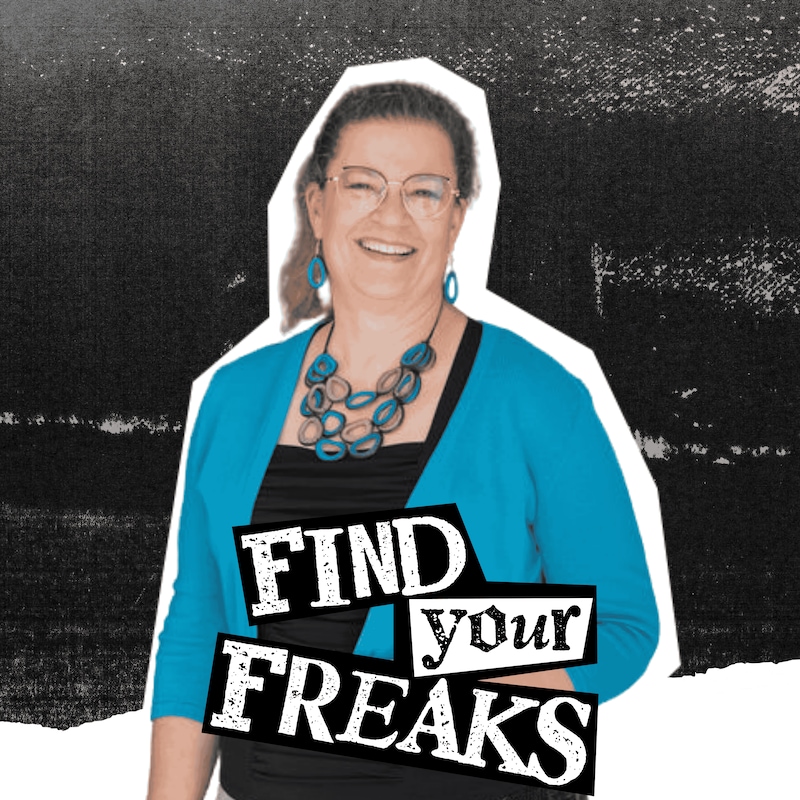
In this episode of Find Your Freaks, Tonya Kubo sits down with business strategist and operations expert Gwen Bortner to explore what community looks like when you opt out of hype, funnels, and “bigger is better” messaging — and choose intentional depth instead.
Gwen has spent over four decades building businesses, forming networks, and supporting women entrepreneurs. And while she doesn’t run a massive membership or chase viral growth, she has cultivated something many people secretly crave: meaningful, values-driven connection that sustains itself.
Together, Tonya and Gwen unpack what makes a community truly work, why shared values matter more than shared industries, and how defining success on your own terms changes everything.
If you’ve ever felt pressure to scale bigger when what you really want is deeper — this conversation offers a grounded, confident alternative.
Episode Highlights
[04:15] Why being “smart” doesn’t mean being smart at everything
[11:30] How shared values create stronger connection than shared revenue levels
[18:40] Why curated small groups bond faster than large memberships
[24:10] The confidence required to build “small on purpose”
[31:55] Why sustainable success matters more than being the best
[39:20] What happens when communities connect independently of the leader
[46:05] How to ask better questions than “What do you do?”
[52:30] One simple shift to help you find your people offline
When Smaller Becomes Stronger
Gwen challenges the assumption that community must be massive to matter.
Her approach is simple but powerful: curate small groups around shared values — not shared industries, revenue levels, or status.
In her quarterly planning retreats, women from wildly different business models and financial stages gather. What binds them isn’t similarity in structure — it’s alignment in values. Creativity. Kindness. Integrity. A desire to leave the world better than they found it.
The result? A community that sustains itself — even outside the container Gwen creates.
Private chats flourish. Partnerships form. Support extends beyond the structured event.
Not because it’s engineered.
Because it’s aligned.
Success Defined by You
One of the most liberating themes in this episode is Gwen’s clarity around success.
She doesn’t chase being the biggest.
She doesn’t need to be the best.
She doesn’t measure her worth by follower counts.
Instead, she focuses on being consistently good — and building a business she can sustain without burnout.
In a world obsessed with scaling up, Gwen reminds us that confidence comes from knowing your own definition of success — and refusing to borrow someone else’s metrics.
The Power of Values in Connection
Perhaps the most practical takeaway from this conversation is this:
If you want to find your people, stop asking what they do.
Ask what they love about what they do.
That one question reveals values. And values are the fastest way to determine alignment.
Community doesn’t form around résumés.
It forms around meaning.
Meet Our Guest
Gwen Bortner is a business strategist, operations expert, and trusted advisor with more than 40 years of experience across multiple industries. She helps women entrepreneurs define what they truly want and build sustainable businesses that reflect it — without chasing trends or sacrificing themselves in the process.
You can learn more at EverydayEffectiveness.com and listen to her co-hosted podcast, The Business You Really Want.
Meet Your Host
Tonya Kubo is a community strategist and marketing consultant known for building digital spaces that feel like chosen family. As host of Find Your Freaks, she brings together unconventional thinkers who know “normal” was never the point — and who believe that belonging is built through honesty and human connection.
Key Quotes
- “Shared values matter more than shared industries.” — Gwen Bortner
- “You don’t have to be the best to be consistently good.” — Gwen Bortner
- “If it isn’t sustainable, it isn’t success.” — Gwen Bortner
- “Confidence builds on itself.” — Gwen Bortner
- “Ask people what they love about what they do — that’s where the real connection starts.” — Gwen Bortner
Resources & Mentions
Support the Show
If Find Your Freaks matters to you, consider buying us a coffee to keep the show ad-free. Every dollar supports production so more weirdos can find their people.
Find Your Freaks merchandise is available through Abilities and Attitudes.
Let’s Stay Freaky
What’s Next
Small circles matter. But what makes them sustainable? In the next episode, Tonya explores the hidden structural flaw inside most communities, why designing everything around the leader creates fragility, and what it takes to build belonging that can thrive long after one person steps back.
Transcripts
We found out one time that there were all of these private chats going on during the day. Someone, you know, kind of just mentioned that there was these whole conversations going on in private chats. And it was like, oh, I love that.
But because I knew it was, it was about them supporting each other, sharing an additional idea, because I wasn't in your small group, but you just mentioned this thing. And oh, by the way, I have this additional resource for this additional idea that you need to know about that too. Whatever it was, it was all about, we are kind people, we support one another.
And like I said, for me, that's a win. It really can be about the power of really amazing women. If I was in a community and was trying to figure out who were my people, I would start asking them, what do you love about what you do? When you ask that question, you start hearing what they actually value as opposed to what they do.
We're wired for connection, but most of us are faking it to fit in. I'm Tanya Kubo, and this is Find Your Freaks, the podcast that flips the script and spotlights the quirks you thought you had to keep quiet. Subscribe now and head to findyourfreaks.com for show notes and extras.
Because around here, what makes you weird makes you wonderful. Normal was never the point. We love to talk about community, how to build it, grow it, sustain it.
But today we're talking about what does it look like when you opt out of the usual models and just create connection your way. Maybe no platform, definitely no hype, and a healthy level of skepticism when it comes to this word funnel. So I'm here today with Gwen Bortner.
Gwen Bortner goes by a lot of titles. Some people refer to her as a business strategist. She's a trusted advisor.
She is somebody I am lucky enough to co-host a podcast with. Shameless plug for The Business You Really Want. Find it at thebusinessyoureallywant.com. Here's what I know about Gwen.
Gwen has done a little bit about everything and a lot of most things. She has spent more than 40 years across dozens of industries. And really where she has landed is she has decided that her personal playground is helping women figure out what they really want and how to build a life that reflects it regardless of what all the gurus like to say about what we should want.
So Gwen isn't your traditional community leader, right? She prefers tight-knit in-person relationships and yet she is one of the most naturally connective and connected people I know. And so what I want to do today, Gwen, is I want you to help us see what happens or what it looks like when you pull back the curtain and talk about how connection can work off the grid. So here is how we start every episode.
Gwen, I want you to tell us who are your freaks and why do you love them? So my freaks, my freaks are kind of all of the freaks. And I will say part of my freaks, particularly these days, are the ones who don't fit quite in the room, whatever room that we're in. Because I'm not fitting in a lot of the rooms I'm in because I am not a typical entrepreneur, because I am not what I would call a true visionary.
I am an operations person, right? But I own my own business. So I'm an entrepreneur. Look at you already defying stereotypes.
Right? But I'm not a typical visionary. And so my current freaks that I'm working with are all other women entrepreneurs. Now, most of them are actually supervisionary because they don't need another visionary.
They need an operations-minded person. Another visionary, which is, it would be bad. It would be like throwing gas on the fire.
It sounds like the last thing they need are more ideas. Yeah, no, more ideas is not what they need. So those are my freaks.
But when I'm in other environments, like those are the people that I'm serving. But when I'm in other environments, the people that I tend to resonate with are the ones that I'm also seeing that are feeling uncomfortable being in the environment, whatever the environment is. Yeah.
And so, you know, I have all my guests fill out a little intake form just so I can come prepared to the interview. And one of the things you said is that your people are super smart women who don't feel smart. Where do you think that disconnect comes from? Oh, well, part of it is because I'm old, right? And that was one of the things we were still fighting that as I was coming up through, you know, the career ladder and through school and college, girls were still not well received if we were smart on the whole.
Yeah. Sometimes we were well received by a small group, but usually not a huge group. That was usually, you know, was a problem or it was OK.
But you were just, you know, you were the smart one. Right. And yeah, everyone knows when you're the smart one, that is code for you're ugly.
True. Right. Yeah.
Oh, well, maybe they'll be smart. You know, I mean, like, you know, you see, you know, an ugly baby or something. It's like, like that's code for for they're going to they're ugly.
Right. And so all of it, you know, all of that played in. And what I find is most of the women are feeling like that there's areas that they're stupid and that they shouldn't be stupid there, that if we're going to be smart, we have to be smart at absolutely everything, which, of course, is also silly that we believe.
But but somehow that's the other that's the other side of the smart coin is if you're smart, you can't be smart at a few things and not amazing at everything else. Right. Right.
And so if you're not amazing at anything else, then that means you must be dumb. Right. Can't can't play both, but that's what we do.
Yeah. Well, I imagine those who you work with who are smart know they're smart. They just think everybody is as smart as them, like they don't realize how much smarter than the average person they might be.
Oh, yeah. I've had those conversations as well, because I do know that I'm smart. And they're like, well, you know, but you're smart.
It's like, yeah, I'm smart, but you're a different kind of smart. You know, because they're smart, and then they're super smart. And then there's like crazy smart.
And then there's super fast smart. And I mean, like, you know, there's different kinds of smart. And and that's the thing I think is most women don't realize how many different kinds of smart there are.
And it's okay not to be all the kinds of smart. Yeah. Well, and, you know, with that in mind, right, it's okay to not be all the kinds of smart.
Something that I know about you, right, is you don't run a community. You don't spend your days online, if you can help it. And I should qualify that you do spend your days online, because most of your work with clients is virtual.
So you love marathon days of zoom call after zoom call after zoom call. But part of it is because you love that you're not spending every waking moment on LinkedIn, on Facebook, you don't run a membership, you don't spend a bunch of time on online memberships that you're even in. But at the same time, you have a highly connected network.
And connection seems to be at the core of just kind of how you move about the world. So when you're thinking of the term community, like, how do you define that for yourself? So for me, community is, I have a I have a really huge community, but it's a much looser community than a lot of other folks, where where there's where a lot of the folks I know have a number of pretty close relationships in a variety of in a variety of ways, you'd be one of those those people, quite honestly, that I would, you know, put into that category. I find it difficult to create those kinds of relationships.
I have very, very few really close, tight relationships, but I have a ton of beyond casual, but not tight relationships. And, you know, and there's, there's all sorts of research where they talk about, you know, how many people can you actually know how many people you have relationship with, and they, you know, it always looks like a target, you know, smaller, bigger, bigger, bigger, right? Well, my target, you know, that is really, really tiny, but that next group is actually a pretty big circle. It's not in that kind of concentric circle, evenly dispersed, you know, kind of way.
And then the next ring out is also really, really huge, which is very loosely connected that I know you exist, we've talked, we've had some, you know, thing and I can usually it's like, Oh, wait, I know I've got a person I know I've got a person and I can usually, you know, pull up in my mind who that person is. And so my community is a much looser community than what we I think what we typically think of as community, but if you get the right small number of people, and I'm thinking about, you know, we do a quarterly planning process as part of everyday effectiveness that you obviously know well, because you're like in the middle of that is a community. And the first time I pulled it together, which was before you and I were working together, it bonded as a community almost instantly, which I didn't quite get the uniqueness of because I do that consistently with small communities.
It wasn't until you got on board and started talking to me, it was like, people don't do that. That's not the way this works. And it was like, Oh, really? But I wouldn't necessarily be able to do it with 200 people.
But I can do it with 15 or 20. Pretty, pretty fast. Yeah, well, okay.
So since you brought up the quarterly planning process you do, we call it the quarterly tune up. And just for the benefit of the listeners, right? I help with the virtual facilitation of that online planning retreat. Because I really like this as a great example of community that doesn't look like community and yet checks all the boxes of what true community is.
So my definition of true community is, it is an environment where people gather together around a shared purpose or shared interest. In your case, these are all female business owners who want to be more effective in their business, even if it's not necessarily efficient. And ultimately, what they're looking for is sustainable success.
They're looking for success that they can see themselves doing day in, day out. They're not interested in constantly being on the roller coaster of sprinting and then collapsing from exhaustion, so on, so forth. So that's their shared purpose, right? Sustainable success.
They're all women. And they are happy to meet together quarterly. The second thing you need to have true community is you need to have the ability to connect with content and usually your content provider.
So the quarterly tune up is great because you're on the mic, you're the emcee. Having me do the facilitation means you don't have to worry about finding links and all the tech and making sure the Zoom is doing what Zoom is supposed to do. You get to be there really present for them.
They get to ask questions. When they share things, you mirror what you've heard. And so even though it is a group environment, and I think we've had as many as 25 people on it at one time, they feel directly connected to you because you are able to really be in the moment, eyeball to eyeball with them on the call.
So that piece is there. They get to connect with the content because as you present the content, you break them out into breakouts to help them further process and distill the information that's being delivered. And then in the process of those breakout rooms, they're connecting with each other, which I think is the third component that you need.
That's the third leg of every community stool is the ability to connect with other members of the community around the content and also around the content creator of the content facilitator. So you check all those boxes. So more than most memberships that I see out there, you fit the definition of community and community leader, right? Because there's a lot of memberships out there where you never see the owner.
Nobody has any opportunity to really talk to each other and connect, but you have facilitated that for these women. So that's what you have done intentionally or unintentionally 100% right when it comes to community building. But the thing that always flabbergasts me when I am with you and I see this right where I'm like, this should not work.
And yet it does, right? Is they are not the same type of businesses. These are not all service providers, right? Because we've been a lot of spaces where it's like female entrepreneurs, but they're all service providers. They're all coaches, consultants.
So they're not all service providers. They're not all product-based businesses, but even among the product-based businesses, they're not all retailers. Some of them have just very different products that they have.
Right. They're manufacturing. Yeah.
Yeah. They're manufacturers. So all different industries, all different revenue levels as well.
I've heard from a lot of people that you can't put the seven fig business owners with the six figs and with the five figs, and yet you managed to do it just fine. And nobody in those rooms ever acts like they're too good to be there. Nobody in that room ever acts like they're not good enough to be there.
Although some of them secretly believe that they're not good enough to be there because they're sitting there going, what did I do to be surrounded by all this coolness? And it's beautiful. And I think one of the things that you do so well, and I want you to talk about this. So this is my, this is me.
Hey, you have some thinking time here. Is you do such a great job of first of all, reinforcing the belief that everybody has a right to be there. Like if for no other reason than the fact that you invited them and you don't invite bad people to places.
The second thing is you do such a great job of getting the heck out of their way. You don't try to micromanage every aspect of their experience with the community. And so they actually get the freedom to build these relationships outside of you, because we now know that we now know that these women get together more than once a quarter.
Sometimes, you know, most of the groups, sometimes just little pockets, and they're building these beautiful partnerships and relationships independent of you. And yet they credit you as if you orchestrated it. All right.
Now talk, tell me your thoughts on what my thoughts are. Well, you know, it's interesting because one of the things that I have decided as part of it is owning that I am the center of this and saying the reason that they're all here is because of their relationship with me. Right.
And so I think your point, which is a really interesting one I hadn't thought about before, although you and I have talked about it in other places, is I do show up. I am not the person who even advocates the whole be the CEO of your business and never show up in it ever again. I don't actually believe that for the types of businesses that we're working with.
And so I also mirror that I don't say I'm going to build this really amazing business advisory firm that no one knows me at all. Right. So I curate you're not you can't sign up for this on the web by itself.
You have to talk to me first. And it doesn't happen often. But occasionally, I have encouraged someone to think about another option instead of joining us because I could tell it was not it was not gonna be a good fit personality wise.
people. You know, this is:And so you can curate a group that size having shared values that are, you know, kind of real core values. And that's the thing is their real core values are shared, even though I'm sure we have at least one or two atheists in there. And we also have people who are highly involved in the church, you know, in traditional religion in there and kind of everything in between.
But the core values of valuing people, valuing creativity, there's there's some core values that I'm not even sure I can quite pull them out. But they're there, you can feel them. And I think that that allows me to not feel like I need to micromanage the space.
al events. So remember how in:And, you know, in the world of online business, you know, there's a lot of online business owners that believe, you know, with these six, six figure high ticket programs, five, five to six figure high ticket programs, and they believe that the only way you could sell those is if you got everybody together in a room in the same physical location, they had to invest time, the plane ticket, all the things, right. But we had a pandemic shut down the world, we couldn't get people together in the same room, we had to figure out a way to make this happen. And so that's when, you know, in my role as a community leader, people went from I don't really think that's like a viable business idea to, oh my gosh, we desperately need you come and help us and we'll pay you any amount of money to do it.
And so in this one community was on Slack, and you know, Slack, like I know Slack, well, maybe not as well as I know Slack these days. But Slack had not been known for a great place to connect outside of the workplace. It's a hard to organize and all those things.
did this event three times in:And we went by revenue level stage of business, industry, ideal client. And we tried to get them together in that. And it was a train wreck, Gwen, an absolute train wreck.
And we're talking about like:And what they said is that in all their research, what they found is it was all down to values that you could bring people from no any kind. And they had piloted this on college campuses for student retention and time to graduation. And so we brought them in.
I got to work with this team. It was amazing. But they came down to they had a list of I don't remember if it was eight to twelve values.
And what they wanted to do is they wanted to get to each participant's top five values. And they were if we can get them in a group that aligns with one or two, they'll stick it out, they'll stay for the whole event, they'll do all these things. And they were 100 percent right, Gwen.
Yeah. 100 percent right. And so we and we were able by the third time we were able to really narrow down that matching.
But you were the first person who I have ever heard say that. Like I've ever heard who's not in community building, in community facilitation, who actually recognizes that the values matter way more than the circumstances, the revenue, the business focus. So now I just have to ask, like, where did you come to that information? Because we've never talked to this before, so you didn't get it from me.
It's instinctual. And having done enough of this for as long as I have, you mentioned, you know, in the intro, I've been doing this for nearly 40 years. I also formed my first networking group from scratch about 40 years ago.
Way back when, when the way you found a networking group is you got a mailing list in snail mail to invite people to come to a thing. You know, I mean, seriously, this was a very different world, people. And if you're not, you know, old enough, you can't even imagine what what that was like.
But I was doing that back, back when I was in my very early 20s, because I could see the importance of gathering people together. And back then, that was also a women's in business group, because there weren't tons of us. And this was part of the whole thing.
And then I did all sorts of other things. I did what was way before BNI, you know, all sorts of different versions of this kind of thing. And you're right, we've never talked about it.
I hadn't thought about it until it came up. Because you know, good extrovert me, sometimes I don't know what's in my brain until we start talking. And it's like, Oh, that was kind of smart.
But I could tell it is about values. And like I said, like you said, and like I instinctively know, it's not like all of the values have to line up, because we have some folks that are probably at really opposite ends of the spectrum. But there is a commonality of some level of creativity, and really caring about people.
I mean, you know, you know, all of our people, they all care about people in true ways, not, not the Oh, I love people, you know, when, and then they go do nasty things to yeah, no, they do. Well, they care about people. I mean, like, they're all truly nice people.
Yeah, people kind. Yeah, they're kind. They want to do good things in the world.
They it's not just like, Oh, I want to take care of my clients, or Oh, I want to take care of my customers. I want everybody who walks into my shop to feel good. No, they really want to leave the world a better place than they found it.
They raise their kids to do that. They incentivize their staff to do that, like they they really are. And I was gonna say the whole like, you don't feel like you have to micromanage the space because of how good those your people are.
I think that is why you don't for sure, right? Because I mean, your people just come to the table with such great intentions, and they understand how to clearly articulate their great intentions. But I would argue, if I'm comparing you from a lot of other community leaders, and even like coaches and consultants who run group programs, what I see set you apart from them is that you have the confidence and the intrinsic belief that them getting together independent of you doesn't dim your shine. Which sounds so cliche.
I know it's like such like a cereal box. It does. But it's even more than that.
I think I actually find them getting together independent of me as a giant win. Right? I mean, like, it's not that it just doesn't dim my shine. But it's like, oh, my God, that's exactly what I wanted.
Like, you know, we found out one time that there were all of these private chats going on, you know, during the day, you know, because our session is two, three hour Zoom sessions, two days of three hour Zoom sessions. These are not a little 30 minute planning thing. I mean, these are intense.
And we found there was these whole conversations going on. Someone, you know, kind of just mentioned that there was this whole conversations going on in private chats. And it was like, oh, I love that.
I love that. That makes me really happy. Because I don't assume that the private chat is talking bad about me.
Because I think some people go there immediately. They immediately go into that negative space. It never even occurred to me until just now when I said it was like, yeah, that's that's not what it was.
But it was a but because I knew what it was. It was about them supporting each other, sharing an additional idea because I wasn't in your small group, but you just mentioned this thing. And oh, by the by the way, I have this additional resource, or, you know, this additional idea, you need to know about that too.
You know, whatever it was, it was all about, we are kind people, we support one another. And like I said, for me, that's a win. So when I'm talking with one of my clients, it's been at this I can say, remember, so and so said, don't forget, it ends up being that it doesn't have to be all about me all the time.
It really can be about the power of really amazing women. Yes. And I will say to me, that is how you know, you have built a successful community is because the community should be able to both sustain and police itself independent of you.
If you've done your work to lay a strong foundation, set up appropriate guardrails, and really invest in the culture, they shouldn't need you to behave themselves, they shouldn't need you to play nicely with each other. And I think this is one of those things that you do instinctively without knowing you do it simply because it feeds in to that core belief you have that if whatever you're doing to be successful isn't something you can do all the time, then it's not sustainable. Right? Yeah.
Okay, I want to move from this. And I want to talk about something that you said earlier on, because you keep emphasizing how it's a small group, it's a small group, right? It's like 25 people are. And I know that you operate in big rooms.
But I feel like when you operate in big rooms, you naturally collect or curate a smaller group within the big room. Is that true? That is true. It is true.
And so if I walk into a big room, where I don't know very many people or anybody, because I'm a natural extrovert, and pretty high on the real extrovert scale, that doesn't freak me out, because I can do meaningless small talk for hours. I mean, I used to say when I was young, I was really good at a cocktail party, because I knew, you know, a tiny bit about almost everything. So so I can, you know, someone can mention a thing, and I can like, say something back to them, and they look at me like, how do you know about that? Because they think like, I've got this great knowledge.
And it's like, I've pretty much just given all of it away, you know, and then I tell them how I know about that, which they find interesting. And then they tell me, you know, I don't have to actually say that much. So I really am good at a cocktail party.
And so that whole small talk thing doesn't doesn't bother me. So I'm okay in that scenario. But I'm not necessarily comfortable or happy in that scenario.
So so it's not like I'm uncomfortable, and I've got to get out of here, got to get out of here. But I don't actually feel like I'm a part of the community until I have curated my, my small group. Okay, so I'm just gonna say what listeners are thinking, even if they don't know they're thinking it.
ke people's stories. But it's: our email list isn't at least:You can't have a successful business if you haven't gone viral on social media. So with all this messaging of you got to be bigger, bigger, bigger, because this is who you were before I met you. So I know that I'm not the person who educated you on the fact that you didn't need that.
But I need to know two things here. I need to know one, how did you get comfortable with your affinity towards smallness, especially in rooms where I know you're hearing that bigger is better? And number two, how are you successful in business today, in spite of what everybody else says you need to do? Or maybe because you're doing something that different than what everybody else says you need to do? So I think the answer to both questions is, I have gotten very clear on what my definition of success for me is. And that's not going to line up with a generic definition of success, which is what we're seeing from the gurus, social media, all of those things.
That's a generic definition of success. Because that's, well, because that's what it is. It's something that most people can agree on that if that thing is happening, you probably are successful.
we can pick, it's, you know,:And so I really think that's the answer to both questions, is I'm really comfortable knowing what my definition of success is. Although I am competitive, I have never had to be first. And I never have been first.
I've never, I've never been the best. It's not ever been my driver, where a lot of entrepreneurs being the best has been their driver. Was I an A student? I absolutely was an A student.
But I wasn't a straight A student. There were a few Bs in there, which, you know, didn't make me happy at the time. Because, you know, I was, I was a good student.
But that was also my reality. And that continued on through a whole, a whole lot of things. And so understanding that I don't actually have to be the best, but I can still be very, very good is okay.
Because there's only one person who can stand at the top of the podium on any given day. And if you watch any of those kinds of competitions, who's on the top of the podium changes day to day to day. Rarely does one person stand on top of the podium every single solitary time.
Yeah. Right. And so I have way less pressure on myself, knowing what I want, and saying, I want to be good.
I want to be consistently good. But I don't have to be on the top every single solitary time. Okay, so one more question on this thread.
How? Gwen, how? Because I know that there are people who are listening who are like, I want to be comfortable with that, too. But I'm not. So how did you get comfortable? Were you always comfortable? Were you born comfortable with this? Or is this something that you came to terms with over time? I don't ever remember not being confident.
Got me in trouble in grade school. Because in grade school, kids don't know what to do with a confident kid. Because most people are not.
And so I was banished from the class. I got a really nasty letter signed by everybody in the class, that basically was mad at me for being confident. And, you know, terribly hurtful, terribly hurtful.
And I also got over it. I still ended up, you know, hanging out and being friends with a whole lot of the people who signed that letter throughout my, you know, throughout my high school years. Because that's part of also being confident is knowing that's about them and not about you.
Right. So I don't ever remember not being confident. I give a lot of credit to my parents for that.
They would allow me to go into situations that were challenging situations, but where they knew I would be supported. My church environment allowed for me for that when I was young, I was allowed to try and do things that were adult things, and was able to be successful at that. And so that gave me gave me confidence.
So for the most part, I mean, there are there are obviously a few areas in my life that I have never been confident. And you know, that's a that's a whole, we don't have enough time for all that. But for the most part, I have always been confident.
And the confidence piece builds on itself, it is a self fulfilling prophecy. If you can start being confident in one thing, then you can be confident a little bit more. And then when you're confident more than you can become a little bit more, and it just grows, grows, grows, grows, grows, grows.
And as someone once said, Yeah, your confidence is actual confidence. It's not a fake it till you make it confidence. It's just like, nope, I can do that.
I can be okay with it. And I'm also okay that not everyone's gonna like me, not everyone's gonna be, you know, not everyone's gonna bow down at my feet, not everyone's gonna hire me, not everyone, not everyone, not everyone. Okay, because the right people will.
Well, and like, you know, something that I always say is right is it's not for everybody. Like you're not for everybody. But for certain people, you are their exact somebody.
I am their exact somebody. Yeah, exactly. So, Gwen, for people who are listening right now, and they want a deeper connection, but they just like a deeper connection, like you've described, but they don't know where to start.
What do you think would be like one small but meaningful way that they could begin to find their people, especially if they like to find people offline? So I think it's really being open to hearing their values, right? Because I do think the values piece is the easiest place to line up with, with folks. And so it's asking deeper questions, it's asking more interesting questions. And you know, we've talked about it before this, this question comes from Chris Voss, who wrote Never Split the Difference.
But instead of saying, what do you do ask, what do you love about what you do? When you ask that question, you start hearing what they actually value, as opposed to what they do. Oh, that's good. Right.
And so if I was in a community and was trying to figure out who are my people, I would start asking them, what do you love about what you do? And not even asking what they do, because that's also part of the fun is to figure out like, do you know what they do based on what they describe what they love? Yeah, what they do? Right. But they will tell you way more, they'll tell you stuff that they never thought they'd ever tell any, you know, like, two minute stranger. Well, I think sometimes probably because they, nobody's ever asked them that.
And you actually get the unfiltered answer. I love that. Yeah.
Okay, so we're gonna put all the information on where to find you in the show notes. But you know, for the for the benefit of those who are more listeners than readers, they can find out more at everyday effectiveness.com. Secondary shameless plug for the business you really want.com, which is a great podcast, if I do say so myself. We are super awesome together.
And Gwen, you actually the one place you do love to connect with strangers and friends is over on LinkedIn. So we will go and put your LinkedIn information. Now for the end of this, we have a little rapid fire segment, which I did not prepare you for, because I know that you like this sort of thing.
I love this sort of thing. So it's a quick round of five questions. We're going to go fast.
There's no wrong answers, just whatever comes to mind. Are you ready? As ready as I'm going to be. Okay, so finish this sentence for me.
You're my kind of freak if you're willing to do hard things because you love them. What's something you love that your friends just don't get my very eclectic mix of loving indoor hobbies like knitting and quilting and outdoor hobbies like paddleboarding, skiing and hiking. Yeah, okay, that doesn't make sense to me either.
So well, we're just gonna let that one sit. What community would you infiltrate just to understand it better? I don't know, because I think every time I come across one, I just do it. I yeah, no lies detected on that one.
We'll just go with that. Okay, what tool ritual or practice helps you stay connected to your people? For me, one of the things is I do have a what I'm going to call a private networking group that I've established that it's also curated. And it allows me to stay in touch with a smaller group of people.
And we meet once a quarter, they get a newsletter, but it allows me to stay in touch. Okay, last one is who's someone doing freakishly good work, who you think deserves a bigger stage? It's so hard because there's so many names. So the what I what I think I'm going to actually say is pretty much every one of my clients.
And they're all of course, doing very, very different kinds of work. Yeah, but the work that they're doing in in their area is always freakishly good. And there's only one of my clients that really has a giant stage.
Okay, okay, true to this entire interview, you are like your clients biggest fan. So, Quinn, thank you for showing up. Thank you for showing us that not everybody has to do what everybody else says they have to do in order to be happy, to be successful.
You definitely don't have to build a massive group to fill a sense of belonging. And sometimes the most powerful communities start really close and really insulated. So for everybody listening, if you ever feel like you don't fit the mold of what community is supposed to look like, I hope that this episode reminds you that there's nothing wrong with the way you connect.
It just might mean that you haven't found your people yet. That's it for this episode of Find Your Freaks. To help more weirdos find their way here, subscribe, rate and leave a review.
And if you're craving connection, join the freak show at findyourfreaks.com. What makes you weird makes you wonderful. Normal was never the point.
