Shownotes
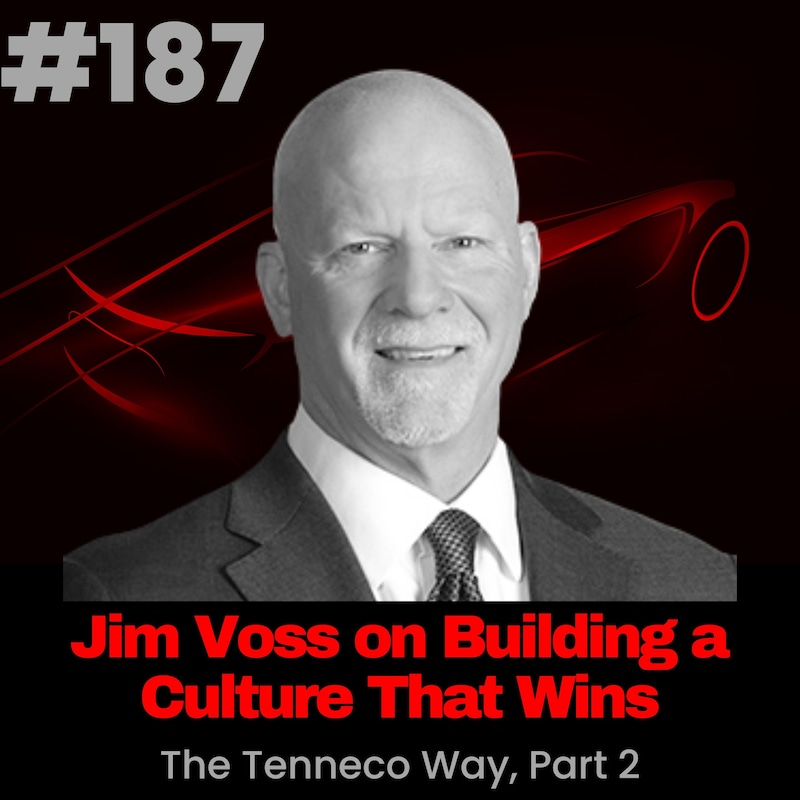
In Part 1, Jim Voss, CEO of Tenneco, took on a company in need of a turnaround. In Part 2, he hands you the playbook behind it.
This is the Tenneco Way. Not a poster on a wall. Not a slide deck someone presents once a month. It’s the operating system running a 100-year-old company with more than 60,000 people across 28 countries. And as Jim puts it, it is the company's sustainable competitive advantage.
Jim sees culture as the most powerful advantage a leader can build. It's the thing that drives every result you actually care about, because people drive results, and culture shapes people.
From there, it builds. Simplify, kill the bureaucracy and the silos, and go hunt for friction instead of waiting for it to find you. Organizational velocity, the differentiator Jim believes will separate the winners from everyone else. Tenacious execution, because strategy gets eaten alive without it. Accountability and ownership without a shred of micromanagement. And win, treated as a mindset, not an outcome.
Then Jim gets practical. How do you roll core values out to 60,000 people in 28 countries without peanut-buttering it across the wall? The Tenneco mindset and the power of humility. Why did he grow his own talent through Tenneco University and the P3 standards that went from impossible to gold? This is not the legacy playbook. This is a transformation that actually happened, told by the leader who lived it.
Themes Discussed in this Episode
- Why culture is an operating system, not a soft HR initiative
- The six gears of the Tenneco Way
- Radical candor and building a company where bad news travels fast
- Redefining failure: we never fail, we win or we learn
- Organizational velocity as the next great competitive differentiator
- Accountability and ownership without micromanagement
- The Tenneco mindset and the power of humility
- P3 standards and the pride that drives performance
🎥 Watch the full episode on YouTube:
https://www.youtube.com/@jangriffithsautomotiveleaders
This episode is sponsored by Lockton, click here to learn more
Featured Guest: Jim Voss, CEO at Tenneco
Jim is the CEO of Tenneco, a global automotive supplier with operations spanning 28 countries and more than 60,000 employees. Before joining Tenneco in 2022, he spent more than a decade with Apollo Global Management as an operating advisor and portfolio CEO, leading complex business transformations across multiple industries. With nearly 30 years of leadership experience in industrial, chemical, and manufacturing sectors, Jim is known for driving operational excellence, building high-performance cultures, and leading large-scale turnarounds. He also serves as Chairman of Vacuumschmelze and sits on the boards of ABC Technologies and Kem One.
About Your Host – Jan Griffiths
Jan Griffiths is the champion for culture change and the host of the Automotive Leaders Podcast. A former automotive executive with a rebellious spirit, Jan is known for challenging outdated norms and inspiring leaders to ditch command and control. She brings honesty, energy, and courage to every conversation, proving that authentic, human-centered leadership is the future of the automotive industry.
Mentioned in this Episode:
- 21 Traits of Authentic Leadership
- Execution: The Discipline of Getting Things Done by Bossidy and Charan
Episode Highlights
[01:38] The Tenneco Way: Jim defines it plainly. It is the operating system and the company's sustainable competitive advantage, built on the belief that people drive every result.
[04:18] The six gears: Jan and Jim walk through the framework gear by gear, starting with core values.
[04:35] Radical candor: Start with the truth. Build an organization with the courage and the skills to have the tough conversations that get to the facts.
[08:11] Bad news travels fast: Jim's tell for a healthy culture. In most companies, good news flies and bad news crawls. He pays attention to how fast the bad news moves.
[15:14] Simplify: Reject bureaucracy, minimize layers, eliminate silos. Go find the friction instead of waiting for someone to bring you a problem.
[18:10] Organizational velocity: Jim's pick for the number one differentiator going forward. It takes getting every element right, from strategy to frontline competency.
[22:48] Tenacious execution: The bedrock of everything. Strategy gets eaten alive without execution, and Jim spends 95 percent of his time on it.
[24:00] Accountability without micromanagement: Why control is the easy way out and the enemy of true ownership.
[32:38] The Tenneco mindset: If he could keep only one gear, this is it. The power of humility, learned from the All Blacks, and refusing to be a victim of anything.
[41:08] P3: People, Pride, Performance: Manufacturing standards so rigorous that plants winning OEM awards weren't yet certified bronze, developed bottom-up with plant managers.
Top Quotes
[01:38] Jim Voss: "The Tenneco Way is our operating system. More importantly, it's our sustainable competitive advantage. "
[26:44] Jim Voss: " A winning culture is learned."
[47:23] Jim Voss: " Good leadership never builds something around an individual, whether it's the CEO or anyone in the organization. "
If this episode resonated, share it with a fellow automotive leader and subscribe to The Automotive Leaders Podcast, where we’re shaping the future of authentic leadership in the automotive industry.
This podcast episode is also available on YouTube. Check out our YouTube channel at Jangriffithsautomotiveleaders
Send us your feedback or questions — email Jan at [email protected].
Transcripts
[Transcript]
[:This episode is brought to you by Lockton. Rising benefit costs aren't inevitable for you or your employees when you break through the status quo. Independence matters, it means Lockton can bring you creative, tailored solutions that truly serve your business and your people. At Lockton, clients, associates, and communities come first, not margins and not mediocrity. Meet the moment with Lockton.
Welcome back to part two of the Tenneco story. We're gonna dive deep into the Tenneco Way. It's one thing to talk about culture as an operating system, but how do you make that happen in a legacy automotive company with a tremendous amount of complexity? We're gonna find out. We have with us today Jim Voss, the CEO of Tenneco. Jim, let's get into it.
[:[00:01:35] Jan Griffiths: The Tenneco Way, come on. Tell us all about it.
[:Any results, financial results, KPIs, whatever you're looking for. It's people. People are going to drive those results, so what should you focus on if you want superior results? You have to focus on the people, what's driving them, and the culture around that gives them the opportunity to do great things, right? To dare to be great. Nothing great ever happened by playing it safe.
On the other hand, you have to have guardrails, and you have to be prudent, but you can have your cake and eat it too. And everything that we do is around the culture that allows our organization, our people, to do great things for our customers.
And so, I would argue with anyone, what else is there? What else should you be working on? What else would be your operating system? We have great technology. We have great engineers. We have great customers. So does our competition, if we're real honest. We've got some good competitors out there that make quality products as well.
Yes, we continue to differentiate ourselves with our products. We think we have better products, we think we have better technology, but we're confident that our culture is second to none, and we live it every day.
[:[00:03:22] Jim Voss: I hope you're wrong about the CEOs. I know what you're saying. I think a lot of leaders in organizations, auto or otherwise, do very much understand the importance of culture. I think oftentimes it's misunderstood or people just don't know how do you actually go about changing it? I mean, what do you have to do? It's not a poster on a wall. It's not a PowerPoint and a presentation once a month. It's actually understanding what does it really take to change a culture? What does it take to perpetuate that? And that's very, very hard work. That's why I say, I welcome anyone, come in, and I'm not saying that we're perfect, and we have a ways to go, but take a look at what you're doing, we're doing, excuse me, and it's just replicating that is tough because you have to be focused and committed to it 100% of the time.
[:[00:04:18] Jim Voss: We do have six gears.
[:[00:04:21] Jim Voss: Deal.
[:[00:04:27] Jim Voss: Okay. There's no order to 'em, by the way. They're all important, but core values is first. It's the first one we rolled out.
[:[00:04:35] Jim Voss: Radical candor.
[:[00:04:39] Jim Voss: And it's very difficult, as you know. Radical candor means exactly what it says. You have to start with facts, and this is stolen from the book by Bossidy and Ram, Truth Is Harmony. We're all entitled to our own opinions, not our own facts, and so we have to start, if you wanna make something better, if you wanna optimize something, if you want to improve something, if you want to tackle something, you have to start with the truth. And you have to have an organization that has the courage of their convictions, that have constructive debate and tough conversations to make sure that we're starting from the truth.
How many meetings have we all sat in, talking about a subject, knowing full well we're not getting to the point of what's wrong. So there's no possible way you could leave that and thinking that we're gonna have confidence we can quote, fix it or address it. And that plagues organizations in I don't care what industry you're in. And so, you have to first and foremost, before you can simplify or execute or move with velocity, you better be starting from the facts and the truth. And as simple as it sounds to say in a podcast, very difficult, because think about what that requires. It requires people to have very, very difficult conversations, not just with their peers, but their boss.
[:[00:05:54] Jim Voss: Or their boss's boss. And so, number one, that's frowned upon in a lot of companies, in a lot of cultures around the globe. But the most important thing I think, is when you set these core values, radical candor is a great one, you have to make sure that you're also addressing the needs, that competency needs of the people. The training and the development that it takes to give the people the skill set and the confidence to have those conversations.
So, instead of you and I having a difficult conversation and one of us making a mess, and making it worse, we have the skill and the competencies to wade through a difficult conversation and get on the other side of that, get to the truth, maybe have a little bit of a tough conversation, but we know we can move forward and fix it. And so, it's very difficult, but it's complex. You can't just say it, you have to really focus on making sure people understand how to do it.
[:[00:06:47] Jim Voss: Definitely starts with me.
[:This episode is powered by Seraph. When manufacturing leaders need to launch scale, relocate production, or navigate supply chain disruption, they call Seraph. Hands-on operators. Measurable results. Learn more @seraph.com.
[:[00:07:19] Jan Griffiths: Yeah, yeah. And then it's fear, you're driving fear into the culture.
[:[00:07:23] Jan Griffiths: And the other side to that, I'm thinking about leaders, in my career, where you're sitting in a conference room, you're talking about something, and everybody, the leader, the CEO, will say, "I think we should do X." And then everybody around that table nods and said, "Yeah, that's a great idea." Even though the majority of the people do not agree with it.
[:[00:07:42] Jan Griffiths: They go along with it, and you see.
[:[00:07:45] Jan Griffiths: Exactly, exactly! Been there, right? And but think about the time, the waste of time and energy, and we're talking about transforming an industry and we need speed. When we play all these silly games and people cannot put their voice forward in a safe environment where you can have a constructive debate, we're not gonna get there.
[:[00:08:07] Jan Griffiths: So this is, it may sound simple, oh, well radical candor. But it's the core.
[:[00:08:15] Jan Griffiths: Yes.
[:[00:08:51] Jan Griffiths: Yes. And then, the silo protection mechanism kicks in because if you have a problem, the first thing you do is you try to hide it.
[:[00:08:59] Jan Griffiths: Right? And then what do you do? You blame somebody else.
[:[00:09:03] Jan Griffiths: If you can't hide it, "Well, it wasn't my fault, it was operations, it was supply chain, it was purchasing."
[:And so, it's really about the boss and that mentality, and it's also then redefining success and failure. That's part of our mindset is we never fail. We win or we learn. That was from Mandela, by the way, not us, but it's powerful because you have to redefine winning and you have to redefine losing, if you will. And if you have a mindset where we're not ever going to fail, we may not reach the objective, but we are definitely gonna win or we're gonna learn from it, and we're gonna move forward. And then you have to have the courage of your convictions to do that again.
[:[00:10:18] Jim Voss: Because the thing about high performers, what do they not like to do? Fall short.
[:[00:10:23] Jim Voss: We don't like to not win. And so, you have to really redefine it and be able to say, "I am a high performer even when I don't hit my mark every time." That's when great things happen. We don't want people to, I always say, I don't want people to think outside the box. I don't wanna see a box. There's no box. There's just the art of the possible, and that's tough to do in this industry a little bit.
[:[00:11:06] Jim Voss: Absolutely. Absolutely.
[:[00:11:08] Jim Voss: Bouncing back from something you fall short of and doing something great afterwards feels even better than knocking it out of the park one time. But I will tell you this, Jan, it's not for everyone, and I don't want it to be. If you think about it, if you want to be the best in the world, you simply want the best people to work for you. And so, I have said publicly many times, maybe our culture's for 5 or 10% of the workforce out there. Maybe. Because I think it is exhilarating. I see a tremendous amount of excitement. Again, I'm not suggesting that we're perfect, but there's a lot of people that don't want that level of, I say pressure, but.
[:[00:11:46] Jim Voss: They wanna play it safe. Hey, listen, I know I can hit 100. Jan, I'm gonna tell you 80. I'm gonna hit 90, you're gonna think I'm a genius, I'm gonna go home. That's not how we play the game. I'm gonna tell you I'm gonna hit 120. I think I can do it. I hit 110, and you're high-fiving me all the way home.
Did I fail? Did I fall short? I don't know. I'm higher than the 90 that I would've given you if I was sandbagging with you. And so, it takes more than words. It takes leadership behavior, like, those moments where someone falls short. So, culture is the behavior of leaders, but if you were to peel that onion back just a little more, culture's really seared in the behavior of leaders when something goes wrong.
[:[00:12:26] Jim Voss: When something happens that's not good, that's when it sears in the real culture. When someone took a risk, a very calculated risk, and fell really short. How does Voss react? How does so-and-so react? And it's those moments everybody's watching you. Does he really mean we never fail? We win or learn, or is that just, like, a saying on the wall? So, I think that is the hard part. Not just the articulation, and the behavior and the consistency of that behavior, 'cause all you have to do is get that wrong one time and that permeates.
[:[00:12:59] Jim Voss: Exactly. So, it's powerful, but it's tough
[:Did you know suppliers now spend 157 hours on an average RFQ and still face the same roadblocks as 20 years ago? UHY and the Center for Automotive Research, break it all down in their new white paper.
Download your copy. There's a link in the show notes.
Tariffs, disruption, uncertainty. Your supply chain has answers. Tradeverifyd helps you ask why and what to do about it. Visit Tradeverifyd, that's verifyd with a yd.com.
You really have to believe in yourself, don't you, Jim? I mean, who you are as a person, your value system, and who you are as a leader, because you can't be one way at work and then a different person outside of work. I mean, it has to be in your DNA.
[:Because, again, if you're going to ask an organization to behave differently, and in our case, I think drastically differently, you have to spend the time to coach and work with the teams to give them the skills and the confidence to be able to do those things. Because, I mean, myself included, sometimes, something does happen and I'm like, "Hmm, okay, this doesn't feel like winning right this second." Doesn't even feel like learning right this very second. No, I mean, but that's the emotional intelligence of yourself says, "Wait a second."
[:[00:15:03] Jim Voss: Calm down, your team's looking at you. And that's what's powerful about it. It's not easy for any of us.
[:[00:15:14] Jim Voss: Hear, hear.
[:[00:15:25] Jim Voss: Hear, hear.
[:[00:15:28] Jim Voss: Well, it might be the simplest one to kinda wrap your head around, but again, super important. If you don't start with the facts, the truth, you're not gonna get to the point of what are the problems out there? We call it identifying friction. Where's the friction in the organization? Can we have radical candor around talking about that friction? And then can we make some of that friction go away? A lot of that friction is around lack of simplification.
You certainly cannot have organizational velocity, which is next, without simplifying. And you said in your opening, we're like a lot of our competitors, and certainly our customers, very large, very complex. And so, any time we have the ability to simplify something, we should take it. And it sounds like such an obvious one, but when I came into, when I come into most companies, I'm kind of a turnaround, fix it CEO. It sounds very simple, if you will, but it's actually something that is very difficult for organizations to do because they trap themselves in those silos, and the command and control is not about simplifying. It's about creating more bureaucracy, more command, that creates all the processes that slow things down.
If there's one thing that employees love, like out in the field, if you can just make their jobs easier. So often, we're asking them to run a marathon every day, and as a corporate culture, we're throwing rocks in their shoes as they run. And how about we do the opposite of that? How about we try to make it easier? But it's an active process. People say, "Well, wait a second, when somebody brings me a problem, we try to address it." I'm like, "No, no, no. Someone's bringing you a problem, you haven't done your job." Go find them. Get out there. Get into the trenches, identify those points, and how can you make it easier?
It's not just even simplifying because it's better. It's more productive. Your people will have a lot more time to do the evaluated things if they can be focused on what they really know they need to be doing.
[:[00:17:31] Jim Voss: Absolutely.
[:[00:17:42] Jim Voss: No, no, no.
[:[00:17:49] Jim Voss: Right.
[:[00:17:51] Jim Voss: Yeah, listen. No, you're right. You have to have processes in place, governance if you will. But you don't have to have those layers of bureaucracy, that's the point. And I think where people get it wrong is they don't think it's part of their job to go out and find those things. It's an active process to go fix.
[:[00:18:10] Jim Voss: Oh my gosh. I mean, I spend the great majority of my time when I'm talking about this subject on velocity, because I think it's gonna be the number one differentiator in companies going forward. I think it's gonna be the thing that we talk about the most. And I'm not talking about AI and all the things that are gonna change with that. I think a lot of people don't understand is what it actually takes, and we touched on this, I think, in our first session, of getting it all right.
It's not about an executive or somebody pounding the table saying, "Go faster." Okay? It doesn't work that way. You have to look at every single element and get it right, from the strategy down to the competency of the leaders especially, middle management, frontline management, and their ability to move at a very fast pace. I think when I look at the differentiating companies around the globe, the ones that are winning big are the ones that are able to adjust and move very quickly.
So, we specifically designed the tenets of our culture when we started this journey in '22 of being able to say, "Listen, I don't exactly know where the industry's going. I'm not a pro here. I'm new to the industry. What I know is it's in flux. What I know is no one knows exactly how this is gonna end, or the middle part of it. So we're gonna build a culture and a competency set that wins no matter what. No matter what happens, we're gonna win. We're gonna be able to pivot faster, make better decisions, have a workforce that's more motivated, getting discretionary effort. Our goal post is not just gonna be financials, but it's gonna be that emotional allegiance, that 'it' factor, why people wanna be here. And I'm not gonna try to pretend I know where this is going, but we're gonna have a winning game plan, operating system, no matter what." And so, that's how we kinda built the pieces.
Our core values were not meant to hang on a wall. They do hang on walls in our plants, but every one of our employees, I think, knows our core values 'cause we talk about them every single day, and we use them in real life every day. I've asked people we hired from other companies, "What were your core values?" And they looked at me like I was like, "Who cares?"
[:[00:20:15] Jim Voss: You know? And I'm like, "Cool. Okay. We got a little work to do here. Welcome to Tenneco," because it's all about that culture and the Tenneco way.
[:[00:20:31] Jim Voss: Oh, yes.
[:[00:20:34] Jim Voss: Listen, I think you have to make sure people understand, the biggest thing you have to do is remove the status quo thinking.
[:[00:20:40] Jim Voss: The biggest thing that keeps people from moving at higher velocity is between their own ears. We're conditioned. How long does it take to get a new product launch from A to B? Oh, that takes 12 months. It's always take 12 months. This is gonna be 12 months. And it's like, well, why does it take 12 months? China's not doing it in 12 months, so and so's not doing it in 12 months. So then success breeds success.
So if you can just break down these things we tell ourselves and then you go out, and the Nike principle, "Just do it." And get out there, then that success breeds success. People feel great about it. We're doing things now in our organization, not just in China or Asia, but in all parts of the world, that were taking three or four months now take three or four weeks.
And now, the team is challenging, how do we get it to three or four days? So, it really is about changing that mindset. Listen, some things take time, okay? That's just the way it is. But most of the things are in our own head. One of my favorite phrases is, "Difficult tasks take time. Impossible tasks take just a little longer." And if you can get people to think that way, once they do something, our P3 standards were impossible to hit two years ago when we set them. They were very difficult. Every plant manager's like, "Jim, you know, you don't understand. This is never gonna happen."
[:[00:21:57] Jim Voss: Oh, my gosh Yeah, it's impossible. You're not from auto. I'm like, "I'm not. Just pity me and let's go for it together." And now, we're up to 70 plants and counting. Four gold, I think, right now. So, that success breeds success, and now they're challenging me, what's next? We can do more.
So, it's not just fun to watch because it drives our financials. It's why we have differentiated performance, but it's really cool to go to, say, one of these celebrations we talked about when we were off camera, and little grown men and women crying at the end of the night because they accomplished something that was so very difficult, and there's a little bit like I feel I'm so happy for them. We all have to come to work every day. We all have to pay the bills and support ourselves. We might as well do something great together and kind of that atmosphere and that attitude.
[:[00:22:48] Jim Voss: That's the bedrock of everything has to be execution. The bedrock of culture, the bedrock of your operating system, everything has to be about execution. The industrial logic of putting Tenneco and Federal-Mogul together was always brilliant. It was always brilliant when they did it back in, I think it was '17. There was just no execution. And so strategy will get eaten every day by execution or lack thereof. So, when you're designing a culture or anything else, the bedrock has to be execution because culture doesn't come to life unless something happens.
[:[00:23:22] Jim Voss: It's execution. So, the principles of execution, one of the best books I've ever read was, the Bossidy-Charan book that I said came out maybe 25 years ago, the Art of Execution. And in the first 62 pages, like they lay it out and as well as you can see anyone else, and it's still relevant today. Execution isn't just this tactical thing that middle management does. 95% of my time is about execution, and I would challenge any executive who's not doing it that way, maybe rethink the priority because that's what's going to empower organizations to do great thing.
[:[00:23:58] Jim Voss: Of course.
[:[00:24:04] Jim Voss: Oh, definitely, 100%. In fact, there's no room for micromanaging. Think of what is micromanagement? Micromanagement isn't, well, it isn't attention to details 'cause I'm as detailed, we're both detail freaks. That's not it. It's when you have to dig into someone else's work and almost do it for them and watch them. If you have to do any of that, you have the wrong person, or the wrong setup, the wrong something.
So, micromanagement is never, ever the right answer, and I don't know that you ever have accountability if you micromanage. If you're always telling me what to do, then I always have you to blame for my work.
[:[00:24:39] Jim Voss: So, I don't think you have true accountability unless you're not micromanaging and you're handing those decision-making points to people, allowing them to learn. As a byproduct, probably falling short every now and again, and learning from that, and you build that into the process, and you have to cultivate that as leaders. Then great people will develop, great things will be done, and the accountability is theirs. And then, that will breed the accountability down the line. I think, unfortunately, in a lot of situations, leaders think great management is about control.
[:[00:25:12] Jim Voss: And it couldn't be further from the truth.
[:[00:25:20] Jim Voss: Completely.
[:[00:25:22] Jim Voss: It's the easy way out.
[:[00:25:36] Jim Voss: Exactly
[:[00:25:38] Jim Voss: It perpetuates itself. Even if a younger, manager or whatever wants to do it, the machine won't let it, won't let him or her. And so, you just have to break that mold. It's very difficult. And I also think a lot of, I've seen a lot of really, really smart executives, and unfortunately that many of which I've had to make tough calls on, they don't know how to do it any other way.
When you've been doing something for 20 years, 30 years, it's not about old dogs and new tricks. It's just I don't know how to do it. And sometimes you can teach people to do it a different way and that works great. Oftentimes, not.
[:[00:26:20] Jim Voss: No, I think win is super important in terms of our core values. Think about it, I always like to use kinda sports analogies. Winners win. It's a mindset. If you study winners, business, sports, they do things differently. They have different habits. They have a different mindset. They have a different preparation. They have a different level of expectation of themselves and other people. And so, a winning culture is learned, and I think it's a big difference to be able to say, "Well, we wanna have the will to win." Okay, I know what you mean by that, but we have to have a culture of that we're going to win. Kind of failure is not an option, and we're going to find a way. Oh, we can't win because we have tariffs. Oh, we can't win because we have this. Oh, we can't. Yes, there are obstacles, absolutely, and they're real, and they're affecting things. But a winning mindset, part of your core values is no excuses. I am not going to be a victim to anything. We are gonna immediately attack in all directions, and we're going to win. But to win, you have to win with your employees first.
[:[00:27:25] Jim Voss: This is not about me winning. This is not about our owners winning. I mean, they need to win too, by the way, but it's about winning with our customers and our employees. If you can win there, then you will win big.
[:[00:27:52] Jim Voss: They certainly don't. Especially the first one.
[:[00:28:00] Jim Voss: Well, I'll start at the bookends of our core values. First of all, you just, you have to work really, really hard, and you have to take a lot of time and work with your team to understand what it takes to make that work in India or China or Mexico or wherever.
Here's what every culture wants to do. I don't care where it is around the globe. They wanna win. They wanna win. This I promise you. So I'll just use radical candor, 'cause that's probably one of the most difficult ones, depending on what culture you're in. It's not a go-to way of thinking in China, for instance. It's a different place. So you have to really spend a lot of time in saying, "Listen, why are we doing this? What are we really doing? Truth. Do people want the truth? Do we really want to have a conversation about the real facts?" And you've gotta get people in a room, and you've gotta make it okay. And you have to have leaders with the competency in whatever country, whatever culture, that then it's okay, Jan, if you're my boss, I can come up to you. And please package it the right way. Give them the skills to have that difficult conversation, but to say, "Listen, I'm wondering if the direction we're going in is right," or, "I'm wondering if the decision is okay," and then having those people be okay with hearing that.
ause six or eight months into:[00:29:41] Jan Griffiths: Ah. Oh, okay, great. I like that approach.
[:[00:29:49] Jan Griffiths: So, you started more with the behavior.
[:[00:29:51] Jan Griffiths: So, that they could see it and feel it. And so, everybody could have that aha moment.
[:[00:30:06] Jan Griffiths: Yes.
[:[00:30:33] Jan Griffiths: But what you've done is you've given people a language, a framework to be able to have the discussion.
[:[00:30:51] Jan Griffiths: Yes, yes. I had somebody work for me once, and they said, we were going through different energy leadership levels. And I had come out of a meeting, and I was all stressed, and she wanted to talk to me about something. So, I walk into the office, and she starts talking to me, and I just immediately started. And that's not me typically, but I did, 'cause I'd come out of a bad situation. And she looked at me and she said, "You're at a level two right now. Until you come back up to your normal four or five, we'll have this conversation another time." And at first I was mad for a second, but then I thought, "Wow, you know what? What we've done is we've created a language. "
[:[00:31:30] Jan Griffiths: For her to say, 'You know what? We cannot have an adult conversation right now 'cause it's not gonna go anywhere for either one of us.' And you have to be able to do that.
[:[00:31:47] Jan Griffiths: Yes.
[:[00:31:56] Jan Griffiths: Yes.
[:[00:32:22] Jan Griffiths: Yeah. Now, all of this is wrapped up in the Tenneco mindset. I've heard you talk about mindset, I mean, many, many times in the short time I've known you. It's important to you. Tell us what it means to you and why is it so important?
[:Every word of the Tenneco mindset is purposeful. Every piece of it, whether it's humility. I remember, we worked with Gilbert Enoka. He was the mindset coach for the All Blacks' for 23 years, I think. And one of the things that he taught us and challenged us, was the importance of humility. And why were they so good? Why are they the winning-est sports team out there, or at least at that time? And was it their talent? Was it their strategy? Maybe some of that, but it was their mindset. And they just had a mindset that was rooted in humility, 100%. And that's just one piece of the mindset.
So, people ask me all the time, "What's the most important of those cogs, Jim? Come on, tell me." And I'm like, "Well, you kinda need them all. That's why they're there." And they say, "Come on, Jim, come tell me." And I say, "Well, okay, fine. I'll bite. If you could just have one then mindset's the one."
Because in my life now, I've known people that have grown up and didn't have the best standards. They didn't have the best home life or the best parent situation. So they didn't have the standards that, that I was very fortunate to have. I know people that weren't able to go to college, developing self and others and other ones. They didn't have that opportunity. They didn't grow up with those core values in the family life that I was so fortunate to have from my family, but they had a mindset. They weren't gonna be trapped in this little town that I came from. They weren't gonna let be a victim of anything. And you show me somebody that has that right determination and that right mindset, and I'll show you a winner. I'll show you somebody that's gonna have it.
And I think that's a huge piece of it because it basically says, "I'm not gonna be, I'm not gonna be a victim to anything. I'm in control of me. And by and large, that mindset is gonna determine my attitude, my behavior, and ultimately my outcomes." And along the way, we're gonna give people the skillsets to stay in that mindset. That's why we have emotional intelligence in there. It's impossible to stay in the Tenneco mindset if you're not emotionally intelligent.
[:[00:35:32] Jim Voss: You had the mindset.
[:[00:35:43] Jim Voss: You told me your story of you sitting here in this job, and that was mindset. You said, "I'm going to do this." You took tremendous risk, and here you are. So If you're gonna differentiate your culture, if you say you wanna be the world's best, you have to be able to say out loud, "We're gonna do things drastically different."
[:[00:35:58] Jim Voss: And that's one of the reasons why develop yourself and others. We know it's very difficult, not impossible, but difficult for people to come from the outside into Tenneco. And we have some great success stories of people coming in, but if we wanna perpetuate the differentiated culture, we know we have to invest a lot of time and energy in developing our own people, from not just leaders, but I'm talking plant managers, the most important job in our company. And so, we spend a lot of time on that.
[:Sometimes, you're lucky if they're successful, or they have their own ideas built up from where they came from, and then it's a disaster area. But you, at Tenneco, you believe in growing your own and developing your own talent. Why do you believe that, and how do you do it, Jim?
[:[00:37:31] Jan Griffiths: Right.
[:And so, we invest a tremendous amount, something that did not exist at all in Tenneco three and a half years ago, that I think is leading edge in terms of what we're doing because, like I said before, if you're gonna have a differentiated culture, you have to perpetuate that by developing people with those skillsets.
[:[00:38:39] Jim Voss: The Tenneco university is fantastic. First of all, it's a fantastic partnership with michigan State. So, kudos to Michigan State. They worked with us from day one last year. They were open-minded about what we wanted to accomplish. They had never done anything like it before because we do a lot of the teaching ourselves. We don't just use their professors, and that was different for them.
So, they were very partnering and creative with us, but it's really creating a week-long program, very, very tough, for different levels of management to really indoctrinate them, not just in the technical way, but what are the skillsets that's necessary? How can we develop that? How can you focus on developing yourself and developing other people? And it's been hugely successful.
That's just one small piece of a lot of things that we're doing, but it's been a ton of fun. And quite frankly, very successful. We have another one coming up in a couple weeks, and I look forward. I usually kick it off on Monday morning. Well, Sunday night actually, for dinners and everybody meets, but these are long days for the participants and all of us, but it's been very exciting. We actually even did one in India, for a cohort in India with India School Business. And we all stayed there at the dorms for a week and it was a lot of fun, and we all learned a lot.
[:[00:39:58] Jim Voss: Yes, ma'am. I lived in a dorm room for one week. It's been a while. I complained a little, but just, no, I'm teasing. Yeah, it was fun. It was a lot of fun.
[:[00:40:23] Jim Voss: Absolutely. You learn so much at the end. You can do surveys afterwards, and we do, and we get rich feedback from it, radical candor from our folks. But nothing beats sitting around at 9:30 at night when people are tired kinda telling you what's on their mind, not just about what's going on that day, but what's going on in the company. That's one of the reasons I spend so much time in the field. I don't know how I can do a good job as a leader if I'm not out there and really listening and engaging. Quite frankly, I think our employees deserve that, to have executives that are, we're kinda blue collar working executives. That's just who we are, and I think, because I think that's what they need.
[:[00:41:08] Jim Voss: P3, oh gosh. Again, another topic we could talk about all day. So if you want to be the best in the world at anything, but specifically in what we do, you certainly should have the highest standards and processes in the organization. There were no standards, there were no manufacturing standards in the company when we came in. And so, we partnered with some folks, again, with McKinsey, but really internally. And spending a lot of time outlining exactly those key performance areas within the manufacturing process that we have to win and win big in. Starting with safety, by the way. And we developed these very, very difficult standards.
I say we rolled them out, but we developed them with our plant managers. And they were a part of it, and not just a part of it, but they drove it. And so, these standards, they're tough, and I think I shared, I don't remember if it was this session or last session, when we first rolled it out, it was like, "No one's ever gonna hit this." These are standards that are higher. We're winning awards from our OEMs and plant, and you know what all the awards that the folks give out are, when our plant's aren't even certified bronze, much less gold.
So, you can just see how rigorous it is, and very comprehensive. And so, but like anything else, impossible tasks take just a tad longer, and that first one hits, and the second one hits, and then, well, wait, wait a second, how come China can do it and India can't do it? Then India's doing it. How come they can do it and Europe can't? Well, then they're doing it. And then, how come the US isn't? Well, now they're doing it. So, it's somewhere between healthy competition. And great people want to do great things, great teams wanna do, no one wants to do anything easy. And when you do hard things, you develop a bond with people that is powerful, that elicits that emotional allegiance, but it also then it gives that confidence to saying, "What else can we do? What else can we do?" And I think that's what our customers and our employees deserve, just an organization that just, like, we're gonna come to work every day, let's be the best.
I tell my team, "Jim, do you really think You wanna be the best in the world?" I'm like, "Listen, I'm a simple guy from the Midwest. Someone's gotta be the best. If someone's gotta be the best, well, how come not us?" And they're like, "Well, okay. I guess that makes sense." So, why don't we just go about being the best in the world or trying to be the best in the world?
[:[00:43:43] Jim Voss: Sure.
[:[00:43:49] Jim Voss: It doesn't even look right. Now listen, number one, I hate consultants, just for the record. But when you find a group of people, forget the name of the company, that really engage with you and help you, it's invaluable. And the reason why Srikanth and Yogesh and the team were so important to us were because it's not like we didn't know how to manufacture. We had some pockets of excellence. I mean, this company has been very successful long before I got here. But we knew if we really wanted to not just survive but thrive in the industry and be number one, we had to combine our knowledge and strength with a group of people that have a broader breadth. They see a lot of things. They see a lot of companies. So, they're able to help us with that clean sheet thinking, and they're great with me for that even is saying the art of the possible. And then, being able to bring in some.
I don't benchmark ourselves to competition, no offense to our competition, but I want to be the best that we can be. I don't want to just beat you. I want to be the best, so I don't think about it from that perspective. And they can help us bring that together. So, these were bottoms up, if you will, from the plants. And saying, "Listen, if we can even hit bronze out of bronze, silver, and gold, this is world-class of world-class."
And so, I remember a conversation I had maybe a year ago. One of our plant managers in China, Mack is his name, and he was bronze already, and he was going for silver. And I looked at him, I said, "Why are you going for silver? Why don't you go for gold?" And he kind of looked at me in that way only Mack can look at me. He's like, "Okay, fine. Bring it on. Game on." And six months later, he's gold. Golden Mack. Mindset. And then, when we went to celebrate with him for that, what did he ask me that night? What's next?
[:[00:45:30] Jim Voss: I mean, so it's that mindset. It went from impossible to now pushing me. "Hey, what's next, boss?" And just to see the pride in that group of people, not to mention the plant is amazing. That's powerful. And that's what standards, not even just standards, but really having a process for people to get their head wrapped around to accomplish. That's what it can do for an organization. And now we have the entire organization just working very hard to get that certification, to be that next plant, 'cause they have pride in what they're doing.
[:[00:46:04] Jim Voss: I do, too, and pride's such a cool word. I like pride because you can't buy it from people. Like, there's only one way to feel proud about something, and I have to decide I'm gonna be proud. I'm proud to be sitting here with you. I'm proud to be part of Tenneco. You can't pay me to do that. And so, that to me, is a great way to determine if you're getting it right, you know?
[:[00:46:39] Jim Voss: Right
[:[00:46:48] Jim Voss: Oh, totally.
[:[00:47:15] Jim Voss: Well, I'm not going anywhere, by the way. I do turn 60 this year, but I've got a lot of gas left in the tank. Legacy's a funny thing. I don't think about it from that perspective a lot, but good leadership never builds something around an individual, whether it's the CEO or anyone in the organization.
So, if you methodically look through the Tenneco way, everything is foundational. It's not about any one person. It's about a set of things that's consider the foundation of the building, and if that foundation is strong enough, and I believe ours is, then you can have as many floors as you want. That's one part of the legacy.
Another part of the legacy, not of me, but us, the team that's here now is people development. I'm very fortunate. Sure I worked hard and did things, but I mean, come on, none of us got here by ourselves, people took chances on us. People gave us jobs that we weren't ready for, and we muddled our way through it and found our way to ... sitting here talking to each other, and that to me is important.
It's important to be able to invest in people, put in, have a culture where you can come and work as an intern, and not 30 or 40 years later, but maybe 10 or 15 years later, be that VP or senior VP running a business. I don't care. I don't care how old someone is. I don't care about any of this. Give their chance to perpetuate it. And then, maybe when I am, maybe five, 10 years from now, if I'm hanging up, I can look back and say, you look at people, maybe they're CEOs, maybe they're running businesses, they're doing certain some things, so you pay it forward.
No, I don't take credit for their success, but you kinda get back and you grin a little bit and say, hmm, you know, it's great to see so-and-so be doing these things or doing those things. And being that company that's kinda known for maybe developing great leaders or great processes or having the world's best operations, to me, it's important. Yeah, I have pride. I wanna look back and say, "Hey, listen, this was kinda fun," but it's more important for the organization and saying, "Listen, I can't guarantee this is gonna be around for 100 years, but I know we're gonna be successful for the next decade." And so, to me, that's what I think about, foundational pieces that will long outlive any of us, if you will, our work life career anyway.
[:[00:49:46] Jim Voss: Jan, thanks for having me. It's been a lot of fun. I love talking about Tenneco, and I hope we can do it again.
[:[00:49:51] Jim Voss: Thank you.
[:


