Shownotes
Contact Ian at [email protected] and Joshua at [email protected] for further conversation
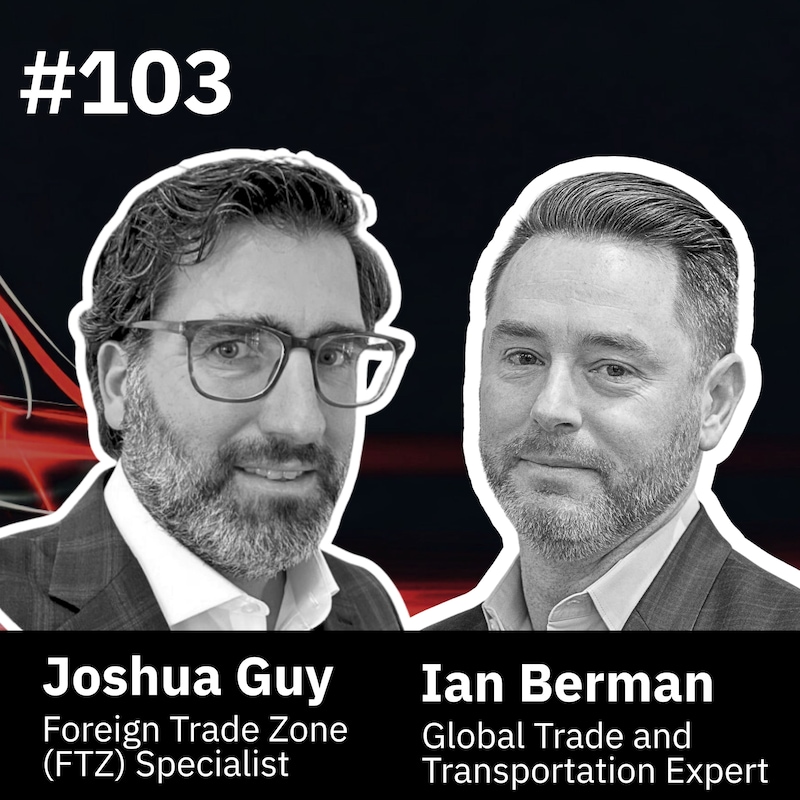
Global trade does not have a compliance problem. It has an execution gap. The classifications exist. The brokers are in place. The duties are being paid. Yet too often, trade is treated as documentation instead of strategy. In this episode, Jan Griffiths and Tom Roberts sit down with Ian Berman, Global Trade and Transportation expert, and Joshua Guy, Foreign Trade Zone specialist, to challenge that mindset and introduce a new one.
Ian and Joshua make the case that tariffs are no longer a temporary disruption. They are a structural operating condition. With layered duties, stacked exposure, and policy volatility, organizations cannot afford to treat trade compliance as a cost center. The companies that will win are the ones that shift from a system of record to a system of action. That means modeling exposure before it hits. Scenario planning under uncertainty. Using infrastructure like FTZs deliberately. And building systems that react at the speed policy changes.
The honesty in this conversation sets the tone. Jan openly admits she once treated trade compliance as something to “just like keep me clean. Don’t get me into trouble.” Ian confirms how common that mindset is, saying, “They look at that as just a cost center. Honestly, Jan…” That old-world thinking no longer works.
Joshua explains why the stakes have changed: “This is way too complicated of an environment that is changing daily, and so you have to be dependent on systems for this. You cannot be dependent on the old way of how things work.” In a world where executive orders drop on Friday and implementation happens Tuesday, modeling tools and automation are no longer optional. They are survival mechanisms.
This episode is a reminder that global trade is not back-office reporting. It is strategic infrastructure. Leaders who treat it as such gain flexibility, cash flow timing advantages, and margin recovery. Those who do not will absorb cost and call it unavoidable.
Themes Discussed in This Episode
- Why treating trade compliance as a cost center is a strategic mistake
- The shift from system of record to system of action in global trade
- Tariffs as a structural operating condition, not a temporary disruption
- Modeling exposure before policy changes hit
- The critical role of data accuracy under refund and audit scrutiny
- Building scenario capability to react at the speed of volatility
- Foreign Trade Zones as strategic infrastructure, not paperwork
- Turning landed cost management into a competitive advantage
Featured Guest
Name: Ian Berman
Title: Global Trade and Transportation Expert
About: Ian is the Manager of Business Consulting with QAD Supply Chain. Ian has been with QAD for 11 years and has 20 years of experience in global trade and transportation management. He holds a Masters Degree in Supply Chain Management as well as an ASCM CLTD Certification.
Connect: LinkedIn
Name: Joshua Guy
Title: Foreign Trade Zone (FTZ) Specialist
About: For more than 25 years, Joshua has worked at the intersection of engineering, product leadership, and global trade, helping organizations bring structure and clarity to complex supply chains. Today, he leads strategy for Foreign-Trade Zone solutions that enable multinational importers to manage tariff exposure, reduce compliance risk, and strengthen financial performance. He also led the development of QAD FTZ, an industry-leading Inventory Control and Recordkeeping System that supports manufacturers, distributors, and 3PLs as they move from reactive compliance to proactive, resilient trade strategy in a volatile global environment.
Connect: LinkedIn
About Your Hosts
Jan Griffiths
Jan is the host and producer of the Auto Supply Chain Champions Podcast and The Automotive Leaders Podcast. A former automotive manufacturing and supply chain executive, Jan is recognized as a Champion for Culture Change in the automotive industry. She brings direct, grounded conversations to leaders navigating execution, disruption, and transformation across the global automotive ecosystem.
Tom Roberts (Co-host)
Tom is Co-host of the Auto Supply Chain Champions Podcast and Vice President of Strategic Industry Development at QAD. He works closely with automotive and industrial manufacturers to close the gap between insight and execution, helping leaders move from visibility to systems of action that drive real operational outcomes.
Episode Highlights
[01:38] Falling on the Sword: Jan opens with honesty, acknowledging that she once viewed trade compliance as protection, not potential. It was about staying out of trouble, not driving advantage. That mindset, she admits, is exactly what leaders must now challenge.
[03:58] Cost Center Thinking: Ian names the pattern many organizations fall into. Trade teams are treated as overhead, brought in after decisions are made, measured by cost instead of contribution. In today’s environment, that thinking leaves value on the table.
[10:51] The New Reality: Joshua reframes the moment with clarity. Uncertainty is not a phase. It is the operating model. Leaders who accept that shift can move from reacting to preparing.
[17:30] Start with a State of the Union: Before making bold moves, Ian calls for alignment. Understand what you buy, where it comes from, what you pay, and what systems support it. Clarity is the foundation for action.
[10:33] Volatility Isn’t Going Away: Ian delivers the hard truth. Today’s structure will change again. Waiting for stability is not a strategy. Building agility is.
[12:29] Systems Over Spreadsheets: Joshua draws the line between the old world and the new. Manual tracking cannot keep pace with stacking tariffs and shifting rules. Systems of action are no longer optional. They are essential.
[19:37] FTZ as a Lever: Joshua shifts the lens from compliance to opportunity. Foreign Trade Zones are not paperwork exercises. Used well, they become a financial lever that improves cash flow and protects margin.
[22:07] Leadership Urgency: Tom closes with resolve. When double-digit cost increases appear, leaders cannot hesitate. They must understand the full landed cost, explore every lever, and act decisively.
Top Quotes
[04:49] Ian: “They look at that as just a cost center. Honestly, Jan, and again, you fell on the sword and you're not alone.”
[10:51] Joshua: “I think the only certainty is uncertainty in these times, right?”
[12:29] Joshua: “You have to be dependent on systems for this. You cannot be dependent on the old way of how things work.”
[22:07] Tom: “If I'm facing 10% additional cost, or 15 or 40, or whatever it is. I am gonna figure this out.”
Follow the Auto Supply Chain Champions Podcast for real conversations with leaders who are making hard choices, focusing their bets, and leading with intent.
🎧 Follow the podcast: https://autosupplychainprophets.com/
🔗 Learn more about QAD Redzone: https://www.qad.com/
Transcripts
[Transcript]
[:[00:00:30] Tom Roberts: Great to be here, Jan. What I see every day is simple: manufacturers don't have a data problem, they've got an execution problem. This show is about how artificial intelligence, systems of action, and empowered teams can help close that gap.
[:Hello and welcome to another episode of the Auto Supply Chain Champions Podcast, and it has been a week, hasn't it? We have all been up to our eyeballs in IEEPA tariffs and Supreme Court decisions and understanding what a section 122 is. And I learned something this week. What the heck is a liquidation date?
And I learned all about that, but it strikes me. We're looking at this the wrong way, but let's check in with my co-host and see what he has to say about the subject, Tom Roberts.
[:[00:01:38] Jan Griffiths: I would agree, and I am gonna start off this episode. Tom, I am gonna fall on the sword. Are you ready? So, several years ago I worked in the wire harness business. And I had the trade and compliance department under me in supply chain, and I wanted nothing to do with it. And I feel terrible saying that. And it wasn't because I didn't like the people, or I didn't understand that it was an important department.
I mean, it was a wire harness business we had. Plants in Mexico. I think we had 10 plants at one time, so we had product crossing all the time, and I just didn't wanna know because it wasn't my number one priority. I just wanted to just like keep me clean. Don't get me into trouble. And the idea of saving money didn't even enter my mind, right?
It was just like, this is a compliance thing, and you say the word compliance to me and I start twitching. 'cause I'm a visionary, creative, right? I don't want anything to do with spreadsheets and compliance and all that stuff. So I have to fall on the sword and say that's how I view trade and compliance, and I have a feeling that there are some other people out there that may have the same way of looking at it. And to your point, Tom, I think it's a missed opportunity. So today we are thrilled to bring on the show two experts that know this subject inside and out.
Our first guest today is Ian Berman. Ian is Global Trade and transportation expert. If that isn't enough, he's got a deep supply chain background. Ian, welcome to the show.
[:[00:03:26] Jan Griffiths: Yeah, and our second guest is Joshua Guy, and Joshua is an FTZ Foreign Trade zone expert. Joshua, welcome to the show.
[:[00:03:47] Jan Griffiths: Well, let's start off with Ian. Let's start off with you. So you just heard me fall on the sword and admit it. Do you see that? What do you see out there in the industry?
[:I just know I have to pay 'em a lot of money and ultimately they make sure my stuff shows up. But it happens all the time even having a colleague of mine that was a licensed customs broker working for a Fortune 500 company, and he would say, honestly, we're the last people in the room to kind of be acknowledged of what's going on.
And more importantly, when they start making decisions, they're not brought in, they're told afterwards. They go, somebody shows up to your point and says, Hey, we just found this new cheap manufacturer for this product, and it's over here in this country, and I just need you to get it into my facility here in Detroit, or wherever it might be.
And all of a sudden, now the compliance team goes, okay, well, I'll let you know. And now they start working backwards of what's it gonna cost, getting with transportation logistics, figuring all of that out. And, a lot of finance and logistics. And they look at that as just a cost center. Honestly, Jan, and again, you fell on the sword and you're not alone.
And I think probably a lot of the listeners are probably in the same boat that, yeah, we have a whole team that's dedicated to this, but. We don't see where the revenue or even where that might come from, and I think it's really time to clearly by the news, to look at it and see what you can take advantage of those processes and aspects.
[:And so I think the companies that are really kind of shifting their focus and being a little bit more forward thinking, a little bit more proactive with the way that they're looking at their whole global trade picture are really gonna be the ones that are able to survive.
[:[00:06:39] Tom Roberts: I think that what we want is for when these tariffs to change or get enacted, what kind of elements can we do to automate some of these things? Like, you know, do I have something that's subject to a tariff?
What is the tariff amount? And then are there other things out there? Like, can I actually find out where this, the tariff optimal countries are? And then potentially look at alternative sourcing and all of the customs elements that go along with that. What can we do to react to some of this and maybe even get in front of it?
That's what I'd love to know.
[:And if now isn't the time to do that, I don't know what is now is the perfect time. So how Ian, how do we do that?
[:The idea of all the refunds and the tariff aspects. There's even other parts of this of getting into, okay, well now I don't have these IEEPA tariffs, but are my goods on the annex two list liquidation dates, all of these different pieces and parts that are out there.
The first thing to do is to sit down and get a State of the Union type of scenario. I know timely, but what's happening in my world? Where are things coming from? What am I paying today? You can't do that if you don't have the pieces and parts in place to be able to pull that information.
Then from there, you can start actually looking and knocking on the doors of those people in the corner are called compliance professionals and saying, are there programs that we should be looking at? What can we do? You're the experts getting some guidance from there. Is a foreign trade zone helpful or can it optimize our processes? Looking at all of those pieces and parts, there's just a lot of volatility right now, obviously, right. We just saw the Supreme Court kind of make all of those changes and then knowing that, well now there's another 150 days worth of the 122s.
We don't know what gets codified. We don't know what they might change or what else might get put in after that 150 days, what happens on day 152? But if you have a good state of the union and state of your business, then you can. Plan, you can start making ideas. You can be agile with that, and again, that requires some teamwork, some tools, some systems to really outline and define what all that looks like, as part of it.
But until, you know. First, what's going on? It's gonna be very complex and hard to even be able to navigate this kind of going forward. And I think that's the biggest part is okay, yeah now it's a flat tariff. Not really. There's all different pieces and parts out there that are still sticking up and 20% here or however that gets calculated.
Understanding what you have, where you have it from before you start making any other decisions, Jan, you called it out. Are they looking to source from other places or Tom, you're talking about looking at all of those pieces and parts. I'd be interested, even from our own listeners to understand is that activity happening currently?
Did this shift the mindset of do we start looking at new suppliers or things out there? Mainly Now let's figure it out. You have to be agile. It's gonna change again, I guarantee you, in 152 days from today, there's gonna be something else, something different. What does that look like? I put my magic eight ball away at this point 'cause it wasn't doing me any good. So
[:There's gonna be some other action moving forward, and we're not gonna be able to have this long timetable to be able to prepare and implement. And so I think that's what really becomes important with system of actions versus system of records, right? Is the systems of actions need to be able to kind of proactively.
Figure out what potential changes might be. So I was talking to somebody earlier this week about this whole subject with tariffs and trying to figure out modeling about countries and potential impacts and a IEEPA refunds and audits and how all this stuff might go. And there's even tracking of potential tariffs, which literally are just going out and looking at news sources, true social things like that to understand what tariffs are being thrown around to be able to capture that information to then be able to proactively plan, Hey, if this country does get this tariff, what's that gonna look like for me? How's that gonna impact me? How do I need to shift stuff around?
And again, companies that are utilizing a system of action like that are really gonna be the ones that do have that strategic advantage because it is not, the current environment is not able to be maintained by the compliance team just going out and compiling the information and kind of having that knowledge within their team. This is way too complicated of an environment that is changing daily, and so you have to be dependent on systems for this. You cannot be dependent on the old way of how things work. We've gotta be able to react quickly.
[:[00:12:52] Joshua Guy: Yes, absolutely. I mean, you need to be able to understand. The impact and then be able to model that against different scenarios that might happen.
The other thing that's really important is to have a good understanding of the accuracy of your data, right? So, all of these classifications need to be accurate, right? That's the compliance part. But all of the information coming down from that too, with the 232s, the derivatives, that's where it gets really hairy because you have the derivative details that you've gotta capture. And this is information that these importers were previously not collecting for information about, country of smelt, country of cast for all of this, and the derivative value, the portion of steel, copper, aluminum, whatever it is.
That is data coming downstream that these importers have never had to deal with before. And so again, being able to model those different scenarios, understanding that broad picture and then proactively looking forward we're talking about these IEEPAs getting struck down, but the big question on everybody's mind is, how do I get my money back?
And that's still an unknown. But again, you need to have systems in place that can, for one, audit the accuracy of that information so that when you go to try to draw back some, whatever the method is gonna be, right? However that ends up coming about, you've got to make certain that the data that you're reporting to customs, trying to get that IEEPA money back is accurate and that you have systems in place that are accurately capturing and tracking that information.
[:So accuracy is important, but this idea of predictive analytics, that's a huge issue. Joshua, tell us more about the world of FTZ and how you're handling some of that.
[:When 2025 hit the IEEPA started coming down, we quickly realized that the way that we were handling additional tariffs was not gonna work with what we were seeing, right? So one of the things that we did is kind of develop this whole additional tariff engine that would take a look at the primary classification coming in the country of origin.
Bill of lading, export date, any sort of information that went into the inputs to be able to calculate what all these additional stacking tariffs would be. We implemented that quickly because we understood two things. We understood one, that talking about accuracy of data, the customers would struggle. On their own to be able to capture and manage that information.
And then two, we knew the speed at which these things were being implemented was such that it was going to be hard again for the customers to, to manage and maintain that. So, when you're dealing with the executive order on a Friday and the implementation date on a Tuesday. That's not the previous timeline that we looked at historically with any sort of tariff changes like this.
lowed us to help navigate the:Now, saying all of that. I think 2026 might shape up to be an even more crazy year. At least. We've got our feet kind of wet and we've got our bearings, but 2026 is vial accounts going to be quite an interesting year, much like 2025.
[:[00:17:30] Ian Berman: I think probably the first thing, as I called out before, get a state of union, figure out where everything is. Find out what systems you have in place, what they can do. Start getting your modeling done. Break it down as best as you can understand.
As part of that, you should be looking for a revenue driver in your supply chain and in this process, because there is revenue to be had, even though it's more about cost savings on landed costs and modeling as part of it than it is direct revenue. But I think you start there. State of your union.
Looking at and then understanding what projects or pieces you can put in place. Also looking to find what are you missing based off of what those, you know your compliance professionals are doing. What's missing? What tools don't you have? What can't you model? What can't you look at or to understand?
Because doing all of those activities, and as Josh and Tom and Jan, you've called out already, if I don't know. What to do, or I'm missing information. That model or those ideas might steer you in the wrong direction and go from there. Understanding what you can do, right? What is, can I move away from that supplier?
Can I go here or there? You gotta figure out where you stand right now and less about what refunds you might be getting and more about what can I make sure. In the future, I can minimize or speed up that process.
[:You know, really get an understanding of all those things. Where am I sending this? Where am I assembling things? Get that good scenario. Then once you have that, now you can start working through customs information, tariff information.
Awesome. Josh, from your side, again, top three things that leadership should be doing right now.
[:Maybe that's not something we want to deal with. But right now with all of the tariff changes and just tariffs in general, FTZs should really be looked at as a tool for a couple of different reasons. I mean, there is just some flexibility that FTZs provide you, but in the current environment with all these additional tariffs.
FTZs can be used to kind of mitigate some of those additional expenses, right? And so the FTZ is not gonna allow you to bypass tariffs for anything that's being imported into the us but you can defer the duty. So you have some cost of money savings there. If you are an importer and you export a good bit, you can save on the duty for those exports.
If you have a large scrap in yield loss, you don't pay duty on that. There are weekly processing savings as well. So if you're a high volume importer, you can save on NPF and brokerage fees. So there are lots of different ways that companies can utilize the FTZ again to try to squeeze as much as they can out of it to help with some of these difficult times.
Now, one of the things that we can also do talking about modeling and all of that is, it is really easy, fairly easy to figure out what potential savings for a company would be within an FTZ. And so that's one of the things that we'll do is kind of a cost benefit analysis where we can look at what are they bringing in, what are they exporting, what are they scrapping, where their inventory turns, and we can kind of model what those savings would look like for the importer in an FTZ. And those are real numbers. I mean, they're substantial numbers. It's not just pennies.
[:Is it a system of record? Is it a system of action? Are you going to use it to drive real hard savings to the bottom line because the opportunity is there and it is right now, Tom. Close us out.
[:I wanna figure out what products I have out there, where they're coming from, where they're going. I want the details and I wanna know, does a foreign trade zone, set up work for me? Does that generate the savings that I'm looking for? What is the landed cost, right? It's no longer just negotiating a price.
How much is the cost for the item to actually get where it needs to be with everything that goes with that.
Very important, very important.
[:Are you open to our listeners reaching out to you if they have questions or would like to have a conversation with you?
[:[00:23:15] Jan Griffiths: Okay. Joshua, are you okay with that?
[:[00:23:34] Jan Griffiths: Okay. And we'll drop a link. We'll put your emails in the show notes, and a link to the event. Where is that event, Joshua?
[:[00:23:42] Jan Griffiths: Oh, okay. All right. Very good. Okay, well thank you gentlemen. I can't wait to do what we gotta talk about next time.
[:[00:23:49] Ian Berman: Thank you.
[:
