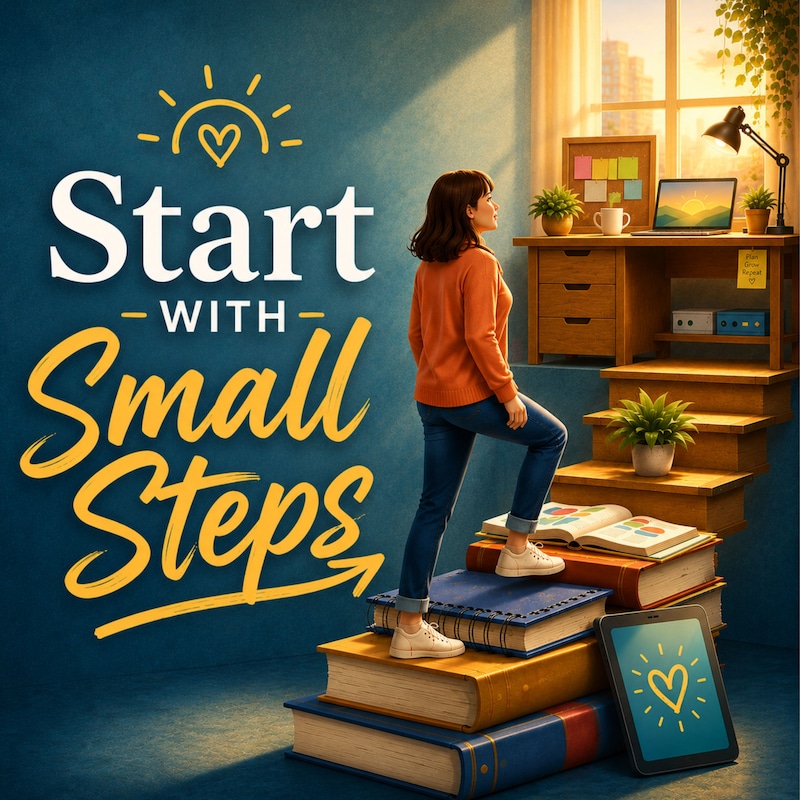
Shownotes
In this episode of Start With Small Steps, we explore why so many New Year’s resolutions fall apart just weeks into January—and how to make lasting changes instead. This isn’t about motivation hacks or dramatic transformations. It’s about starting where you are and making your goals achievable every day, even on your worst days. We’ll break down why giant goals often fail and how shrinking the entry point can lead to real, sustainable progress. Whether you’re hoping to get healthier, become more consistent with prayer or writing, or simply want a better routine, this episode provides practical advice to help you build habits that last.
Top Topics:
Why New Year’s Resolutions Often Fail
We begin by recognizing the common trap of high-intensity resolutions—new planners, intense workouts, strict diets—that often fizzle out by mid-January. This failure isn’t about laziness or lack of discipline. It’s usually about starting too big, too fast, without any on-ramp or plan for consistency.
The Power of Starting Small
Small steps aren’t about lowering your standards—they’re about making your goals actually doable. Whether it’s reading one page a day, putting on workout clothes without requiring yourself to exercise, or eating one extra vegetable, these steps reduce friction and bypass resistance. Your brain doesn’t fight small goals.
Consistency Over Perfection
The core habit matters more than performance. Instead of tracking everything or aiming for high metrics, the focus should be on doing something most days—even if it’s small. This creates momentum and makes it easier to jump back in after setbacks.
How to Design Sustainable Habits
You’ll learn three practical rules: 1) Start from where you are now. 2) Shrink your habit until it fits your worst day. 3) Separate the habit of practice from perfect performance. It’s not about running fast—it’s about running consistently and learning what works for you.
Making It Work for Your Personality
Different people succeed in different ways. For some, writing goals in a journal is powerful. For others, like Jill, visual cues like post-it notes or image boards throughout the house are more effective. The goal is to find what works best for you—and stick with it.
Key Takeaways:
Start with one or two areas that would make the biggest difference in your life and build around that. Don’t try to fix everything at once. A single paragraph, one prayer, a quick walk, or five minutes of effort can grow into meaningful transformation over time. The real secret? Create habits so small and easy that you’ll do them even on your worst days.
Focus less on the impressive and more on the consistent. You don’t need a perfect plan or a fancy setup—just a realistic, manageable action you’re willing to repeat. Start today, start small, and keep going.
Jill’s Links
http://jillfromthenorthwoods.com
https://startwithsmallsteps.com
https://www.youtube.com/@startwithsmallsteps
https://www.buymeacoffee.com/startwithsmallsteps
Email the podcast at [email protected]
By choosing to watch this video or listen to this podcast, you acknowledge that you are doing so of your own free will. The content shared here reflects personal experiences and opinions and is intended for informational and inspirational purposes only. I am not a licensed healthcare provider, psychiatrist, or counselor. Any advice or suggestions offered should not be considered a substitute for professional medical or mental health advice. You are solely responsible for any decisions or actions you take based on this content.
Transcripts
How can we start the new year off right? That's what we're going to talk about today.
Hi, this is Jill from the Northwoods, talking about how to get your goals and how to achieve the things that you finally want to get—one small step at a time. You know, we're talking about January, and we're right here at the end of this year and talking about next year. I talked about this in the health channel that I also run, on the stuff that I'm going to talk about: Start With Small Steps YouTube channel, primarily talking about weight. But we're going to talk about it when it comes to bigger goals and other goals besides weight and health.
We start off the year, and people feel hopeful and determined. They make plans that sound amazing—and quietly, they fall apart somewhere in mid-January. You see that in the gym. I always went to the gym, and the gym would get packed right away in January. And then, all of a sudden, three weeks in, people would stop. Stop going to the gym. And suddenly, the gym would empty out again. Finally, all the machines are available.
And what happens? You know, whenever it is we have these kinds of goals, people aren't lazy. They don't always lack discipline. I mean, people I know who have really great discipline can't keep all of their goals going. And they care very deeply about their goals. You sort of wonder—what happened? What made that go?
Now, I like starts of new things. I like new beginnings, and New Year's goals are actually really great. I like any time that you have this opportunity to start fresh. Sometimes that happens when you move to a new town, when you start a new job. You can start fresh at any time. But New Year's is a really great time to do it.
And what happens when you start creating these new versions of yourself—when you start looking at the things that you really want to achieve in this next year—you end up starting off great. And then the problem is that a few weeks in, that's when the real work starts to show up. And a lot of times, every year, I've hoped that this year will be different. I'll finally get to do the things that I want to do. And if you're someone who's seen that drift away a few weeks in, we're going to talk a little bit about how you can actually start going after those things that you want in the new year—and how you can retain them so they don't quietly fall.
The first thing that usually happens is people identify some level of change. And it's usually hard to identify: “I want to get healthy. I want to lose weight. I want to improve my health. I want to improve my budget. I'm going to become a whole different person.” These goals are usually performance-based goals: read 50 books, lose 30 pounds, pray for an hour every day, work out six days a week.
And the big one is that they usually go after it with huge intensity—new routines, new planners, new diets, new schedule. Everything changes all at once. And it works for a little bit. But then the brain kind of experiences the day-to-day, and this new inspiration suddenly either becomes boring or I'm tired or something happens. Maybe you're great. You start off good, you're going to the gym six days a week, and something happens. Maybe someone gets sick in your family, and you just don't have time. For some reason or another, that new plan falls off.
And it's not even necessarily a bad thing or something that you could control. And then as soon as people fall away from that, they either feel guilty about it—“I just can't stick with anything,” or “I never get my goals,” or “I knew this would happen.” Again, it's not a motivation problem. The problem usually is that you're starting too big, too fast, with no on-ramp.
January goals are designed to be lived with. They're designed to show us kind of this different future that we had planned for ourselves. And instead, we just go too fast, too hard. We come up with ideas and goals that are not something that we can actually either attain within the time limit or work our way up to.
Again, this is Start With Small Steps. And so I think that's where we have to head. A lot of times, when people hear "small steps," they think that it's lowering standards, settling, giving up on the big dreams. And that's not what small steps are about at all. Small steps are about shrinking the entry point—your beginning—to a level that you will actually get things done and you'll start to get into a rhythm.
It's not about the final outcome. It is about getting into a pattern of behavior that you will maintain. And so it requires less motivation, willpower, whatever you want to call it—less of the perfect mood, the perfect clothes. When you have a goal that's too big, it is dragging you in through a different pattern of behavior that you weren't prepared for. Let's put it that way.
A good small step usually feels kind of silly. It usually feels very small and usually feels so non-dramatic that you think it's not even a step at all. Maybe if you wanted to read more, you'll read one chapter. Or if you wanted to pray more, you'll decide that you're just gonna do one simple, quiet 30-second prayer per day.
Or if you want to exercise—for me, to get myself to exercise—how did I do that? I said that I actually just had to put on the clothes and show up at the gym. I didn't actually have to do anything. But usually, once I was there, I did exercise.
Or, if you're thinking about wanting to eat better, maybe it's one vegetable for dinner every day. One additional vegetable, one additional protein a day or something like that. It's very small. And these small steps work because your brain won't argue with it. It feels very safe. It also means that you will slowly ramp yourself up to it.
If you make too big of a plan and then the plan falls apart, a lot of people just walk away at this point. While this is very, very small, it’s very easy to maintain. And if, for some reason, you were to miss a day—fail at some point—I don't want to say “fail,” but not do the thing you wanted to do, it's very easy to get back on the bandwagon again.
Once you start getting momentum, then you'll be able to start doing it time and time again.
So there are basically three rules for starting out small:
1. Look at where you are right now.
Not where you want to be, but where are you right now? If you're someone who doesn't exercise at all, can you exercise one extra time a week? Can you just put aside 10% of your money every month? If you're trying to come up with a goal—let's say you're a writer and you're trying to write a book or whatever it is you're trying to write—don't think about a chapter. Think about, can I just do one paragraph or one sentence even a day? Something very small. And like I said, if you fall off the bandwagon, you'll be able to jump back in right away. Once you start getting into the habit, then you'll be able to do more and more.
2. Shrink it so that it fits into a bad day.
Honestly, when it comes to any new habit or any new change that you want to make in your life, the habit is the most important thing. So if you get into this habit that every day after I eat breakfast, I exercise—even if it's five minutes—the habit of you exercising is the most important thing. Because as you start getting stronger, as you start feeling like this gets easier, you will exercise more.
I think that's where I've really fallen down in the past. When I've gotten into exercise before, I would suddenly be like, “Oh, I'm going to go for a half-hour bike ride after work.” Very easy to do—and I did it. But then what would happen is I would suddenly break out into two hours of bike riding. I would just get really into it. I tend to overdo things. And then suddenly, it was impossible to maintain. I can't go for a bike ride every day for two hours after work. It was unsustainable.
I'm not saying I should back away from those things, but I should realize that essentially a two-hour bike ride is not an everyday kind of thing. A half-hour bike ride—that's an everyday kind of thing. And then when I stopped doing the two hours, then eventually I just stopped at all.
So we want to shrink down the habits so that they can fit not just with our ramping up, but also shrink it so that it fits into a bad day. So again, if you're creating this new habit and you're trying to do whatever it is you're trying to do—write, save money, exercise more, eat more vegetables—can I do this when I'm tired? Can I do this when life gets really messy? Is this something I could do on a day where I'm just lacking motivation entirely?
And I think that if you see that this is too big for you, the idea is to shrink it again. The goal is to just do it most days. What is it you're willing to do most days? That kind of goal will open up the door for you. Consistency is about building it slowly. It's about doing it day by day. Some days, you're going to screw up and you're not going to do it. Some days, you just can't do it. So that's the important thing—you want to shrink your goals so that you can do it consistently, even on a bad day.
3. Separate the practice from performance.
A lot of times people get into running programs, right? And they just start out running. I've done this before, because I've started out running and I'm hoping this year is the year that I'm going to start running again. And then they're like, “Oh gosh, I'm really slow.” The idea is that when you're starting out any of these new habits you're doing, you might be bad at it. You might be slow at it. You might not have the most optimal experience about it. But what you're trying to do is practice. You're trying to do it so that you gain consistency.
So whether you do it and it's imperfect, you'll learn what works for you. You'll build familiarity with it. And so you'll be able to do that. You're not looking to judge yourself or track yourself aggressively. That's my problem—I always track myself aggressively.
What you want to do is just sort of see, “Hey, how does this go?” When I first started learning to run, I found out actually pretty quickly that I don't like sidewalk running, and I don't like cities very much. I forgot, when I started doing this, that I would go out hiking in the woods. And one day, I realized I was wearing my trail running shoes—because I hike in trail running shoes—and I started thinking, “Why don't you just try running here?”
I learned I loved trail running. I started doing more and more trail running. When you are starting a new habit or when you're starting a new thing, you're going to learn more about yourself and find ways that you can actually make it work for yourself a little bit better.
If you're writing, you'll learn what it is that you need to do in order to write—where you feel comfortable, where you enjoy it the most. If you're exercising, you'll learn a little bit more about what works for you. Now, I’ve learned through all these years of going to the gym: there are things I like to do in the gym and things I really don’t like to do.
When I started actually finding things that I enjoyed—or even situations I enjoyed in the gym itself—that helped. The gym I went to had these monitors, and you could pick different places that you were hiking, walking, or running in. I started doing places like Yosemite. At that point, I had never been to Yosemite. I started doing these trail runs in Yosemite, and I started doing more and more because I wanted to see how the trail ended. I realized that I would run for 20 minutes and then stop, and I never saw how the trail ended.
That encouraged me to do a little bit more. Just having a video of nature made it more enjoyable for me. Or having a book—an audiobook—that I really enjoyed. You will learn more about yourself, and you'll figure out ways that you can actually start to enjoy what you're doing. Then you'll start to be able to lean into that particular piece more.
The idea is that you should just start right away. In this case, this podcast is coming out a couple days after New Year’s. Just start. The question is, what can you do today? What can you do right now? What are you willing to do to start immediately?
Because if you make a plan—that was another big problem that I used to have—I would build up this entire plan: How am I going to exercise? What is my budget? What's my big budget plan? Instead of just—stop spending money right now.
That’s the idea. What can you do right now?
You can even ask yourself a question when you're looking at these kinds of goals: What’s an area that you really care about that you would like to fix in this particular year?
You don't want to pick too many of them. I know this is another problem that many people have. They pick everything: “I'm going to eat totally good foods. I'm going to exercise every day. I'm going to faith journal and meditate every day. I'm going to take up painting…”
And it keeps going on and on and on.
The question is, what is one or two areas you can pick that would make the most difference in your life right now?
Then you want to look at what's the smallest daily engagement possible—not to be impressive or efficient or to show off great stats. What are you willing to do every day? That’s the idea.
I will talk about this in a future episode. I'm going to redo my BATNA and WATNA—which is the Best Alternative to a Negotiated Agreement. But the idea is: What is something that you're just willing to do?
Not the biggest run. I know a lot of people, like I said, when they start out running, they decide they're going to do a half marathon. How about just thinking about the practice—the system of saying, “I'm going to run three times a week. I'm going to just run—maybe not for a distance, but for a time.”
When you start out—when I first started running—I had worked with a gym trainer. She had me run two minutes on, one minute walking. Then we worked out a plan where that would just increase and increase and increase. That’s how I got started running.
Turns out, if you haven’t run in a long time, you just probably can’t even run anymore. It’s very doable. Her rule was: you don’t increase more than 10% a week. So if you ran for five minutes last week, you're going to run 10% more the next week. Don’t increase too much.
The other question to ask yourself is: How can you make the friction less?
How can you make starting it easier? Set out your clothes. Get good running shoes. Find a nice place—if you’re not going to run inside, where can you run outside? Just start with less friction.
That’s the idea.
Examples of this: if you’re going to start praying, maybe you pray over one verse a day. Or you pick one verse and pray over it for a whole week.
If you're starting out in health, maybe you just go for a quick 10-minute walk around the block once a day, once a week.
Or if you're trying to get back into—like, my friend is learning how to paint. Maybe you start with one thing. She started doing YouTube classes. One YouTube class that she works on, I think, for a couple of weeks.
One sentence. If you're going to be a writer.
If you're going to organize—clean one surface off. Don't look at the whole room. Start with small steps and improve that one step. Then, as you get better and better at it, your momentum will come.
That’s why the small steps are going to make the most impact in your daily life.
If you're looking also to maintain your habits, I talked to Em, who’s my bud. She says that it’s important for her to write it down. Now for me, writing it down was always kind of weird. But she keeps journals, and she writes it down.
She says, even if you write it down and you never look at it again, it's now implanted in your brain that this is the thing you're working on right now.
To me, I tend to like to put Post-it notes in my bathroom. Because every morning when I get up, I see it. Locking away something in a journal that I don't look at again has not been very helpful to me. For her, it's helpful. For me, it's putting Post-it notes in my bathroom to remind myself, first thing in the morning: “Oh yeah, Jill, this is what you're working on.”
So go through it with small steps. Be faithful to those very small steps. That's how real change begins. Don't expect fireworks. Instead, expect consistency. Even if it's very small—do it every day. And if you miss a day, don't miss two days. Then just keep going with it. That’s the important thing.
So if you're trying to get started in this new year, pick something that works for you. That's where I always kind of differ from other podcasters. You'll hear people that will say, “You have to write it down in a book, and you have to do a bullet journal, and you have to do this and that.”
You know what? We're all really different.
The thing for you and your challenge is to figure out what works for you.
For Em, it is writing it down in a journal and putting it in a journal. For me, it's putting Post-it notes in my bathroom. I get a little ADHD, and sometimes I literally would forget I was on a diet, you know?
If you can remember those kinds of things and see them in places…
The next thing I think is important for writing it down is to be able to visualize your goal. I like to actually make boards and photo things where it's like the images of what I want.
So I have picture frames all throughout this entire house, and it shows me on hiking adventures, with friends, doing things. That's what I want. I want to be able to go on longer hikes, more adventures. And so I have them visualized all over this house. So that's another way that you can write them down—without writing it down.
Anyway, I hope that helps. I hope you have a great new year. And I hope that you start thinking about the things that you really want.