Shownotes
The automotive supply chain runs on scale. Volume buys capacity, amortizes tooling, and puts a buyer at the front of the queue. Karma Automotive builds roughly 150 vehicles a year, so none of that leverage exists. A traditional tier-one scrap earns more in a week than Karma needs in twelve months.
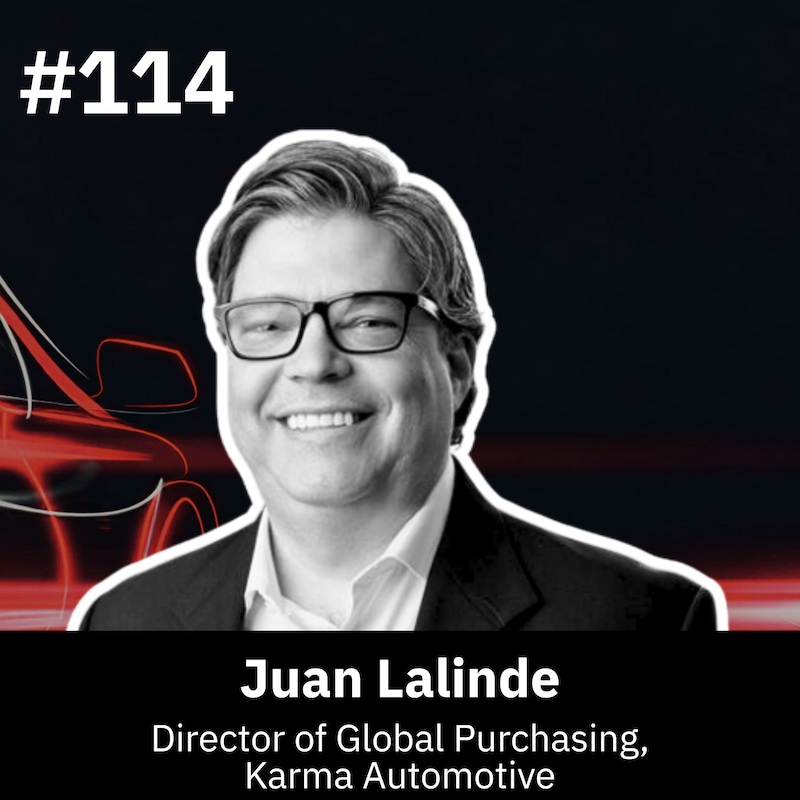
In this episode of the Auto Supply Chain Champions Podcast, Jan Griffiths and Tom Roberts sit down with Juan Lalinde, Director of Global Purchasing at Karma Automotive, the California ultra-luxury automaker built from the assets of Fisker. Juan sources a company where a $2 million tooling quote sits against a 150-unit build year.
His model is not a smarter algorithm. It is a stronger network. AI clears the noise, and the non-value-added work, and the doors still open the old way, through a knock, an introduction, and a supplier who wants a shot at ultra-luxury. Juan calls it HI. Human intelligence.
That approach got tested. Karma pulled a structural program out of Northern Europe, where the Fisker-era extruders had merged, closed, or scrapped the tooling, and localized it with a supplier in Tijuana, two hours down the road. Requalification finished. The tooling was paid for. Then the tariffs on Mexico landed. Juan ran the numbers, saw that China carried heavier-duty and domestic quotes at 10 times the cost, and chose to stay and work the problem with the supplier.
What came out of it is a different kind of negotiation. Karma hands the supplier the schedule: deliver 100 parts by the date, and run the job at 1:00 in the morning if that protects the capacity, paying their bills.
Juan is also clear that Karma is not a pure EV. The motors are electric, and the engine exists only to charge the battery, which takes charging infrastructure out of the decision, where it still stops buyers.
Most supply chain leaders will never buy at 150 units a year, and the lesson holds anyway. When volume stops doing the negotiating, what is left is the relationship, the speed of the call, and whether the supplier believes the business is going somewhere. That work does not automate.
Themes Discussed in This Episode
- Sourcing when scale is not on your side
- Why relationships still open doors that data cannot
- AI for the noise, human intelligence for the decision
- Localizing to Mexico and absorbing a tariff shock with the supplier
- Developing small suppliers from ISO to IATF
- Schedule flexibility as a low-volume negotiating tool
- EREV and the charging anxiety are still holding buyers back
- Brand desirability as a sourcing asset
This podcast is powered by QAD RedZone.
Featured Guest
Name: Juan Lalinde
Title: Director of Global Purchasing, Karma Automotive
About: Juan is Director of Global Purchasing at Karma Automotive, with extensive experience in global supply chain management and process improvement. Known for driving operational efficiency and leading high-performing teams, Juan has delivered multimillion-dollar savings and innovative solutions across the automotive and technology sectors. Juan holds an MBA from the University of San Diego and is fluent in English and Spanish.
Connect: LinkedIn
About Your Hosts
Jan Griffiths
Jan is the host and producer of the Auto Supply Chain Champions Podcast and The Automotive Leaders Podcast. A former automotive manufacturing and supply chain executive, Jan is recognized as a Champion for Culture Change in the automotive industry. She brings direct, grounded conversations to leaders navigating execution, disruption, and transformation across the global automotive ecosystem.
Tom Roberts (Co-host)
Tom is Co-host of the Auto Supply Chain Champions Podcast and Vice President of Strategic Industry Development at QAD. He works closely with automotive and industrial manufacturers to close the gap between insight and execution, helping leaders move from visibility to systems of action that drive real operational outcomes.
Mentioned in the Episode:
- Beyond the Bottleneck: The State of AI in Automotive Manufacturing and What’s Next, the QAD webinar with Automotive News
- Marques McCammon, CEO of Karma Automotive, on The Automotive Leaders Podcast
Episode Highlights
[03:11] The Phoenix in the Portfolio: Juan describes the third-generation Revero as the proof of everything Karma has engineered since 2020, with the Gyesera, the Ivara, and the Kaveya super coupe behind it.
[04:10] Volume Buys You Nothing: Traditional tier ones and twos scrap more in a week than Karma needs for a year, so the search is for a partner who cares about the part rather than the quantity.
[06:16] Everything Matters at 150 Cars a Year: Juan walks through the paint shop and the body-in-white line, where the goal is to give skilled people their time back and keep rework from stealing it.
[08:09] “I Know a Guy” Is a Sourcing Strategy: Karma finds the operator who left a big tier two to open a shop, checks for ISO certification, and develops them toward IATF. If they grow, Karma grows.
[09:30] AI Clears the Noise, HI Opens the Door: Juan draws the line between what AI is good for and what still requires a person, and explains why Karma has had to hear a lot of noes to get its yeses.
[14:56] Not a Pure EV, and That Is the Point: The powertrain is electric, and the engine only generates power for the battery, which Tom credits as a direct answer to range anxiety.
[19:19] The Tariff That Landed After the Tooling: Karma localized an aluminum program to a Tijuana supplier, invested in tooling, and then watched duties on Mexico appear. The relationship, not the contract, carried the cost conversation.
[21:00] Hand the Supplier the Schedule: Forecasting and open communication let Karma work around a supplier’s capacity instead of competing for it, which is how a 100-piece order stays welcome.
Top Quotes
[08:09] Juan Lalinde: "The automotive is a big industry, but it's a small space."
[09:30] Juan Lalinde: “Even though AI is the future, for us, HI, human intelligence, is what’s taking us to the next step.”
[16:57] Juan Lalinde: “It’s a game of Whac-A-Mole. It’s like a trivia pursuit but with tariffs. You don’t know what you’re gonna get in the next roll of dice.”
If this episode resonated, share it with a fellow automotive leader and subscribe to the Auto Supply Chain Champions Podcast, where we're closing the gap between insight and action across the global automotive supply chain.
Follow the Auto Supply Chain Champions Podcast for real conversations with leaders who are making hard choices, focusing their bets, and leading with intent.
🎧 Follow the podcast:
🔗 Learn more about QAD Redzone: https://www.qad.com/
Transcripts
[Transcript]
[:[00:00:30] Tom Roberts: Great to be here, Jan. What I see every day is simple: manufacturers don't have a data problem, they've got an execution problem. This show is about how artificial intelligence, systems of action, and empowered teams can help close that gap.
[:Hello, and welcome to another episode of the Auto Supply Chain Champions podcast. Let's check in with my co-host, Tom Roberts.
Tom, what you been up to?
[:But that's, that was the, one of the big blocks I've had to get through in the last week, so that was great.
[:Yes, I've been thinking a lot about, believe it or not, low volume. Don't ask me why I've been thinking about low volume, but I've been thinking about challenges with low volume production. And well, I'll tell you where it came from. I was on a Reuters panel, a webinar a few weeks ago, and I was very impressed with all the leaders that we had on that webinar.
But somebody that really got my attention I wanted to bring on the show is Juan Lalinde, and he is the director of global purchasing and supply chain at Karma Automotive, and he's here with us today.
Juan, welcome to the show.
[:[00:02:13] Tom Roberts: Great to have you.
[:I mean, we have the exact same philosophy around leadership and culture. We both grew up in legacy automotive world. He is fired up and pumped to make a success out of this company. And so I'm thrilled today to come from that CEO-level vision to really come into the nuts and bolts now of supply chain at Karma.
Before we get into that, tell us a little bit. Let's get our audience grounded on what Karma is. Karma grew out of the ashes of Fisker, if I remember rightly. Is that right?
[:[00:03:52] Jan Griffiths: Yeah, I see images with superstars driving around in them, right? And, I mean, it really is quite something. The vehicle, the company, you know, great, beautiful, but the challenges for supply chain, Juan, woo. Low volume. Talk to us.
[:Because in ultra-luxury, details matter, right? And it's not just the details of the technicians. It's like every single piece, right? It's how it's designed. It's how it's put together. It's how it's sourced. And to your point with under Marcus' leadership, the caring permeates, right? The developing of the cross-functional team collaboration is paramount, and it takes time, right?
It takes time to build those teams. It takes time to build that trust. But as we've been working through the new Rivero and pulling through those challenges that, that happen in the supply chain around the world during the manufacturing process, we all grew, and it's a really fun place to be at, and it's just a beautiful product.
[:There is no option for or... you can't have 10 vehicles. You can't do that kind of thing. There's no, those stats
[:[00:06:09] Tom Roberts: So that's a really amazing concept that you have to drive home, is that everything matters.
[:And now, the plan is how do I remove them from having to put hours into planning ingredients for the paint? What if I can have them just painting and doing what they're passionate about, and let them forget about, "Do I need this color? Do I need this other color? Do I need this base coat?" And that's just the one example, right? You start meeting the people that put together the body in white, how we have a portion that goes to the robots, but then you have a guy that is keeping an eye on the robot, making sure that it's not over-welding or overdoing, and that it's just right, 'cause it has to be just right.
'Cause stock up, at the end of the day, right, when you're only making 150 cars a year, you need to make sure that your peer down the hall doesn't have to waste too much time reworking whatever you just did, because then that's time that they cannot put towards beautiful vehicle at the end.
So it's one of those things where now that you know what the next one has to do if you make a mistake or if something is not perfect, then you wanna make sure that they're utilizing their time and materials to put the care into the car. So it's been a wonderful process.
[:[00:08:09] Juan Lalinde: Yes. We've had several issues where we have some of the traditional tier twos, tier threes where they say, "I have no capacity because we just received this massive order for like a big German OEM or for one of the big threes, so your order has to go to the back burner." The automotive is a big industry, but it's a small space.
So as long and I don't know if you remember, Jan, during our o-other event, is the phrase I know a guy, right? It's always critical, and I mentioned, in Steve we trust. So we have a very tight team. So between our VP of supply chain, my director of strategic sourcing, and myself, and the rest, we find folks that we know are interested in growing the business.
Somebody that left a big tier two because they were passionate and created their own shop. And we have the ability to develop the supplier, and we have some prerequisites. So, we talk about are you at least ISO certified? Because if you're ISO, then we can work towards IATF. And we start developing this because if they grow, we grow.
So we start finding these golden nuggets here and there. And quite frankly, for us, even though AI is the future, for us, HI, human intelligence, is what's taking us to the next step. So yes, AI is helping with a lot of the noise and a lot of the non-value-added tasks, but the doors are open through a good old knock on the door. And we find always somebody that can help us get through a door and, get a step in. And we've got a lot of noes, but we've also had multiple yeses with people that are interested in the technology, that wanna step into the ultra-luxury world, and they haven't been able to go with the traditional luxury guys. But they believe in what we're doing.
They know of Marcus, they know of Nick, our chief designer, and it's just a matter of us continuing to do what we say we're going to do. So it hasn't been easy, but we've managed to meet some wonderful companies that have been developing really good partnerships with us and helping us take these cars to the next level.
[:They're not gonna touch that.
[:And when you talk 150 units in one year, 250 units in another year, then that becomes a barrier of entry. So how do you find options of manufacturing? Is there another type of low-volume tool that can help us get the detail that we need in the finishing of the part without breaking the bank? because we have to be smart about how we spend the money. We don't want to be the ashes from what another car company comes out of, right?
We wanna be the standard. We wanna be that, the best American ultra-luxury company, and we wanna be the ones that the Ferraris and the Lambos of the world are gonna be saying like, "Oh, my goodness, here comes the new Karma." Right? "It's on." and that's what we wanna do, and that's the narrative we're taking it, and we're showing it, right? If you look at, and you're gonna see it this weekend in the Monterey Car Show, our beautiful, that beautiful GS-R and how it looks. It's just stunning.
I agree with you. It's the marketing. It's some people wanted to take the gamble, and it goes both ways, right? We're taking the gamble with a few smaller shops that want to get in, we found them.
The advantage of us also is, in this space, is that there's a little more room to have the ability to invest in smaller companies that could be in the UK, in India, in Europe, somewhere in, in South America. Domestically, there's a few, that once this partnership, evolves and gets to the point where we start producing cars and they start seeing To your point, Jan, a celebrity, Jay Leno has one of our cars, right? He has a video already in his youTube channel.
Started seeing all of these guys talking about how beautiful the details are, how the lights look, how the interiors look.
It's a very big deal, right? 'Cause now their part is being talked about by some of these, these experts and automotive fans.
So it is a different thing and it's where we're getting to, and it's fantastic. We've seen great responses from companies in the IT world. For example, Dell Computers. We've had a great partnership with them, and they've been really supportive in many aspects of the business. And, it's been wonderful because it's also the connection of the connection, right?
It's how you get to other places. It's a company that does wonderful things for small and medium companies. So I normally go, "Hey, who else do you got in the small business that is doing automotive, and is there anybody doing something like this?" And then they connect people. It's a big networking. It's just about knowing a person that can connect two people and see where it gets you.
[:Like, if it's, you have a beautiful car, people see it, they wanna know about it. There's nothing like it. I can remember, Juan, kind of talking about your particular story. I can remember before I joined QAD, in talking with some of the other leaders in North America at some of the companies I worked, at before one of them, and they would get calls from smaller EV companies that were just starting, and sometimes they would say to me that, " we don't even know who these guys are." I think what you're doing is if you have the right vision, and you see a compelling product, that is what gets people to, to buy into those things. And I think that that is a beautiful vehicle, so it's just a great way to approach it
[:[00:14:49] Jan Griffiths: I just want to clarify one thing. So some people think of Karma as a pure EV, but it's not pure EV, is it?
[:[00:14:56] Juan Lalinde: No, no, no. We are EREV, so it's an Extended Range EV.
So the, power train is electric, but our current vehicles have an internal combustion engine that generates power for the battery. So you get the best of both worlds. You get to drive it both ways. You get to use your stealth modes and use the battery alone, and for quite a good range. And then if you wanna just switch power and give it a go, you'll feel it, and you can just go through, use some of the gas engine power, and it'll just continue to generate electricity for the motor. So yes, you're correct, Jan. We're not purely EV.
[:[00:15:42] Juan Lalinde: You should.
[:[00:15:45] Tom Roberts: It's funny because, you see there's almost jokes online or memes online where you have the person who will have a pure EV, but they'll have that little Honda generator that they put in their trunk.
[:[00:15:58] Tom Roberts: It's almost brilliant what I think you guys are doing and having that level of range, that level of alleviating range anxiety. I think it's actually a great approach technologically.
[:So it's a great way to present this technology for sure.
[:So we've got a lot of supply chain volatility, geopolitical risk. You've been resourcing some products from China. You know, tell us what's, what, how are you dealing with these challenges?
[:So, in Scandinavia and some of those big, big aluminum extruders are located way out there. And some of them have disappeared, some of them merged with other people. And once we start knocking on the doors saying, "Hey, you know, we used to have inventory, but you have our tools. We need to order some more."
And they said, we kinda reached out to you like 10 years ago. Nobody answered. Your tools are gone." So we have to start looking into, like, "Okay, how do we start this again," right? And let's find people that have the capabilities to do this, and where are they? so of course, China has massive, massive manufacturers and stampers and extruders and all that. But then there's also, well, we found a company close to us in Mexico. They have a facility in Tijuana. fantastic company, fantastic team. So we started working with them, and they didn't mind the volumes. And we worked creative ways on how do we manage the minimum order quantities because they're, of course, used to running, thousands and thousands and thousands of parts a day.
[:[00:18:31] Juan Lalinde: And so you know, I grew up in Colombia, and we have a saying, right? The world is a handkerchief, right? It's so small. It just happened that luckily one of the executives turned out to be graduated from university with my cousin and was a really good friend of one of my best friends from high school.
So we connected, and that changed the entire conversation, right? 'Cause now I wasn't just some unknown person that was knocking on the door. He had personal connection now. so we had an open conversation, open book. I took him to the plant, took him to the office, showed him what we're about, say we're not just some business plan, business case, because unfortunately, there was a lot of EV startups that failed, and that also caused a problem for us, right? One of those side effects of the failed EV companies is wanna do business with any EV-related company.
We started working with this company, developing the relationship, and we started show- seeing their capacities. Their high ATF, their ISO, every, every potential certification that you want, these guys had it. And the best part is that they're in our backyard, right? We're in Southern California. This is a two-hour drive, two hour and a half with bad traffic, right? And we got a part. We said, "This is cool." And then all of a sudden, the administration doesn't like Mexico and Canada, and now we have tariffs. And we're like, "Ah, here we go again." And we had just invested in tooling.
And it's just that. So at some point, like, what is the cost of opportunity of this? And you start throwing the numbers, right? It's a numbers game. So what do we do? Okay, what is the cost if we go back and resource it from somebody else? And it turned out that the... once we run the numbers, and the fact that these guys were just in our backyard, it made sense to continue to push it even though the tariffs were high. Because, with China, they had tons of extra tariffs, so it didn't really make sense to go back and source from China. Domestically, was impossible because the cost of doing it here was 10 times more. It just didn't make any sense. So, we ran the numbers and we said, "You know what? Let's push it." And made the business call to continue to invest and develop the relationship. And we've gotten really creative on pricing structures and how do we best support this supplier so we're not taking capacity that they could use for somebody else.
in the morning, at:[00:21:37] Jan Griffiths: Yeah, so that you're giving them more flexibility.
[:[00:21:40] Jan Griffiths: Love that
[:[00:22:31] Jan Griffiths: Yes
[:[00:22:37] Jan Griffiths: Yeah
[:So it's been fun. I just love it. Like, I keep telling Marcus, for example, it's like, "Look, the day that you see me getting here after my one hour and 20 minute commute without a smile, worry. That's the day I'm bored." It's not happened yet, and I've been here for almost three years, and I don't see it happening anytime soon.
[:Thank you for joining us today.
[:[00:23:26] Jan Griffiths: We wanna hear from you, our listener. Tell us what are your challenges right now? What conversations do you want to hear across the airwaves on this podcast? Drop us a comment on our podcast website. The link is in the show notes.

