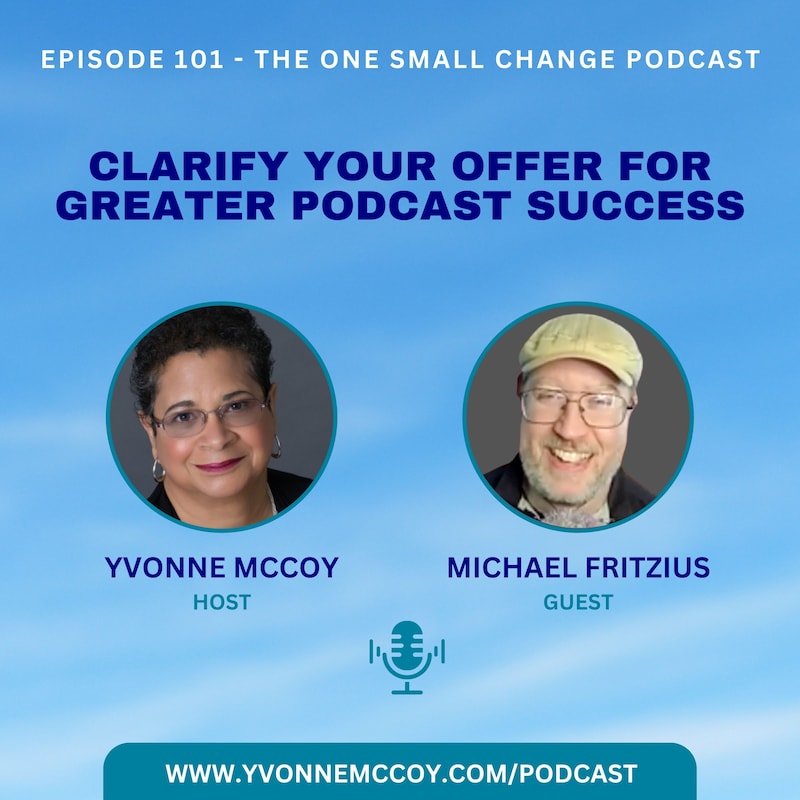
Shownotes
In this episode of The One Small Change Podcast, Yvonne McCoy welcomes Michael Fritzius, an expert in podcast guesting and revenue generation, to explore the transformational power of small shifts in business mindset and strategy. Michael Fritzius shares his personal journey from a life-changing cancer diagnosis to launching his entrepreneurial path, discusses how podcasting can drive significant business results, and emphasizes the importance of clarity, authenticity, and emotional connection in both sales and client relationships. Listen in for actionable insights on prioritizing what matters, the psychology of sales, and how to turn authentic storytelling into real business growth.
Guest Bio:
Michael Fritzius is a business owner who specializes in helping entrepreneurs get booked on podcasts and leverage those opportunities into substantial business revenue. With a background in computer science and a unique blend of technical acumen and people skills, Michael Fritzius brings a deep understanding of both the logistics and emotional aspects of marketing, sales, and personal clarity. His journey into entrepreneurship began after a cancer diagnosis that prompted a major reevaluation of priorities, and he now guides others in clarifying their offers and building rewarding, sustainable businesses.
Chapters:
00:00 Podcast booking strategy discussion
04:49 Balancing family and business time
08:14 Embracing a results-focused mindset
10:44 Crafting a 30-second business pitch
15:18 Using an ice roller at home
18:19 Understanding Sales Hesitation
21:26 Overcoming perfectionism in business
24:03 Family trip to the horse farm
27:51 Stepping out of your comfort zone
Quote from the Guest:
"As business owners, your best clients are going to come to you with what they think is the problem. It's almost always a symptom. Dig deeper. Don't give them what they're asking for, give them what will actually help them and explain why it's going to help them.”
Links:
Transcripts
Welcome to the One Small Change. I am thrilled to embark
Speaker:on this journey of exploration, transformation with you. I'm your host,
Speaker:if you don't know, Yvonne McCoy, and I bring almost 30 years of
Speaker:entrepreneurial experience. And I have an insane
Speaker:passion for discovering growth through the power of seemingly
Speaker:small change. And I try to bring people into this
Speaker:podcast that I think are going to enrich your world, help you grow
Speaker:your business, and just give you incredible
Speaker:information. And so this week I have
Speaker:a guess that I just met, but he is fascinating
Speaker:in what he does. Michael Fitzhugh. And
Speaker:he's going to tell us why he
Speaker:is good at what he does that makes him an expert
Speaker:and what it was that kind of got him started on this path.
Speaker:So, Michael, do you like to be called Michael or Mike? Usually
Speaker:Fritz is good. There's a lot of Michaels and Mike's out there.
Speaker:Fritz, then even better. That's another way to get you found that you're
Speaker:not a Michael, you're a Fritz. There aren't a lot of Fritzes around. That's right.
Speaker:All right, Michael. So I just.
Speaker:I went back to the Michael. Sorry. That's okay. Fritz,
Speaker:tell us what you do and what happened to put
Speaker:you on this path so that you are the expert at
Speaker:this and not just somebody in the field.
Speaker:So I get people booked on podcasts and I use that to turn it into
Speaker:a hundred thousand dollars of new business revenue. And
Speaker:what got me on the path actually was
Speaker:cancer, believe it or not. Back in 2012. Yeah,
Speaker:back in 2012, I got diagnosed with cancer. And it wasn't a real bad kind
Speaker:or any, but anything but. It really was the
Speaker:warning shot that I needed. That I needed to get my life
Speaker:under better control. I didn't have my priorities set right. I was putting
Speaker:career above family, and I was putting family above
Speaker:God. And it just. Everything needed to flip. Everything needed to change.
Speaker:That was the wake up call I needed. So that was back when I was
Speaker:a full time employee. I was a W2 guy. And
Speaker:I left that and ended up getting into contracting and then
Speaker:consulting. And then I launched my first business in 2015. So
Speaker:I've eased my way into entrepreneurship. I know a lot of people, they kind of
Speaker:cannonball into the deep end of the pool and I'm like, well, we'll get there.
Speaker:I mean, we're learning. Yeah. So. But yeah, that's really.
Speaker:That's really what kicked it off, was a cancer scare. And what it led
Speaker:me to do is operate
Speaker:at the highest possible level as much as I can
Speaker:bring my whole self into everything I do. And so what I
Speaker:do with the podcast booking work is I talk
Speaker:with people about their offer first. When people come
Speaker:to me and they say, hey, I want to get booked on shows, tell me
Speaker:about your offer. What I find most of the time is that
Speaker:deep down, they're kind of afraid to sell their brains, don't really
Speaker:believe what it is that they're trying to sell. And that's why they're trying to
Speaker:guest on podcasts and get in front of as many people as possible, because they're
Speaker:hoping, hey, if 1% of 100,000 people come buy my thing,
Speaker:then I won't have to do all that scary ooky selling stuff
Speaker:I can just enjoy. Right? And it's like, let's solve that problem, and then
Speaker:let's get you booked on podcast. It'll work a whole lot better. All right, I
Speaker:need to stop you. Okay. Because the thing that
Speaker:you said at the very beginning
Speaker:is so important. And then the cancer thing.
Speaker:Well, I need to get my priorities right. Oh, yeah. And.
Speaker:And. And that is one of the things. I mean, I think we all go
Speaker:through that cycle where at some point, you know, we're.
Speaker:We're in our late 20s, 30s, you know,
Speaker:we're trying to get our careers off the ground. We're doing whatever it is,
Speaker:right. And in that process, we lose ourselves.
Speaker:Yes, Lose ourselves. And our family becomes secondary. I mean, I.
Speaker:One of the things that I say is, you know, I was tired of
Speaker:splitting my personality. You know, outside my house, I was
Speaker:a businesswoman. You know, I was the. The mba.
Speaker:And inside my house, I was mom. Right?
Speaker:And it got confusing. I mean, sometimes I talk to my kids like
Speaker:my staff, and sometimes I talk to my staff like they were kids.
Speaker:So I think as an entrepreneur, you don't get
Speaker:24 hours to be an entrepreneur and 24 hours to be a person.
Speaker:You only get 24. And so you need to prioritize
Speaker:that. And it may. In within that prioritization, it
Speaker:may shift a little bit. You know, if you're doing a launch,
Speaker:you know, you may be like, really focus. You know, your
Speaker:religion or your higher values are always going to be first. You know,
Speaker:you may put more. You know, like this month, you may put a little bit
Speaker:more time into the business because something special is going on. But next month,
Speaker:you do put more time into the family. So it, you know, it doesn't
Speaker:have to be a static thing, but it's got
Speaker:to have. I mean, you can't just
Speaker:leave your family Behind, I guess, is what I'm saying. And what I did
Speaker:for. For many years. So I just wanted to point that out because I think
Speaker:that is something that we do not spend enough time with.
Speaker:Right. Second thing is when you are clear about what
Speaker:you're doing, you are not scattered.
Speaker:You are not doing 50 million things and not doing any of them
Speaker:well. Right. So that's one of the things
Speaker:that you and I both have in common, is that we get people to
Speaker:clarify what they do before they start, you
Speaker:know, doing other things. Okay. So please keep going on about,
Speaker:you know, I'm excited about the idea of possibly making money for my
Speaker:podcast. A lot of people are. A lot
Speaker:of people are. And what life has
Speaker:taught me. And I'm kind of. I kind of have a cool
Speaker:background. I say weird, but it's really cool, because
Speaker:if I was just a purebred, what I went to school for, I went. And
Speaker:I got a computer science degree. I should be developing software right
Speaker:now. Just put them in a closet, put some Hot Pockets under the door every
Speaker:once in a while, keep them fed, Just keep pumping coffee, and you're good.
Speaker:And somewhere along the line, I guess I hung around enough
Speaker:public speakers, it kind of rubbed off on me. I can talk to people. I'm
Speaker:a huge nerd, but I can also talk to people. And.
Speaker:Yeah, it is. And. And it's. It's really weird because when
Speaker:I look at my history and my upbringing
Speaker:and just the growth and the path, it's almost like I. I've got, like,
Speaker:my feet. You know, I get two feet in two different areas where a lot
Speaker:of people will be like, dude, just pick a lane. Can you just pick a
Speaker:thing? No, I don't want to pick a thing. That's boring. Isn't it boring?
Speaker:I mean, that is the thing that makes you unique.
Speaker:Yeah. Is that you can. And I always called that when I was trying,
Speaker:when I was in that situation where I was kind of
Speaker:in the business world and the educational world, I considered myself a
Speaker:translator that I could translate the
Speaker:needs of both. When I went into a company and I had a grant,
Speaker:I wouldn't say, I can bring your reading level up of the
Speaker:staff, because they didn't care. But if I said, I can cut
Speaker:your rework, your redos down, because people
Speaker:can read the instructions that they were
Speaker:interested in. Yeah. And so my guess is that
Speaker:that's one of the things you do really well, is you
Speaker:understand the logistics behind the scene, but you
Speaker:can talk to somebody like me who it's Like, I'm never going
Speaker:to get this. Just tell me what I need to do. Yeah.
Speaker:To get the results that I want, you know? Exactly. And you said it. You
Speaker:said it. Results. That's what people care about. They don't. They
Speaker:don't care as much. They'll pay lip service to,
Speaker:oh, this is how you can improve my life. Oh, this is how you can
Speaker:get. You know, you can do this. Okay, that's awesome. But. But what's the actual
Speaker:result? And if you can get it down to those, just the brass tacks.
Speaker:Hey, you're going to pay me this much. I'm going to get you this much.
Speaker:Here's how I'm going to go about that. But we're going to get there. Just
Speaker:stay with me. Let me help you. And. And focus more on results. And it
Speaker:takes bravery to do that, though, because we live in a world where
Speaker:there are a lot of coaches where it's kind of high level
Speaker:song and dance and you kind of can't.
Speaker:If you can't stop and take a look and say, okay, how do I get
Speaker:this result for this person? And it causes a lot of hesitation. And that's
Speaker:why when I look at how I
Speaker:used to think about sales, how I used to think about my offer, I
Speaker:used to hate sales. I love it now because finally my brain
Speaker:believes in what I'm selling because it's like, oh, I get it now. I see
Speaker:how we're going to go about doing this. Yeah, let's giggity go. And it's like,
Speaker:why weren't you like that five years ago, man? Well, because it wasn't clear. Yeah.
Speaker:So here's what I want people to put a pin in because this, again,
Speaker:is so important. The first thing is when you have clarity about what
Speaker:you do and why you're different than everybody
Speaker:else, you automatically
Speaker:become energetic and confident. Yes. Because
Speaker:you know that nobody else does it. I mean, I find it
Speaker:so amazing when I talk to people about their strengths
Speaker:that they don't value because they figure everybody's got them.
Speaker:Right. And I say, this is what you do that nobody
Speaker:else does. And they're like, what do you mean nobody else
Speaker:does that? Right. And then it's like,
Speaker:oh, my God, I can talk about this because this is who I
Speaker:am. I don't have to be anybody else. I can be myself.
Speaker:And it just. You know, one of the things that, for me that I found
Speaker:amazing is when I started saying one of my words for
Speaker:business is energetic.
Speaker:And. But I never said that in anything
Speaker:Right. And so when I, you know, talk about that and
Speaker:I tell people that, and I go, everybody's got an energy level
Speaker:that's right for you. Your energy level doesn't have to be my energy level.
Speaker:Right. But when people call me, they go, I love your energy. And
Speaker:it's like a filter. The people who hate my energy don't call
Speaker:me. Yeah. You know, so
Speaker:that is understanding. That is amazing. And
Speaker:that will get your confidence, which will then convert to get your
Speaker:consistent clients. You will attract the people that
Speaker:are a good match for you. I'm sorry. Exactly. No, it's good.
Speaker:I'm loving this conversation. Me too. I'm telling you, it's like we're just,
Speaker:you know, we're getting going. But, you know, one of the things. And I was
Speaker:just talking about this with a buddy yesterday, talking about, like,
Speaker:how to pitch, you know, how do you get your pitch down to 30 seconds
Speaker:and do the work of attracting people? But it's just as important
Speaker:to repel the wrong people as well.
Speaker:We unfortunately live in a society where a lot of us are feeling
Speaker:like we're made. We're made to feel like we need to be all things to
Speaker:all people. Oh, you gotta work for everybody. You gotta get. And it's like, no,
Speaker:you don't. And the first few times that you find somebody that you're like
Speaker:that person was an absolute blessing. Just a
Speaker:godsend. I would love to work with more people like that. Surely there's got to
Speaker:be some. It's like, what is it that put them close to
Speaker:you and attracted them to you to where they wanted to work with you? Like,
Speaker:I cannot wait to work with you. And I'm excited to work with you as
Speaker:well. You know, reciprocal white. What is it about that
Speaker:person? Really analyze that and then make the
Speaker:wild assumption that. And there's got to be thousands more people like
Speaker:that. And I bet they run around together. They probably know each other.
Speaker:So, you know, it. It's a huge mental lift off
Speaker:as well. You save lots of energy. There's just. Yeah. You
Speaker:ever. Have you ever had that happen? You ever work with somebody? Oh, yeah. And
Speaker:person's an absolute drain. So. And here's the flip side to that.
Speaker:Right. So the first thing is, as entrepreneurs
Speaker:were squirrels,
Speaker:right? Yes. And so I know when I started my
Speaker:workshop, and also probably the podcast,
Speaker:but more the workshop, it was like, you mean you want me to do the
Speaker:same workshop every month? How
Speaker:boring is that? Yeah. What I found out,
Speaker:thank God, was by doing the same workshop,
Speaker:I go Deeper, not wider.
Speaker:The message is clear. It connects
Speaker:more strongly with the people that it should connect with.
Speaker:The other thing is the workshop is always different
Speaker:because the people that come are different. The
Speaker:interaction and that kind of thing. And, and, and to my surprise, I
Speaker:have people that come multiple times. I mean, each workshop
Speaker:is different. I find different things that interest me. The, the skeleton
Speaker:is the same. Do you know I have the same
Speaker:13 slides? Yep, that's it. Right.
Speaker:But sometimes the stories are different, sometimes the things
Speaker:somebody says. Because my, mine is really a workshop. It's not a
Speaker:webinar. It's interaction. We do an activity, you know,
Speaker:that kind of thing. So it just, you know,
Speaker:anyway. Yeah. About me, because this is about you. So this
Speaker:is, this is, it's key. It's good stuff, though.
Speaker:You're. You're hitting on some good stuff and you're adding value. You are.
Speaker:I think that sometimes the most important
Speaker:thing seems like it's just a ripple. Do you know? But
Speaker:that ripple can become a tsunami if you can get people to
Speaker:focus on it. Yes. And imagine how easy that makes business
Speaker:too, though. Because if it's not up to us to be like, I gotta do
Speaker:all the heavy lifting, oh my goodness, I gotta make fresh content. Every single time.
Speaker:People like you just said, people come to your workshop again and again.
Speaker:They're hearing the exact same thing again and again. Not everybody gets it the first
Speaker:time. Maybe it takes three or four or seven touches and eventually they're like, oh
Speaker:my goodness. Why didn't you say this at the beginning, bruh? I was.
Speaker:It's just, it took every little bit. Right. I say it every time. I've got
Speaker:seven zoom recordings showing you. I said it every time. You want to watch them.
Speaker:You're like, you're in different places, you're open to different things.
Speaker:Yes. Right. And when you find a client
Speaker:that, that you love to work with, you can
Speaker:surpass their expectations. Yes. Because
Speaker:one is excites you. And just like
Speaker:your client learns from you, you learn from your client.
Speaker:And the thing that, that happened recently that you talked about
Speaker:is what I call the refrigerator question, which is so strange,
Speaker:but the idea is the piece that's missing so much
Speaker:when you're just pitching or you start out. I'm so and so I have a
Speaker:five step process. Right. The potential
Speaker:client cannot see themselves working with you.
Speaker:Right. And the refrigerator question has to do with, with
Speaker:a gift that I gave my friends. None of them used it. It was a,
Speaker:an ice roller for your face that you put, you know,
Speaker:Cosmetics into, you know, make you glow,
Speaker:right? And none of them use it. And it was like,
Speaker:how is that possible? Because I'm like, I think it's fabulous, right?
Speaker:But my refrigerator, I have a small refrigerator on my second
Speaker:floor, so I can come out of my bathroom, go take my medicine, do my
Speaker:face, you know, and then go get dressed. But if you have to go
Speaker:downstairs to find your reef, you know, to do
Speaker:this, you're not going to do it. And if I had said, where's your
Speaker:refrigerator? I could have said, all right, let's see how
Speaker:this would work best for you. Maybe you won't use
Speaker:it in the morning. Maybe you would use it in the afternoon. You know, at
Speaker:night when you come home and you just want to have some energy to do
Speaker:something or you want to put a, you know, a toner in or something before
Speaker:bed. Maybe you only use it on the weekend as a beauty routine.
Speaker:Right, right. And that was the question that we. We dealt
Speaker:with during my summit that, you know, we took people from, why am I
Speaker:special? And then, what is my refrigerator question?
Speaker:You know, so the people were actually getting. Getting value
Speaker:people. You know, your. Your potential clients can see themselves working
Speaker:with them. So I'm going to put you on the spot. I've never asked this
Speaker:question of a guest before. Okay, but what is your
Speaker:refrigerator question? What would you say to me?
Speaker:That I could see myself working with you.
Speaker:I knew that was coming. You telegraphed that punch. I'm like, I bet she's
Speaker:going to ask me that question. I bet she asked that. Of all the guests
Speaker:in your life, I've never asked this because this is a brand new thing for
Speaker:me. I mean, this just happened this month. So. Yeah,
Speaker:so what's my refrigerator question? The thing. So if I
Speaker:were to use the analogy that you had, because I'm in
Speaker:the podcasting space and I understand things about the space
Speaker:that. Because I've been on the business end of it for a bit, for me,
Speaker:I have a refrigerator right outside my bathroom. Kind of like you.
Speaker:For the other people, their fridge is in the
Speaker:kitchen like normal people have. And so they'd have to walk
Speaker:a little bit. For those people,
Speaker:when they come to me and they ask, can you get me booked on shows?
Speaker:My refrigerator question for them is, I'll
Speaker:say, yeah, definitely, I can do that. How do you feel about
Speaker:sales right now? Like, let's get
Speaker:emotional. You're talking tactical. You want to know how to get on shows, how to
Speaker:get booked on shows. Awesome. That's tactical, strategic. I want to talk about your
Speaker:emotions. The thought of sales, does that bother you?
Speaker:Does it make you feel ooky, make you feel insecure? Let's talk
Speaker:about that. And the reason why that's such a
Speaker:powerful refrigerator question is because it's a pattern interrupt. First
Speaker:they're thinking, how can I get to the Joe Rogan podcast? How can I get
Speaker:on the top 1% Apple podcast? And then what do I. And it's like, are
Speaker:you afraid to sell your product? What is your service? What do
Speaker:you. What do you want to do? What impact do you want to have? Do
Speaker:you feel like you can sell it? A lot of people say, no, they don't
Speaker:want to. And then when I start talking about why their brains
Speaker:make them not want to sell, they start to open up, and they're
Speaker:like, I have felt that way for a long time. Then we're getting into, like,
Speaker:psychographics. You know, we're not even talking about podcasting anymore. Like, we got to fix
Speaker:the foundation first before we try to build a third floor on this house. Put
Speaker:a refrigerator on the third floor. You got one on every floor
Speaker:now. But they're like, wow, that is really
Speaker:insightful. It's like you've been reading my mind. That is. That is
Speaker:amazing. And the other part to that is
Speaker:that buried in everything that you said is
Speaker:that we move from the tactical into the emotional.
Speaker:And I think that is a big piece that people miss in the selling. Oh,
Speaker:my God, I hate to do this, but, oh, we have a time
Speaker:limit. Okay, so what. What's your free
Speaker:gift? And what are three things that people can do right away?
Speaker:Yeah, free gift is come to my huddle. So I host a
Speaker:huddle every week, Mondays at 11am Central. And what
Speaker:we do is for business owners that want to guest on podcasts and
Speaker:actually make money doing it. And the way it works is, first,
Speaker:I'll talk about some tactics and strategies that would work.
Speaker:And then afterwards, we pair everybody off into breakout rooms
Speaker:of two. They each interview each other, and they send their interviews up to our
Speaker:system. And then we can get you booked on some shows for free. It's a
Speaker:lot of fun. You get to meet some cool people. Every single time people come
Speaker:to this huddle, they're like, I can't believe that I was put in
Speaker:a room with such and such person. It's random. And they're like,
Speaker:turns out they might be my best kind of client. Or it turns out that
Speaker:they went through the exact same kind of trauma I went through. Or,
Speaker:turns out they know Some people that would be a great fit for my business.
Speaker:Like, that happens all the time and people just keep coming back and it's growing.
Speaker:We usually have about 30 people in every week. So definitely come
Speaker:three things that I would say to start doing. Get good at
Speaker:telling a story. Like, really engage people. Connect with them emotionally, but connect
Speaker:with them at their senses. If you can tell a story and make
Speaker:people feel and see and smell and hear and touch and taste
Speaker:the exact same experience that you had, you're going to be doing really well.
Speaker:It's going to help you. Yes, in podcasting, but also public speaking,
Speaker:sales, communication. You know, instead of just rattling off
Speaker:a bunch of facts, it's like, make people feel a certain way. That's really
Speaker:cool. Second thing that I can think of is start
Speaker:hanging around some podcast hosts. I mean, they're really cool people. There's a few yahoos
Speaker:out there, but the vast majority of them are really cool. Start making friends with
Speaker:them, they network like crazy. And as soon as you want to start hitting the
Speaker:circuit, ask a couple and say, hey, who do you know that has a
Speaker:podcast about, blah, blah, can you help me get on there? They're like, yeah, or
Speaker:just come to my huddle. That's a, that's much easier way.
Speaker:Third thing, don't try to get things right
Speaker:the first time. You are not going to get it right the first time. Yeah,
Speaker:I should have led with that. I have spent, I, I
Speaker:spent a large portion of my time in life and business
Speaker:being a perfectionist. And I think that's because I used to be a software tester
Speaker:where if you miss a big fat bug, then
Speaker:people are like, hey, our clients are losing millions of dollars a second.
Speaker:Like, can you fix this? Yeah. So, you know, try
Speaker:to turn that into, hey, we're going to be a business owner where we just
Speaker:have to make like tactical decisions and move quickly and you don't have to have
Speaker:all of the information in front of you. You don't have to be
Speaker:perfect. But the fact that you're moving forward means you're on the right track.
Speaker:So keep doing it. I should have led with that. I always say I'm
Speaker:glad people didn't see my first. You know, the people that are following
Speaker:me now that I, that I didn't start videoing now
Speaker:because they would be like, you know, I mean, I look at some of the
Speaker:first videos I did and it, they're just like cringe worthy. So I'm
Speaker:glad I did them when nobody was following me. Yeah,
Speaker:it's Good. It's good. And you know, and I find too, like, the speed of
Speaker:improvement is going to decrease that amount of time. Like, if you think about,
Speaker:well, this is what life was like for me, you know, a year ago. And
Speaker:then if you think, well, this is what life was like for me a month
Speaker:ago. And it's like, oh, man, it's just as cringe worthy and it's only
Speaker:been like three business days. That means you're really growing, like
Speaker:a lot. So, yeah. So if you feel cringeworthy about
Speaker:the beginning of the day versus now, girl, you are making
Speaker:it. I was a walking dumpster fire. I had a buddy tell me that years
Speaker:ago, six years ago, when I joined his community. He's like, man, this Fritz guy,
Speaker:he comes walking in and none of us knew what the heck he did.
Speaker:Like, oh, he does podcast stuff. He does podcasts in the back seat of his
Speaker:truck and I think he produces them. He's like, he is so clear now.
Speaker:It is without a doubt he knows what he's doing. I'm like, yeah, man, it
Speaker:took me six years. So, yeah, my husband and I
Speaker:first got married and we're talking like 50 years ago.
Speaker:A friend of his said, you know, I actually like Yvonne, but talking to
Speaker:her is like talking to a computer. Because I would be like,
Speaker:oh, I am so different now. Hey, I would have taken that as a compliment
Speaker:back in the old days. I'd be like, thanks, mister. I was like, how much
Speaker:time is this going to take? How much does it cost? Where is it? You
Speaker:know, where are we doing this? How are we doing this? You know, what? How,
Speaker:you know? And I was like, I was
Speaker:brutal. Numbers. Just give me a spreadsheet. Yeah,
Speaker:yeah, exactly. All right, so
Speaker:for fun, when was the last time you did something new for the first time?
Speaker:Goodness, I try to do something new all the time.
Speaker:First time I ever went to there's a horse farm this past Saturday
Speaker:and we went there and we and my wife and my wife Charlotte and I,
Speaker:we haven't been married 50 years, but we've got four daughters ages 10, 12,
Speaker:14 and 16. And so we do things organically here as much as we can.
Speaker:We got a garden and they've been to this horse farm where they
Speaker:have lots and lots of compost. And it's like, it's free. Just bring a truck
Speaker:and load it up. So for the first time, I went to that horse
Speaker:farm and we filled that truck bed up. Our
Speaker:younger two girls were like on top of the cab and they're like,
Speaker:Jumping off into poop, basically. I mean,
Speaker:they're having fun. They have old shoes on. But I'm like, man, this is.
Speaker:This is wealth. Like, I'm really having fun, literally shoveling poop with
Speaker:my family. I've never done that before. I'm a city boy. Second
Speaker:person this week that has told me that they are getting
Speaker:free horse manure. Yeah. Do I have to pay? Well? Do I have to pick
Speaker:something else? Like, do I need to pick something? No, no. I'm just. I'm like,
Speaker:you already had a poop story. Come on, try again, Fritz. Yeah, no, no, that
Speaker:was out on a podcast, you know, and I'm in the middle of an
Speaker:urban city, so, you know. Yeah, that's not. That's, like,
Speaker:not a thing for me. Right. All right. I
Speaker:gotta give the commercial. All right. And so for
Speaker:those of you that are here, the first thing I want to make sure you
Speaker:do is that you subscribe and that you share and you engage this
Speaker:podcast on social media. And one of the
Speaker:reasons that I did it is I designed it to help supercharge your
Speaker:business through true connections. And it's our way of giving back to
Speaker:this vibrant community and fueling your quest for growth and impact.
Speaker:So I hope you will continue to. To join me for the one small change,
Speaker:and let's see how the tiniest shifts can yield monumental
Speaker:transformations. And there are some. If you listen to the
Speaker:first episode, that'll tell you why, you know, where I started. And there's
Speaker:some individual episodes that are coming up
Speaker:that. That I do, because I. I like to talk, and
Speaker:I have to try to. Not to talk over my guests. So I do some
Speaker:on my own as well. So, Fritz,
Speaker:what are the last. Some last words that you can give people? Some
Speaker:words of wisdom or quote, you know, a quote that you like or something like
Speaker:that that people can. Can use. Oh, here's some
Speaker:wisdom. As business owners, your best clients are going to
Speaker:come to you with what they think is the problem. It's almost
Speaker:always a symptom. Go to the doctor. I'm hurting.
Speaker:Oh, well, I've got a headache. Awesome. Well, if a doctor
Speaker:prescribes a painkiller for you, that doesn't actually solve
Speaker:the problem. The pain is an indicator of something else. Maybe you've got a brain
Speaker:tumor and that's causing the issue. Ibuprofen is not
Speaker:going to solve it. So you can assume that people are going to respond to
Speaker:the pain. They're going to come to you, and they'll say, I need help getting
Speaker:this. Okay, well, here's the actual problem. Dig
Speaker:deeper. Don't give them what they're asking for. Give them what
Speaker:will actually help them and explain why it's going to help them.
Speaker:You will set yourself apart as a provider of an actual
Speaker:holistic solution and not just another drug dealer.
Speaker:So, boom, Mic drop.
Speaker:Dig deeper.
Speaker:We are so in sync. I just did a
Speaker:post this week. Are you solving the right problem? Yeah. Or are you solving
Speaker:the wrong problem? Something like that. All right, guys, we
Speaker:could go on and on. And after we're finished, this, we might.
Speaker:So I got a whole hour booked.
Speaker:I mean, we only get in together for 30 minutes. We got time today. Yeah.
Speaker:So, everybody, I. I just want to remind you that
Speaker:change can be simple, but it's not always easy. And it
Speaker:requires courage and resilience and a willingness to step out of your comfort
Speaker:zone. For me, if I'm not filling the willies
Speaker:or feeling a little bit uncomfortable when I'm doing something, it means I'm
Speaker:either complacent, I'm stagnant, or I'm just doing. You know,
Speaker:I'm just being robotic. So step out of your comfort zone.
Speaker:Take a chance. It's worth it. It will pay off. Do a small
Speaker:change. Right, Because a small change,
Speaker:if done correctly and over time, will lead to
Speaker:transformation. So keep
Speaker:joining us for the one small change, and until then,
Speaker:stay very, very curious. I'll see you soon.
Speaker:Thanks, Fritz, so much. Thank you.