Shownotes
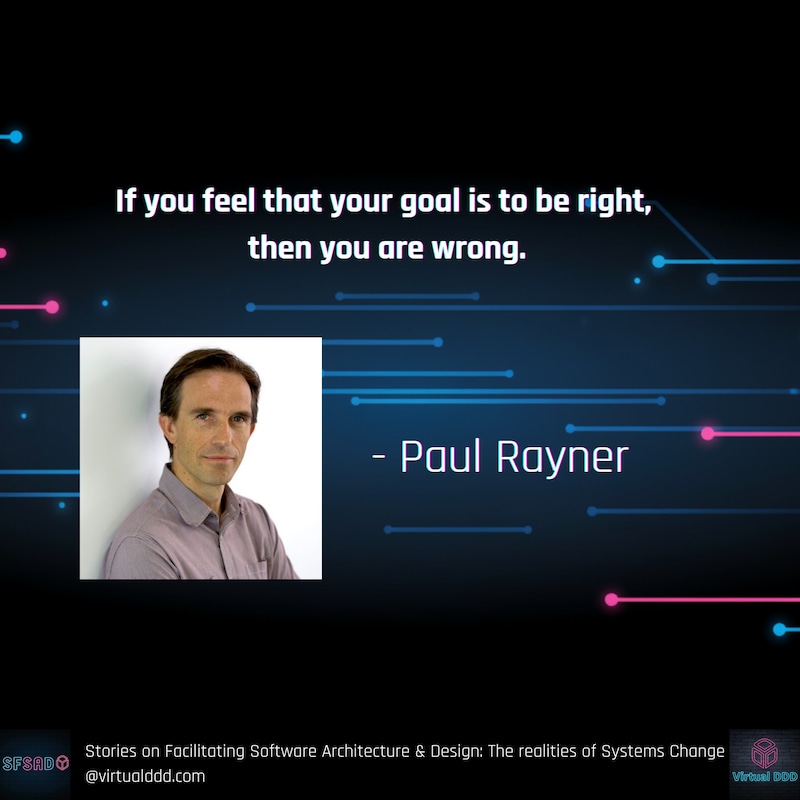
In this episode of Stories on Facilitating Software Design and Architecture, we are joined by Paul Rayner, a seasoned consultant and expert in Domain-Driven Design and EventStorming. Paul shares a candid "war story" from his time as a tech lead that completely changed how he views leadership and influence. He recounts a well-intentioned refactoring session where he publicly critiqued a team member's code, aiming to teach better practices. The result was unexpected and severe: the developer felt shamed by the experience and quit shortly after.
This experience served as a harsh wake-up call about the "unseen authority" leaders wield and how easily the "blast radius" of our actions can damage team psychological safety, even when our motives are pure. Paul opens up about the "dominant blindness" that often affects technical leaders—where we fail to see how our rank amplifies our words, turning a simple suggestion into a crushing directive.
We dive deep into the power dynamics of technical leadership, exploring why simply having the "right" technical solution isn't enough. The conversation covers how to move from "fixing" people's work to facilitating their growth, why resistance should be treated as a valuable resource rather than an obstacle, and how methods like EventStorming can help externalize conflict.
Key Learning Points:
- The Gap Between Intent and Impact: Why "I meant well" is never a sufficient excuse when a team member feels alienated or embarrassed by your actions.
- Dominant Blindness: How leaders often underestimate the heavy weight of their rank and the pressure it puts on colleagues, especially when navigating contractor-employee dynamics.
- Resistance is a Resource: Instead of pushing harder against pushback, view it as a signal to understand the underlying fears, threats, or misunderstandings driving the resistance.
- Challenging Mental Models: Recognizing that when you criticize code, you are often challenging the deep-seated mental models and hard work of the person who wrote it.
- Externalizing the Problem: How using visual tools like sticky notes (e.g., in EventStorming) can shift the focus from "me vs. you" to a collaborative discussion about the problem on the wall.
Transcripts
Hello and welcome to Stories on facilitating
2
:Software Design and Architecture.
3
:today we're here with our
guest, Paul, who will introduce
4
:himself in a, in a, in a minute.
5
:We're also here with, uh, the normal,
our normal crew, uh, which is of course,
6
:Kenny, Andrew, and myself, Andrea.
7
:So Paul, how about a little, a little
intro about who you are and what you do.
8
:Paul Rayner: Sure.
9
:Uh, I've been.
10
:Developer most of my career and consultant
more recently, over the last decade and
11
:a half, mostly specializing in domain
driven design and event storming.
12
:So I do training and
facilitation in those things.
13
:And then also probably more known
in the United States for starting
14
:the Explore DDD conference,
which runs in Denver every year.
15
:And uh, I'd give talks at conferences
and we're here in Melbourne.
16
:Just having wound up and taught an event
storming workshop together yesterday.
17
:Andrea Magnorsky: So,
which was really fun.
18
:It was really nice to work with
you in running this workshop.
19
:Thank you for, you know, working together.
20
:Um, so today, uh, Paul is
gonna share a story with us.
21
:so Paul is, what's, what's your story?
22
:Paul Rayner: Yeah, well, yeah.
23
:I was talking about this a bit
with Kenny and I think a good war
24
:story is maybe one that we could s.
25
:Lead off with.
26
:So, I was a kind of architect, architect,
tech lead on a project that, um.
27
:This was, I guess, late two thousands.
28
:Um, and I'd been working with a team.
29
:We had, uh, I was based in Colorado
where I am now, and we had developers in
30
:Chicago and also in, uh, Buenos Aires.
31
:And we were working on a
very complicated system.
32
:It was the first.
33
:System where I'd actually tried to
apply to domain driven design and test
34
:develop, test driven development and
a lot of these kinds of techniques.
35
:And, uh, I thought it would be a good
idea to get all the development team
36
:on a call and pick some code and, and
kind of talk through how to refactor
37
:code and how to improve it and make it
more expressive at the domain concepts.
38
:So we did that.
39
:I got, we got everyone on a
call and me as the tech lead.
40
:Um.
41
:You know, walk through, I'd pick
some code and, and just sort
42
:of started doing extract method
refactorings and showing how to do
43
:a bit of test driven development.
44
:And that, not long after that call,
one of the developers quit, and
45
:uh.
46
:I didn't know what I'd done, but
it, it should be pretty obvious.
47
:What I'd actually done is, um, one of
the contractors in our team in Chicago
48
:was actually the code that he'd written
and he felt very embarrassed and
49
:shamed by what I'd done because it of
implied to the rest of the team that
50
:the code that he'd been involved in
was not up to par and, and, uh, and so.
51
:I reached out to him and
apologized and, and then
52
:apologized to the rest of the team.
53
:And, uh, and fortunately he uncut came
back and, and, you know, was a, he had
54
:been a, a key team member and continued
to be a, a core team member and.
55
:And I remember at the time thinking
I was doing everything with the right
56
:intentions and you know, the right
motives, but I just had a complete lack
57
:of understanding, I think, of how that
would be perceived by the person that,
58
:that had done that and, and how my.
59
:Misuse of my power and authority actually
cause someone a lot of embarrassment and
60
:shame, even though it was unintentional.
61
:So, know, it, it was a real wake up call
for me about and, and, you know, being
62
:aware of other people and the power that I
wield and, and, and also how to go about.
63
:Cha changing hearts and minds and, and,
and, you know, coming alongside people
64
:to, uh, try to show different ways
of doing things instead of, you know.
65
:Taking an approach like I did, which
was clearly not a good way to go.
66
:So that's my war story.
67
:and I learned a lot that.
68
:And it doesn't mean I haven't
made mistakes since, but yeah,
69
:that was one of my bigger ones.
70
:Andrea Magnorsky: I, I think it's,
it's also that you're, you're
71
:talking about, um, not just.
72
:The practice and you know, we, I think
it's clear to see for us here, the, not
73
:just like the, the intention, but also,
uh, the, the, you're like, oh, the, the,
74
:you're, you're bringing to the force.
75
:Something that I think, uh, it's
a lot to do with decentralization,
76
:which is understanding power, uh,
and power dynamics in an organization
77
:and, and how important they are.
78
:How impactful they are when,
79
:When, you know, when you have
more, especially the more authority
80
:you have, the, the more careful
you need to be about Yeah.
81
:That effect.
82
:And, and also why it's good to
decentralize that so that these things are
83
:have, less damaging to, to certain degree.
84
:Um, so I guess, I guess
that's the question.
85
:Do you think in a, in a more
autonomous teams, like in teams
86
:that work in a more autonomous
way, do you think this would've.
87
:Been different if, if they had
more, kinda not just to do what they
88
:need to do, but also responsibility
for the actions that they take.
89
:Paul & Andrea: That's a good question.
90
:It's hard to say.
91
:I, I mean, I haven't really
thought through an answer to that.
92
:I haven't been asked that question before.
93
:In terms of decentralization
and autonomy, uh.
94
:I look back over it, I mean,
I had a lack of empathy.
95
:I did not take the time to think, how
would I feel if somebody did this to me?
96
:And I don't know that if the
team had been, I mean, the team
97
:was fairly autonomous and, and
power was fairly decentralized.
98
:And I, I thought of myself as,
as like one of the peers, There's
99
:other dynamics as that were in play.
100
:Like I was an employee,
he was a contractor.
101
:Mm.
102
:Right.
103
:Yeah.
104
:And, and that adds another,
uh, complication to that.
105
:then, uh.
106
:don't know.
107
:I've been in situations that,
that were decentralized, where
108
:there was still a lack of empathy
and, and people said things that
109
:they didn't really think through.
110
:uh, maybe the blast radius is less.
111
:Mm.
112
:Yes.
113
:Uh, but I don't, I I, yeah.
114
:I wish I had a better answer.
115
:And I think it's, it's good's a question.
116
:We're exploring.
117
:We're exploring this theory.
118
:This is.
119
:Kenny (Baas) Schwegler:
I, I have a thought there.
120
:So you say lack of empathy and I think
I, I struggle a little bit in that.
121
:I, I agree with the, the.
122
:With that, but you can
never have enough empathy.
123
:So it's very hard if you, you work with
different cultures, if you work with
124
:different people, like you say, I, I
wasn't aware of it, but if you look
125
:back at their experience, was there
any point that you, that that person
126
:signaled in a way they didn't agree?
127
:Right, because it's two way on one hand
I hear you were dominant blind, right?
128
:You were blind to your, to your rank.
129
:On the other hand, I always ask myself a
question when that happens to me, is that
130
:what, what are some signs or something
that you can think back of like that
131
:that person didn't agree, could act on?
132
:Paul Rayner: Yeah, ahead of time.
133
:I think I was just to.
134
:The, the dynamics in terms of
employee and contractor and, and,
135
:you know, I, I wasn't really his boss
necessarily, but, but you know, kind
136
:of a certain seniority on the team.
137
:And, and then think related to
that, just a lack of understanding
138
:of how to people to change.
139
:you know, I, I at least was trying to show
rather than tell, but it wasn't done in a.
140
:way that would actually have led to that.
141
:I mean, it came up in today's
hands-on session this afternoon
142
:of I'm, I'm teaching the same
techniques today that I, I was trying
143
:to get across all those years ago.
144
:And the same questions come up from people
like how, you know, my team is reluctant.
145
:They, they, they wouldn't
understand the value of this.
146
:How do I convince them?
147
:And, and I told the same story.
148
:I'm like, well, don't do this.
149
:Right.
150
:Um,
151
:Andrea Magnorsky: well listen,
at least there's a, a, a story.
152
:You got a lot out of.
153
:As in, it would be sad if that
had happened and you would've
154
:not learned anything from it.
155
:Right.
156
:So I think the fact that not only
you learn from it, but you're willing
157
:to share it shows like, uh, sure.
158
:It's like a good thing.
159
:Multiple, not just learning and
sharing the, so other people learn it.
160
:Kenny (Baas) Schwegler: I
think about the empathy.
161
:That's why I'm saying it, even though
you learned, I, I had that many times
162
:happening to me and it, it still happens.
163
:Right.
164
:And I think the important part, what I
hear from you is that you didn't step
165
:into to your cognitive dissonance of
Yeah, but I had the right intention.
166
:And I think that, that, that was a
big learning point for me as well.
167
:I'm not sure for you as well, but, but
being that, being in, in that way, right?
168
:I try to have the right intention
because that's what usually happens when
169
:people step up to the, to the plate.
170
:They're also propagated then in a way,
and you'll make mistakes, but then.
171
:You can do two things, right?
172
:You can say, well, but
you wanted this, right?
173
:So you can, you can go that
route or you can go to the root
174
:of, okay, how can we improve?
175
:This is a very tri tricky slope
from, let's say you are in a team
176
:coding and it's rather exact, right?
177
:Coding is rather exact.
178
:There, there's a, a solutions, and,
and then you step up to that plate
179
:of technical leading something,
and then there's all this flakiness
180
:going on there because people.
181
:Yeah.
182
:Paul Rayner: I,
183
:yeah, I'm, I'm really not, not sure.
184
:I, I think that, I mean, this was
a while ago, so I don't remember my
185
:initial reaction, but, but certainly.
186
:I, I expect that my initial reaction
would've been, well, I had the
187
:right intentions, but then at the
end of the day, the other person
188
:responded the way they did, and now
I need to, and whether or not they
189
:overreacted is, is another question.
190
:But I think certainly got my attention
and, and, and then, you know, I, I
191
:was working hard to make it right.
192
:And, and I think that's,
that's a pattern that I.
193
:I try to do, it's like, okay,
I'm going to make mistakes.
194
:And if you are in leadership,
you're going to make mistakes.
195
:Yeah.
196
:You're going, you know, you're
going to do things that people
197
:are going to misinterpret or, uh,
you might do the wrong, the wrong
198
:thing with the right intentions.
199
:I mean, these, these things happen
and I think part of it then is,
200
:well, what is, how, how do we fix
things when we, we do make mistakes
201
:and how do we, uh, prioritize those
relationships and, and go about.
202
:reconciling and, and, and so, you
know, actually giving a proper apology
203
:instead of just, I'm sorry, you feel
bad, but actually like, no, I was wrong.
204
:I did the wrong thing.
205
:No, I'm sorry.
206
:You feel the way.
207
:Right.
208
:And, and then, uh, actually.
209
:Thinking about, okay, well how wide
is the blast radius of this socially?
210
:And it, well, it's the whole team,
so I need to apologize to the whole
211
:team, not just to this one person.
212
:Andrea Magnorsky: Right.
213
:Yeah.
214
:'cause obviously this person quit,
but other people might have also.
215
:Paul Rayner: Everyone else was there.
216
:Andrea Magnorsky: Yeah.
217
:Paul Rayner: So they
218
:Kenny (Baas) Schwegler: Yeah.
219
:Andrea Magnorsky: might have left
220
:some of them
221
:Kenny (Baas) Schwegler: It's
always when someone has a
222
:feeling, someone else in a group.
223
:But what, what I'm mostly curious
about is you, you went in, get
224
:into a solution mode, right?
225
:So you say, well, let's do this.
226
:So that got that person embarrassed.
227
:You solved that on
228
:emotional
229
:level, but was it solved on,
because it can still form
230
:tension if that person still
231
:didn't agree
232
:with the approach you took.
233
:Was, was it that they also didn't
agree on the approach you took?
234
:Because that can be an another level of.
235
:Messiness.
236
:Right?
237
:Because if, if now you reconcile,
but you still go your way, that can
238
:end up with sort of like, even though
your your way might be the least
239
:worst solution, I always say, right.
240
:It it, it can, it can.
241
:How, how did you cope with that?
242
:Did, did you, did you his ideas in,
or, or how did you get him to go along
243
:Paul Rayner: You know,
244
:Kenny (Baas) Schwegler: see?
245
:Paul Rayner: so honestly
it was so long ago.
246
:I can't remember now.
247
:Kenny (Baas) Schwegler: do it
248
:Paul Rayner: I'd like to,
249
:Kenny (Baas) Schwegler: how would you
250
:Paul Rayner: like to think I
said, so what do you think?
251
:And all of that, but I
really, I, I don't remember.
252
:That would be more my
preferred approach now is to.
253
:solicit advice and, and you really
want people to change, you have to meet
254
:them where they're at and, and kind of,
and, and really hear their concerns.
255
:And so I would try to
do that more these days.
256
:If someone's pushing back, then I.
257
:Why are they pushing back?
258
:And there's a, there's a
great article by Dale Emery.
259
:Uh, resistance is a resource where he,
uh, elaborates why people resist change.
260
:And, and so being able to
what is the resistance?
261
:Is it somebody who's feeling threatened?
262
:Is it somebody doesn't understand?
263
:Is it, you know, any one of these
number of reasons that, that somebody
264
:might be, be pushing back that.
265
:That article does a great job of
explaining that that's actually
266
:a signal that you should,
uh, understand and mm-hmm.
267
:And, and explore as a way of moving
forward, rather than just detecting the
268
:pushback and then pushing back harder.
269
:Kenny (Baas) Schwegler: I've, I've heard
a Dutch anthropologist say resistance
270
:is just someone else's opinion.
271
:Paul Rayner: Yeah.
272
:Kenny (Baas) Schwegler: Yeah.
273
:Paul Rayner: Yeah, I think so.
274
:Kenny (Baas) Schwegler: That's it.
275
:Someone's just propagating, wanted
to propagate their opinion usually.
276
:That, that was really learned for as well.
277
:This concept that you, that you're
saying was really learned for me as well.
278
:Yeah.
279
:Andrew Harmel-Law: I think there's
one thing I was wondering about, um,
280
:Paul, the, because this, so this,
one of the things that interest
281
:me a lot about software is I.
282
:Fundamentally, like we're all, we, we
have all these mental models and then we,
283
:we are understanding of what the problem
is, and then we turn that into code.
284
:And at an architectural level that's
kind of easier because there's less in
285
:the current ways of doing architecture,
there are less people at the top
286
:who are doing architecture, right?
287
:And then they kind of do their
work and they pass it down to.
288
:Pass it down, like with the stress and the
word down to like the development teams.
289
:And they kind of just do it,
but they don't just do it.
290
:Right.
291
:They have their mental models.
292
:They have like, you know, this
person had their ideas of this
293
:code that, that they'd created.
294
:Right?
295
:And they obviously, what they
had in their head probably
296
:largely reflected what they did.
297
:And there were probably other
people who did other bits.
298
:I think it's 'cause one of the parts
of architecture is kind of trying
299
:to come to the shared mental model.
300
:But as, as you've been saying, right, the.
301
:Trying.
302
:Challenging people's code is one thing,
but challenging their mental models that
303
:turned into the code is another thing.
304
:And then kind of trying
to facilitate that thing.
305
:That's a big, especially if you're
emotionally related to your code, right?
306
:Like, I thought really hard about this and
this is my best solution to this problem.
307
:And then you're like,
here's a different way.
308
:Or even maybe not a different way, maybe
even a worse way, but a way that we more
309
:all commonly understand in which DDD is a
great way for getting to that kinda stuff.
310
:Do you think.
311
:How much do you think you are
challenging this person's?
312
:Again, maybe it was quite a long
time ago, but like when you see this,
313
:'cause I've seen this in the past.
314
:How much do you think you're fundamentally
challenging this person's, maybe not
315
:worldview, but their understanding of
the problem and all of the work that
316
:they've done to try and get to this?
317
:'cause I feel I see this a lot, right?
318
:It's very easy to do architectures.
319
:And the less you engage with
the people who are gonna build
320
:it, the better, because they're
not gonna push back on you.
321
:But what you really wanna do is
collaborate with them and get all of
322
:that pushback, and then get it into the
code and get that pushback and stuff.
323
:Paul Rayner: Yeah, I agree.
324
:Andrew Harmel-Law: What's the.
325
:Paul Rayner: uh.
326
:think of the five dysfunctions
of a team and the idea that just
327
:going for consensus really people
are saying yes when they may no.
328
:Mm.
329
:Andrea Magnorsky: Or silence
when they may like, oh my god.
330
:Paul Rayner: Right.
331
:And I think that's part of
what you're describing and I.
332
:I, I think it's much better
now to hear people's concerns,
333
:to validate their concerns.
334
:To the real collaborative aspect of
modeling is, uh, Eric Evans would
335
:always talk about, like, model it three
different ways, that's something I try
336
:and emphasize in when I teach domain
driven design is, okay, you come up
337
:with an idea, so try to look at it.
338
:Three different ways, or if you have
disagreement between two people, over
339
:two different approaches, then at least,
at least come up with three different
340
:options on the table, because then it's
not, you know, me versus Kenny, right?
341
:In terms of his approach or my
approach, or me versus you Now.
342
:Now we've got options on the table that
we can consider, I've actually found that
343
:to be a really good diffuser of these
types of things because It's, and, and
344
:event storming is like that as well.
345
:Like we were talking yesterday, there's
something about externalizing those
346
:internal mental models sticky notes and
then being able to stand up together.
347
:Yeah.
348
:At a wall and, and, and a con looking at
a very concrete, looking at something and
349
:pointing at something and saying, well,
what about this and what about that?
350
:And what if we rearranged it this way
351
:Andrew Harmel-Law: Yeah,
352
:Paul Rayner: this doesn't make
353
:Andrew Harmel-Law: but this is it, right?
354
:Like it is, like Andrea said, it is
like, this is, I think, the genius
355
:of events or one of the geniuses.
356
:It is concrete 'cause it's on a
sticky note on a wall, but it's
357
:written in someone's handwriting
and you might have three things that
358
:are similar and different types of
handwriting and it's sticky notes
359
:so you can like move them around.
360
:And I think it, like, it
confronts that head on right.
361
:Kenny (Baas) Schwegler: Well, there's
362
:Andrew Harmel-Law: This is what we
think, oh, we, we all think different
363
:things and like, oh, like that's.
364
:Kenny (Baas) Schwegler: also
a meta to event storming, so
365
:with which I've seen, right.
366
:Because event storming also propagates
that you're doing it in one way, which
367
:maybe someone doesn't, isn't, isn't
able to express it in an event storming,
368
:but with, with a storytelling, right.
369
:So I, I once was at a conference
with three facilitators in one group,
370
:and we all each used our own tool,
but it worked in the end because.
371
:What you're saying, Paul, it
wasn't about the approach, it's
372
:about, oh, we can interact with
the model with each other's models
373
:Front.
374
:their way.
375
:And, uh, I've seen that happen often
on the meta level as well, that
376
:we say, no, we, you really need to
do this in an event storming way.
377
:Well, but I want to do, okay, let's on.
378
:As long as you visualize it was, uh, yeah.
379
:Paul Rayner: Yeah.
380
:One of the best things I ever heard
was, I, I remember years ago teaching
381
:a DDD class in Paris, around the
time of DDD Europe, and one of the
382
:attendees said, you know, this event
storming thing, I mean, it's good,
383
:but I much prefer domain storytelling.
384
:And uh, you know, and I'm
like, great, well at least now,
385
:you know, post I don't care.
386
:Kenny (Baas) Schwegler:
You're collaborating.
387
:Paul Rayner: Right.
388
:Like,
389
:Kenny (Baas) Schwegler: Yeah.
390
:Paul Rayner: know.
391
:Andrea Magnorsky: Yeah.
392
:But I think that there's a, that's
a really valid thing, but at the
393
:same time it's like knowing both.
394
:And at some point maybe they prefer
that and at some point they might
395
:go, you know what, I prefer them
domain storytelling, but for this
396
:group when coming is gonna work.
397
:Yeah.
398
:Really?
399
:'cause I, I also have
referenc them swap over time.
400
:Right.
401
:Kenny (Baas) Schwegler: So, so my, my, my
wife, uh, has a background in anthropology
402
:and, and about this, uh, thing right where
you meet someone of where they are and she
403
:said, told me from a culture perspective,
and that really settled with me, right?
404
:You, you can, people are okay with
changing as long as it's a different
405
:differentiator of themself or a
differentiator of their model.
406
:But if you like, really change the model.
407
:Like there, that's not acceptable.
408
:So you want to meet them here
instead of what, what you are saying.
409
:And, and that really by me, right?
410
:People can, if they are really doing
something with UML, okay, let's start
411
:doing UML, but then collaboratively in
another way because, well, that's what
412
:Right.
413
:doing, so let's do more of it than, uh,
414
:Andrea Magnorsky: I think, I think
actually I have, have a slightly
415
:different mental model when it comes
to that and that mental model is that
416
:people will, uh, will be okay with
certain level of change as long as
417
:you don't attack their core beliefs.
418
:Obviously nobody has their core
beliefs printed on a nice, handy,
419
:you know, list on their forehead
or, or their arm, unfortunately.
420
:But person might have been, my core
belief is that I hate testing or not.
421
:Who knows?
422
:Or the, I love this
pattern and this language.
423
:And by doing that, you, you touched
on, or you said something that
424
:touched on their core beliefs.
425
:And I think, I think I like to
think of Thomas Coon and the
426
:structure of scientific revolution
and you know, this is the person
427
:that thought of paradigm shifts.
428
:You talked about how people
changing and, and someone to change.
429
:They need to change their core,
some aspect of their core beliefs.
430
:Some, some, some of them are like
really close to like being alive
431
:and other ones are like professional
life, emotional life, and they have
432
:less or more levels of, of depth.
433
:But I think when you talk on one of those,
you, they need to do the, the work of
434
:wanting to want that belief to change.
435
:and, and they do that, that movement from.
436
:don't like Let's say this
person didn't like testing.
437
:I'm completely making it up.
438
:So let's say they were like testing.
439
:I don't like it because reason, they,
they saw it and this really annoys them,
440
:and in fact, really being annoyed by it.
441
:have been the reason why it was okay and
they learned about testing, et cetera.
442
:So this might have been a tipping point on
being ready to change their core belief.
443
:Or maybe it was like, I think everyone
that does testing is horrible and
444
:turns out that you were really
nice to them, and that is like, oh,
445
:actually that's not true anymore.
446
:So I need to reevaluate that
core belief and move it.
447
:So this core belief idea is kind of what
helped me this behavior in some ways.
448
:Like, well, if I was really attached to
this idea and it was part of who I am.
449
:Which is similar to what
you're saying, isn't it, Kenny?
450
:Um, thing of how do you move forward
on something that is something that
451
:is nearly your identity, right?
452
:Kenny (Baas) Schwegler: It's
a different model, a different
453
:Andrea Magnorsky: Yep.
454
:Kenny (Baas) Schwegler: which I agree
455
:Andrea Magnorsky: Yeah.
456
:Kenny (Baas) Schwegler: Going back to
457
:Andrea Magnorsky: Yeah.
458
:It might be useful to, to other people to.
459
:Andrew Harmel-Law: Yeah, that's, and
that actually reminds me there's a talk.
460
:I think it's not my, my most famous
blue sky skeet, I think that's what
461
:they're called, which isn't very famous,
but it's been like retweeted a lot.
462
:It's just me quoting Gien
I'm gonna say that wrong.
463
:Apologies.
464
:Heen, but Heen at for quite good, right?
465
:Heen at, um, did a talk about
decision making at, uh, new Craft
466
:in Paris last week, I think.
467
:And it was basically like
the thing we should spend the
468
:most time on is the context.
469
:It's not the solution,
it's not the options.
470
:It's like where do we all start
and where does the problem start?
471
:We don't, 'cause we're like, let's fix it.
472
:And like, but spending time.
473
:Um, and like just judging by the number
of people who've reshared that people
474
:are like, yeah, that's, and it's true.
475
:Like, we don't, I don't do it.
476
:I'm like, let's get past this
boring context piece where
477
:we actually are right now.
478
:And like the actual, like, let's
forget understanding the problem
479
:because that's probably less exciting.
480
:Let's figure out how to solve it.
481
:Kenny (Baas) Schwegler: I think that's it
482
:Andrew Harmel-Law: And, and, yeah.
483
:Yeah.
484
:Andrea Magnorsky: Think that, do
you have any closing thoughts or
485
:something you wanna share with us?
486
:We, without them to kind of take it away.
487
:Paul Rayner: Well, just grateful to be
here, uh, grateful to do the workshop
488
:with you and thanks to, uh, both of
you for, uh, the time to talk today.
489
:This is, this is really great.
490
:Andrea Magnorsky: Well, thank you
so much for coming and well, super
491
:good to do the workshop together.
492
:Great to see you too as well.
493
:And see you next time.
494
:I.
