Shownotes
Do your challenges leave you feeling stuck, drained, or frustrated — like you’re carrying a backpack full of heavy rocks you never asked for?
In this episode of Whole Again, Michael O’Brien shares a powerful mindset shift he discovered in his own recovery: turning problems into puzzles. This simple reframe can help you swap stress for curiosity, open the door to creative solutions, and bring more energy into every challenge — whether it’s a health setback or just the Sunday crossword.
- Learn how a puzzle mindset keeps you from getting stuck in all-or-nothing thinking
- Discover practical questions to spark curiosity and creativity when facing obstacles
- Find out how small wins (even in a crossword) can build momentum for bigger breakthroughs
Take a deep breath and learn how to reframe your struggles as puzzles — and unlock more resilience, curiosity, and wins in your daily life.
Receive my free text messages by texting Whole Again to 866-612-4604
Did you know that stickers are wonderful visual cues to help you create healthy habits? You can get one of my free Pause Breathe Reflect stickers by clicking sticker.
To discover more and sign up for My RIPPLE EFFECT newsletter by clicking Ripple Effect.
We can also connect on LinkedIn. or at [email protected]
Subscribe to be sure you don’t miss any of the micro-meditations, wellness tips, and guidance that I publish every Monday, Wednesday, and Friday at 7:11 am.
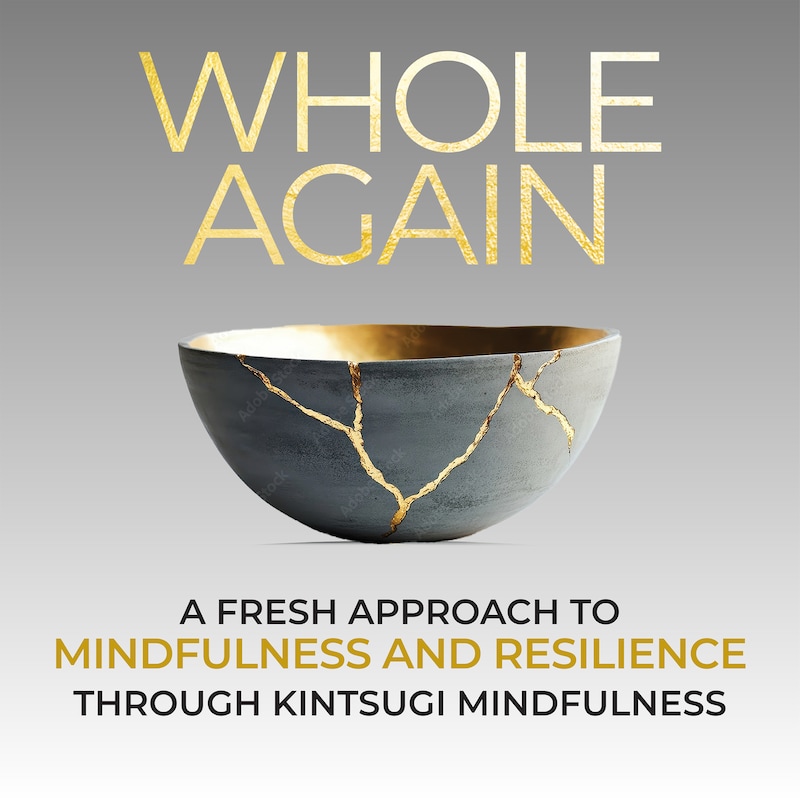
With Whole Again: A Fresh Approach to Healing, Growth & Resilience after Physical Trauma through Kintsugi Mindfulness, listeners explore resilience through personal stories of trauma, scars, and injury while learning to overcome PTSD, imposter syndrome, self-doubt, and perfectionism with self-compassion, self-love, and self-worth. Through insightful discussions on building resilience, resilience building, resilience and fitness, fitness and resilience, stress management, mindfulness practices, and digital wellness, the show offers practical tools like breathwork, micro-dose meditation, grounding techniques, visualization, and daily affirmations for anxiety relief and stress relief. Inspired by the art of kintsugi, the podcast embraces healing as a process of transformation, encouraging a shift in perspective from worry and being overwhelmed to gratitude and personal growth. By exploring the mind-body connection, micro-dosing strategies for emotional well-being, and holistic approaches to self-care, this podcast empowers listeners to cultivate emotional resilience and live with greater balance and intention.
Transcripts
In this episode, you'll discover a trick to help you solve your problems, and a little tip to solve the New York Times crossword puzzle.
Hey there, it's Michael. Welcome to Whole Again, A show about helping survivors of physical injury and trauma reclaim their strength and resilience through the wisdom of Kazuki. I'm glad you're here. Today you'll discover ways that you can be an expert problem solver, and you might even be able. To solve the New York Times Sunday crossword.
But before we dive in, if you haven't yet signed up for our amazing text messages, they're all free. They come about three times a week and it's the perfect message at the moment. You need to hear it. If you like to get them, all you have to do is text me whole again to 8 6 6 6 1 2 4 6 0 4. I'll say that one more time.
Eight six. Six six. 1 2, 4, 6 0 4, and I'll set you up. Now let's dive in to this week's episode. It's all about reframing our problems as puzzles. So let's start here. It's a bit of a question of reflection, if you will, when something hard comes up for you, a flare up from your injury. Maybe a setback. I've had both of those in my recovery journey.
Maybe a miscommunication between you and your caretaker, or you and your healthcare professional team, or simply a ripple, or maybe it feels more like a wave of exhaustion that hits out of nowhere. What do you talk about in your mind? What does that conversation with yourself sound like? Do you say, Ugh, not again.
Why is this happening to me? Or perhaps you say, this shouldn't be so hard. I'm with you on that one. Or it could be, I can't figure this out. I'm totally stuck. I don't know what to do. And these are all perfectly normal responses. So congratulations, you are my friend. Officially human. But here's my next question.
What if we can take those moments of frustration and make a shift, a mindset shift, and we turn them from a moment of frustration, a bad moment, if you will, as I like to say, and we turn them into curiosity, so much so that we actually get excited to solve the problem. Another way of looking at it is seeing it through a different lens.
So instead of looking at whatever you happen to be facing through a lens of pain or frustration, you can look at it through the lens of a problem solver. Let me share more because this is something I had to discover during my recovery, and once I did, it was so helpful. You see, when we face a problem or a problem comes to our door, it can feel heavy.
It's an unwanted guest, and it can trigger a lot of thoughts in our mind from past experiences because we bring a lot to the party. All those rocks in our backpack that I like to talk about, well, with that, with that heaviness that we carry into our life's moments. When a problem comes up, it can feel like a lot of pressure.
We might think we don't have the energy or the strength to solve them, and sometimes it can get pretty personal. It can even bring forward emotions like shame or guilt, or somehow were a failure just because a problem came up. A puzzle is completely different. It's a completely different lens To look through a puzzle is almost like an invitation.
With a puzzle, there's more engagement. It's something to play with, whether that happens to be wordle. If you're a New York Times Wordle person, a jigsaw puzzle, or even a Rubik's Cube, it's a chance to play, have fun, even though it's. Challenging. Challenging, but we get to explore. We get to move things around.
We get to figure it out. It all assumes that there's a solution to the puzzle, but when we have a problem, sometimes that's not as a parent, but with a puzzle. We know there's a solution. We just gotta figure it out. We just haven't found it yet, but we can. That important word yet. Something I talked about in a previous episode.
All the goodness that comes when we work on a puzzle, helps to shift our conversation that we're having with ourselves into a better place so we can have the same moment, but when we shift from, I see it as a problem too. I see it as a puzzle. There's a completely different energy that comes along with it.
That can help build our resilience and promote better healing. If you're game, let's try one of these shifts out together. Let's assume the problem as we first see it is that we have some fatigue. We're tired, more tired than usual, and we don't know why. And that can create a loop, a self narrative that makes us feel even more tired.
So the problem mindset could be or could sound like why am I always tired? What's wrong with me? Now with a shift, a shift into more of a puzzle way of looking at it, you could say, huh, that's interesting. Why am I so tired? You might, if you have like a whoop one of those wearables, you might go to that and try to find out what may be going on.
Whether or not you have a whoop, that doesn't matter. You can still meet the moment with curiosity. You could say, this is interesting. What's changed this week? Or What's changed over the last several weeks? What can I experiment with? What small shifts can I make? What small steps can I make to improve my energy?
Is it with my sleep? Is it how I'm using my digital devices? Am I on my phone a little bit more frequently over the last week? If so, why is that? So, how's my stress? Is there something adding to my stress that's new? Again, what's one thing, one step I could take to play with, to experiment with? Notice the difference.
One is, oh my God, this totally stinks. Or other choice words, the other brings a different type of energy into the situation. The problem mindset almost creates a full stop. We get stuck pretty quickly. A puzzle mindset keeps the story open. And I know we're talking about this in terms of recovery, healing 'cause that's the focus of the show.
But you can bring this mentality into every aspect of your life, and when you do, it could be a real big game changer for you. Here's why our nervous systems crave safety and agency. Or we wanna be in charge, right? Who doesn't? And when you see things as a puzzle, it can create both. When you approach a challenge as a puzzle, your brain relaxes a bit.
Say you're working on connections from the New York Times, and if you've detected a theme here in this episode with all these New York Times puzzles, there's a reason for that in my household, a certain someone that I know. But when we approach whatever puzzle we happen to be working on, we relax a bit.
We step out of survival mode and into more of a creative solution focused state. It's almost like our central nervous system takes a big exhale, ah, we're safe here. And I should say, this is not about. Bypassing the hard stuff or ignoring it, we can still have some of our attention on that. At the same time, we can hold our attention on this puzzle orientation.
It's simply about engaging in our moments a bit differently, in a way that helps us bring out the best in ourselves. In so many ways where our attention goes, our energy flows, or another way of looking at it, what we focus on that grows. Let's make this practical and relatable because I like to do that as we approach healing.
I also like to do that through our way of doing mindfulness and meditation. I'll invite you to think of something that you're struggling with right now. It could be almost anything. A sticky situation. Could be financial stress, maybe a persistent symptom. Again, it could be anything. Now let's pause and take a few deep breaths, and in this space you're creating right now, I'll invite you to reflect.
What would this look like if you saw it as a puzzle? Not a problem. What piece is missing? You need to solve it. Another question could be, what have I tried and what haven't I tried yet, and this one is my favorite one. If I approached it through the lens of a beginner's mind, what would be different? This shift isn't about fixing everything all at once.
It's simply a start. To engage with whatever you happen to be facing differently and with more anabolic energy that can help build your resilience and further your healing. This week I'll invite you to notice your struggle, bust moments, those challenges, and see if you can reframe them from a problem to more of a puzzle.
Play with them. Be curious, explore and see how that shifts your orientation, changes your energy.
As always, thank you for being here and thank you for being a fellow survivor. In this episode, you discovered how to approach your problems differently and upfront. I shared one way to help you solve the New York Times crossword, and this is the tip. Start with the easy words first, and that might be a tip for all of us in all aspects of life.
Try to pick at the low hanging fruit to get some wins, because those wins can help us build momentum, and that momentum can help us solve. Our problems more like puzzles. And remember, if you like to receive those text messages I send out, to help promote your recovery, all you have to do is send me a text to 8 6 6.
6 1 2 4 6 0 4, and I'll set you up.
And if you wish to learn more about creating beautiful ripples and how to prevent a bad moment from turning into a bad day, please visit my website, Michael O'Brien schiff.com. And sign up for my newsletter called The Ripple Effect, and join us each Monday, Wednesday, and Friday here at Whole Again, and discover how you can heal, grow, and become more resilient and celebrate our scars as golden symbols of strength and resilience.
Until then, remember, you can always come back to your breath. You've got this. And. We've got you.