Shownotes
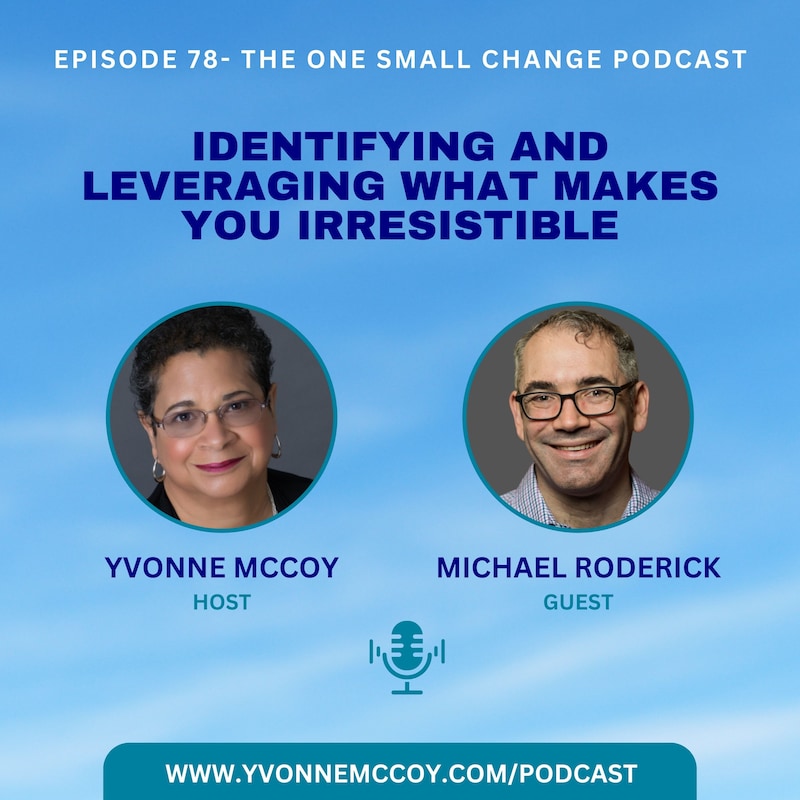
In this episode of the One Small Change Podcast, Yvonne McCoy welcomes Michael Roderick, an innovative business thinker who went from high school teacher to Broadway producer in just two years. They dive deep into the concept of discovering and leveraging your innate talents—whether you're a scientist, celebrity, or magician—to foster transformation, build authentic connections, and approach growth with small, yet powerful changes. The conversation highlights how recognizing and embracing your unique strengths creates ripple effects in your professional and personal life, and why implementation and community matter more than ever in today’s fast-moving world.
Guest Bio:
Michael Roderick is the CEO of Small Pond Enterprises which helps thoughtful givers become thought leaders by making their brands referable, their messaging memorable, and their ideas unforgettable. He is also the host of the podcast Access to Anyone which shows how you can get to know anyone you want in business and in life using time-tested relationship-building principles. Michael's unique methodology comes from his own experience of going from being a Highschool English teacher to a Broadway Producer in under two years. Michael uses Broadway-informed branding techniques to helps his clients find their I.F. (Innovative Framework) and create offers where they get paid for their brains.
Chapters:
00:00 Mastering Fundraising Through Practice
05:19 "The Triple Threat Concept"
08:47 Natural Talents and Their Strengths
11:29 Magicians as Science Translators
13:57 Value of Delegation and Expertise
18:42 "Test, Adapt, Fit Your Market"
21:30 Focus on Problems, Not Solutions
24:36 Daily Experiments Yield Insights
27:03 Genuine Giving Builds Connection
30:29 "Podcast Growth and Engagement Tips"
Quote from the Guest:
“The keys to all the doors we need open are in other people’s pockets. And the most important component of that is that you, right now, in this moment, are sitting there with a pocket full of keys.”
Link:
Discover your referability with Michael’s quiz: www.myreferabilityrater.com
Transcripts
Hi, everybody. Welcome to the One Small Change Podcast. And I'm thrilled,
Speaker:as always, to embark on this journey of exploration and transformation with
Speaker:you. I'm your host, Yvonne McCoy, and I bring almost 30 years of
Speaker:entrepreneurial experience, and I have a passion for discovering
Speaker:growth through the power of seemingly small change.
Speaker:I'm really happy that you're here. And of course, one of the reasons that I
Speaker:do this is so that you can also be exposed to some of the wonderful
Speaker:people that I've met in my journey and help you to grow your business
Speaker:and. And. And, you know, just have a total different outlook
Speaker:on life. And this week, we are talking to the amazing Michael
Speaker:Roderick, and he's going to share how a smaller, unexpected or
Speaker:insignificant decision sparked a remake.
Speaker:We're Live and my lips moving Today, a remarkable
Speaker:transformation and how it. How it sparked growth in
Speaker:either their personal or professional or both. Michael,
Speaker:thank you for coming. Hopefully my brain will start working.
Speaker:No worries. Thanks for having me. I'm very excited to be here.
Speaker:Tell everybody what I know about you, what you do,
Speaker:and why you're the best at it. Sure.
Speaker:The work that I do is focused on helping subject matter
Speaker:experts who are feeling overwhelmed by their own
Speaker:expertise come up with what is that
Speaker:big idea? What is that thing that's going to make
Speaker:them more. More referable? The type of person that everybody wants to reach
Speaker:out to and connect with. And the reason
Speaker:why I do this very, very well is
Speaker:I personally went from being a high school English teacher to becoming a
Speaker:Broadway producer in under two years. So
Speaker:I've spent a lot of time thinking about how to package things, how
Speaker:to present things so that more people talk about them and how they
Speaker:can appeal to a mass audience. So
Speaker:what made you go from being a high school teacher to being a
Speaker:Broadway producer? I mean, that's gotta be a story in itself. Yeah.
Speaker:Well, I was always interested in theater. I
Speaker:had done a lot of work in the industry
Speaker:in different capacities. But when I found out
Speaker:about Broadway, I just became really fascinated with sort of how that
Speaker:system, sort of like, how that side of things worked. And the thing that I
Speaker:learned was you needed to basically raise money. You need
Speaker:to get people to write checks for these very, very
Speaker:large, sort of elaborate productions.
Speaker:And in that side of things.
Speaker:A lot of my colleagues were selling one show, so
Speaker:they'd go to different investors and they'd say, hey, I'm working on
Speaker:this one show. Do you want to write a check? Kind of thing.
Speaker:But me, I was actually just more interested in getting better at
Speaker:raising money. So I went to a bunch of
Speaker:producers and I said, listen, I don't even need credit right
Speaker:now. I just want to get out there and sort of get my reps in,
Speaker:in terms of raising money. So I had a lot of producers give me
Speaker:paperwork. And the other side of it was that I ended up
Speaker:with basically a portfolio where basically if I was with an
Speaker:investor and they weren't interested in one show, I had three or four
Speaker:others. And then word got around that I started raising money and then I was
Speaker:good at it. So I eventually started getting offered opportunities
Speaker:to get credit on the Broadway shows that I worked on.
Speaker:So there's a lesson there. To put this into a
Speaker:lesson. What would it be? I mean, how would you. Yeah, I would
Speaker:say the lesson is every industry
Speaker:has a system. Every industry has a way that things
Speaker:are executed on and that are done. And
Speaker:in all, in every industry, there are people who are
Speaker:moving through that system. And if you take the
Speaker:time to make those people more successful, if you find out what
Speaker:it is that they aspire to, then you're probably going to
Speaker:move faster. Right. If you look at what it is that's going to
Speaker:help them grow and you become part of that, word's going
Speaker:to get around. People are going to talk about you as the person
Speaker:who made those connections, made those opportunities
Speaker:happen. So there are two things that I want to point out.
Speaker:Yeah. One is that you took
Speaker:it from the perspective the other side of the
Speaker:coin, which is what so many entrepreneurs don't do.
Speaker:I do this, I do this, I do this. And I say to them, we
Speaker:don't care. Tell me what you're going to do for me.
Speaker:You made it convenient for investors to go to them
Speaker:and say, you don't like this one? I've got something else. So it was kind
Speaker:of like a one stop shopping and it was a collaborative effort.
Speaker:It was do it alone. You did it with a group.
Speaker:Yeah. And that was probably one of the lessons that I learned
Speaker:was getting more into community and getting into
Speaker:affiliations and things like that. So that's amazing.
Speaker:That's amazing. But that's not what I know you
Speaker:for the most. Yes. So tell us about
Speaker:that because that I find this amazing. I love this. Yeah. So
Speaker:this comes from my theater, this comes from my theater background. And
Speaker:basically there's this concept I've developed called the Triple Threat. And
Speaker:in the theater world, there's the idea of being an actor, a singer and
Speaker:a dancer. And what a lot of folks don't know about that
Speaker:unless you're in the industry is that the order of those things is
Speaker:actually very important to your success. So if acting is your top
Speaker:talent, for example, then you should be focusing on film and TV,
Speaker:should be focusing on musicals with a really good book. You should be focusing on
Speaker:straight plays and really playing to your top
Speaker:talent. Well, in the expert world, there is
Speaker:another form of Triple Threat, and that is the scientist, the celebrity, and
Speaker:the magician. And if your top talent is the
Speaker:scientist, you tend to be very good at the analytical side
Speaker:of thinking, sort of breaking things down. But you usually
Speaker:aren't as thrilled about sort of being out in front of people. And
Speaker:if you're. If the celebrity is your top talent, then
Speaker:you're very good at the people side of things. You're very good at connecting, being
Speaker:out in front of people. You're also very good at making other people feel like
Speaker:celebrities. But you may not be nearly as excited about the
Speaker:science. Right. And really breaking things down and understanding things. It's
Speaker:for you, it's more about the people. And finally, if
Speaker:your top talent is the magician, you are 100%
Speaker:wired for novelty, Meaning that you really are
Speaker:a very, very innovative thinker. You're always kind of looking at all the different
Speaker:angles, all the different ways that you could potentially do something.
Speaker:And you're very inventive, you're very creative, but
Speaker:you hate repetition. So even if something is
Speaker:making you successful, you will stop
Speaker:it if it feels too repetitive, if it feels too
Speaker:redundant. And I think that
Speaker:all entrepreneurs have a touch of music magician in
Speaker:them. Yes. We're so easily bored. I mean, when
Speaker:I started doing my workshop and someone said, you do the same
Speaker:workshop, I'm like, oh, you know, because I've been like, okay, this month I'm going
Speaker:to do that, you know, God, this is going to be horrible,
Speaker:you know, however, what I learned, apparently
Speaker:I entertain myself quite well. So,
Speaker:so learned is, you know, one
Speaker:of my things is curiosity and
Speaker:enticement. And each workshop, even though the
Speaker:skeleton of it is the same and, you know, like
Speaker:90% of it is the same, there's some little something
Speaker:that's different either because of the people in the room or
Speaker:because I've found something. And what I find from that is that
Speaker:I'm able to kind of go deeper rather than just broader.
Speaker:Yeah, but I love that. So I think the other
Speaker:thing that we're saying is play to, you know, if. Play to your
Speaker:strengths. Yes. Which is what my workshop is
Speaker:about. It's, you know, attract your right client by unlocking your
Speaker:unique powers and Your unique powers are something
Speaker:that are ingrained in you. And it does that you're,
Speaker:you're. Or I should put this in a question.
Speaker:I'm the interviewer, right? I
Speaker:should say to you, tell me about how people, you know,
Speaker:you don't have all one Small Change. How do people, you
Speaker:know, that kind of thing? Yeah, well, I think
Speaker:that there's just a, there's a talent that just comes
Speaker:very, very naturally to you. And so if,
Speaker:let's say being a magician is your top talent,
Speaker:ideas just sort of flood for you. Like,
Speaker:you don't really have any trouble coming up with a new angle or sort of
Speaker:a new way of doing things. Whereas if scientists is your top
Speaker:talent, you really don't struggle at all with
Speaker:really complex stuff. Like you can just like sit and
Speaker:read a research study and you're not bored by it. Like
Speaker:you're happy to like dig in and sort of figure out like all the components
Speaker:and all of the, all of the elements. And if celebrity's your
Speaker:top talent, you don't really worry about
Speaker:connecting with people. There's really kind of no like social anxiety
Speaker:there. There's no real challenge of like getting out in front of a crowd.
Speaker:Like, it's super. It feels just very, very
Speaker:natural to you and very, very easy to you. And usually
Speaker:whatever that natural thing is, that's usually your top
Speaker:talent. But then you have something else that you're pretty good at
Speaker:still, right? And that's the second talent. And then the last talent,
Speaker:it's usually the one that you don't use as much, you don't spend as
Speaker:much time on and maybe you need to work on, right? So for me
Speaker:personally, I am magician, celebrity, scientist.
Speaker:That's the, that's the order of my triple threat. I am
Speaker:very, very good at sort of coming up with innovative ideas and sort of coming
Speaker:up with interesting things. But I also love people. I
Speaker:love connecting, I love meeting folks, I love sort of
Speaker:the relational sort of component of it. And I
Speaker:think in a very sort of organized, scientific
Speaker:way. But you're never going to find me sitting there, you're never going to find
Speaker:me reading like a 56 page research study. I'm
Speaker:gonna want to hear like the Cliffs Notes of that study.
Speaker:That's me. And, and I also find that because
Speaker:I'm so visual and I think this is where people, you know, where
Speaker:I like kind of a matrix approach. Like, I love this,
Speaker:what you're saying, which gives light to some other things.
Speaker:So for me, scientific stuff is the most interesting.
Speaker:When I see it. So. So, you know, my
Speaker:husband will hook me into YouTube about, like,
Speaker:he had me watching. I don't know, some
Speaker:kind of killer fish thing the other night, which
Speaker:I would have never picked up a book. Yeah, you have read
Speaker:about, you know. Yeah. How does this. How does this impact
Speaker:the kind of clients that you have? Or what is your.
Speaker:Yeah, yeah. I do find
Speaker:that a lot of the time you'll attract
Speaker:more scientists when you're a magician. And
Speaker:basically, a lot of the time, magicians are very
Speaker:good translators for people. So scientists tend to
Speaker:kind of be in this. Like, I have all these ideas, I
Speaker:have all these things I want to do, but I have no idea how to
Speaker:talk about it. And magicians tend to be very good at sort of looking at
Speaker:that whole mess of things and saying, oh, this is how to talk
Speaker:about it, this is how to think about it. This is how to
Speaker:break it down. But conversely, you wouldn't go to a
Speaker:magician if you were looking for somebody to build a system
Speaker:for you and break everything down and sort of live in
Speaker:that, you know, that kind of world. Because scientists are more
Speaker:attuned to that idea. Right. They're better
Speaker:at coming up with, okay, this is the exact process.
Speaker:Whereas magicians are much more. They're going to lean into
Speaker:experimentation a lot more, and they're going to
Speaker:often enjoy experimentation a lot more. Whereas the
Speaker:scientists, a lot of the time, they're like, I want a clear
Speaker:sort of journey here. I want to know exactly what I'm doing,
Speaker:exactly sort of what's, you know, what's happening. So I do think
Speaker:that you'll have instances where you do have
Speaker:to pay attention to what are those things that those people
Speaker:want, but also recognize that some of them are going to be
Speaker:more attracted to your skill than others. Like, there
Speaker:are some people who really need that translation, and that's at the top
Speaker:of priorities for them. But then there are other people who. They're not
Speaker:really actually interested in translation right now. They feel like they kind of know what
Speaker:they have, but they might actually be more interested in
Speaker:growing that thing or building that thing, or they might be interested
Speaker:more in developing a system. And I think it's important to identify,
Speaker:like, where are those strengths for you and where are
Speaker:those areas that it just doesn't really make sense and you would probably
Speaker:do better to pass it off to somebody else where it would be a little
Speaker:more complimentary. So I. So the first thing,
Speaker:regardless whether you're looking at this as your. Your three
Speaker:things or something else, I think you know, my
Speaker:thing is, you don't need to be fixed, you need to be found. And
Speaker:nobody is good at everything. True.
Speaker:So sometimes it's a. Not a waste,
Speaker:but it's not as effective, I think, to spend a lot of
Speaker:time on something you're not good at when somebody else can do it
Speaker:really quickly. And part of our problem is the
Speaker:things that we're good at come so naturally
Speaker:to us. We don't realize that other people struggle with it.
Speaker:I mean, I was helping one of my clients. We were, you know, kind of
Speaker:putting together her client's journey and what the price range and the package
Speaker:titles and, I mean. And, you know, we went in about 20 minutes, I had
Speaker:taken what she had and rearranged it and, you know, whatever. And she was like,
Speaker:you didn't tell me that you were going to help me with my packaging.
Speaker:And I was like, oh, doesn't everybody do
Speaker:that? Yeah, because it feels natural. Right. Like, it
Speaker:just feels like I just do this. It just comes. Right.
Speaker:Yeah. And. And I think the thing is that,
Speaker:you know, there are certain words that you said to describe things that I
Speaker:just went, that's me. That's me. Yeah, the translator
Speaker:and. And some of the other
Speaker:archetypes and stuff. There's like, also the Small Change.
Speaker:Yes. I want to know why it works. You know, that
Speaker:kind of. And so, you know, the. The bottom
Speaker:line is.
Speaker:You have talents that other people need.
Speaker:Yes. So first you have to be aware of what
Speaker:your talents are, and then
Speaker:you need to know who are the people who need
Speaker:it. And sometimes it is not as
Speaker:obvious as it seems. Yeah,
Speaker:yeah. Very, very often. And I think that a lot of the time,
Speaker:we. Whatever our strength is, like, whatever. The thing is that we do
Speaker:really well for others, it's really tricky
Speaker:to do it for ourselves. Right. Like, it's really tricky to sort of
Speaker:flip that on because we just don't have the gift of
Speaker:distance. Right. Like, we can't see it. So I will
Speaker:have lots of instances where I'll meet people who are very much
Speaker:magicians. They're very good at packaging and solving other
Speaker:people's problems and, like, coming up with really interesting phrasing
Speaker:and all that kind of stuff, but they try to do it for themselves
Speaker:and it falls flat. And it's not really, you know, it's not really strong. So
Speaker:they end up looking to somebody with an outside
Speaker:perspective to help them see the things that they can't
Speaker:see. I find it really interesting that when I
Speaker:point something out to somebody that, to me, is really obvious.
Speaker:And they're like, why didn't I know that?
Speaker:Yeah, I, I'm smart. I should know that.
Speaker:Yeah. And the same thing is true with me. It's
Speaker:like, oh, my God, somebody said something. It was
Speaker:like, how come I didn't know that? Yeah. So.
Speaker:So I think that, you know, probably one of the biggest lessons is you
Speaker:as an entrepreneur. You cannot grow your. Your business in a vacuum.
Speaker:Yes. A couple of reasons for that. One is that
Speaker:the world is constantly changing. Whether you are or not, the world
Speaker:is changing. It is different every day. And
Speaker:you can't put your finger on the pulse of everything that's
Speaker:going on. So people, you know, so you're shooting at a moving
Speaker:target is the way that. Yeah. And you can do
Speaker:that so much better in a group. You know, whether it's a community,
Speaker:whether it's a coach, whether it's a mastermind or something like
Speaker:that. Then you can by yourself, because
Speaker:you just can't take in the information that you need. I mean, because there. Yeah.
Speaker:Information is everywhere. And what I say to people now is the trend
Speaker:is not information. That used to be the gold of
Speaker:expertise. Now the gold
Speaker:is implementation. Because you can get information anywhere.
Speaker:Yeah. You know, it's. Right. But you can get it anywhere.
Speaker:Right? Yeah. But being able to use it is really
Speaker:the thing that is so, so important.
Speaker:Yeah. Yeah. I mean, it's a, It's. It's essential. And
Speaker:I think that what tends to happen is
Speaker:we'll get information or we'll read something or
Speaker:we'll see something, and we'll have this thought of, oh,
Speaker:okay, now I know what I need to. What I need to do.
Speaker:And the fact of the matter is, until you actually test
Speaker:whatever that thing is, you're not going to know if
Speaker:it's actually going to work for you for the One Small Change
Speaker:that you have. And I see this all the time where somebody will learn
Speaker:something or see something on a. On a video or a course, and
Speaker:they'll try to do the exact same thing, but
Speaker:it doesn't fit who they are or it doesn't fit what their market's actually
Speaker:looking for. And that's why I am very, very bullish
Speaker:on the aspect of you need to
Speaker:test, like, you need to see what kind of
Speaker:reaction you get from something that you're creating
Speaker:and then decide, do you want to double down on that? Do
Speaker:you want to go deeper into that, or is it not really a fit for
Speaker:you? Is it not really a fit for your market? Well, it's funny
Speaker:because it's really taken me a long time to go from
Speaker:building a whole thing and putting it out there to
Speaker:putting it out there and seeing if I have any nibbles. Yeah. I am very
Speaker:excited about The One Small Change Podcast. Have an idea of what I want it
Speaker:to be. Putting it out there to see if I have any nibbles. And then,
Speaker:you know, so I am not. That is probably one of my
Speaker:weaknesses. I am not a big tester. I want to really focus on The One
Speaker:Small Change Podcast. Yeah. I can be really impulsive.
Speaker:But I am now about to do a pre Something
Speaker:survey, which I've never done before. Nice. So
Speaker:you can learn as you go along. You can get better. Exactly.
Speaker:Let me, before we run out of time, because really enjoying
Speaker:this, tell me three things you think
Speaker:people should do and be sure. We need to talk about your gift as well.
Speaker:Sure, sure. Yeah. So I think, you know, the first thing
Speaker:is that I think a lot of time we don't
Speaker:really look at who we already know. I think we spend
Speaker:so much time on relationship acquisition and not enough time on
Speaker:relationship retention. And I think, like, if you
Speaker:just take the time to sort of sit down and say, who, who do I
Speaker:already know? Who do I already have? Converse. Have I already had conversations
Speaker:with? And who would I like to deepen the relationship with?
Speaker:I think there's a lot of opportunity there that most people
Speaker:don't really pay enough attention to.
Speaker:Yeah. I just want to interject this. And I think
Speaker:one of the things that people forget is that
Speaker:the people that you met before.
Speaker:There. I don't know how to say this. You know, you know how, like, in
Speaker:retail there's always, like new customers. Only. People
Speaker:who have been customers feel like, well, you know, why are they getting a deal
Speaker:and I'm not. I'm. I'm a loyal customer. Yep.
Speaker:And so though going back to those people just
Speaker:really deepens that relationship. And it really. I mean, I think
Speaker:it's like gold mine that people ignore them and don't
Speaker:nourish them at all, you know, as much as they should. I'm sorry, that just.
Speaker:Yeah, no, no, I. I appreciate that. And I think it's a very, very important.
Speaker:It's a very, very important point for everybody to be thinking,
Speaker:you know, be thinking about. Second thing I'll say
Speaker:is that most of the success that I've
Speaker:experienced in my life has come from
Speaker:focusing more on people's problems than
Speaker:on the solution that I provide to those problems.
Speaker:Meaning I spend far more time
Speaker:having conversations with people to understand what the actual
Speaker:problem is, like, what the actual issue is. And I make
Speaker:that part of the content and the things that I create, I write about
Speaker:problems, and I have far more interest
Speaker:from clients when I've taken the time to help them understand
Speaker:the problems as opposed to talking about the solutions. And I think
Speaker:it's a very, very important thing to just, like, always be thinking
Speaker:about for yourself is, are you
Speaker:a understanding the problems that your clients have
Speaker:and be communicating that you understand those
Speaker:problems, like helping them understand those problems, naming
Speaker:those problems for them, because that is one of the best
Speaker:tools that you have from a selling standpoint
Speaker:that. That there is. Well, it's funny because,
Speaker:you know, one of my first coaches said to
Speaker:me, you paint your door red with what they think the
Speaker:problem is, and when you get them inside, you actually
Speaker:help them, you know, solve the real problem. And so for me, when
Speaker:I was, you know, doing productivity, most people thought that meant
Speaker:time management. Yep. I'm like, no, it's not, you know, but
Speaker:rather that. Rather than, you know, go into the no, it's not kind
Speaker:of thing. It was like, yes, we're going to do that, but
Speaker:we're going to do more. Right. Okay, give me the third one because these
Speaker:are gold. Oh, thank you. So I would say
Speaker:the last one. I call this the gate
Speaker:strategy. And every day, challenge
Speaker:yourself to open and close the gate. So every day,
Speaker:give without expectation of return. Just do something
Speaker:for somebody. No ties, Just help
Speaker:somebody in some particular way. But every
Speaker:day, in addition to that, ask for something
Speaker:that you need. Let your network know
Speaker:if you need something. Communicate that.
Speaker:Make sure that you work that muscle of asking every
Speaker:single day. The T is for
Speaker:thank. And every day,
Speaker:identify somebody that you can send a
Speaker:meaningful thank you to. Thank them, tell them
Speaker:what they did, what it meant. And finally,
Speaker:every single day, the E is for experiment.
Speaker:Look for something within the work that you're doing
Speaker:that you could do a small test on. It doesn't have to be anything
Speaker:really big. It could be you're going to change a subject line, you're going to
Speaker:change the way that you describe something, you're going to choose something else to talk
Speaker:about on a Podcast, whatever it is, Every
Speaker:single day, come up with at least one Small
Speaker:experiment. And if every single day you open and close the
Speaker:gate, after a while you're going to start to notice patterns in
Speaker:all of those areas. You're going to start to notice, oh, well, when I give
Speaker:here, these are the types of reactions that I get when I ask
Speaker:these people. These are the things that work, these are the things that don't. When
Speaker:I say thank you. These are the opportunities that show up when I do these
Speaker:experiments. These are the experiments that work the best. If every
Speaker:day you open and close the gate, you're going to notice
Speaker:a marked difference in your business
Speaker:and in your life. Okay, so first I want to go back.
Speaker:Give me the word again that the acronym is for gate.
Speaker:Gate. Okay. Give.
Speaker:Something, think, and experiment. I don't. Yes,
Speaker:ask, Ask. Which is probably the reason I don't remember.
Speaker:Yep. Something that that is. Is. Is a muscle
Speaker:that I don't use. I mean, the simple thing of, you know,
Speaker:just building it into. When you interview somebody on a Podcast saying, do you know
Speaker:anybody else that. That might be a good guest on my Podcast, or
Speaker:do you know anybody else that I might be a good guest. And I always
Speaker:forget to do that. Yep. Yep.
Speaker:And. And it creates, like, a ripple effect. And I
Speaker:think is. Particularly.
Speaker:I think particularly women, because so many of
Speaker:us were alive during that. Women, hear me roar.
Speaker:You know, you can do everything that asking seems like
Speaker:it's a weakness. Yeah. In fact, asking is
Speaker:a strength. Oh, 100%. I mean, that is,
Speaker:I think, the reason why so many people get overwhelmed. And, you know.
Speaker:You know, it's just, you know, and. And I think.
Speaker:I don't know. This is a personal thing. It's kind of. I asked for
Speaker:something. What's it going to cost me? I mean, emotion, the
Speaker:price. And. And so that is, you know, I think, you know,
Speaker:when someone said to me when I first started doing affiliates, when you work
Speaker:with more secure people, you don't have that
Speaker:issue. Yeah. You know, willing to give
Speaker:without any kinds of con. And I found that to be true. I mean,
Speaker:it is. I am in a place right now where
Speaker:I feel like when I ask people, like, do you want to be on my
Speaker:podcast or do you want to be on my summit? And stuff like that, I
Speaker:am, like, so amazed at how fast the answers come back. Like, I'm so glad
Speaker:you asked me, or, I can't do it this time, but will you make sure
Speaker:to make, you know. You know, and it is. It
Speaker:is. I think when you show up as your genuine self
Speaker:and you can give the gifts that you can give that other
Speaker:people can't give. Right. Want to
Speaker:be with you. You know, I find it interesting now
Speaker:when I go networking, somebody will say, oh, you need to make
Speaker:sure you talk to Yvonne. Or, you know, and I'm like, wow.
Speaker:I'm just, like, totally amazed by that. Okay, we're running out of time, and I'm
Speaker:having Fun. Let me ask you this.
Speaker:You didn't name what your GIF was. Yep. Yeah.
Speaker:So I have a tool called the Referability Rater. If you go to
Speaker:my ReferabilityRater.com, basically, this
Speaker:is a tool that will help you understand how referable you
Speaker:actually are. So it actually takes you through a number of
Speaker:things that you can see how referable you
Speaker:are as an individual, as a business, et cetera.
Speaker:And if you go and you use that, you're going to notice
Speaker:those areas for yourself. You're going to start to be like, oh, wait a
Speaker:second. Here are the areas where I could use some
Speaker:improvement. Here are the areas where I'm really strong. And
Speaker:that'll help you get a better sense of, like, what's working and
Speaker:what's not. And not only that, when
Speaker:you contact other people from the fat, and you know that
Speaker:then you're probably going to get more results from it.
Speaker:Absolutely, Absolutely. Okay, so when was the last time you did something
Speaker:new for the first time? Yeah, I was thinking about
Speaker:this because there are so many things that end up
Speaker:feeling like, wait a second, I've done this.
Speaker:You know, I've done this before. I've sort of gone through, you know. So I'm
Speaker:thinking as I think back to it.
Speaker:We went to a water park, and it
Speaker:had been a very long time since I was a kid,
Speaker:that I had done any of the, like,
Speaker:scary ones. Right. Like, like, you always kind of did, like, the safe
Speaker:ones. Right. And I've got two little girls, and
Speaker:they wanted to get on. They wanted to go down one of these ones
Speaker:where it's like, you sit on a tube and that thing, like,
Speaker:spins around like, as you're going, I did
Speaker:it. I don't know if I'll ever do
Speaker:it again, but I did it.
Speaker:No, I think that. I think there are lots of things that we do for
Speaker:our kids. Yes. That, you know. And,
Speaker:you know, one of the things that, you know, I have a. I have a
Speaker:child that's like 12 years younger than my oldest child.
Speaker:People go, she's going to keep you young.
Speaker:So, you know, you. You do things that you. You thought you had been
Speaker:finished doing. Right. 100.
Speaker:Oh, I can't believe. All right, so let me give you the commercial and
Speaker:we'll wind this up, even though I don't want to. So, everybody,
Speaker:as a first step, please subscribe, share, and engage on social media
Speaker:with the podcast. And, you know, the reason that I do this is
Speaker:to introduce you to people that maybe you haven't met and supercharge
Speaker:your business through new connections. And it's my way of giving back
Speaker:to this vibrant community and fueling your, your quest for growth.
Speaker:And I hope you'll continue to join me for the one small change as
Speaker:you're making these tiny shifts that, that are going to yield
Speaker:monumental transformations. And for
Speaker:those of you who don't know, every quarter I do a quarterly clarity
Speaker:chat where I talk about what I think is coming up in the trends. And
Speaker:so you might want to also look. So Michael, what are your last words you
Speaker:want to leave us with? So I always like to say that the keys to
Speaker:all the doors we need open are in other people's pockets.
Speaker:And the most important component of that
Speaker:is that you, right now, in this moment, are sitting there with a
Speaker:pocket full of keys. You have no idea
Speaker:how much you can benefit somebody else until you start having
Speaker:those conversations and finding out where they could use help, where they could use
Speaker:support. So make sure that you, you use those
Speaker:keys. Don't just walk around and
Speaker:with these heavy pockets full of keys. Not only that,
Speaker:that means that people who are starting out have keys as well.
Speaker:Yes, indeed, very much so. They discount
Speaker:themselves and they really should not because is
Speaker:kind of ahead of somebody and you can help and
Speaker:share and, you know, be of value just by your
Speaker:presence. I mean, I, I, my goal is
Speaker:that we both leave better for having met each other.
Speaker:I love that, whatever that is. Do you know?
Speaker:Yeah. Oh my God. Okay, so
Speaker:everybody remember, change is simple, but it's not always easy. And
Speaker:it requires courage, resilience, and a willingness to step out of your
Speaker:comfort zone. And let me tell you, if you're comfortable,
Speaker:it actually means you're stagnating because the world is changing
Speaker:all around you and you are not keeping up.
Speaker:I just want you to know that so many things
Speaker:are possible just by making a small change or making a
Speaker:small connection. And you will be amazed at the things
Speaker:that change in your world. Anyway, so join me for the one small
Speaker:change every week as we embark on this journey. And
Speaker:until then, stay very, very curious.
Speaker:Michael, thank you so much. Thanks for having me. It's an absolute
Speaker:blast.