Shownotes
You can check out the companion video here REAL PROPERTY EASEMENT EXAMPLES: How a 2-Acre Lot Lost Half Its Buildable Area
https://youtu.be/WTJLeb2OGGM
When you purchase property for your dream home, what you see is definitely not what you get. Property easements home building restrictions are legally binding rights that allow others—utility companies, neighbors, government entities, conservation organizations—to use specific portions of your land for designated purposes. You own the property, you pay the taxes, but someone else has legal rights that restrict where and what you can build.
In Episode 35 of The Awakened Homeowner podcast, continuing the Understanding Design Limitations series, Bill Reid reveals how property easements can render entire sections of your lot completely unbuildable. These invisible legal agreements, often granted decades or even centuries ago, automatically transfer when you purchase property—whether you discover them beforehand or not.
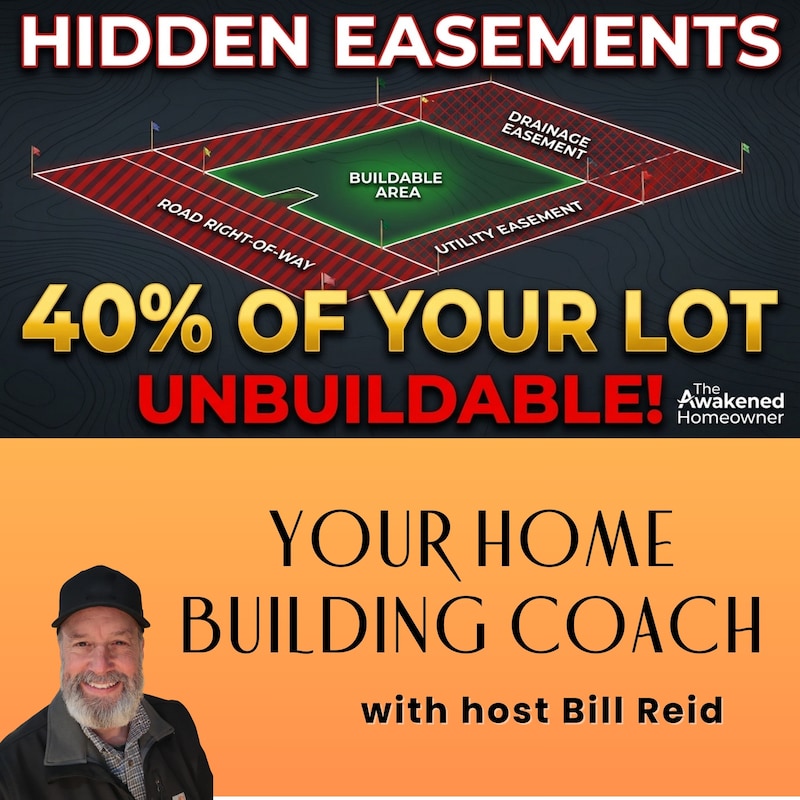
The episode features a detailed real-world analysis: a 2-acre Northern California property where easements consumed 6.5% of the lot (5,655 square feet) before any setbacks were applied. Combined with setback requirements, only 68.5% of the original lot remained buildable. Additionally, because this jurisdiction subtracted easement areas from floor area ratio calculations, the allowed home size was reduced by an additional 1,414 square feet—nearly 7% smaller than if the full lot counted.
Bill also references a companion YouTube video showing an actual property survey walkthrough, making these invisible restrictions visible and understandable for visual learners. You can see the video here https://youtu.be/WTJLeb2OGGM
🎯 In This Episode You'll Discover:
✅ What property easements are and why they're fundamentally different from setbacks (contractual vs. regulatory)
✅ The 5 main easement types affecting residential construction:
1. Utility easements (most common—electric, gas, water, sewer, telecom)
2. Access easements (neighbor rights to cross your property)
3. Drainage easements (natural water flow corridors)
4. Conservation easements (environmental/agricultural protection)
5. Prescriptive easements (established through long-term use without permission)
✅ Building restrictions in easement areas: You absolutely cannot construct permanent structures including houses, garages, pools, sheds, retaining walls, or anything with foundations
✅ Floor area ratio impact: Some jurisdictions subtract easement areas from lot size for FAR calculations, dramatically reducing allowed home size
✅ Grading and drainage complications: Easements prevent grade changes and site modifications without permission
✅ Access and privacy concerns: Rights of way crossing your property affect daily living quality
✅ The 6-step due diligence process:
1. Review preliminary title reports (and read actual easement documents)
2. Order professional surveys showing exact easement locations
3. Walk properties observing current use patterns
4. Contact utility companies directly for easement information
5. Consult planning departments about FAR calculation methods
6. Hire architects/consultants to analyze buildable area before purchasing
✅ Real 2-acre property case study: Complete breakdown showing how easements and setbacks combined reduced buildable area to 68.5% of original lot, plus additional FAR reduction impacts
✅ Common homeowner mistakes: Trusting title insurance to cover everything, ignoring "small" easements, waiting until design phase to address restrictions
✅ Negotiation strategies: How discovering easements during due diligence enabled $50,000 price reduction
📍 KEY TIMESTAMPS:
0:00 - Introduction: The Invisible Property Restrictions
5:15 - What Are Property Easements?
8:30 - How Easements Differ From Setbacks
12:00 - Type 1: Utility Easements
18:15 - Type 2: Access Easements
24:30 - Type 3: Drainage Easements
29:00 - Type 4: Conservation Easements
32:45 - Type 5: Prescriptive Easements
37:00 - Building Restrictions in Easement Areas
41:15 - Impact on FAR Calculations
51:15 - How to Find Easements: Title Reports
55:30 - How to Find Easements: Professional Surveys
59:00 - How to Find Easements: Property Observation
62:15 - How to Find Easements: Utility Companies
67:00 - How to Find Easements: Architects/Consultants
70:15 - Real Example: 2-Acre Property Analysis
76:30 - Common Mistakes With Easements
80:00 - Complete Due Diligence Action Plan
83:15 - Key Takeaways and Closing
📚 RESOURCES MENTIONED:
📖 The Awakened Homeowner Book
• Amazon: https://www.amazon.com/dp/B0F1MDRPK7
• All Platforms: https://books2read.com/u/bpxj76
📚 The Tale of Two Homeowners (Free Story)
See the dramatic difference between informed and uninformed homeowners:
https://the-awakened-homeowner.kit.com/09608e1727
🎥 Related Episodes:
• Episode 34: Property Setbacks and Building Envelope
• Episode 33: Floor Area Ratio and Lot Coverage
• Previous episodes in Understanding Design Limitations series
🎥 Companion YouTube Video:
Property survey walkthrough showing actual easements:
https://www.youtube.com/@TheAwakenedHomeowner
🔗 CONNECT:
🌐 Website: https://www.theawakenedhomeowner.com/
📧 Email: [email protected]
📸 Instagram: https://www.instagram.com/theawakenedhomeowner/
👍 Facebook: https://www.facebook.com/theawakenedhomeowner/
🎥 YouTube: https://www.youtube.com/@TheAwakenedHomeowner
🔗 LEARN ABOUT THE BUILDQUEST APP:
🌐 Website: https://www.buildquest.co/
👤 ABOUT YOUR HOST:
Bill Reid is Your Home Building Coach with 35+ years of experience in residential construction. He created The Awakened Homeowner methodology to enlighten, empower, and protect homeowners through their building and remodeling journeys.
🔔 SUBSCRIBE & REVIEW:
If you found value in this episode, please subscribe to Your Home Building Coach podcast and leave a 5-star review on:
• Apple Podcasts
• Spotify
• Google Podcasts
• Or wherever you listen
Your reviews help other homeowners discover the guidance they need!
🎯 NEXT EPISODE:
Episode 36: Continuing the Understanding Design Limitations series with additional property restrictions that affect home building.
Subscribe now so you don't miss it!
Keywords: property easements, easement types, utility easements, access easements, drainage easements, home building restrictions, land purchase, buildable area, title report, property survey, custom home construction
________________________________________
© 2025 The Awakened Homeowner | Your Home Building Coach with Bill Reid
Mentioned in this episode:
Transcripts
Bill Reid:
All right, welcome back. This is Bill Reid, your home building coach. If you've been following along with this Understanding Design Limitation series, and I really hope you have, we've been covering a lot of ground together. In last episode, Episode 34, we talked about setbacks and property lines and how they create this invisible box that defines where you can build on your lot.
Today we're diving into easements, which are a completely different beast. I touched on easements in the previous episode, and after thinking through this, I thought it would be really important to dedicate an entire episode to easements because it is something that can really impact the floor area ratio and the overall allowance on your lot to build.
If setbacks define the edges of your building envelope, easements can punch a hole right through the middle of it. Here's the thing about easements: they're one of the most misunderstood and underestimated restrictions in home building. I've seen it happen over and over again. Homeowners fall in love with a property, they start designing their dream home, and then they discover an easement that makes their lot unbuildable. By that point, they've invested thousands of dollars in architectural fees and months of time.
The reason easements catch people off guard is you simply can't see them. When I mentioned when you're considering buying a parcel—let's say it's a two-acre parcel or even a one-acre parcel in a development—and you're standing at the top of the street overlooking this beautiful property, there's a pretty good chance you're seeing part of your neighbor's property that borders your property. That distorts the perception of the size of your property. Easements are kind of the same thing, where you're looking at this beautiful piece of property, but you do not know what's lurking underground. And overhead you can see, but sometimes people don't even realize those could be easements as well.
With a setback, you can at least visualize it once you know where the property lines are. But easements? They're underground utility lines, they're overhead power lines, they're access routes for neighbors, and you didn't even know they existed. You can't see them.
**[:Bill Reid:
I'm going to give you the complete education on easements today: what they are, the different types, how they affect your building plans, and most importantly, how to find them before you make any commitments.
Here's something I'm going to start doing: I've created a companion YouTube video where I walk through an actual property survey. It's a real project, a two-acre parcel in Northern California. You can see exactly what a 20-foot-wide easement looks like on a professional survey and how it impacts the buildable area. What's naturally going to be occurring here is I'm going to start educating you on what survey drawings look like, what the purposes of them are, and why that data is so important. So we're going to cover kind of two things at once on the companion YouTube video for this Episode 35.
I'll give you the link at the end in the show notes. You can always go to the YouTube channel, The Awakened Homeowner, look at that latest video, which will be Episode 35, and then some of the other ones I've done. This walkthrough should be incredibly valuable, so make sure you watch it. But I'm going to stick with the podcast here because I know there's a lot of people out there listening, driving, kicking back in the backyard, or skiing down the slope—whatever it is, I want you to stick with it.
In the previous episode, I diverged and did a YouTube video presentation in the middle of it, and for those podcast listeners, that can be a little bit tough. So I'm going to try to accomplish both here with two different mediums.
By the end of today's episode, you'll understand the different types of easements, how they affect your floor area ratio calculations in some cases that I covered in Episode 33 (that's how big your home can be relative to your lot size), and exactly what questions to ask before you purchase any property.
Does that sound good? Let's make it happen.
**[:Bill Reid:
An easement is a legally binding right that you've granted to someone else, or that's already been granted by the previous owners, to use a specific portion of your land for a specific purpose. You own the land, but someone else has the right to use it.
Think about that for a second. You own the property, you're paying the property taxes, you're responsible for it, but someone else can come onto your land and use it, and they don't need your permission every single time.
Keep one really important thing in mind: when you've purchased a property, the easements come with it. These easements could have been declared 100 years ago—who knows—but they will always be attached to the property. We'll get into the legal aspect of it in a minute.
This is completely different from setbacks, which we talked about in the last episode. Setbacks are regulatory restrictions the city or county creates. They're creating that box, that invisible box that we talked about—your building envelope. Those are the edges where you can build. Setbacks are defined by zoning ordinances. They're the rules imposed by the government.
Easements, on the other hand, are contractual agreements. They're defined by recorded legal documents. They're agreements between parties that give someone the right to use your land. So if setbacks create that box where you can build, easements can punch holes right through it. That's the way I think about it.
Both can restrict where you can build, but the origins are completely different, and how you deal with them is completely different too.
**[:Bill Reid:
Why do easements exist in the first place? Well, there are a lot of reasons, and honestly, most of them make sense when you think about it.
First of all, there's practical necessity. A big common easement is for utility companies. Utility companies need to get electricity, gas, water, sewer, telecommunications to your property—all of that infrastructure has to get to your property and to your neighbor's property. The only way to do that is to run lines across land, and that's where utility easements come from.
Second, there are legal requirements. If you've got a landlocked property—meaning it doesn't have direct access to a public road—there has to be a legal access easement across someone else's property. Otherwise, that land would be completely worthless and you couldn't even get to it.
Third, there's environmental protection. Drainage easements exist because water's going to flow downhill whether you like it or not. If we block that natural drainage, we're going to flood somebody else's property. Conservation easements protect agricultural land, wildlife habitats, and historical sites.
Fourth, there's public benefit: shared access roads, trails, that kind of thing.
And fifth, and this is important, there are historical agreements. Many easements were granted decades ago, sometimes even a century ago. They were recorded at the county recorder's office and they run with the land forever unless they're formally terminated.
Here's what I mean by "run with the land": when you buy a property, you inherit all existing easements. They don't expire when the property is sold. They transfer automatically from owner to owner. This is why you absolutely need to check the title report before you buy. I can't emphasize this enough.
**[:Bill Reid:
Let me break down the five main types of easements you're most likely to encounter, and more importantly, how each one can impact your building plans.
**Type 1: Utility Easements**
These are by far the most common. They give utility companies the right to install, maintain, and access utility lines on your property. We're talking about electrical lines, gas lines, water lines, sewer lines, telecommunications, cable, fiber optic cables—all of that infrastructure.
Utility easements usually run along property lines or through the property following the path of the utilities. They can be underground, overhead, or both. The width varies—typically 10 to 30 feet wide—but I've seen utility easements that are much wider.
Here's what you need to know about utility easements and building restrictions: You cannot build permanent structures in a utility easement. This includes houses, garages, sheds, pools, or retaining walls. The utility company must be able to access that area with equipment if they need to repair or upgrade their lines.
In some cases, you can install landscaping, driveways, or patios in utility easements, but check with your local building department first. And be aware that if the utility company needs to dig up that area to access their lines, they can, and they're not responsible for replacing your landscaping or repaving your driveway.
I've seen homeowners pour beautiful concrete patios right over utility easements, only to have the utility company come in years later, dig it all up to replace a sewer line, and leave the homeowner with a mess to clean up. The utility company has that right. They're not liable for what you've put there.
**Type 2: Access Easements**
These provide a legal right of way for someone to cross your property to access their property. This is most common when you've got a landlocked parcel—a property that doesn't have direct frontage on a public road.
Access easements can be for vehicles, pedestrians, or both. The width depends on the intended use. A typical driveway access easement might be 12 to 20 feet wide. A pedestrian access easement could be narrower—maybe 6 to 10 feet.
Here's what you need to know about access easements: You cannot block an access easement. If your neighbor has a legal right of way across your property, you have to maintain that access. You can't build structures, gates, or fences that prevent access unless you have explicit written permission from the easement holder.
You are typically responsible for maintaining the portion of the access easement on your property. That means if there's a shared driveway across your land, you might be responsible for repairs to your section.
Access easements can significantly reduce privacy and the usable area of your property. If you've got a 20-foot-wide driveway running right through the middle of your lot, that's not ideal for your dream home location.
**Type 3: Drainage Easements**
These allow water to flow across your property. They're designed to manage stormwater runoff and prevent flooding. Drainage easements typically follow natural drainage patterns—swales, creeks, low-lying areas where water naturally flows.
The width varies depending on the volume of water and the grading. I've seen drainage easements that are 10 feet wide, and I've seen some that are 50 feet wide in areas with heavy runoff.
Here's what you need to know: You cannot block, fill, or redirect drainage in a drainage easement. You can't build structures in these areas because they need to remain clear for water flow. Changing the drainage pattern could flood neighboring properties, and you could be liable for damages.
In some jurisdictions, you can't even plant trees or large shrubs in drainage easements because the root systems could interfere with the drainage or because during heavy rain, the area might be completely submerged.
Drainage easements are often overlooked during the design process, and they can have a huge impact on where you can place your home, your landscaping, and your outdoor living spaces.
**Type 4: Conservation Easements**
These restrict development to preserve natural resources, wildlife habitats, agricultural land, or historically significant features. Conservation easements are typically voluntary. A property owner grants them to a land trust or government agency in exchange for tax benefits.
But they can also be required by local regulations if your property has wetlands, endangered species habitats, or other protected features.
The restrictions depend on the specific terms of the easement, but they typically prohibit or severely limit development, subdivision, commercial use, and sometimes even certain agricultural practices.
Conservation easements are less common in residential subdivisions, but if you're buying rural property, large acreage, or property near protected areas, you need to check for these.
**Type 5: Prescriptive Easements**
These are the tricky ones. A prescriptive easement is created when someone uses your property openly, continuously, and without your permission for a certain period of time—usually 20 years, depending on the state.
Think about it this way: if your neighbor has been driving across a corner of your property to access their garage for 20 years, and you've never objected or tried to stop them, they might have a legal right to continue doing so, even if there was never a written easement agreement.
Prescriptive easements are established through court action. Someone has to file a lawsuit claiming they've acquired the right through continuous use. But here's the important part: they can be a hidden liability if you're buying property.
If the previous owner allowed neighbors to use a portion of the land for years without objection, those neighbors might claim a prescriptive easement. This is why it's critical to walk the property, observe how it's being used, and ask questions.
**[:Bill Reid:
Now let's talk about the practical impact of easements on your building plans. This is where theory meets reality.
**Building Restrictions**
The most obvious impact is you cannot build permanent structures in easement areas. And by "permanent structures," I mean anything with a foundation: houses, garages, ADUs, sheds, pools, retaining walls, sometimes even fences. If it's anchored to the ground and can't be easily removed, it's probably not allowed in an easement.
Why? Because the easement holder—whether it's a utility company, a neighbor with access rights, or a government entity managing drainage—needs to be able to use that land for its intended purpose. If you build something there, it interferes with that right.
Some jurisdictions are stricter than others. In some places, you might be able to install removable structures, like a temporary shed or landscaping. But you need explicit approval from your local building department and sometimes from the easement holder.
**Impact on Floor Area Ratio (FAR)**
This is where easements can really sting, especially in areas with tight development regulations. In Episode 33, I explained Floor Area Ratio—the ratio of your building's floor area to the size of your lot. Many jurisdictions use FAR to control density and limit how big your home can be.
Here's the critical question: Does your jurisdiction subtract easement areas from your total lot size when calculating FAR?
Some jurisdictions do. If you have a 10,000-square-foot lot with a 2,000-square-foot utility easement, they might only count 8,000 square feet for FAR purposes. If your allowed FAR is 0.35, that means instead of building a 3,500-square-foot home (10,000 × 0.35), you can only build a 2,800-square-foot home (8,000 × 0.35).
That's a 700-square-foot reduction—potentially an entire bedroom suite, home office, or family room—just because of an easement.
Other jurisdictions don't subtract easement areas from the lot size for FAR calculations. They count the full lot size but still prohibit building in the easement. That's actually better for you because you're getting credit for the full lot size even though you can't use every square foot.
You need to ask your local planning department how they handle easements in FAR calculations. Don't assume. Get it in writing.
**Grading and Drainage Challenges**
Easements don't just affect where you can build; they affect how you can grade your property. If you've got a drainage easement running through your lot, you can't change the grade in that area without permission. You have to maintain the natural flow of water.
If you've got a utility easement with underground lines, you're limited in how much soil you can add or remove above those lines. Dig too deep and you might hit a gas line or sewer pipe. Add too much soil and you might make it impossible for the utility company to access their infrastructure.
Grading restrictions can force you to adjust your home's elevation, which can affect everything from your foundation design to your driveway slope to your drainage plan. And all of that adds cost and complexity to your project.
**Access and Privacy Issues**
Access easements are particularly challenging. If you've got a neighbor with a legal right to drive across your property, that's not just a legal issue—it's a quality of life issue.
Think about it: Do you want a driveway cutting through your backyard? Do you want headlights shining through your windows at night? Do you want the noise and dust from vehicles passing by your outdoor living space?
Access easements can severely limit where you can place your home, your landscaping, your fencing, and your outdoor amenities. And there's not much you can do about it unless you can negotiate a relocation or termination of the easement—which is expensive and difficult.
**[:Bill Reid:
This is the most important section of this entire episode. Finding easements before you commit to a property can save you tens of thousands of dollars and months of frustration.
**Step 1: Review the Preliminary Title Report**
When you make an offer on a property, you enter escrow, and the title company prepares a preliminary title report. This document is incredibly important. It lists all recorded easements, liens, encumbrances, and restrictions affecting the property.
Do not skip this step. Do not just glance at it. Read it carefully. Look for any mention of easements, rights of way, covenants, conditions, or restrictions (CC&Rs).
The title report will reference recorded documents by book and page number or by document number. Those documents are the actual easement agreements. You can request copies from the title company or download them from the county recorder's office.
Read those easement documents. They'll tell you the width of the easement, the location, the purpose, who holds the easement rights, and what restrictions apply. Don't rely on someone else to summarize them for you. Read them yourself.
**Step 2: Order a Professional Survey**
A title report tells you that easements exist, but it doesn't show you exactly where they are on the ground. That's what a survey does.
A professional land survey—specifically a boundary survey or an ALTA survey—will show your property lines, all recorded easements, any encroachments, and sometimes physical features like fences, driveways, and structures.
The surveyor will locate the easements based on the legal descriptions in the recorded documents and mark them on the survey drawing. You'll see exactly where that 20-foot utility easement runs through your lot.
This is not optional if you're serious about building. I cannot tell you how many times I've seen homeowners skip the survey to save $2,000 or $3,000, only to discover easements that force them to spend $30,000 or $50,000 redesigning their project.
Order the survey during escrow. Make it a contingency of your purchase. If you discover an easement that makes the property unbuildable or significantly less valuable, you can renegotiate or walk away.
**Step 3: Research County Records**
Your county recorder's office maintains public records of all recorded easements. You can usually search these records online for free or for a small fee.
Search for your property by address or parcel number. Look for recorded easement agreements, right-of-way grants, and utility easements. Sometimes you'll find easements that aren't listed on the title report—particularly older easements or easements granted by previous owners.
Also check with your local utility companies. They often have maps showing their infrastructure and easement locations. Some utilities will even come out and mark their lines before you start designing or digging.
**Step 4: Conduct a Visual Inspection**
Walk the property. Look for physical signs of easements.
Do you see overhead power lines? That's probably a utility easement.
Do you see underground utility markers—those little colored flags or stakes?
Do you see a shared driveway or access road crossing the property?
Are there drainage swales, culverts, or areas that look like they channel water?
Are there any trails or paths that look like they're being used regularly?
Take photos. Mark locations on a map. Then compare what you see to what's on the title report and survey. If you see something that's not documented, investigate further.
**Step 5: Ask the Seller Direct Questions**
The seller has a legal duty to disclose known defects and encumbrances. That includes easements. But they can only disclose what they know, so you need to ask very specific, direct questions because it's their responsibility to disclose what they know about the property. If they don't, then you've got recourse if something comes up later.
Here are a couple of questions: Are there any easements on this property? Has anyone else ever used portions of this property for access? Where are the utility lines located? Have any neighbors mentioned easements or access rights? Are there any recorded agreements affecting the property?
That will come out in the disclosures, but the more you can learn early on, the better, before you waste a bunch of time purchasing a property.
Watch out for red flags in their responses. If the seller is reluctant to answer, if they say vague things like "I don't think so" or "I'm not sure," if there's no survey available, if they haven't reviewed their own title report—those are all warning signs.
Here's the thing: always verify independently. Even if the seller says there are no easements, you check the title report, you get the survey, you do the research. Because sellers aren't always fully informed about their own property, and sometimes they're not fully honest.
**[:Bill Reid:
Let me talk about when you should bring in professional help, because easements can have legal and financial implications that go beyond your DIY research.
Consider hiring a real estate attorney to review the title report and easement documents. That can cost you $500 to $1,500, and they can spot issues you might miss.
I have to say, if you're a user of any AI technology such as Claude (which is what I use often), you can probably upload that document to Claude and ask him—quote unquote "him"—to review the title report and find anything that you should be concerned about as a homeowner, especially when it comes to easements and liens. So you could try that. I'm not going to take any responsibility for the results because I'm not an AI expert or an attorney, but gosh, it's something that you can do in minutes and it doesn't cost you much at all.
From a professional help standpoint, there we go again with that surveyor. You need to really think about that.
If you're finding out that easements affect the grading, the drainage, the utilities, bring in a civil engineer to help you understand the implications. Remember, a civil engineer is not just for that purpose. Architects often consult with civil engineers or bring civil engineers onto the design team to handle the design process outside of the structures for grading and drainage and utilities and septic systems, retaining walls—all of these things that are outside the boundaries of the structure. That's what I talked about on Episode 11.
If you're seriously considering trying to modify or relocate an easement, you definitely need a land use attorney who specializes in that area.
If you're spending money on these professionals—maybe $2,000 on a survey, $500 on an attorney review, maybe more if you need engineering help—compare that to the alternative: a $50,000 mistake that results in either redesigning, or you overpaid for a parcel because now the value has gone way down. There are a lot of different variables here that you can control and you can use even when in the negotiations of purchasing your lot, but especially to help you when you go to start designing your project so that you're being prudent about it. You're not having to pick up entire structures and move them over 20 feet because you didn't know something existed.
**[:Bill Reid:
So your complete checklist: Review the title report. Even if you already own the property, review your title report. Order a professional survey. Research county records. Walk the property. Ask direct questions. And bring in professionals when needed.
If you're really serious about your project, go to the effort of getting the survey done before you even interface or engage with an architect. Get a topographic map done. Walk into your architect's office or send them over your survey document. They'll be very pleased that you've already done some of your own due diligence on the project, and that will fast-forward—that'll leapfrog—your design process.
The key principle is to find the easements during escrow, not while you're digging the foundation of the house. A few thousand dollars in due diligence can save you tens of thousands in redesign costs.
**[:Bill Reid:
All right, so let's bring this all together.
Property easements are legally binding rights you've granted to others—whether it's utility companies, property owners, government entities, et cetera—to use portions of your land. Unlike setbacks, which are zoning regulations, easements are contractual rights that are typically permanent and very difficult to modify or remove.
We covered five main types today: utility easements, access easements for landlocked properties, drainage easements for water management, conservation easements, and prescriptive easements where somebody may have been using your property for 20 years and can try to get rights to it.
You can't build permanent structures in easement areas.
And we've covered your due diligence checklist: review the title reports, order surveys, research the county records, conduct visual inspections, ask direct questions—all before you commit to the property or before you start designing.
**[:Bill Reid:
Now here's what I want you to do next. Head over to YouTube and watch the companion video I created specifically for this episode. In that video, I walk you through an actual topographic survey of a two-and-a-quarter-acre parcel in Northern California. It's actually up in the Napa Valley, and you'll see exactly what—I think it's a 20-foot, I can't remember off the top of my head—I think it's a 20-foot utility easement and what it looks like on a professional survey.
I show you how it cuts through the buildable area, how the surveyor documented it, and we calculate the real impact on the property, which in this case reduced the buildable area by a lot—like 40%. And it wasn't just the easements that did this. It was also some of the dynamics of the sloping property, which you should also be very concerned about.
That visual demonstration makes everything we talked about today concrete and real. You can find the video on the YouTube channel at The Awakened Homeowner, or I'll put the direct link in the notes for this episode.
Trust me, seeing a real survey with a real easement, I'm hoping, will make this all click for you. And even if you're a design professional or maybe an aspiring design professional, this can help you connect the dots too.
Everything we covered today about easements comes from Section 2.3.1.1 of The Awakened Homeowner book. That section has additional details and more examples. If easements are a concern for your project, or if you want to understand all the design limitations that affect home building, this book is really your comprehensive guide. I know that a lot of people begin thinking about a project and don't know where to start, and this is a great book to have by your side, even way before you contact any design pros. That's what it's all about.
You can find it on Amazon, and of course, it represents a tiny, tiny, tiny fraction of what you'll invest in design or the project, so it's going to help you.
There's even a free little story that I'll have a link to—The Tale of Two Homeowners that I've created myself. It's a fictional story that ties all of this together, and it's based on real-life examples, but I created this story.
I want to hear from you. If you've encountered easements on your property that surprised you, or if you're in the process of evaluating a property right now and you've got questions about easements, send me your questions at [email protected] or find me on Instagram at The Awakened Homeowner.
If this episode helped you understand easements better, please take 30 seconds to leave a review for me on the Apple Podcast or Spotify. Your reviews genuinely help other homeowners find this information when they need it most. I read every review and really appreciate you taking your time.
**[:Bill Reid:
All right, everyone. I'm Bill Reid, your home building coach. Remember: enlighten, empower, and protect. That's what we do here. And don't forget to watch that video. It'll connect all the dots for you.
We'll see you on the next one.
═══════════════════════════════════════════════
END OF TRANSCRIPT
═══════════════════════════════════════════════




