Speaker:
00:00:06
There was something magical about putting a CD into a computer and discovering
Speaker:
00:00:11
that you'd just opened the door to an entire world.
Speaker:
00:00:14
Not a film, not a game, not an album, but knowledge.
Speaker:
00:00:19
Thousands of articles, photographs, maps, videos, sound clips,
Speaker:
00:00:25
interactive features, all sitting there on one little disc.
Speaker:
00:00:30
And you could explore almost anywhere.
Speaker:
00:00:32
You could start by looking up the Roman Empire, and 20 minutes later find yourself
Speaker:
00:00:37
reading about volcanoes, or dinosaurs, or the history of aviation,
Speaker:
00:00:42
or something completely unrelated that you'd never even considered before.
Speaker:
00:00:46
There was no plan. You were just curious.
Speaker:
00:00:50
For generations, encyclopedias had been these enormous collections of knowledge.
Speaker:
00:00:54
Heavy books, rows of them, usually somewhere in a library, a school,
Speaker:
00:01:00
or a home where someone had spent a lot of money on something that took up an entire shelf.
Speaker:
00:01:05
You'd open a volume, find a subject and read about it.
Speaker:
00:01:09
And if something in that book caught your attention, you'd turn to another volume, then another.
Speaker:
00:01:14
There was a physicality to learning. You could see how much knowledge there
Speaker:
00:01:18
was simply by looking at the shelf.
Speaker:
00:01:20
Then computers came along and changed the experience. Suddenly,
Speaker:
00:01:24
an encyclopedia didn't have to occupy an entire bookcase. It could just fit on a CD.
Speaker:
00:01:30
And for a kid sitting in front of the family computer, that was pretty cool.
Speaker:
00:01:34
Because you weren't just reading an encyclopedia, you were exploring one.
Speaker:
00:01:39
Into that world came Microsoft Encarta, which became one of those defining
Speaker:
00:01:43
pieces of software for a generation of home computer users.
Speaker:
00:01:47
You put the disc into the drive, and suddenly there was this enormous collection
Speaker:
00:01:51
of information sitting inside your computer.
Speaker:
00:01:54
But unlike a traditional encyclopedia, it didn't just sit there waiting for you to read it.
Speaker:
00:01:59
You could click, search, jump from one subject to another, look at photographs,
Speaker:
00:02:05
explore maps, watch videos, or listen to audio.
Speaker:
00:02:09
You could begin with something you already knew about and then end up somewhere
Speaker:
00:02:13
you'd never intended to go.
Speaker:
00:02:15
And that was the magic. Encarta wasn't simply giving you answers.
Speaker:
00:02:19
It was giving you places to wander.
Speaker:
00:02:22
And I think that's why it felt a bit different from doing a Google search today.
Speaker:
00:02:25
You weren't necessarily trying to solve a problem. You were exploring.
Speaker:
00:02:30
There's a particular kind of curiosity that happens when you don't have a destination.
Speaker:
00:02:35
You look up one thing that leads to another, that leads to something else.
Speaker:
00:02:39
And before you know it, you've spent an hour learning about something you didn't even know existed.
Speaker:
00:02:45
And we still do this, but today we call it falling down a rabbit hole.
Speaker:
00:02:49
But today's technology surrounding that experience has changed.
Speaker:
00:02:53
Within Encarta, the boundaries were already there.
Speaker:
00:02:56
You had this enormous collection of knowledge sitting on a disc,
Speaker:
00:02:59
but you couldn't simply ask it anything.
Speaker:
00:03:02
You couldn't instantly search the entire internet. You explored what had been included.
Speaker:
00:03:07
But that limitation was part of the experience. You knew there was a finite
Speaker:
00:03:11
world inside that little disc.
Speaker:
00:03:13
But you didn't necessarily know where that world ended.
Speaker:
00:03:17
Then the internet changed what it meant to know something. If you wanted an
Speaker:
00:03:21
answer, you'd search for it.
Speaker:
00:03:23
And eventually, searching became so fast and so comprehensive that the idea
Speaker:
00:03:28
of looking something up became almost invisible.
Speaker:
00:03:32
Today, if I wonder how long it takes light to travel from the sun to the earth,
Speaker:
00:03:36
I don't need an encyclopedia.
Speaker:
00:03:38
I don't even need to think about where to find the answer. I can just ask.
Speaker:
00:03:42
And that's a pretty cool thing. But there's a difference between finding an
Speaker:
00:03:46
answer and discovering something.
Speaker:
00:03:49
An answer ends a question. Discovery creates another one.
Speaker:
00:03:54
And that's what I loved about encyclopedias and CD-ROMs. You could go in looking
Speaker:
00:03:58
for one thing and leave knowing five other things you hadn't planned on learning.
Speaker:
00:04:03
And I think that's why these old encyclopedia discs still feel pretty magical.
Speaker:
00:04:07
Not because information was better. It wasn't. Not because the technology was
Speaker:
00:04:12
especially sophisticated.
Speaker:
00:04:15
By today's standards, it was incredibly limited.
Speaker:
00:04:18
I think the reason it felt magical is because it made knowledge feel tangible.
Speaker:
00:04:23
You could hold a disc, put it into the computer, hear the drive spin,
Speaker:
00:04:28
and then there was a world waiting for you.
Speaker:
00:04:31
The disc itself was an artifact of a very particular moment.
Speaker:
00:04:36
A moment when the enormous promise of the internet was beginning to arrive in
Speaker:
00:04:39
our homes. but before everything was connected to everything else.
Speaker:
00:04:44
Because of that, knowledge still had edges. It could fit inside a box and that
Speaker:
00:04:48
made the world feel both smaller but also much bigger.
Speaker:
00:04:52
And that's what I really miss about those old encyclopedias.
Speaker:
00:04:56
Not having all the answers but having time to wonder.
Speaker:
00:04:59
To click on something because it looked interesting.
Speaker:
00:05:02
To follow a trail simply because you wanted to know where it went.
Speaker:
00:05:06
There was joy in not knowing what you'd find next.
Speaker:
00:05:10
And maybe that's why the likes of Encarta still evoke such warm memories.
Speaker:
00:05:14
Because it wasn't just a collection of facts, it was an invitation.
Speaker:
00:05:18
Open me, look around, see what you find.
Speaker:
00:05:24
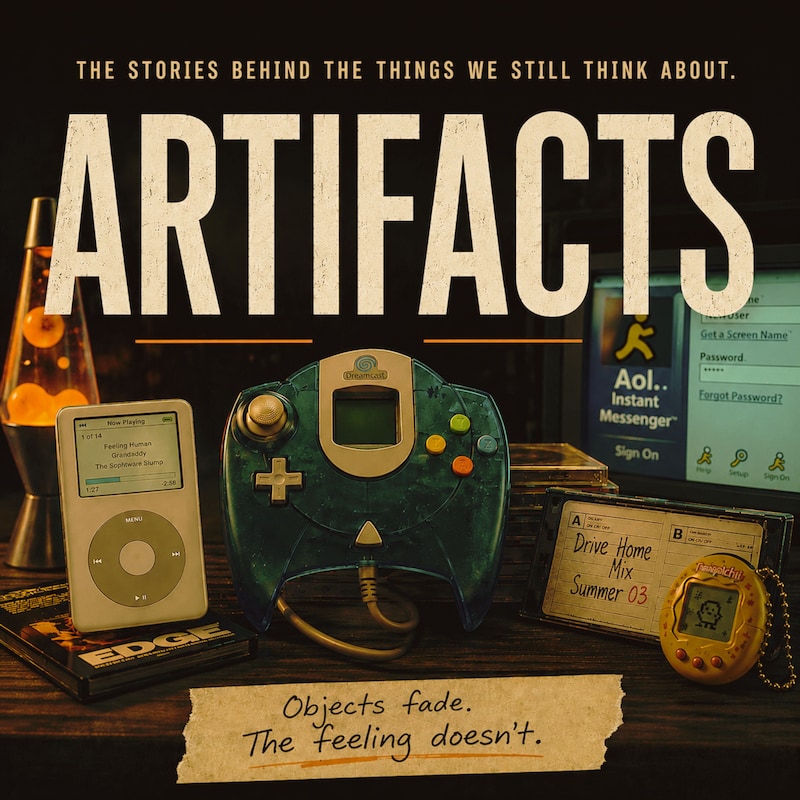
I'm Danny Brown, and this is Artifacts.