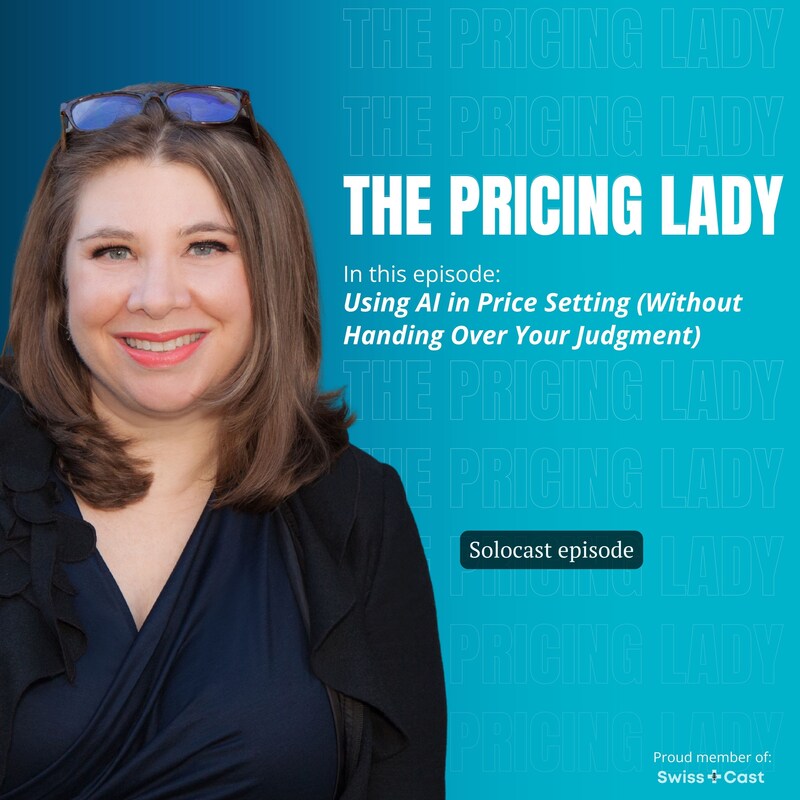
Transcripts
In this episode of The pricing
Lady Podcast, we talk about
2
:using AI in setting prices.
3
:Doing so without handing
over your judgment.
4
:Sit back, relax, and enjoy the episode.
5
:Hello and welcome to this episode
of The pricing Lady Podcast.
6
:We're smart business owners, price
with purpose and profit with clarity.
7
:I'm Janene your hostess.
8
:Now this is a topic that I have been
bringing into what I do and how I work
9
:with clients for about a year and a half
now, and I finally feel like I'm ready
10
:to have the conversation with you about
how you can be using AI more effectively
11
:when it comes to setting prices.
12
:So why are we talking
about this now and today?
13
:So first of all, AI is very accessible.
14
:Nearly everyone, not just big companies,
has access to it and people are trying
15
:to figure out how to use it and when to
use it, and what to do in the right way.
16
:And that has changed the starting point
of a lot of pricing work, but oftentimes
17
:people go about doing it in a way that
isn't going to help them in the long run.
18
:And that's why we're having
this conversation today.
19
:I'd it should not replace
who makes the decisions.
20
:And that's really important.
21
:We don't want to replace your judgment
and you needing to make, it doesn't
22
:replace you needing to make that
decision, but it does give you more
23
:information to work with, but we have to
be careful about how we go about doing it.
24
:What this episode is about and not about.
25
:I think that's really important.
26
:I'm not gonna be talking about advanced
optimization, dynamic pricing how to let
27
:AI to decide prices for you, any shortcuts
or even prompts, in this episode, what
28
:we're going to be taking a look at is
how AI can support your pricing thinking,
29
:can support that thought process.
30
:Where it can create false
confidence and how to use it without
31
:outsourcing your own decision making.
32
:because ultimately, one of the
most important things in pricing
33
:in your own business is being
able to make pricing decisions.
34
:That's a skill that you want to
build and develop, and so that when
35
:you get asked questions or when
things come up in conversation.
36
:You have a good, solid foundation upon
which to respond in that situation.
37
:If you outsource all that decision making,
then it's harder for you to be able to
38
:have those conversations and to make
those decisions going forward when AI
39
:isn't readily available to you or when it
would be awkward to to consult ai, right?
40
:So we need to keep you in the driver's
seat when it comes to decision making.
41
:Where does AI go wrong?
42
:We want to look at a couple
of different areas here.
43
:because there's really two extremes.
44
:First is using AI as the decision maker.
45
:Treating the output as truthful.
46
:Which we all know, that there are issues
with the truth that we get, kind of
47
:putting that in air quotes, you can't see
me, you know the information that you get
48
:out, you have to be able to validate it.
49
:Skipping that validation, taking this
truth, and then skipping the validation.
50
:And also confusing speed, the speed that
it gives you with clarity and certainty.
51
:So using AI as a decision maker makes
these things much more risky for you.
52
:Now refusing to use AI at all, in
my opinion, is also another problem.
53
:It is a tool that you
have at your disposal.
54
:It will do some things better with the
caveat that you still have to validate it.
55
:It'll speed things up.
56
:It keeps you slow paced.
57
:It'll take you longer to do some things.
58
:It forces you to only rely on intuition.
59
:Where it's good to use intuition
and some fact-based information
60
:or validated information to
gather in your price setting.
61
:And you may miss early signals of things
because you're not using the most readily
62
:available information that is out there.
63
:Refusing it to use AI at all in your
price setting is just as risky as
64
:allowing it to be the sole decision maker
when it comes to setting your prices.
65
:Both are judgment problems
and not technology problems.
66
:It's about using it in
the best way possible.
67
:You are probably asking yourself at
this point, all right, Janene, I get it.
68
:I should use it, but where can it
help me the most at this stage?
69
:That's a great question.
70
:My experience over the last year and
where I've seen it help my clients the
71
:most is in that first round exploration.
72
:What I call the data gathering
stage, where you're pulling in
73
:information from different resources.
74
:For example, and exploring
different customer types or
75
:different aspects of your market.
76
:Earlier this year, I had a client who
was selling a product, into food and
77
:gastronomy, into bars and restaurants
and kiosks and things like that.
78
:And they didn't understand the
margin levels that might be
79
:expected in those types of clients.
80
:Today, you can go into a i, you
can ask that question quickly, and
81
:then you can go out and validate
that information in the market.
82
:Right.
83
:Scanning market dynamics and
competitors is another area.
84
:Pressure testing assumptions about
value, net value or willingness to
85
:pay or even understanding value.
86
:You may have one understanding of value.
87
:AI can help you validate some of that,
but also explore it further exploring
88
:different packaging options or commun
ways to communicate your prices.
89
:And also spotting misalignment across an
offer or across a portfolio of offers.
90
:These are areas where I have developed
tools to help my client to use AI in
91
:their pricing in a more effective way.
92
:AI is very useful for exploration,
not for making the final decisions.
93
:Certainly you can ask it its opinion, but
you would want to know why it's coming
94
:up with that opinion, why it's saying
that, and then validate it for yourself.
95
:The mindset that makes AI useful
in pricing is really around
96
:these four core principles.
97
:First of all, AI output
does not equal the truth.
98
:In any context, not just pricing, but we
have to understand that AI is only going
99
:to give us what information it has, it's
gonna extrapolate from what it has if it's
100
:not clear, which means that AI output is
definitely not going to equal the truth.
101
:So it's up to us to use that
information in the right way
102
:and not accept it as the truth.
103
:Exploration does not equal decision.
104
:That's the second core principle.
105
:Using it for exploration does not mean
letting go of the decision making.
106
:It doesn't mean that you should.
107
:Yeah.
108
:Or that you are now, speed does
not necessarily equal confidence.
109
:Just because you have a lot of
information now, you have a lot more
110
:information more quickly than you
did in the past, that's for sure.
111
:Right?
112
:Doesn't necessarily mean, you're
going to feel more confident about
113
:it unless you know how to use
that information the right way.
114
:So for some people who choose
not to use it, it might feel
115
:like information overload is one
of the reasons not to use it.
116
:So yes, you'll get a lot more
information, but you can then narrow
117
:that information down to what's useful
and then go out and validate that.
118
:But having that information faster is not
necessarily going to build your confidence
119
:about how you use that information.
120
:And the last core principle is
a validation is non-negotiable.
121
:And this, I'm a big stickler for this.
122
:I am always telling my clients,
use ai, use it wisely and validate
123
:the information you're getting.
124
:Before when you wanted to understand
your customers, you really needed to go
125
:out and talk to them in the first step.
126
:Now you can do a little exploration
upfront using something like ai.
127
:And then AI can help you understand,
okay, what do I need to validate in the
128
:market and how can I best go about doing
that in these interviews, let's say.
129
:And it can help you
with that step as well.
130
:So validation is so important in
this whole process of you using ai.
131
:You can't just take it at what it's,
you know, at what it's telling you.
132
:You have to go out and then make
sure that that information aligns
133
:with what you're actually doing in
the market and what you're actually
134
:hearing and seeing from people.
135
:All of this is very strongly
tied to the pricing and value
136
:anchors in your business.
137
:AI can help surface possibilities
or opportunities for you
138
:that you've never seen.
139
:I've also experienced that as
I've been playing around with it,
140
:if you will, in my own business.
141
:But the anchors come from the decisions
that you ultimately stand behind.
142
:Yes, it can give you ideas, it can show
you opportunities, but ultimately when
143
:you make a decision about something
based on a foundation of information
144
:that you believe represents the market
and represents the situation and what
145
:you need in your business and what your
clients need, that is where you come
146
:up with decisions and prices that you
feel, "yeah, I can stand behind this.
147
:I know why this is the price
and it's the right price."
148
:Fairness also still needs
to be assessed by human.
149
:Yeah, by a human being.
150
:So is it fair?
151
:Sure, you can ask ai, but ultimately
it's that personal relationship
152
:with an individual that's going
to determine the fairness in.
153
:The price that you set or
the decisions that you make.
154
:All of this again, ties back
into some solid anchors.
155
:I don't know if you remember
the last episode we were
156
:talking about value anchors.
157
:Again, that's all tied in here and you
want to make sure that you have the right
158
:value anchors, the right pricing anchors
for your business, and ultimately you are
159
:the one who determines what those are.
160
:Pricing anchors don't come from tools
they come from your judgment ultimately.
161
:Here are a few guard rails to
help you use AI more wisely.
162
:Yeah.
163
:First of all, treat outputs as
directional, not as definitive.
164
:We've touched on this a lightly here,
but this is information gathering.
165
:It's not the final story.
166
:It's not the final answer.
167
:You have to bring all that information
together to see the big picture.
168
:Sanity check against real customers.
169
:And context.
170
:So again, that's hints
towards this validation.
171
:So you need to go out there, you still
need to talk to customers, in my opinion.
172
:Not just my opinion, but this is my
experience that, even using AI in your
173
:business still, the most important
thing any business owner will ever
174
:do, is talking with customers and
understanding what their needs are,
175
:what they value, how they make buying
decisions, all of these things.
176
:It's good to gather information
on that from ai, but then you
177
:want to test it soundly, check it
against real customers and content.
178
:Don't outsource those pricing decisions.
179
:Make sure that you are using that
information to support you in making
180
:decision as opposed to making it for you.
181
:And use AI to ask better
questions, not necessarily just
182
:to answer the questions for you.
183
:So you, like I said before, you can
use the outputs from a AI where you're
184
:exploring your customers to then have
it help you figure out what questions
185
:to ask customers in a robust way
throughout that whole process, not
186
:just getting that first information.
187
:I'd like to close this up by
reinforcing a few key messages.
188
:The first is AI lowers the cost
of starting your pricing work.
189
:Before in order to get market
information and customer information
190
:is a very laborious process.
191
:Sometimes a very expensive one as well.
192
:And nowadays you can quickly go onto
AI and start doing some research,
193
:getting some first information.
194
:It lowers the cost and it
lowers the time aspect of this.
195
:It does not, however, reduce the
responsibility for deciding, even deciding
196
:well making good business decisions.
197
:That is still ultimately
your responsibility.
198
:And pricing still needs
anchors you believe in.
199
:You still need to anchor it in things that
are relevant to you and your customers
200
:so that you can make decisions and have
prices that have a solid foundation
201
:and that you ultimately believe in.
202
:I'd like to leave you with one last
question today, and that is the following.
203
:Are you using AI to think more clearly
when it comes to your price setting or are
204
:you using it to avoid making decisions?
205
:I leave you with that final
thought to reflect on.
206
:I hope you enjoyed this episode.
207
:I've enjoyed preparing it for you.
208
:I wish you a great day and
as always, enjoy pricing.