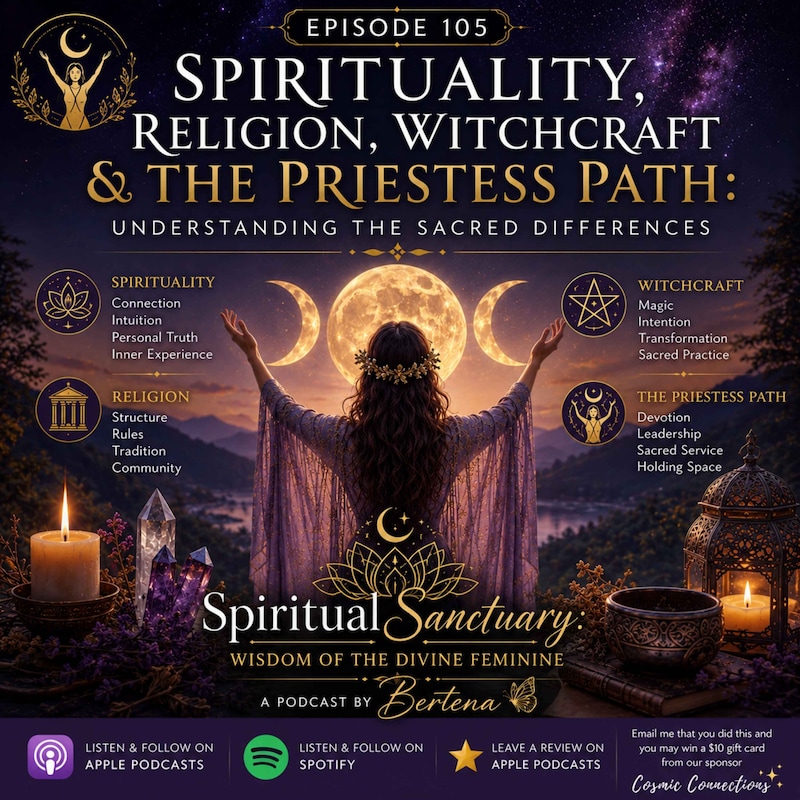
In this deep and thought-provoking episode of The Spiritual Sanctuary: Wisdom for the Divine Feminine, Bertena explores the powerful differences between spirituality and religion, the truths and misconceptions surrounding Wicca and witchcraft, and the evolving role of the witch versus the priestess in modern spiritual practice.
This episode is designed for seekers, healers, mystics, and curious souls who are exploring their spiritual identity and wondering where they fit on the sacred path.
Topics include:
What spirituality really means
The role and purpose of religion
Why many people are leaving organized religion
What Wicca actually is
Common myths about witches
The history of witchcraft and folk magic
The modern witch movement
What makes a priestess different from a witch
Sacred feminine leadership and devotion
Can you be both a witch and a priestess?
Creating your own authentic spiritual path
This episode also includes reflection prompts, spiritual insight, and guidance for anyone navigating awakening, healing, intuition, ritual, and Divine Feminine spirituality.
Welcome back to The Spiritual Sanctuary: Wisdom for the Divine Feminine.
I’m Bertena, and today we are diving into a topic that I believe many people are quietly wrestling with internally.
Questions like:
What is the difference between spirituality and religion?
Can someone be spiritual without being religious?
What exactly is Wicca?
Is every witch Wiccan?
What is the difference between a witch and a priestess?
And where do I fit into all of this?
These are important questions because we are living during a time where many people are awakening spiritually, but they may not have language for what they are experiencing.
Some people were raised deeply religious and now feel disconnected from those systems.
Others still love aspects of religion but are craving more personal spiritual experiences.
Some are exploring tarot cards, meditation, moon rituals, energy healing, or goddess spirituality and wondering if that makes them a witch.
Others feel called into sacred leadership, healing, ceremony, or women’s circles and wonder if they are walking a priestess path.
Today, we are going to gently explore all of these paths without judgment, fear, or shame.
This is not about saying one path is better than another.
This is about understanding.
Because when we understand something, we can release fear around it.
And fear has surrounded spirituality, witchcraft, feminine wisdom, and sacred practices for centuries.
So let us begin.
Part One: Spirituality vs Religion
Let’s first talk about spirituality and religion because many people use these words interchangeably, but they are not actually the same thing.
Religion is generally an organized system of beliefs.
It often includes:
Sacred texts
Rules or commandments
Specific doctrines
Rituals
Moral structures
Leadership hierarchies
Community worship
Shared theology
Religion often answers questions such as:
Who is God?
What happens after death?
How should humans behave?
What is considered sacred or sinful?
For many people, religion offers:
Structure
Community
Guidance
Stability
Tradition
Identity
Religion can be beautiful.
Religion has inspired incredible art, compassion, service, prayer, architecture, music, and community care throughout human history.
But religion can also become rigid.
Sometimes people feel disconnected when spiritual experiences become replaced with rules, fear, shame, or control.
This is often where spirituality begins emerging more strongly for people.
Spirituality is more personal.
It is often about direct connection.
Instead of:
“What does the institution say?”
Spirituality asks:
“What is my soul experiencing?”
Spirituality often involves:
Intuition
Meditation
Energy awareness
Personal growth
Sacred connection
Nature
Mysticism
Inner healing
Consciousness
Divine connection
Spirituality tends to focus more on experience than doctrine.
A spiritual person may believe:
The Divine exists in all things
Energy connects everything
The soul continues after death
Intuition is sacred
Nature is holy
The body is sacred
Personal awakening matters
Some spiritual people belong to religions.
Others do not.
Some combine multiple traditions.
Some create deeply personal practices.
And honestly, many people today are somewhere in the middle.
They may still love prayer but also meditate.
They may still believe in God but also work with crystals.
They may attend church while also practicing yoga or tarot.
And that is something important to understand:
Human spirituality has never been as separate as people think.
Throughout history, cultures blended mysticism, healing, ritual, prayer, ancestor connection, herbal wisdom, sacred movement, and divine devotion together.
The separation often came later through systems of control and institutionalization.
Part Two: Why So Many People Are Spiritually Awakening
One reason spirituality has become so popular is because people are craving direct experience again.
They want:
Authenticity
Healing
Connection
Meaning
Sacredness
Community
Emotional truth
Many people are exhausted by constant productivity culture.
They feel spiritually empty.
Disconnected from nature.
Disconnected from themselves.
Disconnected from ritual.
Disconnected from silence.
Disconnected from mystery.
Modern spirituality often becomes a way of returning to the sacred.
People begin exploring:
Meditation
Breathwork
Tarot
Reiki
Somatic healing
Moon rituals
Goddess studies
Yoga
Divination
Energy work
Not because they are evil.
Not because they are trying to rebel.
But because they are searching.
Searching for meaning.
Searching for healing.
Searching for remembrance.
Part Three: What Is Wicca?
Now let’s move into Wicca because this is where confusion often begins.
Wicca is a modern pagan religion.
It was popularized in the mid-:
Wicca generally focuses on:
Nature spirituality
Seasonal celebrations
The Divine Feminine and Divine Masculine
Ritual practice
Magic
Energy
The cycles of the Earth
The Wheel of the Year
Many Wiccans celebrate:
Full moons
New moons
Sabbats like Beltane, Samhain, Yule, and Imbolc
Many Wiccans also honor:
A Goddess
A God
Nature spirits
Sacred elements
One core teaching often associated with Wicca is:
“An it harm none, do what ye will.”
Another commonly discussed idea is the Threefold Law — the belief that energy returns amplified.
But here is something important:
Not all witches are Wiccan.
And not all Wiccans identify as witches.
Wicca is a religion.
Witchcraft is a practice.
Those are not automatically the same thing.
Part Four: What Is a Witch?
The word “witch” carries enormous historical weight.
For centuries, witches were feared, persecuted, demonized, and misunderstood.
Historically, many accused witches were:
Healers
Midwives
Herbalists
Mystics
Outsiders
Independent women
Spiritual practitioners
The witch became a symbol of fear because witches often represented power outside traditional authority structures.
Modern witchcraft is incredibly diverse.
A witch today may practice:
Herbal magic
Candle rituals
Tarot
Astrology
Energy work
Ancestor work
Moon rituals
Folk traditions
Protection practices
Manifestation
Kitchen magic
Some witches are deeply spiritual.
Some are secular.
Some are religious.
Some are atheist.
Some are Wiccan.
Some are Christian witches.
Some are eclectic.
Some focus entirely on nature.
Witchcraft itself is usually about intentional energy and practice.
It often asks:
“How do I work with energy, nature, intuition, ritual, and intention to create transformation?”
At its core, modern witchcraft is often about:
Personal empowerment
Intuition
Healing
Ritual
Sacred connection
Transformation
Part Five: Witch vs Priestess
Now we move into one of my favorite discussions:
The witch versus the priestess.
And I want to say immediately:
A person can absolutely be both.
But there are differences in focus and energy.
The witch is often associated with:
Magic
Transformation
Personal power
Spell work
Energy manipulation
Ritual practice
Folk wisdom
Mysticism
The priestess, however, is often associated more with:
Sacred devotion
Spiritual leadership
Ceremony
Service
Temple work
Divine embodiment
Holding sacred space
Guiding others spiritually
The priestess path is often less about controlling energy and more about channeling sacred presence.
A priestess may:
Lead circles
Hold rituals
Guide healing ceremonies
Teach spiritual wisdom
Work devotionally with goddesses
Serve community
Create sacred containers
Initiate transformation in others
Historically, priestesses existed in many cultures.
They served temples.
Oracles.
Healing sanctuaries.
Mystery schools.
Sacred rites.
Women’s initiation spaces.
They were often spiritual leaders, healers, mediums, and keepers of sacred wisdom.
A witch may ask:
“How do I create transformation?”
A priestess may ask:
“How do I serve the sacred?”
Again — neither is better.
They are simply different archetypal energies.
And many people embody both.
Someone may practice tarot, moon rituals, herbal work, and spell work while also leading ceremonies, mentoring women, teaching sacred wisdom, and holding healing spaces.
That blending is becoming very common in modern spirituality.
Part Six: The Rise of the Modern Priestess
One reason the priestess archetype is returning so strongly right now is because many women are reclaiming spiritual authority.
For centuries, women’s spiritual leadership was often suppressed.
Women were told:
Their intuition was dangerous
Their bodies were sinful
Their emotions were weak
Their spiritual gifts were suspicious
But now many women are remembering.
Remembering:
Their intuition
Their sacred voice
Their connection to nature
Their cyclical wisdom
Their healing gifts
Their spiritual leadership
The modern priestess is not about superiority.
It is not about ego.
It is not about pretending to be perfect.
It is about devotion.
Embodiment.
Integrity.
Compassion.
Service.
And sacred responsibility.
Part Seven: Can You Be Spiritual Without Labels?
Absolutely.
You do not have to label yourself at all.
You do not need permission to meditate.
You do not need permission to pray.
You do not need permission to honor nature.
You do not need permission to explore spirituality.
Some people resonate with:
Mystic
Witch
Priestess
Pagan
Spiritual seeker
Healer
Devotional practitioner
Energy worker
Others resonate with none of those.
And that is okay.
Your spiritual path is deeply personal.
The important thing is discernment.
Integrity.
Compassion.
Grounding.
And remaining connected to your own inner truth.
Reflection Questions for Listeners
I want to leave you with a few questions to journal about after this episode:
What spiritual beliefs genuinely resonate with my soul?
What beliefs were inherited through fear?
Where do I feel spiritually alive?
What sacred practices bring me peace?
Do I crave structure, freedom, devotion, or experience?
What archetype calls to me most strongly right now: mystic, witch, healer, priestess, seeker, oracle, teacher?
And most importantly:
What does the sacred mean to me personally?
Closing
Thank you for joining me today on The Spiritual Sanctuary: Wisdom for the Divine Feminine.
If this episode resonated with you, please share it with someone exploring their spiritual path.
You can learn more about my classes, readings, spiritual mentorship, priestess programs, and events at:
bertena.org
You can also book tarot readings, Reiki healing sessions, spiritual coaching, and classes through:
Cosmic Connections
And don’t forget to use code BertenaPodcast10 for 10% off your online order.
Until next time…
May you walk your path with wisdom, discernment, healing, and sacred remembrance.