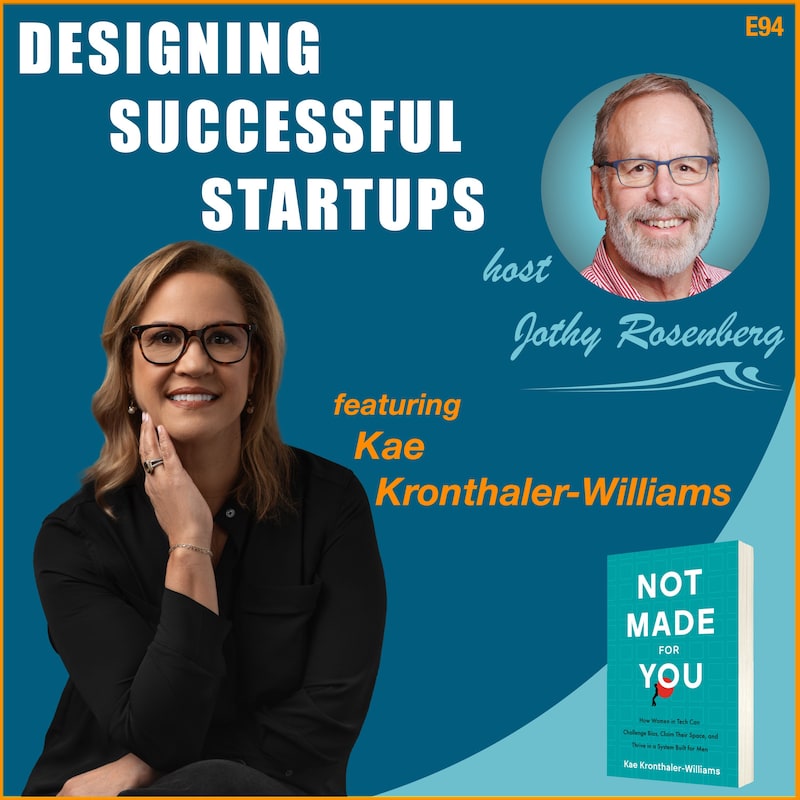
Shownotes
Kae Kronthaler-Williams
Bio
Kae Williams is a global software marketing executive on a mission to empower women in their careers through her work and her forthcoming book, Not Made For You. She raises awareness about bias and hostile work cultures so every woman feels supported, respected, and enabled to achieve her full potential. She champions this cause through writing, speaking, coaching, and nonprofit work because when barriers are removed for women, everyone benefits.
Intro
The conversation with Kae Kronthaler-Williams delves into the nuanced challenges faced by women in the realm of startup leadership, particularly as she articulates her experiences navigating a landscape often fraught with unspoken barriers. Kae draws upon her extensive career to illuminate the systemic issues that hinder women's full participation and recognition within corporate environments. She emphasizes the necessity for women to develop pragmatic strategies to confront these insidious barriers while maintaining their career trajectories. Furthermore, Kae's insights extend to her forthcoming book, "Not Made For You," which aims to provide a voice to these challenges and offer actionable guidance for women striving for success in their professional endeavors. This discourse not only underscores the importance of gender representation in leadership roles but also serves as a clarion call for organizational awareness and cultural transformation.
Notes
The discussion between Jothy Rosenberg and Kae Kronthaler-Williams presents a profound exploration of the challenges encountered by women in the startup ecosystem. Kae, with over three decades of experience in startup leadership as a woman of color, articulately shares her insights on the barriers that often remain unspoken yet significantly hinder women's career progress. Through her personal experiences and her new book, 'Not Made For You', she sheds light on the pervasive issues of sexism, ageism, racism, and microaggressions that women face in the workplace. Kae emphasizes the necessity for women to navigate these challenges with resilience and strategic acumen, providing practical approaches to overcoming obstacles and achieving success. This episode serves not merely as a narrative of struggles but as an empowering guide for women aspiring to thrive in their careers, offering them tools to confront biases and advocate for themselves effectively.
Takeaways
- Kae Kronthaler-Williams emphasizes the unspoken barriers women face in their careers and how they can navigate these challenges effectively.
- The discussion highlights the importance of equal gender representation in leadership roles, which significantly impacts workplace dynamics and decisions.
- Kae shares her experience of advocating not only for herself but also for her team, showcasing the need for visibility and recognition in male-dominated environments.
- The podcast underscores the necessity of building one-on-one relationships to overcome biases and foster authentic connections in professional settings.
- Kae's insights reveal that women's experiences in the workplace can differ drastically from men's, necessitating unique strategies for success.
- The significance of addressing issues like sexism, harassment, and microaggressions is paramount, as these factors contribute to the challenges women encounter in their careers.
- Kae's web site
- Substack
- Kae Kronthaler-Williams - United States | Professional Profile | LinkedIn
- Who Says You Can't Startup | Full Bundle | Incorrigible Entrepreneur - The online course for startup founders
- Jothy's TEDx talk - On why those with disabilities tend to overachieve
- Our YouTube channel
- Designing Successful Startups — Jothy Rosenberg | Author | Speaker | Podcaster - Site with all podcasts
- Tech Startup Toolkit book
- Please leave us a review
Transcripts
Hello. Please meet today's guest, Kay Crumphaler Williams.
Kae Kronthaler-Williams:They go unspoken and they have a large impact on careers, mine included.
And so I wanted to find a way to put a voice to those barriers and illuminate how they, how they appear at work and then provide women with practical strategies to, to confront them and maneuver and navigate around some of these barriers to still be really successful in their career. Because I have. Right. I've had a great career and I've met wonderful people. I've worked with wonderful leaders. But that doesn't mean that it was easy.
Women can't just show up for work, though, you know, being their full selves the way men can. We have these other things that are happening, and we do just want to come in and do our jobs.
Jothy Rosenberg:What happens when you're the only woman in the boardroom fighting not just for market share, but for basic recognition? Today's guest, Kay Kronthaler Williams, has spent over 30 years navigating startup leadership as a woman of color.
And she's got the battle scars and victories to prove it.
From Geotrust, where she helped execute one of the boldest David versus Goliath strategies in tech history, systematically stealing market share from an industry giant until they had no choice but to acquire the company. To her new book, not made for you, Kay reveals what really happens behind closed doors in startup leadership.
You'll hear about the marketing campaign that became so controversial, it sparked heated debates at industry conferences. The moment she realized having equal gender representation and leadership changes everything.
And why that Sports Illustrated calendar story will make every male founder rethink their office environment. This isn't just another diversity conversation.
It's a masterclass in leadership resilience and building winning strategies when the deck is stacked against you. I'm Jothi Rosenberg and this is designing successful startups. And here is Kay. Welcome to the show, Kay.
Kae Kronthaler-Williams:Good morning. Thank you. It's nice to be here with you, Jathy.
Jothy Rosenberg:It's been way too long. We've known each other for a really long time and we've had these very long gaps, which maybe we can rectify that going forward.
I actually always start by asking our guest where they're originally from and where they live now.
Kae Kronthaler-Williams:I am originally from Massachusetts and I currently live in Massachusetts. I just recently moved back about a year and a half ago from.
Jothy Rosenberg:From. But from. But you live in a particularly beautiful part of Massachusetts.
Kae Kronthaler-Williams:I. I was not born here. I live on Martha's Vineyard. But I was born and, and raised in Central Mass. But right now I Live in Martha's Vineyard.
Jothy Rosenberg:It's just gorgeous out there and it is beautiful.
Kae Kronthaler-Williams:Yes.
Jothy Rosenberg:Do you have at the tip of your tongue how many startups you've worked at in your entire career?
Kae Kronthaler-Williams:Oh, I got. There's a lot I don't have off the tip of my tongue. It's probably more than five or seven, I think. Yeah.
It's one of quite a bit of expansion stage companies that I've worked for.
Jothy Rosenberg:It's a, it's an interesting kind of niche that you've chosen and. And from the beginning you've had a marketing role in all of them, correct?
Kae Kronthaler-Williams:That is correct. One, one company. I ended up being a general manager for US Cloud division.
So I ran marketing, sales and customer success, which was interesting, was my first time running a field sales organization. I've always run BDRs as part of marketing, but other than that it's always been marketing. Yes.
Jothy Rosenberg: t at was. Was probably around:He and I started Geo Trust. What was really strange about it was that he lives in and was based in Portland, Oregon and I, and I at the time I lived in Newton, Mass.
And, and what we decided that we would have a team at Wellesley, Mass. That's just where I found the office space and a team in Portland and I was the poor SAP who was going to fly back and forth.
This was a typical company that. Not typical but so many are like this way too early to market and so we had to pivot and then we, at that point it was time to change things over.
But I was not confident that our new pivot was going to work either. And I had met this guy who was going to become our CEO because I liked him and he had, he was a good idea and he was going to go do it himself.
He was working at a huge company and he was going to go do it himself. And I said look, we've got an established company, we've got a great engineering team.
Why don't you come and do your idea here and I'll let you take over CEO and I'll be CTO and I'll partner with you and all that. And it wasn't long after that and then we actually decided to completely shut down the Portland office because it was just too expensive.
And then we contracted into Wellesley and then shortly after that you came on board.
Kae Kronthaler-Williams:Yes. I didn't know all I don't Think I knew all that history. I don't remember it, but yes. Then I came on board when you guys were in the Wellesley office.
Yeah.
Jothy Rosenberg:So that I just. I wanted to set the stage and I wasn't sure if you remembered all of that. And when you came in, were you immediately. Were you VP of marketing or cmo?
Because I don't think people were using that. The CMO title that much.
Kae Kronthaler-Williams:No, the CMO title wasn't there. I don't think I was VP of marketing.
Jothy Rosenberg:Yeah.
Kae Kronthaler-Williams:The company.
Jothy Rosenberg:You must have been excited about the, the vision for the company, which was interesting. The whole goal was to.
There was one particular company that we were essentially going to go after, get market share from at a steady rate until they had. They felt so much pain that they had to acquire us.
Kae Kronthaler-Williams:That's right. That's exactly. I loved that. First of all, I love technology and I still, I'm still so excited about technology. That's why I'm still in the industry.
But I loved the idea of what you guys were doing when I came in and the fact that it was very clear what your goal was. Because usually when I'm interviewing, I ask the CEO, what's your plan? Are you planning to. You want. Is an exit strategy? What's the goal here?
Because I want to help achieve that goal. And you guys had a very clear cut. You even knew who you wanted to buy the company. And that was very fascinating.
Jothy Rosenberg:The technology was interesting and complicated because in that day, in those days, if you partnered with another company, then a consumer, let's say, or a business came to your partner's website but needed to interact with you as well. That was very challenging because no one wants to let a customer whose eyeballs are on their site leave.
You don't want them to leave because how do you know they're going to come back?
There was this new standard called web services that was going to enable everyone to quit doing that screen scraping and instead have a programmatic interface. Because our partners were trying to sell somebody a new domain, a domain name. Because people were buying those left and right.
Kae Kronthaler-Williams:Yes.
Jothy Rosenberg:And at the same time we wanted them to buy the security Geo Trust wanted to sell them the digital certificates.
Kae Kronthaler-Williams:Right.
Jothy Rosenberg:And the partner didn't want them to leave the site. And that web services thing worked out great.
And it, it drove me to write a new book and it has the worst, most boring title of any book anyone has ever seen. It's called Securing Web Services with WS Security. That's isn't that they said we like to have titles that really say what.
Kae Kronthaler-Williams:It is, doesn't say it's descriptive. Right.
Jothy Rosenberg:But yeah, but honestly that appeals to about 12 people in the entire world. Now that we know that this idea of going after the 800 pound gorilla and making them feel so much pain that they buy you.
So now you're the head of marketing and so you're the tip of the spear. You're the one that's going to make sure everybody knows, yeah, our product's better because it only takes 10 minutes, not four days.
And you know, but tell me that.
Kae Kronthaler-Williams:Was the answer right there.
I remember being in your office and asking you, and I think one of the product guys, it was Chris Bailey or somebody that tell me about this product, I need to understand why is it better? And I kept digging and digging and then we got to this.
Most people, it takes four weeks, it's done manually and we can automate an SSL certificate authentication in 10 minutes or less. And I was like, what? We need to scream that off the rooftops. And that's what, that's.
It was the product differentiation that made that company successful and that it became controversial. So we changed all our messaging around being this certificate factory.
I don't remember if you remember, we were at like RSA or something and we had this boat that looked like a factory and I had everybody wearing like Tyvek suits and stuff to make it look like a factory. And. But that was the thing that really made the difference was that key competitive positioning.
And when we went to the analyst, they got heated about it, right? They were questioning whether that was true or not and if it was truly secure.
And I remember going back to you and the CEO at the time and saying, please tell me this is real. Right? This. Because we're out there talking about it. And so it became this controversy in that sector.
And even I remember Gartner talking about it in one of their sessions. And that just blew up for us right then. We were named. And that was my goal.
Anytime we were, there was press around the company that we wanted to have them buy us. I want, we wanted to be in that same sentence. And we were, we achieved that.
But it was because it was a great product and it was controversial what we had done. Right. It was so innovative that people didn't believe it was true.
Jothy Rosenberg:What was strange about that, because there was no doubt it was, it was good. It was, it was not a lie, was that the world was changing very rapidly.
Because if you remember, basically the web was a thing only starting in about 95, 96.
So four years previous to when you were looking at this, at this messaging and starting then and continuing on to this day, people were saying hey, this database that I've got, if I just make that available for a fee. And this was the whole idea of everybody wanted to monetize their data.
And very quickly we were able to get access to the Dun and Bradstreet information about companies and that was online and yes.
And whatever the five or six things we needed to authenticate that somebody, a human being really was legitimately part of such and such a company and that company was a legitimate company and that's all we needed to do. And it was this 800 pound gorilla that was not seeing that they could change their ways. And they had they all this time.
It probably took two solid years from when you started that messaging till the goal was get a point a month or roughly of market share. And by the time we would get to the estimate was 25% which turned out to be true.
25% market share away from that 800 pound gorilla they would be feeling a lot of pain.
Kae Kronthaler-Williams:Right.
Jothy Rosenberg:And that's exactly what happened. There was one manual step which was proving that person was allowed to represent that company.
Kae Kronthaler-Williams:Right.
Jothy Rosenberg:But you can, that was doable within 10 minutes.
Kae Kronthaler-Williams:But that with many brands, right. That they don't see the innovation. Look at Sony, the Sony Walkman and then eventually music like comes online. They could have owned that space. Right.
But they didn't have the foresight to see where that industry was going. And I think that was the same thing that happened with the company that ended up acquiring GeoTrust. They didn't see it.
Jothy Rosenberg:And somebody at Apple was a genius marketer because right away that I'll never forget their message was a thousand songs in your pocket.
Kae Kronthaler-Williams:Yes. And Sony could own that. Right. Like I always thought about that. Like how did they. But it happened.
You got a lot where these really big companies, they're too big almost to be innovative. Right. And so they miss the mark on the, on what's going on with their consumers.
Jothy Rosenberg:And one last question about your days at GeoTrust. How big a team did you need to, to do that?
Because like I said, the product was simple once we solved that front end problem and it was all about marketing.
Kae Kronthaler-Williams:Yeah. I don't, I didn't have a big team. I think I had maybe two people and that was it. It was a small team. We were a scrappy organization I think.
But, but you're right. And a lot of it was Online so it was easier.
But yeah, there was about, I think we had two people on the team and for a while it was just me and then we hired people.
Jothy Rosenberg:Okay. So that's when we first got to know each other.
And then tell us a little bit about your journey since then because you stayed there through the acquisition.
Kae Kronthaler-Williams:No, I did not stay through the acquisition. I left.
Jothy Rosenberg:Oh, you didn't?
Kae Kronthaler-Williams:Yes. Yep. And I, I remained really excited. As I said, I still love, I love technology. I find it very thrilling and mentally stimulating frankly.
And I love marketing, the marketing professional profession. So I stayed in the industry but in, in different sectors of tech.
So supply chain manufacturing, connected vehicle data, which is really automotive tech, higher ed tech. So I, I went through a number of industries and part of that was competitive non competes when a company gets acquired.
ng, which probably started in:So we went from being a cost center to a revenue driver, right from the back room to the front room, side by side with sales. And now all of a sudden we had numbers that we had hit targets of pipeline and revenue just like sales.
And I had to transform the marketing and my approach to meet that, that new way of doing marketing.
And with a little bit of luck and some really amazing marketing teams, I came very good at quickly bringing up to speed a marketing organization and creating this demand engine that helped fuel the growth for these expansion stage companies.
Jothy Rosenberg:Hi there. I hope you're enjoying the show.
In addition to the podcast, you might also be interested in the online program I have created for startup founders called who says you can't startup in it?
I've tried to capture everything I've learned in the course of founding and running nine startups over 37 years with no constraints like there were with my book Tech Startup Toolkit. The program is four courses, each one about 15 video lessons plus over 30 high value downloadable resources. Each course individually is only $375.
The QR code will take you where you can learn more. Now back to the podcast.
So what was it like in, in all these startups and all these years you were always a pretty senior person, so a leader in the company. And of course as everyone can tell, you're a woman in tech.
Kae Kronthaler-Williams:Yes.
Jothy Rosenberg:And which they're not actually that many of. Unfortunately, no. What have you what have your experience has been like, what have you learned about, you know, leadership?
Especially, like I said, as a woman in tech.
Kae Kronthaler-Williams:So typically I was the only female on the executive team and in tech, sometimes I was probably one of the younger by the executive team by 10, 20 years, certainly the only person of color a lot in those rooms. And what I learned was that leadership isn't just about getting results. It's about navigating the dynamics of recognition, visibility and influence.
And that there's givens for men in these rooms at these levels that aren't there for women. We don't have immediate credibility.
We don't get the, the visibility of special projects or in front of the influencers in a company where promotions happen. It's not the same support and guidance that I saw the men getting in those organizations.
And I had to advocate not just for my team in those rooms, but I had to advocate for myself and maneuver through these kind of biases that, that women face in these organizations.
And so the way I interact, the way I navigate rooms, the way I've built relationships is all through the lens of these barriers that shapes how I navigate within these companies. So, for example, the way I build relationships, men seem to be able to just talk to each other.
They go out and golf and they have drinks together, or they talk about sports so they can build this rapport with the right people where I wasn't always included in those. And so I had to build one on one relationships with people in the company.
But I actually found that worked better because as people got to know me as a person, some of the bias that people tend to hold against women diminished as they started to get to know me and work with me. So I thought, I feel like that worked better anyway.
But I did have to change how I showed up at work and how I navigated those systems that were, as I say, built by men for men.
Jothy Rosenberg:Obviously you can't know what a meeting of a leadership team that is all men is because you're not there. But the minute that a woman is injected into that, that all male group things get better.
Because first of all, people aren't wasting time telling stupid boy jokes or other kinds of things like that. Everybody has to think a little bit more about what they're saying. Maybe they were being offensive.
And early on became, before DEI was a thing, I became well aware that my teams that I was trying to build were vastly better if there was diversity.
And female is one form that I was looking for on every team and, and people that were well, not just of color, but that had a different background and thought differently, thought in a different way.
And honestly, if you just get a bunch of people with a lot of different life experiences, you get a better team because somebody will say something and then somebody else will say, here's how we think about that. We think about that and you go, oh, wow, that's. That's a cool, new to me way of thinking about something.
Kae Kronthaler-Williams:Right.
Jothy Rosenberg:Did you ever have a sense that it happened, even though you hadn't been at this, within this team before you were you joined? But did you get a sense that, like, right away the dynamic changed in a good way because just because you were there?
Kae Kronthaler-Williams:I did not get that sense till recently in my career. What I. The sense that I got was they didn't want me in the room because they couldn't be comfortable and say whatever they wanted to say.
That's what I felt. And I felt. And I got. I didn't have the credibility in those rooms. A lot of times I was spoken down to. I was talked over a lot.
I did have one CEO who would coach me and say, you need to be speak up in these rooms. I'm like, I am. You have to see what's happening. I am trying to speak up, but I immediately just get discredited. Or they just like, okay.
And then they go to the next guy and take what he has to say. So I didn't feel that until recently. And what happened was my. The last company I worked in, there were equal men and women on the executive team.
The first time in my career. And I've been doing this for 30 years or more. And what I noticed was because there were equal men and women in the room now, the.
And the men were raped, but they had to listen to other women. It wasn't just me. It's easier to ignore one person than it is three or four and who are going to also stick up for each other.
So I noticed the change then and we started to. We were an amazing executive team. And I think because of that, we came from. And again, it is not just gender. It is economic backgrounds, right? It's.
It is race. It's education levels. Like, we came to a question or a problem from very diverse thinking. And that produced, I thought, amazing decisions.
And it's proven right. They say people, diverse Teams make 75% better decisions, I think is the stat. And so I noticed it then, and it was great to work in that environment.
And we women were able to stick up for each other. When somebody talked over on them. Or someone took credit for an idea that the woman just said. Right. So it. It changed the dynamics.
And the men were forced.
I say forced because these were great guys, but they were forced to look at us as professionals in our particular areas and let us be the expert in our areas. But when you're the only one in the room, that doesn't always happen.
Jothy Rosenberg:Yeah, this statistic said. I've heard it too many times, 75%. And it makes me so sad that.
That a whole bunch of companies that I just assumed would hold their ground are being forced to give up any of their DEI initiatives. And it's counterproductive. Anybody can read about. Anybody who reads can read about this statistic and realize it's very silly to.
We're just handing more advantages to other nations that we're competing with for. For business.
Kae Kronthaler-Williams:Right.
Jothy Rosenberg:Okay. So this is a good segue to talk about your book, which is called not made for you. I got a.
You gave me a great opportunity to read the manuscript before it's been published. And it's. It's coming out quite soon in November, and. And we'll put the links to it in the show notes. But some of what we just talked about is.
Or some of the themes in your book. Talk. Talk some more about that.
Kae Kronthaler-Williams:Yeah, that's true. They are in the book. And you know why. The reason why I wrote the book is through my years of experience and I mentor a lot of women.
What struck me was that these dynamics that. And barriers that we're facing, women face sometimes on a daily basis in these rooms are not being openly acknowledged. They're.
They go unspoken and they have a large impact on careers, mine included.
And so I wanted to find a way to put a voice to those barriers and illuminate how they appear at work and then provide women with practical strategies to confront them and maneuver and navigate around some of these barriers to still be really successful in their career. Because I have. I've had a great career and I've met wonderful people. I've worked with wonderful leaders. But that doesn't mean that it was easy.
Women can't just show up for work, though, being their full selves the way men can. We have these other things that are happening, and we do just want to come in and do our jobs. So that's why I wrote the book.
And it, again, it talks about some of these themes of sexism, harassment, ageism, racism, microaggressions that we experience. And then I give them practical strategies that I've developed For myself over the years to be successful and thrive in their careers.
Jothy Rosenberg:I know you wrote the book largely thinking that your. Your readers are women, but. But I have to say that as a man building who's built teams all of my career, it's. I think it's just as valuable for men.
Maybe not the part that says here's a strategy for how to deal with aggressions against you, but the rest of it. The rest of it is extremely valuable to a broader. A broader readership than just women.
Kae Kronthaler-Williams:Yes. And I agree. I would love if men read this book. Leaders and founders, if they read this book, because it will show them that this is real.
It is not an even playing field in these environments for women. And hopefully it brings.
It enlightens them and brings awareness to that so they can help transform their cultures and their organizations for the better.
Jothy Rosenberg:We're not all. We don't just pop out of the egg like a bird and know the right ways to. To manage or to. Or even to interact with people in the workplace.
I consider myself pretty careful and pretty respectful now, and I have been for quite a while. But when I was first.
Kae Kronthaler-Williams:For a very long time. Thank you. Yes, I.
Jothy Rosenberg:When I was 20. When I was first a manager, which would. Which.
Which was probably when I was 26, I didn't even think about the fact that the calendar that I put up on the wall in my office was the Sports Illustrated swimsuit calendar. And it was. I. It was just stupid, but I didn't even think anything of it. But a woman came into the office and she said, she. Who worked for me.
And she said, you probably shouldn't. Shouldn't do that. And I said, oh. Oh, why?
And she said, you're not gonna believe why I'm asking you not to do this, but it's because I'm gay and I'm distracted by the women in the calendar.
Kae Kronthaler-Williams:That was not the answer you were expecting.
Jothy Rosenberg:I'm sure I was not expecting that, but it had the exact right effect. I never did anything like that again.
But it was like it shocked me in two ways because she said, and now I have not come out and you can't tell anyone.
Kae Kronthaler-Williams:Right.
Jothy Rosenberg:Oh, shit. It was like. That was a weird day for me. It was a tough day. So I know you. What you want to have come out of this book is.
It's like I've always written books where it was a. It was a book I wished I'd had but didn't seem to exist. And so I wrote it in each case. Yes, Even that weird web services security book. But.
But it's really been true about all of these books. And so there's that, but maybe even broader than that.
Think about it from the standpoint of, wouldn't it be like a dream come true to you if a company said, we want all of our managers to read this book and they buy 50 copies of it? So what is it you hope that changes at a company, let's say, not just with a single individual at a company.
We already talked about how the teams will get better when there's more diversity and that there's not only people should avoid having. I think a story you just told is great. Avoid having there be one poor isolated woman on a team who doesn't have a. A colleague who can support her.
So what is the broader kind of context for this book?
Kae Kronthaler-Williams:I think it's awareness, really. I think I want companies leaders to. We all know the baseline. Let's face it right now, we know the baseline of this, right?
We need equality in all levels of the company, promotions, et cetera. Right. So I think we all know the baseline, but it's awareness that these other things are happening right there.
There's things that are happening in these rooms to women and minorities, these slights being interrupted, not getting credit for something, and the man says it and they're like, oh, that's a great idea. We deal with that on a daily basis. And I think it's just that hyper vigilance of watching the interactions in a company and advocating against that.
And so you're building, or you're building these cultures and work environments where people can just come as their selves and do the job that they want to do, be in the profession they want to be in without all these barriers. Right? Just transform that culture. But it starts with awareness and who you hire. Right. Don't you know, there's things like cloning.
Don't clone yourself in hiring. We do that a lot. We.
We are attracted to people like us, but we have to recognize when we're hiring or when we're looking at resumes that we're looking at them through. We're evaluating these through this filter of bias.
And we need to be aware of our biases at work, conscious or unconscious bias, so that we don't create environments of misogyny.
Jothy Rosenberg:I know the.
I know you're just getting done with the book and you're getting it out there and you've already got a chapter in there on ageism, but I think you're going to write a second edition in about 10 or 15 years when you are, you get to add a third thing to your, to your characteristics that you talk about in the book. You'll be a woman of color who's subjected to ageism too.
Kae Kronthaler-Williams:And that's already.
Jothy Rosenberg:Let me tell you what, that's all right because here's a really dumb thing that, that happened to me.
I have had a beard, full beard, since I was a junior in high school, except for this 10 year period of time that ended only about a year two years ago when I, and for that 10 years I shaved the beard off because I was getting ageism from investors when I was out trying to raise money for my startup. Last two startups, the beard makes a 10 year difference in how people. Sure, I'm 69.
People don't think I'm 69, but if you, if I have my beard off, I would be even, even. It would be even harder for people to believe I was 69. So ageism and all the other that you talked about.
So obviously just what you've, what you describe in the book, what you've gone through, you talked a little bit about it here. That has toughened you up. But you had grit before that because you wanted to do startups.
And everybody that does one startup, but everybody that does five, seven, whatever you're on startups has a lot of grit. Where do you think that grit comes from?
Kae Kronthaler-Williams:Probably coming like what we talked about, me being on time. It's probably, I think it started just coming from a military family really, I think, and I came from a family of nine, nine kids.
So better have grit to survive eight session. So I think it started there certainly. And yeah, over the years I knew what I wanted. I was always very goal oriented.
So I knew what I wanted out of each company and I was going to get that no matter what. Right. I wasn't going to let somebody deter me from my goals. And so I think that helped.
And yes, I have grit and resilience, but I also learned how to be professional always so that biases can be diminished. Right. If I get a show up angry in a, in a meeting, it looks very different than a white person or a white man showing up angry.
So always calm and professional and I had to learn how to do that well and remain objective in these rooms. So yeah, that's part of the grit and resilience I think as well.
Jothy Rosenberg:It's been great to, to reconnect, to chat with you.
Yeah, you've, you've helped me create another really great episode for the podcast, and I'm always really thankful when I can find a woman who's in startup land that that can be on the show because there's not as many I have trouble finding. Yes, but you're helping me.
Kae Kronthaler-Williams:I am. We. There are some. And hopefully there'll be more if we continue this work and talk about it. That's the goal, right? To have more women in these rooms?
Jothy Rosenberg:Yes, Absolutely. Thank you. Before we wrap up, here's your founder toolkit from today's conversation. First, master the art of controversial positioning.
K certificate Factory messaging was so disruptive that analysts questioned whether it was even true and that controversy became their competitive advantage. Don't be afraid to challenge industry assumptions if your product can back it up. Second, hire for cognitive diversity, not comfort.
Teams with equal gender representation make 75% better decisions. Stop cloning yourself. In hiring your startup, survival depends on different perspectives attacking the same problems.
Third, build one on one relationships intentionally. Whether you're navigating bias or just building influence, individual connections often work better than group dynamics.
Take the time to let people know you as a person. It diminishes bias and builds authentic advocacy for your ideas. That's your toolkit. Now go build something remarkable. And that's our show with Kay.
The show notes contain useful resources and links. Please follow and rate us@podchaser.com designing successful startups. Also, please share and like us on your social media channels.
This is Jothi Rosenberg saying ttfn ta ta for now.

