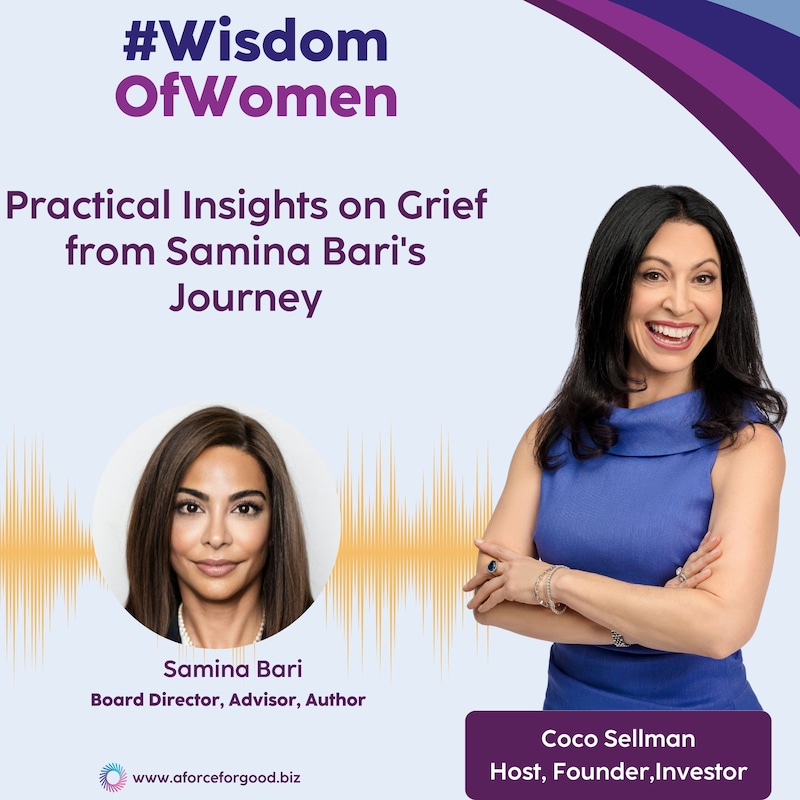
Shownotes
The central theme of this episode is the exploration of grief and the profound impact it has on individuals, particularly in the context of losing a spouse.
We are honored to host Samina Bari, a seasoned public company officer and author, who shares her deeply personal journey following the unexpected death of her husband. Through her experience, Samina has crafted her book, "Don't Call Me Widow," which serves as a practical guide for those seeking to support grieving individuals.
In our dialogue, we delve into the complexities of grief, the societal discomfort surrounding it, and the vital importance of offering genuine presence and understanding.
As we navigate this difficult terrain, we aim to illuminate how we can better support those in our lives who are facing unimaginable loss.
Our Guest This Week:
In this week’s episode of #WisdomofWomen we have a 🌟Heart-Brave Truth-Teller 🌟 in our presence.
Samina Bari is a two-time author, seasoned public-company officer, and strategic advisor who has spent 30+ years helping CEOs and boards navigate high-stakes moments—from IPOs and fundraising to crisis, governance, and reputation strategy. She has orchestrated transformation and growth efforts connected to major acquisitions involving global Fortune 500 companies, including deals valued at $2.3B, $2.6B, $14.3B, and $21B. After the sudden death of her husband in 2023—her partner of 21 years—Samina found herself living the kind of loss most people fear and few know how to support, while also parenting two young daughters through the unthinkable. That experience became Don’t Call Me Widow, a raw, practical, first-hand guide that teaches us what to say, what not to say, and how to show up with real presence when grief rewrites someone’s life. With the voice of a healthcare executive and the heart of a woman who has rebuilt from trauma and tragedy, Samina’s work turns pain into clarity—and gives all of us a better way to love people when it matters most.
Takeaways:
- Samina's journey through grief highlights the profound challenges faced by those navigating loss.
- Practical guidance is provided on how to support individuals experiencing grief in a meaningful manner.
- The discussion delineates the societal discomfort surrounding death and grief, urging more open conversations.
- Samina's book serves as an essential resource for understanding how to approach grief sensitively and effectively.
- The episode underscores the importance of community support and presence during times of profound loss.
Chapters:
00:06 Amplifying Women's Voices in Business
05:50 Understanding Grief and Loss
22:17 Navigating Grief: The Impact on Parenting
26:58 The Importance of Acknowledging Children's Grief
36:33 Navigating Grief and Professional Life
Burning Questions Answered:
1.Why grief can’t be fixed—and why trying to fix it causes harm
2.How “well-meaning” phrases often land painfully wrong
3.What presence actually looks like when someone’s world collapses
4.Why children are not resilient—and why they need us to ask better questions
5.How leadership, compassion, and humanity intersect in moments of loss
Guest Offers & Contact Information:
https://www.linkedin.com/in/saminabari/
Book: “Don’t Call Me Widow” - https://www.saminabari.com/books
Podcast: After Life: https://podcasts.apple.com/us/podcast/after-life-with-samina-bari/id1844478739
Follow the #WisdomOfWomen show for more inspiring stories and insights from trailblazing women founders, investors, and experts in growth and prosperity.
YouTube: https://tinyurl.com/yja3w7nh
Spotify: https://tinyurl.com/4tak8ajk
Amazon Prime: https://tinyurl.com/366syddj
Apple Podcasts: https://tinyurl.com/bdhananz
RSS Feed: https://feeds.captivate.fm/womengetfunded/
Coco Sellman, the host of #WisdomOfWomen, believes business is a force for good, especially with visionary women at the helm. With over 25 years of entrepreneurial experience, she has launched five companies and guided over 500 startups. As Founder & CEO of A Force for Good, Coco supports purpose-driven women founders in unlocking exponential growth and prosperity. Her recent venture, Allumé Home Care, reached eight-figure revenues and seven-figure profits in just four years before a successful exit in 2024. A venture investor and board director, Coco’s upcoming book, *A Force for Good*, reveals a roadmap for women to lead high-impact, high-growth companies.
Learn more about A Force for Good:
Website: https://aforceforgood.biz/
Founders Circle: https://courses.aforceforgood.biz/landing-founders-circle
#WisdomOfWomen Show: https://aforceforgood.biz/podcast-wow
FFG Tool of the Week: https://aforceforgood.biz/weekly-tool/
The Book: https://aforceforgood.biz/book/
Force for Good Business Show: https://aforceforgood.biz/podcast-ffgbr/
Transcripts
Welcome to the Wisdom of Women Show.
Speaker A:We are dedicated to amplifying the voice of women in business.
Speaker A:A new model of leadership is emerging and we are here to amplify the voices of women leading the way.
Speaker A:I am your host Coco Salman, five time founder, Impact Investor and creator of the Force for Good System.
Speaker A:Thank you for joining us today as we illuminate the path to unlocking opportunities and prosperity for women led enterprises by amplifying the voice and wisdom of women today.
Speaker A:We have an extraordinary heart brave truth teller in our midst.
Speaker A:Sameena Bari is a two time author, seasoned public company officer and and strategic advisor who has spent 30 plus years helping CEOs and boards navigate high stakes moments.
Speaker A:From IPOs and fundraising to crisis governance and reputation strategy, she has orchestrated transformation and growth efforts connected to major acquisitions involving Global 500 companies including deals valued at 2, 2.6, 14.3 and $21 billion.
Speaker A: death of her husband Doug in: Speaker A:That brings us to our topic today.
Speaker A:That experience became her book, Don't Call Me Widow, a raw, practical, firsthand guide that teaches us what to say, what not to say, and how to show up with real presence when grief rewrites someone's life.
Speaker A:With the voice of a healthcare executive and the heart of a woman who has rebuilt from trauma and tragedy, Samina's work turns pain into clarity and gives all of us a better way to love people when it matters most.
Speaker A:Welcome Samina.
Speaker B:Thank you so much Coco for having me and for that wonderful introduction.
Speaker A:I'm honored to have you and I'm super excited to talk about your book.
Speaker A:But before we do, I would love to hear what is a book written by a woman that has significantly influenced your life?
Speaker B:I think for me, that's a very easy one.
Speaker B:I felt, growing up with a very critical mother, that I did not fit in and I was not like other women because I didn't meet her expectations of what a woman should be.
Speaker B:I was always too loud, too direct, too bossy and too ambitious in her eyes.
Speaker B:But when I read Sheryl Sandberg's Lean in, it spoke to me.
Speaker B:I felt like I belonged.
Speaker B:It felt that I wasn't alone, that all of the alpha traits my mother accused me of having were actually acceptable and wanted and normal and necessary.
Speaker B:So I think that is the one book that really validated who I had Always been.
Speaker B:And gave me further proof to continue on in an unabashed, confident manner.
Speaker A:Amazing.
Speaker A:You know, I couldn't agree with you more.
Speaker A:I love that book.
Speaker A:And it's a good one for us to revisit, right?
Speaker B:Absolutely.
Speaker B:I do pick it up every now and then.
Speaker B:Yes.
Speaker B:Yeah.
Speaker A:Because the world is still getting comfortable with women in power.
Speaker A:Right.
Speaker A:And leaning into whatever their strengths and their place in the world is.
Speaker A:So I want to transition us to your book.
Speaker A:Before we got on the show today, Samina and I were talking and here's the book.
Speaker A:Don't Call me Widow.
Speaker A:You can see I have gone in here and highlighted sections.
Speaker A:And the biggest thing about this book for me is that it has.
Speaker A:First of all, I wept when I read it.
Speaker A:And it opened my heart to how much I love my husband and how grateful I am for my life and my family and how important it is to stay connected to that and be grateful.
Speaker A:It also taught me how to support people when they're going through an unimaginable loss.
Speaker A:You talk in your book about a lot of wonderful things, but you start out talking about your story, how you lost your husband and our collective discomfort with death.
Speaker A:And you write, we're uncomfortable sitting with grief.
Speaker A:So when someone's world explodes, you write, we reach for well meaning platitudes and scripts we've absorbed over time.
Speaker A:And then you describe what some of those are.
Speaker A:Be strong.
Speaker A:Everything happens for a reason.
Speaker A:They're in a better place.
Speaker A:Let me know if there's anything I can do.
Speaker A:And you went on to say, even these most well intended words can land wrong in deep moments of grief.
Speaker A:Tell us about our discomfort with grief and death and how it makes it so hard for us to support people when they've lost a spouse.
Speaker B:Yeah.
Speaker B:First let me say that I too was on the other side.
Speaker B:I had lost my parents, I had lost my best friend, I lost pets.
Speaker B:I thought I was very comfortable with dealing with grief until this loss, because this truly is a loss that alters your life, it alters your world, it alters your sense of who you are.
Speaker B:And with the death of my husband, a part of me died, too.
Speaker B:And it wasn't until I sat on this other side, being the receiver of these condolences, that I had, in some cases, really angry reactions to what people were saying.
Speaker B:I was so grateful for those who showed up with love.
Speaker B:And I got angry at the people who said things that really hurt me.
Speaker B:And it took me many, many months and discussions within my grief group of others who had experienced the Same hurts by others.
Speaker B:And we sat there with our collective anger, thinking, how could people be so insensitive?
Speaker B:How can people do and say those things?
Speaker B:Don't they understand?
Speaker B:And I sat with that anger for so long, and I thought we were joking, you know, we should write a book, you know, get our anger out, which is, of course, a therapeutic mechanism.
Speaker B:I was the only one who did that.
Speaker B:I wrote out my anger.
Speaker B:I didn't do anything with it.
Speaker B:It wasn't until the fog began to lift more than a year later that I had the clarity of mind to realize, well, people didn't mean to hurt us.
Speaker B:They didn't set out to visit a grieving woman and hurt us.
Speaker B:And the spark came in.
Speaker B:I said, well, you know, they're uncomfortable with it.
Speaker B:They didn't know what else to do.
Speaker B:They made the effort to show up, but they said the wrong things.
Speaker B:And then I thought, well, you know, of course they said the wrong things, because theories are two separate worlds.
Speaker B:There is the world of the untouched, the non grieving.
Speaker B:And then those of us who are grieving this profound loss.
Speaker B:And I really felt it was important to pull back the curtain between us, those of us who have experienced this loss, this particular loss, and everyone else, so that there was more understanding from both ends.
Speaker B:So that when you say X, this is how we hear it in our altered, grief, addled state.
Speaker B:You don't believe it.
Speaker B:You don't think it's going to do that.
Speaker B:You don't think the power of a little platitude could have that much power.
Speaker B:But it does.
Speaker B:When we are broken and we are angry at the world and we are devastated.
Speaker B:And that was really the impetus for the book.
Speaker B:It was the realization, after all of the hurt and anger, that none of it was intentional.
Speaker B:My hope was to bring clarity to this so that there was greater understanding, because I lost my husband way too soon, much earlier than you're supposed to.
Speaker B:But ultimately, everyone will lose their partner.
Speaker B:It's not an if.
Speaker A:It's a when we're going to watch our friends and our family members go through this exact pain and this type of loss.
Speaker A:One of the things that you talk about is it struck me so deeply.
Speaker A:It's just that it's not about me.
Speaker A:The grief that you're going through is not about me.
Speaker A:But because I don't know what to do for you, it becomes about me, the outsider.
Speaker B:Right?
Speaker A:And that's a problem, right?
Speaker A:Because I haven't dealt with my grief, my beliefs and fears about death or what's involved with that kind of grief or not being able to fix something.
Speaker A:And I project that on you in the moment when you need me to be focused on you.
Speaker B:Yeah, absolutely.
Speaker B:Everyone has gone through some sort of grief, but it is well established that the death of a spouse is the single most devastating occurrence in a person's life.
Speaker B:Because you lose yourself with that death.
Speaker B:You don't know who you are anymore.
Speaker B:You've lost your place in the world.
Speaker B:You've lost your past, your memories.
Speaker B:You've certainly lost your present.
Speaker B:You've lost, you've lost your future.
Speaker B:And the dreams you once held onto are gone.
Speaker B:So you have no dreams.
Speaker B:So it is an incredibly destabilizing event.
Speaker B:And you're right, we as a society don't want to think about death and grief.
Speaker B:That's why we put off wills and those uncomfortable financial conversations with adult children.
Speaker B:Or we say, God forbid or if I die as opposed to when I die.
Speaker B:There's such a resistance to it because we're wholly uncomfortable with it.
Speaker B:It's your individual discomfort that drives how you behave.
Speaker B:It is the, the fact that you don't want to see someone you care about be in pain.
Speaker B:So you try to fix things.
Speaker B:You try to bring positivity into a discussion like, oh, you look great.
Speaker B:Oh, oh, I'm so happy to see you're smiling and that's because you're uncomfortable.
Speaker B:It's not because we are any better, because you're trying to fix it and you can't fix us.
Speaker B:And when you try to empathize, you instead compare losses.
Speaker B:So I can't tell you how many people said, I know exactly how you're feeling.
Speaker B:I just lost my mother and you know, like a 90 year old woman.
Speaker B:How is that in any way comparable to the untimely out of cycle death of my husband and my children's loss of a father?
Speaker B:Those phrases and behaviors come from a place of discomfort, your own individual discomfort and just trying to get over it, trying to do something but not doing it quite well.
Speaker B:And what it does is it further isolates us because we already feel incredibly lonely in what has happened.
Speaker B:And it further makes us feel that, oh, no one understands this.
Speaker B:No one, you know, I'm just on my own.
Speaker B:And we.
Speaker A:Well, it also adds to the level of frustration and anger.
Speaker B:I mean, you know, people would say to me, oh, you know, well, I'd like to believe God has another angel.
Speaker B:And I thought, well, what kind of a God would take a father away from the two young children?
Speaker B:Don't talk to me about God.
Speaker B:So even those things, like every little thing, I remember every single kindness, even though I wasn't able to express my gratitude, but I also remember every slight.
Speaker B:And every slight really wounded me.
Speaker B:And I know I speak for so many people in this community.
Speaker B:Validation.
Speaker B:I had some of my.
Speaker B:My.
Speaker B:The people in my grief group, they.
Speaker B:They reviewed the book for me before I published it.
Speaker B:I wanted to make sure I gave voice to others.
Speaker B:It is something I see constantly on the Facebook groups I belong to.
Speaker B:It is the same behaviors that wound us, that we vent about.
Speaker B:I'm two and a half years past it, so it's not as raw for me, but I wanted to give everyone that agency, that voice, so that the whole community surrounding them had a little bit more understanding of what it's really like.
Speaker B:Because it is an unimaginable loss.
Speaker B:There's no way you can equate it to any other loss.
Speaker A:You cite some different research about it and really go into depth about what a unique loss it is for a person.
Speaker A:You talk about grief, and I appreciated what you said when you talk about grief and what we need is support, care, and presence, because grief is something that cannot be fixed or solved.
Speaker A:You talked about some of the feelings of grief, the profound loneliness, the disorientation or emotional paralysis, social exhaustion, and what you called.
Speaker A:Can you tell us more about that and how we.
Speaker A:What it looks like, what are we supposed to do, or how do we respond to that?
Speaker B:Well, I mean, first of all, I have to say I want to clear up myth that there are stages of grief.
Speaker B:And I do cite that.
Speaker B:I do cite that in my book, because people would say to me, what stage of grief are you in?
Speaker B:And it was so maddening.
Speaker B:Elizabeth Kubler Ross did this study a long time ago with terminally ill patients, and what she was documenting was their feelings of grief at the understanding that their death was imminent.
Speaker B:And unfortunately, it got mistakenly hijacked and is now broadly used for grief in general.
Speaker B:It has been well refuted by the scientific community, but as we've seen with the whole vaccine issue, one bad study, when it gets represented, it takes off and it becomes a reality.
Speaker B:That's actually not true.
Speaker B:And so, you know, when we go through this grief, it does depend on the type of loss.
Speaker B:Mine was not planned.
Speaker B:Mine was an accident.
Speaker B:It was very sudden.
Speaker B:I had no warning.
Speaker B:My husband was healthy, and I had grief in addition to ptsd, depression, and anxiety because the shock was so immeasurable.
Speaker B:But grief brain is honestly your body's way, your mind's way of trying to protect you from something so terrible that it neurologically, it scrambles everything.
Speaker B:We don't know what we're saying.
Speaker B:And I can tell you, Coco, I don't remember any conversations from that period of time.
Speaker B:Very, very few do I remember.
Speaker B:But people even now will say, remember, you saw so and so.
Speaker B:And I have no recollection.
Speaker B:Like.
Speaker B:And that wasn't me, but it was me with grief brain.
Speaker B:I could not think straight.
Speaker B:I could not drive.
Speaker B:I just physically, like, nothing was connected.
Speaker B:For a year, I could not drive.
Speaker B:And that was, you know, can.
Speaker B:No two people are the same.
Speaker B:Everyone will experience grief.
Speaker B:That was.
Speaker B:This was my instance.
Speaker B:But I could not drive.
Speaker B:I had just simply forgotten how to.
Speaker B:Nothing was connecting.
Speaker B:I was looking like.
Speaker B:I mean, my eyes were open, but I don't know what I was looking at.
Speaker B:I was remembering to eat.
Speaker B:I didn't know what day or time it was.
Speaker B:I didn't remember who was coming, who was going.
Speaker B:It was just, you know.
Speaker B:And I will say I was on tranquilizers.
Speaker B:I was on medication, but that was to keep me calm and my, you know, my anxiety from, you know, from having panic attacks.
Speaker B:I was having panic attacks, too.
Speaker B:But it does alter your brain chemistry.
Speaker B:Grief has a way of doing that, and it takes different people, you know, different amounts of time to get through it.
Speaker B:Eventually, some of these things come back.
Speaker B:It hasn't all come back for me.
Speaker B:So, for example, for me, I have limited attention.
Speaker B:Spanish.
Speaker B:Now, I don't have the same drive, the ability that I, you know, I'm not the person I used to be.
Speaker B:I don't have the same stamina.
Speaker B:Definitely my energy levels.
Speaker B:I still lie down every day.
Speaker B:I still have to lie down.
Speaker B:But it does.
Speaker B:It's a very real phenomenon, and it shouldn't be ignored.
Speaker B:And so you're just scrambling things.
Speaker B:Like, it looks like you're forgetting things.
Speaker B:Like perhaps you have Alzheimer's, perhaps it's menopause brain.
Speaker B:But honestly, it is the brain's way of protecting.
Speaker B:Protecting us from a trauma so devastating that we can't think straight.
Speaker A:You describe it in such a way that it helped me understand how important it is to hold space for somebody going through it.
Speaker A:Because there's nothing I can do for you in that space other than hold space.
Speaker A:Right?
Speaker B:Yeah.
Speaker B:And I think that's the thing people struggle with.
Speaker B:They think there's gotta be some perfect words or a grand gesture or something meaningful that they have to do.
Speaker B:And the presence is what's meaningful.
Speaker B:The sitting with us in silence, making a cup of tea.
Speaker B:And not talking, just being with us.
Speaker B:One of the most touching things I remember and one of the most helpful things I remember is two days after Doug died, it was actually Easter morning, and I had a very good friend.
Speaker B:I have an amazing community of neighbors, friends.
Speaker B:I called them my chosen family because they are truly gems.
Speaker B:One of them, she just walked into my house.
Speaker B:She had a dozen eggs.
Speaker B:She.
Speaker B:She made me some eggs and some bacon.
Speaker B:She did it all in silence.
Speaker B:She didn't ask me where anything was.
Speaker B:She never.
Speaker B:She never talked to me.
Speaker B:And I was sitting at the kitchen counter.
Speaker B:She made it.
Speaker B:She sat there.
Speaker B:She didn't talk.
Speaker B:She let me eat what I could eat.
Speaker B:Then she cleaned up and why don't you go lie down?
Speaker B:And that was it.
Speaker B:And it was just.
Speaker B:So I had a couple of bites of food.
Speaker B:I had someone there with me who was thinking about the fact that I hadn't eaten.
Speaker B:I probably wouldn't eat.
Speaker B:How difficult this day was.
Speaker B:And she just.
Speaker B:That was her presence.
Speaker A:Yeah.
Speaker A:Because in that state, I imagine just getting peppered with questions when, what can I do for you?
Speaker A:What do you need?
Speaker B:What do you need?
Speaker A:How can I help?
Speaker A:You wouldn't even know what to do with that.
Speaker B:Right.
Speaker B:And that's the thing.
Speaker B:It places more of an emotional burden on us at a time where we can't think straight.
Speaker B:So, you know, so many people say, I'm here for whatever you need.
Speaker B:Well, that is useless.
Speaker B:And again, I was one of those people, too.
Speaker B:I mean, I did the very same things.
Speaker B:And it's not until I was on this side that I realized, oh, my gosh, that's the worst thing to say.
Speaker B:How can I help?
Speaker B:What can we do?
Speaker B:Because it's just adding to our inability to articulate anything.
Speaker B:Because, you know this, and especially women, even in the best of circumstances, we don't like asking for help.
Speaker B:It's hard for us to ask for help.
Speaker B:So how, in this moment of devastation, can we come up with something?
Speaker B:And that's really one of the reasons why I wrote the book, because we just don't know what to do.
Speaker B:We don't know what to say.
Speaker B:So I offer tips of things that are really helpful.
Speaker B:Little things that people can do easily without stressing, but that mean the world.
Speaker B:Because even though we can't express it in those moments, yeah, we notice it, it does help.
Speaker A:Yes.
Speaker A:One of the things I love most about your book is how clear and directive it is.
Speaker A:You have this wonderful checklist of things you can do, like support checklists, immediate tasks, wellness support, initial coordination, Specifically, call the physician of the grieving spouse.
Speaker A:Coordinate someone to stay the first several weeks, form a friend group.
Speaker A:It's very specific.
Speaker A:And none of it's like, ask the person what they need because they couldn't possibly know.
Speaker A:The other thing I really appreciated in this chapter around grief was you think, oh, they've gotten through the first year, the worst of it's over, and you're like, actually, year two is even in some cases worse.
Speaker B:Yeah, year one is grappling with everything that needs to be done.
Speaker B:So it's, you know, busy time.
Speaker B:It's purposeful in terms of the administrative tasks you have to do.
Speaker B:You're getting through all of your firsts, your first birthdays, your first children's birthdays, your first holidays, all of that.
Speaker B:Everything seems like a monumental task, but it's all anchored in purpose.
Speaker B:Getting through this first, getting through that first.
Speaker B:And when you get to year two, when you plan your year anniversary that everyone remembers, that's when everyone disappears.
Speaker B:And you say, this is forever.
Speaker B:Yeah, right.
Speaker B:Because now is when you have to live.
Speaker B:After that, there's nothing in front of you and you're on your own and you have to figure it out.
Speaker A:So you also talk about what it's like to be a parent when your spouse passes.
Speaker A:And you say that when a co parent dies, we are left to manage our own grief while also tending to our children's emotional needs, often without a break.
Speaker A:Talk to us about that additional layer of grief of challenge that you go through when you have children in this situation.
Speaker B:Yes, that is so difficult.
Speaker B:My husband and I had a struggle with infertility for many years.
Speaker B:So we were older parents and my husband also was a full time dad, so he allowed me to soar in my career and so he was their primary parent.
Speaker B:I have two little girls and daddies loved being a girl dad.
Speaker B:Their devastation was and is still so profound that, you know, as a parent, you live for your children, you want your children to be okay.
Speaker B:Even though I was struggling, I had the added mental and emotional load of worrying about them and trying to help them.
Speaker B:And so, you know, one of the first things I did, and I do remember this, I had my girlfriends and by the way, those tips and everything that I put in the back, those are directly taken from what my community did for me.
Speaker B:Without my knowledge, they organized themselves and that's why I felt it was so important to put that in there.
Speaker B:But with the children, they knew my heart was broken, of course, for me, but also for my girls.
Speaker B:One of the first Things we did was organize therapy for them.
Speaker B:So my children have been in therapy since two weeks after their father died.
Speaker B:Wow.
Speaker B:And they have gone consistently every single week since then.
Speaker B:And they will be going for the foreseeable future.
Speaker B:But why parenting young children is so difficult is because, you know, they are not little adults.
Speaker B:They don't have the emotional maturity or tools to understand how to process their grief, their loss, their trauma.
Speaker B:So they act out with behaviors that seem like bad childhood behaviors, but that's not their fault.
Speaker B:They just don't possess the understanding and emotional maturity that we have.
Speaker B:They're not developed the challenges with schools, for example, they do not know how to handle children of grief and trauma.
Speaker B:In fact, most educators, most teachers in this country, will go through their entire career without ever experiencing a child who's lost a parent.
Speaker B:That's staggering considering how many children of loss there are.
Speaker B:And so they don't have the level of empathy and understanding.
Speaker B:And so they label those children as bad children acting out.
Speaker B:They're doing this, they're doing that.
Speaker B:And, you know, as a parent, you're on your own with that.
Speaker B:And so we're trying to balance advocacy for our children, comforting our children, guiding our children, going through all of the tough stuff with our children without anyone to help us as well, meaning as friends are, they're not the other parent you can't make those decisions about.
Speaker B:Do you think we should switch schools?
Speaker B:What should we do about this?
Speaker B:They're not doing well in math.
Speaker B:And so when you've got this crushing emotional load, this mental load that is nonstop, it never goes away.
Speaker B:And one of the points I make in the book also is so many people said to me, oh, children are resilient.
Speaker B:Children are resilient.
Speaker B:And I have to tell you, Coco, for your viewers and your listeners, children are not resilient.
Speaker B:It is also one of those platitudes that adults like to use because it makes them feel better.
Speaker B:Those are not people who've ever had or experienced a child in trauma or grief.
Speaker B:That is wholly untrue.
Speaker B:So I hope people stop saying that, because they're not my children.
Speaker B:Yeah, my children will forever be shaped and carry this around like a tattoo in their heart.
Speaker B:Even though they may not be showing it visibly, it's not that it's not there.
Speaker A:Oh, my goodness.
Speaker A:You talk about how children often feel that there's no focus on them because the adults in the room are.
Speaker A:And even their friends, obviously, because their friends are young, and how would they know what to do?
Speaker A:And so nobody asks them how are you doing?
Speaker A:Everybody dances around the kid and says, well, you wanna go get ice cream?
Speaker A:Going out for ice cream is good, right?
Speaker A:It's good to get the kid out of the house.
Speaker A:That's a good favor to do.
Speaker A:But there's a section where one of your daughters expresses how nobody asks about me.
Speaker A:Absolutely.
Speaker B:Because it's discomfort driving everyone.
Speaker B:Right.
Speaker B:People are coming into the house uncomfortable to deal with me, let alone like, how do you deal with a child?
Speaker B:So everyone was coming for me.
Speaker B:And one of my daughters said, everyone is here for you.
Speaker B:There's no one here for me.
Speaker B:I can give you an example.
Speaker B:Even this weekend, I was with friends and there was a grandma rocking her grandson on her legs.
Speaker B:And one of my daughters said, oh, my daddy used to do that to me.
Speaker B:Grandma got so uncomfortable, she changed the subject.
Speaker B:My daughter wanted to talk about her father.
Speaker B:Yeah, and that's really important.
Speaker B:When a child offers that, you take that and ask the child.
Speaker B:I'm so sorry.
Speaker B:Your daddy was wonderful.
Speaker B:Tell me some of your favorite memories or do you want to cry?
Speaker B:How can I help you?
Speaker B:But because adults are uncomfortable with other adults on this matter, children just freak them out.
Speaker B:But what they really need is to have a conversation.
Speaker B:One of the things I did with my entire community was I said, we are always going to say his name.
Speaker B:I don't want you to not say his name.
Speaker B:And I have to tell you, my husband's name comes up regularly, weekly in conversations, texts, jokes, all sorts of things from all different friend groups.
Speaker B:Because I never wanted to make a taboo.
Speaker B:I never wanted to erase him.
Speaker B:And so my girls are comfortable talking about their dad with the other adults, you know, this grandma notwithstanding.
Speaker B:But, you know, I think that's also really important.
Speaker B:You have to ask about them.
Speaker B:How are they feeling?
Speaker B:And, you know, holidays are tough.
Speaker B:And I know you miss your dad.
Speaker B:Acknowledge it.
Speaker B:It's.
Speaker B:It's, you know, it's like their elephant in the room.
Speaker A:Yes, of course.
Speaker A:And it's your elephant in the room too, right?
Speaker B:Yes.
Speaker A:Yeah, yeah.
Speaker A:No, absolutely.
Speaker A:So what?
Speaker A:So I'm just going to read through a couple of things.
Speaker A:You, you know, you have a whole section on what not to do or say, and I'm going to read a couple of them and just have you maybe give us some reactions.
Speaker A:I found the list so helpful.
Speaker A:Don't ask what do you need?
Speaker A:Don't try to fix it.
Speaker A:Don't compare losses.
Speaker A:Don't ask what happened.
Speaker A:Don't push us.
Speaker A:Don't give us more to do.
Speaker A:Don't judge.
Speaker A:Don't bring sunshine and rainbows.
Speaker A:Don't call me widow.
Speaker A:Don't encourage big decisions.
Speaker A:Don't rush closure.
Speaker A:Don't expect thanks.
Speaker A:Maybe touch on a few of these and give us some guidance.
Speaker B:Yeah, absolutely.
Speaker B:Well, we talked about comparing losses and bringing sunshine and rainbows.
Speaker B:I think that really speaks to people's wanting us to be happy.
Speaker B:It's like when people ask us, how are you?
Speaker B:You expect us to say, oh, we, we're fine, we're fine because that will make you feel better.
Speaker B:That's not what we feel.
Speaker B:So when you get a compliment, oh, you're looking really well, and oh, look at you smiling, you must be over the worst of it.
Speaker B:That is very, very painful because every single day is a struggle to survive in those early days.
Speaker B:Don't call me widow.
Speaker B:I should touch on that because that's the title of my book.
Speaker A:Yeah.
Speaker B:You know, when someone first called me Doug's widow and I had not thought of this, I just, I cringed.
Speaker B:I had such a visceral reaction because in my mind, a widow was an old gray haired lady with her hair in a tight bun, stooped over and all black.
Speaker B:And I was really uncomfortable with it.
Speaker B:And I thought, well, I'm not like that.
Speaker B:And then I looked up the origin of the word.
Speaker B:And the word is very ancient.
Speaker B:It's got Sanskrit and Old English roots and it means to be destitute, like, to be set aside and of no worth to the general society without your man.
Speaker B:And I thought, oh, hell no.
Speaker B:Like, I don't ever talk.
Speaker B:So I say, to take your lead from someone and don't use that term because there are apparently a lot of women who do not like that.
Speaker B:And I've gotten a lot of advocacy for that.
Speaker B:When I put the book out, people say, oh, I hate that word.
Speaker B:And yet no one has said anything.
Speaker B:And that's also one of the reasons, as I mentioned, I wanted to put this book out.
Speaker B:I wanted to give voice and agency to the millions of us who are in this club.
Speaker B:We didn't ask to join.
Speaker B:There are so many things not to say and not to do.
Speaker B:Sit with us in the dark is one of the things I say, you can't fix us, so don't try to, you know, check us, check lists off for us and say, oh, I've done this, I've done this, I've done this, I've done this.
Speaker B:And you just need to do this, this and this.
Speaker B:Because for a type A personality that feels like you've accomplished something, but that's not what we need.
Speaker B:There are so many don'ts.
Speaker B:But there's a really good reason for the don'ts.
Speaker B:Because they.
Speaker B:Because in those moments, they land wrong, and again, they hurt.
Speaker B:They hurt.
Speaker B:Absolutely.
Speaker A:Yeah.
Speaker A:Well.
Speaker A:And then you go on to tell us what actually helps, and you talk about, don't wait to be asked.
Speaker A:Instead, take initiative.
Speaker A:Don't let things pile up.
Speaker A:Instead, support every day, Help with administration of death.
Speaker A:There's lots of very specific things I wanted to share a section that you wrote that I just loved.
Speaker A:It was in your section called don't phone it in.
Speaker A:And it's about.
Speaker A:Instead, offer thoughtful gestures.
Speaker A:So you talk about how people send flowers and then say, I've done it myself.
Speaker A:But it wasn't until I was surrounded by wilting flowers, I realized that flowers die.
Speaker B:And.
Speaker A:And so dead flowers, dead husband.
Speaker A:What a terrible thing to have to surround people with.
Speaker A:And then you said, one evening, a group of friends came over to my house, and over Indian food and wine, wrote and mailed my thank you cards for me.
Speaker A:By doing so, they essentially created a healing circle, helping me tackle a task they knew would be painful and challenging.
Speaker A:I just thought, oh, my God.
Speaker A:Right?
Speaker B:I have to say, I have a remarkable group of friends and community, my chosen family.
Speaker B:Those lists were really driven by what everyone did.
Speaker B:When I say, don't phone it in, there are some people who are uncomfortable with showing up.
Speaker B:They resort to silence.
Speaker B:There are thoughtful gestures that can remove that discomfort and make you feel like you're doing something supportive.
Speaker B:Like, you know, I'll do this, and I'll take care of that.
Speaker B:You know, my friends really early on understood that they tapped into their areas of strength.
Speaker B:So, for example, one friend who is an excellent writer and she's a communications person, she drafted the obituary for me.
Speaker A:And she said, I've.
Speaker B:I've written this for you for you to look at.
Speaker B:And so she took care of that.
Speaker B:The other one, who is great with technology, set up the memorial site.
Speaker B:I've already set it up for you.
Speaker B:And here.
Speaker B:And gave me the passwords.
Speaker B:Like, she wrote everything down for me and had me look at all the content.
Speaker B:My friends who had never met formed text groups, divvied up roles and responsibilities so they could all be presence.
Speaker B:And the one thing they all recognized first and foremost was, what would Doug do for Samina?
Speaker B:How can we step into those roles for her?
Speaker B:Wow.
Speaker B:And it is that.
Speaker B:I mean, that was the power of it.
Speaker B:Yeah.
Speaker A:Because he did the cooking.
Speaker B:He did all the cooking.
Speaker B:And so, you know, it wasn't Just a meal train, right?
Speaker B:You send the meal train.
Speaker B:You feel like, okay, I sent them a meal.
Speaker B:Well, someone's got to serve the meal, plate the meal, clean up the meal, do the dishes, re repackage the meal, label it, freeze some, you know, because people send big, big things, which is wonderful, but too much.
Speaker B:So someone else cleaned out the freezer throughout the old food, packaged everything, labeled everything, put some, you know, some in the main freezer, some in the garage freezer.
Speaker B:But all of those things, you know, oh, gosh, you know, all of the accounts are in his name.
Speaker B:And I had another friend do all the technology.
Speaker A:Yeah, yeah.
Speaker B:And to make sure everything was taken care of there.
Speaker B:Who's going to take the kids to school?
Speaker B:Who's going to make their lunches?
Speaker B:Who's going to get them up and dressed?
Speaker B:Who's going to be their buddy?
Speaker B:Who's going to talk to the school and the teachers?
Speaker B:They all took it.
Speaker B:There are so many things.
Speaker B:It's the invisible burden we talk about with women.
Speaker B:Like all of the invisible tasks we have, they sorted through it and they did it.
Speaker A:I can't even imagine.
Speaker A:Now I got to pay bills and all these responsibilities.
Speaker A:Take the garbage out, feed the dog, take the dog for a walk.
Speaker A:All these little things when you have grief brain.
Speaker A:Yeah.
Speaker A:And then you two children, they're young, who need your love.
Speaker A:It's overwhelming and it's almost embarrassing as a society that we don't really know what to do and that we fumble up so badly.
Speaker A:And why your book is so necessary in the world, because it does help.
Speaker A:It helped me dramatically.
Speaker A:See, see how to better be helpful.
Speaker A:I was sharing with you before that.
Speaker A:It's been helpful for me, not just in situations where I have a friend who has a spouse who's passed, but with other losses.
Speaker A:It's really helpful to see what can be helpful.
Speaker A:I am curious to know through all of this, how did you manage your professional life?
Speaker A:Did you set it aside?
Speaker A:Did you put it on pause?
Speaker A:How did you manage that?
Speaker B:You know, I was in permanent contractor position where I was transitioning a company through an acquisition.
Speaker B:I was leading the integration.
Speaker B:And when this happened, so I took the immediate two weeks off.
Speaker B:But recognizing I wasn't going to be able to work for the foreseeable future.
Speaker B:My husband died on April 7.
Speaker B:I took the two weeks off and then I finished up end of June.
Speaker B:And it kept me busy.
Speaker B:Everyone, of course, knew what happened.
Speaker B:I said, please, I don't want to talk about it.
Speaker B:People were in general, very good, respecting it.
Speaker B:Some People didn't, you know, and not in a bad way, but they were just crying with me.
Speaker B:And I was trying to use work as my, you know, let me tune it all out and keep myself busy.
Speaker B:I had been consulting before then.
Speaker B:That was what I had been doing in the biotech industry.
Speaker B:I recognized I needed to take that pause for myself to get my children squared away, because like any parent, you're going to focus on your children.
Speaker B:And I recognize in that moment that I have far more yesterdays in my past than I have tomorrows in my future.
Speaker B:But my children have their whole lives ahead of them, and I have to make sure that I give them everything they need to grow, to be successful in adulthood despite these circumstances.
Speaker B:So I did take a year because I had to, but I didn't take the full year in that.
Speaker B:I pivoted because life had given me this pivot.
Speaker B:It forced it upon me.
Speaker B:I was so successful because I had an amazing husband who supported me.
Speaker B:He stepped back from the professional world, devoted himself to our children, and allowed me to soar professionally.
Speaker B:I recognized that I could not take on that type of an operator role that I had.
Speaker B:I was focusing purely on M and A, which is very intense.
Speaker B:I couldn't do that anymore.
Speaker B:I took pause, with the one exception that the evening my husband had his accident, he passed away early the next morning.
Speaker B:I was in bed reading the final pages of a memoir I had spent the last three years writing.
Speaker B:And I put it aside when I found out about the accident.
Speaker B: And I picked it up in: Speaker B:And my one regret is he never read it because I wanted it to be in such good shape that I promised it to him the next day, and he never got to read it.
Speaker B:So I rewrote the final chapter of how it was supposed to end, and I published I Can, I Will, and I did, in March of this year.
Speaker A:Of this year.
Speaker B:So, yeah, I pivoted from my biotech advisory business to my author Persona last year so I could do this as a testament and a gift to him because he would want to see me finish that.
Speaker B:So I did that.
Speaker B:And at that period of time, I'd also started taking those notes from my group.
Speaker B:And as soon as I published my first book, I got right onto the second book.
Speaker B:Don't Call Me Widow is intentionally brief.
Speaker B:It is direct.
Speaker B:It uses large font.
Speaker B:It's indexed clearly.
Speaker B:And I did that so purposely because I thought, well, I have a lot to say and it's not like academic or theoretical.
Speaker B:It's really practical.
Speaker B:So I wanted to make it as visually appealing, practically, you know, as well.
Speaker B:And so I didn't.
Speaker B:It took me less time to write that, obviously, because I knew exactly what I wanted to accomplish.
Speaker B:Hearing you say that, now you've learned something, you know that that is what in my heart I wanted it to do.
Speaker B:I wanted it to create a greater understanding so people can have a gentler experience.
Speaker B:When this happens, well, I feel very.
Speaker A:Compelled for everybody to get.
Speaker A:Pick up a coffee and check it out.
Speaker A:Read it.
Speaker A:Don't call me Widow.
Speaker A:A firsthand guide to help support someone who's lost their spouse.
Speaker A:It really is a must read and a good one to keep at your side for those moments when you come across someone who's lost their spouse.
Speaker A:You can hand it off to their friends because it isn't all intuitive.
Speaker A:Once you read the lists and see the ways that the people in your community helped you in the way you guide, it's obvious, but for some reason it's not intuitive how to respond.
Speaker A:I'd love to go to our Fast Fire round where I'll ask you five questions in five words or less to to answer.
Speaker A:Are you ready?
Speaker B:Okay.
Speaker A:Yes.
Speaker A:Here we go.
Speaker A:What should friends stop asking when they've lost a spouse?
Speaker A:Even when they mean well.
Speaker B:How can I help you?
Speaker A:What is one concrete thing people can do in the first 24 hours after a.
Speaker B:Just show up and give a hug.
Speaker A:What did you need most in year two that nobody warned you about?
Speaker B:Oh, that's a good one.
Speaker B:Continuity of people keeping in touch.
Speaker A:What's the most helpful sentence someone said to you after Doug died?
Speaker B:I can't imagine what you're going through.
Speaker A:Finish the sentence.
Speaker A:Please don't call me widow because I'm not done.
Speaker A:Amen to that.
Speaker A:How can we get a copy of your book?
Speaker A:How can we learn about you?
Speaker A:How can we stay in touch with you?
Speaker A:Because I have no doubt there is more to come.
Speaker B:Oh, thank you so much.
Speaker B:You can reach out to me on saminaberry.com I have a website where there are links to both of my books as well as links to a companion podcast I created for Don't Call Me Widow that's called Afterlife and available on all streaming platforms.
Speaker B:I'm on Instagram as saminabarry underscore.
Speaker A:Wonderful.
Speaker A:And we will put that all in the show notes so everybody can be in touch.
Speaker A:Just thank you, Samina, for writing this incredible story.
Speaker A:I'm so sorry that you've gone through this incredible journey and tragedy and my heart surrounds you and your girls with love.
Speaker A:I'm grateful that I've been able to get to know you over the last year and I look forward to seeing what you continue to bring out and what we can do together to help continue to do good things in the world.
Speaker B:Thank you so much, Coco.
Speaker A:So to all of you world changing listeners, be sure to follow, like and share the wisdom of women.
Speaker A:Show on Whatever your favorite listening or viewing platform you prefer to infuse more wisdom into your business, remember to take the Growth Readiness Quiz at aforceforgood Biz Quiz and cover where your insight and wisdom is needed most.
Speaker A:The world is made better by women led business.
Speaker A:Let's go make the world a better place.
