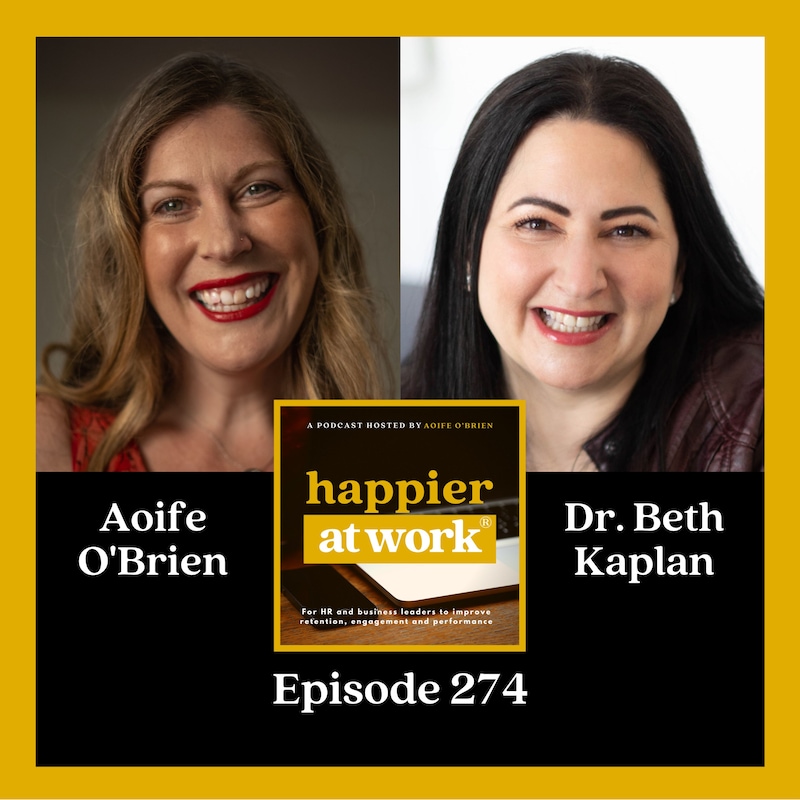
Shownotes
Are you searching for true belonging at work without sacrificing who you are?
In this thought-provoking episode of the Happier at Work podcast, Aoife O’Brien is joined by Dr. Beth Kaplan, one of the world’s leading belonging experts and a passionate researcher of human connection in the workplace. Beth candidly shares her personal journey, from navigating toxic leadership and workplace trauma to redefining the concept of belonging as an “innate desire to be part of something greater than ourselves without sacrificing who we are.” Together, Aoife and Beth discuss why so many high-achievers feel like outsiders at work, how values underpin our sense of belonging, and practical steps for embracing authenticity while thriving in professional environments.
In This Episode, You’ll Discover:
- The importance of defining belonging as showing up authentically and not sacrificing your core self to fit in.
- Why workplace belonging is complex and different from both inclusion and exclusion.
- The significance of identifying and living by your personal values to determine if a workplace environment is truly for you.
- The risks of companies using “family” language without living up to the expectation of care and loyalty.
Related Topics Covered:
Values at work, Imposter Syndrome, Workplace Trauma
Connect with Aoife O’Brien | Host of Happier at Work®:
Connect with Dr. Beth Kaplan | Global Voice on Belonging, Learning & Leadership:
Related Episodes You’ll Love:
Episode 184: A Framework for Building Happier Work Cultures with Aoife O’Brien
Episode 195: Workplace Culture Dynamics creating a positive Work Environment with Caroline Collins
About Happier at Work®
Happier at Work® is the podcast for business leaders who want to create meaningful, human-centric workplaces. Hosted by Aoife O’Brien, the show explores leadership, career clarity, imposter syndrome, workplace culture, and employee engagement — helping you and your team thrive.
If you enjoy podcasts like WorkLife with Adam Grant, The Happiness Lab, or Squiggly Careers, you’ll love Happier at Work®.
Join Aoife O’Brien for weekly insights on leadership, workplace culture, career clarity, imposter syndrome, and creating work that works for you.
Website: https://happieratwork.ie LinkedIn: https://www.linkedin.com/in/aoifemobrien/ YouTube: https://www.youtube.com/@HappierAtWorkHQ
Transcripts
Aoife O'Brien [00.00.00]:
Would you like to feel a greater sense of belonging at work and create an environment where other people feel like they belong as well? This is the Happier At Work podcast. It's the Career and Culture podcast for People First Leaders. I'm your host, Aoife O'Brien, the career and culture strategist for commercial leaders and teams.
And my guest today is Dr. Beth Kaplan, and we talk all about redefining belonging at work. What does belonging really mean? We dig below the surface and we get into how do we actually define it, and how do we feel this greater sense of belonging. I really know you're gonna enjoy today's episode. I would love to know at the end, what's one thing that you're going to do differently?
We're here for action rather than inspiration, so don't be afraid. To get involved and let me know in the comments on LinkedIn. Let me know. On your favorite podcast platform, what's one thing that you're gonna do differently after listening to today's episode?
Aoife O'Brien [:Beth, you're so welcome to the Happier at Work podcast. I'm so excited for our conversation today. Do you want to let listeners know a little bit about you, your journey to date, and what has you. What has you occupied these days? What are you most interested in?
Dr. Beth Kaplan [:Absolutely. Thank you so much for having me. Hi, everyone out there. I'm Dr. Beth Kaplan, and I am one of the world's leading belonging experts. I study belonging and human connection on top of the fact that I'm a very proud mom of boys living a house of all boys and in Newtown, Pennsylvania, so the east coast of the United States. And as I mentioned, I'm a belonging researcher, and I didn't really set out to study belonging. However, like most researchers who study their own trauma, I set out to understand why so many people, myself included, felt that they had to prove their worth just to exist in certain spaces.
Dr. Beth Kaplan [:So the more I researched, the clearer it became. Belonging was this complex concept that everyone thought was easy but had their own definition of it. Some thought it was attachment, some membership. People even described as. As fitting in. So I redefined it myself, and I look at belonging as the innate desire to be part of something larger than ourselves without sacrificing who we are.
Aoife O'Brien [:I love that definition. Can I just say, absolutely love it. And I think you're so right. I think we. We maybe confuse it with things like this sense of fitting in. I want to fit in or I want to be part of a group. But I love how you. It's kind of.
Aoife O'Brien [:There's a few different elements to how you describe it, and it's not sacrificing who we actually are as a person. And talk to me a little bit about that evolution. So when you first started looking into this, what drove you to look into it in the first place? And what are some of the things that you. You thought maybe at the start, but maybe the further you looked into it, like, actually, that's not the case at all.
Dr. Beth Kaplan [:So I would say my journey really started probably from as early on as I can remember. I'm always the person that brought people together. It gives me extreme joy to build community. But I always felt a little bit like an outsider, even in the communities that I built. And then, of course, growing up, our first set of leaders are our parents. And for me, learning those behavioral patterns and all the different things that they installed was what continued on from school into the workplace. So for many of us, that's what happens, good or bad. We really do see our bosses as those figures that give Us.
Dr. Beth Kaplan [:Structure and order. And I had a very happy career until I didn't with a boss that just. I didn't mesh with very well, who would praise me in public, and then behind the scenes would really give me a very hard time. And all I wanted to do was win him over. All I wanted was gold stars.
Aoife O'Brien [:Yeah.
Dr. Beth Kaplan [:And it just wasn't going to happen. So that's the long story short. It's all in the book you read all about there. But I got very curious to understand why I was this, you know, high achiever on paper, outstanding performer. And I was just desperately lonely and unhappy. And so about a year after, I had a performance review with my boss where he said some pretty disparaging things.
Aoife O'Brien [:That's what I was going to ask you about, actually.
Dr. Beth Kaplan [:Yeah.
Aoife O'Brien [:Whether so in public he was praising you, and then privately he wasn't. But that was.
Dr. Beth Kaplan [:That.
Aoife O'Brien [:That was to your face as opposed to behind your back. It.
Dr. Beth Kaplan [:It was a mixture of everything.
Aoife O'Brien [:Okay. Wow. Yeah.
Dr. Beth Kaplan [:So no. I would get awards in public, and then I would hear things, and he would send people to do certain things. And I couldn't understand why he was almost competing with me in certain zones.
Aoife O'Brien [:Okay.
Dr. Beth Kaplan [:But instead of remembering who I am and what I bring to the table, his perception became my reality to such a dangerous level where I stopped sleeping as much. My hair was falling out, I was gaining weight. And the more and more I looked into why this was happening, there were very little answers for me. And I would do things like go to HR or employee relations, and nothing seemed to be getting better. So I was honest with him and I came clean. I wasn't just figuratively killing myself in the workplace. I was suicidal. I really was.
Dr. Beth Kaplan [:And so stigmatized by the fact that I was feeling so badly about something I felt was trivial. The workplace and trauma. I wasn't, you know, saving cats or trees and performing surgeries, but I felt desperate. And when I told him that I was suicidal, his response was, and verbatim, so, sorry, I have another meeting to get to.
Aoife O'Brien [:Oh, wow.
Dr. Beth Kaplan [:So it was right then and there that I realized I stopped mattering to myself. I did. And you can't belong to something greater until you belong to yourself first.
Aoife O'Brien [:Yeah.
Dr. Beth Kaplan [:So I quit a job that I loved very much, by the way. It was only him that I really had a hard time with. And I went to grad school, and my dissertation kind of became my personal rewrite of everything going on. I decided I wanted to understand why people like me, like I said, didn't feel worthy to Be in the spaces they were in. And to your earlier question, no. No one agreed with me almost ever. So it was an uphill battle in grad school because I would say things like, the opposite of belonging, and people would say is exclusion. And I would just kind of scratch my head and say to myself, well, but inclusion and belonging aren't the same things.
Dr. Beth Kaplan [:They're not. They may elicit certain feelings that feel similar, but they're not. So why would exclusion be that? And the great thing is that grad school kind of built me up to understand what the differences were. And it was really became, in my opinion, became up to me to clarify that and to bring some new research to the world.
Aoife O'Brien [:Brilliant. I love that. Yeah, I love this idea that you mentioned about belonging to yourself first, because it sounds like. I mean, I love how you describe it. Like, you put all of your worth essentially into this manager who wasn't giving you what you really needed, and you lost yourself in that, and you were like, okay, so I must be completely unworthy because this other person doesn't believe in me. And I'd love to. To jump forward now that you, you know, you're looking back, you've got division. What was actually going on there?
Dr. Beth Kaplan [:You know, that's a really great question. I think in hindsight, I think that he felt competitive with me, and I don't think he was in it to coach and grow me. I think he was tolerating me. The thing is, I've gone back in my head many, many times. You know, unfortunately, I would love to tell everyone out there that you stop thinking about those bosses, but we carry that trauma with us up to 10 to 15 years.
Aoife O'Brien [:Yeah. If.
Dr. Beth Kaplan [:If you're able to get in under that time frame. Wonderful. Brilliant for you. I think that we were at a point where his only job was really to care about me. And I'm not talking about, you know, in a thoughtful manner, which should be done anyway, but to advocate for me, to give me candid feedback. And I don't think that that's what he wanted to do, because truthfully, if he would have shown me care, even if he didn't even mean it, I probably would have stayed. So I do believe that it was a struggle. I was finding with myself that he happened to be the star in my show.
Dr. Beth Kaplan [:Right. And I should also have been the star in his. And I don't think that's what was happening. I think instead of bringing out the best in others, I think he was kind of like, I don't really Want her on this team. And instead of moving me or doing anything else, it just fell apart.
Aoife O'Brien [:Yeah. I mean, there's a couple of things that are kind of coming up for me now with that. Was he like that with others? Is one of the kind of first questions. Like, is it. Was it just you or was it with other people as well? And, you know, this. This idea of how he's behaving is not a reflection on you. You can see that now, but it's really a reflection on him and what's going on for him. That he feels like he's unworthy, that he needs to be competitive or whatever it is.
Dr. Beth Kaplan [:That's right. So I will tell you now, looking back, I have a lot of empathy for him, and I think that shocks people when I say it. You know, I don't want the worst for him. I want the best for him. I don't ever assume to understand what he was going through or was going on. But the end result is, as a leader, you should be willing to meet people where they're at, because we all get into that to bring up the best in others. No one goes into it ready to mess someone's life up. But when those signs were there, he did have a responsibility to keep me healthy.
Dr. Beth Kaplan [:Because if the workplace is able to say, we are the destination for belonging, which many do, and we will provide you with safety, it's not just psychological or physical. It should be both.
Aoife O'Brien [:Yeah.
Dr. Beth Kaplan [:So in hindsight, I understand that now. Do I think I would have spoken truth to power? Looking back, probably not. I was desperately uncomfortable.
Aoife O'Brien [:Yeah.
Dr. Beth Kaplan [:I think what I've learned from that is while the leader has the biggest influence on our sense of belonging in the workplace, and that's not going to change. As employees, there are certain things that we can do to minimize the impact on the rest of our lives. Like, for me, I probably would have tried to observe him more and absorb less.
Aoife O'Brien [:Yeah. Yeah.
Dr. Beth Kaplan [:I always say in hindsight, if I would have absorbed less of his emotions and stopped really focusing on the positive as much as the negative, which is very hard to do, by the way. You know, someone tells you you're wonderful and you feel valued, you want to feel good about that.
Aoife O'Brien [:Yeah.
Dr. Beth Kaplan [:If I would have just taken everything he said with a grain of salt or literally said, okay, great, he loves this move on. He doesn't love this move on. I think it would have been a healthier environment for all of us.
Aoife O'Brien [:Yeah. Yeah.
Dr. Beth Kaplan [:No, it wasn't me, by the way. There were.
Aoife O'Brien [:Yeah, okay. Yeah, yeah. But that you don't become overly reliant on that external validation. Again, this idea of coming back to yourself and being like, okay, what. What is it that I stand for? And that's great that he liked that. Okay, let's move on to this next thing. And I suppose on a. Maybe on a broader context, why is it that you think that so many people feel this sense that they.
Aoife O'Brien [:That they don't belong? Like you say, maybe high achievers, everything looks amazing on paper, but actually we have this underlying sense that I'm a bit of an outsider, I don't really belong here.
Dr. Beth Kaplan [:So I think what people go through is super interesting. We're all hardwired for deep human connection. However, what happens is we go through this phase that unfortunately follows through life where we don't necessarily feel worthy of it. And in the workplace that's almost become a universal experience that we don't necessarily feel worthy of that connection, even though we want it so badly. And then what happens is fear takes over. And fear is one of the hardest emotions to suppress. It really is. Fear is built in for our survival just as much as connection is at this point.
Dr. Beth Kaplan [:However, the what we're surviving is different. Right. We're not surviving the elements like we may have when you're really starting to get in crane to human DNA. Same thing with belonging. Belonging has also changed where we used to find it in religious or family or in community. Changed quite a bit. And I do firmly believe that people now look to the workplace for a lot of those things. It's where we spend the most amount of time.
Aoife O'Brien [:Absolutely 100% agree with that. And I was chatting with someone a number of years ago about that and it is that idea that maybe we used to go to church on Sundays and find a real sense of connection and belonging to when we spend time in those places and like you say, with our families. But since we spend so much of our time at work.
Dr. Beth Kaplan [:Yes.
Aoife O'Brien [:Not only are we seeking it out there, but we have this expectation that we're going to find it there as well.
Dr. Beth Kaplan [:That's right. Oh my goodness. Completely. Just like. I mean, I will tell you, I was absolutely one of those people that was tickled pink to be in a company whose value was family. Family, especially for me, coming from maybe not the most positive family backgrounds was so attractive to be with. Group of people that were going to embrace me that way. Little by little, though, you learn that that's not really possible because you don't give benefits to your family like you do in the workplace.
Dr. Beth Kaplan [:And on the other end, we can't fire family.
Aoife O'Brien [:Yeah, right.
Dr. Beth Kaplan [:So you can't really be loyal to something that can't be loyal back. And I think that's one of the distinguishing factors that companies are trying to embrace, but is really negatively impacting the workforce.
Aoife O'Brien [:Okay, yeah. So on the one hand, we're saying, yeah, it's like family here. And I have seen, like, I've been in an organisation where I felt like it was family. I felt so included and it was so nice. And the only way I probably would describe it is family. But I see it being used in lots of different ways. And then I see people being really derogatory about it, saying, oh, it's like, this is not a family. Because exactly, like, say, you can't fire your family.
Aoife O'Brien [:Or, you know, and then I saw something, I think it was just earlier today, actually, that was like, okay, the next time someone says this company is like a family and you don't want to do something, you were like, you're not my mom, or, you know.
Dr. Beth Kaplan [:Exactly, exactly.
Aoife O'Brien [:You got to retaliate against this kind of stuff. And so we're seeking out those. These kinds of things in the workplace. We're not necessarily finding it. What is the secret then, to having this sense of belonging? If we're. If this is what we're looking for, if this is so connected to that sense of deep human connection, we're seeking it out in the workplace. But actually, well, maybe rather than talking about what the solutions are, what are the things, what are the big barriers that are getting in the way, I.
Dr. Beth Kaplan [:Think that everyone assumes belonging is an all or nothing concept. I think that's a really hard one for people. You belong and you don't. But that's not necessarily true. I always like to use the gym analogy. It's such a great way of thinking about it. I belong to three physical fitness places. I go to one because I see camaraderie with the women that I work out with, who are just phenomenal people.
Dr. Beth Kaplan [:I go to another one because a personal trainer focuses on me only. And then the other one I don't go to, let's be honest. So I have a deeper connection to some than others. And belonging is the same. You may feel a deep sense of connection to your boss or your company and not the team. Yeah, or the team. The company and not your boss. So it's not all or nothing.
Dr. Beth Kaplan [:And it's important to understand how those communities fit into your life and against your values. The thing. All day long, we are asking ourselves the same question, who am I and where do I belong?
Aoife O'Brien [:Mm.
Dr. Beth Kaplan [:So understanding what that response is and the space in between is incredibly important. I don't know about you. I've been in plenty of places where I get there. I know I don't belong, and I stay anyway.
Aoife O'Brien [:Yeah. Oh, yeah.
Dr. Beth Kaplan [:And it's not serving you. It's not serving me. So understanding who you are and where you belong or if you want to belong, is key. The other thing is there's. When I say belonging is not all or nothing. There are multiple types of belonging.
Aoife O'Brien [:Okay. Yeah, yeah.
Dr. Beth Kaplan [:So it's understanding where you fall in. In that spectrum. So the way I've defined it is really, therefore, they are true belonging, which is what everyone thinks about, you know, that happy, rewarding feeling where you belong to something greater without sacrificing who you are. The opposite of that is a thwarted sense of belonging where we don't feel it.
Aoife O'Brien [:Okay.
Dr. Beth Kaplan [:And that could be quite dangerous. The reality for that is that belonging is an antecedent to suicide. So when people don't feel like they have more to offer the world or don't feel like they can be themselves to such an extreme point, that can become very dangerous. And the other two, which run rampant in the workplace and other parts of life, by the way, are sacrificial. Belonging. So sacrificing a part of yourself consciously or subconsciously for the greater good, which is really where we see a lot of people get trapped in the workplace.
Aoife O'Brien [:Yeah. Yeah.
Dr. Beth Kaplan [:Oh, if I work longer over my pto, I will get a raise or someone will include me more or I'll get access. And the thing is, the spoiler on that one, it never works out well. It always catches up with people. Okay? So if you're out there and you're thinking, do I have it or not, you want to think about the type of sacrifice and if it's really noble or not. Eight out of ten times it's not.
Aoife O'Brien [:Yeah, I love that.
Dr. Beth Kaplan [:And then perhaps my favorite is dissimulated belonging. It really is. Dissimulated belonging does not mean that you are not able to achieve a sense of belonging. It just means that you're not feeling a sense of belonging within the context of where you are. So you may be in the workplace and feel either a minimal sense of belonging or enough to get through because you want to get your job done. But your personal life may be so much more beneficial and exciting to you that you put up with work to get through with the rest. And why that's difficult is the workplace values our corporate cheerleaders. Right.
Dr. Beth Kaplan [:They want everyone to be happy and represented in the company. You know, I would challenge that, that we need more culture ads, more than cultural ambassadors, because you want things. You want people to bring diversity of thought into the workplace as well. Dissimulated belongers have a very happy sense of being. It's just not necessarily all their eggs in the work basket.
Aoife O'Brien [:Okay. Yeah, yeah. So they don't. They don't place all of the emphasis, I suppose, on. On I have to find myself belonging in the workplace. They can actually get that outside of work. Kind of going back to what you said, feeling that sense of connection and belonging with the ladies that you go and exercise with at the gym. Yeah.
Aoife O'Brien [:So that's kind of.
Dr. Beth Kaplan [:Right.
Aoife O'Brien [:Yeah. Another thing that's kind of coming up for me when you're talking about things like the sacrifices that we make. And for me, I'm seeing this linking back to fear and the fear that we're not enough, the fear that we don't belong, all of these kinds of things. And I'm making a leap then to say, is this related in some way, then, to imposter syndrome? And, like, I feel I need to compensate in some way in order to feel like I'm enough, in order to feel like I deserve this.
Dr. Beth Kaplan [:It can. I mean, so imposter syndrome and feeling like you're not worthy of something that people feel that you are can be tricky and absolutely can. And I think as a result, we do things like cover, which is this concept that refers to the way individuals downplay or hide parts of their identity to fit into, you know, the dominant norms that we face, like the workplace or public settings. Whereas covering is where we hide. In imposter syndrome, we typically do the opposite, which is to amplify things we may not necessarily be comfortable with, because we think that's what got us here. So what gets us here should get us there. But that's not always the case. So I always like to say, if your sense of belonging is impacted by imposter syndrome, you want to really stop and ask yourself for.
Dr. Beth Kaplan [:Beyond the question, why? Well, what do you think you're in that you're not doing well.
Aoife O'Brien [:Yeah, yeah. So really trying to dig into, like, where. Where that sense comes from.
Dr. Beth Kaplan [:That's exactly. Identify what that is. Identify the parts that you've kept. You've kept hidden.
Aoife O'Brien [:Yeah.
Dr. Beth Kaplan [:And see if there's a disconnect there. Because imposter syndrome is incredibly difficult to make up. I happen to say. I always joke around That I don't have imposter syndrome. Because when I was at Pennsylvania, they argued so much with me that I felt extremely confident by the time I was done.
Aoife O'Brien [:Yeah, yeah, yeah.
Dr. Beth Kaplan [:But it doesn't always have to get to that place. And I think the more that we're able to pump ourselves up, especially around imposter syndrome is incredibly important, so. Sounds super cheesy, but I'm going to be honest with you. For me, I have a lot of dysmorphia. I don't have workplace dysmorphia. I don't. My identity isn't wrapped around my job, but I might have body dysmorphia or I may have all these different things. And so talking nicer to myself in general is what helps me overcome that imposter syndrome in other areas of life.
Aoife O'Brien [:Yeah.
Dr. Beth Kaplan [:And I always tell people to do it. I get a lot of messages, hilariously enough, where people are like, I just looked at my butt in the mirror and I was like, wow, looking good, girl. Because that's what I do to myself. I don't do that. But the rest of me, I'll be like, looking good. Because eventually I will believe it for.
Aoife O'Brien [:Myself and it'll be, yeah, that makes us feel better about ourselves.
Dr. Beth Kaplan [:It does. We don't talk very nicely to ourselves.
Aoife O'Brien [:No, no. It's definitely not. No, no, no. I think we're. We're our own biggest critics. Really? Yeah. Coming back to this idea, I'm not sure the term you used was it types. The different types of belonging.
Dr. Beth Kaplan [:Yes.
Aoife O'Brien [:This sense of true belonging. Do you think that that is possible, given. I mean, in the workplace, given how we work? And I'd love to explore.
Dr. Beth Kaplan [:Yes.
Aoife O'Brien [:How that might unfold before we come on to maybe some of the other kind of challenging types of belonging.
Dr. Beth Kaplan [:Sure. So I absolutely think that true belonging is achievable. I think it means, basically, there's things that you have to give up in. In general. Right. So if you're true belonging, while the majority of that is such a happy, positive feeling, it also means that your sense of self with the company is balanced. That's really hard to achieve. So you're not making decisions based on the company only or yourself only.
Dr. Beth Kaplan [:It's. It's a. It's a balance that you're able to achieve, which brings that positive nature, and that does make it possible. There are challenges with true belonging. Just like anything else, one of the biggest things is navigating diverse perspectives. So true belonging involves embracing diverse perspectives and backgrounds, managing complex, sustaining inclusion and being this ally and why that sounds like it's harder for true belongers because they're really good the way they are. It's accepting other influences inside that is harder for them.
Aoife O'Brien [:Okay. Yeah. And when it comes to this sense of true belonging you mentioned at the start, but we haven't really explored it that much, this idea of values, does it all really come down to our values and understanding ourselves really? Well.
Dr. Beth Kaplan [:I could argue it both ways, but I'm going to go with yes.
Aoife O'Brien [:Because argue both ways. I'd love to hear both. Yeah.
Dr. Beth Kaplan [:So for us, our sense of gravity is our moral sensitivity. We are all born with the nature of positivity. And when you're going through that, your personality traits, your characteristics, all start to settle into what becomes your values.
Aoife O'Brien [:Okay.
Dr. Beth Kaplan [:And all day long, your body is almost playing a game of pinball where it's going back and forth. Is this impacting this is it. And it's. If it's not, okay, great, I can move on. Is this impacting it? Oh, wait, it is. And it's stopping me from being the person I want. And it puts us in this state of either alignment or misalignment. Misalignment can be very dangerous because it's important that we're able to stay true to ourselves without feeling like we can.
Dr. Beth Kaplan [:We are giving up part of ourselves, I guess, is what I would say. And on top of that, what happens in the workplace when we're unsettled, there's a sense of uncertainty that sets in.
Aoife O'Brien [:So that's at its crux. That's what makes us us. And it's about finding that place where we can be ourselves. So how do we actually find that place where we can show up as we are? How do we know in advance? Or is it a case that we can't know in advance where we're going to feel like we belong?
Dr. Beth Kaplan [:So in the workplace, that's hard because we're all essentially. I always like to look at this as a relationship right in the beginning, it's the wooing state.
Aoife O'Brien [:Yeah.
Dr. Beth Kaplan [:Telling us that, you know, these are our values and you try to align those. Right. You're not going to go to a place that outwardly doesn't. That outwardly messes with your sense of integrity, for example. So I believe that we all go into it with this alignment, and then it's important to understand when that alignment starts to fall apart. And if it's things you can live with or things you can't.
Aoife O'Brien [:Yes.
Dr. Beth Kaplan [:I often say if it has you sacrificing who you are, your sense of integrity, then that's a deal breaker.
Aoife O'Brien [:Yeah.
Dr. Beth Kaplan [:But at the same time, what's great about the book is it does dive into the fact of what happens when you're at an impasse, because many of us are, and work still contributes to our livelihood. It's not like we could just quit. Yeah, yeah, right. So for me, my guidepost is always what is, what makes me me. And if I'm at risk of giving that up, that's something that I have to seriously examine before I can move forward with anything else.
Aoife O'Brien [:Yeah, I think. I think, like, that's, I suppose, what I wanted to come on to next. I love how you've explained it. Like, and going back to this idea of managers as well. Like, as a manager, you don't set out to do harm. You don't set out to ruin someone's day or ruin someone's life. You don't intentionally do that stuff, but somehow that happens. But it's the same, I think, in a workplace.
Aoife O'Brien [:So we're not intentionally, as an individual, looking for somewhere to work that's going to be in big conflict. We like what we see during the interview process, during our research. We like the people that we meet and we join with good intentions. Now, you know, we could probably talk about this on a whole other podcast episode. The idea of both sides are kind of bringing their best selves during that phase. So it's not necessarily, you know, and I've certainly joined organisations where it was slightly misleading during that interview process, where they weren't really upfront about what was really going on. And that's an easy mistake for anyone to make. And I think oftentimes we blame ourselves for making those kinds of mistakes, let's say, or missteps.
Aoife O'Brien [:And I'd love to know then when we get to this impasse and we're like, oh, something's not quite right here. And that can happen sooner or that can happen later. What do you advise for people, again, going back to this idea that our job is our livelihood, that's how we make money. And I've done this myself where I've got to a stage where I'm like, I'm not taking this anymore. And I chose to leave two organisations in, you know, kind of similar circumstances.
Dr. Beth Kaplan [:So if we find ourselves at an impasse, what you want to do, and there's so many activities in the book that make this easier, but you want to understand your values and what you cannot live without.
Aoife O'Brien [:Yeah.
Dr. Beth Kaplan [:To the time you were brought into the workplace. Again, because you like similar values. There are things that you want to aspire to. And what you also need to remember is that the company is the same if they have aspirational values, we have a major disconnect when they don't actually meet reality.
Aoife O'Brien [:Yes. Yeah, yeah.
Dr. Beth Kaplan [:So if you say we're a family and then you have layoffs, like a month or two later, it messes with us. And you'll be able to see these are my top values. This is what I am not willing to put out with when. If it comes to anyone eroding those values. At the same time, you don't want to ape your values in the sense where someone else's values. So you really need to determine what you can live with and what you can't live without at the same time. There is a pecking order for me, my sense of integrity, that's the highest. And I'm not willing to sacrifice that.
Dr. Beth Kaplan [:If there's a company that will be, you know, leading me to feel like I need to give up a part of myself, then that for me is a deal breaker and I would move on to another company.
Dr. Beth Kaplan [:I think what people need to examine when they are looking at a company or at a company and looking to stay is what have they done versus what aspirational values have they set out to do. If a company is living their values, you're much more excited to be there and want to stay.
Aoife O'Brien [:Yeah, yeah.
Dr. Beth Kaplan [:If a company is asking you to change your values, that's where you might have a disconnect. Learn what makes you you and take a step back.
Aoife O'Brien [:Do you have any specific exercises that we could do to like. So this is something that I've done and what I found when I first understood that I have personal values as opposed to just being, you know, just understanding that companies have values and they're on the Wall, and they're in the email signature and all of that. When I first realized that I, as an individual also have values. And the importance of those values being in alignment with the lived experience, not just what they say the values are, you know, but when I went through that process of trying to uncover what are my values like, it's. It's a long process, I found. I think when I first did it, I was like, oh, I have 35 values. And it's like, no, you don't have 35 values.
Aoife O'Brien [:It's. It's kind of chipping away, narrowing them down, maybe grouping some things together and figuring out, well, what makes you different? What makes you you.
Dr. Beth Kaplan [:That's right. And you may not always like what that looks like. That's the thing to note, is that you may look at those values, and what I'd encourage you to do is be honest with yourself. It's not always pretty, but it's you. So embrace it. I mean, success can't be scheduled on your timeline. And sometimes who we are also needs to be more of a truth. So as you want to become a truth teller about you and the situation around you.
Aoife O'Brien [:Yeah, I think there. There are probably some general aspirational values. Things like fairness. We all would like to be fair. We all would like to live in high levels of integrity, but that's not necessarily who we are. Or at least if we. If we value integrity, maybe it's not the very first thing on our. On our pecking order, on our.
Aoife O'Brien [:On our kind of list. Yeah. We've covered quite a lot around belonging. Is there anything else that you'd like to share before we wrap things up?
Dr. Beth Kaplan [:No, I just. I think it's an important exercise for yourself, as we just mentioned, to really do a values inventory, understand what's you and what's not. It can be really shocking.
Aoife O'Brien [:Yeah.
Dr. Beth Kaplan [:You know, in the book, there's a lot of discussion around the grudges we hold, and that seems to sit funny with people. It's a really cool exercise because the grudges we hold even shape our values. Right. So just a little tip there to pay attention to those signals and embrace you.
Aoife O'Brien [:I'd love that. And so when you're talking about grudges, is it the things. It's the things we hold against people. But are they things that have gone against our values in some way, and for that reason we're holding something against the other person? Okay. Yeah.
Dr. Beth Kaplan [:Prospective exercise.
Aoife O'Brien [:Yeah. To understand. Okay, this is where maybe where there's a misalignment of values. And broadly speaking, would that apply to relationships and friendships as well?
Dr. Beth Kaplan [:Everything.
Aoife O'Brien [:Yeah.
Dr. Beth Kaplan [:The book is around braving the workplace, but it's really braving yourself. It's being yourself in a world that tells you to be something different every single day.
Aoife O'Brien [:Yeah, I love that.
Dr. Beth Kaplan [:That's how you get happier at work, by the way.
Aoife O'Brien [:Yes, 100. Yeah, 100% agree. Because my, you know, the research that I've done ties in a lot with this. I think we use different terminology some of the times, but yeah, I mean, like, to me, everything that you're saying makes total and absolute sense. I love the idea of being yourself. Now, a couple of more follow up questions that have come to me now that we're talking about. This is the idea that what if I'm afraid to be myself? What if I'm afraid that I won't belong or that no one will like me or I'll lose certain friendships because I've had this facade or I've had this pretense going on for a long time.
Dr. Beth Kaplan [:So that's, I think a lot of the times people are afraid to be themselves. But you won't, you're. You're not able to achieve real actualization until you can start to embrace what makes you you. And it's incredibly scary. But I think that's a lifelong pursuit.
Aoife O'Brien [:Yeah.
Dr. Beth Kaplan [:Anyone's born particularly as self confident as they may appear.
Aoife O'Brien [:Yeah, no, I like, I like the idea that it's a lifelong pursuit and it is about finding yourself, uncovering yourself. That pinball analogy I think is really good. You're like, if I go this way. Oh no, that actually didn't work out. Now I'll go the other way and bounce off that. Okay. That's the correct way for me to go. That's, that's actually what's working for me.
Aoife O'Brien [:So I love that idea and that it's. Yeah. That it's a lifelong thing. We're not going to figure this out in a few days, but we can keep going on the journey. And for me, and this is hard to do. Like, I struggle with this myself as well.
Aoife O'Brien [:It's something that's really hard to do and I really struggle with it myself as well. The idea that if you are truly yourself.
Aoife O'Brien [:This idea that if you are truly yourself, you will attract your tribe, you will attract other people who are like you, because you're showing up truly as yourself. And people say that a lot. But I think it's a really hard thing to do, to put into practice, because we're so afraid of what might happen as a result.
Aoife O'Brien [:The other thing that I wanted to talk about, like, let's say someone is listening now, and they're like, oh, that describes me. I've reached a stage in my career where actually it could be any. Any number of things that we've spoken about today that they've reached that impasse that they are in an organisation, and then suddenly you're like, actually, that doesn't sit right with me. That's not what I want. What advice would you have for someone who's listening today going, oh, I think something like that is. That's. That's what's going on for me. I don't feel this sense of belonging, and I want to feel more like I belong to myself.
Dr. Beth Kaplan [:So I would say, bravo. First of all, make sure that you know that the number one person that you need to belong to is yourself.
Aoife O'Brien [:Yeah.
Dr. Beth Kaplan [:Before you can belong with others is huge. And I would say if you're not feeling that or if you feel like you're sacrificing yourself to get that feeling. Feeling, then that's when you should. You can absolutely take this as the opportunity to start looking elsewhere. It doesn't mean you have to move jobs. And guess what? You can move to different parts of the company, too. Make it even easier.
Aoife O'Brien [:Yeah.
Dr. Beth Kaplan [:Just where you're at right now is not the right fit for you.
Aoife O'Brien [:Yeah, no, I think that's a really good point, because I do reflect back on the decisions I made. And maybe in one situation, yeah, it was absolutely the right thing. But in another, I could have found something that was maybe a better. I was gonna say a better fit. I'm like, oh, I can't say fit, but something that would bring out the best in me a little bit more than the situation that I was in. And that could have happened within the organisation itself, rather than having to take the. The. The leap to join something else.
Aoife O'Brien [:Yeah, brilliant. So the question I ask everyone who comes on the path, the podcast, Beth, is what does being happier at work mean to you?
Dr. Beth Kaplan [:I'm going to stick with the answer. Around being yourself in a world that tells you to be something different every day, being you makes you feel happy in the workplace. You know, there's always a saying around bringing your authentic selves. I always say, instead of bringing your authentic self, bring your best self, because that's really going to make you feel good about who you are and what you do.
Aoife O'Brien [:Yeah, I love that. And we have had a conversation previously on the podcast about this idea of your authentic self. And it's like you, you can't bring your authentic self because you're not showing up in the same way to work as you would do, say, with family members. So I love this. The reframe of it's about bringing your best self. And if people want to find out more about the book, where can they do that? What's the best way they can do that? Or if they want to reach out to you to connect and find out more about what you do, what's the best way they can do that?
Dr. Beth Kaplan [:Thank you. The best way to find out more is Beth. Dr. Beth Kaplan.com or you can go on LinkedIn. I'm there. You can find me. I also run a group called Belonging at Work. It's also on Instagram.
Dr. Beth Kaplan [:You can find me. Tons of different ways to get in touch. Don't be a stranger. We're all in this together.
Aoife O'Brien [:Brilliant. Love it. I so enjoy the conversation today. Me too. So much in alignment, I think, with the kind of work that we do. So I really, really appreciate your time today. Thank you for sharing.
Dr. Beth Kaplan [:Thank you so much. I really appreciate you having me as a guest.
Aoife O'Brien [00.43.00]:
That was Dr. Beth Kaplan talking all things belonging at work, and I know I had so many insights to take away from today's episode. I really hope you did as well, and I would love to know what you're gonna do differently after listening to today's episode. Don't forget to share this with a friend who you think would benefit from listening to today, and I'd be ever so grateful if you could leave a rating or a review on your favorite podcast platform.




