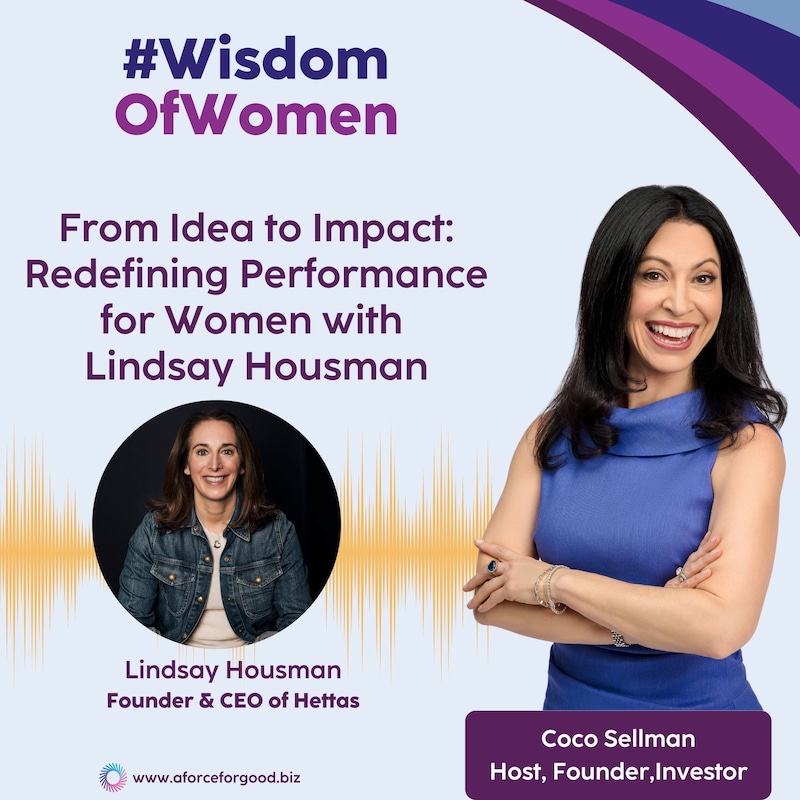
Shownotes
In our new episode we have an esteemed guest, Lindsay Housman, is a trailblazer in this realm; as the founder of Hettas, a performance footwear company meticulously engineered from a female perspective, she embodies the intersection of innovation and advocacy for women's athletic needs.
Throughout our dialogue, we explore how Lindsay's personal experiences, particularly as a mother, catalyzed her commitment to creating products that challenge the status quo within the sports industry.
By prioritizing research, community engagement, and impact, Lindsay's work stands as a testament to the profound influence of women-led enterprises on the broader landscape of business and society.
Our Guest This Week:
In this week’s episode of #WisdomofWomen we have a 🌟 Female-First Performance Architect 🌟 in our midst.
Lindsay Housman is the Founder of Hettas, a science-backed performance footwear company designed entirely from the female perspective—grounded in female biomechanics, anatomy, and lived experience. With a background spanning finance, operations, technology, and purpose-led retail leadership, she brings rare systems-level rigor to building an impact-driven brand from the ground up. Inspired by her twin daughters, Lindsay founded Hettas to challenge an industry long designed for men and to ensure women and girls receive the research, funding, and recognition they deserve in sport. Her work exemplifies what it looks like to scale a company of purpose, substance, and longevity—without compromising values, family, or integrity. ⭐
Takeaways:
- Lindsay founder of Hettas, emphasizes the importance of designing products specifically for women's biomechanics and experiences.
- The podcast discusses the urgent need for equitable support and recognition of female athletes in the sports industry.
- Lindsay shares her personal journey of resilience and the impact of her twin daughters' athletic experiences on her entrepreneurial vision.
- The significance of fostering confidence and risk tolerance in young women through sports is a central theme of the episode.
- The conversation highlights the need for women to take on leadership roles in investment and entrepreneurship, fostering a new generation of female leaders.
Chapters:
00:07 Amplifying Women's Voices in Business
04:27 Defining Moments: Embracing Change and Risk
12:42 Starting a Purpose-Led Brand: The Story of Hedda's
24:33 Navigating Funding Challenges
36:10 Empowering Women through Leadership and Investment
Closing Thoughts:
What stayed with me in this conversation is how much of building a business… isn’t visible.
It’s the decisions you make when no one’s watching.
The belief you hold when things aren’t working yet.
The willingness to keep going, even when the path isn’t clear.
Lindsay’s journey is a reminder that building something meaningful doesn’t follow a straight line.
It asks for courage.
It asks for patience.
And sometimes, it asks you to trust that the work you’re doing matters—long before the world reflects it back to you.
And maybe that’s the real work.
Not just building a company.
But becoming the person who can carry it forward.
Guest Offers & Contact Information:
https://www.linkedin.com/in/lindsay-housman-5815783/
https://www.instagram.com/wear_hettas/
https://www.tiktok.com/@wear_hettas
https://www.facebook.com/profile.php?id=100089973908189
Follow the #WisdomOfWomen show for more inspiring stories and insights from trailblazing women founders, investors, and experts in growth and prosperity.
YouTube: https://tinyurl.com/yja3w7nh
Spotify: https://tinyurl.com/4tak8ajk
Amazon Prime: https://tinyurl.com/366syddj
Apple Podcasts: https://tinyurl.com/bdhananz
RSS Feed: https://feeds.captivate.fm/womengetfunded/
Coco Sellman, the host of #WisdomOfWomen, believes business is a force for good, especially with visionary women at the helm. With over 25 years of entrepreneurial experience, she has launched five companies and guided over 500 startups. As Founder & CEO of A Force for Good, Coco supports purpose-driven women founders in unlocking exponential growth and prosperity. Her recent venture, Allumé Home Care, reached eight-figure revenues and seven-figure profits in just four years before a successful exit in 2024. A venture investor and board director, Coco’s upcoming book, *A Force for Good*, reveals a roadmap for women to lead high-impact, high-growth companies.
Learn more about A Force for Good:
Website: https://aforceforgood.biz/
Are Your GROWING or PLATEAUING? https://aforceforgood.biz/quiz/
FFG Tool of the Week: https://aforceforgood.biz/weekly-tool/
The Book: https://aforceforgood.biz/book/
Growth Accelerator: https://aforceforgood.biz/accelerator/
Transcripts
Welcome to the Wisdom of Women Show.
Speaker A:We are dedicated to amplifying the voice of women in business.
Speaker A:A new model of leadership is emerging and we are here to amplify the voices of women leading the way.
Speaker A:I am your host, Coco Zelman, five time founder, impact investor and creator of the Force for Good system.
Speaker A:Thank you for joining us today as we illuminate the path to unlocking opportunities and and prosperity for women led enterprises by amplifying the voice and wisdom of women.
Speaker A:So today we have a female first performance architect in our midst.
Speaker A:Lindsay Housman is the founder of Heddas, a science backed performance footwear company designed entirely from the female perspective, grounded in female biomechanics, anatomy and lived experience.
Speaker A:With a background spanning finance, operations, technology and purpose led retail leadership, she brings a rare systems level rigor to building an impact driven brand from the ground up.
Speaker A:Inspired by her twin daughters, we, Lindsay founded Heddas to challenge an industry long designed for men and to ensure women and girls receive the research, funding and recognition they deserve in sport.
Speaker A:Her work exemplifies what it looks like to scale a company of purpose, substance and longevity without compromising values, family or integrity.
Speaker A:Welcome Lindsay.
Speaker B:Oh my gosh, that is the nicest introduction I've ever had.
Speaker B:I might just tear up.
Speaker B:Wow.
Speaker B:Thank you so much Coco for having me today.
Speaker B:And thank you for all of your work highlighting women leaders and purpose led companies.
Speaker B:It's so important and I truly appreciate you.
Speaker A:Oh gosh, Lindsey, thank you for that and I'm so happy to have you on the show so we can learn all about you and your daughters and your company.
Speaker A:So as we start, I always like to ask, what is a book written by a woman that has significantly influenced your life?
Speaker B:The Origin of the Company is actually based on two books.
Speaker B:One is a photo editorial book by Kate T. Parker called Strong is the New Pretty, which she wrote based on a photo that she took of her daughter who was entering a triathlon to show her daughter how fierce and strong she was.
Speaker B:And it turned into this amazing photo editorial of young women, girls age 6 to 18 calling out traits like resilience, creativity with these beautiful photography quotes and editorial on these traits.
Speaker B:Around the house is a coffee table book.
Speaker B:And the second one was Untamed by Glennon Doyle that I read around the same time between when they were 6 and 8 and just the stories and essays in that book about what is possible when you look beyond what boundaries you may perceive.
Speaker B:I was like, yeah, I can do hard things.
Speaker B:I can do this.
Speaker A:Yeah, I love that.
Speaker A:Book Untamed and I am going to have to pick up a coffee copy of Strong is the New Pretty and it turned into like a, like T shirts and everywhere I was I was seeing this, this wonderful, wonderful new mantra and way to live right like rewiring our brains of what it means to be feminine.
Speaker A:And I love that.
Speaker A:Thank you for those recommendations.
Speaker B:Yeah, no problem Lindsay.
Speaker A:I always like to start out to learn some moments of our guests lives.
Speaker A:There are moments that shape us into who we are.
Speaker A:Sometimes we have moments of pain or struggle.
Speaker A:Sometimes we have moments of surprise and delight and epiphany.
Speaker A:Looking back at your life, what are three defining moments or experiences that brought you to where you are, shape you as the human that you become today?
Speaker B:I love this question because I so believe in like you look back and you can connect dots that maybe you didn't see as moments along the way.
Speaker B:And I think the first one really goes back to grade nine.
Speaker B:I can clearly remember this.
Speaker B:I grew up in Ontario and it, I always felt like it didn't suit my personality from like I loved being outdoors, I loved being athletic and it just, I was in a suburb out of Toronto that was a great place to grow up.
Speaker B:But it, and I remember we had a pool and we were, I was cleaning the pool cover with my dad and this person came around on a bike and was handing out pamphlets about the University of British Columbia.
Speaker B:I was like, whoa, I've never, I've never been to that side of Canada.
Speaker B:This looks amazing.
Speaker B:And I said to my dad, I'm going to go to ubc.
Speaker B:This looks like my type of people.
Speaker B:Like there's mountains, there's skiing, there's a campus, there's a city, it's.
Speaker B:And my dad was like, oh, that's nice sweetheart.
Speaker B:And then in grade 10 in a French project I did Whistler as my, I made a brochure of Whistler and I was like, no, I'm going to go to UBC and I'm going to go to Whistler.
Speaker B:And so when it came time to apply for universities, I only wanted to apply to ubc.
Speaker B:And my mom was like, you need to apply to more than one school.
Speaker B:And so I humored her and I filled out the applications and I remember arriving on the UBC campus and I remember my first time going to Whistler and just like I made this happen.
Speaker B:Like I put this out in the world and I worked really hard and I remember driving around Whistler and seeing like the hotels I had put in my pamphlet in grade 10 and it just really gave me this belief that if you believe in something and you work hard, that you can make things happen in your life.
Speaker B:And so I think that was a big moment for me, realizing that I can be a steward of what I would like to do, even if it's hard.
Speaker A:I love that I can be a steward of what I want to do, even if it's hard.
Speaker A:I just think that's such a brilliant piece of wisdom to take into life.
Speaker A:Right.
Speaker A:There's a book that I love, Women who Run with the Wolves.
Speaker A:And at one point there's a she says, what if I'd been born knowing that I had the heart of a warrior?
Speaker A:Like, what if somebody told me that?
Speaker A:And I love this message that you're saying that, yeah, I can be a steward of my dreams.
Speaker A:And you, I love this.
Speaker A:You're ninth grade and along comes somebody on a bike with a pamphlet and UBC is just like, I gotta go, right?
Speaker B:I gotta go.
Speaker B:We're gonna do this.
Speaker B:Yeah.
Speaker B:So I think that one, I'm trying to think of another one that stands out as impactfully, but that's the one that I always look back and remember.
Speaker A:Yeah, I gave.
Speaker A:You were clear.
Speaker A:One of the things I'm fascinated by in my own experience and in when we're making big decisions in life, whether it's having children or getting married or having starting a company or shutting down a company, it's like there was.
Speaker A:We always wish we were clear, right?
Speaker A:We always wish we knew what we wanted.
Speaker A:And sometimes we know.
Speaker A:I want to go to ubc.
Speaker B:I guess one more that comes to mind.
Speaker B:And this one was crazy.
Speaker B:And I think this one sort of gave me.
Speaker B:When I look back on it, as someone who's very pragmatic, accounting technology, one might say my appetite for risk has been low.
Speaker B:But we had 13 month old twins.
Speaker B:We had just closed on a house in Vancouver.
Speaker B:My husband was at Lululemon and we'd got back from a trip and he got called into the office on like a day he wasn't supposed to be working.
Speaker B:And I was like, oh, you're probably, they're probably going to the new role that you were taking.
Speaker B:And he calls me from the office and said, are you sitting down?
Speaker B:And I was like, no.
Speaker B:So Lulu has this thing where you put your goals on the wall and we had to decide you have to tick if you're open to international.
Speaker B:And we had decided that we were, yes, open to international, but I think the only place I will go is that I would like to go is Melbourne, where I have friends.
Speaker B:And he said, that one's not going to happen.
Speaker B:It might be Hong Kong or London, but Melbourne, you know, that one's probably not in the cards.
Speaker B:And I said, okay.
Speaker B:So he called and we literally just bought this house with babies.
Speaker B:And he was like, they've offered me the job in Melbourne.
Speaker B:Do you want to move to Australia?
Speaker B:And it was like there was no hesitation.
Speaker B:It was just like, yes, we are going to Australia.
Speaker B:We will figure this out.
Speaker B:And.
Speaker B:And we moved six months later with 18 month olds, you know, to a brand new country and stayed there for three years and had the absolute.
Speaker B:That was such a. I call it a priceless time in our life that there's.
Speaker B:I cannot put a value on what we got out of that experience.
Speaker B:But there was no hesitation where someone might think, oh, this is really an odd time to be moving across the globe to someplace that's at minimum a 17 hour direct flight.
Speaker A:But you did it.
Speaker A:Right, I see.
Speaker B:Yeah.
Speaker A:I find this to be a really common stripe on women who are up to big things.
Speaker A:Right.
Speaker A:We do stuff like we make decisions and we try stuff out.
Speaker A:And our lives are not a perfect line.
Speaker A:They're a zigzag and a spiral and an in and out.
Speaker A:Yeah.
Speaker A:As I was hearing you say this, I have 18 month old twins and here I am, I'm going across the world and I'm going to live in Australia.
Speaker A:And wow, that's just like all the reasons that could come into your mind to tell you why you shouldn't.
Speaker A:But there was something bigger calling you, right?
Speaker A:Like just.
Speaker B:Yeah.
Speaker B:You know, and yes, it was an experience of a lifetime and zero hesitation.
Speaker B:So I also look back on that.
Speaker B:Someone asked me in a different interview about when my appetite for risk and I was like, I think that made me realize that I could do something that would seem really risky.
Speaker A:Yeah.
Speaker B:And yes, there was definitely not a straight line when we were there.
Speaker B:And lots of things happened.
Speaker B:And I look back on photos and definitely there was a lot of sleep deprivation, but it doesn't matter, like the overall tone of the experience.
Speaker B:I look back on it and I'm like, well, I did that.
Speaker B:That, you know, and then I coupled that with 18 moving out to British Columbia, never having been here before.
Speaker B:I hadn't even toured the campus.
Speaker B:And so you realize that you can put yourself in these situations and you're, you're capable to figure it out.
Speaker B:Yeah.
Speaker B:And that's part of the fun.
Speaker B:Like that's the journey.
Speaker B:Right.
Speaker B:And I love puzzles.
Speaker B:I Love doing puzzles.
Speaker B:And I think if it's that, like, how can you eat an elephant?
Speaker B:Like that small piece, like if I put down a thousand piece puzzle on the table, I might be completely daunted.
Speaker B:And it's okay, just find two pieces that fit.
Speaker B:And I feel like if you can take that into retrospect, into those experience, that's what I was doing.
Speaker B:Like, how do we do this?
Speaker B:What's one thing I can do today to feel a bit more settled in this new country?
Speaker A:Oh my goodness.
Speaker A:And what I'm hearing too is you said no resistance, but like joy, right?
Speaker B:Yeah, joy in figuring it out, especially.
Speaker A:When things are hard and when we're just kind of in the ins and outs, the messy middle that like finding those little moments of calling big or small, whether it's a restaurant we want to go to or and escape to a beach that's nearby or whatever, to like keep those, those moments of joy coming out.
Speaker B:Right?
Speaker B:Yes, absolutely.
Speaker A:And then did you have a third moment you'd like to share with us?
Speaker B:No, I think that's it.
Speaker A:Well, I'm going to ask about one more specific moment.
Speaker B:Okay.
Speaker A:I want to know how your girls were a part of the story of starting Hettas.
Speaker A:Tell us what is Hedda's and, and tell us why you started her.
Speaker B:Yeah, so my daughters are, they were eight at the time when we started thinking about maybe doing something when they were done high school.
Speaker B:So the original idea.
Speaker B:So again part of Lululemon vision and goals.
Speaker B:My husband and I had sat down that Christmas and said, oh, 10 years out, our kids will be done high school.
Speaker B:And we thought, oh, wouldn't be cool to start a purpose led, social impact type brand.
Speaker B:We both love brand.
Speaker B:We both love gear.
Speaker B:We both firmly believe in the role of sport in women's lives.
Speaker B:Okay, let's just put that out there and park it.
Speaker B:And what is now Hedda's is a female specific performance running shoe brand that we pulled forward 10 years from 20, 20, 30.
Speaker B:And the reasons we landed in footwear, which at that time we had left it really loose.
Speaker B:And the reasons we pulled it forward were largely related to our kids and what we were seeing happening in the world.
Speaker B:And I had read an article that at the age of eight, people start talking to girls differently.
Speaker B:There's a different way in perceiving their athletic ability.
Speaker B:And I was like, that seems crazy.
Speaker B:Like our kids are eight, they're very athletic.
Speaker B:I don't want anyone to be speaking them in a way that's going to limit what they think is possible?
Speaker B:Because right now they think everything is possible.
Speaker B:And that's how I want them to go through life.
Speaker B:And they were in a ski program and the instructor, they were aiming for a program sort of two levels up and we're skiing at that level.
Speaker B:And the instructor was like, well, you know, I just want to set your expectations.
Speaker B:I think we'll put them in this other program next year.
Speaker B:And I said, well, why?
Speaker B:And he said, well, because they're girls, they're petite.
Speaker B:And I said, well, that's.
Speaker B:What about their capability?
Speaker B:How are they skiing?
Speaker B:Are they able to keep up with the group that they want to go in?
Speaker B:And another mom and I, with our friends, we were very big advocates, like, look, we'll listen and put them with group.
Speaker B:But it has to be ability based.
Speaker B:It can't be gender based.
Speaker B:And if there's a risk, like they're going to be doing things that are too challenging and that they're not capable of handling and they could injure themselves, absolutely put them in the other group.
Speaker B:So they got assessed and all three girls ended up in the group that they wanted in their goal group, which was two levels ups.
Speaker B:And I was so proud.
Speaker B:And also that they didn't know that this had been going on in the background.
Speaker B:So to them they were just value.
Speaker B:They did their assessment, they passed, and they got in the new group.
Speaker B:And then the next year, my daughter, one of them won a gender neutral competition, girls and boys.
Speaker B:She's nine years old, and it's her standing between, you know, two boys that are like a foot taller than her with her little ears on, her helmet, having won this, like, big mountain skiing line.
Speaker B:And that's what I want them to go through life believing, like, it doesn't matter gender.
Speaker B:And that same time that was all going on, we started seeing their friends stop participating in sports day, stop participating in track.
Speaker B:And there was a great editorial piece in the New York Times around the same time highlighting Mary Kane, Alison Felix, all of these stories.
Speaker B:And I remember saying to my husband, this is really broken, like, really broken with how girls, collegiate athletes, professional athletes, female athletes are treated.
Speaker B:The training, the nutrition, everything.
Speaker B: This was around: Speaker B:And I said, you know, I think the time is now.
Speaker B:Like the time we're going to be.
Speaker B:We can actually do something about this.
Speaker B:We have skills from our careers.
Speaker B:We landed on footwear because I'd been having all of these feet problems.
Speaker B:And my husband kept saying that a colleague of ours, Doug, will make you a pair of shoes.
Speaker B:And finally I said, why Would Doug just make me shoes?
Speaker B:And Doug was like, you're wearing shoes made for men.
Speaker B:So it was like the.
Speaker B:I was like, okay, now I know we're doing footwear, so we're.
Speaker B:We're going to do a brand focused on building quality athletic female footwear, which is gear, which I love gear, and I love athletics.
Speaker B:And so this really fit, and it's not easy, and it's going to be super challenging.
Speaker B:And I'm not even going to think about the big companies out there that are doing this, because then you would think you're insane.
Speaker B:But I'm just going to focus on why we're doing it.
Speaker B:And why we're doing it is to keep girls in sport, to fund female athletes, to bring equity to women in sport, to put public research available out there to educate women on what they need for their bodies, for performance in sport and for longevity.
Speaker B:What was starting to go through my mind is if my feet are this SORE When I'm 40, you know, I had visions of playing tennis till I was 90.
Speaker B:Like, if my feet are this sore and I'm 44, how.
Speaker B:Forget 90, how am I going to be playing tennis actively in my 50s and 60s?
Speaker B:And I was like, this needs to be addressed, like, now.
Speaker A:Yes.
Speaker B:And so it was that sort of confluence where Hedda's is very much committed to quality, technical female performance, sportswear, athletic footwear, but driven by three mission pillars of research, impact and community.
Speaker B:And I like to say the shoe is the vehicle to do the work to keep the girls in sport, to bring equity, to do the work around the research.
Speaker B:And so that's.
Speaker B:That's what I'm doing now.
Speaker A:I love the stories of how your commitment to girls in sports and what it was that you said that the importance of sports in women's lives, in particular young women's lives.
Speaker A:Can you say a little more about that?
Speaker B:I think there are such amazing qualities that come through sport.
Speaker B:Confidence, teamwork, dealing with conflict at some point, failure, learning how to lose.
Speaker B:And there's this great quote from Billie Jean King where boys are trained to be brave and girls are trained to be perfect.
Speaker B:And when I read that quote, I was just like, that is the source of Beyond Sports so much.
Speaker B:And we as women need to learn to take risk and to be comfortable with risk and all aspects of our lives and be confident that we can recover from a failure.
Speaker B:And I really think that sport and that participation gap and girls not having access, having the equipment, whether it's a sports bra that they feel comfortable in or they're wearing men's hockey gear.
Speaker A:Yeah.
Speaker B:But there's such a breakdown and then it, it impacts everything.
Speaker B:And I, I remember reading an article in the Atlantic, gosh, I don't know how many years ago, and it talked about it's not a pay gap as in careers and business for women, it's a confidence gap.
Speaker B:And we put that together with the Billie Jean King quote.
Speaker B:And then also what I'm seeing in the startup world and in the investing world.
Speaker B:Yes.
Speaker B:And I really think, I look back, I'm like, this all comes back to building confidence and risk tolerance and the teamwork piece of being okay to fail and your friends are going to support you.
Speaker B:It's not going to be a red mark.
Speaker B:So that's why I think sport is so important for girls.
Speaker A:And I love the story of how you're sort of bringing all of this into the brand.
Speaker A:So Hedis is both obviously very purpose led and science backed.
Speaker A:How have you approached and you touched on this just a touch but like how have you approached funding and scaling your business in a way that protects the integrity of your mission while also building a company that has growth and longevity?
Speaker B:I didn't realize that would be the hardest part of what I was doing and part of me is grateful for that.
Speaker B:I started my career at kpmg.
Speaker B:I worked in forestry, I worked in mining.
Speaker B:Then I worked in the ski industry also pretty big boys club ski and golf, worked in finance in that industry.
Speaker B:I had never felt my gender before until I started Hedda's fundraising for Hedez.
Speaker B:And I didn't know the stats at going in about venture capital and I'm thankful for that.
Speaker B:And there are no stats on angel investing or family office investing, but I would dare to say it's similar as the venture capital gap.
Speaker B:And so at the beginning I thought I had two investors, both of which fell through for, for valid reasons.
Speaker B:And it came to, I lined up Simon Fraser to do research and they, they came to us with the invoice to run the first two research studies.
Speaker B:We didn't have a proto, we had a name, we didn't have a shoe design.
Speaker B:And there was this check for a sizable amount of money that I needed to write if we were going to do the research.
Speaker B:And my husband and I had a long conversation about it and we're like, we're not doing Heddas unless we do the research because I'm not just going to make a shoe and say this is for women unless we are being transparent around what we're doing.
Speaker B:And why we're doing it.
Speaker B:And this education and research piece is so important.
Speaker B:So we decided to write the check ourselves, which we were in a fortunate position to be able to do.
Speaker B:But it was, I like to say I traded tae's bedroom for a research study.
Speaker B:We were going to do a renovation on our house and didn't cut the check instead.
Speaker B:So it was the absolute right decision and it was so scary.
Speaker B:And we did that.
Speaker B:And then we did a friends and family round.
Speaker B:And we're fortunate to have people in our community, our neighbors or friends, which is also super scary.
Speaker B:To take money from friends, like friends that we see all the time.
Speaker B:And for them to cut sizable checks for us made me cry with gratitude and then also be terrified that I am going to, I could lose these people's money.
Speaker B:But it was, if we wanted the company to exist, we had to do this.
Speaker B:And everybody seemed to be going in, eyes wide open.
Speaker B:So we did.
Speaker B:And that actually happened relatively easily.
Speaker B:And that was what I'd like to call the Boys Hobby Investment Club.
Speaker B:Like where we had some.
Speaker B:Even though there were really accomplished women as part of this group, as their, as their wives, it was still like a group of men that organized, made the phone calls.
Speaker B:We were funded within two weeks.
Speaker B:Super, super grateful.
Speaker B:And it made me think that this was going to be easy.
Speaker B:After that, I don't know.
Speaker B:Then we had a lot of rejection, a lot of no's.
Speaker B:I, I did a lot of investor phone calls, I did a lot more self funding.
Speaker B:We did a small bridge round, took on small business loans that require you to have personal guarantees, which again push your risk tolerance to a place of discomfort.
Speaker B:We hit a point where there was no more funding.
Speaker B: It was: Speaker B:When we tried to raise money, it all just froze.
Speaker B:We self funded business, loaned our way through it and.
Speaker B: And then in: Speaker B:I had worked at a company in Vancouver, that's an alcohol company known in the US for White Claw and Mike's Hard Lemonade.
Speaker B:It's founded by one person, it's owned by one person.
Speaker B:And his story of resilience is incredible.
Speaker B: worked there in like the late: Speaker B:And it's just like, I need help.
Speaker B:Literally I was, I had calls to figure out how, how can we continue?
Speaker B:He got an investment to me that week to keep us going.
Speaker B:And they have been invested in us the last two years, which I am extremely grateful for.
Speaker B:The level of investment relative to what I think we need to actually scale and market has been very small.
Speaker B:So our marketing has been very limited.
Speaker B:And then that puts you in this cycle where investors go well, where's all your revenue?
Speaker B:And it's like, well I have to buy inventory, I have to market.
Speaker B:Like if I'm putting in a few hundred thousand a year, it's not like putting in a million a year.
Speaker A:Yeah.
Speaker B:Where you can have the funds to show that paid digital works or PR works.
Speaker B:And so we're in this interesting place right now where we are still.
Speaker B: e been actively raising since: Speaker B:And I have grown a much thicker skin around all of the no's.
Speaker B:And I've also become much more savvy about who I'm willing to talk to and who I think is values aligned and who will understand that we are purpose driven as well as product driven and social impact.
Speaker B:And since I've made all of these decisions, I've noticed I've had an influx of inbounds.
Speaker B:Now where they're going to go I don't know.
Speaker B:But I'm finding people who are values aligned who want to be part of something larger than just a product.
Speaker B:And it's.
Speaker B:I'm optimistic I think for the.
Speaker B:I feel like the energy.
Speaker B:I have this thing go where the energy is and that that's part of the reason I stopped doing pitch conversate pitch competition.
Speaker B:I was putting so much energy out and so much prep out and same with the VC calls.
Speaker B:I stopped VC calls.
Speaker B:It's not going to work with them.
Speaker B:I know that it works with family offices.
Speaker B:I know that it works with individual high net worth individuals.
Speaker B:Finding people that are passionate.
Speaker B:Now there is the odd VC that is getting established to support women so that those I will.
Speaker B:And I am having some meaningful conversations.
Speaker B:But largely I'm not going through lists of VCs anymore.
Speaker B:I'm not trying to do things where I feel like there is a disproportion in energy and I'm saving my energy for the places that really matter to keep the momentum moving forward.
Speaker A:I just think that's so wise and you know, and it's, it's a balance I feel like because when you first get started you kind of need.
Speaker A:You don't know it's going to work.
Speaker A:No, you kind of have to try a bunch of stuff.
Speaker A:And then at the same time, you got to know.
Speaker A:You have to have this instinct that reminds you of when to pull back from things, even when there's part of you that feel.
Speaker A:If you're.
Speaker A:If you let yourself feel scarce.
Speaker B:Yes.
Speaker A:Could convince yourself to just run really hard and really fast in every direction, which doesn't work, Right?
Speaker B:No, it's not good for anyone.
Speaker A:Yeah, it's really hard.
Speaker A:Right.
Speaker A:So.
Speaker A:So what.
Speaker A:Tell me now, like, what do you feel like right now?
Speaker A:You feel.
Speaker A:What are you most proud of in the journey thus far in what you've created?
Speaker B:So last Christmas, even though we'd secured funding.
Speaker B: So: Speaker B:We were a big family of skiers, and we were up in Whistler, and I just skied for two weeks.
Speaker B:Nature.
Speaker B:I wanted to be in snowstorms.
Speaker B:Like, I just.
Speaker B:I needed to be in the elements and.
Speaker B:And read books and did puzzles and played Mario Kart with my kids.
Speaker B:And at the end of the break, I was just so emotional about driving back down to Vancouver and going to work that I couldn't stop crying.
Speaker B:So we're in with the last day, and I'm, like, hanging out with my kids, and they're like, why is mom crying?
Speaker B:What is going on?
Speaker B:And my husband's.
Speaker B:What's been a very emotional fall.
Speaker B:We're heading back down.
Speaker B:And they're like, mom, you're not gonna stop.
Speaker B:And they're like, you have to go on.
Speaker B:You cannot give up.
Speaker B:And that is my most proud moment, that those girls didn't see a barrier.
Speaker B:They were like, you can do this.
Speaker B:And that they are going to go into the world in their lives with that type of.
Speaker B:I can do this.
Speaker B:That is my most proud moment.
Speaker A:Oh, that's beautiful.
Speaker A:What I'm noticing just as you're talking about is how nurturing that thought is.
Speaker A:Right.
Speaker A:Like, how beautiful that is for you, how beautiful it is for them.
Speaker A:And thinking about every founder I've ever known, it's just like.
Speaker A:It's that gentleness of that healing, thoughts of acknowledgement.
Speaker A:It is much easier if you can grow fast and you have all the money to do that.
Speaker A:But for most of us, it's just not the way it goes.
Speaker B:No.
Speaker B:And I think, you know, there are so many gifts that come from not having the money because you are forced to be creative.
Speaker B:And I think you learn so much.
Speaker B:I'm really glad that the funding didn't come in.
Speaker B:And even now, I don't want someone to give me, like I am looking for a proportionate size to what I need.
Speaker A:Yes.
Speaker B:So that I can continue to be thoughtful.
Speaker B:Because I think I can even see it in the way, even though I'm conscious of it, if an investment lands in the account, you start to behave a little bit differently.
Speaker B:And so it's like, okay, no, I've got to keep that mindset of responsibility and spend and not make a decision quickly just because I'm feeling more secure, making sure I'm being making the right decision for the right reason.
Speaker B:And I think that's where, you know, having that experience of four years of running Super Lean really caused us to learn in a different way that I think will be beneficial and also know where we need to put the capital to scale versus, you know, you're still going to make mistakes.
Speaker B:But I think what having some capital does is allows for you to make the mistake.
Speaker B:Because when you don't have a lot of capital, you end up back in that situation where you feel like you have to be perfect.
Speaker B:And that's not how you're going to succeed.
Speaker B:Yeah.
Speaker A:It's that terrible vicious cycle.
Speaker A:And because, like, you need to run those experiments.
Speaker B:Yes.
Speaker A:You know, y.
Speaker A:And you just aren't going to know till you run those experiments.
Speaker A:You just have to.
Speaker A:So it's a hard thing.
Speaker A:So what do you feel like I'm curious about what do you feel like you're stepping into now?
Speaker A:Like as you've grown as a leader, you've gone overcome all that you have, you've had all these investment calls you've had, you've built a beautiful brand and you're.
Speaker A:It's providing wonderful shoes into the world serving women and girls.
Speaker A:So what do you feel like you're stepping into now?
Speaker A:As a human, as a steward, as a leader, as a person?
Speaker B:I feel like I'm stepping into this place where I have a responsibility to have this company work.
Speaker B:Not just because of the product, because of all of the other pieces.
Speaker B:And I've seen firsthand how meaningful the research, the athlete support programs we've set up, the participating in the Women's Decathlon movement because it's still a heptathlon in the Olympics.
Speaker B:Working with the Mum Forward Movement group out of San Francisco, creating meaningful community events where we bring together practitioners and have conversations and safe spaces with women with a run.
Speaker B:And all of those pieces are so important.
Speaker B:I feel this responsibility to nurture those and to grow the company in a sustainable way so we can keep feeding those mission pillars.
Speaker B:The amount of difference that those little pieces would have.
Speaker B:I like to say we're doing athlete support in a startup way.
Speaker B:And anytime I have a bad day, my husband's like, just hop on a call with an athlete.
Speaker B:And as soon as I start talking to an athlete and I realize the impact that our fifteen hundred dollars can have on their ability to participate in that next race they didn't think they could get to or their sport.
Speaker B:I didn't realize the gap in support between the top.01% of athletes and everybody else.
Speaker B:And so as I'm learning about these gaps, I feel like there is a responsibility there and then the other place I'm starting to learn and I want to lean into.
Speaker B:As we is supporting other founders and supporting women in investment and how do we coach women out of this idea of perfect and understanding that also what they view as philanthropy can be social impact investing.
Speaker B:I think there is a huge opportunity with this great generational wealth transfer and the way women have been systemically trained around being the philanthropist of the household versus the male being the investor.
Speaker B:This social impact investing is a.
Speaker B:Is real and a great bridge.
Speaker B:And also this risk tolerance where I think women feel comfortable and I'm generalizing here more with philanthropy because they know it's a.
Speaker B:They know that it's a donation and it's going to whatever cause where with investment, I feel like there's this need to make sure that they're going to put their money in something that's for sure.
Speaker B:And that's not how investing works.
Speaker B:And so, you know, how can I participate in this conversation in a way to be supportive?
Speaker B:I think this is going to take a while to shift.
Speaker B:This is a major systemic change.
Speaker B:But it's.
Speaker B:The conversations are happening and there are amazing women doing this work.
Speaker B:So I also want to be part of that.
Speaker A:I love that today I'm an exited founder and I'm looking to buy a business right now.
Speaker A:And it's kind of the biggest motivator for me is what I will, what I get to do with the capital that I have and the power.
Speaker A:I mean the power of capital is really significant and significant.
Speaker A:We need to have women in the room.
Speaker B:Yes.
Speaker A:With our capital making decisions 100%.
Speaker A:And I find that it's a common thread for women founders.
Speaker A:We're less interested in the Maserati and we're more interested in what we're going to do to further the success of others and of causes we care about and purpose and the idea.
Speaker A:I love that like your husband reminds you to call an athlete when you're having a good day, a bad day, because it's to me, that's what purpose fuels.
Speaker A:Profit.
Speaker B:Yeah.
Speaker A:When you're connected to purpose, you do your best.
Speaker B:100%.
Speaker B:100%.
Speaker B:And that, you know, we don't have a big team at Hedis at all.
Speaker B:I have one full time employee and a few contractors.
Speaker A:Yes.
Speaker B:And everybody that has joined the team is, has reached out and been fueled by the purpose to want to be part of it.
Speaker B:And it's amazing what you can accomplish with a very small, fragmented.
Speaker B:10 Hours a week here, 10 hours a week, their team, when they are fully connected to what you are building.
Speaker B:And it, it makes such a big difference in your day to day to feel like I'm do I'm working for something bigger than me.
Speaker A:Yeah.
Speaker A:It's a human need.
Speaker A:Right.
Speaker A:We can create cultures and companies that fulfill that incredibly deep need and do good things in the world.
Speaker A:Wow.
Speaker A:That's awesome.
Speaker A:So I'd like to now take us to our fast fire round.
Speaker B:Okay.
Speaker A:Okay.
Speaker B:Ready?
Speaker B:All right.
Speaker B:Yes.
Speaker A:So a favorite athlete who inspires you?
Speaker B:Oh, Gabby Thomas.
Speaker A:Gabby Thomas, as a mother of twin daughters, what leadership behavior are you most conscious of modeling through headers?
Speaker B:Tenacity.
Speaker A:Tenacity.
Speaker A:What's a quiet win you're deeply proud of that?
Speaker A:Doesn't show up in metrics or press releases.
Speaker B:My kids.
Speaker A:Yeah.
Speaker A:Risk or resilience?
Speaker B:Resilience.
Speaker A:If you could hand one hard earned piece of wisdom to a woman founding a science or product led company today, what would you want her to know sooner?
Speaker B:Oh, that is a hard one.
Speaker B:That is not.
Speaker B:That is not a fast question.
Speaker B:What would I want her to know sooner?
Speaker B:That she is making an impact.
Speaker B:It might be silent for a while, but she's making an impact.
Speaker B:Just keep putting one foot in front of the other so people are noticing.
Speaker B:People see the work and it's.
Speaker B:You just keep moving forward.
Speaker A:Keep climbing the mountain.
Speaker B:Right?
Speaker A:Yeah, I love that.
Speaker A:So Lindsay, how can our listeners find you?
Speaker B:Yes, we sell online across North America and soon to be Europe in April and we have new colors launching.
Speaker B:So I'm so excited.
Speaker B:So our website is www.head as h e t t a s.com and we do sell in a couple locations in San Francisco and a few in Canada.
Speaker B:They're listed on the website as well and they'll have stock once our new colors come out.
Speaker A:So everybody go, go to hedis.com httas.com check it out.
Speaker A:Get signed up on the mailing list so you can stay in touch and be sure to order a pair of sneakers designed finally for women.
Speaker A:And you can also follow and get to know Lindsay on LinkedIn.
Speaker A:She has a place there.
Speaker A:And you can also go to Instagram and TikTok.
Speaker A:Instagram and TikTok.
Speaker B:Yes, we on Instagram and TikTok.
Speaker B:We are wear W e a r underscore headers.
Speaker A:Wonderful.
Speaker A:Yeah.
Speaker B:Please join us and follow along.
Speaker B:Yay.
Speaker A:So thank you so much, Lindsay, for joining us today on the Wisdom of women show.
Speaker A:We really appreciate your wisdom and your truth and your vulnerability and your strength.
Speaker A:Oh my goodness.
Speaker A:Creating Hedda's out of nothing, out of just a pure desire to help kids, help girls find their way and not drop out of athletics so soon.
Speaker A:And to you listeners, our world changing listeners, be sure to follow like and share the wisdom of women show on whatever your favorite listing or viewing platform is.
Speaker A:And be sure to infuse more wisdom into your business.
Speaker A:Take the growth readiness quiz at a ForceForGood biz quiz and uncover where your insight is needed most.
Speaker A:The world is made better by women led business.
Speaker A:Let's all go make the world a better place.
