Shownotes
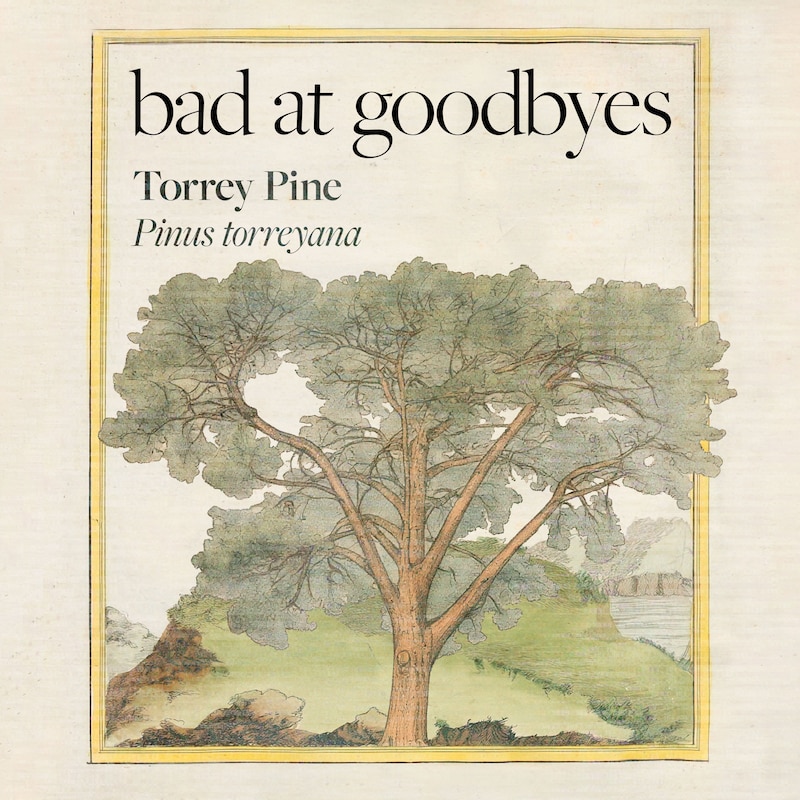
Torrey Pine :: Pinus torreyana
Bad at Goodbyes :: Episode 078
On today’s show we learn about the Torrey Pine, a critically endangered evergreen conifer, native to the North American Pacific coast, with two populations in California, one near San Diego and one on Santa Rosa Island near Santa Barbara. Its scientific name is Pinus torreyana and it was first described in 1855.
- (00:05) Intro
- (02:05) Species Information
- (22:46) Citations
- (24:29) Music
- (30:39) Pledge
For more information about Torrey Pines conservation, please see the Torrey Pine Conservancy at https://www.torreypines.org
Research for today’s show was compiled from:
- American Conifer Society. n.d. “Pinus torreyana.” American Conifer Society. – https://conifersociety.org/conifers/pinus-torreyana
- Biondi, Franco, Daniel R. Cayan, and Wolfgang H. Berger. 1997. "Dendroclimatology of Torrey Pine (Pinus torreyana Parry ex Carr.)." The American Midland Naturalist 138 (2): 237–51. – https://doi.org/10.2307/2426817
- California State Parks. n.d. "Torrey Pines State Natural Reserve." Accessed May 16, 2026. – https://www.parks.ca.gov/?page_id=657
- Di Santo, L.N., Mead, A., Wright, J.W. and Hamilton, J.A. (2025), Genetic Basis of Reproductive Isolation in Torrey Pine (Pinus torreyana Parry): Insights From Hybridization and Adaptation. Evolutionary Applications, 18: e70094. – https://doi.org/10.1111/eva.70094
- Di Santo, L. N., Hoban, S., Parchman, T. L., Wright, J. W., & Hamilton, J. A. (2022). Reduced representation sequencing to understand the evolutionary history of Torrey pine (Pinus torreyana parry) with implications for rare species conservation. Molecular Ecology, 31, 4622–4639. – https://doi.org/10.1111/mec.16615
- Esser, Lora L. 1993. "Pinus torreyana." In Fire Effects Information System. U.S. Department of Agriculture, Forest Service, Rocky Mountain Research Station, Fire Sciences Laboratory. – https://www.fs.usda.gov/database/feis/plants/tree/pintor/all.html
- Farjon, A. 2013. Pinus torreyana. The IUCN Red List of Threatened Species 2013: e.T42424A2979186. – https://dx.doi.org/10.2305/IUCN.UK.2013-1.RLTS.T42424A2979186.en
- Hamilton, Jill A., Alayna Mead, Jessica W. Wright, and Mikhail V. Matz. 2017. "Genetic Conservation and Management of the California Endemic, Torrey Pine (Pinus torreyana Parry): Implications of Genetic Rescue in a Genetically Depauperate Species." Ecology and Evolution 7 (18): 7370–81. – https://doi.org/10.1002/ece3.3306
- Johnson, M., Vander Wall, S.B. & Borchert, M. A comparative analysis of seed and cone characteristics and seed-dispersal strategies of three pines in the subsection Sabinianae . Plant Ecology 168, 69–84 (2003). – https://doi.org/10.1023/A:1024470224134
- McMaster, Gregory S., and Paul H. Zedler. 1981. "Delayed Seed Dispersal in Pinus torreyana (Torrey Pine)." Oecologia 51 (1): 62–66. – https://doi.org/10.1007/BF00344654
- Steele, Stephanie, and Christa Horn. 2021. "The Torrey Pine." Zoonooz, January 20, 2021. – https://sandiegozoowildlifealliance.org/story-hub/zoonooz/the-torrey-pine
- Tianshi, E., Chau, P.C. Foliar water uptake in the needles of Pinus torreyana. Plant Ecology 223, 465–477 (2022). - https://doi.org/10.1007/s11258-022-01222-z
- Wells, Molly L., and Arthur Getis. 1999. "The Spatial Characteristics of Stand Structure in Pinus torreyana." Plant Ecology 143 (2): 153–70. – https://doi.org/10.1023/A:1009866702320
- Wikipedia – https://en.wikipedia.org/wiki/Torrey_pine
- Williams, A., Still, C., Fischer, D., & Leavitt, S. (2008). The influence of summertime fog and overcast clouds on the growth of a coastal Californian pine: a tree-ring study. Oecologia, 156(3), 601-611. Pubmed ID: 18368424. – http://dx.doi.org/10.1007/s00442-008-1025-y
Please find us on the web at Bad at Goodbyes and on instagram. Please subscribe and rate/review Bad at Goodbyes wherever you listen to podcasts. Please help spread the word about the show and about the species we feature. Please take care of each other, and all of our fellow travelers.
A note on accuracy: I strive for it! These episodes are well-researched and built from scholarly sources, hoping to provide an informed and accurate portrait of these species. That said, I’m a musician! I am not an academic and have limited scientific background. I may get things wrong! If you are using this podcast for scholarship of any kind, please see the cited sources and double-check all information.
Transcripts
Welcome to Bad at Goodbyes.
On today’s show we consider the Torrey Pine.
Species Information:The Torrey Pine is a critically endangered evergreen conifer, native to the North American Pacific coast, with two populations in California, one near San Diego and one on Santa Rosa Island near Santa Barbara. Its scientific name is Pinus torreyana and it was first described in 1855.
The Torrey Pine is a midsized conifer (meaning it reproduces via cones). Its growth form is wildly diverse based on growing conditions. It can range from 30 to over 100 feet in height depending on where it grows. Individuals sheltered in ravines and canyons grow tall and straight with a fairly symmetrical branching canopy. Individuals more exposed to coastal forces like wind and salt spray, are much shorter with a wide flattened irregular crown, with bent and twisted branches, and a crooked trunk that often leans away from prevailing coastal winds.
Their bark is dark grayish, redish-brown, with deep furrows and ridges. The bark is thick, a protective barrier against these environmental stressors
The Torrey Pine's leaves are thin, fairly stiff, long cylindrical needles, each roughly a foot in length, and typically growing in bundles of 3-5 dark-green / grey-green needles near the ends of the branches. The needles are adapted for foliar water uptake, that's absorbing atmospheric moisture (like clouds and fog) directly through its foliage.
Many plants in arid environments have waxy foliage, adapted to prevent water-loss. With the Torrey Pine that protective layer is sparse and uneven, and so moisture does not bead and quickly runoff, instead droplets flatten out, with a larger, thinner surface area, allowing for absorption directly through the needle's surface.
And because many of the tree's branches and needle-bundles grow upward-pointing, droplets that do form slide down the length of the needle, funneled directly into a highly absorbent area at the needles' base, called the fascicle sheath which captures any excess runoff that wasn't already absorbed by the needle's surface.
Additionally, the Torrey Pine also relies on more common fog drip moisture capture. That is when condensation on the upper canopy needles and branches, falls, drips to the soil at the tree's base, which is then later absorbed by the tree's roots. So during say a prolonged heavy fog, needle surfaces may become fully saturated, unable to take on more water, so that additional moisture drips to the soil below providing water both to the tree itself and importantly to younger Torrey Pine saplings.
The Torrey Pine is monoecious. Both male and female reproductive structures grow on the same individual. The Torrey Pine is a conifer, so, these are cones. The smaller male pollen producing cones are yellow and cluster on lower branches. The female cones are red, and are located higher in the canopy.
The male cones release their pollen from January to March, and the pollen is dispersed by the wind. Torrey Pine generally cross pollenates, so the pollen released from the lower growing male cones requires a strong updrafting crosswind to carry the pollen to the upper branches of neighbor trees to fertilize the canopy growing female cones. Once fertilized the female cones can take up to 3 years to mature, developing into large 4-6 inch diameter woody cones, which hold roughly 100 hard shelled seeds tucked beneath protective woody scales. In a fairly unusual adaptation, the Torrey Pine's seed cones remain on the tree, with the woody scales opening to release seeds very slowly, over the course of up to fifteen years. Over which the seeds do remain viable. Once released the seeds have a small wing, but research has demonstrated that the wing, due to the weight of the seeds, plays little role in wind distribution, most seeds simply fall beneath the parent plant. Any farther distribution is via zoochory, by animals, in this case by the California Scrub Jay. The Jay feeds on the seeds, and will frequently gather and store surplus seeds in small caches across its range, using its bill to bury the seeds. Forgotten caches, seeds essentially planted by the bird but not returned to, may successfully germinate and grow into saplings.
It takes roughly 12 years for a sapling to reach reproductive maturity, and the Torrey Pine can live to over 150 years-old.
————
In the dream,
A century bent by the slow forces,
Tender to the wind and the sea.
To anchor the soil
To invite the jaybird to supper
To drink sunlight, and fog.
To holdfast through storm,
To choke upon mansmoke,
To thirst in drought,
To kiss the sea-spray,
To age into a gnarly twisted beauty,
To live long
Resilient and perhaps quietly defiant.
In the dream.
————
The Torrey Pine is native to the Pacific Coast of North America, in southern California. They're found in two subpopulations: along a narrow strip of coast in San Diego County, in the Torrey Pines State Natural Reserve. And on Santa Rosa Island, roughly 25 miles off the coast of Santa Barbara, in the Channel Islands National Park.
This is a California Coastal Sage and [shapp-er-EL] Chaparral ecoregion, a kind of arid fog belt ecosystem where native species have adapted to survive in a low precipitation environment. The landscape is rugged, with steep sandstone cliffs, jagged coastal bluffs, rocky gullies, and deep ravines. We find our Torrey Pine in scattered groves and as singular individuals anchoring their roots into thin sandy soils in canyons, and on ridgetops exposed to strong ocean winds and heavy salt spray.
This is a temperate maritime climate. Summer temperatures average in the mid-80s°F; winter temps average in the 40s°F. Rainfall is sparse, averaging under roughly 15 inches per year, falling primarily in winter and early spring. In the long, very dry summer months, marine fog often blankets the coastline, providing essential that moisture to species like our Torrey Pine adapted to collecting it.
Torrey Pine share their coastal habitat with:
California Scrub Jay, Black Sage, Striped Skunk, California Poppy, Western Yarrow, California Ground Squirrel, Santa Rosa Island Manzanita, White Sage, Bobcat, Red-tailed Hawk, California Buckwheat, Bush Poppy, Slender Wild Oat, Coyote, Western Fence Lizard, Mule Deer, Great Blue Heron, Oniongrass, California Scrub Oak, California Sagebrush, Saw-toothed Goldenbush, Purple Cudweed, Bent Grass, California Quail, Desert Cottontail, California Kingsnake, Anna's Hummingbird, Brown Pelican, Long-tailed Weasel, and many many more.
, to Santa Rosa Island in the:The mainland population was also affected by domesticated grazers, as well harvested for timber, and logged for fuel.
es leading to mortality. From:Human induced climate change, brought on by persistent overreliance on fossil fuel, presents immediate and long term threats to the Torrey Pine. Global warming is resulting in longer dry seasons, and less rainfall overall in Southern California, a stressor on the Torrey Pine. Climate change is also producing more frequent extreme weather. And with a concentrated, small population, the risk is a single weather phenomenon, a stochastic event, like say a coastal mudslide, could severely reduce the Torrey Pine population all at once.
Additionally global warming and urban development are resulting in particularly specific circumstances that threaten the Torrey Pine. San Diego is growing; replacing undeveloped land with human infrastructure like roads and highways. Concrete and asphalt hold and release heat which generates a heat island around the city. Relatedly, warming oceans are increasing surface temperatures along the coast. This combined heat is affecting patterns of cloud cover. There is a specific altitude at which a rising air mass cools enough for its water vapor to condense into liquid droplets, this is called the Lifting Condensation Level. So clouds only forming now at higher atmospheric elevations than in the past. The risk is the clouds forming too high for the Torrey Pine to utilize that moisture via their fog capture adaptations. The fog still rolls in, but above the tree's canopy.
on were protected as early as:Torrey Pines State Natural Reserve has developed a successful program to capture bark beetle using pheromone traps, reducing pressures on our Pine.
Torrey Pine seeds have been collected and are preserved at the San Diego Zoo's Native Plant Seed Bank. The zoo has also initiated an off-site program to selectively cultivate bark beetle resistant saplings which will then be reintroduced to their habitat.
ed on the IUCN Red List since: ounts estimate that less than: Citations:Information for today’s show about the Torrey Pine was compiled from:
American Conifer Society. n.d. “Pinus torreyana.” American Conifer Society. – https://conifersociety.org/conifers/pinus-torreyana
ayan, and Wolfgang H. Berger.: ,: ght, J.W. and Hamilton, J.A. (: ht, J. W., & Hamilton, J. A. (: Esser, Lora L.: Farjon, A.: Wright, and Mikhail V. Matz.: (: egory S., and Paul H. Zedler.: Stephanie, and Christa Horn.: (: , Molly L., and Arthur Getis.:Wikipedia – https://en.wikipedia.org/wiki/Torrey_pine
, Fischer, D., & Leavitt, S. (:For more information about Torrey Pines conservation, please see the Torrey Pine Conservancy at https://www.torreypines.org
Music: Pledge:I honor the lives of all Torrey Pine. I will commit their name to my record. I am grateful to have shared time on our planet with this being. I lament the ways in which I and my species have harmed and diminished this species. I grieve.
And so, in the name of the Torrey Pine I pledge to reduce my consumption. And my carbon footprint. And curb my wastefulness. I pledge to acknowledge and attempt to address the costs of my actions and inactions. And I pledge to resist the harm of plant and animal kin and their habitat, by individuals, corporations, and governments.
I forever pledge my song to the witness and memory of all life, to a broad celebration of biodiversity, and to the total liberation of all beings.




