Shownotes
Positive thinking alone isn’t enough—and neuroscience proves it.
Lasting change happens when you understand how the mind actually works, especially the subconscious systems that drive habits, emotions, and behavior beneath conscious awareness.
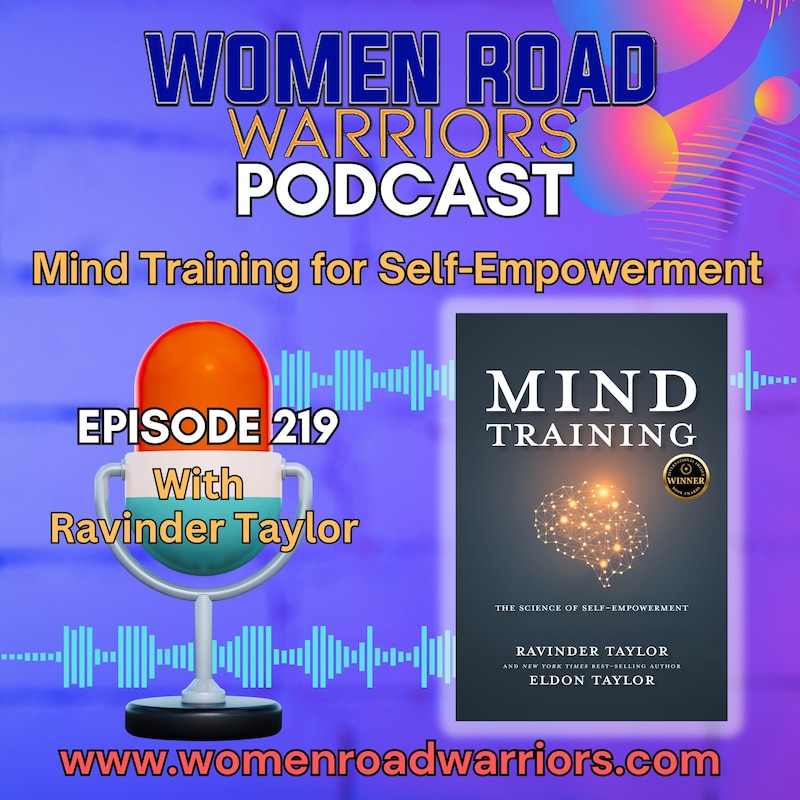
On Women Road Warriors, Shelley Johnson and Kathy Tuccaro sit down with Ravinder Taylor, lead author of the groundbreaking book Mind Training: The Science of Self‑Empowerment. Ravinder brings a rare blend of scientific rigor and real-world application, drawing from her background in biology, neuroscience, and more than 30 years in hypnotherapy and psychotherapy.
In this powerful conversation, Ravinder explains why mindset alone falls short—and how intentional mind training rewires neural pathways that shape confidence, motivation, and emotional regulation. She breaks down the science behind self-empowerment and shares practical tools anyone can use to interrupt self-limiting patterns, retrain subconscious responses, and create meaningful, sustainable change.
If you’re ready to move beyond surface-level positivity and learn a science-based framework for personal growth, fulfillment, and peak performance, this episode delivers psychology and brain science at its best.
Train your mind. Reclaim your power. Create a life that actually changes.
https://womenroadwarriors.com/
https://womenroadwarriors.com/power-network
#MindTraining #Neuroscience #SelfEmpowermen #BrainScience #RavinderTaylor #WomenRoadWarriors #PodcastEpisode
Transcripts
This is Women Road warriors with Shelly Johnson and Kathy Tuccaro.
Speaker A:From the corporate office to the cab of a truck, they're here to inspire and empower women in all professions.
Speaker A:So gear down, sit back and enjoy.
Speaker B:Welcome.
Speaker B:We're an award winning show dedicated to empowering women in every profession through inspiring stories and expert insights.
Speaker B:No topics off limits.
Speaker B:On our show, we power women on the road to success with expert and celebrity interviews and information you need.
Speaker B:I'm Shelley.
Speaker C:And I'm Kathy.
Speaker B:We hear a lot today about positive thinking.
Speaker B:What many people don't know is positive thinking alone is incomplete.
Speaker B:Real self empowerment happens when you understand the mechanics of the mind, especially the subconscious processes and train them intentionally.
Speaker B:Can you imagine rewiring your brain to empower yourself and overcome your mental barriers?
Speaker B:There are actionable ways to do this.
Speaker B:Ravinder Taylor is the lead author of the groundbreaking book Mind Training the Science of Self Empowerment.
Speaker B:It combines neuroscience with practical self improvement strategies that offer people insights into unlocking their full potential.
Speaker B:It's psychology and brain science at its best.
Speaker B:It's a science based framework for training the mind.
Speaker B:Ravinder is a seasoned mind science researcher who transitioned from a biology lab to 30 years in hypnotherapy, psychotherapy and the research of mental empowerment.
Speaker B:She shares tools anyone can use to stop self limiting behaviors and live a more fulfilled and successful life.
Speaker B:Kathy and I couldn't wait to tap into her insights so we invited her on the show.
Speaker B:Welcome Ravinder.
Speaker B:Thank you so much for being with us.
Speaker D:Well, thank you, Shelly.
Speaker D:Thank you, Kathy.
Speaker D:I appreciate you having me on and I'm looking forward to a really fun conversation.
Speaker B:Oh yes, no kidding.
Speaker C:Thank you for being on the show.
Speaker B:Yes, this is going to be really exciting.
Speaker B:I mean, your insight is amazing.
Speaker B:Ravinder, I know Kathy and I are super curious, but before we explore your information, is it possible for you to talk, talk briefly of how you got started and maybe how this methodology's helped you?
Speaker D:Oh, that's, that's a big question.
Speaker D:I've been using the tools, all of the tools and techniques that I talk about in my training.
Speaker D:I have been putting into practice in my own life for the last 30 plus years as, as I come across something new, I will try it out for myself and if it works, it ended up in the book.
Speaker D:If it didn't, it got discarded.
Speaker D:I think I've always had an interest in the mind, but my background is in microbiology.
Speaker D:It was very much the hard science.
Speaker D:And so when I was younger and when I went through university and I started working I was very much science based.
Speaker D:So I was working in the path lab and there was a particular event that shifted my entire career focus.
Speaker D:It actually caused the entire transition.
Speaker D:And one day I was in the path lab and we heard about a lecture that the hospital was sponsoring.
Speaker D:And the lecture was on hypnosis and hypnotherapy.
Speaker D:At that time, I thought hypnosis was just something entertainers did on stage, try to get people up there to act like idiots and make everybody laugh.
Speaker D:So I didn't take it seriously at all.
Speaker D:But I found the lecture itself absolutely fascinating.
Speaker D:And one of the stories that had a huge impact on me was an account of a woman who had had a pain in her arm.
Speaker D:She'd had a pain in her arm for about a decade.
Speaker D:She had seen all of the experts, all of the doctors, they hadn't been able to help.
Speaker D:So as a last resort, she went to see this hypnotherapist.
Speaker D:Actually he practiced hypnotherapy on the side.
Speaker D:He was an anesthesiologist during the day.
Speaker D:But she went to see him and under hypnosis he went back to the triggering event.
Speaker D:And she did remember an emotional event, but she had put it to the back of her mind.
Speaker D:It was an old situation.
Speaker D:You know, we all have events in our past that have upset us, but it doesn't mean that it has a hold on us right now.
Speaker D:But she remembered this event, didn't think too much of it.
Speaker D:But the following day she called the hypnotherapist up and said the pain had gone.
Speaker D:The pain had actually gone immediately, but she hadn't believed it.
Speaker D:So she had waited until the following day.
Speaker D:Now, I found this really, really intriguing to me, how a past event, a trauma in the past, maybe you remembered it, maybe you don't, but either way, you thought you had moved on from it.
Speaker D:But how something like that can have an effect on our current day experiences.
Speaker D:And with all the research I have done since then, I've discovered quite the kind of impact it has.
Speaker D:How our past experiences can hold us back, how they prevent us from trying our hardest.
Speaker D:So that was where it all started, though, from that one lecture.
Speaker D:From there I went and did a three year course in hypnosis and psychotherapy.
Speaker D:I underwent hypnotherapy myself.
Speaker D:I got to experience and then learn how to do hypnotherapy.
Speaker D:Hypnotic drawing, hypnotic writing.
Speaker D:It just fascinated me, the amount of information that was in the subconscious mind.
Speaker D:So I've been working on how to tap that information and how to have it help us rather than hinder us.
Speaker B:The brain is an amazing organism when you think about it, and I think it's still kind of misunderstood by even the professional neurologists and everything else.
Speaker B:There's so much we're still discovering.
Speaker B:What exactly is the subconscious mind?
Speaker D:The subconscious mind, you can divide the mind up.
Speaker D:Now, there are lots of different models.
Speaker D:There isn't any hard information here, but there are these models that talk about the conscious, the preconscious, and the subconscious.
Speaker D:So the conscious is what we are experiencing right now.
Speaker D:The preconscious will be those things that they're not to the top of our mind.
Speaker D:But that's when we try to remember.
Speaker D:Remember someone's name, remember a song from our past.
Speaker D:All of that is stored in the preconscious mind.
Speaker D:The subconscious stores all of our experiences, everything that we have learned, and it tries to guide us as to how we make choices.
Speaker D:Now, we tend to think we make choices from our conscious mind.
Speaker D:If you ask me to choose between vanilla ice cream and chocolate ice cream, you think that's coming from the conscious mind.
Speaker D:But what can happen is that these choices actually come from the subconscious mind.
Speaker D:They've actually done hard research to show this.
Speaker D:Benjamin Libet started this in the 80s.
Speaker D:John Dylan Hayes went on and developed it further, as did Itzhaq Farid.
Speaker D:They used different technologies, from FMRI to implanting electrodes.
Speaker D:But what they found was there is activity in the subconscious mind before you make a choice.
Speaker D:So a technician looking at the equipment can predict what you are going to choose up to seven seconds before you indicate you have made a choice.
Speaker D:Now, these choices are really simple.
Speaker D:It's am I going to press the button with my right hand or my left hand?
Speaker C:Or, like, am I going to eat the chocolate?
Speaker D:Yeah, well, that one's not much of a choice.
Speaker D:Of course, I got to eat the chocolates.
Speaker D:As I said, they discovered there's activity in the subconscious part of the mind that indicates what it is we're going to choose.
Speaker D:Now, this becomes really, really important, because if our choices are made by our subconscious mind, then are we in charge of anything?
Speaker D:What happens to the idea of free will?
Speaker D:There are lots of people out there, lots of the greatest minds.
Speaker D:Sapolsky has written a fabulous book, Determined, that explains in great depth why there is no such thing as free choice.
Speaker D:And it makes perfect sense because everything has a precursor to it.
Speaker D:So our genetics have an influence.
Speaker D:Our past experiences.
Speaker D:Whether we're fortunate to be born in a home that supports personal development or whether we're not all of these things.
Speaker D:There's always a precursor event.
Speaker D:But the idea that my husband and I have regarding this is if the choices come from the subconscious mind and the subconscious mind absorbs all of our experiences, what can we do to program the subconscious mind so that it supports us?
Speaker D:So let me give you one particular example.
Speaker D:Lots of people are afraid of public speaking.
Speaker D:There was a time I was petrified doing an interview like this wouldn't have happened.
Speaker D:Now, my husband is a New York Times bestselling author.
Speaker D:He's written lots of books.
Speaker D:He's done lots of interviews.
Speaker D:There were opportunities as he was writing his books for me to go on these interviews with him.
Speaker D:I ran a mile.
Speaker D:There was no way I would do such a thing.
Speaker D:Through all of the process, all of the work that I've done, I realized, looking back into my past, that there was one particular event for me.
Speaker D:Obviously, there are.
Speaker D:You can have the first event, but then you can have lots of other events that reinforce the idea that I didn't want to stand up in public and make an idiot of myself.
Speaker D:And it was an event that happened when I was in junior school, so I would have been about nine, I believe.
Speaker D:And we had a school event and one of the other people couldn't attend.
Speaker D:So I ended up having to take two roles.
Speaker D:One of the roles I had was just to hit two coconut shells together to make the sound of horse hooves.
Speaker D:And then I had to do the speaking part.
Speaker D:So I'm there on stage, and I come to this speaking part.
Speaker D:So I have to quickly put down these coconut shells and pick up my paper and read from it.
Speaker D:I was nine years old.
Speaker D:I've always been really short.
Speaker D:I'm five foot and I'm five foot now.
Speaker D:Back then I was a whole lot shorter and small.
Speaker D:And anyway, the audience, looking back on it now, the audience thought I looked cute, but that wasn't how I took it at the time.
Speaker D:I thought, they're laughing at me, and I was embarrassed and I felt stupid.
Speaker D:And it was in.
Speaker D:It was through hypnosis, hypnotherapy.
Speaker D:It was through understanding the different developmental stages of life.
Speaker D:It was looking at all of this.
Speaker D:When that information came up from my subconscious mind that says no, that was where it started.
Speaker D:That was when I felt embarrassed speaking in public.
Speaker D:And so the subconscious mind wants to protect us from future hurt and future pain.
Speaker D:So it would prevent me from doing anything where public speaking was involved.
Speaker D:So our past experience had this huge effect on today.
Speaker D:But if we can uncover it, if we understand how the information gets in there, what we can change it.
Speaker A:Stay tuned for more of Women Road warriors.
Speaker A:Coming up.
Speaker B:Industry Movement Trucking Moves America Forward is telling the story of the industry.
Speaker B:Our safety champions, the women of trucking, independent contractors, the next generation of truckers, and more help us provide the best of our industry.
Speaker B:Share your story and what you love about trucking.
Speaker B:Share images of a moment you're proud of and join us on social media.
Speaker B:Learn more at truckingmovesamerica.com.
Speaker A:Welcome back to Women Road warriors with Shelly Johnson and Kathy Tucaro.
Speaker B:If you're enjoying this informative episode of Women Road Warriors, I wanted to mention Kathy and I explore all kinds of topics that will power you on the road to success.
Speaker B:We feature a lot of expert interviews, plus we feature celebrities and women who've been trailblazers.
Speaker B:Please check out our [email protected] and click on our Episodes page.
Speaker B:We're also available wherever you listen to podcasts.
Speaker B:Check us out and bookmark our podcast.
Speaker B:Also, don't forget to follow us on social media.
Speaker B:We we're on Twitter, Facebook, Instagram, Pinterest, LinkedIn, YouTube and other sites and tell others about us.
Speaker B:We want to help as many women as possible.
Speaker B:We hear it all the time.
Speaker B:Think positive, stay optimistic.
Speaker B:Just change your mindset.
Speaker B:But what if that's only part of the equation?
Speaker B:What if the real power to change your life lives deeper inside the subconscious patterns you've been running on autopilot for years?
Speaker B:Our guest, Ravinder Taylor, says lasting empowerment doesn't just happen by wishing, it happens by training the mind.
Speaker B:Ravinder is the lead author of the groundbreaking book Mind Training the Science of Self Empowerment.
Speaker B:It combines neuroscience with practical self improvement strategies that offers people insights into unlocking their full potential.
Speaker B:Ravinter blends real neuroscience with practical tools that anyone can use to rewire mental habits that keep us stuck.
Speaker B:Stay with us.
Speaker B:This is where self empowerment gets real.
Speaker B:Ravinder.
Speaker B:So basically the subconscious mind, which I've always thought was kind of something that archived the daily events and everything else that we aren't really aware of and then maybe it also kind of intervenes in our dreams, it actually could be responsible for some of the fight flight because of a past experience then definitely, definitely.
Speaker D:If you had a bad experience with a dog as a child.
Speaker D:For me, my mother wasn't into having pets.
Speaker D:She would tend to think that dogs and cats were dirty and get them out of here.
Speaker D:So there was this constant programming when I was a child that if my mom saw animals There'd be lots of screaming and shouting and chasing them off type stuff, which instilled fear in me.
Speaker D:I think my family got the first cat.
Speaker D:I would have been in my early 20s and I was afraid to pick it up.
Speaker D:There were lots of other events too.
Speaker D:So it wasn't just my mother.
Speaker D:But I mean, everything adds on.
Speaker D:When I first started doing, when I underwent hypnotherapy myself, we discovered this, but we went back looking for the cause of a particular situation I was dealing with.
Speaker D:And the hypnotherapist, he went all the way back.
Speaker D:And what he did was he used an idiomotor response.
Speaker D:So under hypnosis he says, I'm going to take you back, I'm going to count you back from your present age.
Speaker D:So 25, 24, 23.
Speaker D:And whenever there's a year where there is an event that contributed to your current issue, your index finger will raise.
Speaker D:And I discovered there that there were lots of them.
Speaker D:So you can have the original event happen when you're five, six, seven years old.
Speaker D:But then it gets reinforced and reinforced and reinforced.
Speaker D:So it ends up you have this constant programming going on that says, be afraid of dogs, be afraid of animals.
Speaker D:And I had to work consciously to get through that.
Speaker D:Now I love my dogs.
Speaker D:We've had lots of dogs.
Speaker D:My dogs are crazy.
Speaker D:I'm definitely a dog lover and a cat lover, so that's the way it is.
Speaker D:But it did take work and it took understanding where it all comes from.
Speaker B:It's interesting.
Speaker B:It's almost like our subconscious mind.
Speaker B:We can't remember what it's doing.
Speaker B:We can't remember the events that it's storing.
Speaker B:It almost feels like it might work against us sometimes.
Speaker D:It definitely feels that way.
Speaker D:You know, that's the underpinnings of self sabotage and self destructive behaviors.
Speaker D:You look at the person who always chooses the wrong kind of partner.
Speaker D:Well, what kind of programming is there in the subconscious mind that causes that?
Speaker D:It could be that they were told that they didn't deserve anything better.
Speaker D:It could be that they were just taught that this is what a relationship looks like.
Speaker D:Perhaps they witnessed their parents.
Speaker D:Perhaps one spouse always bullied the other.
Speaker D:So they thought that's what a healthy relationship looks like and that's what they end up looking for because they think it's normal or they think they don't deserve it.
Speaker D:They don't deserve to be in a good relationship.
Speaker D:They don't think they're worthy, don't think they're good enough.
Speaker D:There can be lots of other causes for it.
Speaker D:But it can definitely feel like your subconscious mind is trying to sabotage your goals, where it's in fact trying to give you what it thinks that you want.
Speaker B:It's almost like we have two minds.
Speaker C:You know, sorry, I'm a Gemini.
Speaker C:I am definitely too.
Speaker B:But we have our conscious mind that we're using right now to speak, but then we have the subconscious that's taking it all in.
Speaker B:And it's got its own opinion, essentially.
Speaker D:It does indeed.
Speaker D:Anytime you come across an area in your life where you are not doing as well as deep down within you, you know you're capable of, then you definitely want to look at self sabotage.
Speaker D:And the more you question your subconscious mind, the more the answers will appear.
Speaker D:I can tell you that from personal experience, as I've been doing this on myself for about 35 years.
Speaker D:And when I seriously ask my subconscious mind what the cause is, why am I doing this?
Speaker D:Why am I doing this again?
Speaker D:And then I go quiet, the answers will come.
Speaker D:At first it doesn't.
Speaker D:It does take practice.
Speaker D:It takes quite a bit of practice.
Speaker D:But I can assure you, the more you believe that the answer is in the subconscious mind, the more you ask yourself, the more it will appear.
Speaker D:And there are tools in my training that will give you some guidance on how to uncover some of this information.
Speaker D:So one of the things that I do cover is the eight stages of development that Erikson put forward.
Speaker D:Now, I don't agree with everything that he says.
Speaker D:He assigns virtues to these different ages and he goes through different categories.
Speaker D:So from birth to one and a half, one and a half to three, and the kinds of things that you are supposed to learn at those stages in your life all the way up.
Speaker D:So, for example, they could look at infants and by assessing the degree of attachment they had to their primary caregiver, their parents or a guardian, whoever it was.
Speaker D:But by assessing that degree of attachment, they could predict how many friends they would have in high school and what their early intimate relationships would look like.
Speaker B:Wow.
Speaker D:So it gets embedded in there for me.
Speaker D:When I went back and looked at these eight stages of development, it was looking at the primary school age again.
Speaker D:8, 9, 10 years of age.
Speaker D:And I realized that I used to have great feelings of insecurity, inferiority, inadequacy.
Speaker D:And you look at that particular stage, that's when you come into yourself and you gain some of that conf.
Speaker D:Well, for me, I was brought up in England.
Speaker D:We were the only brown family in the area.
Speaker D:It was very, very, very white.
Speaker D:At a time that England was very much.
Speaker D:I just felt like I was surrounded by people that constantly told me, this is the right way to do things and if you do it any other way, you're inferior.
Speaker D:I felt like people were constantly looking down there and whether it was real, whether it was quite that bad, I don't know.
Speaker D:That was a feeling I had.
Speaker D:But it was only as I was looking at Erickson's eight stages of development that I looked at that particular stage and said, ah, there it is, the answers.
Speaker D:The memories start popping up as to why.
Speaker D:Up until my 20s, I would say I always felt insecure, inadequate, less than.
Speaker D:And it is something that I still have to guard against.
Speaker B:So is that the subconscious working there or.
Speaker B:I know in your book you have a section, I believe beliefs shape biology.
Speaker B:Is it a belief system that you basically developed based on how people were treating you?
Speaker D:It's based on all of our experiences.
Speaker D:But we also have a negativity bias, okay, which makes perfect sense because evolutionarily, if you're out in the jungle and you don't respond to that rustle in the grass, well, maybe that snake's going to come out and bite you or the tiger's going to jump on you.
Speaker D:So you have to have a negativity bias for self protection.
Speaker D:Today we don't have snakes and tigers about to jump on us.
Speaker D:But.
Speaker D:But we do have society.
Speaker D:We are herd animals.
Speaker D:We need the approval of society.
Speaker D:If we can't be better than other people, we want to at least be normal.
Speaker D:We want to be considered normal because society works together.
Speaker D:We get a great deal of validation from how people view us, but we have this negativity bias.
Speaker D:So for example, if you're talking to a group of friends and someone says something negative about you, you'll remember that.
Speaker D:And that's the stuff that gets embedded more deeply.
Speaker D:The subconscious mind holds onto all of our experiences, but it remembers more strongly those areas where we could hurt ourselves.
Speaker D:If we don't have approval of our friends and society.
Speaker D:It holds onto those.
Speaker D:John Gottman at the University of Was looked at relationships and he was able to predict based on how couples were talking to each other.
Speaker D:I think he said that within half an hour he could predict if that couple would get a divorce in three years.
Speaker D:Because these small things, when your partner doesn't respect you, when they look down their nose at you or they tut and they sigh or they complain, it can be the small things, those little eye rolls or the disregarding of your opinions, these things go deeply into your subconscious mind.
Speaker D:But what John Gottman found is because of the negativity bias, we grab onto that.
Speaker D:So if you have upset your partner, don't think you can just apologize and move on.
Speaker D:It takes at least five positive affirmations, five acts of love, to counteract that one stupid thing that you said in anger that you didn't really mean but is now we know in your partner's subconscious mind and it would influence their ability to trust you.
Speaker D:So it does take five positives and this has also been replicated in the business area as well.
Speaker D:They actually found, working with teams, that one negative needs at least five positive affirmations in order to counteract it.
Speaker B:Interesting.
Speaker A:Stay tuned for more of Women Road Warriors.
Speaker A:Coming up.
Speaker B:Industry Movement Trucking Moves America Forward is telling the story of the industry.
Speaker B:Our safety champions, the women of trucking, independent contractors, the next generation of truckers, and more.
Speaker B:Help us promote the best of our industry.
Speaker B:Share your story and what you love about trucking.
Speaker B:Share images of a moment you're proud of and join us on social media.
Speaker B:Learn more at truckingmovesamerica.com.
Speaker A:Welcome welcome back to Women Road warriors with Shelly Johnson and Kathy Tucaro.
Speaker B:If positive thinking alone worked, we'd all be living our dream lives by now.
Speaker B:But real change happens when you understand how your brain actually works, especially the subconscious processes shaping your decisions every single day.
Speaker B:Ravinder Taylor is a mind science researcher, helping people break self limiting patterns using proven science based techniques.
Speaker B:She's the lead author of Mind Training the Science of Self Improvement.
Speaker B:Her work bridges psychology, neuroscience and real world application.
Speaker B:Ravinder, in our last segment you talked about how many positive things you have to say for just one negative thing you said or have done to someone.
Speaker B:It takes that much.
Speaker B:Because of our negativity bias, it takes at least five positive affirmations to counteract one stupid thing we may have said in anger to someone, which is pretty amazing.
Speaker B:You're actually hitting somebody's trigger when you think about it.
Speaker B:If it's something that a person's really turned off about, they may not explain it to you, but you say the wrong thing and they'll ruminate.
Speaker B:I don't know if guys do it as much as women do, but I know that I think women tend to ruminate on stuff and play it around in their head.
Speaker B:It's like, I can't believe he said that.
Speaker B:You know, Even though they may not be saying it out loud, I can.
Speaker D:Assure you, Shirley, guys have the same thing.
Speaker B:Oh, okay.
Speaker D:They absolutely do.
Speaker D:They can hide it differently.
Speaker D:We have different Compensation strategies.
Speaker D:So women, for me, you know, I cry too easily.
Speaker D:I do, I'll get upset.
Speaker D:But men can get angry instead and they can hide it behind that act of being all tough.
Speaker D:But it's not the case.
Speaker D:It is the same for both.
Speaker D:And I think this is that kind of belief, Shelley, that we have to protect against.
Speaker D:You know, you are about empowering women, but it's important not to fall into these stereotypes that men don't understand this or one of the worst things you can do for your relationship is gather together with your female friends and all start complaining about your partners.
Speaker D:When you do that, you'll be focusing on that.
Speaker D:You stop expecting them to treat you correctly.
Speaker D:When you're focused on that, you can end up creating that as well if you don't expect them to trust you.
Speaker D:And there are micro cues.
Speaker D:There are lots of things that we do that can cause somebody else to treat us badly.
Speaker D:There was a research study that I came across recently and what they did, let me see if I can remember this correctly, but they painted a scar on a subject.
Speaker D:They painted this really vivid looking scar on the subject and told them to go out and speak to other people.
Speaker D:And when they did that, the person became very self conscious.
Speaker D:They thought that people they were talking to were focused on this big ugly scar that went from ear to the mouth.
Speaker D:What they didn't realize was that as part of the experiment, they painted the scar on, had them look in the mirror to see the scar and then said, oh, hang on a sec, I need to put some moisturizer on that or something.
Speaker D:And without the subject knowing, they removed the scar.
Speaker D:Interesting.
Speaker D:The subject went out and still reported negative interactions with people.
Speaker D:They felt judged, they felt insecure because of that.
Speaker D:So our perceptions of ourselves can have an influence because what happens is they had what they thought was a scar on their face.
Speaker D:It had been wiped off, but they didn't know that they expected to be treated less than.
Speaker D:So they weren't as open, they wouldn't smile as broadly, they wouldn't be as friendly, they would hesitate, they would slow down.
Speaker D:And then that gets reflected back.
Speaker D:That forms the basis of the Pygmalion effect that I cover in depth as well.
Speaker D:The Pygmalion research was done.
Speaker D:It began in schools and they dealt with primary school children.
Speaker D:So these were kids from 6, 7, 8 and 9.
Speaker D:What they did was they actually lied to the teachers.
Speaker D:And this was important because the teacher had to believe it.
Speaker D:But they administered a test to the children and they said that this test could predict how well the children would do.
Speaker D:And they told them, the children in their classes, who they expected to do particularly well.
Speaker D:Now the teachers believed that they taught the kids.
Speaker D:The kids were tested at the end of the year and lo and behold, the kids that the teachers expected to do better did significantly better.
Speaker D:For the 6 and 7 year olds, they could do 15% better.
Speaker D:But what happens is when the teacher expects a child to be bright, then they give them a little bit more attention, they praise them a little bit more, they call on them more, they boost the child's confidence.
Speaker D:Now you could really see this because in the first two years, the six and seven year olds, the results were a whole lot more striking.
Speaker D:After that, it felt fell back.
Speaker D:But if you think about the school experience, when a child first goes to school, they don't have a track record.
Speaker D:They go into the classroom, they want the approval of the teacher, and when they get it, they thrived.
Speaker D:But when they got to eight or nine, they have a better idea of how they are in comparison with their classmates or if they're going to play up.
Speaker D:And the teachers would have the same thing as well.
Speaker D:The teachers can be told these kids are brighter, they're expected to do better.
Speaker D:But the teachers would also have an idea of which kids would play up in class.
Speaker D:So they wouldn't believe it as well.
Speaker D:But they did this research, it went on.
Speaker D:They've done this in the business arena, in sales and marketing.
Speaker D:They've done it in physical, mechanical businesses.
Speaker D:They've done, they did it in the military as well.
Speaker D:And they consistently found when the authority figure believed in you, you did better.
Speaker C:I spent my whole life being told how awful I was and how ugly and stupid and useless and you know, I was a waste of air, a waste of skin that I polluted the air anyway, it goes on and on and on.
Speaker C:And so I spent my life even though, you know, physically I look really good and you know, I modeled for when I was young and did all this stuff, but inside I didn't believe, like I had no self esteem, no self worth, no nothing.
Speaker C:It's like that ugly scar on your, on your cheek.
Speaker C:Well, I was carrying that scar on the inside.
Speaker C:And the most interesting thing happened is I finally went to treatment where I had to unlearn all this, you know, decades of trauma and then relearn who exactly Kathy was at the age of 40.
Speaker C:And the most interesting thing is that we did a trial session where emdr.
Speaker C:And that EMDR is eye movement desensitization, retinopathy.
Speaker C:I think it's called and where it actually crosses the neural pathways.
Speaker C:So when the counselor worked me backwards into, you know, where this belief of unworthiness came from, well, that came from being sexually abused since I was, you know, the age of 2 and 3 and 4.
Speaker C:And then when she asked me when did have I ever felt worthy?
Speaker C:I was about to say never.
Speaker C:And it was the most amazing thing because all of a sudden I got this tidal wave of images of every single moment when God has been in my life.
Speaker C:And so, and I mean by the hundreds and hundreds and hundreds so I've had, it was like images and images and images.
Speaker C:And that was the moment where all of a sudden I understood, oh my God, like it doesn't matter what man thinks.
Speaker C:Like really like if God thinks I'm worthy, who cares?
Speaker C:And that was my moment because ever since then I don't carry that, that, that unworthiness.
Speaker C:I don't carry that low self esteem.
Speaker C:And so that, that flipping that switch has changed my life.
Speaker C:I can really relate to it.
Speaker C:I can really understand.
Speaker C:And how the brain, it's the most interesting thing and it's really what you feed it and how you feed it and what, how you're going to nurture it, whether it's good or bad.
Speaker D:I'm truly sorry you had that experience, Kathy.
Speaker D:These things do get buried deep within us and we end up repeating it.
Speaker D:We end up repeating all of that.
Speaker D:It's really good that you found faith as a way through it.
Speaker D:I totally relate to that.
Speaker D:When you have that kind of faith, you can turn this over, you can hand it to me.
Speaker D:I actually had an experience kind of like that when I was younger.
Speaker D:I was overly passionate, easily upset.
Speaker D:If people didn't behave the way I thought they should.
Speaker D:I could get and get really worked up.
Speaker D:But I was also going through a religious phase of my own.
Speaker D:And a friend said to me, why are you worrying about this?
Speaker D:Just turn it over to God.
Speaker D:And at that time I was able to do that.
Speaker D:I could create this picture in my mind of a God figure.
Speaker D:I didn't see the head or anything, but just a God figure.
Speaker D:And I had the ability to take all of my problems and put them in God's lap.
Speaker D:What I learned in that process, because I did this for a number of months, what I learned in that process was that most of the things I worried about didn't happen at all.
Speaker D:And even if they did, I hadn't wasted all of that time worrying about them.
Speaker D:I could deal with it when it came along.
Speaker D:Faith is A really good way to deal with this.
Speaker D:And some people have it and, and some people don't.
Speaker D:And mind training is very much a science based book.
Speaker D:But if you read it carefully, you will see all the places that spirituality pops its head up.
Speaker D:Spirituality is my primary passion, I have to tell you, but I wanted to make mind training as science based as possible in order not to have those people, you know, putting it down.
Speaker D:I wanted everything backed up by hard science and that's precisely what I've done.
Speaker D:And I've had a number of psychology professors read the book and say, unlike other self help books that just touch things on the surface they're modeling, they're just very superficial.
Speaker D:This is doable, it has all the tools and techniques.
Speaker D:This will make a difference in your life.
Speaker D:They're not difficult tools and techniques.
Speaker D:You just have to have an idea of where these things come from and then start practicing the tools and techniques.
Speaker D:Make them part of your everyday process.
Speaker D:So if you're naturally a pessimistic kind of person when you understand all the benefits of being optimistic, there was a longitudinal nurses study that they did and in that one of the things they found was the most optimistic women had a 16% lower risk of dying from cancer, a 39% lower risk of dying from stroke, 52% lower risk of dying from infection.
Speaker D:When they look at optimism, they show that optimistic people are going to have better relationships, live longer, live healthier, be more prosperous.
Speaker D:Now we come into this world with our own experiences, our own genes.
Speaker D:Some people are naturally pessimistic, but when you see the amount of data there is on being optimistic, you get the incentive to try to make some changes.
Speaker D:So then you can start observing yourself.
Speaker D:And when you constantly think that this isn't going to happen, you can catch yourself, you can tell yourself perhaps the worst won't happen.
Speaker D:And as I said, most of the time it doesn't.
Speaker D:So you can make these changes in yourself, but you have to have an understanding.
Speaker D:First of all, you have to see the benefits.
Speaker D:I believe part of the experience, our subconscious mind embeds all of our experiences.
Speaker D:But if you start making these changes in your life, if you take the risk and say, okay, I'm going to learn how the mind works, I believe I can improve my life, I believe I can do better, I just need the right tools.
Speaker D:And you start to put these things into practice, then your life will change.
Speaker D:Absolutely guaranteed, 100%.
Speaker D:You will start to feel healthier, happier, people will gravitate towards you, you'll have more friends, but in that process, you become part of somebody else's experience.
Speaker D:So those people around you can look at you and they can say, oh, you always used to be so negative and pessimistic.
Speaker D:Things didn't work out for you.
Speaker D:You were constantly gravitating towards the wrong relationships and now look how you are doing.
Speaker D:If it worked for you, perhaps it can work for me too.
Speaker D:So you become part of their experience.
Speaker D:And there to me is one of the places spirituality really comes forward.
Speaker D:It's about be the change that you wish to see in the world.
Speaker D:Reflect to the world how you want the world to be.
Speaker A:Stay tuned for more of Women Road warriors coming up.
Speaker B:Industry movement Trucking Moves America Forward is telling the story of the industry.
Speaker B:Our safety champions, the women of trucking, independent contractors, the next generation of truckers and more.
Speaker B:Help us promote the best of our industry.
Speaker B:Share your story and what you love about trucking.
Speaker B:Share images of a moment you're proud of of and join us on social media.
Speaker B:Learn more at truckingmovesamerica.com.
Speaker A:Welcome back to Women Road warriors with Shelly Johnson and Kathy Tucaro.
Speaker B:What if you could train your mind the same way you train a muscle?
Speaker B:Intentionally, scientifically, and with lasting results?
Speaker B:That's exactly what Ravinder Taylor teaches.
Speaker B:From her early work in biology labs to decades in hypnotherapy and psychotherapy, she's developed practical tools that help people stop sabotaging themselves and start living with clarity and confidence.
Speaker B:This isn't theory, it's transformation, backed by brain science.
Speaker B:We're delving heavily into transformation right now, so stay right here.
Speaker B:Rayvinder so your book covers mind training and basically rewiring the brain and what changing our mindsets.
Speaker B:You have steps you take the reader through.
Speaker B:Am I correct?
Speaker D:Yes.
Speaker D:Yes.
Speaker D:Each chapter in the book, I go through the science.
Speaker D:But then at the end of each chapter, I talk about why that information was important, why it's significant for this personal development journey.
Speaker D:And then I give you exercises to put it into practice.
Speaker D:So every chapter will have exercises.
Speaker D:They're short, they're easy.
Speaker D:There's nothing complicated.
Speaker D:But there's no better teacher than experience.
Speaker D:When you start doing these things and you start feeling better, it gives you the incentive to continue doing this work.
Speaker B:And you're helping people with their mindset, which is really impactful.
Speaker B:I was reading that research shows mindset alone can reverse markers of aging.
Speaker B:So, I mean, this can help people in terms of maybe even their memory.
Speaker B:When you think about it, there are a lot of benefits in the brain because we kind of are.
Speaker B:We're told, oh, you're getting older.
Speaker B:So people kind of go in that groove.
Speaker B:Is that part of it?
Speaker D:Yes, it's the biggest.
Speaker D:I think as we get older, it's the area that we have to pay most attention to.
Speaker D:Society teaches us that getting older means becoming more feeble.
Speaker D:I think from the time I turned 40, I heard people around me saying, oh, I can't move like I used to.
Speaker D:I can't do this, I can't do that.
Speaker D:And what happens is when they have that kind of belief, then they stop trying to do these things.
Speaker D:And that creates the aging process.
Speaker D:And you're absolutely correct when it comes to memory and cognitive abilities.
Speaker D:How many jokes have we all heard about the senior brain?
Speaker D:Oh, I keep forgetting this as though it's a natural part.
Speaker D:But now what happens is you get that messaging.
Speaker D:It goes into your subconscious mind.
Speaker D:So the subconscious mind stops trying to remember.
Speaker D:It starts assuming that you're not going to remember.
Speaker D:So it doesn't do the work that you can do.
Speaker D:Reverse all of that.
Speaker D:We actually have programs.
Speaker D:I've been talking to people just this last week about the memory program.
Speaker D:We have a technology, inner talk.
Speaker D:It is a subliminal technology, but it has been researched by numerous independent universities and institutions and been demonstrated effective at priming your self talk.
Speaker D:So we've spoken a great deal about the subconscious mind, but look at it from a slightly different angle.
Speaker D:We talk to ourselves all the time as we're going through the day.
Speaker D:You can say, if you're having a good day, that self talk is, oh, this is fun.
Speaker D:I enjoy life.
Speaker D:Life is great.
Speaker D:If you're having a bad day, that self talk is going to go along the lines of, I can't wait till I get home, I hate my job.
Speaker D:People don't like me.
Speaker D:I can't do this.
Speaker D:I always fail.
Speaker D:I'm stupid, I'm dumb.
Speaker D:This just goes on.
Speaker D:Inner talk works by changing that.
Speaker D:The affirmations are embedded in the soundtrack.
Speaker D:You don't hear them consciously, although you can be aware of talking going on in the background.
Speaker D:But the affirmations on the programs are all positive.
Speaker D:So when it comes to memory, the affirmations on our programs are going to be, I can remember, my brain is strong, my mind is strong, I learn easy, I remember easy, I pay attention.
Speaker D:When that is your kind of self talk, then that is exactly what you are going to do.
Speaker D:We've got programs for advanced memory, cognitive enhancement, learning easily.
Speaker D:I pulled them all and created a playlist, and I played those programs.
Speaker D:And I promise you, I've had that experience.
Speaker D:People talk about going from one room to the next and then they can't do remember what they went to the second room for.
Speaker D:There's actually a scientific basis for this, is to do with boundaries.
Speaker D:As you go from one to the other, you kind of shift gears and so you forget.
Speaker D:But it's a common thing that older people can talk about these senior moments.
Speaker D:And I was having these more and more.
Speaker D:But after I worked with the programs and I actually worked with the programs pretty constantly because we don't live in pristine environments, that messaging out there about getting older means losing cognitive abilities is very strong.
Speaker D:So we have to protect against it constantly.
Speaker D:But I've had this experience after working with these programs myself and having experience going from one room to the next and I can't remember what the heck I went there for.
Speaker D:I would stop and say I can remember.
Speaker D:And I can visualize in my mind as I crossed that boundary, I could feel that memory walking away.
Speaker D:But after working with our programs, I could see it turn around and come back to me.
Speaker D:I told myself I can remember and I did remember, and I do remember.
Speaker D:And I have that experience frequently now.
Speaker D:So now I don't have that boundary issue of going from one room to the next because it can happen.
Speaker D:I have that experience, but immediately I have that self talk that comes back that says I can remember and the memory appears.
Speaker D:It works really well.
Speaker D:But you have to believe in yourself.
Speaker D:If you don't believe in yourself, you won't try your hardest to achieve it.
Speaker D:So it works for memory, it works for relationships, it works for business, it works for health, it works for your careers.
Speaker D:If you don't believe in yourself, you will put a cap on your own abilities.
Speaker D:And mind training is all about becoming the best version of ourselves.
Speaker D:It's not about competing with other people, but I can be the person that I choose to be.
Speaker D:I can decide for myself what is important to me.
Speaker D:Mind training is about becoming who you choose to be and it's making that choice on a more conscious level.
Speaker D:It's about ironing out those things in your past that can bring you down.
Speaker D:It's by changing that.
Speaker D:And it's about exploring how high is your up.
Speaker B:I like that.
Speaker B:So where do people find your book?
Speaker B:This is just fascinating.
Speaker B:Mind training, the science of self empowerment.
Speaker B:Where do people find that and find out more information about you?
Speaker D:You can get the book anywhere books are sold.
Speaker D:If your local bookstore doesn't have it, they can order it in.
Speaker D:You can of course, order it on Amazon and Barnes and Noble or whatever your big bookstore is.
Speaker D:I think it's Waterstones in England.
Speaker D:You can order it through all of those sites.
Speaker D:You can learn more about me by going to my website that is simply Ravinda Taylor.
Speaker D:So if you do read the book, if you do enjoy the content of this discussion that we're having right now, if you have questions, feel free to reach out to me.
Speaker B:Thank you, Ravinder, for a terrific interview.
Speaker D:Well, thank you, Shelley.
Speaker D:Thank you, Kathy.
Speaker D:I love the work that you are doing.
Speaker D:I'm very much about.
Speaker D:I'm into empowering everyone, but empowering women, because we come from behind already.
Speaker D:So the more that we can do to support each other, to believe in ourselves, to help those around us, our sisters and I look at all women around the world as being our sisters.
Speaker D:Whatever we can do to assist them, to empower them, that has become a bigger and bigger focus of my life, actually, right now.
Speaker D:That's really important to me.
Speaker B:That's wonderful.
Speaker B:And you're doing it.
Speaker B:Thank you, Ravinder.
Speaker B:This is just.
Speaker B:This is wonderful.
Speaker D:Well, thank you for having me on.
Speaker D:I appreciate it.
Speaker B:We hope you've enjoyed this latest episode.
Speaker B:And if you want to hear more episodes of Women Road warriors or learn more about our show, be sure to check out womenroadwarriors.com and please follow us wherever you listen to podcasts.
Speaker B:Thanks for listening.
Speaker A:You've been listening to Women Road War, Road warriors with Shelly Johnson and Kathy Takaro.
Speaker A:If you want to be a guest on the show or have a topic or feedback, email us at sjohnsonomenroadwarriors.
Speaker A:Com.




