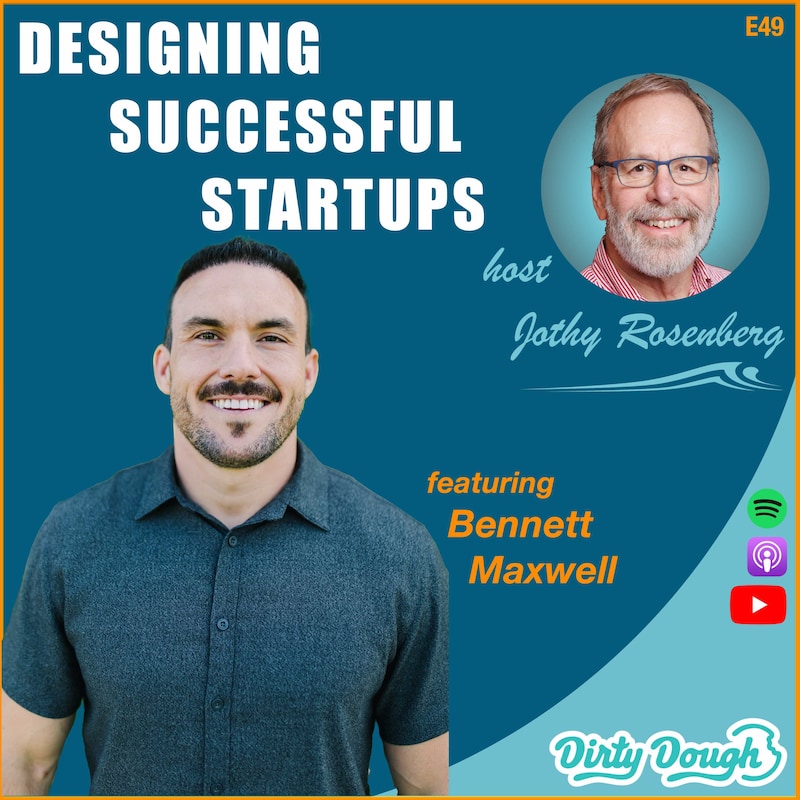
Shownotes
Summary
Bennett Maxwell, a multifaceted entrepreneur and the founder of Dirty Dough Cookies, shares his inspiring journey of overcoming challenges and innovating in the competitive cookie market. He discusses the unexpected lawsuit from Crumble, a billion-dollar company, which initially seemed like a setback but ultimately became a catalyst for his brand's growth. With a focus on joy and fulfillment, Bennett emphasizes the importance of maintaining a work-life balance, especially after realizing that monetary success does not equate to happiness. He reflects on his experiences growing up in a large family and how that instilled a sense of grit and determination. Through candid insights, Bennett highlights the significance of nurturing relationships and prioritizing personal well-being over purely financial goals.
Story
Bennett Maxwell’s entrepreneurial journey is a compelling tale of innovation, resilience, and the pursuit of fulfillment beyond financial success. From his early days of selling lemonade and cookies to navigating the challenges of running a national franchise, Bennett’s path is marked by both triumphs and tribulations. The conversation reveals the intense pressures of scaling a business, including facing a lawsuit from Crumble, a larger competitor. Bennett’s reaction to this legal challenge transformed it into an opportunity for growth, showcasing the power of a positive mindset in the face of adversity. His ability to pivot and leverage the situation for brand exposure not only solidified his company’s presence in the market but also highlighted the often unpredictable nature of the entrepreneurial landscape.
Central to the discussion is Bennett’s personal evolution regarding the meaning of success. After achieving his goal of becoming a millionaire by the age of 30, he faced a profound realization: financial success does not equate to happiness. This awakening prompted him to reassess his priorities, placing a higher value on joy and fulfillment in his daily life. He candidly shares how he now approaches decision-making with an emphasis on family time and personal well-being, a practice that has enriched his life significantly. This shift not only transformed his perspective on work-life balance but also reinforced the idea that true success encompasses emotional and relational dimensions.
Listeners will appreciate Bennett’s insights into the entrepreneurial mindset, particularly the importance of perseverance and adaptability when faced with setbacks. His journey serves as a reminder that success is not solely measured by monetary achievement but by the quality of relationships and experiences we cultivate along the way. This episode resonates with anyone navigating the tumultuous waters of entrepreneurship, offering valuable lessons on maintaining one’s values and prioritizing what truly matters in life.
Takeaways
- Bennett Maxwell emphasizes the importance of work-life balance, especially after selling his solar company.
- He shares how legal challenges from Crumble Cookies turned into unexpected marketing opportunities for Dirty Dough.
- Maxwell highlights the role of mentorship and guidance in navigating business challenges and personal growth.
- He explains that true fulfillment comes from relationships and joy, not just financial success.
- The journey of growing Dirty Dough from a single store to 80 franchises showcases innovative business strategies.
- Maxwell discusses how personal experiences and family influence entrepreneurial grit and resilience.
Links
Dirty Doug site: https://dirtydoughcookies.com
Please leave us a review: https://podchaser.com/DesigningSuccessfulStartups
Tech Startup Toolkit (book): https://www.amazon.com/Tech-Startup-Toolkit-launch-strong/dp/1633438422/
Site with all podcasts: https://jothyrosenberg.com/podcast
Jothy’s non-profit: https://whosaysicant.org
Jothy’s TEDx talk: https://www.youtube.com/watch?v=PNtOawXAx5A
Transcripts
Hello, I'm Jathi Rosenberg, the host of Designing Successful Startups, where today's guest is Bennett Maxwell.
Bennett Maxwell:And it was right after CRMBLE just put up some billboards because we're both kind of right here in Utah county that said like selling a million cookies a day.
Bennett Maxwell:And you know me, I mean, I'm all analytical.
Bennett Maxwell:I was like, a million cookies and they're selling for $3 and 75 cents each.
Bennett Maxwell:I'm like, oh, that's a billion dollar company.
Bennett Maxwell:So I just calculated that they were a billion dollar company.
Bennett Maxwell:And then literally a week or so after I get a lawsuit served.
Bennett Maxwell:To me, never read a lawsuit, right?
Bennett Maxwell:And I'm just like, oh my gosh.
Bennett Maxwell:I honestly, I mean a lot of it was, we're probably like, should I just give up right now?
Bennett Maxwell:Because this lawsuit's stupid.
Bennett Maxwell:Um, like I read through it and it talked about our cookies having sprinkles and their cookies having sprinkles and we have white vanilla ice cream and they have white vanilla ice cream and we do a, a cookie with caramel and chocolate like a Twix and they also do one.
Jathi Rosenberg:Bennet Maxwell is a multifaceted entrepreneur renowned for his innovative approach to business and commitment to enhancing the entrepreneurial landscape.
Jathi Rosenberg:He is currently the driving force behind Dirty Dough Cookies, a fast growing national cookie brand with over 80 stores open and dozens more set to launch this year.
Jathi Rosenberg:Maxwell's career spans diverse industries from real estate in Utah to co founding and successfully selling switch to solar.
Jathi Rosenberg:In addition to his entrepreneurial ventures, he is a sought after speaker who regularly shares insights with the media.
Jathi Rosenberg: han Dough podcast launched in: Jathi Rosenberg:And here is Bennett.
Jathi Rosenberg:Hello, Bennett.
Bennett Maxwell:Jonathan, how's it going?
Jathi Rosenberg:It's great to see you again.
Jathi Rosenberg:We've had one chance to get to know each other just a little bit and so we're going to spend some time here getting to know each other better and hopefully giving some good information to the listeners.
Jathi Rosenberg:Let's start by giving people a sense of, you know, context.
Jathi Rosenberg:Where are you originally from and where do you live now?
Bennett Maxwell:I mean, same place, I guess.
Bennett Maxwell:Utah, Utah County.
Bennett Maxwell:I've lived a lot in California doing cells, but Orem, Utah is where I grew up and now I'm in Pleasant Grove, Utah.
Bennett Maxwell:And it's beautiful outside.
Bennett Maxwell:We got snow right on the.
Bennett Maxwell:All over the mountains.
Bennett Maxwell:Absolutely gorgeous.
Jathi Rosenberg:So are the ski areas opening early?
Bennett Maxwell:I don't know, I haven't looked into it.
Bennett Maxwell:But this is the first year that I'm going to take my two kids skiing or snowboarding.
Bennett Maxwell:So we're, we're looking forward to it.
Jathi Rosenberg:Oh, fantastic.
Jathi Rosenberg:And what's the ski area of choice?
Bennett Maxwell:Well, we probably just do Sundance.
Bennett Maxwell:It's the closest one to us.
Bennett Maxwell:It's probably like the crappiest of all the resorts too, and the cheapest.
Bennett Maxwell:But that's 25 minutes from our house.
Bennett Maxwell:And my kids, like, you go up there, you get the hot chocolate and then you get this special sucker that they sell and they just want to go to Sundance all the time for just the sucker.
Jathi Rosenberg:Yeah, they have the right idea.
Jathi Rosenberg:Well, as I mentioned to you last time we talked, I spent a lot of time skiing in Utah and I'll be out again.
Jathi Rosenberg:I just booked my trip to come out first week of March to ski at Deer Valley.
Bennett Maxwell:Oh, awesome.
Bennett Maxwell:Well, let me know if you're in town, you have some extra free time for some lunch, okay?
Jathi Rosenberg:Okay, that sounds great.
Jathi Rosenberg:All right, so you've had a journey through several different things.
Jathi Rosenberg:And we'll dig into the thing you're running right now, but in a minute.
Jathi Rosenberg:But what are some of the things that you've done on your entire entrepreneurial journey?
Bennett Maxwell:Yeah, started pretty young, I think in elementary school selling stuff, shaved ice, lemonade stands, candy bars at school.
Bennett Maxwell:It's kind of, that was just a environment that I grew up with with my siblings.
Bennett Maxwell:There was nine of us and we were, most of us are spaced.
Bennett Maxwell:Just every two years there's another kid.
Bennett Maxwell:So anyways, we did a lot of business together and then fast forward 20 years, we're still doing a lot of business together with a lot of my, my siblings.
Bennett Maxwell:I got into Cutco sales right out of high school, served a two year Mormon mission, which is another two years of sales and persuasion and follow up, which was great.
Bennett Maxwell:That led very well into a door to door career for a few years, which then led me to start a solar company.
Bennett Maxwell:I ran that only for 18 months, sold it, bought my, the current company, Dirty Dough.
Bennett Maxwell:I shouldn't even say it's the current company.
Bennett Maxwell:I don't know if I told you this, Jothi, but last month I exited Dirty Dough.
Bennett Maxwell:We sold to Crave Worthy Brands, a restaurant portfolio company led by the Jimmy John's former CEO.
Bennett Maxwell:So now, now I'm on to the next thing again.
Bennett Maxwell:Well, I mean I'm always, I'm always on to the next thing.
Jathi Rosenberg:You're not just, you know, gonna take the season off and just focus on skiing?
Bennett Maxwell:I mean, maybe, maybe I should, maybe I should do that.
Bennett Maxwell:I'm always busy though.
Bennett Maxwell:Try not to be too busy.
Bennett Maxwell:But I don't know, it's so exciting.
Bennett Maxwell:Like turning.
Bennett Maxwell:Ending one business and going to the next is just everything's up in the air, you know, and it's what am I going to do next and who am I going to meet?
Bennett Maxwell:So right now I'm very in that first excited phase.
Bennett Maxwell:Now I'm staying on as the director of franchise sales for crave worthy brands.
Bennett Maxwell:They have 15 portfolio brands to sell franchises.
Bennett Maxwell:But you know, I'm always doing more than one thing.
Jathi Rosenberg:All right, well, so one of the things that you told me that you really like to spend time on is entrepreneurial innovation.
Jathi Rosenberg:The idea or the general concept of.
Jathi Rosenberg:Well, there's some very simple ideas that could be turned into thriving businesses even in competitive markets.
Jathi Rosenberg:And I'm, I'm imagining that Dirty Dough is one of those examples.
Bennett Maxwell:Yeah, I mean there was nothing.
Bennett Maxwell:I bought Dirty Dough and it was a single store out of Tempe, Arizona.
Bennett Maxwell:I bought it with the purchase with the intention of franchising it and really expanding it to, you know, with.
Bennett Maxwell:I wanted a national brand.
Bennett Maxwell:And if you want to open up like right now we have 80 stores.
Bennett Maxwell:We've opened up 80 stores in the last two years.
Bennett Maxwell:And a lot of people know the brand name.
Bennett Maxwell:How did you open up 80 stores?
Bennett Maxwell:You know, if each store costs, let's call it a quarter million dollars, it's quite a bit of money, you know, $20 million to open up all those.
Bennett Maxwell:Either you have the 20 million or you go find franchise partners.
Bennett Maxwell:They fund it, right.
Bennett Maxwell:They're paying for the store to be open and then the benefit to them is they get to use your name, brand your products, your systems.
Bennett Maxwell:So it's a really good win win in that franchising.
Bennett Maxwell:So I chose the franchising.
Bennett Maxwell:Now what am I going to do to be different?
Bennett Maxwell:The big competitor in the space is Crumble Gourmet Large Cookies weekly rotations and they do really well.
Bennett Maxwell:But their back end system, everything is made by hand and weighed by hand.
Bennett Maxwell:And it just, I don't think that that's sustainable.
Bennett Maxwell:Especially when you have California minimum wage is $20 an hour if you're a food brand with or if you're any brand with over 50 locations.
Bennett Maxwell:So it's just really hard.
Bennett Maxwell:So what I did is I want to compete with Crumble but on the back end I wanted to compete with more established models.
Bennett Maxwell:Mrs.
Bennett Maxwell:Fields, great American Cookie, Insomnia cookies.
Bennett Maxwell: ,: Bennett Maxwell:What do they do?
Bennett Maxwell:They centralize all their production so you get economies of skill.
Bennett Maxwell:And then you mix thousands of cookies at a time rather than 60.
Bennett Maxwell:Right.
Bennett Maxwell:Use professional bakers rather than college kids in the store.
Bennett Maxwell:And then rather than hand weighing and hand portioning, you throw them to machine, which gives you greater accuracy.
Bennett Maxwell:And then for us, it gives us a much more unique product.
Bennett Maxwell:All of our cookies are stuffed and we also do the world's only three layer cookie, which is like a peanut butter cookie on the outside, chocolate cookie in the middle with hot fudge filling.
Bennett Maxwell:So really, as far as that sounds good, it was taking the backend model from systems that have been working, looking at the crumble model, that's proven that it's very good at high, you know, high revenue sales and kind of combining them.
Bennett Maxwell:So that was the innovation, which is funny because there's nothing new about it, but it is just combining two things that already worked and making a little bit better.
Jathi Rosenberg:But you bought this one store in Tempe, Arizona and you hadn't, you hadn't done a really scaled franchise before that.
Bennett Maxwell:Know what a franchise, I mean there's the franchisee and the franchisor.
Bennett Maxwell:The franchisor owns the corporation, the franchisees buying the franchise.
Bennett Maxwell:I didn't know what that was three years ago.
Bennett Maxwell:Yeah, I'd had no experience or into food, but I did believe that generally like business is business, right.
Bennett Maxwell:You have a product, you have to go sell the product and keep your costs low.
Bennett Maxwell:It's just a different industry.
Bennett Maxwell:So there's a lot of pros and cons obviously jumping into a new industry.
Bennett Maxwell:But, but a lot of the pros were, I didn't have like this is how I used to do it when I worked for KFC or whatever.
Bennett Maxwell:Right.
Bennett Maxwell:There was no preconceived notion.
Bennett Maxwell:So I think we did try a lot of things that maybe other people wouldn't have tried and a lot of those failed, but a lot of them really worked.
Jathi Rosenberg:When you were first just the owner of a single store, but you knew you wanted to to franchise, where did you go to learn all about a cookies and all the equipment that you needed and how to scale it.
Jathi Rosenberg:Did you have a bunch of advisors or how did you do that?
Bennett Maxwell:A little bit of everything.
Bennett Maxwell:The first employee that we hired kind of on the corporate side, not that's running in the store, was a former Mrs.
Bennett Maxwell:Fields employee.
Bennett Maxwell:So that brought, you know, a lot of knowledge of cookies and how to make them.
Bennett Maxwell:And anyways, so it kind of started with, with her.
Bennett Maxwell:And then it.
Bennett Maxwell:And then the next step was finding, I mean, anybody and everybody who could teach me.
Bennett Maxwell:So way before I found that first employee or any advisors, I was already just talking to any and everybody, hey, what do you know about franchising?
Bennett Maxwell:This is what I'm doing.
Bennett Maxwell:How do you do it?
Bennett Maxwell:And then it's like, oh, I recommend this franchise attorney and then I talk with them and somebody else recommends a different franchise attorney.
Bennett Maxwell:I talk with them and then somebody else says, oh, this person used to be in franchising, you know, So a lot of it was just networking with random people, which is a little intimidating in the fact, like I don't even know what I was asking them.
Bennett Maxwell:Right.
Bennett Maxwell:I didn't have a clear.
Bennett Maxwell:I just like, I want to franchise it.
Bennett Maxwell:What do I do?
Bennett Maxwell:But once I had that general concept, I got my first advisor, John Richards, very good business guy.
Bennett Maxwell:He had a company that went public called InfoSpace.
Bennett Maxwell:$30 billion IPO.
Bennett Maxwell:He knows business.
Bennett Maxwell:I'm like, can you be an advisor?
Bennett Maxwell:I got him on.
Bennett Maxwell:Then I asked him, okay, now what do we do?
Bennett Maxwell:He goes, we need more advisors, but you need an advisor that's an expert in the franchise space.
Bennett Maxwell:So he called his buddy Steve Hart, who owns Property Management Inc.
Bennett Maxwell:Which is the largest property management franchisor in the nation.
Bennett Maxwell:And then we got him on the board as well.
Bennett Maxwell:And then the third person that I was going for for my advisor ended up being our CEO.
Bennett Maxwell:She was the founder of Maui Wowie Smoothies and coffee.
Bennett Maxwell:Started that 40 years ago, grew it to 600 plus locations or franchises before exiting.
Bennett Maxwell:So yes, it was surrounding myself with really good people and listening to their advice and then I guess staying in my lane in the sales side.
Bennett Maxwell:Like, I know I'm really good at sales, setting up some processes, but I don't follow anything, you know, I'm not, I'm not, I'm not a follow through person.
Bennett Maxwell:I'm a big idea.
Bennett Maxwell:Let's start on a project, get excited, and then in two weeks I'm on to the next idea.
Bennett Maxwell:And I want to hand that off to a good operations or good integrator, which I found with that CEO.
Jathi Rosenberg:Very, very lucky.
Jathi Rosenberg:So I'm guessing by the name that of her coffee franchise that she from Hawaii, not from.
Bennett Maxwell:Honestly, I forgot the story around it.
Bennett Maxwell:It was something.
Bennett Maxwell:Yeah, they went to Maui quite a bit.
Bennett Maxwell:Not from there though.
Bennett Maxwell:I'm going to ask her because I should definitely note that.
Jathi Rosenberg:Okay, so you're a workaholic, but.
Jathi Rosenberg:And you came from a really, I.
Bennett Maxwell:Mean, I like working, but I really don't work more than 40 hours a week and have it for probably at least three years, at least, since I sold my solar company.
Jathi Rosenberg:Maybe I didn't mean workaholic in terms of hours, but you work hard, but you also have a family and a lot of people who are startup people or want to be startup people that might be listening to this, I think sometimes worry that it's pretty hard to balance work life balance when you're, you know, running a startup.
Jathi Rosenberg:But.
Jathi Rosenberg:But you've always considered that to be really important.
Bennett Maxwell:Yeah, and I.
Bennett Maxwell:I would say it got.
Bennett Maxwell:It got really important when I sold my solar company.
Bennett Maxwell:So that was just three years ago.
Bennett Maxwell:And I just put kind of everything on hold until I was a workaholic that was, you know, working 80 hours a week because it's like, I just once I'm a millionaire.
Bennett Maxwell:If I could achieve millionaire status before 30, all your problems go away.
Bennett Maxwell:I got up to 310 pounds, didn't have a great relationship with my wife.
Bennett Maxwell:Didn't even know I didn't have a great relationship with my wife.
Bennett Maxwell:I thought it was great because we didn't fight, but I guess there's more to relationship than just not fighting.
Bennett Maxwell:But that was kind of the situation I was in.
Bennett Maxwell:Sold the company, achieved that goal, and I felt amazing.
Bennett Maxwell:But what happens in the brain is your dopamine levels go back to baseline very quickly.
Bennett Maxwell:So then it's like, okay, I sacrificed all of that for an hour, a week, a month worth of dopamine.
Bennett Maxwell:It wasn't worth it.
Bennett Maxwell:So at that point I'm like, okay, well, what am I even working for?
Bennett Maxwell:And I told myself this.
Bennett Maxwell:If I have more money, then that equals more time off, more time freedom.
Bennett Maxwell:And what am I gonna do with more time?
Bennett Maxwell:I'm gonna go on more vacations.
Bennett Maxwell:And why do I want to go on vacations?
Bennett Maxwell:Because I'm with my family and I.
Bennett Maxwell:And I need to be with my family because they make me happy.
Bennett Maxwell:And then going through all of that, selling the company, achieving all of that, and I'm like, shoot, what do I do from here?
Bennett Maxwell:I started seeing a therapist.
Bennett Maxwell:And he kept.
Bennett Maxwell:He helped me see that loop that I was telling myself for that progression.
Bennett Maxwell:And he said, well, why don't you just start doing it every day?
Bennett Maxwell:Like, you don't need to go on a vacation to take your kids out, you know?
Bennett Maxwell:So, yeah, about four years ago, I was like, okay, I'm just not going to work past four.
Bennett Maxwell:I'm not going to work the Weekends, there's a few exceptions here or there.
Bennett Maxwell:Like this last weekend I went to Houston, but I took the day off before and the day off after.
Bennett Maxwell:That way, you know, if I'm working two days over the weekend, then I'm not working two days during the week.
Bennett Maxwell:And that really helped kind of with the work life balance.
Bennett Maxwell:Because again, what is it all for?
Bennett Maxwell:It's all to be with your family.
Bennett Maxwell:But I don't need to sacrifice my family to then be with them later.
Bennett Maxwell:I could just be with them now.
Bennett Maxwell:So I think having that clear distinction right from the beginning of like, what am I after?
Bennett Maxwell:And if I'm after increasing relationships with my family, don't sacrifice that to start off with, if that makes sense.
Jathi Rosenberg:You must have a lot of discipline to.
Jathi Rosenberg:I mean, obviously you do, but I mean, to be able to shed a lot of extra weight that you somehow gained during that period of time.
Bennett Maxwell:Yes.
Bennett Maxwell:I mean that the whole weight loss thing was, was a, was a whole nother journey and a necessary journey, I think Dirty dough with our, I mean, last year we went from seven to 70 stores in one year.
Bennett Maxwell:And it was as stressful as can be.
Bennett Maxwell:You know, I don't know how honestly I would have gotten through all of that if I didn't really lean into health and fitness and being present in my body because there's just so much stress.
Bennett Maxwell:You know, you're always worried about tomorrow and this problem or that.
Bennett Maxwell:But the thing is, they don't exist in the moment.
Bennett Maxwell:Right.
Bennett Maxwell:So if you, for me, what I did is you have debilitating stress and you're like, crap, am I going to make it?
Bennett Maxwell:Do I need to go raise more money?
Bennett Maxwell:Do we have money?
Bennett Maxwell:Am I going bankrupt?
Bennett Maxwell:Like all of those are going through your thoughts as an entrepreneur.
Bennett Maxwell:If you're rapid growth, or at least it was for me, so very stressful.
Bennett Maxwell:And the way that I was able to, I guess, cope with that was ice baths and saunas and working out and red light and vibration plate and really.
Bennett Maxwell:Because all of those things allow you to not think about the future.
Bennett Maxwell:Right.
Bennett Maxwell:You're not thinking about how I going to pay rent next week.
Bennett Maxwell:When you're in an ice bath, that's 35 degrees.
Bennett Maxwell:So it really shows you, hey, you can get rid of your problems because by just being present.
Bennett Maxwell:And for me, that was very beneficial.
Jathi Rosenberg:Is your strategy for exercise to, you know, put it on your calendar and make sure you, you know, it's.
Jathi Rosenberg:It's a meeting.
Jathi Rosenberg:It's a meeting that's just with you.
Jathi Rosenberg:Is that how you do it.
Bennett Maxwell:Yes.
Bennett Maxwell:Except for it's not just with me.
Bennett Maxwell:In the last, in the last few months, maybe two months ago, I posted on LinkedIn, I said, hey, anybody like to talk business and want to work out together?
Bennett Maxwell:And I got several dozen people to hit me up on that.
Bennett Maxwell:So, um, almost at two to three times a week, I go to the gym with a random person.
Bennett Maxwell:Just business, another business owner.
Bennett Maxwell:And we just kind of talk and network and that's, that's super fun.
Bennett Maxwell:Um, I try not to get too regimen with my workout because the purpose of working out for me is to feel good and I don't want to feel stressed around working out.
Bennett Maxwell:So like this morning I didn't work out, it was on my calendar, but instead I took my kids to school and my other kid to the babysitter.
Bennett Maxwell:Right.
Bennett Maxwell:And then I'll just find some time later.
Bennett Maxwell:Um, which is a little weird on the working out.
Bennett Maxwell:Like when I work out as well, I'm also not counting sets or reps, which is kind of very weird.
Bennett Maxwell:I'm just going till whatever feels good and then I, and then I leave after 30 minutes.
Bennett Maxwell:So because it's such an enjoyable time, it doesn't cost a lot of work to get there because it's not like, oh crap, I have to go to squat £400 today.
Bennett Maxwell:Um, it's.
Bennett Maxwell:No, I'm just going to go do whatever feels good.
Jathi Rosenberg:On, on swim workout days.
Jathi Rosenberg:I have to be very regimented because it's, it's a, it's a, it's a, it's a set time, you know, with a coach.
Jathi Rosenberg:So.
Jathi Rosenberg:Okay, yeah, so it is it.
Jathi Rosenberg:I did have to quit one master's program because it was very stressful.
Jathi Rosenberg:I had to get up at 4:15 because we were in the water at 5:15 and, and, and then for some reason the coach kept, just thought he should push me and make me lead the lane and then somebody's touching my heels and, and it was like, okay, this is, this is.
Jathi Rosenberg:Stop being fun, you know?
Bennett Maxwell:Yeah.
Jathi Rosenberg:And then, and then you just gotta quit and try something else.
Bennett Maxwell:Yeah.
Bennett Maxwell:And I think that relates back to having business as well.
Bennett Maxwell:It's like, what?
Bennett Maxwell:Well, what are you doing this for?
Bennett Maxwell:It's for fun.
Bennett Maxwell:And if it's not fun anymore, then make it fun or go do something else again.
Bennett Maxwell:I mean, I think that's a pretty good principle.
Jathi Rosenberg:One of the things that you mentioned to me before, but we didn't have time to go into any details, so now is a good time to go into Those details was that dirty dough had some legal challenges.
Jathi Rosenberg:And I think that's a useful thing to talk about because people need to be prepared for, for dealing with those kinds of surprises.
Jathi Rosenberg:So talk about that, would you?
Bennett Maxwell:Yeah.
Bennett Maxwell:About two and a half years ago, before we opened up our first franchise, we got a lawsuit from Crumble.
Bennett Maxwell:And it was right after Crumble just put up some billboards because we're both kind of right here in Utah county that said like selling a million cookies a day.
Bennett Maxwell:And you know me, I mean, I'm all analytical.
Bennett Maxwell:I was like, a million cookies and they're selling for $3 and 75 cents each.
Bennett Maxwell:I'm like, oh, that's $1 billion company.
Bennett Maxwell:So I just calculated that they were a billion dollar company.
Bennett Maxwell:And then literally a week or so after I get a lawsuit served.
Bennett Maxwell:To me, never read a lawsuit, right?
Bennett Maxwell:And I'm just like, oh my gosh.
Bennett Maxwell:I honestly, I mean a lot of it was, we're probably like, should I just give up right now?
Bennett Maxwell:Because this lawsuit, stupid.
Bennett Maxwell:Like I read through it and it talked about our cookies having sprinkles, their cookies having sprinkles.
Bennett Maxwell:And we have white vanilla ice cream.
Bennett Maxwell:And they have white vanilla ice cream.
Bennett Maxwell:And we do a cookie with caramel and chocolate, like a Twix.
Bennett Maxwell:And they also do one.
Bennett Maxwell:And it was just like we use rectangle boxes.
Bennett Maxwell:We do whimsical designs.
Bennett Maxwell:And they use whimsical designs.
Bennett Maxwell:Obviously they didn't invent any of this.
Bennett Maxwell:So it was, it's a tactic that a lot of businesses use to stifle competition because it doesn't matter if it's legitimate or not.
Bennett Maxwell:If you're suing someone that's doesn't have a hundred thousand dollars sitting in the bank and to like fight you off and say no.
Bennett Maxwell:I mean, we went through this a year and a half till it.
Bennett Maxwell:And we did settle it, but a year and a half spent 300 something thousand dollars.
Bennett Maxwell:And we didn't even start into expert witnesses yet.
Bennett Maxwell:It was just like discovery.
Bennett Maxwell:So it was about to start getting really expensive.
Bennett Maxwell:Anyways, back to the, back to the story.
Bennett Maxwell:So they sue us.
Bennett Maxwell:Nothing happens.
Bennett Maxwell:A local news article a month and a half later picks it up.
Bennett Maxwell:Crumble suing.
Bennett Maxwell:Dirty though.
Bennett Maxwell:So then it's like, crap.
Bennett Maxwell:We, we'd sold like 60 franchises in the first six months, which was off to a great start.
Bennett Maxwell:And now I'm like, crap.
Bennett Maxwell:Now I have to, you know, talk about this lawsuit to our existing franchisees.
Bennett Maxwell:It's going to be an issue for all potential Franchisees.
Bennett Maxwell:So I'm going to be out there on social media.
Bennett Maxwell:But I chose to do it kind of as a smart ass because that's, that's who I am.
Bennett Maxwell:So the first thing I, I, I took a screenshot of the lawsuit and I tad crumble.
Bennett Maxwell:And I, I said something about like a billion dollar company suing startups like over sprinkles, something like that.
Bennett Maxwell:Watch out, granny there, they might be coming for you next.
Bennett Maxwell:Something, something stupid, you know, but that gained a lot of traction and people really like that and it was kind of funny.
Bennett Maxwell:And then we put up billboards to respond to their billboards, but our billboards said, cookies so good, we're being sued.
Bennett Maxwell:Cook our cookies.
Bennett Maxwell:Don't crumble with the competition.
Bennett Maxwell:Let your taste buds be the judge.
Bennett Maxwell:Just stupid.
Bennett Maxwell:Tongue in cheek things.
Bennett Maxwell:Super funny.
Bennett Maxwell:Same thing posted on social media.
Bennett Maxwell:Got over a million impressions just on LinkedIn alone.
Bennett Maxwell:Again, tagging crumble.
Bennett Maxwell:Love your billboards.
Bennett Maxwell:What do you think about mine?
Bennett Maxwell:And I guess a lot of people, I guess got behind us as kind of the David and Goliath story.
Bennett Maxwell:And I also broke down every single point in the lawsuit and said why it was kind of bullcrap.
Bennett Maxwell:And I was trying to raise awareness that, I guess legal war warfare, you know, you can just sue people out of business even if you're wrong.
Bennett Maxwell:And that, and that's completely legal.
Bennett Maxwell:Long story short, we had sold 60 franchises in the first six months.
Bennett Maxwell:The next six months we sold an additional 230 franchises.
Bennett Maxwell:And that was from the exposure of our reaction to the lawsuit.
Bennett Maxwell:We also did professional commercials of the big cookie company shutting down lemonade stands because they also sell cookies.
Bennett Maxwell:And very fun and very playful, but it got us on Good Morning America, cnbc, all of that.
Bennett Maxwell:So it really gave us the eyes that we needed to fuel the growth.
Bennett Maxwell:So kind of a lemon at first and I end up turning into the most amount of lemonade that I could ever imagine.
Jathi Rosenberg:But so I don't understand how they the real grounds for their suit.
Bennett Maxwell:So they don't need any real grounds.
Bennett Maxwell:I could sue you today right after this call because the glare off of your glasses caused me emotional disturbance.
Bennett Maxwell:You don't need any grounds to file a lawsuit.
Bennett Maxwell:You could claim whatever you want and then you can't go get an SBA loan tomorrow.
Bennett Maxwell:And you're like, no, no, it's a lawsuit about the glare in my glasses.
Bennett Maxwell:This is stupid.
Bennett Maxwell:Just read it.
Bennett Maxwell:And the SBA or any bank says, nope, it's just a hard and fast rule.
Bennett Maxwell:We won't Give you a loan.
Bennett Maxwell:And that's just, and then you also have to disclose it on your franchise documents if you're in a lawsuit as well.
Bennett Maxwell:So that means every potential franchisee is seeing that you're being sued by a billion dollar company.
Bennett Maxwell:So it doesn't, it doesn't matter that it was about sprinkles in a rectangle box.
Bennett Maxwell:It matters that we have to now disclose it on our fdd and that could scare away potential franchisees.
Bennett Maxwell:And now I can't go get funding.
Bennett Maxwell:Um, so then I had to go the private route.
Bennett Maxwell:And you know, that was a full time job just raising money from angel investors.
Jathi Rosenberg:But I, I, you know, if they're saying sprinkles in the rectangle box, then it sounds like an infringement kind of argument, which is, like you said, is, is, is crap because there's no patent.
Bennett Maxwell:You know, there's no, this is how crappy it was.
Bennett Maxwell:There's six pitchers on the lawsuit side by side.
Bennett Maxwell:And when I say vanilla ice cream, they, they put a picture of our product, which is a cookie and an orange cup with vanilla ice cream on top.
Bennett Maxwell:That's an actual product that we sell.
Bennett Maxwell:And they set it next to their product that they don't even sell, which is a black cup of a pint of ice cream.
Bennett Maxwell:And that's how they sell it.
Bennett Maxwell:But it's like they're not even the same.
Bennett Maxwell:But they put those pictures side by side and then sprinkles and a handful of other cookies.
Bennett Maxwell:Well, everything's timestamped on social media, right?
Bennett Maxwell:When, when we release a cookie for the first time, it's on social media.
Bennett Maxwell:Same thing with crumble.
Bennett Maxwell:Of the six examples, five of them we did first.
Bennett Maxwell:So they actually found five examples that they copied us and they sued us over it.
Bennett Maxwell:So yeah, their attorney was an idiot.
Bennett Maxwell:Zero like that.
Bennett Maxwell:The facts on the lawsuit were all wrong.
Bennett Maxwell:And that's why it went in our favor because it wasn't like a he said, she said battle.
Bennett Maxwell:This was something that I'm telling people on social media.
Bennett Maxwell:Look at the two screenshots.
Bennett Maxwell:Who did sprinkles first?
Bennett Maxwell:Dirty dough did who?
Bennett Maxwell:Yet they're suing us.
Bennett Maxwell:Look at the rectangle box.
Bennett Maxwell:They, they do have a trade dress on their box, but it specifically says we do not claim the shape of this box in this mark, period.
Bennett Maxwell:So they're saying it has nothing to do with the shape and then they're suing us only over the shape.
Bennett Maxwell:So it was just a bullshit lawsuit.
Jathi Rosenberg:So, so you're saying.
Jathi Rosenberg:So you're Saying that.
Jathi Rosenberg:That when this.
Jathi Rosenberg:There was a settlement.
Jathi Rosenberg:They paid you?
Bennett Maxwell:No.
Bennett Maxwell:And I can't disclose settlement other than what we.
Bennett Maxwell:We threw out.
Bennett Maxwell:We did some general press release about the settlement.
Bennett Maxwell:We changed.
Bennett Maxwell:We did actually change our boxes from a square to Rank Tango.
Bennett Maxwell:There's no way in hell they would have ever won, but it would have cost another hundred thousand to go through that process at least.
Bennett Maxwell:So it was just like, who cares about the shape of the box?
Bennett Maxwell:I don't care, you know?
Bennett Maxwell:So that is, that is what we, we changed.
Bennett Maxwell:And other than that, I think it worked out really well.
Jathi Rosenberg:Oh, that's great.
Jathi Rosenberg:By the way, you're.
Jathi Rosenberg:As I said earlier, your cookie that you described really sounds delicious.
Jathi Rosenberg:So you're going to have to tell me where there's a store when I'm up in.
Jathi Rosenberg:When I'm up.
Jathi Rosenberg:Yeah.
Jathi Rosenberg:Well, I'll be in basically Deer Valley and up there.
Jathi Rosenberg:So there's probably one up there.
Bennett Maxwell:Yes.
Bennett Maxwell:Well, I guess in Salt Lake.
Bennett Maxwell:I'll bring some to you.
Bennett Maxwell:Don't worry.
Jathi Rosenberg:Yeah.
Jathi Rosenberg:Okay.
Jathi Rosenberg:Well.
Jathi Rosenberg:Okay.
Jathi Rosenberg:So you also talked a lot when you first met with me about just the joy of that.
Jathi Rosenberg:You want to make sure there's a lot of joy in your life beyond the financial achievements.
Jathi Rosenberg:And you've, you've, you mentioned family, you've mentioned vacations, and, and what else, what else do you think of when you sort of want to paint this whole picture of kind of your successful life?
Bennett Maxwell:Yeah.
Bennett Maxwell:So when I went through my midlife crisis at 28 years old and I started seeing a therapist on, like, why am I saying that My family and my health are the most important, but if I look at my calendar, I just am working all the time.
Bennett Maxwell:Right.
Bennett Maxwell:Like, what's going on there?
Bennett Maxwell:And it was because I set my goal, which was the million dollar goal.
Bennett Maxwell:Right.
Bennett Maxwell:But why did I want a million dollars?
Bennett Maxwell:I didn't ask myself that, other than like, because you have less problems.
Bennett Maxwell:Right.
Bennett Maxwell:But I didn't really think through it.
Bennett Maxwell:And then re.
Bennett Maxwell:I had to kind of reanalyze life again and say, okay, what drives my behavior?
Bennett Maxwell:What drives human behavior?
Bennett Maxwell:Because we all set, you know, these material goals.
Bennett Maxwell:But do material goals actually drive human behavior?
Bennett Maxwell:Well, what are we after?
Bennett Maxwell:We're not after material things.
Bennett Maxwell:We're after an emotional state.
Bennett Maxwell:And I think that's very evident because I could say, do you want a billion dollar company, but you're guaranteed to be depressed every day?
Bennett Maxwell:Or do you want to be poor, but you're guaranteed that you're enthusiastic and happy all the time.
Bennett Maxwell:Right.
Bennett Maxwell:It's like, of course it's not about the money, it's about your state of well being.
Bennett Maxwell:So if your goals don't include a state of well being, you're falling short, in my opinion.
Bennett Maxwell:So what is that well being that I wanted?
Bennett Maxwell:I narrowed it down to joy and fulfillment.
Bennett Maxwell:And I chose joy over happiness because at least to me, happiness is more of a momentary emotional state where joy is like, you can have a joyful life, but you're not happy all the time because that's impossible.
Bennett Maxwell:And then fulfillment more than just being happy.
Bennett Maxwell:But do you feel good about your life?
Bennett Maxwell:And then I threw in despite life's dirtiness, you know, kind of play on words.
Bennett Maxwell:But for me, it meant don't wait to sell your solar company to find joy fulfillment.
Bennett Maxwell:So I created that mission statement, finding joint fulfillment despite life's dirtiness for myself and others.
Bennett Maxwell:And then the company adapted that, which really brought on, I mean, I kind of, without an intent, a lot of franchisees gravitated kind of towards that mission statement.
Bennett Maxwell:And that I was, I guess, very upfront with it.
Bennett Maxwell:So once I narrowed that down, now as I'm making my decisions, I'm making my decisions based off of joy and fulfillment, not money.
Bennett Maxwell:So Friday of last week, three days ago, five, four days ago, I have a few meetings.
Bennett Maxwell:It's a Friday I and I see that my son is going to his first preschool field trip ever to the pumpkin patch.
Bennett Maxwell:And it's like, oh great.
Bennett Maxwell:Hey, can I.
Bennett Maxwell:This is a pretty important meeting.
Bennett Maxwell:But in the grand scheme of things, will it matter if I push it out a week?
Bennett Maxwell:It.
Bennett Maxwell:No, not at all.
Bennett Maxwell:I pushed it out a week.
Bennett Maxwell:I went to the.
Bennett Maxwell:I went to the field trip and had a great time with my son.
Bennett Maxwell:Because again, the question was, what's going to bring me more joy and fulfillment?
Bennett Maxwell:Not what's going to bring me more money.
Bennett Maxwell:And I think having that emotional state defined and then using that as I'm making my decisions on how many franchises sell, do we raise money?
Bennett Maxwell:Who do we accept money from?
Bennett Maxwell:It's what's going to bring me more joint fulfillment rather than what's going to maybe make me more money.
Jathi Rosenberg:Hi.
Jathi Rosenberg:The podcast you are listening to is a companion to my recent book, Tech Startup Toolkit how to Launch Strong and Exit Big.
Jathi Rosenberg:This is the book I wish I'd had as I was founding and running eight startups over 35 years.
Jathi Rosenberg:It's like a memoir of my entrepreneurial journey.
Jathi Rosenberg:I tell the unvarnished truth about what went right and especially about what went wrong.
Jathi Rosenberg:It's for the founder, the CEO and wannabe founders of tech and non tech startups.
Jathi Rosenberg:You could get it from all the usual booksellers and also from the publisher@manning.com.
Jathi Rosenberg:i hope you like it.
Jathi Rosenberg:It's a true labor of love.
Jathi Rosenberg:Now back to the show.
Jathi Rosenberg:Yeah, I'm curious.
Jathi Rosenberg:What, what made you think that a million dollars would make you not have to worry?
Jathi Rosenberg:I don't know.
Bennett Maxwell:You just, I don't know, you grow up and you're like.
Bennett Maxwell:You hear somebody's a millionaire and you're like, oh, wow, they're a millionaire.
Bennett Maxwell:You know, and, and, and granted, a million dollars today is a lot different than a million dollars 20 years ago.
Bennett Maxwell:But.
Bennett Maxwell:Yeah, I, I don't know.
Bennett Maxwell:I never thought it through.
Bennett Maxwell:Just like before that.
Bennett Maxwell:My goal before that was to be a pediatrician.
Bennett Maxwell:Why?
Bennett Maxwell:Because it sounded good.
Bennett Maxwell:I think doctors are well respected.
Bennett Maxwell:I like kids.
Bennett Maxwell:Little did I know, you know, I'm, I'm queasy when it comes to blood, but that's still the career path I chose just because I didn't really think through it.
Bennett Maxwell:Right.
Bennett Maxwell:You, you put a few hours of thought and you're like, okay, they, they make 200 grand.
Bennett Maxwell:They're well respected.
Bennett Maxwell:I didn't think about 11 years of school and residency and a hundred thousand dollars in debt and not seeing my family.
Bennett Maxwell:Um, that's just what I chose because I didn't think about it enough.
Bennett Maxwell:So going back to the.
Bennett Maxwell:Whether it's a business coach, a mentor, an advisor or therapist, like having somebody else to guide you through that and let you see what you're not seeing is extremely, extremely beneficial.
Jathi Rosenberg:I did the math like a year or so ago.
Jathi Rosenberg:I think the number is somewhere between 6 and 8 million.
Jathi Rosenberg:You can live off of it and not touch the principal.
Bennett Maxwell:Yeah, yeah.
Bennett Maxwell:If you get $5 million, you're accounting for a 3% inflation and you make an 8% return.
Bennett Maxwell:That means without.
Bennett Maxwell:While you're accounting for inflation, you could withdraw 5% and your money's not getting eaten by inflation.
Bennett Maxwell:5% of $5 million is 250,000 a year.
Bennett Maxwell:So, yeah, even with 5 million, you can live off of $250,000 per year and not touch your nest egg and not be affected by inflation, which is pretty cool.
Bennett Maxwell:But I didn't, I didn't know all that.
Jathi Rosenberg:I also had the same goal to get a million by the time I was 30.
Bennett Maxwell:And I didn't achieve it and nothing happened.
Bennett Maxwell:Probably.
Bennett Maxwell:Right.
Bennett Maxwell:And I achieved it and nothing also happened.
Bennett Maxwell:It was either way, it was just Like a goal that.
Bennett Maxwell:I think goals are very important because they're exciting.
Bennett Maxwell:But if we attach our self worth and our progression and our validation on if we achieve that goal or not, I think that is a recipe for failure.
Bennett Maxwell:Because at the end of the day, there's so many things that are out of our control.
Bennett Maxwell:And to realize that and not try to control everything, I think without a doubt leads to a, to a happier life.
Bennett Maxwell:Having less expectations on life leads to a happier life rather than having higher expectation.
Bennett Maxwell:Because all discomfort, suffering, whatever comes from wanting something.
Bennett Maxwell:Right, that the Buddha, Buddha said desire is the root of all suffering.
Bennett Maxwell:And you think about it, you're like, that's true.
Bennett Maxwell:So if I could just want less, then you're going to suffer less.
Bennett Maxwell:Rather than having, you know, I need $1 million to be happy, I need a Tesla, I need this or that.
Bennett Maxwell:It's like, no, I just need to live and experience life.
Bennett Maxwell:And then whatever comes, comes.
Bennett Maxwell:And that's the way I'm gravitating more and more.
Bennett Maxwell:And it's, it's hard because it's different.
Bennett Maxwell:But I, I do think that I've made a lot of progress and it's allowed me to not pull my hair out every night.
Bennett Maxwell:You know, when, when the business stress and just life stress comes down at you.
Jathi Rosenberg:We all say that every startup founder has a lot of grit.
Jathi Rosenberg:In your case, grit probably, I would guess, has to be defined as fearless because you've just taken on these things.
Jathi Rosenberg:You've had to have no fear to, to turn one cookie shop in a city that's not even where you live into a franchise.
Jathi Rosenberg:And do all these multiple businesses.
Jathi Rosenberg:Do all people of the LDS faith have grit?
Jathi Rosenberg:Or do all people coming from a family of nine kids have grit?
Jathi Rosenberg:Or where's yours come from?
Bennett Maxwell:I mean, I think both looking at family, out of the nine kids, even the few that, like, went to the corporate route, they still have side businesses.
Bennett Maxwell:You know, one, one works for Facebook, but he also has an app that he's been running for a few years on the side.
Bennett Maxwell:You know, So I do think a lot of the entrepreneur or the grit does come from a kind of figure it out mentality in a household of nine kids with a single mom.
Bennett Maxwell:Okay, talking about grit, if you want to go to football camp, it's 400 bucks.
Bennett Maxwell:I don't have 400 bucks.
Bennett Maxwell:Right.
Bennett Maxwell:What do you do?
Bennett Maxwell:You can go sell a banner to a business so they could advertise on the, on your football stadium.
Bennett Maxwell:I was the only kid in the, in the School that did that.
Bennett Maxwell:And I was just cold knocking businesses.
Bennett Maxwell:So like those little things, I was selling cookie dough door to door to pay for my wrestling program.
Bennett Maxwell:Same thing with rugby.
Bennett Maxwell:They also use the same cookie dough fundraising.
Bennett Maxwell:So it kind of came full circle.
Jathi Rosenberg:Was that your mother's idea to do that?
Jathi Rosenberg:When we first know those, those are your idea programs.
Bennett Maxwell:Yeah, yeah.
Bennett Maxwell:It's just if you want something, go figure out how to do it.
Bennett Maxwell:I mean, I remember maybe in third grade I would wake up, she was, she went back to school, so.
Bennett Maxwell:And she was gone.
Bennett Maxwell:Like when me and my brothers were waking up.
Bennett Maxwell:So me and my two little brothers, I would wake up, make them breakfast burritos every morning, make myself the breakfast burrito and walk over to the neighbor's house and get a ride to school and then we'd walk home, you know, so.
Bennett Maxwell:And there's nothing, absolutely nothing wrong with that.
Bennett Maxwell:I think that kind of set us all up for the hey, kind of take care of yourself, Mom's here for you.
Bennett Maxwell:But you're also capable of taking care of yourself.
Bennett Maxwell:Going to the lds, I think that's probably the bigger reason, at least in sales.
Bennett Maxwell:You see a lot of ex missionaries, former missionaries, really good at sales.
Bennett Maxwell:And you see all of the top door to door companies in the world right here in Utah County.
Bennett Maxwell:Brigham Young University, Utah Valley University, 70,000 students, 10 minutes apart from each other.
Bennett Maxwell:And then you have all the big door to door companies just recruiting because it's all former missionaries and you do receive all of that training.
Bennett Maxwell:I think there's a lot of negativity around it.
Bennett Maxwell:There's a lot of positivity.
Bennett Maxwell:There's a culture of you.
Bennett Maxwell:You go on a mission when you're 19 years old and it's two years, you don't know where you're going.
Bennett Maxwell:I went to Tijuana, I didn't know Spanish.
Bennett Maxwell:They throw you in the mission, you have a companion.
Bennett Maxwell:He didn't speak any English, I don't speak any Spanish.
Bennett Maxwell:And it's just like good luck, you know, you get a call home twice a year, once on Mother's Day, once on Mother's Mother's Day and Christmas for an hour each time.
Bennett Maxwell:And then you get one hour of emails on Monday.
Bennett Maxwell:Everything else is head down and working.
Bennett Maxwell:I think that is very healthy for a young adult to go through and be so dedicated to something.
Bennett Maxwell:I do think there's a lot of shame around it.
Bennett Maxwell:Like if you don't go on a mission, that's shameful.
Bennett Maxwell:Girls don't want to marry you you know, because you're not worthy, you're not righteous.
Bennett Maxwell:And if you come home early from your mission, forget it, you know, like, oh, you couldn't finish it.
Bennett Maxwell:You're not faithful enough for the Lord.
Bennett Maxwell:Which I think that's all bullshit.
Bennett Maxwell:But it does create a very good culture of these, like, die hard kids that just want to finish it.
Bennett Maxwell:And then you take kids out and you teach them.
Bennett Maxwell:Summer sells.
Bennett Maxwell:So, like, my first year, I recruited 40 college kids, plus me.
Bennett Maxwell:We all moved out to North Carolina to go sell pest control in the summer.
Bennett Maxwell:And you have.
Bennett Maxwell:It's a hard job, right?
Bennett Maxwell:Door to door sells.
Bennett Maxwell:It's hard job.
Bennett Maxwell:And you have a lot of people that don't make money.
Bennett Maxwell:It's straight commission.
Bennett Maxwell:And you're like telling them, okay, it's time to go home.
Bennett Maxwell:It's been a month.
Bennett Maxwell:You've made not no money.
Bennett Maxwell:And they're like, no, I promised myself I'd finish.
Bennett Maxwell:I would see it through.
Bennett Maxwell:And you're like, no, this is a job.
Bennett Maxwell:This isn't a mission.
Bennett Maxwell:It's not a.
Bennett Maxwell:It's not shame if you quit, you know.
Bennett Maxwell:But yes, I think there's LDS culture gave me a ton of grit that I'm very grateful.
Bennett Maxwell:I'm not associated with the religion at all, but the things that it taught me, I.
Bennett Maxwell:I'll be forever grateful for our.
Jathi Rosenberg:So where were you in the nine kids?
Bennett Maxwell:Seven.
Bennett Maxwell:Seven out of nine.
Bennett Maxwell:And there's seven boys as well.
Bennett Maxwell:So anyways, yeah, me and I have a brother two years younger than me, four years younger than me, and then another brother two years older than me.
Bennett Maxwell:So the four of us, within eight years, we were pretty tight.
Bennett Maxwell:And I mean, we still are.
Bennett Maxwell:We still do business together, we still hang out, so it's fun.
Jathi Rosenberg:So the oldest one is quite a bit older than you.
Bennett Maxwell:Yeah, his name is Uncle Blake.
Bennett Maxwell:He was on his Mormon mission in Ireland when my youngest brother was born, Bailey.
Bennett Maxwell:So when he came home from his mission, Bailey was, you know, 12 years old, and he called him Uncle Blake because he didn't know it was his brother.
Bennett Maxwell:Yeah, 20 years apart.
Jathi Rosenberg:That's amazing.
Jathi Rosenberg:I gather that you're.
Jathi Rosenberg:You're not planning to repeat the nine kids thing.
Bennett Maxwell:No, I mean, I don't know why my mom did it.
Bennett Maxwell:I mean, I'm grateful because I was number seven, and I guess if she only had six, I wouldn't be here.
Bennett Maxwell:I don't think that that's healthy to have nine kids.
Bennett Maxwell:And in the sense of you only have so much time and attention to teach and to nurture your children.
Bennett Maxwell:Firsthand experience.
Bennett Maxwell:When you got nine, you don't have time to actually pay attention to your kids.
Bennett Maxwell:So me and my wife have three kids right now and we are extremely happy with three that we have.
Bennett Maxwell:And they're young and it's still like dance practice, gymnastics, tumbling, soccer, field trips, you know, it's still so much.
Bennett Maxwell:I'm like, yeah, if we had another, if we had a fourth kid, I would have to start missing games.
Bennett Maxwell:And one thing that I've already committed to, I won't miss soccer games.
Bennett Maxwell:I mean, I won't miss anything.
Bennett Maxwell:I don't care what the work is.
Bennett Maxwell:I don't care, like everything can wait for tomorrow.
Bennett Maxwell:Because I do know.
Bennett Maxwell:I guess this goes back to Harvard study.
Bennett Maxwell:If you've heard of the longevity study, it's the longest study out of any study.
Bennett Maxwell:I believe it's been going on for like 90 years on happiness.
Bennett Maxwell:And they're following up with 700 individuals every 10 years or so.
Bennett Maxwell:The study's coming to an end, you know, 90 years later.
Bennett Maxwell:And the number one thing that's indicative of a healthier, longer living life is close relationships.
Bennett Maxwell:And they also said there's not one person that we've interviewed that said, I wish I would have worked more.
Bennett Maxwell:Not one person is saying I wish I would have worked.
Bennett Maxwell:But most of them are saying, I wish I would have spent more time with my family.
Bennett Maxwell:So I'm like, I'm going to hopefully pull from their wisdom and just say I'm going to put my family first over work.
Bennett Maxwell:I'll share one, one little story that because this is a, this is a pretty proud moment for me this summer or sorry, last summer I was going to Vegas for a day.
Bennett Maxwell:I had a handful of meetings lined up, important meetings, Allegiant Stadium, we were doing a sponsorship with them.
Bennett Maxwell:And that last year was the super bowl.
Bennett Maxwell:You know, like, do we want dirty dough here?
Bennett Maxwell:I had a meeting with a six time Olympic gold medalist, huge influencer, another big real estate influencer with millions of followers, another guy that has 125 KFCs.
Bennett Maxwell:So I have all these meetings lined up and then it's my daughter's graduation, kindergarten graduation.
Bennett Maxwell:And I'm like, oh, well, I already booked the flight, you know, I'm going in the morning, coming back, sorry, I'll take you on a date before, I'll take you on a date after.
Bennett Maxwell:Like, what do you want to do?
Bennett Maxwell:And then my wife said, hey, that's fine, but just so you know, she only graduates kindergarten once.
Bennett Maxwell:That's all she said.
Bennett Maxwell:Like, not.
Bennett Maxwell:Not to guilt trip me.
Bennett Maxwell:She just.
Bennett Maxwell:That's.
Bennett Maxwell:And I'm like, you know what?
Bennett Maxwell:That is a thousand percent true.
Bennett Maxwell:And I know going forward, I will not remember not, like, missing these meetings, but I will remember missing the kindergarten graduation.
Bennett Maxwell:So I texted all those individuals and I said, hey, sorry, I got my schedule confused with my wife.
Bennett Maxwell:I'm not going to be able to make it.
Bennett Maxwell:And I specifically said for my daughter's kindergarten graduation.
Bennett Maxwell:And they all didn't care.
Bennett Maxwell:You know, all of them are like, oh, yeah, yeah, go take care of that.
Bennett Maxwell:Every single one of them was supportive.
Bennett Maxwell:And I was just like, holy crap.
Bennett Maxwell:And I did reschedule for the next week, and I was still able to meet with three of the four.
Bennett Maxwell:Right?
Bennett Maxwell:And I'm like, I'm looking back at that.
Bennett Maxwell:And I'm like, now that's a story and a memory and a positive memory.
Bennett Maxwell:Something I'm proud of, where if I would have missed it, maybe it's still a memory, but it's something that I probably would have regretted.
Bennett Maxwell:So, so far, it's.
Bennett Maxwell:It's working.
Bennett Maxwell:It's a little scary.
Bennett Maxwell:And you're always like, no, this.
Bennett Maxwell:These things can't wait for tomorrow.
Bennett Maxwell:And they can.
Bennett Maxwell:And they can wait always till tomorrow.
Bennett Maxwell:They can always wait, wait till the weekend.
Bennett Maxwell:Even growing to give people an idea, we've been burning $200,000 more than what we've spent every single month for the last two years.
Bennett Maxwell:That's.
Bennett Maxwell:That's extremely, extremely stressful.
Bennett Maxwell:And even in that environment, and going from zero to 80 stores in two years, even in that environment, I tested this theory that I'm telling everybody, if I get something at 6pm, it's waiting till tomorrow.
Bennett Maxwell:And so far, there's never been anything that couldn't wait till tomorrow.
Bennett Maxwell:If I get something at 6pm on a Friday, it's waiting till Monday.
Bennett Maxwell:Even if it's an investor that's ready to go, it's like, everybody can wait.
Bennett Maxwell:And then people are like, no, you just don't get my situation.
Bennett Maxwell:I'm like, I don't know.
Bennett Maxwell:I don't know if it was harder than this situation.
Bennett Maxwell:And it did work.
Bennett Maxwell:So if anybody wants to try it, I'm imploring you, please try it, because it works.
Jathi Rosenberg:That's a great message, and I think it's a great way to kind of end this episode.
Bennett Maxwell:Awesome.
Jathi Rosenberg:Thank you very much.
Jathi Rosenberg:It's been great.
Jathi Rosenberg:That's a wrap.
Jathi Rosenberg:Thanks for tuning into this week's episode of the Designing Successful Startups podcast.
Jathi Rosenberg:Check out the show notes for resources and links.
Jathi Rosenberg:Please follow and rate us@podchaser.com designing successful startups.
Jathi Rosenberg:Also, please share and like us on your social media channels.
Jathi Rosenberg:This is Jonathan Rosenberg saying TTFN ta ta for now.

