Shownotes
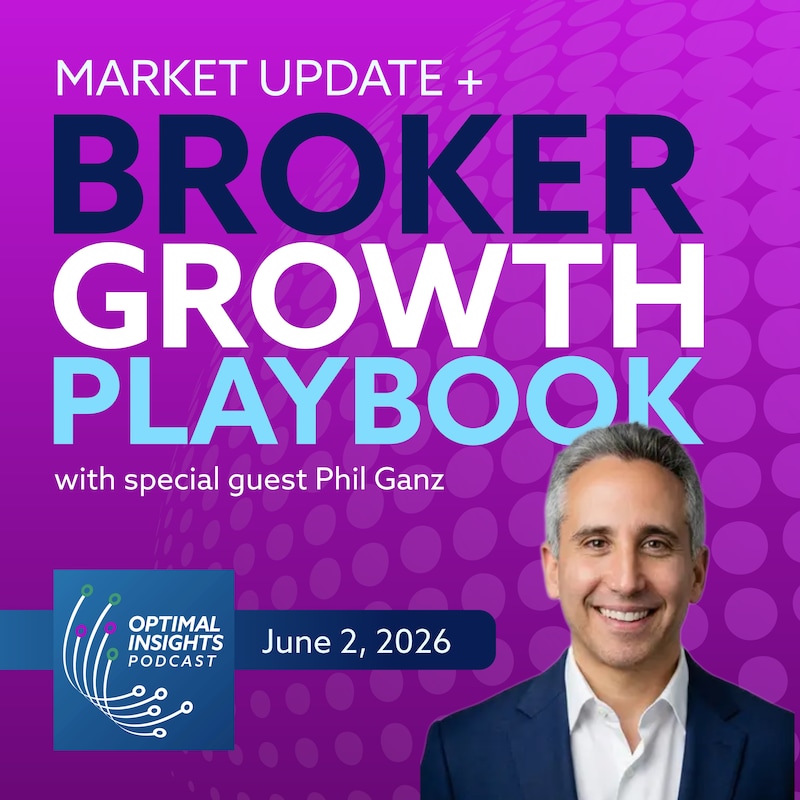
In this episode of Optimal Insights, Jim Glennon and Alex Hebner open with a market update focused on inflation trends, labor market conditions, and how both are shaping the current rates environment. They discuss the role of energy prices, recent economic data, and why jobs numbers remain a critical input for market expectations and policy outlooks.
The episode then features a conversation with Phil Ganz, president of Next Wave Mortgage, on building a broker growth playbook in a challenging market. Phil shares how domain-matching strategies can drive lead generation, why simplicity and quality matter in search visibility, and the operational realities of managing high lead volume. The discussion also explores first-time homebuyer strategies, conversion challenges, and leadership lessons centered on consistency, long-term improvement, and resilience.
Key Points:
- Inflation and jobs data shaping the current rates environment
- Why labor market trends remain critical for market expectations
- Phil Ganz’s broker growth approach, including lead generation and conversion
Chapters:
- 00:00 - Welcome and episode overview
- 00:34 - Market update: inflation and jobs
- 02:23 - Rates outlook and macro drivers
- 10:13 - Economic data and labor market focus
- 14:08 - Interview with Phil Ganz begins
- 17:48 - Broker lead generation and growth strategy
- 30:53 - Leadership and long-term mindset
- 40:39 - Closing remarks
Optimal Insights Team:
- Jim Glennon, Senior Vice President, Hedging and Trading Operations
- Alex Hebner, Hedge Account Manager
Special Guest:
- Phil Ganz, President, Next Wave Mortgage
Production Team:
- Executive Producer: Sara Holtz
- Producers: Matt Gilhooly and Alex Kreuter
Commentary included in the podcast shall not be construed as, nor is Optimal Blue providing, any legal, trading, hedging, or financial advice.
Mentioned in this episode:
Get Ahead of What’s Next at Optimal Blue Summit 2027
The mortgage market keeps moving. Optimal Blue Summit 2027 brings together industry leaders, innovators, economists, and technology experts for three days of market intelligence, hands-on learning, and meaningful connections. Join us February 1–3 in Scottsdale, Arizona, to hear from Troy Aikman, Bob Broeksmit, Michael Fratantoni, Joe Tyrrell, and other influential voices shaping the future of mortgage. Optional training sessions and a championship golf experience are also available. Early-bird registration is just $199 through October 31. Register today at Summit.OptimalBlue.com.
Transcripts
Welcome to Optimal Insights. I'm your host, Jim Glennon, Senior Vice President of Hedging and Trading Operations at Optimal Blue. Our clients and industry partners have long relied on Optimal Blue for trusted insights and commentary. And these podcasts are an evolution of our commitment to keeping the industry informed. Let's dive into today's episode.
Jim Glennon (:Welcome everybody. Welcome, welcome to first week of June. We've got a great show for you today. We are here to help you focus on what's most important, whether you're an originator, capital markets person, or just someone interested in
mortgage industry and some great market commentary. ⁓ in a minute here, Alex and I will give you a little bit of a market update. A little bit to talk about here, a little bit coming up later this week. After that, I did a great interview with a gentleman named Phil Ganz. Phil is someone I met just a few weeks back and wanted to introduce him to our listeners. Phil runs a a newish mortgage company called Next Wave, and they're a mortgage broker and just have a very interesting business model.
And I just I just think Phil's an interesting person with some great ideas about our industry, but also just about business and leadership in general. So we'll talk with Phil here in a minute. ⁓ so stay tuned for that. In the way of market data, ⁓ OBMMI, six and a half, kind of hovering around there ever since the war with Iran started. The 10-year spiked over four and a half today, with once again the ping pong ball has been flung across the table. And this Monday we are
questioning the ceasefire, questioning the deal in Iran, kind of the same deal we've been working with back and forth over the past few months. We did hit 4.6 a couple weeks ago, which was a like a 15 year record for the 10 years. So we're a little bit below that, but we're creeping up on that number again. All right, Alex, let's get into some market chatter. Maybe just start with some numbers and then we should we should touch on the conflict as well, even though it feels a little bit like Groundhog's Day. So we saw.
Inflation data last week about as expected, even though it's elevated versus what we would have seen and expected before this war in the Gulf, right?
Alex Hebner (:Right, right. The number came in at expectations, right around three point eight percent on ⁓ non core CPI. number again was expected, but it's about a full percent higher than it was ⁓ on the February release before the beginning of this conflict. So again, really just driving home the point that ⁓ these raised energy costs on the back of this conflict are ⁓ producing some inflation here at home.
Jim Glennon (:Yeah. All right. And so a war that we thought was gonna take four to six weeks is now, I believe, entering its fourth month. Oil is, you know, between ninety and a hundred and ten dollars a barrel. Obviously that is a problem for inflation, and that that kind of keeps us in the US anyway, focused on just this war in Iran. Right? But at the same time, not totally by coincidence, there's also
this war in Lebanon, mostly between Hezbollah and and the Israelis, that's that feels like it's never like it has not conformed to any of the ceasefires that we've been been engaged with with the Iranians. We've also been lobbying bombs back and forth between us and the Iranians. I mean, where are we really at with with this whole with these multiple conflicts in the the Middle East?
Alex Hebner (:Right.
Right. The the when you you hear the term ceasefire, that ceasefire is in regards to the US and Israel and Iran, the state that you can find on the map. and that ceasefire has held pretty steadily. ⁓ there have been, you know, here here and there little strikes by both sides, what has been a a a a through line through this entire conflict from when it began in February, ⁓ has been a conflict that was
Entirely being fought by the Israelis against ⁓ Hezbollah, which is a an armed group in Lebanon that is backed by Iran. So you can't really find Hezbollah on a map. They are a political party in Lebanon and they have a military wing, and that is who Israel is is you know attacking and in active conflict with. and that conflict had there there was never any ceasefire in that particular conflict. They are in the Hinter regions, northern northern Israel, southern Lebanon. at this point, Israel has fully invaded, you know, southern Lebanon in a
effort to to stamp out Hezbollah. And that conflict has actually, during this period of ceasefire, has actually escalated quite a bit. In fact, over the weekend, ordered an a further escalation, further incursions into into Lebanon. So I think that's part of the reason this morning, you know, we've we've seen you know a spike in oil prices, spike in the 10 year, spike in you know, US Treasury rates is one, the ceasefire that is again between the US and Iran
We're we're still just kind of kicking it out sixty days at a time. You know, there's really no resolution on the horizon. And then at the same time, there is this same you know, continuous conflict that's going on that's underlying that that really isn't picked up as heavily here in in on the mainstream press just because this isn't the thing that's driving those those energy prices that the US is so sensitive to.
Jim Glennon (:Right. Yeah, it is kind of maybe out of sight, out of mind, but it is a major, as you said, a major escalation in southern Lebanon and it's still in that same region. So that you still worry about possible any sort of possible contagion or or just breaking across borders the the conflicts that are going on there. And as you said, there still is, I believe over the weekend the Iranians lobbed a couple of missiles over at our our bases, I think in Kuwait, which is
Alex Hebner (:Mm-hmm.
Correct.
Jim Glennon (:obviously
provocative. So then we know we intercept those missiles typically, but then that's an act of aggression that we have to retaliate against. So that we've we're kind of focused on that again and then but still have what's going on in Lebanon. So something to keep an eye on or at least to when you're watching the news, when you're trying to keep up on news, you kinda have to search for that one versus it being at the headline level because we are a war that our country's literally in, but also President Trump is obviously gonna talk is fully focused
it seems on the on the the w our side of that war. until anything is done to resolve that, we're obviously going to have a the straight of four moves completely shut down, at least for practical purposes. So we're gonna continue s to see inflation that all stems from mostly oil just being elevated and being a an input for everything in this country that we consume.
but the rest of the world's seeing it a lot worse. Like that that that bears repeating as well. We don't get a lot of the news from Europe, but we have a lot of our own energy here in the US, so there's we have much less feeling much less of a shock. Sure, airline tickets are more, gas is is a bit more, but in other parts of the world that are feeling a a a major hundred percent shock versus kind of the twenty, thirty percent that we're seeing.
Alex Hebner (:Spot on, spot on, yeah. No, Europe and and you know, Asia, you know, Japan, Korea, ⁓ these countries that really rely on a lot of imported fuel, far more so than we do, as well as China. They they've seen in increased costs. And then, you know, in some more of the third world ⁓ spots, Africa, Southeast Asia, they're they are seeing, you know, full full-on shortages. You know, it's not just you know, gas is expensive, it's that gas isn't available at any cost, at any price point. so yeah, we're we're definitely insulated here. ⁓
Jim Glennon (:Right.
Alex Hebner (:for the time being. ⁓ they they do expect and I've explained this a couple of times now how, you know, if you're looking at a world map, you know, you know, kind of these price hits are going to be seen southeast and then they're kind of going to move northwest across the map as as these growing seasons and everything, you know, you need energy for for agriculture as well. So we're gonna see those shocks kind of move across the map. So ⁓ you know, without any resolution, I do think we can see, you know, prices here in the US go a little bit higher. But
To your point, you know, we we should be thankful that ⁓ we are a net energy exporter and have the those resources here at home as well.
Jim Glennon (:Right. So it's yeah, it's interesting to dig deeper if in fact if you're again interested in just the world oil and energy, you know, market and the exchange process, it's worth Googling more on that too. Whether you're reading about some of the black market oil that is making its way from Iran to places like China, or just the yeah, the overall, as you said, kind of the stranglehold that's ⁓ making it so some countries literally don't have fuel and also how long there's this debate about how long can the Iranians go
without the economic benefits of selling their oil. With you you can't assume that they're selling no oil. That's kind of the the trick there, right? Is is there are millions of barrels of oil somehow getting out of the Strait of Hormuz, somehow getting through to places like China where they're they're paying probably pennies on the dollar, but still being able to liquidate, so to speak, that oil in other parts of the world. Meanwhile, they're stashing it throughout their infrastructure in Iran.
waiting for either some kind of resolution or just for some of these these alternate routes or these shortcuts to get to get figured out. Just a super interesting dynamic going on there. That's it's difficult to kind of think about all the different facets of it and how it might play out.
Alex Hebner (:Right now it seems like both sides feel that they hold the cards to win the game. ⁓ and it's really kind of a they're playing a game of chicken, I think, just kind of staring each other down, seeing who can who can ⁓ you know have their arm twisted behind their back longer before they they kind of you know yell uncle. but yeah, no, there's a lot of very interesting, and it's far outside the purview of this podcast, but there's a lot of interesting debates right now going on in the in the energy community and energy traders on,
Jim Glennon (:Mm-hmm.
Alex Hebner (:what the bottom is, so to speak, or rather the top in regards to to energy and the bottom of the barrel scraping out the last wet oil. Yeah.
Jim Glennon (:Mm-hmm.
So to speak. Yeah.
All right. So yeah, to bring it back to to rates and the mortgage industry, doesn't seem likely we get under six and a half ish percent on the 30 year until we have some kind of resolution, mainly because of inflation. We have the new Fed Fed chair coming in for this next meeting, Kevin Walsh. Certainly not expected that we'll get a cut. Probably another pause, possibly a hike at some point, second half of the year. Just
Alex Hebner (:Mm-hmm.
Jim Glennon (:you know, not great outlook for for rates right now. We have unemployment report this week, which is the most important number that's going to come out this week, most likely, unless there's some kind of black swan. So what are we expecting there? What what should we be, I don't know, hoping for or worried about?
Alex Hebner (:that's the thing about the, you know, we were really before this conflict broke out, we were really nailing in on the jobs number every month and just seeing, you know, when when's that tipping point for, you know, when we can justify a rate cut. and right now, ⁓ to to your last few points, I I really see very few downward pressures on rates, especially from the the traditional avenue of, you know, the Fed cutting that that short term lending rate and it feeds through to your longer term rates.
Right now the the jobs number on Friday isn't expected to be a a blowout in in either direction. It's it's really expected to be right where it has been the last few months, which has interpreted by the market as, you know, filling ⁓ you know, the needs. ⁓ but you know, we don't have a job shortage or ⁓ a a surplus of jobs. You know, we'd really be looking for a shortage of jobs and and unemployment ticking up.
pretty substantially for us to expect a rate cut any time this year.
Jim Glennon (:Right. So to paraphrase, you know, pre Iran war, we were getting close to justifying kind of a preemptive cut, right? As the job market was starting to slow down. There was we felt like we had inflation mostly under control or headed back towards two percent. So we could justify cuts to kind of stoke the economy a little bit, get things moving, stave off any sort of deflationary pressure or disinflationary. But then we have the Iran war and we've we've kind of lost all that justification. So unless we get a you know.
half million job crater, like negative jobs number this Friday, we're likely even if we're close to zero, we're probably still looking at rest of the year being a stagnant interest rate market.
Alex Hebner (:Right, right. ⁓ yeah, very much so in agreement. Yeah, even before the Iran conflict, we were trying to tease out rate cuts were by no means certain. ⁓ we were trying to tease out, you know, what's the impact of AI, what's the impact of the immigration policies that are counteracting some of these layoffs we're seeing, you know, what is the actual, you know, net neutral ⁓ jobs number here in the States. ⁓ yeah, that that
Jim Glennon (:Mm-hmm.
Alex Hebner (:Friday numbers expected around ninety thousand, which is on the lower side of where we've come to expect it to be. It's usually in the in the one tens, but a twenty thousand job difference over one month is is by no means to cut rates.
Jim Glennon (:Yeah, with you know, immigration policy still having an effect on how many jobs need to be created to keep us stable, you know, at four point three, four point four percent, the the Fed and everybody's gonna look at that as full employment. So we'd have to get I would think we'd have to get closer to five at this point. It used to be like seven, four eight before the the Fed is even under any sort of pressure to act, even with you know, with inflation being where it is.
Alex Hebner (:Yeah, and just to put some, you know, raw numbers and our percentages on that, you know, like a half right now we're at four point three percent. To get to four point eight percent, it's whole half percent change. That's that's you know, that's half a million million jobs. So
Jim Glennon (:Mm-hmm.
That's a big bogey to hit for for for our hopes that that rates go down in the second half of the year. All right. Good stuff. Alex, what else do we have?
Alex Hebner (:Yeah.
Mm-hmm.
that's really the headline this week. Just just keep an eye out for any changes in the situation in the Middle East. ⁓ we're getting pretty heavily teased last week that there was gonna be some sort of deal, but based on how the markets are reacting this morning, it seems that we're we're ⁓ less close to a deal than than was expected last week.
Jim Glennon (:Yeah, we're back to where we were once again. All right. Well, here's the hoping for better better momentum in the resolution of the Iran war this week. But otherwise look out for that unemployment number. And thank you very much, Alex. Good talking with you as always. And we will transition to talk with Phil. Thanks, Alex.
Alex Hebner (:Mm-hmm.
Appreciate you.
Jim Glennon (:guest is someone I had the opportunity to talk with a few weeks back. I think he's a super interesting guy with some great thoughts about our industry, but also just about building businesses in general, and also some really good ideas and thoughts about leadership and competitive philosophies. So I wanted to ask him to come on the pod to talk about these things. His name is Phil Ganz. He's the president of Next Wave Mortgage, a wholesale lender that's found some, I'd say very interesting ways to grow.
Quite a bit faster than what our industry is experiencing right now. So glad to have you on today. Welcome, Phil.
Philip Ganz (:I am so excited to be here. It's an honor to be on your podcast and ready to bring value to the audience.
Jim Glennon (:Right on. Thank you for saying that. And yes, we we're excited and honored to have you as well. just to get right into it, could you tell just the audience a little bit about next wave and what y'all are doing that's different than what maybe we we think about as a traditional growing mortgage business?
Philip Ganz (:Yeah, so next wave mortgage, you know, we started the company in a state that we were never from, Florida, where I moved, two years, seven months ago. And we're we're we're a broker, and I mean a true independent broker. So we we don't have market share of any one investor, I think over twenty percent. So there's many different people and we don't well, we
like the bigger companies were really independent of always trying to put the customer first.
Jim Glennon (:That's great. Yeah. I mean that so you're a broker, so you kinda have your you've got that flexibility that's always been associated with being a broker lender. You can work with yeah, you could work with the UWMs of the world or you can work with some of the much smaller guys just to get whatever kind of rate you're looking for, but also the the exact right product for a borrower, right?
Philip Ganz (:Really
comes down to the product, you know, and to be able to deliver the product, you know. At Next Wave Mortgage, we do a lot of affordable housing. We do a lot of down payment assistance, you know, programs. and we kind of, you know, we got into it, and just so the audience knows, we have a lot of websites that bring in a lot of clients. This is what kind of like helped us grow, We get a lot of business coming through our doors.
Jim Glennon (:Mm-hmm.
Yeah.
Philip Ganz (:Give you an example. we own like say Hometown Hero Loan Program. That's like the number one loan program in the state of we have a lot of those domain matches and what the for the audience is we own the answer for the Google search, So we have a lot of people applying. And so we've really focused in and home honing in on helping first time homebuyers achieve their dream.
And this is like a big thing. I think a lot of people look at other types of loans and they look at other types of stats. But we've really tried to focus in on getting people into their first house.
Jim Glennon (:Right. It's I mean, can you elaborate a little bit more as much as you're willing to to talk about sorta to our our listeners about how you get your how you get those leads, how those borrowers come to you and and that whole go Google search.
Philip Ganz (:Actually, I'll go into great
detail, People are here for detail. I'm gonna get into the detail. I'm gonna give you all the secret. And what I will say to the people that are listening to this, the last employee we had let go, you know, he's like, I'm gonna give, I'm gonna you have to give me 200,000 or I'll tell everyone your trade secrets. What I'm gonna tell you was the same thing that he wanted 200 grand for.
Jim Glennon (:Right. Let's do it.
Philip Ganz (:What we do is we do something so simple. It's called domain matching. So, for example, if you and if like the number one program is Hometown Hero Loan Program, If you Google Hometown Hero Loan Program into Google, we come up number one,
mean, we're over approaching:and growing mut qu pretty quick. In fact, we don't even create websites anymore. because we can't even our leads are going way faster than right now, than we well, than our capacity to like help out this is something really big. And we learned it through actually losing, is because originally we had these like websites. Our first website was make far to your home. And it was a big hit. We were getting almost at our height.
50,000 clicks in in in in a month. I mean, we I think our top day was almost 300 applic leads, People that wanted to apply. What happened to the we couldn't handle it. But you know, this is what I tell people is that it was such a success. What happens is every ninety or so day, Google has core updates.
And we lost almost everything overnight, especially with AI. So we said, All right, how do we defeat Zillow? How do we win? And I'm telling people right now, here's your $200 million answer. You just need a one or two page website, and that's it. You don't have to be fancy. It just has to be high quality. He said, Well, what do you mean high quality? It has to make sense. Yes.
Jim Glennon (:Mm-hmm.
Philip Ganz (:AI can help you structure what it is, but you actually have to put it in the effort. In fact, that's why the guy had to go. The guy had to go because he did not meet my quality standards, And I tell people there are no shortcuts to success, only long cuts, I tell people that failure. His last month was, you know, 88 websites, and I think we got one lead a month out of it. This is true story.
I like most of our other websites are generating so many leads we can't handle it. It's just he he he he wanted shortcuts and this is the opposite of my philosophy is high quality and if you look at successful people like when Steve Jobs fired his top engineer they said why did you fire him? He's like, Well, he wasn't obsessive, you know, because Steve Jobs was obsessive with the fonts, He was the best engineer that was not obsessive with fonts.
And that is exactly the way you need to be obsessive if you're creating your one or two page website. Is that, you know, find something that's that there gets a lot of search volume. And then that search is now your website, whatever that phrase is. You become the answer. And that's how we did it. We're we have so much, so many leads. It's actually led to, you know, two pretty good partnerships with these Zillow
Jim Glennon (:Yeah.
Philip Ganz (:real estate companies for what they are. The two biggest ones, one in Florida and one in Texas. We do business with both of them, by the way, I will say this is that that created a new problem. Because when you get first time homebuyer leads, it's a it's a it's different than the playbook of Zillow, right? For people, your audience that
Jim Glennon (:Mm-hmm.
Philip Ganz (:May not realize the playbook of Zillow is on the reorder side is hi, I'll meet you at the property and be as don't say anything. Just like show up as quickly as you can. And that's a different than when you have a first-time homebuyer lead. Because a first-time homebuyer lead, here's what you do to convert, The first thing is you create alignment. This is very important to close deals. You create alignment with the
Exactly what you offer and what their goals are, and he asks them questions. This is very important. You always need alignment in any relationship, especially if someone's brand new at something. Like you can't have to do it. The second step is that you need contrast. What do you do completely opposite than the competitor? You can't be a little better. You need to be the best, right? You need to be completely the opposite.
So if it's a yes or no question, you may be the best. Like we offer down payment assistance, That is the opposite versus a lot of companies that just don't do that, we we show the And then once you have the contrast and you have the alignment, at that point you start to build the relationship and ultimately close the client, which was different than the Zillow, complete opposite. So that is, you know.
A big thing that the audience can take away is sometimes not realizing the playbook that a lot of these online leads are coming through. If they're on Zillow or Realtor, and they get sucked into that game, and all they really need to do is create that alignment, hit them with the contrast, and then build and close. So we've we've done really well. We're gonna do better on this, had a lot of people don't want to talk about their failures.
⁓ and yeah, and and just to let people know, in December, in December, we were like at 72 million, For for the like value of what the company would be doing. Now I think we're at like 152, and we'll probably be at 300 by the end of the year. So we're gonna like four X where we were. And so that's what ⁓ what we're up to. That's the struggles we faced. That's how we've like accomplished a lot of it.
Jim Glennon (:That's how you learn.
Mm-hmm.
Philip Ganz (:I think you know, we have I think our bigger, you know, what our our our goals are where we're gonna convert more because our conversions are horrible. People are, you know, what are your conversions right now? I mean, we don't have enough people to handle So it's less than one percent, wanna be typically two, three, four, five And when you're at like a ha it's because like you know, things come up and I can't we don't have enough bodies, And
Jim Glennon (:But
Yeah, but the notional numbers
are huge, right? Like I hope people are finding this as interesting as I did. I don't know if but or maybe I got sold by Phil and his his pitch, but just this I haven't been on the production side of mortgage for many years. and I know back then leads were hard to come by. They were expensive, and I think that's still the case in a lot of ways, unless they come from a realtor, which you're kind of covering with these these realtor partnerships. But then the you know, I think it's worth doubling down on
this whole kind of search engine optimization meets creative product advertisement angle that you guys have have teed into as well, which is crazy that you're just kind of letting this out there 'cause it seems like almost seems like a shortcut.
Philip Ganz (:And and I wanna let you know
the brilliance of it is like what do you pay a month? Look, we always reinvest, but once you have a site done, say you have a site and it gives you like fifty leads a month, That site costs you zero dollars to basically maintain an annual hosting fee of nine dollars. So while it took you maybe a day or two to like do your not I mean we can do them in an hour.
But let's just say it takes you two days to do one site. That one site could give you 50 leads, 100 leads a month, every month with no additional cost.
But I say it because I want to help people. Because right now, the information I just told you, you could take. And if you do a co if your wife does a coffee shop, you or your spouse does anything in any small business, you could instantly rank and be number one for what you you want to be. And it's just not mortgages. I think people miss this.
Jim Glennon (:Yeah.
That's a that's an old that's not a new concept. The search engine optimization business has been around since the internet's been around, right?
Philip Ganz (:But the big thing is you just need to do it with a two-page website or a one-page website, not anything more than two pages. It actually works in reverse. It's like no way. After two pages, it's like forget it. I'm just telling you guys, look at my best site. My best site, here's what I would tell people. If you go on my best site, make Florida your home. Check it out. Make Florida your home. This site looks incredible.
Jim Glennon (:Click click here. Yeah.
Philip Ganz (:It is unbelievable. Make Florida your then you go to my two-page website that I haven't updated in like a year, called Hometown Hero Loan You know, you could Google Hometown Hero Loan Program this thing gets like 300 leads, six extra leads. You know, and you're like, no way. Because you'd be so amazed of how nice make Florida your home looks.
In comparison to this, it doesn't matter. Nice, i it needs to be the way AI and and the search engines are working today. You're overrating Because I will tell you, make Florida your home is the nicest looking website.
like a high school project. It was just funny. You see, why? Because I'll also tell you this: over time it ranks higher. So we just didn't like really like update the looks.
Jim Glennon (:It is pretty good looking. I'm I'm folded up right now. This is pretty good. Yeah.
Philip Ganz (:Just because it like works and it generates so many leads. But our other websites that we create now over time, and that's what happens is that people give up on like this one or two page website. But that's how it happened. Like we had just, it was a crazy concept that randomly was starting to work when one site was tanking. We were getting like three leads a month from like hometown here program and just built over time.
It was an accident, and then the accident became a strategy. And you're like, well, Phil, if you had to do this tomorrow, like you couldn't do mortgages, It would work in any industry. You name it, we can do it. Because all you need to do is is just look at the search results. The facts are already there. You can go to SEM Rush for like 50 bucks a month. You you could find out everything that you'd ever want,
Jim Glennon (:Yeah.
Philip Ganz (:Get the data and then create your one or two page website. And it's like you you could just do this again and again. And you could take your biggest real estate competitor, see their top pages, and then you could take their top pages and just make them to single page websites. You could do that with versus a lot of companies. But I I just told people this, you know, because we created a a huge lead problem.
And now we're working on the conversion problem, right? Which we're gonna do. We know how to solve it.
we're we're now focused on our creating or fixing our conversion problem.
You need to kind of approach this in the beginning, more of like a when you're trying to do marketing and generate leads, it has to be more of like a
long drive competition you gotta take a big hack you gotta take a big hack and why and this is the big thing you gotta you gotta be able to like let it rip you gotta do it and I I tell people that's the mentality like I've made so much mistakes I've made more mistakes than like anyone else like I just learned all this
Jim Glennon (:Yeah, you w you wanna take big swings. Every producer does, right? You you wanna Yeah.
No, that's good wisdom, man. And and I I like how you had you know, you brought up jobs, You and I have talked a little bit last time, and I I thought it was intriguing. So I want to make sure we get to this, right? And now I think is a good time to to segue to it. We talked as leaders of organizations and about how there's certainly challenges to that. There's great rewards in being a leader. and just kind of related to everything we just talked about, you you view leadership rightfully so.
As this ongoing journey, right? You drew some parallels to sports. I'm sure you could draw some parallels back to software. And you said that the focus shouldn't just be on winning a single championship, but rather building a strategy that helps you keep winning month after month. Like how can you elaborate on that? How do you how do you think about that in your business now? How you look at it with you know Tesla or or Optimal Blue?
Philip Ganz (:Yeah, no, absolutely, I think, you know, it it's really a mindset, like you can't be about collecting trophies. You have to be about always improving and trying to make things better. Because a trophy may not even be your best effort. A trophy may get in the way of like trying to win, This is a complete distraction.
And why I think sometimes, you know, why you know, people they're so big on trying to get this one thing. That's why it's so hard to repeat in sports, take your foot off the gas, you think it's a good moment, You think you're so close. And I'll tell you a personal story that just like relates look, we all learn more, we agree, through like Gemini, realize.
But one crazy story is I didn't know the true story. I didn't know till this year that my dad had the highest age score, which is a publishing score. He's he still works, he's 76 years old for cardiology. That's never won the Nobel Prize. This is true. And so I came up with this idea because I'm good at domain matching. I was gonna like try to help him win the no, you know, try to get him recognized because I could identify to 3,000 people and I.
Say to him, dude, I got this idea. We're gonna win the Nobel Prize. I'm gonna try to ⁓ jimmy rig it so you can get some votes. And I came up with this idea to try to win. And he's like, dude, he's like, he's like, Phil, he's like, this is the worst idea I've ever heard. I'm
why it was such a terrible idea. And what my dad explained to me was is that that would stop his progress. Ultimately, it would stop trying to do amazing things. And that's failure, right? The minute you stop trying to improve, if that event led you to st to not like achieve more.
Like if a championship stops you from wanting to to achieve more, it's just that's not what it's It's always trying to get better at your craft and do it. And look, for somebody like my dad, he's just trying to make humanity better. He doesn't need, he didn't ever even view these things as like winning. And the only funnier thing about the story is I said, you know, my my dad said is is that the guy that had
The record before my dad was my dad's former boss. So the reason why I bring that up is that that is taught. That trying to like you know, trying to win this championships, it rubs off on people, It does. It wasn't random that the the guy before that, I think his name was That he was all also that attitude.
It rubs off, it wins championships. More than you've then more people could ever know. And you're like, well, what's the the score difference? You know, the average that someone would win a Nobel Prize in cardiology is 60. His score, I think, right now is I think it was like 121. So it's like he's the Will Chamberlain. I scored the most points, a lot of MVPs, rebounds, and just didn't, you know, sometimes you just don't get. And I and I bring this up because.
Jim Glennon (:Yeah.
No championship.
Philip Ganz (:All the other like things lead to it. And he he doesn't want to stop. In fact, he just takes it year by year. This is always his approach.
But he's chasing, always trying to like continue to do better. And I think, you know, that was again this was a moment this year. This wasn't this was the big thing up until and just to let people know, you know, I go to my mom, I said, you know, mom, did you know?
The story of his age score, no idea. Even my own mom had no idea. He's like, Yeah, well, we figured he's good at publishing, and I think he's well known, but he didn't know like anything else because he's too busy. If he's so against trying to pick up these awards and dealing with nonsense, like he just wants to see he's so laser focused on the next play, and that is something like you see.
Jim Glennon (:Evolving. Yeah.
Philip Ganz (:Of like, my God, that is like something so cool to see. And what like I try to strive for, And that's like, you know, like the lottery tonight is big, My wife's like, what are what are we gonna do? Are you gonna stop? No, I I don't wanna stop. Even if I win, it's not like it's not about like, and I work really hard, I work really hard at mortgages and I try so hard to get better every day.
That like I wouldn't stop even if I won. You're like, would you take a day off? Fine. Maybe I take a half a day, but not more because I have a lot of enjoyment in what I do. I love helping people. I love competing. Now, do I love all the stress of the mortgage industry and like all this? But you know what? That is a privilege. I'll tell people this. I want the pressure. I love the privilege.
Jim Glennon (:Yeah.
Philip Ganz (:Every day I can compete is a privilege,
Jim Glennon (:Yeah, it's a championship mindset, right? I love that you told the story about your folks and your your dad, because I think
Obviously very humble, very hardworking, and I can see that that is in you as well. And you've learned a ton from that and built something once again, built something great that's probably gonna continue getting greater, but the same time you're you're offering to share that with the industry, which is wild, or any industry really. You've given a kind of a formula that could be used to to be successful in any sort of business that
Philip Ganz (:Well, there's a lot
of people struggling right now and I I feel bad. You know, there's a lot of people hurting and you know, a lot of people are self-doubting. And if you can save one person or you can turn around someone's career, what I would tell anyone is with this that in business, one swing in the back be worth a million runs. Unlike baseball that you can only max out at four. See so some of these people maybe
I got one swing left or a couple of swings left. And you're like, what do you do? You're near the end, I need to turn things around. And I think I just wanted to bring some hope to people. You know, I wanted someone to listen there and and and really, you know, give them the confidence and also give them the confidence if they were trying to start their own company to go do it, This was a message of of
Jim Glennon (:Take
Philip Ganz (:I want people to become independent leaders, and to do something great and to have the courage, And I know that sometimes people have to take big risks and there's a lot to lose. I get that. When I moved to Florida, I thought my wife was gonna come with me. She didn't. Her birthday was Valentine's Day. I said, what do you want on Valentine's Day? I want a divorce. So I did not get off to a good start.
Jim Glennon (:Mm-hmm.
Philip Ganz (:in in was a lot of things that didn't happen right. You know, I had to switch companies twice and started my own. There's a lot of failure. Now it worked out well. And I got a beautiful baby Madison, seven and a half months, and a beautiful wife. It is working out great. But there was when I was near my top or at the You know, I say there's three levels. At the top has been and never was
I was at my top when I made this risk. Most people make the risk either where they were they were they're either descending or they never did it in hopes of a spark. This was absolutely my pinnacle. I said, well, why would you take that such of a risk? And I would tell anyone, look, you only live once. And I didn't want any regret. And I also
Jim Glennon (:Mm-hmm.
Philip Ganz (:Even though s business wise, I was very successful. Spiritually wise, I wasn't like completely fulfilled. I wasn't happy. And I think that's mental healthness and wellness. You know, people like talk about it, you know. Biz this is what you see online. Like, hey man, I and obviously I eat I eat healthier. I don't drink. I eat everything organic, but you you know, people say, Well, I didn't drink today. Sometimes you need a you need a spark, you need a
You need a reset in life, You need a a second opportunity, I'm betting a lot, but I'll tell people, I also bet I don't think there's anyone I know that's taken and that was my dad's biggest thing because he he he came from Czechoslovakia and he had escaped in the middle of the night because of Russia invaded,
different for us. It is different than when people have to escape. So no matter how hard you think.
you you you're between a rock and a hard place and you're not sure. You know, I would always tell someone, you know, you live once and you know, make a calculated risk. Would I have done it differently? Sure. There are certain things I would have done differently. But I that doesn't mean I wouldn't have ultimately made the same decision. I just didn't I would have probably consulted, I would have thought this out a little bit more, because that was a little impulsive,
Jim Glennon (:Sometimes that's what it takes though, is to be to take that risk.
Philip Ganz (:It does. It does.
It does. And I I tell people that because people are wondering what their next moves are in the industry or w what they should think.
Take whatever risk you need to take to make it happen.
Jim Glennon (:I love that. I love that. I think it's a great, just bittersweet, beautiful ⁓ way to to wrap this up, Phil. I I so much appreciate you being here with us today, dropping a ton of wisdom on the on on our listeners, but also on me and and inspiring on to boot. So thank you for for taking the time.
Philip Ganz (:Thank you for having me. It was an honor.
Jim Glennon (:All right, take care, Phil.
Jim Glennon (:And that's it for today. Join us next week for another episode of Optimal Insights, where we'll continue to provide you with the latest market analysis and insights to help you stay ahead. Check out our full videos on YouTube. You can also find each episode on all major podcast platforms. Thanks again for tuning into Optimal Insights.






