Shownotes
🎙️ Episode 4 — Where the Live Event Jobs Actually Are
Searching for event planning jobs can feel confusing—because the work doesn’t always show up where you expect it to.
In this episode of So You Want to Be an Event Planner, we demystify the event labor market by breaking down where event planning and event management jobs are actually located. We explore the main employer types—venues, agencies, brands, nonprofits, associations, governments, vendors, and freelance work—and explain why job titles can be misleading in this field. This episode reframes career mobility as a strength and helps listeners understand how to evaluate roles based on environment, not just titles.
If you’re trying to figure out where to apply—or why event jobs are so hard to spot—this episode brings clarity.
🔑 Key Ideas
- Event jobs exist across multiple employer types
- Vendors and freelancers are central to the event ecosystem
- Job titles often hide the real work being done
- Event careers are rarely linear
- Understanding environments matters more than chasing titles
🧠 Language We’re Using
- Employer types
- Vendor ecosystem
- Freelance labor
- Embedded departments
- Career mobility
✍️ Try This
Look up one job that isn’t labeled “event.”
What event-related responsibilities does it actually include?
🎧 Coming Up Next
Episode 5: What Are The Source (Undergraduate) Majors if I Want to Work in Live Events
Once you know where jobs live, the next question is academic: what should you study—and does it really matter?
🔍 Examples Referenced in This Episode
- Hotels and convention centers
- Event and experiential agencies
- Brand-side event teams
- Associations and nonprofits
- Event vendors (AV, production, tech)
- Freelance event professionals
Companies mentioned in this episode:
- Apple
- Movable Inc.
- Dorito
- Bank of America
- Wells Fargo
- Smith and Nephew
- Bill and Melinda Gates Foundation
Transcripts
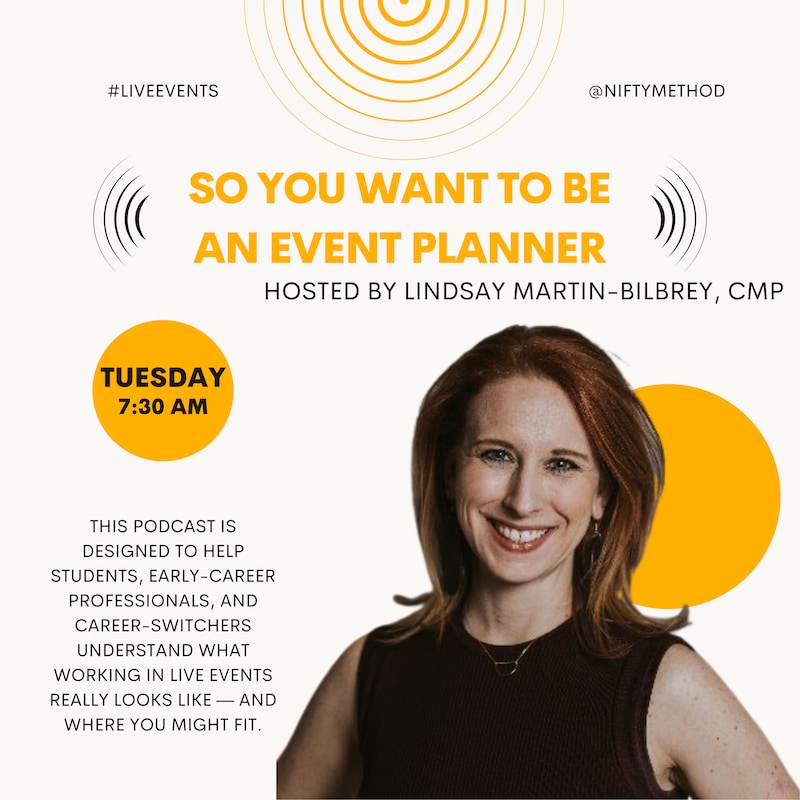
Episode 4 where live event Jobs actually Are welcome to so youo Want to Be an Event Planner, a podcast about how people actually find their way into the live events and experience industries.
Speaker A:I created this show because live events are everywhere in our lives conferences, concerts, weddings, festivals, sports and civic moments.
Speaker A:But the field itself is surprisingly invisible.
Speaker A:People work in live events for years without ever being able to explore what the industry really is, how they got into it, or what paths even exist.
Speaker A:My name is Lindsay Martin Bilbrey.
Speaker A:I've spent over 20 years working across hospitality, live events, strategy, and operations in agencies, venues, brands, associations, and classrooms, and I've seen firsthand how many talented people stumble into this work without a map.
Speaker A:This podcast is designed for students who think they might belong in live events but don't quite know what that means yet.
Speaker A:It's for career switchers who found themselves adjacent to the field and are wondering if there's a place for them here.
Speaker A:And it's for parents, advisors, and educators who want better language for explaining what this industry actually is and how it matters.
Speaker A:This isn't a how to about planning live events.
Speaker A:It's about understanding the field, the roles, the pathways, the identities and the systems behind live events and experiences so you can decide where you fit inside of it.
Speaker A:Let's get into it if you've ever searched for live events jobs, an event planner, an event manager, event director, and felt confused or overwhelmed, you're not imagining it.
Speaker A:The work and career is real, but it doesn't always look or live where you expect it to.
Speaker A:So today, this episode, we're getting very concrete about where event jobs actually are, who hires event professionals, and why job titles are misleading in this field.
Speaker A:Today's episode is called where the Live Events Jobs Actually Are.
Speaker A:Now, in the last episode, we talked about how people get into this field.
Speaker A:Now we're answering the grounding question.
Speaker A:Once you're in, where do you actually work?
Speaker A:Because live events don't hire in just one way, and they don't sit inside one type of organization.
Speaker A:The problem with event job searching is layered.
Speaker A:One of the most frustrating things about entering this field is that event jobs don't always say event in the title.
Speaker A:You might be looking for a job as an event coordinator, an event manager, an event producer, a show caller.
Speaker A:But many event roles live under names like operations coordinator, program manager, travel director, marketing manager, community engagement lead.
Speaker A:It's not that the field is disorganized, it's because live events are embedded inside larger systems.
Speaker A:There are five primary employer categories, plus a bonus one so let's break this down cleanly.
Speaker A:Most event professionals work in one or more of these types.
Speaker A:Venues are one of the most common and stable homes for event professionals.
Speaker A:This includes hotels, convention centers, arenas and stadiums, theaters, cultural venues or campuses.
Speaker A:Venue based event job roles focus on logistics, space management, client coordination, safety and compliance, or food and beverage venue Event roles teach you how live events function.
Speaker A:They're often where people build strong operational foundations.
Speaker A:Employer Type 2 Agencies Agencies Plan, design and produce events on behalf of clients.
Speaker A:This includes event agencies, experiential marketing firms, marketing firms, production companies or creative studios.
Speaker A:Agency roles often involve wearing multiple hats at once, multiple events at once, fast timelines, lots of client management and creative problem solving.
Speaker A:Agencies can be intense, but they're also accelerators for both your career and your network.
Speaker A:Employer type 3 can be what we call a brand side role where you work for a brand or corporation.
Speaker A:Many organizations run events internally and externally.
Speaker A:This includes tech companies, consumer brands, financial institutions, healthcare organizations, startups and enterprises.
Speaker A:So a tech company could be someone like Apple or Movable Inc. Consumer brands are going to be Dorito.
Speaker A:Financial institutions is bank of America, Wells Fargo.
Speaker A:Healthcare organizations like your local hospital or Smith and Nephew or startups and enterprises.
Speaker A:Internal and external event roles support conferences and user events, internal meetings, customer experiences, partner programs.
Speaker A:Often called third party events, these event jobs sit inside marketing, campaign, communications, operations and hr.
Speaker A:Employer type four is nonprofits and associations.
Speaker A:They rely heavily on events as it's one of the other primary revenue streams for them.
Speaker A:This includes professional and trade associations, advocacy groups, foundations.
Speaker A:So what do I mean by that?
Speaker A:The American Bar Association Advocacy groups like your local PAC or a foundation like your community foundation or the Bill and Melinda Gates Foundation.
Speaker A:Event roles found here often touch again on conferences, fundraisers, galas, member engagement and education and certification.
Speaker A:These roles can be purpose driven and are very relationship heavy.
Speaker A:Employer type 5 is a government or destination public sector.
Speaker A:Event roles are often overlooked, but they are very real.
Speaker A:These include city governments, destination marketing organizations or DMOs, tourism boards and public institutions.
Speaker A:These roles focus on permitting and compliance, citywide events like a marathon, economic impact and public safety and infrastructure.
Speaker A:They connect live events directly to our civic lives.
Speaker A:The vendor ecosystem is what I like to call the sixth or hidden employer.
Speaker A:Since the pandemic, this ecosystem has become more prevalent or known as a supplanner or supplier job role inside of it and I believe it's a category that deserves its own attention.
Speaker A:What do we mean by vendors?
Speaker A:Well, this includes the audiovisual companies, the staging and production companies, lighting and sound rental like Furniture rental, plant rental, catering, registration and event tech platforms.
Speaker A:Many event professionals work for the vendors their entire careers.
Speaker A:Vendor roles often provide deep specialization, technical expertise and strong pay at senior levels.
Speaker A:Vendors should never be treated as support.
Speaker A:They are core to the live events and experiential industry.
Speaker A:And it's not uncommon for live event planners to work for a supplier or vendor and then come back into a brand side role.
Speaker A:You should also think as freelance as part of our labor structure.
Speaker A:Freelance work is not a side hustle in events.
Speaker A:It's a legitimate labor structure.
Speaker A:Freelancers may work as producers, project managers, show callers, designers or technicians.
Speaker A:Many people are senior, highly skilled and in demand.
Speaker A:Freelance offers you flexibility, variety and autonomy, but it requires self management, reputation and strong networks.
Speaker A:Now, in the first five years of your career, working as a freelancer can be much harder because you don't have the network necessarily to break in.
Speaker A:But it's not unheard of as a career path.
Speaker A:So why are job titles often misleading inside our world?
Speaker A:Well, one more thing to normalize.
Speaker A:The same job can have different titles across these different types of hiring and labor organizations.
Speaker A:And that same title can mean very different work.
Speaker A:A quote unquote event manager in a hotel job is not the same as a quote unquote event manager at a brand side tech agency.
Speaker A:So don't get stuck on titles.
Speaker A:Instead, look at the responsibilities, environment, type of events and decision making scope.
Speaker A:The job description is offering you how most careers and live events actually move.
Speaker A:Like I've said before, they're very rarely linear.
Speaker A:You could start in a venue and then go to an agency.
Speaker A:You could start in an agency and then go to a brand.
Speaker A:You could then move from a vendor and go freelance.
Speaker A:Or you could start in nonprofits and go corporate.
Speaker A:I started in festivals and then I went to an association.
Speaker A:I went freelance for a while.
Speaker A:I then worked for a supplier, I started an agency and now I work for brands, corporations and associations in my consulting work.
Speaker A:None of these are wrong.
Speaker A:Each move builds different lenses and different opportunities.
Speaker A:This mobility is a career strength, not a flaw.
Speaker A:So why does this matter?
Speaker A:Understanding where live events, jobs live does something important.
Speaker A:It turns your anxiety into a strategy.
Speaker A:Instead of asking where do I even apply?
Speaker A:You can now ask yourself which environment fits my skills right now?
Speaker A:That's how a live events career gets built.
Speaker A:Once you know where the jobs are located, the next question becomes academic.
Speaker A:What should you study?
Speaker A:And does it matter if you're a career switcher?
Speaker A:Should I go back to school?
Speaker A:That's what we're going to explore next.
Speaker A:In the next episode, we're breaking down what the source majors are that feed into a career or a job into live events.
Speaker A:Is it hospitality, business, communications, sport, design, sociology, or more?
Speaker A:And how these academic choices can translate into real roles.
