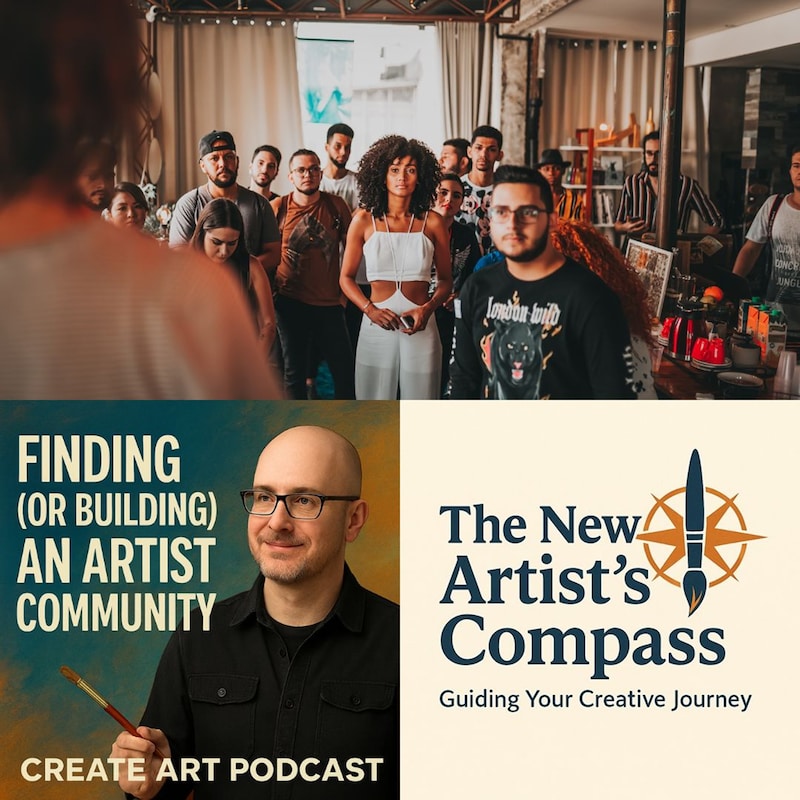
Shownotes
Feeling like your artistic creations are just drifting in the void? Yeah, we’ve all been there, pouring our hearts into art that feels unseen and unheard. That’s why we’re diving into the essential topic of finding or building your own artistic community. Because, let’s face it, no one—absolutely no one—grows creatively in a vacuum. We’ll explore how to spot supportive spaces, brainstorm ways to create your own if the perfect tribe seems MIA, and keep that warm fuzzy sense of belonging alive, even when pesky imposter syndrome tries to crash the party. So grab a snack, kick back, and let’s find out how your creative community might be closer than you think!
1. Why You Need a Creative Community
- Isolation can dull your creative edge — you need others to spark new ideas.
- Accountability: showing up for others helps you show up for yourself.
- Emotional support: having people who get it keeps burnout at bay.
2. What a Healthy Artist Community Looks Like
- It’s collaborative, not competitive — people share, not compare.
- There’s room for vulnerability: sharing unfinished work or honest struggles.
- The best communities are built on curiosity, not ego.
3. Finding Your People (Online and Offline)
- Check out local art collectives, open mics, or gallery nights — anywhere creativity lives.
- Online spaces can be gold — look for small, active groups on Discord, Reddit, or Mastodon where folks actually talk.
- Don’t chase big numbers — quality over quantity in connections.
4. Building Your Own Community (When You Can’t Find One)
- Start small: invite a few creators to meet monthly or share works-in-progress.
- Consistency builds trust — even a casual “creative coffee” check-in helps.
- Use your podcast, art, or blog as a magnet for like-minded artists.
5. Keeping the Community Alive and Real
- Be intentional about giving as much as you get — share resources, feedback, and wins.
- Handle conflict or creative tension openly — it builds long-term respect.
- Celebrate milestones together, no matter how small.
Feeling like your art is echoing in a cavernous void? Yeah, we've all been there. In the latest episode of Create Art Podcast, we dive headfirst into the importance of finding your artistic tribe. Seriously, who wants to create in a bubble? I mean, it's like trying to enjoy a pizza without a slice of your favorite topping—totally unsatisfying! We’re chatting about how being part of a creative community can be a game-changer for your art. It's all about connection, folks! Whether it's online, local, or just a few friends who understand the struggle, finding your circle can give your creativity the jolt it desperately needs. We’ll explore how to discover supportive spaces, create your own if you’re stuck, and keep that sense of belonging alive, even when the dreaded imposter syndrome tries to sneak in. So, if you’ve ever felt like you’re pouring your heart into a black hole, come on over! Your creative community is waiting, and it might be closer than you think!
Takeaways:
- Creating art in isolation can feel like shouting into the void, and it dulls your creativity.
- A supportive creative community is essential for accountability, emotional support, and sparking new ideas.
- Finding or building your own artistic community is crucial because it fosters collaboration over competition.
- Healthy artistic communities are based on curiosity, vulnerability, and sharing honest struggles to help one another grow.
Topics covered in this series
Sharing Your Work Online for the First Time
Dealing With Criticism and Rejection
Finding (or Building) an Artistic Community
Collaboration as a Creative Catalyst
Staying Motivated Long-Term
Art Challenges & Social Media Trends
Mental Health & Creativity
Art Challenges & Social Media Trends
Setting Up a Creative Workspace
Creative Constraints & Prompts
Measuring Growth as an Artist
Why Do You Create?
When to Call Yourself an Artist
Lessons From a Year of Creating
Setting Creative Goals Without Killing the Joy
How do I get such great guests?
PodMatch I use Podmatch to get the best guests on the show. Check out PodMatch if you want to guest on other podcasts or if you have a podcast and need guests for your show. Guests from Podmatch
Make Sharing your podcast easier
Use Podcast Beacon for the best NFS products to share your podcast while out and about or at conferences.
Reach Out To The Podcast
To reach out to me, email [email protected] I would love to hear about your journey and what you are working on. If you would like to be on the show or have me discuss a topic that is giving you trouble write in and let's start that conversation.
- Email: [email protected]
- YouTube Channel: Create Art Podcast YT Channel
- IG: @createartpodcast
- Twitter: @createartpod
Create Art Podcast Newsletter
Special Message
If you have found value in this podcast, please share it with a friend as that is the best way to discover new podcasts. I want this to be a 5-star podcast in your eyes so let me know what you would like to see.
Speaking about sharing with a friend, check out my other podcast Find A Podcast About where I help you outsmart the algorithm and find your next binge-worthy podcast. You can find that podcast at findapodcastabout.xyz.
For all of my projects check out my portfolio website TKBPodcaststudio.com where I help my clients through quiet professionalism lead through the noise.
Special Ask
Let me know what you think about the podcast by taking a survey. 2024 Listener Survey yes it is 2025, but hey I am late to the game on this. Thank you ahead of time to help me make this more of what you are wanting to hear.
This podcast uses the following third-party services for analysis:
OP3 - https://op3.dev/privacy
Transcripts
Have you ever felt like you're making art in a vacuum?
Speaker A:You know, like you're pouring your soul into your work, but it's just floating out there unseen and unanswered?
Speaker A:Yeah, we've all been through there that before.
Speaker A:In this episode of Create Art Podcast, we're talking about finding or even building your artistic community.
Speaker A:Because here's the thing, no one grows creatively in total isolation.
Speaker A:Whether it's online, local, or just.
Speaker A:Just a few good friends who get it.
Speaker A:The right circle can make all the difference.
Speaker A:We're going to explore how to spot supportive spaces, ways to create your own if you can't find one, and how to keep that sense of belonging alive even when imposter syndrome tries to kick down the door.
Speaker A:So stick around, because your creative community might be closer than you think.
Speaker A:Hey there.
Speaker A:This is Timothy Kimo Brian, your head instigator for Create Art Podcast, where I use my over 30 years of experience in the arts and education world to help you tame your inner critic and create more than you consume.
Speaker A: So in: Speaker A:And basically what I wanted to do with that is speak to new artists.
Speaker A:Now, if you've been doing it for a while, I think you're going to find a lot of things in here for you in order to, you know, further your practice.
Speaker A:But if you're brand new, this series is definitely for you.
Speaker A:So let's kick it off with my first point.
Speaker A:And that is why?
Speaker A:Why do you need a creative community?
Speaker A:Well, here's the thing, and I'm guilty of it too.
Speaker A:You know, I being isolated and thinking that nobody gets it, and I'm just doing my stuff out there and, you know, no wonder people don't relate to it, because nobody gets it.
Speaker A:Here's Isolation actually dulls your creative edge.
Speaker A:If you're not out there in the world being face to face with your audience, then you're missing out on something that could spark some new ideas.
Speaker A:You know, talking with your audience and saying, hey, you know, what do you see in this?
Speaker A:Now, I've talked about this in the past.
Speaker A:A lot of my art is a commentary on what I see and comparing notes with my audience and myself to see if we're seeing the same things, and if we're not, what are they seeing in relation to what I'm seeing.
Speaker A:So that isolation, you know, being that little hermit, that can really kill your creativity.
Speaker A:So get out there, find out what your audience thinks about what you're doing.
Speaker A:Talk to them.
Speaker A:I have a Good friend.
Speaker A:His name is Dave Jackson.
Speaker A:He's a huge name in the podcasting world.
Speaker A:And something that he talks about that I really like is when you meet your audience, tell.
Speaker A:Ask them what they like about the show, what they don't like about the show, and what, you know, they.
Speaker A:What changes they would like to see.
Speaker A:And then shut up and take notes and don't try to defend it or anything like that.
Speaker A:If they want an explanation, great.
Speaker A:But go out there and meet with your audience.
Speaker A:Another thing for why you need a creative community is it provides you accountability.
Speaker A:Now, again, I'm going to relate this back to podcasting.
Speaker A:I know it's an arts podcast, but I talk a lot about podcasting.
Speaker A:It's because that's my art.
Speaker A:I've transitioned for that to be my art.
Speaker A: So back in about: Speaker A:And I would keep on coming back and keep on coming back.
Speaker A:And eventually he and I started a podcast called podrec.
Speaker A:And he let me into his world of gaggle pod, which, you know, used to be my network sponsor.
Speaker A:And it was great having him there because he challenged me and I challenged him, and we were both there doing podcasting, something we both dearly love, and we still are there.
Speaker A:As a matter of fact, he just wrote a book about how to start podcasting, and he included me in the book.
Speaker A:He had me read through it and give him some ideas.
Speaker A:So it's that accountability.
Speaker A:It's that somebody is out there going, hey, you know, stop watching Netflix.
Speaker A:Get some art done.
Speaker A:That's what I do for you.
Speaker A:I'm, you know, yes, I do watch Netflix.
Speaker A:Yes, I do watch tv.
Speaker A:Notorious for that.
Speaker A:But I'm also in here, you know, week after week, reminding you, hey, you do have that creative edge.
Speaker A:You do have that creative spirit.
Speaker A:Let's get at it.
Speaker A:Giving you ideas, it, you know, demystifying arts there for you.
Speaker A:So I'm your accountability partner.
Speaker A:And guess what?
Speaker A:I know you don't know this, but you're my accountability partner.
Speaker A:I put this out here for you.
Speaker A:I put it out here for me as well, but I put it out here for you with the knowledge that I've gained.
Speaker A:And then the last thing about why you need a creative community is that emotional support.
Speaker A:You know, being an artist can be lonely, you know, and we can get, you know, lost in our heads and all that kind of stuff.
Speaker A:So we're going to need people that get it, that understand why we do what we do.
Speaker A:And, you know, they're not asking, why do you do that?
Speaker A:They know they get it.
Speaker A:So a lot of times they can help us when we're going through a rough patch.
Speaker A:So it provides emotional support, accountability, and it removes that isolation which can really stun our growth.
Speaker A:Isolation is not a good thing.
Speaker A:Isolation is bad.
Speaker A:Community is good.
Speaker A:All right, so now, since I've convinced you, why you need a creative community, what does one look like?
Speaker A:What does a healthy artist community look like?
Speaker A:Well, first and foremost, it's collaborative, not competitive.
Speaker A:So, yes, there's other art podcasts out there.
Speaker A:I don't consider them my competition.
Speaker A:I consider them my collaborators that are out there.
Speaker A:You know, maybe my voice is not the one that you need to hear.
Speaker A:Maybe it's a different voice that you need to hear to inspire your creativity.
Speaker A:And if that's the case, great.
Speaker A:I'm not here to have the biggest podcast, the wealthiest podcast, or anything like that.
Speaker A:I'm just here for you, to inspire you, to pick up that paintbrush, that pen, whatever it is, and to go out there and create because of the joy that I know that I felt with it.
Speaker A:So I'm a collaborator with you and these other art podcasts that are out there, they're collaborators with me.
Speaker A:Now, they may not know it, but that's okay.
Speaker A:That's all right.
Speaker A:I get ideas from them, they may get ideas from me.
Speaker A:And, you know, we can.
Speaker A:All of us can tell you the same thing, but maybe it's a different voice that you need to hear.
Speaker A:So we always want to be sharing in that artistic community.
Speaker A:Another thing is that sometimes our art can be very vulnerable.
Speaker A:And with people that get it about, you know, they get why we create.
Speaker A:They may not get why we write or paint.
Speaker A:You know, they may not be a painter or a writer or a dancer or nothing or anything like that, but they get the basic of why we're creating, why we need to create, what we're commenting on.
Speaker A:And again, that is kind of very vulnerable.
Speaker A:So when we share in our community some unfinished work or some honest struggles with that work, then we can grow as an artist, and we have somebody we can go to with something that's unfinished and say, is, am I going on the right path with this?
Speaker A:Even if they're of a different artistic discipline, am I going on the right path with this?
Speaker A:That can help you out a lot.
Speaker A:And the best communities are Built on curiosity and not ego.
Speaker A:Way back in the day, I was in this writer's community, this writer's workshop.
Speaker A:It was on Friday nights in Rockford, Illinois, and it was at a African American history museum.
Speaker A:And not one of us was African American.
Speaker A:As a matter of fact, the caretaker of the museum was not African American.
Speaker A:So it was kind of funny.
Speaker A:We'd meet up at this place Friday nights and share work.
Speaker A:I was usually under the influence of some, you know, interesting items.
Speaker A:And there was a lot of drinking going on, and there was a lot of ego going on.
Speaker A:And I remember I had a girlfriend at the time, and there was this English professor that was attending, and he would say, all my stuff is esoteric.
Speaker A:He can't grasp onto it.
Speaker A:It's immature and childish and.
Speaker A:And all this and that, all that.
Speaker A:And he was slamming me in front of my girlfriend so that way he could impress her.
Speaker A:And eventually, you know, they went off and, you know, frolic together for a time.
Speaker A:And I was really hurt at that time.
Speaker A:Really hurt.
Speaker A:So that was not a positive experience for me.
Speaker A:And that really soured me to creative communities for a long time.
Speaker A:But then, like I said earlier, I met up with Kyle Bondo.
Speaker A:And, you know, we weren't trying to, you know, get each other's wives at the time.
Speaker A:We were just there supporting each other.
Speaker A:And that's a very positive creative community.
Speaker A:Even though it can be small, it can be a couple of people, or it can be a hundred people or a thousand people.
Speaker A:The size does not matter.
Speaker A:It's just, is it a healthy environment for you, and is it based on curiosity and not what can I get out of you?
Speaker A:More, what can I help you with?
Speaker A:All right, so now we know why we need one, and we know what a healthy one looks like and why that's important.
Speaker A:How do you find it?
Speaker A:Well, thanks to the wonderful Wide World Web www.
Speaker A:That what we used to call it back in the day, you know, online or offline.
Speaker A:And it's a lot easier now than it's ever been.
Speaker A:There's different meetups that you can go to different community organizations.
Speaker A:You can go to your local arts district or.
Speaker A:Or foundation or whatnot.
Speaker A:That's in, you know, mo.
Speaker A:It's in all major cities, and then there's a lot of them that are in smaller cities.
Speaker A:We have one here in Fredericksburg that I really need to.
Speaker A:And that's the challenge to myself, is I really need to get involved with that.
Speaker A:But find little.
Speaker A:These little enclaves that are out there, you know, open mics, I do an open mic at my nephews a coffee shop on Friday nights.
Speaker A:Here in Fredericksburg we have first Friday, which all the galleries are open late and you can go tour all the galleries.
Speaker A:These spaces are perfect for you to find your tribe because it's already been set up.
Speaker A:And if you don't have something like that, why not start it up yourself?
Speaker A:You know, go to the galleries and say, you know, and go to your town or your city and say, hey, what can we do?
Speaker A:Something like this online spaces can be golden.
Speaker A:You know, you can go on discord servers, Facebook groups, you know, Mighty Networks is another one that's out there.
Speaker A:Twitter or X has, you know, different writers groups that are on there.
Speaker A:You can go online and so if these people are spread out across the country, you can meet online.
Speaker A:We couldn't do that 20 years ago, 10 years ago.
Speaker A:But now with, you know, the advent of remote, you know, virtual rooms and all that stuff, it reminds me of the days of the messaging apps with aol.
Speaker A:Well, and, and, and all that good stuff.
Speaker A:You can get into different chat rooms now.
Speaker A:You can actually get behind a camera and, and see these people.
Speaker A:We're seeing this a lot in the I, I have Ms. And there's support groups for that.
Speaker A:The N A al anon, different support groups that are out there are all going online and meeting virtually.
Speaker A:And this was especially big during the pandemic.
Speaker A:So these spaces are out there.
Speaker A:You don't need to join the biggest one.
Speaker A:You just need to join the healthiest one, healthy for you.
Speaker A:All right?
Speaker A:And you don't need to join all of them.
Speaker A:One or two is perfectly fine.
Speaker A:That may be all you have time for hour or two during the week to join that community, to provide them with support and to get support from them.
Speaker A:That's what we're looking for.
Speaker A:All right?
Speaker A:Now we know where to find them, how to tell if they're healthy or not, and why we need to have our own community.
Speaker A:Let's say that there isn't a community out there, something that you can't find, or the communities that you have found are not to your liking.
Speaker A:Well, go build your own then.
Speaker A:Go build your own.
Speaker A:Figure out what is missing in the other groups.
Speaker A:Why don't you like it?
Speaker A:Really sit down with yourself and go, why am I not enjoying this group?
Speaker A:What am I not getting from it?
Speaker A:And then you start your own group.
Speaker A:It doesn't have to be as big as the old group.
Speaker A:It can be just, again, it can be just a couple of people.
Speaker A:It could be just One person.
Speaker A:For a long time it was Kyle and I.
Speaker A:Then we had a few people join in here and there, but the core of it was two people, myself and Kyle here in Fredericksburg, Virginia with podcasting.
Speaker A:So you can build it, start small, invite a few, make it monthly, or make it, you know, whatever it needs to be every other week, what people have time for, and then be consistent.
Speaker A:So if one or two people show up, that's fine.
Speaker A:You still meet.
Speaker A:You don't screw around.
Speaker A:You don't go, eh, well, there's not enough people here.
Speaker A:No, you still meet.
Speaker A:You build that core group and then it gets bigger and bigger and bigger.
Speaker A:But it's got to start from someplace.
Speaker A:You know, if you have a podcast that you do, great, yay, let me know about it.
Speaker A:But maybe you do a blog for it, you do some artwork for it.
Speaker A:You set it up at a coffee shop and they put you on their events calendar so that way people can track it and find it.
Speaker A:Or you start it up at your local library.
Speaker A:They usually have free open spaces there that you can, you know, start a non profit group, a group that is focused on that.
Speaker A:Maybe it is at a gallery, Maybe you are already working with a collective and you're like, hey, let's start up, you know, a little group here, a little community.
Speaker A:We can have people from the outside come in that are artists and then we can all participate in it, whatever it is.
Speaker A:Build your own, build your own.
Speaker A:I would say first go look for other communities.
Speaker A:If you can't find it or you don't like what you find, then build your own.
Speaker A:But you may have to build your own.
Speaker A:But that's okay because once you build that.
Speaker A:And they will come to it, they will come.
Speaker A:You just have to be consistent and keep on going with it.
Speaker A:Even if you only have a few people, people will come.
Speaker A:People gravitate towards that.
Speaker A:People will want to be part of that community and welcome them in every time.
Speaker A:Whatever didn't happen at communities that you didn't belong to, make it happen at the community that you built.
Speaker A:Okay, my last point is keeping the community alive and real.
Speaker A:The big thing is it's not a competition, it's collaboration.
Speaker A:Be intentional about giving as much as you get.
Speaker A:Keep on giving, because eventually you'll get back.
Speaker A:You want to share your resources, you want to share your honest critique and feedback.
Speaker A:And I would say, you know something that I've seen with the Mike Brennan of the creative Chats group on online, he's on Facebook, is that every Friday, he's Like, hey, what's your small win of the week?
Speaker A:You know, what are you struggling with this week?
Speaker A:And he'll put pop that up every week.
Speaker A:And every week somebody replies in there.
Speaker A:Sometimes I reply in there.
Speaker A:So share those wins with each other, share those struggles with each other.
Speaker A:Somebody may be there that can help you, but they're not going to know unless you bring it up.
Speaker A:Now if there's, you know, if you've created this community and there's some tension or conflict or anything like that, handle it.
Speaker A:Handle it right away.
Speaker A:Don't let it fester, don't let it grow, don't let it remain unsaid.
Speaker A:Handle that conflict or that tension immediately.
Speaker A:You don't have to be heavy handed with it.
Speaker A:But maybe it's a thing where we remind everybody why we are there, why we are in that community and then make sure that you're celebrating the wins, even if they're small, even if they're tiny, even if they're insignificant to you, celebrate it.
Speaker A:Now I'm not saying, you know, go through a parade for somebody that, you know, drew a picture, you know, once a month, maybe that's big thing for them.
Speaker A:You know, something's going on in their life where they can only do, you know, very small things.
Speaker A:And that's fine.
Speaker A:We celebrate that though.
Speaker A:Make sure that we celebrate that.
Speaker A:So keep it alive, keep it real.
Speaker A:Keep the, you know, BS and the politics and all the crazy stuff in the world that's going on.
Speaker A:Keep that outside.
Speaker A:That's not for you to deal with in your creative community.
Speaker A:You can comment on it.
Speaker A:You probably, you know, are not going to be in 100 agreement with folks.
Speaker A:And that's okay as long as we each respect each other and know why all of us are there and come to it with that mindset.
Speaker A:And you may have to remind people time and time again, hey, we're here to collaborate.
Speaker A:We're here to support, not to criticize and break down and say, this is art, that is art.
Speaker A:You're doing it wrong.
Speaker A:They're doing it a different way.
Speaker A:Let's find out why they're doing it that way.
Speaker A:If we have something in our background, in our experience that can help them out, we give it to them.
Speaker A:We give it to them freely and let them do with it what they're going to do with it.
Speaker A:And you don't have to accept all feedback and critique.
Speaker A:You take what you agree.
Speaker A:It's like a buffet.
Speaker A:You take what you want, you leave the rest.
Speaker A:If the critique resonates with you, Fantastic.
Speaker A:Utilize it.
Speaker A:If it doesn't, cool.
Speaker A:And if you give critique to somebody and they don't take it or we don't hold it against them, we don't hold a grudge like that.
Speaker A:It, you know, wasn't the right critique for them.
Speaker A:We didn't understand what was going on with them.
Speaker A:It wasn't the right time for them to get that critique.
Speaker A:They may, you know, be going through some emotional stuff right at that time and they're not open to critique, even though they say they are.
Speaker A:They may not be open to it or they may just, you know, 100% disagree with it.
Speaker A:It's okay.
Speaker A:You're providing help.
Speaker A:If they accept it, great.
Speaker A:If they don't, we leave it alone.
Speaker A:We don't.
Speaker A:We don't get a attitude about it.
Speaker A:All right, that's all I got for you on this episode.
Speaker A:I want to thank you so much for tuning in and listening to this episode.
Speaker A:I really hope you got something out of it.
Speaker A:I know I did.
Speaker A:And it's challenged me to go to my local arts district and join up and, you know, bite the bullet.
Speaker A:I'm always looking for community, so I'll let you know how that goes in future episodes.
Speaker A:All right, folks, I'm going to take my own medicine.
Speaker A:I'm going to take my own advice and do that, and I hope you do as well.
Speaker A:If this helped you out in any way, when I ask you to go ahead and share it with a friend on your podcast app or YouTube, go ahead and share that with the folks that may need to hear about it.
Speaker A:Maybe that's how you start that community up.
Speaker A:You never know.
Speaker A:Speaking about sharing, I run another podcast called Find a Podcast About.
Speaker A:You can find it at findapodcast about xyz.
Speaker A:And there I help my listeners find their next binge worthy podcast and outsmart the algorithm.
Speaker A:Give it a look, see, you might find your next favorite podcast from there.
Speaker A:The other thing I wanted to talk to you about is I started a business called TKB Podcast Studio.
Speaker A:You can find it at tkbpodcaststudio.com and I help my clients there start up their podcast, either through consultation or through actual production of the podcast.
Speaker A:So that way they don't have to do it, but I do that to help them, you know, lead through all the noise that's out there with quiet professionalism.
Speaker A:Look it up.
Speaker A:My portfolio is there.
Speaker A:If you want to see what I'm doing with other podcasts, by all means, check it out and then reach out to me and let's see what I can do to help you start your own podcast.
Speaker A:All right, that's all we got time for here today.
Speaker A:Thank you so much for listening.
Speaker A:Appreciate each and every one of you that listens to this podcast or watches this podcast on YouTube.
Speaker A:Now go out there, tame your inner critic.
Speaker A:Create more than you consume.
Speaker A:Either find or make that community that you need.
Speaker A:We talked about it.
Speaker A:You need it.
Speaker A:I need it.
Speaker A:I'm going out to find it.
Speaker A:Go make some art for somebody you love.
Speaker A:Yourself.
Speaker A:I'll talk to you next time.
Speaker A:It.
