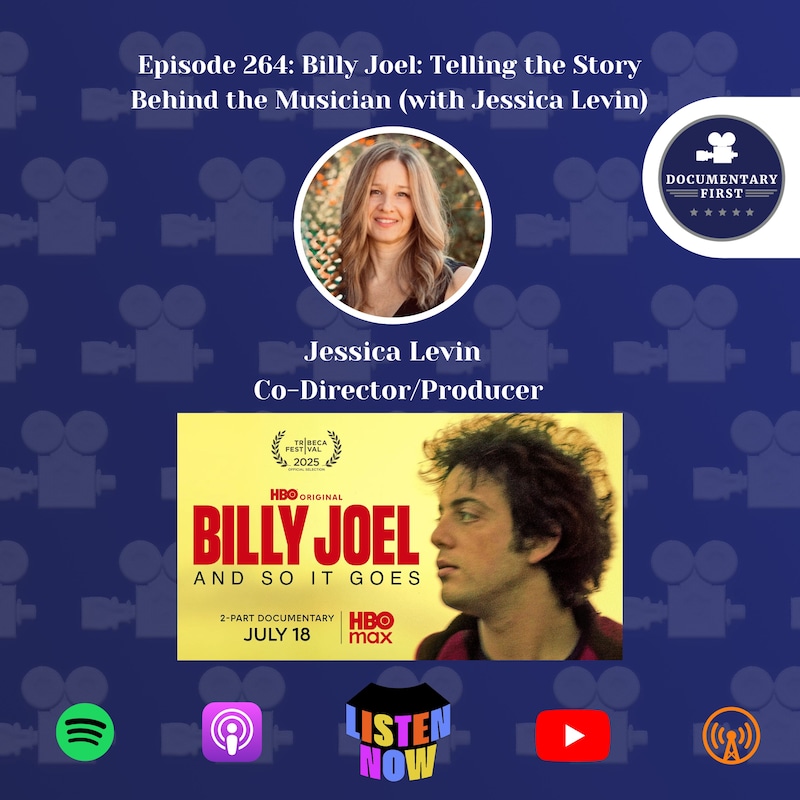
Shownotes
In this episode of Documentary First, Christian sits down with filmmaker Jessica Levin, co-director and producer of the Critics Choice Documentary Awards in the Best Music Documentary-nominated HBO documentary Billy Joel: And So It Goes. Jessica shares what it was like to tell the story of Billy Joel—not just as a legendary musician, but as a human being full of depth, contradiction, humor, and heart.
Together, they explore the craft of music documentary filmmaking: how to build trust during intimate interviews, how to follow emotional truth rather than timeline, and how music itself can become the spine of a narrative. Jessica opens up about the collaborative process behind shaping the film’s nonlinear structure, as well as the responsibility that comes with telling a story about someone the world already feels like they know.
Whether you are a filmmaker, a musician, or someone whose life has ever been held by a song — this conversation is creative, heartfelt, and filled with insights about storytelling, memory, and what it means to truly listen.
Links:
American Masters: American Masters (TV Series 1985– ) - Reference view - IMDb
Billy Joel: And So It Goes: Billy Joel: And So It Goes (TV Mini Series 2025) - Reference view - IMDb
Inventing David Geffen: "American Masters" Inventing David Geffen (TV Episode 2012) - Reference view - IMDb
Joni Mitchell: A Women of Heart and Mind: "American Masters" Joni Mitchell: A Woman of Heart and Mind (TV Episode 2003) - Reference view - IMDb
The Janes: The Janes (2022) - Reference view - IMDb
DocuView Déjà Vu
The Andy Warhol Diaries, 2022, Limited Series with 6 episodes, watch on Netflix, IMDB Link: The Andy Warhol Diaries (TV Mini Series 2022) - Reference view - IMDb
Time Codes
00:00 — Opening Reflections
02:54 — Early Relationships and Artistic Roots
05:31 — Balancing Myth and Humanity
08:19 — Creating Space for Vulnerability in Interviews
11:06 — Collaboration as Creative Strength
13:50 — Following Emotional Truth, Not Just Timeline
16:38 — How Personal Relationships Shape Art
19:15 — Challenges of Documenting a Cultural Icon
22:03 — Crafting a Nonlinear Story Structure
24:55 — The Reality of Producing a Major Music Documentary
27:42 — Audience Reaction and Cultural Memory
30:14 — Tracking Billy Joel’s Musical Influences
33:02 — What Makes His Music Resonant
36:46 — Lyrics as Self-Understanding
40:06 — Love, Loss, and the Songs Between
42:49 — Building Trust On and Off Camera
47:34 — Leadership in Storytelling
51:26 — Scoring the Emotional Arc
56:01 — Why Structure Matters
58:59 — Personal Growth Through Filmmaking
1:02:01 — Final Thoughts & Recommendations
Sponsor: Virgil Films http://www.virgilfilms.com/
Support us by buying merch or watching our films: https://documentaryfirst.com/
Transcripts
of beauty there.
2
:So we're going to push record because a lot of stuff comes in the beginning.
3
:And sometimes we use social media clips where we may say one or two things just in a, I
don't know, people we may be able to use.
4
:But the reason I asked you if you had talked to Steve recently, I wondered he had been on
our podcast and it was back on June 26th, but we, you we air that's your birthday.
5
:Well,
6
:He was busy with me that day.
7
:He may have come to a party for you, in that, in that evening, he was busy with me and we
then released the podcast later.
8
:I mean, actually recently, so it wasn't that long ago.
9
:and, but in my personal life, it was a really interesting thing that happened because it
was a very special, special moment for me.
10
:Billy Joel has been.
11
:um I mean, almost the soundtrack of my life since I was a kid, I lived in Long Island and
he was just, I just loved Billy Joel.
12
:And so um to be able to talk with Steve and talk about this film, I stayed up till 2 a.m.
13
:the night before watching it, because HBO didn't get it to me.
14
:Yeah, they didn't get it to me till like the evening, like 5 p.m.
15
:And I was not going to talk to him without watching it.
16
:And so I watched both, um
17
:both parts and was just so incredibly moved by all of it.
18
:And one of the things that was very meaningful to me was the way that Billy talked about
his mother.
19
:And I loved what you guys did with how he was honest about who she was, and he was honest
about both sides.
20
:He was honest about her challenges with her mental um and emotional capabilities, and how
they harmed him.
21
:but also how she was the one beneath his wings in a lot of ways and how she, you know,
inspired him.
22
:And I loved that, um, that dichotomy and how you treated that and he treated that with
honor and wasn't demeaning.
23
:And I had a lot of the same issues with my own mom.
24
:And so as I watched this whole film, as with any Billy Joel song, you begin to relate to
what he is going through and learn from him.
25
:And so,
26
:I learned so much through your documentary.
27
:So for me, it wasn't a documentarian sitting back and kind of critiquing a documentary.
28
:I tried to do that, but I got too engrossed as uh a fan and somebody just listening to
your story.
29
:And so as I was talking to Steve and telling him this, explaining that that was one of the
great things I thought about your film.
30
:I set a line, is, really hope my mom's not watching this uh and explain what I just told
you.
31
:And the next morning I wake up and I'm packing to go on a trip for a big surgery where I
was going to be out for a few weeks.
32
:And I get a call and I hear that my mom has died and completely suddenly and totally
unexpected.
33
:Yeah, it was, it was crushing and heartbreaking and um
34
:It was, it was, I don't know.
35
:It was crazy for me because that interview with Steve was such a highlight of my life.
36
:And so I went from this incredible, amazing night.
37
:It was at night and I woke up the next morning and I don't know.
38
:I, it was just almost felt like it was these bookends in some sense.
39
:and I had had this cathartic thing the night before.
40
:and was really thinking about my mom, but was thinking about the same thing Billy Joel
was, the positives and the negatives of a mom who had emotional challenges and how it
41
:impacted me.
42
:So, you know, your film for me personally means a lot and it will never be forgotten.
43
:so, for me,
44
:It may have been a minute since I talked to Steve, but it's just, it's very, very um
current.
45
:yeah, well.
46
:Christian, that's very moving.
47
:It's very moving.
48
:And I do think that it hasn't been an uncommon reaction.
49
:Obviously, your story is extreme and I am so sorry for your loss.
50
:really like my heart goes to you.
51
:And especially when something is sudden, that can be really affecting in a way that you
just don't even expect.
52
:But I will say that
53
:four weeks.
54
:oh I will say that, God, it's still very raw, I'm sure.
55
:I would say that your experience is not an uncommon thing that we've heard from people,
which has been really gratifying that they really understood and embraced the emotional
56
:arc of the film and that many of the relationships we touched on, because obviously the
parental relationships in Billy's life,
57
:or paramount to who he became and not just during his childhood and how it then affected
him, but that it affected him throughout his career and throughout his life.
58
:And I think many of us can relate to that.
59
:um
60
:you know, especially those of us who may not have perfect relationships with our parents,
um you know, these things stay with you, you know, throughout your life.
61
:And I think many of the things that you do um can be reactions to that.
62
:And I think that em all I'm saying is that people have really latched onto that in a lot
of ways in the film and it has affected people really deeply because they can relate to...
63
:um
64
:those relationships you try to unravel really for your entire adult life and try to make
sense of them.
65
:And the way Billy made sense of them was through his artistry and through his music.
66
:And that was something really important that Susan and I bonded about very early on in the
making of the film.
67
:First as a producer with my fellow producer Emma Pildes and I and Susan, the three of us
have worked together for...
68
:a long time and I, Susan and I have worked together for almost 25 years, if you can
believe that.
69
:uh But uh we bonded early on about the fact that we knew that the emotional core of the
story was complex and that it was very important that, um you know, we dig deep with Billy
70
:in terms of the music and the...
71
:personal story and how those things related.
72
:Because I think a lot of people don't realize how autobiographical his music is.
73
:And I think that when we kind of happened upon that, Susan and I really bonded over that
and we were like, wow, this is incredible.
74
:Like it's almost like his songs.
75
:are ripped from the journal of his life.
76
:know, if he were, you know, it was like that's the way he processed his emotions was
through his music, through his lyrics, through his, you know, the outpouring of emotions.
77
:And that comes on a lot of different levels.
78
:Of course, some of them are, you know, super.
79
:obviously, you know, personal about specific relationships.
80
:And we go into some of that in the film.
81
:And I think that people really enjoyed hearing those stories and understanding how really
exactly related it was.
82
:Like, for example, like you may be right, you know, people are like, how is it?
83
:That's exactly what happened in his life.
84
:And then he put it into his song.
85
:Yes, that was Billy.
86
:He really, he took, now not that everything was exactly, uh what's the word, word for word
or verbatim to his life, but you know, that.
87
:that's what makes an artist special, right?
88
:They're able to take these things and kind of, I think it's Elizabeth who says in the
film, know, an artist takes this and that and they shake it up and they make magic.
89
:That's Billy, but it's really extraordinary when you start to understand the, you know,
the incredible relationship between his life and his music.
90
:And whether that was personal relationships, whether those were observations he was making
in his community or his friends, or, you know, things that were happening, like uh one
91
:thing, like one song I'm thinking of right now.
92
:That's not about him, but his personal is the song James, for example, which is written
about a friend of his.
93
:I don't know how deep of a fan you are, so I don't know if the songs I'm gonna be about
are.
94
:So for example, the song James, or even in the song uh My Life, where he talks about, uh
you know, whose friend who went out to the West Coast, that's about a real person.
95
:ah Okay, well, you know all this, but not all people do, but in any.
96
:mean, our audience may not, but what's, what's amazing.
97
:I mean, you even think about the ones we, everybody knows, which is piano man.
98
:mean, go, go, go back and go to piano man, which everyone knows.
99
:And everyone thinks, Oh, that's probably just, you know, a made up song because it's kind
of so generic.
100
:No, it actually has its roots in exactly what happened.
101
:But you know, you were a hundred percent right that you guys made the right choice.
102
:in how you told it because what's so real about his music and timeless and why it's so
relatable is the fact and you hit on this almost immediately is that it is pulled directly
103
:ripped from the heart of his life.
104
:And it's true.
105
:Some of those things are true for all of us in one way or another, we can relate to the
struggles of his life and maybe not to his death, you know, but yes.
106
:other piece of it that we didn't know going into this.
107
:And first of all, let me just say, since we are recording, that Susan Lacey sends her best
and was sorry not to be on this podcast.
108
:I will do my best to represent her, but if you're ever able to get her on a one-on-one,
you will certainly enjoy it.
109
:She's a wonderful storyteller and speaker.
110
:But I think one thing I would like to just talk about for a moment is, m
111
:how Billy did open up and begin to reveal himself.
112
:And I do think that um a person like Billy Joel or anybody who has been in the public eye
for as many years as he has and as many run-ins that he's had with the press, positive,
113
:negative, everything in between, he lived his life in the public eye for better or for
worse.
114
:If you think about...
115
:his relationship and marriage to Christie Brinkley.
116
:I mean, that entire relationship played out in the public eye.
117
:And I think that was quite difficult, ah know, quite difficult for him.
118
:So all I'm saying is that he came to this process, I don't think knowing what to expect
and why should he, other than our reputation and Susan's incredible reputation as the...
119
:filmmaker who founded American Masters and had made, you know, umpteen films about
incredible artists.
120
:Everybody from Leonard Bernstein, Bob Dylan.
121
:We made a film about John Lennon called Lenny NYC.
122
:Pardon?
123
:Spielberg.
124
:I mean, Jane Fonda, he knew obviously that we had a strong body of work, but I don't think
he knew how that was gonna translate into reality.
125
:And so I think coming into the process,
126
:He had trepidations like any artist like him would about, know, they're just gonna tell
the same old stories.
127
:They're just gonna rehash.
128
:Why do I need to talk about these things?
129
:And I think that Susan was quite clever in the way that she approached the interviews
besides him being in front of a piano, which I know, which is as we talk about it, as he
130
:says at the beginning of the film, it's my security blanket.
131
:I wanna hide behind the piano.
132
:which is really true.
133
:mean, if you, what was so amazing, Christine, when we would come in to set up for the
interviews, we would be, we would have the crew all around buzzing about him and whatever.
134
:He would walk in when he was ready to come in there, you walk in, sit right down at the
piano and just start playing.
135
:know, it didn't matter.
136
:I it might be classical.
137
:It might be a show tune.
138
:might be, you know, something you heard on the radio.
139
:It might be, you know, something that was on his mind or he would just sit down and start
playing.
140
:And we would all just sort of fall into a fascination watching him because
141
:Obviously he's so talented and he can play anything that he can hear.
142
:So he would just be noodling and we would just enjoy that so much.
143
:So having him at the piano was very key in making him comfortable.
144
:But also Susan started from places that they had things in common.
145
:She started with his story about his own family's backstory in Nazi Germany, which go
ahead, you wanna ask me something?
146
:What I wanna do is I wanna start our podcast.
147
:So we just jumped in.
148
:Yeah, I know, I haven't even started our opening.
149
:This was our just little warmup get to know you.
150
:So let me start our podcast and uh well, this is wonderful.
151
:So we're gonna start and actually uh we're gonna kinda start over.
152
:All right, everybody, welcome to Documentary First, an inside look at documentary
filmmaking.
153
:I'm your host, Christian Taylor and a documentary filmmaker myself.
154
:uh
155
:If you have been looking at the title of this episode, Unlocking Icons, Jessica Levin on
Billy Joel, American Masters and the Art of the Interview, you already know that we have a
156
:distinguished guest on our show.
157
:So let's jump right in.
158
:Actually, we already have.
159
:And what we're gonna do is we're gonna do what all good documentaries do is as you've been
listening, we have started already.
160
:with the beginning of this conversation because we just jumped right in and began talking
about the wonderful movie uh that Jessica Levin and her co-producer, Lacey have put out,
161
:co-director, sorry, co-director, Susan Lacey just put out, and so it goes, the story about
Billy Joel's life.
162
:And so I have the immense pleasure of welcoming Jessica Levin.
163
:Jessica, welcome to the show.
164
:Thank you so much, Christian.
165
:It's a pleasure to be here.
166
:Okay, now before we get started, I did have an icebreaker to throw at you, which we don't
really need, but I wanna give it to you anyway.
167
:So if you were to pick one Billy Joel song as your life soundtrack right now, I know, come
on now, I am, I am.
168
:And maybe you don't have to be the life soundtrack, but let's just say you wanted to pick
one that you really love or that kind of is playing in your head all the time.
169
:Give me one.
170
:Christian, that is one of the most difficult questions that I get.
171
:And this is because I am a lifelong fan.
172
:And I'm glad that I was able to bring that to the table in terms of the collaboration with
Susan.
173
:She came to things from kind of a bird's eye view.
174
:But um we ended up meeting in the middle very much with our intellectual and emotional
approach.
175
:two-hour subject, but um that's a tough one for me.
176
:What I will say is that um I really rediscovered or discovered Cold Spring Harbor, the
Cold Spring Harbor album um in a way that I hadn't before.
177
:I had heard it, but it wasn't really on my playlist.
178
:And I think that, you know, there are some really beautiful songs on that.
179
:um And I think that...
180
:Island?
181
:I'm not, no.
182
:I grew up in Manhattan and Connecticut, tri-state, know, but, um you know, my brother uh
gave me the first album that he gave me as a gift was Street Life Serenade.
183
:um And now let's see, that would have been in the early 80s and that album's from 1974.
184
:but he was always sort of throwing different music at me and stuff.
185
:He was a little bit of my musical mentor early in my life.
186
:And so that was the first album I became very familiar with.
187
:And I really loved it because it had such a sweeping kind of, you know, melodic kind of
epic feel to it.
188
:And it was deep dripping with satire and I just enjoyed it so much.
189
:And so that was my first exposure to Billy Joel.
190
:So I knew him as a true deep melodist.
191
:Yeah.
192
:somebody who, um you know, there was a lot of many layers in his songs.
193
:And now when I first met Billy, I was quite proud that I was a big fan of Street Life
Serenade.
194
:And I said to him, you know, it's such a pleasure to meet you.
195
:I'm such a big fan.
196
:You know, my favorite album is Street Life Serenade.
197
:And I was just so proud of myself.
198
:like, no one ever says that, you know?
199
:And he said to me, well, that's my least favorite album.
200
:I was rushed into the studio and I just don't think there's very good work on it and
whatever and blah blah blah and I was so embarrassed and I was like okay well obviously I
201
:didn't do enough research to be able to have that conversation but that is very indicative
of Billy.
202
:He's very tough on himself.
203
:He doesn't really, he's not a guy who who sits comfortably in a place of praise.
204
:And now whether what that has to do with his own upbringing you know we we could delve
into but
205
:that's not really a place that he's comfortable in any case.
206
:He's always self-deprecating and he always puts humor into all of his answers and all of
the ways that he relates.
207
:em But I don't know, I think some songs that I discovered, I guess I didn't know that the
song on Cold Spring Harbor was um about Elizabeth, about his relationship with Elizabeth.
208
:Sure.
209
:lot of people that may not even know who she is.
210
:And I consider myself a big fan and I did not know.
211
:So Elizabeth Weber was Billy Joel's first wife and his manager.
212
:um And they had a tremendous collaboration that lasted probably a decade all the way
through, I guess, glass houses, it probably was.
213
:Nylon Curtain, there are some songs that are about their relationship, but they were
pretty much fizzling out at that point.
214
:um But Elizabeth Weber, uh Billy fell in love with Elizabeth when they were young.
215
:I mean, young, I mean, 20 years old probably.
216
:And she was married to his bandmate.
217
:It was quite the scandal.
218
:she was married to his bandmate.
219
:Now that was a marriage of convenience.
220
:She was pregnant and she had said to him, we need to get married.
221
:And so they did, but I don't think they were ever a really true love match.
222
:But nonetheless.
223
:because the three of them living in the house together very quickly, he and Billy, she and
Billy Joel became very close.
224
:And they had been close because being, know, Elizabeth's brother and John Small were in
The Hassles.
225
:Billy, Billy, I believe if I have this factoid correct, I believe Billy replaced her
brother in the band and The Hassles.
226
:And this is in, you know, the late sixties.
227
:So Elizabeth knew Billy all the way back.
228
:And I think we talk about in the film.
229
:that she observed him very early on before they became involved and said, wow, this guy
really has tremendous work ethic and he's very talented.
230
:He was certainly not Billy Joel at that point.
231
:He was just a guy from Long Island who was in a band.
232
:But they did get along and they clicked just as friends and it developed into something
more.
233
:it was quite a heartbreak both for him, his dear friend, John Small and Elizabeth.
234
:And they all went their separate ways at that point.
235
:And that's when Billy...
236
:really sunk into a deep depression because he just felt so guilty that he had broken up
his best friend's marriage.
237
:So Elizabeth um and Billy had a tremendous love, tremendous collaboration.
238
:And when they broke up, she left the scene.
239
:She left the rock and roll business.
240
:She left Billy's life.
241
:She left behind the entire Billy Joel organization.
242
:She moved out to California and basically did not speak to them for four decades.
243
:um if you can believe that.
244
:I know it's hard to believe, but true.
245
:There were, her stepson, her, Billy's stepson, Elizabeth's son, Sean, had girlfriends that
didn't even know that his mother was ever married to Billy Joel.
246
:I mean, it was like, just, it wasn't a thing they talked about at all.
247
:So the fact that she spoke in this film was groundbreaking for fans for the story.
248
:was remarkable.
249
:And I will tell you, one of the things that was absolutely stunning to me was how so many
of his past broken life relationships were willing to come on and interview in this
250
:documentary.
251
:In some ways, maybe it didn't happen in real life, but in some ways in the documentary, it
felt
252
:like a very cathartic um healing, know, uh maybe had happened that they were willing to
come on and speak because they didn't speak poorly of Billy.
253
:They just talked about what it was and kind of had accepted what it was.
254
:um But, know, this kind of goes to the first big question I want to ask you because this
is no surface documentary.
255
:This documentary goes
256
:deep into the heart of a very complex person, as you said, um a person who though is very
closed.
257
:And like you said, who needs a security blanket.
258
:You've said that once already.
259
:He does not take praise well.
260
:You said that also.
261
:So he's already, you can tell, got these defenses up.
262
:And not only that, you can tell that this is a guy who doesn't easily talk to people.
263
:or let them in because he writes songs to deal with his stuff, right?
264
:So here you already know, and not only that, um know, weird, we're told from the beginning
of the documentary that lots of people, or maybe that was in my conversation with Steve
265
:Cohen, my other podcast um was told that lots of people had asked him to do documentaries
and he just kind of blew them off.
266
:So that's inside info I have from Steve.
267
:True.
268
:all of this.
269
:And so my big question to you, because what was remarkable to me was how you guys were
able to make him so comfortable that he was willing to just lay his heart bare, his heart
270
:and his life.
271
:And I know, and I know personally, this is not, this is an art cultivated over time.
272
:um And it's not, it's something that's learned and sometimes it's innate by documentary
filmmakers.
273
:And so I really need you to think about how to teach this to our young filmmakers as best
you can.
274
:Okay, so first of all, I want to say that um Susan Lacey did the interviews.
275
:I think it's important for me to say most of them.
276
:I did a few, but she did all the interviews of Billy and sure, yes, of course.
277
:Go ahead.
278
:You can do it if you like.
279
:in the beginning.
280
:I'm going to let you do a quick bio for her just because we want to focus on what you have
to tell us.
281
:You're here and talk about you have a company together or you're in a company and let's
talk a little bit about that.
282
:And hopefully she'll come back on the show and we'll get into her full bio and unpack her
life.
283
:um
284
:really enjoy it.
285
:um Susan Lacey came onto the documentary scene by founding the series American Masters.
286
:I believe it was 1986 or 1987.
287
:And her goal in creating that series was to create um a record of the body of work of
American artists.
288
:to make films about American artists and to understand them in depth so that you could
understand the genesis of the art and the importance and put it in context in American
289
:history and American cultural history.
290
:Now that came in a lot of different forms.
291
:You know, it wasn't a cookie cutter series like some series are.
292
:It didn't have a narrator.
293
:It was a collective of filmmakers.
294
:A filmmaker might come to her with an idea, I want to do a film about Robert Capa.
295
:And they would come and it would be a collaboration.
296
:Susan would help with developing it, sometimes help with raising money.
297
:And that series ran on...
298
:Public television and still is on public television and she ran it for 30 years But it was
her life's mission to create this record of American artists so she is a person who is
299
:well steeped in American cultural culture and arts and Many many other subjects had
trusted her, know prior so if you kind of like take that as kind of your you know, your
300
:your starting point um on this project and in terms of the
301
:left and started this own company.
302
:did you start working with her at PBS?
303
:Did you guys meet there?
304
:Okay.
305
:we started working together in about 2000 or so.
306
:Our first collaboration was on a film called Joni Mitchell, Woman of Heart and Mind.
307
:ah We bonded very early because we were both very big Joni Mitchell fans.
308
:I came to her, she needed a producer and I came to her and we just bonded.
309
:just spiritually and emotionally and intellectually bonded over how important Joni
Mitchell's work was and how important of a figure she was.
310
:in that moment in time in the um confessional folk movement of that moment of the early
70s, late 60s, early 70s.
311
:So we made that film together I produced.
312
:And I just produced every film she did at American Masters from that point forward in
terms of her as a director.
313
:There were other films that were done that she wasn't director of that I didn't produce.
314
:But um so I produced everything she directed at American Masters.
315
:And then we made a film called Inventing David Geffen.
316
:Yes, I love that film.
317
:So great.
318
:one.
319
:For your audience, that film is a lot of fun and really a ride.
320
:It's a great ride through Hollywood and the behind the scenes of the business and the
music business.
321
:And, you know, he's just a fantastic character, David Geffen, and really interesting.
322
:He was another one that was not so easy to get to open up, by the way.
323
:Yes, but he did.
324
:And I think he was happier for it.
325
:And I think frequently this happens with the artists.
326
:They're very closed and they're concerned and they don't know.
327
:But then when they see the finished product, I think they're happy that they went there,
so to speak.
328
:So anyway, so we made this movie, Susan directed, and I produced that.
329
:um And HBO suddenly showed up and said, why are you guys not making films for us?
330
:And Susan said, hmm.
331
:I don't know, why are we?
332
:no, was, you know, what happened in public television and as you know is happening in an
accelerated pace um at this very moment in time is that you have to raise money.
333
:you know, PBS has a certain amount of money that, you know, helps to fund some of the
larger series, but much of it is uh you have to raise the money for each film.
334
:And I think for Susan, the specter of I'm not gonna have to raise money and that HBO is
gonna commission these films,
335
:Suddenly a light went off and she was like, okay, I'm ready, you know?
336
:And she said to me and to our other key person in Pandamanda Productions, Emma Pildes, who
directed a film called The Janes a couple of years ago, which was shortlisted for an
337
:Oscar, um she came to the two of us and she said, well, I wanna do this, but I'm not gonna
do it without you guys because we are like a family, we're a team and we're close, know,
338
:close collaborators.
339
:So we said yes and that was 2013, I think.
340
:And so it's been what, over 10 years.
341
:So we made several films.
342
:We've made several films for HBO and it's been a really wonderful uh place to, filmmaking
home.
343
:HBO is a very artist friendly place.
344
:sort of, em I guess they, their tagline is like prestige television sort of in a way.
345
:And that was a comfortable place for us because I think they understood.
346
:that we weren't just trying to turn something out, that we were trying to make things that
were definitive and that were going to really go deep and where you were gonna learn about
347
:these artists and these figures in a way that you wouldn't otherwise, maybe not even by
reading the book.
348
:Oh, listen, and you guys have knocked them out of the park.
349
:mean, they could not have, you know, they bet the farm, but they, you know, made a very
safe bet uh on you guys.
350
:And, you know, your work has just been stellar.
351
:And, you know, obviously with this film, this two part series, I mean, it is a five hour
documentary.
352
:uh I can imagine, I can only imagine how can you do
353
:documentary about Billy Joel and all of his songs and it not be.
354
:I just can't imagine.
355
:I can't imagine what you
356
:then we, Susan actually made the decision, we've got to get this down to two episodes.
357
:But we really didn't go that much out because each episode is almost two and half hours.
358
:oh
359
:I watched it in succession.
360
:I, and again, I told this in my other podcast.
361
:I didn't even start watching it till like, I don't know.
362
:It was very late, like eight or nine PM one night, cause I didn't get it till late.
363
:And I was, it got till 1130 and I was like, Oh man, should I keep going?
364
:I couldn't not keep going.
365
:Like I just had to, it did not feel like a five hours that I was watching this story.
366
:Yeah.
367
:you know, each film and each piece of art that you make about an artist needs to reflect
that particular story.
368
:So we don't come into films and Susan doesn't come into films with a preconceived notion.
369
:This is going to be, you know.
370
:90 minutes, this is going to be whatever, this is going to be how this film.
371
:We frequently are just driven by the interviews, certainly in this case we were, because
Billy, as he went along, he really began to open up and this story arc really revealed
372
:itself um by the things that he spoke about and the fact that he was able to tap into
emotions that we didn't know where he was gonna go and the fact that he went there enabled
373
:us.
374
:to tell that story and to tell that deeper emotional story.
375
:And you asked the question, you know, you know, interviews and getting people to open up.
376
:How did you get there?
377
:How did you get him?
378
:Because originally, he basically, you know, I think he told Stephen, you know, I don't
think I think he upfront was like, I'm not really going to go there.
379
:I'm not really going to tell these stories or something.
380
:much that.
381
:think that he had, he couldn't imagine what could, Billy is just that kind of
self-deprecating person where he's like, how could my life be this interesting?
382
:Who would want to hear me talk about this again?
383
:I've talked about all this stuff.
384
:We've already done this.
385
:Everything's in my music.
386
:You know, we don't need to do this.
387
:But I think that what happened was that first of all, Susan was very, very clever.
388
:She, she came into the interviews with the things that they had in common.
389
:She first explored
390
:kind of his childhood and his um family backstory um in Nazi Germany, which we go into in
episode two of the documentary.
391
:And she explored that with him and he began to really sort of open up and say, wow, you're
really interested in this, this is great.
392
:And he began to um almost scratch his own memory about things and begin to think about how
they related to his current life in a way that I don't think he necessarily had before.
393
:Or certainly had an on camera.
394
:And em then the second interview, I think, em talking all about classical music and how
his roots were in classical music.
395
:There's a uh tremendous story in the film that if you've seen it, you know about how he uh
really had a difficult relationship with his father.
396
:But when he was a child and his father was still at home, his father left the family when
Billy was about seven or eight.
397
:em He was playing the Moonlight Sonata because Billy was already taking classical lessons.
398
:started at
399
:the age of four and his father was by the book.
400
:You practiced, were, you did what Beethoven wrote and he began playing Moonlight Sonata
and he began improvising because that's what Billy would do because he would just hear
401
:things and use his head and he would just start improvising and his father literally came
down and hit him so hard that it knocked him off of the piano.
402
:Now, you know, these days you'd probably, you know, somebody would be calling, you know,
911 or whatever and they'd be arresting the father.
403
:Look, it was a different time, but
404
:The point is that, you know, he had this early, early, deep, deep connection to classical
music.
405
:That was his foundations.
406
:And Susan Lacey has a tremendous knowledge base about classical music and they connected
on that.
407
:So that was, I believe that was the second interview.
408
:I'm not sure I'm going to remember the sequence exactly, but the point is I think after
those first two interviews, I think at one point, Billy said to Susan, boy, you go deep.
409
:And she said, yes, we do.
410
:And you do too.
411
:you have to go deep too if we're going to make the type of film that we want to make here.
412
:And I think that clicked a little bit with him realizing that, you know, this wasn't going
to be a surface, you know, leitmotif kind of situation.
413
:We were really going to try to explore.
414
:Susan's goal and my goal as coming under, Susan's my mentor.
415
:I'll say that.
416
:And she's been incredibly generous with me and all the way back to the Joni Mitchell film.
417
:sharing ideas and connecting um artistically together.
418
:uh We felt early on that it was just so important to get to the emotional heart of this
person because this is a really famous person, almost maybe the most famous person we've
419
:ever made a film about.
420
:And so in the Zeitgeist and so people have ideas and preconceived notions.
421
:girl, know, just the way you are, you know, this, hits, they know him.
422
:They know, we didn't start the fire.
423
:Oh, that guy, he's a pop Smith, you know, and he knows how to do that.
424
:And we wanted to really try to bust that up and try to make people understand that this is
a really deep complex man.
425
:And yes, you might know these certain hits, but when you get into the deep catalog and you
really start understanding where all this music came from, you have a whole new lens on
426
:it.
427
:Well, and I think it shows you why his music is so enduring.
428
:And I mean, why my children, I have four boys all over the spectrum from 35 to 23, they
all know his music.
429
:So, you know, I'm giving away my age, but I'm 58, my husband's 54, 55.
430
:And, you I have kids all the way down to, you 23 and everyone knows his music.
431
:Well, and everyone can relate and know different songs.
432
:And I think it's because
433
:of that exact reason, his life is in his stories and um it's what makes it so interesting
and everlasting, I think.
434
:you're bringing up is that his music is very intergenerational.
435
:I think what's really interesting for me, I'm not too far from your age, and uh people
have different touch points with Billy Joel.
436
:You know, the first album they heard, or maybe they grew up listening to Movin' Out and,
you know, The Stranger and 52nd Street, or maybe they came in at Innocent Man, you know,
437
:and they know, you know, Uptown Girl, and they know Tell Her About It, and they know the
music videos.
438
:you know, or maybe they came in at Allentown, you know, or maybe they came in at We Didn't
Start the Fire, which was the 80s and, you know, a whole different, you know, period of
439
:time.
440
:So I think one thing that's interesting is that, you know, people in terms of the
soundtrack of Our Lives or Our Generation, it's multiple generations because he was an
441
:artist over so many decades.
442
:And I think that is one of the reasons that for some people, I think, you know, it was a
revelation hearing about the stranger in the documentary because they only knew
443
:Yeah.
444
:that he had this like groundbreaking, know, breakthrough album in 1977.
445
:that is another reason that I think that the film was a touch point with so many people
because they really enjoyed sort of, it's like, oh, I get it.
446
:Now I know why my parents love Billy Joel so much, you know, or, you know, now I
understand why my sister, you know, went crazy for, you know, we didn't start the right,
447
:whatever it is.
448
:So, and that's a lot of fun.
449
:And I think that, you know,
450
:most everybody knows at least something about Billy Joel.
451
:He's a household name.
452
:But like I said, it was very important to us that you understand that this is a very
serious musician.
453
:This is somebody who, you know, not just a serious musician, but an intellectual guy, like
a really deep guy.
454
:used to tell my husband, because I did know music.
455
:I grew up singing and I grew up playing the piano a little bit.
456
:And I didn't know any things about his background musically.
457
:Because, you know, when we grew up, all we really had were the back of the albums or what
we read in the tape jacket.
458
:didn't have MTV until 82.
459
:And we didn't really we didn't watch these interviews.
460
:We had some Rolling Stone, but
461
:Who read that really?
462
:We didn't really know a lot about these artists or their backgrounds and they weren't very
open.
463
:And you were lucky if you went to the big um concerts and things like that.
464
:So I lived in a small town in Mississippi or was in a boarding school in New York.
465
:I didn't have those opportunities.
466
:So I didn't really know.
467
:But what I did know was like, this guy's a genius.
468
:Like I could tell there was something like behind.
469
:all of his music because he just wove things in there that I could tell.
470
:And I could hear what he was doing with his music.
471
:I didn't understand it, but I knew it was more than what I saw on the surface.
472
:And I could, when I listened to it, I would kind of try to point it out to the people
around me.
473
:Like, my gosh, you realize what he just did.
474
:But what your movie did was it showed me.
475
:what it was.
476
:It showed me exactly why he was such a genius.
477
:And that's what I loved about it.
478
:I was like, Oh my goodness, now I know.
479
:No, it really, I think we did do a good job illuminating certain, you know, aspects of
what, you know, the foundational kind of aspects of what makes, what inspired him.
480
:And he had such a breadth of influences.
481
:I think that's the other thing that's very interesting as a musician, a tremendous
breadth.
482
:And we just talked about his, you know, foundational classical training and how his
classical music fed into his deep sense of melody.
483
:And we go into that quite a bit in episode two.
484
:um His producer on River of Dreams makes some really wonderful, Danny Korchmeyer, makes
some really wonderful observations about how he integrated classical music into pop music,
485
:which when he points out Uptown Girl could have been a Mozart piece, he plays it.
486
:And you're like, oh
487
:I guess it could be, you you're like, you know, don't really think about that, but that's
how his brain works.
488
:You know, he's very melodic.
489
:He's driven by, you know, melodic inspirations.
490
:That is what, and he says, I think at one point in the film, he says, you know, the music
always comes first and there's always a message in music.
491
:And it's, you know, I'm trying to pull out, you know, it's like he's going from the gut,
you know, and spilling these emotions out into music.
492
:And then he sort of has to,
493
:almost backtrack and pull out, well, what is this about and what am I talking about here?
494
:And if you look, we use a lot of the lyric books in the film and you get to see sort of...
495
:that was such genius.
496
:I just loved it.
497
:Like the way that you guys used extra things to help tell the story in the lyric book was
was one of them.
498
:out to Mighty Oak who did our graphics.
499
:They did a beautiful job.
500
:um know, the documentary is a very collaborative art.
501
:You know that.
502
:um Our editors, um you know, we had three editors.
503
:started off with the editor that Susan has worked before, Chris Liam.
504
:And then we added two other editors because it was just such a vast story.
505
:um One is James Pilat.
506
:He actually works on staff at HBO.
507
:And then Stephen Ross.
508
:who did, who cut the Warhol series.
509
:don't know if you saw it on Netflix.
510
:It's excellent if you ever get a chance to watch the whole thing.
511
:He's a really talented.
512
:So the point is that we had, we had wonderful collaborators and Mighty Oak, um you know,
did the graphics.
513
:They came in quite late in the process, but they did the graphics, the lyrics and, um you
know, our fellow producer,
514
:thing that I loved how you wove in, you know, the photos of his older photos, those were
just fantastic.
515
:And I loved how you had the handwriting come off of the lyric books too, like just so
creative.
516
:Yes.
517
:listen, I think that some people, you know the lyrics, but in that moment, it's sort of
important to focus on the one thing I can think of, like one example I can think of that
518
:people, a song people really don't know is Where's the Orchestra, which was the last song
on the nylon curtain.
519
:And it's a song of really, know, disillusionment and kind of, um you know, existential
kind of angst.
520
:And so we thought it was important to show the lyrics there because people don't know that
song.
521
:So when you look at it and you look at the lyrics, you're like, ooh, that's pretty dark.
522
:You know, that's interesting.
523
:You know, and then he talks a little bit about it.
524
:But in those cases, when you're talking about something very specific, it's sort of
helpful to sort of see the lyrics when he and Elizabeth are falling in love.
525
:And you realize that these songs are about her and the lyrics are so heartfelt.
526
:How many of those songs are connected to her?
527
:I was stunned.
528
:I was just stunned.
529
:That was what was so revelatory to me.
530
:A, that she existed, but B, how many of those songs were connected to their early years
together?
531
:Well, it's sort of, it's a little bit of a catalog of their relationship actually.
532
:mean, she's got a way, which in my book, and you know, it is one of my favorite songs
because we started to talk about this earlier.
533
:I'm not sure we ever got there, but I really rediscovered Cold Spring Harbor on this film.
534
:And I think a lot of people did because it's kind of an unknown, you know, it was before
he signed to Columbia Records, before Piano Man.
535
:And it was sort of in the singer songwriter tradition, you know, the...
536
:the sort of sparse singer songwriter tradition confessional.
537
:And he was pouring his heart out into these songs because he was heartbroken um over he
and Elizabeth breaking up.
538
:um And if you haven't seen the film, I'll just quickly briefly, he was in love with his
bandmate's wife and the two of them got together and it was heartbreaking for all of them.
539
:I mean, it broke up their relationship, he and John's friendship, and then he and
Elizabeth broke up for a time.
540
:And at that time he was very depressed.
541
:And eventually he realized, I can use these emotions and I can channel these emotions into
music and into lyrics.
542
:And that is what he did.
543
:So that is why for those early songs, we felt it was very important to illustrate the
lyrics because he's talking about how he was channeling his emotions and putting them into
544
:songs and into lyrics.
545
:And I think, you know, one of his first uh songs, You Can Make Me Free, written before he
and Elizabeth broke up was really about them falling in love.
546
:And then later after they broke up, he was pining for her and he wrote, She's Got Away.
547
:And I mean, to me, it's a very, it's one of his first really true harbingers of kind of
the ballads to come.
548
:She's Got Away is just such a beautifully constructed song.
549
:It has incredible bridge.
550
:um You know, his voice is so pure on it.
551
:And so that's one of my favorites, I would say.
552
:I have several, but you know, that was one that I feel like I rediscovered and I think a
lot of people did, including some outtakes that have never been heard we used throughout
553
:the film.
554
:I know that was just such genius.
555
:mean, are you still there?
556
:Okay, um it froze for just a minute.
557
:So we're gonna give it a second to, it's okay.
558
:No, it's usually when it freezes, I'm gonna mark it.
559
:We're gonna edit out that space and we'll start again.
560
:um
561
:So we were talking about lyrics, were talking about Cold Spring Harbor.
562
:were talking about your edit and just how you built this story.
563
:um And that was what I think is so amazing to me.
564
:um It's another wonderful thing that you guys do, which is build the story.
565
:And the story is so important in any documentary and taking something this vast and
figuring out, you know, we were talking about the interviews and I don't, you know, we
566
:never really
567
:finished talking about how you get behind the mystery of this man.
568
:We talked a little bit about that.
569
:Yeah, it is.
570
:by saying that Susan used a lot of common ground with Billy, I think, to break the ice and
to get to know him in a place where she felt very comfortable because this is an area of
571
:expertise for her and also a place that they had commonality.
572
:Her mother was a concert pianist and also she had had uh her families from Germany as
well.
573
:So they had a lot of so.
574
:They bonded over those things and were able to connect just as human beings.
575
:they both on Long Island?
576
:Well, yes, Susan has a house in Sac Harbor.
577
:That's where she lives now.
578
:And so does Billy.
579
:He has a house in Sac Harbor too.
580
:Although, right.
581
:think he's spending a lot of time in Florida, especially during his recovery.
582
:But, um, and then I think what you try to do is you try to sort of take baby steps, you
know, you're not going to talk about the most difficult things first, you know, you need
583
:to kind of do building blocks, you know, you need to do building blocks of story.
584
:You need to do building blocks of emotional things.
585
:You need to do building blocks, talking about music.
586
:and so that you're building some trust.
587
:And I think that at some point, I think I said to you, Susan said, uh to Billy said to her
after one of the interviews, wow, you really go deep.
588
:And she said, well, you're gonna have to go deep too if we're gonna make the kind of film
that we're setting out to make here.
589
:And I think that feeling that you're on the same side with your artist, that your artist
and you are on the same page or on the same team.
590
:m in terms of, you know, how, and by the way, the other thing about these types of films
is that if the artist isn't willing to go there, um you know, people aren't gonna take the
591
:movie seriously.
592
:They're just not, you know?
593
:the artist that?
594
:that's one thing I've been wondering.
595
:Like, did he understand?
596
:Okay.
597
:I mean, there had to be a mental process with him.
598
:okay, I understand the kind of movies they make and am I buying into this?
599
:Am I really going to go there?
600
:I mean, did you have a conversation like that with him?
601
:Like, look, if you want this to be good, I mean, how did that go?
602
:Well, I guess I would say eh Steve um said to Billy early on, Steve Cohen, who is an
executive producer on the film and is a longtime collaborative, Billy Jolls, and is his
603
:creative director.
604
:said to Billy, if you sign up for this movie, you have to know that you do not have
control over this.
605
:I mean, I think the Billy Joel organization is very used to controlling the narrative.
606
:They control their shows.
607
:They control their lighting.
608
:They control their set list.
609
:They control what cities they go to.
610
:They control the messaging out there.
611
:And what I think Steve had to impress upon Billy is that this is an independent film.
612
:You don't have editorial control here and you are not going to have control over this
story.
613
:So before we say yes, you know, let's make sure that you're comfortable with that.
614
:And to Billy's credit, um early on when she met with him, she said to him, I want to know
from you, Billy, um are there areas of sensitivity?
615
:Not that she was going to stay away from them, but that she just wanted to know.
616
:you know, so that I know what mine fields I'm stepping into or where you feel.
617
:And he said to her, Susan, tell the truth.
618
:The best thing you can do is just tell the truth.
619
:And that was our guiding light.
620
:which was tell the truth.
621
:And the other guiding light for us as filmmakers was it's about the artistry.
622
:And it's about what the reason we make this film is because of the music that people have
connected with and people have um felt so deeply.
623
:So that's the reason we're making the movie.
624
:So everything, all roads need to lead back to their artistry and to the music.
625
:And if it doesn't contribute to that, we're not gonna include it.
626
:um
627
:and I talked to your staff prior and I said, I wanted to make sure we were on the same
page and let you know, these are the things I'd like to talk about, but also I wanna make
628
:sure I'm talking about what you want to.
629
:And one of the things that you raised was I'd like to talk about how you made this film
independently without artist control.
630
:Is that what you meant?
631
:Absolutely.
632
:um Billy had no, Billy, or his camp had no editorial control over this film.
633
:That seems to me it would make it more scary for Billy like to open up even more, but
maybe not.
634
:an interesting person because he's not, he's like, how could I be that interesting?
635
:You know, he's not, he doesn't, I don't think he sees it from our point of view.
636
:And that's kind of the charm of Billy.
637
:And that's why we can all relate to him.
638
:And we all have the imposter syndrome, right?
639
:Where we're like, you know, like, ugh, I'm probably the worst at this that there is, you
know?
640
:I mean, he's, he's always so, he's like, he thinks of himself as do the work, you know?
641
:And if the work is solid, then the audience will follow and.
642
:You know, we feel the same way about the movie.
643
:We weren't thinking about how are we gonna please the fans?
644
:How are we gonna please the, you know, the people who don't know anything about it?
645
:We just told the story that we felt needed to be told.
646
:And I think that that is really, um if I were to give advice to a filmmaker, I would say
follow your heart, follow your gut, you know?
647
:Try not to listen to...
648
:the noise, you know, because you have to have a vision, you know, for what you think is
important about a movie.
649
:And Susan and I very early on were like, wow, we need to reveal the person that people
don't know.
650
:People know this person, but they don't know this person, you know, who's underneath.
651
:And that's the person that we want people to know and understand because
652
:all their life of listening to Billy and hearing him and thinking, my God, I love this
song, I love this song.
653
:There's a reason that he is who he is.
654
:And it was almost like, it's kind of like one of those things, what do they say?
655
:Like if you take a bunch of a lump of coal and you put a bunch of pressure on it, turns
into a diamond.
656
:He's one of those guys who, he almost like overcame just insurmountable odds.
657
:absolutely.
658
:I mean, when you hear everything that he went through and that he did to himself, a lot of
times it was own self sabotage.
659
:Like I just can't even imagine what he over and look what he is still overcoming to this
very day.
660
:I mean, you know, even for him to do what he did through this movie while he was still
battling things.
661
:um
662
:It's remarkable to me and it goes to the character, the resiliency, the desire to, uh I
think, inspire others.
663
:It was just remarkable.
664
:You mentioned stick to the story, tell the story, tell the truth.
665
:And that brings me back around to I wanted to talk about the story because the story is
critical to the success of anything.
666
:don't...
667
:We want to hear the story and if it's told well, it brings us in.
668
:If it's not told well, we leave.
669
:And that's what drew me in about and made me want to sit for five hours in the middle of
the night um was the way that you told it.
670
:could not, I couldn't leave, um especially at the end of part one.
671
:I just wanted to know more.
672
:And a lot of that was the tactics that you used in terms of
673
:um the different tools in your toolbox with them, you know, footage that I had never seen
before.
674
:um
675
:nuggets.
676
:was a lot of golden nuggets in the film.
677
:I mean, for people who don't know, they don't know, but for people who are fans and, but
even the home movies and the behind the scenes and the things like that, I mean, that
678
:stuff is people love to see that.
679
:it's because it's real and it's authentic and it's, you know, how someone lives and it's
unguarded.
680
:And that's the stuff that really is revealing and makes these films universal and makes
these films, you know, have an effect on people when they can relate to the
681
:who is the central character in the film.
682
:That's the same in feature films as it is in documentaries, which is if you cannot relate
to your central character and they don't have some humanity to them that you can relate
683
:to, you're not gonna stick with it no matter how fantastic the music is.
684
:But I do wanna say before I forget, I wrote down in terms of story, the music as I've said
was our guiding.
685
:Yes, true.
686
:to move through the story.
687
:And obviously we were very lucky because the music is so autobiographical.
688
:So we were able to use it to, you know, weave through the story, story using the lyrics,
using, you know, hearing longer extended pieces of the music.
689
:But the other thing I wanted to bring out for your audience is that um our soundtrack of
the film is entirely made up of Billy Joel music.
690
:Winning.
691
:to end.
692
:is a soundtrack, I think they call it an audio companion, and it is available on iTunes
and everywhere.
693
:It is called Enzo Ecos, and it is the extended versions of some of the unheard pieces that
we used in the film.
694
:And I think people will really enjoy that.
695
:It also has some snippets of dialogue in it, so you can kind of listen to it.
696
:And that was Steve Cohen's brainchild.
697
:He really wanted to have an audio companion, which was really cool.
698
:But I think what's really important for your audience to know, because you may not know
this when watching the film, is that the film is 100 % Billy Joel music.
699
:Instrumental, classical, and a few interpretations, which was Susan Lacy's brainchild,
which was that she wanted to take a few of his pieces of music and make some kind of
700
:adaptations.
701
:So for example, in the...
702
:uh
703
:In part two, in the ancestor section where we talk about his family and their time in
Germany before they fled, you know, the Nazis, uh we used the song Vienna.
704
:And we had two composers, two guys that worked in, that actually work in Billy's band.
705
:They did a couple of adaptations.
706
:So you hear Vienna and a lot of different, you hear an orchestral version.
707
:You hear a version that's solo violin.
708
:You hear a version of the stranger with solo violin.
709
:So that helps to...
710
:become the soundtrack of the film.
711
:But I think what's important about that, and we have over 110 Billy Joel songs in the
film.
712
:His catalog has about 121 songs in it.
713
:We used 110 of them.
714
:So it was really important to us to weave, just chalk a block with Billy music, Billy
music, Billy music.
715
:And the reason we were able to do that, this is something we were talking about earlier,
is the breadth of his influences.
716
:Because you have this tremendous classical music.
717
:You have this tremendous instrumental music.
718
:Take for example, Street Life Serenade that we were talking about earlier.
719
:Sounds like a Broadway song.
720
:Sounds like a Broadway tune.
721
:You wouldn't know.
722
:mean, here's a rock and roller, but no, here's this Billy the Kid.
723
:It's epic.
724
:It's cinematic.
725
:It lends depth and grace and emotionality.
726
:you know, to these different sections of the film where we're really plumbing emotions of
this person and truly trying to understand his battles, battles with alcoholism, his
727
:battles with trying to come to terms with his parents, his relationships with, with his,
um you know, his relationships with women.
728
:um And, you know, speaking of his relationship with women, what we found really uncanny is
that he's had this incredible uh history of all these very strong women in his life.
729
:If you think about it, he's one of the most macho.
730
:Yeah.
731
:every day, Billy Joel, you but the truth is his foundation has been women.
732
:His mother, you know, Ros Joel, who he wrote Rosalind Isabel, who is, you know, was his
champion, you know, from the beginning.
733
:And yes, she was a complex and troubled woman and Billy had tremendous sympathy for her.
734
:Although I'm sure it wasn't easy to live with at the time he was growing up, but you know,
Christie Brinkley, Elizabeth Webber, um you know, his current wife.
735
:Yes.
736
:ah These are foundational to who he is and who he has become.
737
:And he trusted two women to make his film, to make his story, to his story.
738
:say, I have read so much about you and Susan.
739
:And the more I read and the more I get to know you, I am just stunned and blown away.
740
:So talk about, you know, not strong, accomplished, brilliant women.
741
:Yes, he chose them.
742
:And it's just so interesting.
743
:You're right.
744
:He he does.
745
:And it has to go back to the fact that his mother did raise him and his sister almost
solely on their own.
746
:And what I thought was interesting going back to story is that you didn't tell the story
linear, linearly.
747
:that what I'm looking for?
748
:I thought I really liked that.
749
:I liked it that you did not do that.
750
:Although at one point I was thinking, now, wait a minute.
751
:We haven't heard really about the dad.
752
:And guess what?
753
:You told this story.
754
:You started in on his dad.
755
:And I was like, right in time.
756
:all, wanted to say that Susan had a very, it's hard to tell, not tell these stories,
Linney or Lee.
757
:It is hard to do that.
758
:You have to find the touch points and the places to jump back.
759
:And Susan had a vision early on that she, two really important things, she wanted to go
back to childhood when he returned to New York.
760
:um from California to form his New York band.
761
:That was the juncture at which we talked about his childhood.
762
:It was during the turnstiles era and that was really important to her.
763
:And the other really important nonlinear piece was um when he wore the yellow star on
stage in right after Charlottesville.
764
:And at that point he jumps back to, am a Jew and I will always be a Jew.
765
:And then he jumps back to telling the backstory about his family journey.
766
:too when, you know, he was older too when he reconnected with his dad and, you know, there
was, you know, kind of more understanding almost.
767
:So here we are learning.
768
:it was still really heartbreaking for him though, even though I don't think he dealt with
that for a long time.
769
:And I think, you know, if you, in the film, we do try to paint the portrait of his current
relationship with his half brother, Alexander Joel, who's a quite accomplished opera
770
:conductor uh in Europe and in Vienna is where he lives.
771
:um But I think that, you know, there are pain points there.
772
:um And I think we tried to understand how that relationship affected his music.
773
:And I think that was where what we were going for, not just the cataloging of the pain and
whatever, but how that affected his music.
774
:And I think he, believe he, I'm gonna paraphrase, but I think he sent a note to Susan
after the film was finished.
775
:And he said, um
776
:Thank you for so beautifully connecting the dots of my life and for making me understand
why I did what I did.
777
:my goodness, I was going to ask you how he responded.
778
:How beautiful is that?
779
:He didn't see it till it was finished.
780
:And I think Susan was blown away.
781
:We were all blown away.
782
:I think that it was his relationship with his father while he always knew it was
important.
783
:And I think his, says it at one point, you when my father died, I just, you know, I kind
of freaked out, you know, cause I was like, Hey, I'm never going to have that relationship
784
:with my father.
785
:And, you know, I think it dawned on him like that.
786
:that's gonna be water under the bridge.
787
:And I think that was quite a painful, I had a very similar uh situation with my own
father.
788
:He had dementia and he died and we had a difficult relationship.
789
:And when someone like that passes, you realize like, wow, like this is it.
790
:We just have to bury that because we're never gonna work it out.
791
:And I think that was the realization he had.
792
:And I think that he had some pain point there.
793
:ah But his current wife, I'm going to give her a lot of credit.
794
:She's an incredibly strong person, an incredibly strong support of Bill.
795
:And as he says in the film, oh, you like me for me.
796
:You weren't impressed with the music.
797
:Maybe she just likes me.
798
:You know, and I loved that because it's like, you know what, people like Billy have their
guard up because it's like, ah know, you think I'm just a guy who's, you know, full of,
799
:you know, top 40 hits.
800
:You know, you don't care about who the person is under that, but
801
:but Alexis, you know, she wanted to go there.
802
:And so I think that is what the foundation is of their relationship.
803
:So it makes it quite different than the others.
804
:And she was very there for him when he went through that, when he went through the pain of
his father passing.
805
:So I'm going on too long.
806
:I am so sorry.
807
:Please.
808
:is just so beautiful.
809
:I mean, you've really answered a lot of questions um that I was going to ask anyway, um
and really told me, you know, what we needed to know about the storytelling or about how
810
:to answer questions.
811
:What we haven't gotten to is I wanted to know more about you.
812
:And I don't know if you have time for a few more questions.
813
:have, you know, maybe another five minutes and so I can try.
814
:We'll have you come back another time.
815
:And I'm gonna ask you real quick.
816
:um We have a special segment on my show called DocuVu Deja Vu.
817
:I don't know if they told you about this, but this is where we ask our guests to come with
a documentary that they would like to recommend.
818
:So if you um have a second to think about that, I'm gonna introduce this segment.
819
:All right, everybody.
820
:Now it's time for everybody's favorite segment, DocuVu Deja Vu.
821
:All right, so here we are in our favorite segment.
822
:Do you have a documentary that you've seen recently or that's your favorite documentary or
that inspired you a long time ago that you wanna share with us?
823
:I feel really put on the spot.
824
:The only one that is okay, the only one that's coming to mind right at this second was
that documentary I recommended earlier, the Warhol documentary.
825
:uh Well,
826
:The one thing that I really liked about it was that it was another movie that really
reveals a person and tries to kind of understand the motivations and the...
827
:you know, uh the inner workings of an artist.
828
:And Warhol was a very complicated, very complicated person, not transparent.
829
:Whereas Billy Joel, you know, Warhol certainly lived his life in the public eye as well,
but he was always a character.
830
:And, you know, so it was very interesting to see.
831
:how the filmmakers were able to get beneath the surface and really understand.
832
:He created an entire cultural revolution in his moment in time.
833
:And to understand where the impetus for that came from was just, was really fascinating.
834
:And I liked the fact, I think it was on Netflix, yikes, and it was four parts and each
part was maybe about an hour.
835
:And I kind of liked that format because each sort of, each chapter kind of builds on the
last chapter.
836
:uh
837
:If I had spent some time thinking more about it, I probably could come up with something
else.
838
:No, it's a great one.
839
:We'll go with that one.
840
:Also everybody, didn't get a chance to read Jessica's bio, but you know what?
841
:You can go on the website for her uh production company and why don't you give us the
website address so that people can go and visit.
842
:sure, or pentamentoprods.com.
843
:So pentamentoprods.com.
844
:And you'll find all of our latest news, what we're working on, what the reviews, past
projects.
845
:We have a strong body of work.
846
:And then Susan has a strong body of work prior to even starting Pentamento Productions,
which we also have a lot of information about.
847
:But please come and check us out.
848
:We also have Instagram.
849
:Pentamendor Productions.
850
:So you can always follow us on Instagram so that you can see what we're up to.
851
:We try to keep it up to date, but you know, as filmmakers, you have so much to do.
852
:um know, managing the social media is, you know, maybe above my pay grade, but we're
trying.
853
:uh And thank you so much, Christian, for having us on, having me on, and I hope you get a
chance to talk to Susan in the future.
854
:We will work on it.
855
:Thank you so much for coming and everybody.
856
:Thank you so much for listening.
857
:This has been documentary first where we believe everybody has a story to tell and you can
be the one to tell it.
858
:Bye everybody.
859
:Are we done?






