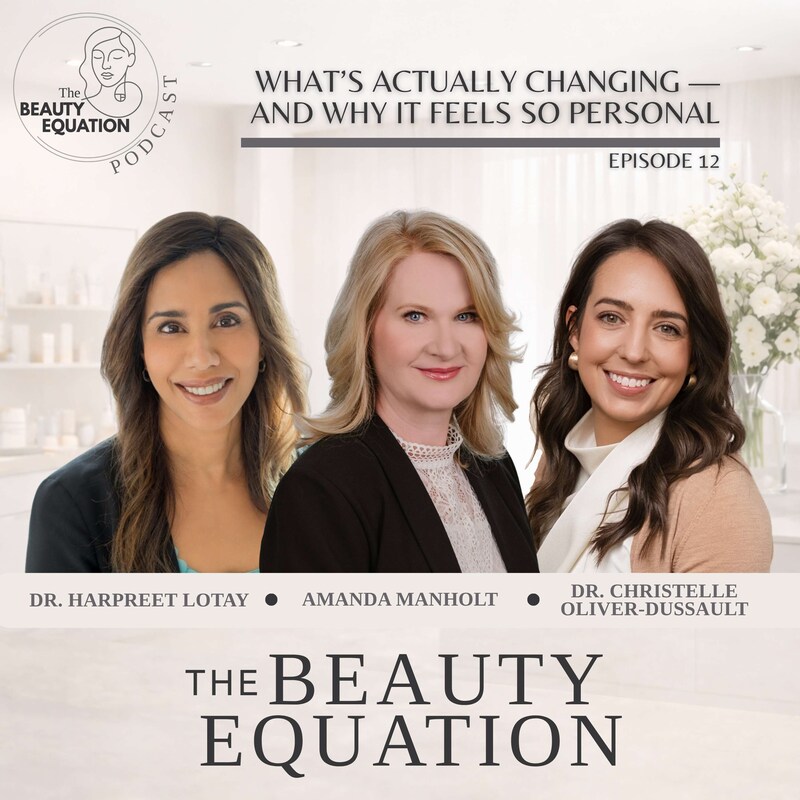
Shownotes
In this episode, Harpreet, Christelle, and Amanda unpack the multifaceted nature of aging — exploring how it impacts not only our physical appearance, but also our emotional well-being and sense of identity. They explain that aging is deeply individual, with genetics playing a significant role in which features change first and how those changes show up over time.
The conversation breaks down the difference between surface-level changes, like skin texture and elasticity, and deeper structural shifts, including volume loss, muscle laxity, and increasing facial asymmetry. By understanding these layered changes, listeners are better equipped to make informed, personalized treatment decisions rather than reacting to what they see in the mirror.
Key Takeaways
- Aging is a multifaceted process that affects everyone differently.
- Genetics play a significant role in how and where aging appears first.
- Surface changes and structural changes in the face require different approaches.
- Understanding the aging process leads to more informed, personalized treatment decisions.
- Embracing aging with awareness and self-acceptance is just as important as any aesthetic intervention.
Disclaimer: The Beauty Equation is for informational purposes only and not medical advice. This podcast does not create a doctor–patient relationship. Always consult a qualified healthcare provider before making medical or aesthetic decisions. Information may change as the field evolves.
Thanks for listening!
Thanks so much for listening to our podcast! If you enjoyed this episode and think that others could benefit from listening, please share it using the social media buttons on this page.
Do you have some feedback or questions about this episode? Leave a comment in the section below!
Subscribe to the podcast
If you would like to get automatic updates of new podcast episodes, you can subscribe to the podcast on Apple Podcasts or on your favourite podcast app.
Leave us an Apple Podcasts review
Ratings and reviews from our listeners are extremely valuable to us and greatly appreciated. They help our podcast rank higher on Apple Podcasts, which exposes our show to more awesome listeners like you. If you have a minute, please leave an honest review.
About the Hosts:
Dr. Harpreet Lotay is a family physician specializing in aesthetic medicine. She is the founder of Sona MD in Kamloops, BC, and serves as Chief Medical Officer at Bios Wellness Clinics. Known for her artistic approach and comprehensive non-surgical treatments, Dr. Lotay combines medical expertise with an eye for natural results. She is also an educator, a national trainer and holds academic appointments where she shares her knowledge in clinical dermatology and aesthetics. You can get in touch with her on Instagram @hlotaymd
Dr. Christelle Oliver-Dussault is a family physician specializing in aesthetic medicine, women’s health, and psycho-education. She brings a holistic, whole-person perspective to her clinical work, blending science with a deep understanding of the mind-body connection.
She is also the founder of Reclaim The Pink Within, a movement that empowers women to rediscover themselves during life’s most transformative stages. In addition, she is passionate about medical education and mentors the next generation of family physicians through her work with the department of Family Medicine at the University of British Columbia.
You can connect with her on Instagram @drchristellemd
Amanda Manholt is a clinic manager, patient consultant, and co-host of The Beauty Equation Podcast. With over 30 years of experience in beauty, aesthetics, and leadership, she has guided patients and teams alike toward confidence, growth, and empowerment. Known for her ability to connect with people and simplify the often-overwhelming world of aesthetics, Amanda brings a warm, practical, and relatable perspective to every conversation. You can find her on Instagram @crowsfeetandconfidence.
Websites
Transcripts
And I think one of the things that we can't escape is
Speaker:our genetics. So you come from your parents and
Speaker:that's going to have a significant impact on
Speaker:how you age, which parts of you show age first. And
Speaker:it's different for every person, but there are certain things that run in certain
Speaker:families and we've touched on that in the past on our own
Speaker:experiences, but that's one thing that you
Speaker:can't change. So in terms of
Speaker:the, you know, the things that we can't change that that we'll see. I find
Speaker:in, from my experience, that it's oftentimes those deeper changes, those deeper
Speaker:structures that you will really see, the ones where they're less affected by
Speaker:sun exposure. I wanna start with that idea of genetics
Speaker:and that every person is different and unique. So
Speaker:even in our teens when we're pretty robust,
Speaker:pretty healthy, and objectively young, we all
Speaker:have an Achilles heel, something that we've
Speaker:inherited that will age us faster than the rest.
Speaker:Welcome back to The Beauty Equation. In the last episode, we talked
Speaker:about that unsettling feeling when your face doesn't quite line up
Speaker:with how you feel inside. And today we're going to talk about
Speaker:why. Because when women notice change and they go in
Speaker:to see the doctor or their professional, they are often given really
Speaker:vague answers like it's collagen loss, it's gravity,
Speaker:it's aging. But those explanations don't
Speaker:always match the experience. And aging isn't just one thing
Speaker:and it doesn't happen evenly. So you have changes
Speaker:in structure, you have differences in your skin, hormones,
Speaker:fat pads, muscle tone, and they're all shifting at different
Speaker:speeds for different people. And when those changes show up on your
Speaker:face, it doesn't just feel physical, it feels emotional
Speaker:and it affects your identity. So today we're going to
Speaker:explain what's actually changing clearly without any
Speaker:drama, not to create fear, but to replace confusion
Speaker:with understanding. So you can stop blaming yourself
Speaker:and start making better decisions. I
Speaker:love that. Yeah. And I think one of the things that
Speaker:we can't escape is our genetics. So
Speaker:you come from your parents and that's going to
Speaker:have a significant impact on
Speaker:how you age, which parts of you show age first.
Speaker:And it's different for every person, but there are certain
Speaker:things that run in certain families. And we've touched on that in the past on
Speaker:our own experiences, but that's one thing
Speaker:that you can't change. So in terms
Speaker:of the, you know, the things that we can't change that we'll see,
Speaker:I find in, from my experience, that it's oftentimes those deeper
Speaker:changes, those deeper structures that you will really see, the ones
Speaker:where they're less affected by sun exposure.
Speaker:Um, so where do you want to start? Well, I want to
Speaker:start with that idea of genetics and that every person is different and
Speaker:unique. So, you know, even in our
Speaker:teens when we're pretty robust, pretty healthy, and, you know,
Speaker:objectively young, we all have an
Speaker:Achilles heel, something that we've inherited
Speaker:that will speed up the— how,
Speaker:like, that will age us faster than the rest, you know. So you
Speaker:might be— you might have skin that's exceptionally sort
Speaker:of sensitive to UV and that tends to wrinkle in a certain
Speaker:way. And your friends might be able to tolerate more sun
Speaker:exposure than you and genetically you can't. So for those people,
Speaker:you know, skin interventions are gonna be some of the first things they get
Speaker:into. Other people, their family
Speaker:structure might be such that they have smaller chins.
Speaker:So when we look at how human beings age, we, you know,
Speaker:let's start with babies. They have little small chins, right?
Speaker:But then so do 90-year-olds. So it's like we grow this chin
Speaker:into adolescence and we get a nice jawline
Speaker:and then it sort of regresses, right? And, well, some of us get a nice
Speaker:jawline. Some of us have never had a nice jawline.
Speaker:That's right. It's less nice. Yeah. So that's what I mean.
Speaker:So if you had a small one to begin with, right, you're going to age
Speaker:that lower part of your face faster. So, so that's, that's something
Speaker:that's always interesting when we see our younger patients to kind of go like, how
Speaker:can we You know, if they're somewhat interested, how can we change their
Speaker:aging trajectory or make it a little bit less, less
Speaker:stark, I guess. Yeah. 'Cause for some who does have that smaller
Speaker:chin, we've talked in previous episode about bone
Speaker:resorption. So that shrinking of the bone happens as you get
Speaker:older. It's a slow process that accelerates over time
Speaker:and becomes much more visible after menopause.
Speaker:But if you already don't have much bone there, your
Speaker:aging is going to show up in your lower face, in your chin, around your
Speaker:mouth much quicker. And there's nothing in your
Speaker:lifestyle, no amount of calcium and physical activity
Speaker:that you can do that will improve that. That's just one of those
Speaker:cards that you've been dealt. Yeah. What about
Speaker:asymmetry? I feel like facial asymmetry is an interesting
Speaker:thing. So some people are very bothered by the fact
Speaker:that they feel like like their lips, for example,
Speaker:like one side's fuller, one side's smaller. And then, you know, when they go
Speaker:and actually see their photos that we do, they realize, oh, one
Speaker:cheek's bigger, one cheek smaller, one eye's bigger, one eye's less, more
Speaker:closed. And then they're like, oh my gosh. And
Speaker:it seems to like everybody has some amount of facial
Speaker:asymmetry. It would be weird if we were completely
Speaker:mirror images. We would actually look bad.
Speaker:Yeah, and we— it kind of alien. It's not normal,
Speaker:right? If you haven't had the chance to Google that,
Speaker:Google symmetrical photos of like, um, they've done it
Speaker:for Britney Spears, other stars that we deem very
Speaker:attractive people. I think there's one of Halle Berry as well. And
Speaker:when you see how they look so symmetrical, they just— they look eerie. They
Speaker:don't look quite right. Weird. Really weird. And I feel
Speaker:like it's exacerbated once we get into mid,
Speaker:mid-age, because as we start to have more bone reabsorption and the
Speaker:fat pads shrink, then that those asymmetries become even
Speaker:more noticeable. So sometimes they do. People will say, oh my God,
Speaker:all of a sudden I'm, I'm not even when you're sort of like,
Speaker:show me a picture of when you were 20 and you can see it, but
Speaker:they have never seen it. Yeah. Yeah. So I think
Speaker:asymmetries can become much more prominent. The hollows more hollow.
Speaker:And I think that's where the fat pad shrinking
Speaker:makes a big difference too. Because then you're seeing what was the. Bone,
Speaker:um, that you may not have seen before. Um,
Speaker:yeah. One of the other things that— oh, go ahead.
Speaker:Oh no, go ahead. That's it. Muscle laxity is
Speaker:something that we've touched on previously as well too. I don't think we
Speaker:talked about it. Do you do face yoga? Yeah, like
Speaker:we will talk about it. Like it's—
Speaker:I don't know how many— everyone's talking about weightlifting these days and I know it's
Speaker:good for you, right? Just enjoy it. So I'm going to stick to my Pilates.
Speaker:But your muscles will get weaker with time. Yes.
Speaker:And with that, they won't work as well.
Speaker:And that applies to your face. We have so many muscles in our face that
Speaker:are responsible for facial expression, and
Speaker:some of them become much more lax
Speaker:and don't have the ability to
Speaker:lift as they used to. And some become
Speaker:really strong. Yeah. As I flex the lower
Speaker:platysma bands, the ones that pull everything down get
Speaker:intensely strong. Yeah. And that's something that can be quite genetic
Speaker:too. So I think you and I have talked about, Amanda, both our
Speaker:families having this. So in my family, a lot of the women, you'll have
Speaker:that like turkey neck. Um, and
Speaker:I'm a pelican. Yeah, the women in my family are all quite
Speaker:petite, but in their photos they'll look like they're overweight just because
Speaker:of that like muscle that is so strong. And I know, Harpreet, I don't know
Speaker:how much you've been putting into my neck and how often we do it. It's
Speaker:just a very— it's just never enough, right? It's never enough.
Speaker:Seriously, most muscles are strong,
Speaker:but you. Don'T want to get too much in there and, you know, then their
Speaker:head falls over. I'm just kidding. No, no, there, there—
Speaker:yes, there's a There's a proper dose,
Speaker:but you're— yeah, you're absolutely right. So all of the muscles
Speaker:that pull our face down seem to become more— become
Speaker:stronger for various reasons. And then the muscles that
Speaker:tend to lift have a harder job of lifting our
Speaker:cheeks up. Right. And there are some treatments that sort
Speaker:of zero in on that. Emsculpt is one of them. They have
Speaker:Emphase for the face that sort of targets that.
Speaker:I think the data that's— we're still understanding the role of that
Speaker:completely, but definitely muscle loss is a marker of
Speaker:aging for sure. Then there's, you know,
Speaker:thinking about photos, you know,
Speaker:I, when I was back in my day,
Speaker:when we didn't have a phone, when we didn't have a camera on us
Speaker:all the time, at all times. Yeah, we weren't
Speaker:taking pictures daily and at every event and of our
Speaker:food and all of these things. Right.
Speaker:I think photos, lighting, you know,
Speaker:it can really amplify the distress, you know,
Speaker:like heaven forbid my front camera turns on when I'm, you know,
Speaker:we've all had that happen where you get that angle where you're thinking, oh
Speaker:my God. I look like Jack the Pug. Yeah. I mean, even
Speaker:the availability of reflective surfaces,
Speaker:right? Like mirrors, right? They weren't that
Speaker:common 50, 70 years ago. Think about that,
Speaker:right? We just didn't see ourselves as often, but now
Speaker:through Zoom or through, you know, photos or whatever,
Speaker:we just see ourselves all the time. I actually had a gal
Speaker:in consult this week say that she was going to just drape all the
Speaker:mirrors in her house. She's like, maybe that's what I need to do. Like, you
Speaker:know, just put scarves over all of the mirrors. I'm like,
Speaker:it's an option. Yeah. I don't know, but you know what?
Speaker:We, it's, um, aging
Speaker:is just, it's a, uh, I don't know how to say this, but
Speaker:it's a continuous thing, right? It's going to move on. Time moves
Speaker:on. We can't stop that completely. And, you know,
Speaker:um, Uh, you know, Catherine O'Hara and that, uh, what was that show
Speaker:that she was in? Uh, Schitt's
Speaker:Creek, right? Do you remember that time where she said, take lots of photos of
Speaker:yourself? Like your photos of yourself when you're young?
Speaker:Yeah, true. I mean, at every age, I should take photos of myself now
Speaker:because when I'm 80, right? So I think we do kind
Speaker:of have to learn to appreciate where we're at and
Speaker:appreciate what we do have. And at the same
Speaker:time, like today's episode's really about understanding, right?
Speaker:Because we don't know why we see these changes, but
Speaker:there's, we still have lots of good stuff, right? Gotta
Speaker:remember that. There's a few people actually, there's someone who works in our
Speaker:clinic who for her aging journey, her big thing has been,
Speaker:she's very slim and always feels like she's,
Speaker:getting— looking gaunt. Um, and the other day
Speaker:I feel like I look like a cancer patient, and she's not sick, she's just
Speaker:the way she's really, really active. And some people that
Speaker:can happen. So she's someone who has these like beautiful cheekbones,
Speaker:right? But below her cheekbones doesn't have much fat. So
Speaker:like 20s and 30s, you know, everyone's envy. Then you get into the
Speaker:40s, that, that fat underneath your
Speaker:cheekbone just keeps going and going, and that hollowness
Speaker:made her look ill. And we did a treatment on
Speaker:her recently, and when she looked and started crying, she's like,
Speaker:I don't look sick anymore. Oh, that's lovely.
Speaker:And it's, it's, that's very
Speaker:individual, whereas other people, they have a lot of fullness in their cheeks and that,
Speaker:that would never happen to them. Yeah, yeah, exactly. Yeah, I'm like,
Speaker:oh, Everyone is different. I don't have any fullness here.
Speaker:You've lost some volume in your cheeks below your cheekbone, but the
Speaker:way your bone sits and your fat pads sit, you don't have that
Speaker:sickly appearance that. Um, I just get
Speaker:nice jowls. Thanks. Thanks to my genetic profile.
Speaker:And, and it's, it's, yeah, I don't know.
Speaker:It's, it's, it, it definitely hits that identity. Firmly.
Speaker:Um. I start to see more of
Speaker:my grandmother in my face, which
Speaker:I loved my grandmother. She raised me, but I
Speaker:don't know that I'm ready to look quite like that.
Speaker:Yeah. And then I think, oh, I'm just being vain, but
Speaker:it definitely can be jarring
Speaker:when it starts to happen. But it kind of happens to all of us.
Speaker:Yeah. So we talked a little bit about like genetic sort of
Speaker:predispositions, but let's talk about something that's universal. I'm
Speaker:going to just kind of go over for people or listeners, like
Speaker:what is— what does happen holistically to your face?
Speaker:And, you know, for one person it's going to be the skin is going to
Speaker:be a weak spot. For another, it's going to be those neck
Speaker:depressors. For another, it's going to be a weak chin. For another,
Speaker:it might be that they're not very robust in the
Speaker:face or have fat in their face to start with. But globally, this
Speaker:is what happens. You start to lose collagen in your skin,
Speaker:right? So in your 20s, you're going to lose about 1% per year, and
Speaker:it just keeps going. So that elasticity and snapback starts to
Speaker:decline. And then depending on your lifestyle too, you're going to
Speaker:have dyspigmentation or sort of dullness of the skin
Speaker:start to show up. And UV damage can also show up
Speaker:as enlarging of— enlarging the pores. And
Speaker:then a watchiness to the skin, and you can also start to develop
Speaker:some creepiness as well. So those start— things start
Speaker:to happen. And then in your 40s, sort
Speaker:of late 30s, you start to see some
Speaker:fat resorption. So a lot of people in their 20s will have
Speaker:chubby cheeks and not like that sort of adolescent look. By
Speaker:their 30s and sort of mid-40s, they have a more sculpted
Speaker:look. And I would say women look really good in their early
Speaker:40s, many of them, right? They're like They look good.
Speaker:They're holding their own. So, but they've got a bit of a sculpted look.
Speaker:And then the fat pads start to resorb beyond what looks good and
Speaker:you start to get hollowing underneath the eyes. You might get
Speaker:some hollowing in the temples, especially our runners. We start to see
Speaker:that they tend to lose fat interestingly in their temples.
Speaker:Just another reason not to run. Yeah. And that sort of
Speaker:up and down bouncing, repetitive sort of pulling on
Speaker:the skin is not good for it either. I'll put that out there. But if
Speaker:it's good for your headspace. You can keep doing it. Yes, absolutely.
Speaker:We'll give you some tools to reverse the running, the positive effects of the
Speaker:running. Yeah. No shame to runners out there. I'm just not going to do it.
Speaker:But I think you're awesome. Go, go, go. Yeah.
Speaker:Yeah. So you start to see that volume loss, then you start to see changes
Speaker:periorally, right? So you get these textural changes around your upper
Speaker:lip where you get lip lines starting, the lips start to get
Speaker:slimmer and slimmer, the chin starts to absorb. And
Speaker:the midface starts to sort of fall into the face,
Speaker:right? So that's what we start to see. Then when you marry that with
Speaker:that continuing collagen loss, you start to
Speaker:see more jowling and sort of hanging of the skin sort of below the
Speaker:jawline. So, so
Speaker:that, that is sort of encapsulates what people can
Speaker:expect to experience. Of course, we have tools and
Speaker:depending on your genetics, 1 or 2 or 3 of those things is going to
Speaker:be something that ages you a little bit a little bit more quickly, and it's
Speaker:going to be the thing that we might target first to keep you looking
Speaker:like yourself. So that was a
Speaker:really good recap. Yeah, thanks. And
Speaker:then just to finish, as your bone shrinks, your skin doesn't, so you're gonna get
Speaker:those folds and that sagging. Totally.
Speaker:You're so right in saying what we target first will
Speaker:depend on your genetics and your anatomy, um, because
Speaker:oftentimes we can get a sense of what's going to start to show
Speaker:up first and that the order in which we discuss treatments may
Speaker:change on the person. And I would add to that what bothers
Speaker:the person the most. Yes. Yeah. Yeah. I had one
Speaker:recently and we didn't end up doing any treatment,
Speaker:but this person came in with the expectation of getting a
Speaker:Botox treatment, but when she went through what really bothered
Speaker:her and we looked at photos, she actually didn't need any Botox. She's someone
Speaker:who had a lot of volume loss in her big midface
Speaker:hollowness and was concerned about, you know, just tired eyes and
Speaker:a bit of heaviness between kind of the tip, the sides of the nose
Speaker:and the corners of the mouth. And she actually had
Speaker:some expressive lines, but not really any lines at rest. And it's really— it was
Speaker:really more volume depletion. And I could see as we were
Speaker:talking, she was quite disappointed because she in her head thought, well, the
Speaker:Botox is going to fix the issue here. And, you know, with
Speaker:understanding, she realized that that wasn't the treatment for her. And oftentimes when
Speaker:those— like the when expect— treatment
Speaker:expectations aren't met with what they were
Speaker:hoping, it can take some time to understand what we
Speaker:discussed. And we ended up deciding that we
Speaker:would check in in a couple weeks and just see if there was more information
Speaker:she wanted, because it can be overwhelming to take it all in. Like, you
Speaker:described it so well, their heartbeat, but it's a lot when you're not doing this
Speaker:every day to wrap. Your head around it all.
Speaker:Yes, yes. But when you understand the difference between surface
Speaker:changes and structural ones, between perception
Speaker:and reality, it becomes much easier to make decisions
Speaker:that actually serve you. So I think
Speaker:if these conversations are helping you see things differently, we'd
Speaker:love for you to subscribe. Yeah.
Speaker:I hope you enjoyed today's episode. It was really about helping
Speaker:you gain a bit of clarity as to what happens.
Speaker:And realizing that this process is gonna happen,
Speaker:but we have tools to slow it down,
Speaker:even when we know that there are some periods in your life where that might
Speaker:speed up. And our next episode, we're gonna talk about
Speaker:the different approaches that we have and how,
Speaker:you know, we can make these decisions and make
Speaker:treatment plans without any urgency, without any pressure,
Speaker:so that you are happy with the outcome and you don't
Speaker:have regret from your treatment options.
Speaker:And really, it's something that will sometimes require more
Speaker:than one conversation, and that is okay.
Speaker:Yes. Until next time. Take care.
Speaker:Bye for now. Bye-bye.


