Shownotes
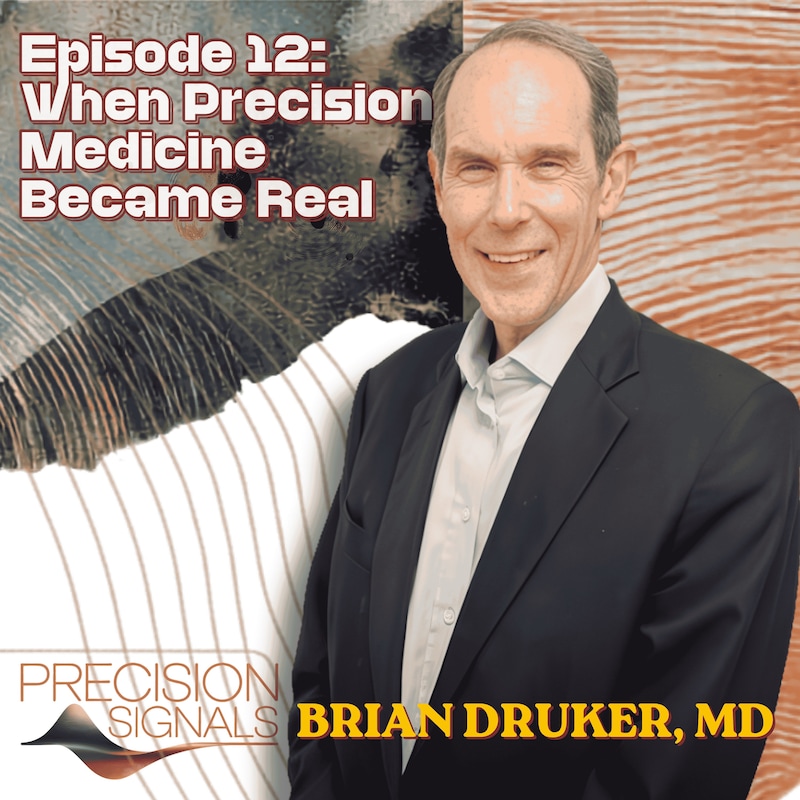
Dr. Brian Druker helped change the course of modern oncology through his central role in the development of imatinib (Gleevec), a therapy that transformed chronic myeloid leukemia (CML) and helped establish the modern era of precision oncology.
In this episode of Precision Signals, Dr. Sean Khozin speaks with Dr. Brian Druker about the scientific, clinical, and human story behind Gleevec, from the early search for a drug that could inhibit the abnormal signal driving CML, to skepticism around targeted therapy, to the first clinical trials and the broader impact on cancer medicine.
The conversation also explores Dr. Druker’s path into oncology, the development of targeted therapies beyond CML, the limits of molecularly targeted drugs, the arrival of immunotherapy, the challenge of persistent leukemia cells, current work in AML, and how AI may help generate hypotheses while still requiring rigorous biological validation.
This is a conversation about scientific persistence, translational medicine, precision oncology, and what meaningful progress in cancer research really requires.
Transcripts
Hello, and welcome to precision signals.
Speaker A:I'm Sean kozen.
Speaker A:Today's conversation is with Dr. Brian Drucker, a physician scientist whose work helped create one of the defining breakthroughs in modern oncoming imatinib, Better known as glivec.
Speaker A:Before glivec, chronic myeloid leukemia was a disease with limited options and an uncertain future.
Speaker A:Glivec changed that.
Speaker A:It showed that a cancer could be understood at its source, not just by where it appeared in the body or what it looked like under the microscope, but by the molecular engine driving it.
Speaker A:Brian drucker was central to that story.
Speaker A:After years studying the signals that tell cancer cells to grow, he set a very specific goal when he established his own laboratory at Oregon health and science.
Speaker A:Find a drug that could shut down the abnormal signal driving chronic myeloid leukemia, Test it carefully, and get it into patients.
Speaker A:He contacted nick leiden at sibagige that tested a set of candidate compounds, and one of them stood out.
Speaker A:It killed leukemia cells while sparing normal cells.
Speaker A:That compound became imatinib.
Speaker A:Years later, it would be approved as gleevec and become one of the clearest examples of what molecularly targeted cancer therapy could achieve.
Speaker A:For many of us who trained in medicine around that time, the impact was hard to overstate.
Speaker A:Cancer had long been diagnosed by anatomy, histology, and treated broadly with toxic chemotherapy.
Speaker A:Glivec showed something different.
Speaker A:That if you understand the biology precisely enough, you, can sometimes change the course of a disease with extraordinary clarity.
Speaker A:But the deeper lesson was not simply that one drug worked.
Speaker A:It was that rigorous science, clinical courage, regulatory openness, Industry, partnership, and relentless attention to patients could converge to change the future of cancer medicine.
Speaker A:In this conversation, we explore the path that led to gleevec.
Speaker A:The skepticism surrounding targeted therapy, the first patients treated with imatinib, the evolution of molecular oncology, and what real progress should mean in cancer today.
Speaker A:And as Brian reminds us, the ultimate measure is not the elegance of the science or the novelty of the technology.
Speaker A:It is the patient whose life is extended, restored, and made newly possible.
Speaker A:Let's step into the conversation and trace the signal beneath the noise.
Speaker B:Hi, Brian.
Speaker B:Welcome to precision signals.
Speaker C:Hi.
Speaker C:How are you, Sean?
Speaker B:Doing well.
Speaker B:I've been really looking forward to this conversation.
Speaker B:It's a great privilege to have you here.
Speaker C:Thank you.
Speaker C:It's my pleasure, brian.
Speaker B: I remember vividly back in: Speaker B:It was one of the first times that I actually appreciated that a cancer can be understood Mechanistically and perhaps treated at the level of a specific molecular aberration.
Speaker B:That moment stayed with me throughout the years and in fact was one of the reasons I went into oncology just like a lot of my peers.
Speaker B:That that story was quite pivotal for a lot of us.
Speaker C:Well, Sean, thank you for that.
Speaker C:And it does.
Speaker C:It did give everybody great hope.
Speaker C:It validated the promise of oncogenes and targeted therap therapy and really gave the field the boost it needed.
Speaker C:And so I'm so pleased to hear that it inspired you and it truly did inspire a generation.
Speaker B:Yeah, absolutely.
Speaker B:But before we get into your professional accomplishments, I'd like to go back to the early days where you grew up.
Speaker B:So you grew up in St. Paul, Minnesota, in a family that was essentially shaped by the ethos of first generation immigrant parents, just like myself.
Speaker B:I certainly relate to that where education was clearly central.
Speaker B:Can you tell us about growing up in that environment?
Speaker C:Well, I just remember a childhood.
Speaker C:I was kind of, you know, I was one of the free range kids.
Speaker C:But we lived in this amazing neighborhood where if I walked down the alley home from school, by the time I got home, my mom knew I had taken an unapproved route.
Speaker C:But it was just a wonderful community.
Speaker C:But my parents were very focused on education as the key to your future.
Speaker C:And if I got one B on a report card, it was, what went wrong?
Speaker C:What do we need to do?
Speaker C:What do we have to change up?
Speaker C:You missed what's going on here.
Speaker C:So it was always ensuring that we were excelling, ensuring that we were getting our work done, ensuring that school was our priority.
Speaker C:And that was.
Speaker C:Was so important to them.
Speaker B:Sure.
Speaker B:So.
Speaker B:So growing up in that environment, the focus on discipline and education, did it feel too much or did you appreciate it?
Speaker C:Yeah.
Speaker C:As I look back, there's a part of me that wished I had had more fun, shall we say?
Speaker C:I remember one.
Speaker C:One summer I wanted to go canoeing in the Boundary Water area of between Minnesota and Canada.
Speaker C:I did it on a trip the year before.
Speaker C:I just loved it.
Speaker C:I love being out in nature and I still love being outside.
Speaker C:And my parents looked at me and said, no, you won't like that.
Speaker C:We need you to do this summer school because it's going to enhance your marketability and enrich your life.
Speaker C:So I didn't get to go to canoeing for the summer.
Speaker C:And so I look back at that and thought, yeah, I was probably.
Speaker C:I probably learned a lot that summer.
Speaker C:But it sure would have been nice to have a really fun summer doing the Things that I really wanted to do.
Speaker B:Right, right.
Speaker B:And it seems like, Brian, you had exposure to science early on.
Speaker B:Your, your father, if I'm not mistaken, was a chemist at 3M.
Speaker B:Was that, was he an influence in, in your scientific aspirations?
Speaker C:You know, it's so interesting to think back, but we never sat around the dinner table talking about his work.
Speaker C:We talk about our work, we talk about the day, politics of the day.
Speaker C:And it was a wide ranging, fun, knockdown, drag out discussions, but we never.
Speaker C:I didn't know that much about my dad's work until much later in life when I realized he had one of the longest running patents on how to do printing in color.
Speaker C:And so back in the 60s and 70s, when he saw the COVID of a magazine that had five different colors, that was a patent of his.
Speaker C:I didn't know that until my 20s or 30s.
Speaker B:That's amazing.
Speaker B:Yeah.
Speaker C:Yes.
Speaker B:And it seems like this is something that we uncovered as we were reviewing your biography, that you wanted to be a baseball player.
Speaker B:And how did that work out?
Speaker B:And can you tell us more about that?
Speaker B:Where did that interest come from?
Speaker C:Well, again, that was one of the things that I loved about growing up.
Speaker C:The things I remember about my, particularly about my dad, is that he loved sports.
Speaker C:And we would go to the Minnesota Twins or the Minnesota Vikings game, he'd stand outside, buy a pair of scalp tickets, and we'd get some good seats and we'd just have the greatest time.
Speaker C:But he was a true baseball fan and a baseball lover and he instilled that in me.
Speaker C:But I had no talent.
Speaker C:I love the game, I loved to play, but I wasn't very good at it.
Speaker C:So you could dream about being in the World Series, you could be about hitting that winning home run, but that was never going to be me.
Speaker B:So there was no time later in your career that you felt that, oh, you should have become a baseball player.
Speaker C:Now I, you know, the one thing I do look back at, as I took up running later in life, I, and kind of did these age graded times, I realized I actually had a little bit of talent in running, but I never enjoyed it as a kid.
Speaker C:And we had one of the most accomplished cross country and track teams in my high school.
Speaker C:And when I tried out, I was kind of fifth string at best, so I never kind of gravitated toward that.
Speaker C:But later in life, I'm an age group winner.
Speaker C:I've done pretty well, and I probably could have done okay there, but probably wouldn't have made the Olympics, probably wouldn't have made a Division 1 scholarship.
Speaker C:So I'm just happy being an age group winning out.
Speaker C:Right.
Speaker B:So when you went to college, you started to work at.
Speaker B:So you went to UC San Diego and you ended up in John Abelson's lab.
Speaker B:For those that are not familiar with Abelson, he was a molecular biologist working on fundamental processes like RNA splicing, DNA recombination.
Speaker B:A lot of early insights emerged out of that lab is that.
Speaker B:Did you know at the time that you wanted to become a physician when you were an undergrad?
Speaker B:And how did you end up in the lab?
Speaker C:When I was going into my junior year, I decided that I wanted to get some lab experience just to see what that was like.
Speaker C:I looked through the list of investigators at UC San Diego and it looked like John Abelson was doing some amazing work.
Speaker C:And so I went and interviewed.
Speaker C:He offered me a job.
Speaker C:I had a job during the school year, then again over the summer.
Speaker C:And in those days there was no New England biolabs.
Speaker C:If you wanted a restriction enzyme, you had to grow up the bacteria and purify it yourself.
Speaker C:And so here was this kid from Minnesota.
Speaker C:Let's put him in the cold room because he probably can manage the cold and he can purify these over the columns and make thousands of dollars of restriction enzymes for the lab.
Speaker C:So that was my lab job.
Speaker C:But what I realized in John's lab, and particularly in a course that he taught in biochemistry, is this was, this was.
Speaker C:Came so easily.
Speaker C:I was so this is something I clearly had talent and it came naturally for me.
Speaker C:I could see palindromes in my head.
Speaker C:I could come up with a restriction map so much more quickly than my colleagues.
Speaker C:And I could think about cloning and splicing and it just came all naturally to me.
Speaker C:And it was, wow, this is amazing.
Speaker C:This is something I'm really good at.
Speaker C:And I definitely knew that I wanted to incorporate research into my career.
Speaker C:But amazingly enough, there was this lab mother, Hildegard Lamp from world renowned scientist who had worked with Watson and Crick, had worked with Rene Delbecco, worked with some of the Lee Hartwell and just Nobel Prize winner after Nobel Prize winner.
Speaker C:She was kind of our lab mother.
Speaker C:And she counseled me, Brian, you have this talent, but I think medical school is going to be the right choice for you.
Speaker C:And I took that advice and applied and that was, that was.
Speaker C:Set me on my path.
Speaker B:Oh, interesting.
Speaker B:So do you think if Shannon said that you would have pursued a career as a PhD?
Speaker C:I thought about it and that was in those days, getting into med school was not easy and acceptance rates for maybe 10%.
Speaker C:And so everybody needed a backup plan.
Speaker C:But for me, I kind of knew that there was always this pushing.
Speaker C:My family, we want a doctor in the family.
Speaker C:I knew that that was something I'd likely pursue.
Speaker C:And.
Speaker C:But when I applied to medical school, I was very clear.
Speaker C:I wanted to incorporate research into my.
Speaker C:Into my career.
Speaker C:It wasn't just taking care of patients that, yes, I wanted to do good for.
Speaker C:For.
Speaker C:For people, but I really wanted to make sure I was going to incorporate research into my career.
Speaker C:Sure.
Speaker B:Makes sense.
Speaker B:So you ended up staying at UC San Diego for med school?
Speaker C:Yes.
Speaker B:And can you tell us about your experience in medical school at the time?
Speaker B:Was it what you had expected?
Speaker B:Did it fulfill your expectations at the time?
Speaker C:Yeah, I look back, medical school was an amazing time, and the camaraderie, my colleagues.
Speaker C:But the culture at UC San Diego was all about translational science.
Speaker C:It was, what do we need to understand about science that we can apply to patients that's going to change and improve the lives of people?
Speaker C:That was the culture there, and that was the culture I was placed into.
Speaker C:And it had an absolutely formative effect on my career.
Speaker C:And so I was just.
Speaker C:I was delighted to be in that environment and delighted to have that introduction to translational medicine when it kind of didn't exist.
Speaker C:But that was the ethos there.
Speaker B:Yeah, very interesting.
Speaker B:So you knew that you wanted to be between the lab, between the bench and a bedside when you went to medical school.
Speaker B:That's remarkable.
Speaker B:And you're absolutely right.
Speaker B:Even now, a lot of folks in medical school, the last thing that are thinking about is translational medicine.
Speaker B:Yeah, that's.
Speaker B:It's great that you had that exposure, and you were smart enough to recognize that it's an opportunity, because the world of oncology at the time was quite different.
Speaker B:And so when you were in med school, you went to residency at Barnes Hospital at Washington University in St. Louis, and you did internal medicine.
Speaker B:Right.
Speaker B:Did you know at the time that you wanted to become an oncologist?
Speaker C:Well, I'm going to back up to medical school, Sean, because in medical school, you're right.
Speaker C:In the late 80s, early 90s, if you were diagnosed with cancer, that was a death sentence.
Speaker C:And I would never say to my colleagues in medical school, I wanted to be an oncologist, even though I kind of knew that was the path I was taking, because the view was, what an incredibly depressing field.
Speaker C:Everybody dies.
Speaker C:Why would you want to go into that field?
Speaker C:But I looked at the field and thought, maybe someday we're going to do something different.
Speaker C:And I want to be a part of that.
Speaker C:I want to be a part of the science and discovery.
Speaker C:And if someday I make a contribution that leads to better treatments for patients with cancer, I'm going to be satisfied with my career.
Speaker C:And that was kind of what set me on my path, is I just can see that in 10, maybe 20 years, new treatments are going to become available that could change the way we think about cancer.
Speaker C:And I said, I just wanted to be a part of that.
Speaker B:Very interesting, Brian.
Speaker B:So it seems like you had that recognition in medical school.
Speaker B: essentially cure rates in the: Speaker B:Is that true?
Speaker C:Yes, it did.
Speaker C:And, you know, I looked at that and, Sean, I'm such a nerd.
Speaker C:I know.
Speaker C:You know, I was.
Speaker C:You'd watch.
Speaker C:I'd watch Star Trek.
Speaker C:And there was this one episode where Scotty was the doctor, and he looked back at something from ancient history and said they were barbaric, what they were doing.
Speaker C:I looked at the cure of childhood leukemia, and I said, I hope that someday we look back at that and think that's barbaric, what we're doing.
Speaker C:And again, those are the sorts of elements and occurrences.
Speaker C:Learning about that cure of childhood leukemia and be fascinated.
Speaker C:You can cure leukemia, but look at the cost to those kids.
Speaker C:Two years of toxic chemicals.
Speaker C:What's that going to mean for downstream?
Speaker C:There's gotta be a better way, right?
Speaker B:And doing your internal residency, internal medicine residency, you know, this was around the time that there were no hour restrictions.
Speaker B:You know, residents worked only 10 hours, if not more, unlike, you know, my experience, which came after the restrictions on the number of hours that you can work.
Speaker B:So you became a very skilled and astute clinician because you were always in the hospital.
Speaker B:And I believe you may have even commented on that.
Speaker B:Can you walk us through that experience?
Speaker B:And do you think being so immersed in patient care during residency is something that is necessary?
Speaker B:And if so, have you lost something today with our restrictions and the fact that, you know, a lot of residents think about medicine as a 9 to 5 job nowadays?
Speaker C:Well, we had an incredibly famous chair of surgery who said, the problem with every other night college, you miss half the good cases.
Speaker C:The reality is, I think that you can learn enough with our restrictions.
Speaker C:It's you.
Speaker C:You can get enough experience and exposure.
Speaker C:But the Opportunity to be there and to be working hard and to get immersed was, was again a once in a lifetime experience.
Speaker C:And for me, I embraced it.
Speaker C:And I'll tell you one, one late afternoon I had just come off call, I had a patient who had insulin resistant diabetes and an he was, at that time we were using bovine insulin and human insulin was just being made available.
Speaker C:And he also had an insulin allergy.
Speaker C:So here was a guy who probably should have been in the icu.
Speaker C:I called up the endocrinology attending who was able to get us compassionate use human insulin, and he walked me through the desensitization protocol with it.
Speaker C:I did that with an allergist and I sat at this guy's bedside for the next eight hours, titrating up this human insulin dose, getting his blood sugars under control and getting him out of diabetic ketoacidosis.
Speaker C:The next morning my resident walked in and said, why didn't you call me?
Speaker C:We could have sent him to the icu.
Speaker C:And I looked at this.
Speaker C:This is a once in a lifetime experience to be on the forefront of medicine doing something that nobody's ever done before.
Speaker C:I'm not going to give that up.
Speaker C:And so again, that was just part of who I was.
Speaker C:I just embraced it and learned so much during those years.
Speaker C:But the formative part there, Sean, was this was in the early days of auto transplants and Washington University.
Speaker C:Jeff Herzig was there.
Speaker C:Tim Lay actually came back from the nih, do a fellowship and he was working on the transplant unit.
Speaker C:And we had no gcsf.
Speaker C:We had, you know, basically patients would get their auto transplants and at least half of them would end up in the ICU and die.
Speaker C:And so it was again, this remarkable therapy that we could give, but at an incredible cost to patients lives.
Speaker C:But again, a formative experience.
Speaker C:And I gravitated toward thinking we can cure patients, but the cost is enormous.
Speaker C:There has to be a better way.
Speaker C:I do not want to do bone marrow transplants.
Speaker C:I want to do something different.
Speaker B:Sure.
Speaker B:So after that, Brian came Dana Farber.
Speaker B:Can you tell us about that transition, how you chose Dana Farber?
Speaker C:Well, I looked this as an opportunity to be at one of the best, if not the best, oncology training programs in the country.
Speaker C:And I wasn't disappointed.
Speaker C:But again, these were the days when fellows did all the work.
Speaker C:And so I was taking care of patients from inner city of Boston to blue bloods of Boston, and I was pretty much on my own.
Speaker C:And it was again an incredible learning experience.
Speaker C:You Very quickly became a competent oncologist, and you were surrounded by experts.
Speaker C:So if you needed some help, you could go to an expert for some advice and bring that back to your patients.
Speaker C:But we were 99% responsible for the care of our patients.
Speaker C:And so the first three months, I felt like I had been thrown in the deep end of the pool, and I didn't know how to swim, but I learned how to swim really quickly, and I learned how to swim really well.
Speaker B:Sure.
Speaker B:Right.
Speaker B:And, Brian, it seems like you pursued the scientific path as well, in addition to the patient care responsibilities that you outlined.
Speaker B:And you joined Tom Roberts.
Speaker B:Yeah.
Speaker B:His lab, which at the time was working on signal transduction.
Speaker C:Yeah.
Speaker B:How did that come about?
Speaker B:Did you know Tom beforehand, or did you interview with several different labs and pick Tom because it resonated with you?
Speaker C:Well, there are two threads to this.
Speaker C:First of all, when I was at Washington University, David Kipnis was the chair of medicine.
Speaker C:And every year he would have an interview with the residents and talk about what their aspirations were and to give them advice.
Speaker C:And if you've ever seen the Graduate, when But Dustin Hoffman characters taken aside, and the guy says, I'm going to tell you one word.
Speaker C:Plastics.
Speaker C:That's the future.
Speaker C:David Kipnis kind of had that plastics moment.
Speaker C:David Kipnis said to me, brian, I've got one word for you.
Speaker C:It's oncogenes.
Speaker C:That's the future of cancer research.
Speaker C:So I knew when I went into my laboratory training, I wanted to look for somebody working on oncogenes.
Speaker C:One of my very close friends had gone to work in George Corey's lab at the nih.
Speaker C:And I was having a conversation with him, and he said, oh, George said, there's this amazing young investigator, Dana Farber, Tom Roberts, you should go talk to him.
Speaker C:So I went and talked to Tom.
Speaker C:He was impressed that I actually had some lab experience, that I was an MD and we hit it off and I joined his lab.
Speaker B:That's great.
Speaker B:And what did you start working on in his lab?
Speaker B:I know that you worked on 4G10 antibody, which essentially detects phosphorylated tyrosine and lets you examine active signaling pathways.
Speaker B:Did you also work on tyrosine kinases in the lab?
Speaker C:Yeah.
Speaker C:So the lab was predominantly focused on polyoma middle tank.
Speaker C:And I look back at that and think, if I had been really smart, I would have looked at, where are there any human cancers that have polyoma middle T in them?
Speaker C:And I could have found that.
Speaker C:But I didn't have the foresight and wisdom to do that.
Speaker C:We were working on the mechanism by which polyoma middle T usurp intracellular apparati to transform cells.
Speaker C:And the way it did, it was bound to and activated the SARC tyrosine kinase.
Speaker C:So then it was, well, what.
Speaker C:What proteins get phosphorylated by src?
Speaker C:There was one that was this 85 kilo Alton protein that turned out to be the regulatory subunit of pi3 kinase.
Speaker C:So we were involved predominantly in tyrosine kinase and substrates of tyrosine kinases and how activation of kinases leads to cellular transformation.
Speaker C:And that was what was my burgeoning expertise in the lab.
Speaker B:What was the community's thinking at the time on tyrosine kinases when it.
Speaker B:When it comes to their role in oncogenesis and perhaps even as a therapeutic target.
Speaker C:And it was clearly an evolving and attractive possibility.
Speaker C:An EGF receptor, PDGF receptor were expressed, expressed, not necessarily mutated in many cancers.
Speaker C:There was no clear indication that SRC was mutated in human cancers, but it was kind of the quintessential oncogene discovered by Bishop and Varmus.
Speaker C:And I just would say that it was really sad to hear the news this week of Michael Bishop's passing.
Speaker C:Just an icon in the field.
Speaker C:But everybody would write a grant and saying, and maybe someday we will translate this knowledge of activated tyrosine kinases into therapies.
Speaker C:And at the time when I surveyed human cancers, and again, I'm working on polyoma middle T, there were two cancers that I thought were were likely caused by activated kinases.
Speaker C:One was CML with BCR abl, and the other one that was becoming a possibility was HER two NEU and breast cancer.
Speaker C:And even that was somewhat controversial since it was an overexpression event, not necessarily an activation event.
Speaker C:So it was a debate.
Speaker C:Was that actually a causative molecular event, or was it an associated and even bcr, ABL and cml?
Speaker C:The debate was, is it associated or causative?
Speaker C:In my simple mind, an activated tyrosine kinases transform cells and a B serable is present in cml.
Speaker C:That must be the cause.
Speaker C:It just seems so simple.
Speaker C:But it wasn't necessarily that simple to everybody else.
Speaker B:Interesting.
Speaker B:So do you think it was a combination of the data that you were generating and seeing and your intuition?
Speaker C:Yes, I do.
Speaker B:Right, because it.
Speaker B:So you had to go beyond what the data was pointing at.
Speaker B:And how do you think one can hone their intuition so they can actually see emergent properties, basically in the data that they're looking at.
Speaker C:Yeah, what a great question.
Speaker C:I think one of the skills that I talk to graduate students and postdocs about is you've got to learn how to pick your experiments because a lot of them are going to fail.
Speaker C:And so our intuition isn't always that good, but we keep thinking of generating hypotheses.
Speaker C:We test them and it's.
Speaker C:The important thing is you have to understand if your experiments aren't working, is it time to move on or do you keep pushing and when do you make that switch?
Speaker C:You only are going to learn through failure.
Speaker C:And if everything you do works, you're not going to learn what failure looks like.
Speaker C:So I had plenty of failure in my career and I had some good intuition.
Speaker C:But when I set up my laboratory, I had this pie in the sky project of targeting beasts are able.
Speaker C:It might not work, but I had my bread and butter experiments that I knew this has to work.
Speaker C:Identifying a substrate and activated tyrosine kinase.
Speaker C:That's what the field was doing.
Speaker C:That was a tried and true, highly fundable.
Speaker C:My lab was going to stay in business.
Speaker C:I continued to make progress there.
Speaker C:And if this was, you know, going back to baseball, if I took a swing for the fences and struck out, I'm still okay.
Speaker C:I'm going to have another at bat, right.
Speaker B:That requires stamina and a lot of comfort with failure, which is very difficult for a lot of people to tolerate for a variety of different reasons.
Speaker B:Brian, can you tell us about your lab and sort of the early days, how it came about and you already gave us signals about your mission and your objectives, but can you walk us through the process in the early days?
Speaker C:Yes.
Speaker C: there, which is this was late: Speaker C:A number of my colleagues had gotten promoted to assistant professor.
Speaker C:I had been an instructor at Dana Farber Harvard Medical School for going on four or five years.
Speaker C:And I had about 20 publications, two or three first authors, lots of collaborative publications because of the phosphotyrosine antibody.
Speaker C:And I had moved my lab work into B cerebral signaling in collaboration with Jim Griffin.
Speaker C:I was making progress.
Speaker C:I was identifying substrates of the activated kinase and I wanted to get my own laboratory.
Speaker C:And when I meant to meet with the head of Dana Farber, he looked through my CV and said, yeah, you got a lot of publications here.
Speaker C:Not very many first authored.
Speaker C:And this work, I just don't see it as going anywhere.
Speaker C:I just don't see I've got a future here.
Speaker C:So that was pretty devastating.
Speaker C:But at that point, as I look back, I probably needed a little bit of a kick in the butt, and I got it.
Speaker C:And when I accepted a job at OHSU in Portland, Oregon, I had one goal, and I was focused and I was determined like I have never been in my life.
Speaker C:And that was I was going to find a drug company that Enable inhibitor, and I was going to get it into clinical trials.
Speaker C:That was my mission, my goal.
Speaker C:And I was lucky enough to make one phone call to Nick Leiden, who had been collaborating with Tom Roberts for many years.
Speaker C:I called Nick and said, do you have any compounds that inhibit abl?
Speaker C:He said, as a matter of fact, we got a bunch of them.
Speaker C:Would you like me to send them to you?
Speaker C:So wait till I get to Oregon.
Speaker C:When I moved to Oregon, he sent me half a dozen compounds, completely blinded, no profiling, and said, here's the best we got.
Speaker C:Let me know what you think.
Speaker C:And three months later, I sent him some data.
Speaker C:And there was one compound that just stood out at killing my CML cells without harming normal cells.
Speaker C:That drug turned out to be Imatinib, or Gleevec.
Speaker C: And that was late: Speaker B:Amazing.
Speaker B:Where was Nick at the time?
Speaker B:He was in Basel, right?
Speaker C:Yeah.
Speaker C:Nick was at Siba Geige.
Speaker C:And part of this interesting story is that we had collaborated with Nick at Siba Geige for several years.
Speaker C:He had used the 4G10 antibody and some of their kinase inhibitor screens.
Speaker C: But in: Speaker C:So we were no longer able to work with Ciba Geige in Tom's lab.
Speaker C:But by leaving, I was able to go and re establish that connection.
Speaker C: The irony is, in: Speaker C:So all of a sudden, this relationship with Dana Farber now becomes a Novartis relationship.
Speaker C: ng with his merged company in: Speaker B:Brian, were there any other calls you made and you were faced with skepticism?
Speaker B:Because I know there was a lot of skepticism at the time.
Speaker B:You already alluded to that briefly about tires and kindnesses and specifically about the approach that you were taking.
Speaker B:How did you deal with skepticism and what other calls, if you can tell us, you made that didn't work out?
Speaker C: published our first paper in: Speaker C:Not the director, but kind of the second, third level down.
Speaker C:And the general view was this is never going to work.
Speaker C:And, you know, there were kind of two camps.
Speaker C:There were the camps of ATPs.
Speaker C:You're never going to have a competitive inhibitor of ATP at a high enough concentration from a biochemical perspective to get to a high enough concentration to work.
Speaker C:And others were, when does a single agent in cancer ever work?
Speaker C:And how can you expect that targeting something that might not even be a causative abnormality may not be involved in the disease process at all?
Speaker C:It's not going to work.
Speaker C:So again, there was just.
Speaker C:It's so much easier to say no than say yes.
Speaker C:But there was just incredible skepticism in the, in the community.
Speaker C:And I kind of looked at it and said, we gotta give it a shot.
Speaker C:Let's.
Speaker C:If it doesn't, let's give it a try in people.
Speaker C:And if it doesn't work, okay, I'll go away, but this deserves a shot.
Speaker B:And Brian, at what point did you have enough preclinical data that you wanted to take it to the clinic?
Speaker B:Basically, you know, what was that inflection point in the data?
Speaker C: Well, probably by mid-: Speaker C: publication in probably early: Speaker C:And I kind of looked at it and thought, we're validating the promise of oncogenes.
Speaker C:Why isn't, why aren't people more interested in this story?
Speaker C:And, you know, it was, you know, I thought it should have been in a higher visibility publication, but it's still an incredibly highly cited article.
Speaker C:So I don't, I don't, I don't look back and I'm not bothered by that anymore.
Speaker C:But it just seemed that if we're going to embrace this, why isn't, why aren't people embracing it now?
Speaker C:And it was.
Speaker C:Well, we had animal experiments, we had cell experiments, but it's.
Speaker C:Well, you don't have proof in humans.
Speaker C:Okay, that seems kind of a high bar for a publication when I can't even get to clinical trials.
Speaker B:Well, so speaking of clinical trials, what year was the first in human study?
Speaker B:And can you walk us through the early experience in the first few.
Speaker C: So it was June: Speaker C:And this was a collaboration between Moshi Talpas at MD Anderson, Charles Sawyers at ucla, and I was the principal investigator out of ohsu.
Speaker C:And our first Patient was a retired.
Speaker C:And so you have to realize I have a long history of being involved in phase one clinical trials.
Speaker C:And one of my nightmares was the phase one trial of Taxol.
Speaker C:And Taxol, as you know, is a breakthrough therapy for ovarian cancer.
Speaker C:But in phase one, you would give it to patients with any cancer that was refractory and you'd go to a maximally tolerated dose.
Speaker C:I had this patient with colon cancer and she wanted to enroll, or maybe, or maybe I convinced her enroll on the phase one trial.
Speaker C:And we were at about the maximally tolerated dose and we had the worst possible outcome.
Speaker C:She got rip roaring diarrhea, needed to be hospitalized for weeks and her tumor didn't respond.
Speaker C:So here was a patient who didn't benefit from this clinical trial and actually was in a worse place because of the clinical trial, because of the toxicity.
Speaker C:And she lost months of quality time having to recover from that.
Speaker C:Now, understandably, patients go into a phase one trial in a very altruistic manner.
Speaker C:But the family was really upset with me.
Speaker C:They felt that I had convinced her that I'd given her false hope and I kind of carried that burden into a phase one trial.
Speaker C:What if this doesn't work?
Speaker C:What if it's toxic?
Speaker C:What if I do more harm than good?
Speaker C:And so this first patient, retired railroad engineer from out on the coast of Oregon, a rural part of Oregon, and just an absolute character.
Speaker C:And he had written to me back when we published our paper, said I want to be your first guinea pig, Just sign me up.
Speaker C:And I would go into his room about once every half hour to make sure it was okay.
Speaker C:And he'd look at me in his raspy voice and say, still here, doc, I'm okay.
Speaker C:Now in his case, we're too low of a dose.
Speaker C:It didn't work.
Speaker C:But within, within six months, everybody was responding.
Speaker C: this patient back By April of: Speaker C:And he responded beautifully.
Speaker C:He lived many, many extra years because of this.
Speaker C:And I just remember that.
Speaker C:I remember that day and that person so fondly.
Speaker B:That's a beautiful story, Brian.
Speaker B:Do you think the way we do dose escalation in first gen human studies for targeted therapies can be modified and changed?
Speaker B:Do you think we rely on the methods that are mostly appropriate for cytotoxic chemotherapies?
Speaker C:Well, I think there's two elements there Sean, first of all, because of my experience with phase one, we lobbied enough artists to make this phase one.
Speaker C:Only patients with cml, we have an ABL inhibitor.
Speaker C:How's it ever going to work in breast cancer?
Speaker C:Why even bother telling somebody we think it might work?
Speaker C:We know it won't work.
Speaker C:If it's going to work, it's going to work in cml.
Speaker C:So let's limit enrollment to people where we think it might work.
Speaker C:And not only will it get some data on safety, we'll also get some really quick insights into effectiveness.
Speaker C:And that was one of the really important elements of this phase one trial, is we tested in the patient population.
Speaker C:We thought it might work.
Speaker C:Interestingly enough, there's this tension between finding an effective dose versus a maximally tolerated dose.
Speaker C:As I look back at our experience, when we learned about resistance, there were some mutations that would respond to a higher dose of imatinib.
Speaker C:If I didn't know the maximally tolerated dose, I wouldn't feel comfortable escalating the dose.
Speaker C:So I think there's a good.
Speaker C:There's good reasons to understand what the dynamic range of effectiveness is.
Speaker C:But I think, you know, we have to be, particularly in these sorts of targeted drugs, once we're seeing some toxicity, I think it's time to back down.
Speaker C:So it's not going to this horribly toxic dose.
Speaker C:It's okay.
Speaker C:We start to see some side effects.
Speaker C:Okay, it's time to stop your dose escalation and barian.
Speaker B:This was at a time when companion diagnostics were not even part of our nomenclature.
Speaker B:Can you tell us about the diagnostic approach?
Speaker B:How did you select the patients for the study?
Speaker C:Yeah, well, this was an easy one, the Philadelphia chromosome.
Speaker C:And so routine cytogenetics were done, or FISH was done.
Speaker C: t coming on board in the late: Speaker C:So.
Speaker C:But again, everybody had the Philadelphia chromosome, and if they had the Philadelphia chromosome, there'd be cerebral positive by definition.
Speaker C:So actually, we did have a companion diagnostic.
Speaker B:And at the time, I guess people weren't calling it companion diagnostic.
Speaker B:How did the FDA react to that?
Speaker B:Because it was probably the first time that they were reviewing an application based on selection by a diagnostic assay.
Speaker B:And how did they.
Speaker B:What was their thinking at the time?
Speaker C:At the time, my recollection is they had no objections to the clinical protocol, and it went through very quickly.
Speaker B:That's interesting.
Speaker C:And I think, you know, this was the early days of Rick Pazder, and I suspect that Rick.
Speaker C:I know that Rick was the.
Speaker C:The agency representative who Went, who did the approval process?
Speaker C:But I suspect that he early on saw this as this is a paradigm we want to support.
Speaker B:Interesting.
Speaker B:Yeah.
Speaker B:Because I'm sure, you know, if.
Speaker B:If the application was being reviewed by the wrong reviewer, they could have poked a lot of holes into it.
Speaker C:Yeah.
Speaker C:Yes.
Speaker C:There were some back and forth around the dose escalation scheme, but I don't remember much, if any, comments around the selection for patients or even the fact that we were treating not the most advanced stage of leukemia, but patients who had.
Speaker C:Were resistant to the current standard of therapy, which was interferon.
Speaker C:And so that was, again, an interesting way to run a clinical trial.
Speaker C:It was patients, again, no other therapies, but not the latest, most refractory stage of the leukemia.
Speaker C:And the view was these patients had maybe six months or more to live, as opposed to a month or less if you had progressed to the acute leukemia stage of cml.
Speaker C:So these are patients who had some time, not a lot of time, but enough time to see a safety profile and maybe some early reads out in effectiveness.
Speaker B:Right.
Speaker B: So in: Speaker B:Can you tell us about the clinical data that was submitted to the FDA and what happened afterwards after the approval?
Speaker C:Yeah, well, it was absolutely remarkable.
Speaker C:But once we got to effective doses, 300 milligrams and above, it should have been 100% response rate.
Speaker C:There was one dropout, so an intention to treat analysis.
Speaker C:It was 53 out of 54 had their blood counts returned to normal.
Speaker C:We were seeing what were called cytogenetic responses.
Speaker C:So when most people came in, 20 out of 20 of their metaphase were Philadelphia chromosome positive.
Speaker C:And we were seeing some people who actually had 0 out of 20 or a complete cytogenetic response.
Speaker C:And we were actually running some PCR tests.
Speaker C:And I actually had one patient who had gone to PCR undetectable.
Speaker C:And that actually caught the attention of the fda, thinking, if you can see that in large numbers of patients, this ultimately could become an approval endpoint.
Speaker C:So they were thinking way ahead.
Speaker C:But the data was just so remarkable, and the safety profile was so good.
Speaker C:It was a simple one.
Speaker B:Right.
Speaker C:And at the announcement, it was Tommy Thompson, who is the Secretary of Health and Human Services, Rick Klausner, the head of the National Cancer Institute, Rick Pazder, who is the approver person at the fda, and Dan Vassello, the CEO of Novartis, announcing a breakthrough, a watershed moment in the history of cancer therapeutics.
Speaker C:It was an exciting, incredible day, and everybody wanted to say what part they played The National Cancer Taking part in the basic research that led to the discovery of the Philadelphia chromosome and BCR abl.
Speaker C:The FDA that rushed it through this life saving medicine saying, you bring us a safe and effective medicine, we can approve this in weeks.
Speaker C:And Novartis saying, we put our money on the line to bring this life saving medicine to patients.
Speaker C:And so everybody got some credit.
Speaker C:And it was this amazing confluence of science and industry and regulatory agencies speeding a life saving medicine to patients.
Speaker C:What a remarkable time.
Speaker B:Absolutely.
Speaker B:And it certainly did capture the imagination of the public at the time as a prelude to a cure for cancer.
Speaker B:And I know that you did a lot of interviews with both mainstream media and also scientific publications.
Speaker B:What were you thinking at the time, especially when it comes to the lay media in their approach to matlab and the questions that you were being asked?
Speaker C:Well, I tried to focus on were my patients and patients were benefiting from science.
Speaker C:This was a remarkable breakthrough.
Speaker C:It was just an incredible time for science and for medicine.
Speaker C:And this was giving people hope.
Speaker C:And what I learned from my experience as I went through this is that patients were coming to me who had been told, get your affairs in order, there's nothing left for you.
Speaker C:They found their way to the clinical trials.
Speaker C:And this is before the Internet or at the very, very early stage of the Internet.
Speaker C:They found their way, they got into clinical trial, they were feeling great, their blood counts were normal and their hope for the future had been restored.
Speaker C:And that was just.
Speaker C:That was the story.
Speaker C:It's about people and impact for people.
Speaker C:And some of those patients are still with me 26 years later.
Speaker C:And that's the return I get is to see the impact of something on real people and the benefit that they've received.
Speaker B:Amazing.
Speaker B:So there were other indications for imatinib.
Speaker B:Can you walk us through that, how those indications surfaced?
Speaker B:What was the preclinical signal?
Speaker C:So early on, I was a kinase guy.
Speaker C:I looked at Tony Hunter's kinase dendrogram and said, what's abl?
Speaker C:When Imaginib was sent to me, it was an ABL and PDGF receptor inhibitor.
Speaker C:And I looked at the kinase tree and said, what are the closest relatives?
Speaker C:SART was really close to abl.
Speaker C:It didn't inhibit sart, the kitten receptor tyrosine kinase, really closely related to pdgf.
Speaker C:I had all the model system.
Speaker C:Actually it was a KIT inhibitor.
Speaker C: And then in: Speaker C:I called up Novartis and Said, hey, I've got another indication for you.
Speaker C:And they said, what is it?
Speaker C:And I said, gastrointestinal stromal tumor.
Speaker C:And there was a bit of signs that.
Speaker C:What?
Speaker C:I said, oh, gastrointestinal stromal tumor.
Speaker C:And then they said, well, how many patients is that a year?
Speaker C:I said, well, it's maybe a thousand or two thousand a year.
Speaker C:And there was dead silence on the other end of the line, because in their mind, this is not exactly a common condition and it's not going to make them a ton of money.
Speaker C:So it's okay, great.
Speaker C:But the investigative community, Mike Heinrich and Chuck Blanke at my institution, George Dimitri at Dana Farber with Dave Tubison, recognized there are patients that we have in our clinics that have this rare sarcoma.
Speaker C:We need to get this drug to them.
Speaker C:And they teamed up.
Speaker C:George did a compassionate use.
Speaker C:The patient responded, and that spurred a clinical trial, and it worked beautifully.
Speaker C:And this was again, just almost a magic bullet as far as patients responding quickly.
Speaker C:I remember one patient who came to our clinics, he had contacted me.
Speaker C:We signed him up for the clinical trial.
Speaker C:His abdomen was swollen, kind of looked like he was nine months pregnant, and he could barely get out of bed because he was in so much pain.
Speaker C:Three days later, he called me and said, hey, doc, guess where I am?
Speaker C:Said, I don't know.
Speaker C:He said, I'm out on the golf course feeling great.
Speaker C:That was three days into therapy.
Speaker C:It was again, an absolute rapid, remarkably remarkable breakthrough for that tumor, and it still remains one of the mainstays of therapy for gastrointestinal stromal tumor.
Speaker B:Right.
Speaker B:Brian, as a kindness guy, someone that pioneered the first targeted therapy, what did you think about the lag that we had following the approval of imatinib when it comes to identifying other Tinus carnase inhibitors?
Speaker B:I remember when I was looking at Gefetinib, for example, you know, one of the first Egyptian inhibitors that was tested in all commerce, and that there was a very interesting signal.
Speaker B:But then the confirmatory trial failed, where after accelerated approval based on response rates, and the company at the time, you know, started to clinically enrich.
Speaker B:They started to do all these studies with clinical enrichment, you know, women, younger, Asian ancestry.
Speaker B:Do you think there was an opportunity back then to actually look at driver mutations?
Speaker B:I'm just very curious to hear about your thinking.
Speaker B:Why do you think there was a lag?
Speaker B:And what did you think about Gefetinib at the time?
Speaker C:Yeah, well, there's so many stories there, Sean, and so many ways to take that.
Speaker C:I'll start by saying that there weren't that many good targets back in those days.
Speaker C:But what it did launch was large kinase sequencing studies.
Speaker C:And that led to the discovery of BRAF mutations in melanoma.
Speaker C:But the gefitinib EGF receptor inhibitors are this remarkable story.
Speaker C:And thousands of patients were treated.
Speaker C:But there was a small subset, particularly Asian younger women, non smokers, who had these rapid, dramatic responses and nobody understood why.
Speaker C:At Dana Farber, Bill Sellers and Matt Myerson started doing large scale sequencing of lung cancers and they actually identified EGF receptor mutations.
Speaker C:The same time.
Speaker C:Dan Haver and Tom lynch at Mass General were working on the same thing.
Speaker C:Tom was a lung cancer specialist working in Dan's lab.
Speaker C:And they were seeing these rapid dramatic responses.
Speaker C:And there's a really funny story.
Speaker C:I was at a conference and I came in late, I wasn't able to give my talk.
Speaker C:And Harold Varmus had organized the conference and said, Brian, why don't you just give a talk at dinner?
Speaker C:Dan Haber was sitting next to me and I talked about gastrointestinal stromal tumor.
Speaker C:And I talked about the fact that both the group at Dana Farber and at OHSU had been sequencing everybody on the trial.
Speaker C:And what they learned was if you had a kit mutation, the response rate was 80, 90%.
Speaker C:If you didn't have a KIT mutation, you didn't respond.
Speaker C:And I think I saw the light bulb go off in Dan's head and he raced back to lab and they started sequencing the EGF receptor in their lung cancer tumors and found that the responders had EGF receptor mutations.
Speaker C:So both groups came at this from different angles, but came to the same conclusion.
Speaker C:Responding patients had EGF receptor mutations and now you could enrich the studies and now you understood it's the target and understanding the target and that again it opened up even more trials to look for mutated kinases and the right matching the right patient with the right drug, right?
Speaker B:Absolutely.
Speaker B:At the time, the company developing Gefetinib pursued their clinical enrichment strategy and it was a Stellis that essentially leapfrogged them with the eurtech study with 300 patients, non sponsored lung cancer patients with an EGFR mutation.
Speaker B:Why do you think the company developing Gefetinib didn't want to molecularly enrich the patients?
Speaker C:You always want to have the biggest population for your drug.
Speaker C:And I think that was probably, I suspect that was a driving thought in my view.
Speaker C:I would absolutely run that trial, but I would have, for me I would have gotten, I would have recommended Getting the quickest approval possible by enriching for responding patients, because that's going to get it to the market as quickly as possible.
Speaker C:Then you can do the trial.
Speaker C:Does it work in EGF receptor unmutated patients?
Speaker C:Negative.
Speaker C:Okay, we learn.
Speaker C:But for me, getting drugs to market as quickly as possible is what I care about.
Speaker B:Right.
Speaker B:Well, as you said, Brian, earlier, that if you have a safe and effective drug, it can go through the regulatory process very rapidly, it can be actually relatively economical to develop it, and if your effect size is high, you don't need that many patients to show a statistically significant benefit.
Speaker B:So.
Speaker B:Well, that was a lapse in reasoning, I guess, for developing gefetinib.
Speaker B:But astellas advanced erlotinib, and it did quite well.
Speaker B:And then we had crizotinib and several other targeted therapies.
Speaker B:First generation, second generation, that addressed resistance mechanisms.
Speaker B:So when you were looking at these tyrosine kinase inhibitors being approved by the FDA at the time, what was going through your mind and what at the time did you think the future would look like?
Speaker C:Yeah, after the wave of enthusiasm that imatinib caused, and first of all, this past October, there are now a hundred kinase inhibitors that are FDA approved.
Speaker C:So it went from one to a hundred.
Speaker C:And, you know, it took what, 25 odd years.
Speaker C:But it's still, to me, an important milestone.
Speaker C:I was caught up maybe a little bit by the overhype.
Speaker C:You know, there's always this wave of enthusiasm.
Speaker C:We think we've turned the corner and then the wave of reality hits.
Speaker C:When we used imatinib for the blast crisis or the acute leukemia stage of cml, patients would respond for weeks to months and then become resistant.
Speaker C:And that's been kind of what you've seen in most advanced cancers with kinase inhibitors.
Speaker C:You can see rapid but transient response and resistance.
Speaker C:Now, having said that, if you look at EGF receptor mutated lung cancer, EGF receptor kinase syndrome is a mainstay of therapy and have completely altered the prognosis.
Speaker C:But my point is that this wave of enthusiasm led to then a wave of disappointment.
Speaker C:Oh, this isn't going to actually work as well as people thought it would.
Speaker C:And I certainly went through that as well.
Speaker C:But then recognizing that for advanced cancers, we have to think about combinations.
Speaker C:It's not going to be one drug.
Speaker C:It's going to be adding kinase inhibitors with other treatments and using, identifying resistance mechanisms and understanding again, understanding our enemy.
Speaker C:What, what pathways are activated, what targets are there and developing drugs to shut down all those escape pathways.
Speaker B:Right.
Speaker B:So where do you think we are today in advanced combination therapies?
Speaker C:Yeah, we aren't as good as we used to be.
Speaker C:When I grew up in oncology, we would use lots of combinations and pretty liberally.
Speaker C:Today I think we're a little bit more conservative in terms of starting with a base of one drug, adding a second and I, I to my way of thinking, we're moving a little bit more slowly than I'd like, particularly for some cancers like pancreatic glioblastoma where the out and even acute myeloid leukemia, AML where outcomes still aren't that great.
Speaker C:And I think we're going.
Speaker C:I'm seeing a bit of a wave of conservatism of we might need In Hodgkin's disease, you needed four drugs, four chemotherapy drugs at effective doses with non overlapping toxicities to cure Hodgkin's disease or large cell lymphoma.
Speaker C:We might need four drugs for AML or advanced lung cancer, not two, not three.
Speaker C:So we're going to have to be able to think a little bit more liberally about combining these drugs at safe and effective doses.
Speaker B:It's very interesting to hear that, Brian.
Speaker B:Why do you think that's the case?
Speaker B:Is it concerns about toxicity or risk radiatory complexity?
Speaker C:Both.
Speaker C:I think it is concerns about toxicity and I think the regulatory agencies have gotten a little bit more conservative.
Speaker B:Right.
Speaker B:Because back in the day of combination chemotherapies, Hodgkin's disease as an example, we use our imagination to guide us in terms of selecting the appropriate agents and combination modalities.
Speaker B:Um, and I believe that nowadays the FDA wants contribution of effect for single agents before one can combine therapies.
Speaker B:So that's probably a big hurdle.
Speaker C:Yes, it is.
Speaker B:How do you think we can address that?
Speaker C:I think.
Speaker C:Well, and first of all, we have to live in the environment.
Speaker C:We have to work in the environment we live in.
Speaker C:But I do think there are novel ways we can think about combinations that the agencies will agree with.
Speaker C:And again, if it's for example, in our beat AML trial, we're using combinations.
Speaker C:We know that venetoclaxinazacytidine is now a standard for older adults with aml, but we're not curing that many.
Speaker C:So we know we've got to get to triplets or quadruplets, but to do that we have to back down on the dose of the of the combination then as the base.
Speaker C:So running a trial to look at if a shorter course is equivalent to a longer course and could be then Used as the base for a triplet, and then as a base for even more.
Speaker C:So again, we have to live within the confines of what we're allowed to do, but continue to try, Push as quickly as we can.
Speaker B:Brian, as we start to see second, third generation targeted therapies Enter the arena, we also started to benefit From a new class of therapies, Immune checkpoint inhibitors.
Speaker B:Can you tell us about your thoughts about the emergence of immunotherapies, where we are today, and are there opportunities to combine immune checkpoint inhibitors and other immune modulation strategies with tyrosine kinase inhibitors?
Speaker C:Well, first of all, what an remarkable breakthrough the immune checkpoint inhibitors have been.
Speaker C:And thank you to the investigators who brought those forward.
Speaker C:For years and years and years, When I talk about the future of cancer therapy, I always had a placeholder for immune therapy, Harnessing the power of the immune system.
Speaker C:And that was in deference to my colleagues who are working on immune therapies that hadn't yet panned out, Recognizing that someday it probably will.
Speaker C:And it has, and it's a remarkable breakthrough.
Speaker C:Interestingly enough, the view in melanoma was, let's combine immune checkpoint inhibitors with braf inhibitors, and there was a lot of liver toxicity, so that was a disappointment.
Speaker C:I'm hopeful, though, that in other cancers, There have been combinations of checkpoint inhibitors and kinase inhibitors.
Speaker C:I'm hopeful that with the right drugs and the right combinations, we can see the combinations of two powerful ways to attack and treat cancer.
Speaker B:So do you think we should.
Speaker A:Be.
Speaker B:Bold and venturesome, let's say, and advance an empirical approach, Essentially trial and error, let's say, with combination therapies, or should we allow the science to show us the path forward?
Speaker C:I think you've got to do both.
Speaker C:And so sometimes, you know, back in the days of combination chemotherapy, it was all empiric, and some of it worked, and it worked well.
Speaker C:Of course, we want science to drive our decisions and discoveries and treatments, and ultimately, that's going to win out.
Speaker C:But if we wait for us to understand everything, I think we're missing opportunities.
Speaker C:I'll give you a really funny anecdote.
Speaker C:I got called in the early days after fda approval of imatinib By a dermatologist in utah.
Speaker C:And he said, I have these patients with hyper eosinophilic syndrome, and I treat them with interferon, and it works, but not that well.
Speaker C:You used to treat cml with interferon, and now you use gleevec, and it works so much better.
Speaker C:What would you think if I tried imatinib for hyper eosinophilic syndrome.
Speaker C:I thought, how's that going to work?
Speaker C:And he said, well, because my patients are pretty healthy, I'm going to give them a dose of 100 milligrams instead of 400.
Speaker C:And I thought, that's crazy.
Speaker C:That's one quart of an effective dose.
Speaker C:And in a disease that it probably won't work, said, I'm going to try it anyway.
Speaker C:And their disease melted away.
Speaker C:It absolutely melted away with this empiric therapy.
Speaker C:And several years later, Gary Gilliland, my good friend at Dana Farber Brigham and women's, sequenced the PDG or did some analysis, and it was actually a rearrangement that activated the PDGF receptor, and it was hypersensitive to imatinib.
Speaker C:So science figured out why these patients were responding.
Speaker C:But it was an empiric clinical trial that led to a breakthrough.
Speaker B:Yeah.
Speaker B:Going back to intuition and imagination.
Speaker B:And then we can always work our way backwards and figure out the science.
Speaker C:Yes, exactly.
Speaker B:Amazing.
Speaker B:Brian, I want to make a quick pivot to night cancer institute, which you built.
Speaker B:Can you tell us more about that?
Speaker C:Well, what a passion project.
Speaker C:And so one of the reasons I got into administration and leadership is the president of the university at OHSU, Dr. Peter Kohler, would introduce me as.
Speaker C:Here's Brian Drucker.
Speaker C:He discovered Gleevec, and we think he's got another one in him.
Speaker C:No, no, no.
Speaker C:This was like a once in a generation kind of a development.
Speaker C:But it got me thinking, well, if I don't have another Gleevec in me, maybe if we build an institute and have amazing researchers, maybe there'll be another one or maybe two or three or five or six.
Speaker C:So I took on the reins of building and growing our cancer center, bringing a new generation of young, hungry investigators and giving them the opportunity to build their labs and build their careers, and predominantly with a translational focus.
Speaker C:And it's just been an amazing opportunity to see our institution grow and thrive and to watch the careers of a new generation of investigators with intuition and drive and passion get the work done.
Speaker B:Remarkable.
Speaker B:Bahrain, can you tell us about your scientific work today?
Speaker C:My scientific work is focused in two areas.
Speaker C:The majority of my patients on imatinib are expected to live a normal lifespan, but most have to remain on therapy.
Speaker C:And I'm puzzled by.
Speaker C:Why can't I eliminate those last few leukemia cells?
Speaker C:What is it about that?
Speaker C:Sort of like that HIV reservoir.
Speaker C:What is that reservoir of leukemia cells that we can't kill?
Speaker C:How do we identify them?
Speaker C:What pathways are keeping them alive and preventing us from curing this leukemia instead of putting it into a long term remission so patients could go from having to take a pill every day to being cured.
Speaker C:So we're looking into the molecular mechanism of disease persistence and the other area we're spending a lot of time on is aml, which is still highly refractory.
Speaker C:We put together a large group of collaborations to understand the entire OMS genome, proteome, transcriptome, what's in aml, what are some of the new good targets that we bring forward that would improve the outcome for those patients?
Speaker C:So those are my two main lab interests.
Speaker B:Sure.
Speaker B:Brian, do you think we need new biomarkers that are clinically validated, that we can take forth in clinical trials?
Speaker B:Some biomarkers that the FDA would be comfortable with when it comes to complex, mechanistically complex diseases like aml?
Speaker C:Yeah, absolutely.
Speaker C:And you know, it's interesting.
Speaker C:I look at all the data we've generated on aml and in some cases I don't think we have the right drugs against the targets, you know, mutated t p, t p 53.
Speaker C:Wouldn't it be great to have a drug that worked there?
Speaker C:But other times I look at the data and think, are we missing something?
Speaker C:Am I not looking at this data Right, or is there some data I'm missing?
Speaker C:I don't know what the answer is, but it seems like we have all this data and we haven't been able to advance outcomes that dramatically.
Speaker C:So, say, do I not have the right data or am I looking at the data in the right way?
Speaker C:And I don't know the answer there, but I'm hoping some young brilliant investigator, maybe somebody using AI or something, will be able to look at this data and identify some insights that, that I just don't see.
Speaker B:Sure.
Speaker B:What do you think about AI, Speaking of artificial intelligence?
Speaker C:I think it's absolutely remarkable what opportunities it's going to lead, both in terms of data analytics, generating hypotheses.
Speaker C:And I'll give you an example.
Speaker C:I worked years ago with a computationalist who said, brian, I think you're all wrong about AML being a block to differentiation.
Speaker C:It's just a skewing of differentiation.
Speaker C:Here's the mathematical model that I think proves it.
Speaker C:Well, I said to him, okay, if that's right, then these driving oncogenes need to be present in the most mature cells.
Speaker C:We tested it.
Speaker C:He was right.
Speaker C:A computationalist generated a hypothesis that we could test.
Speaker C:Now, it might have been wrong, but my point is that AI can give us some insight.
Speaker C:So we can test.
Speaker C:It's not going to tell us the answer, but it might give us some new hypothesis that we didn't think of.
Speaker C:And it's up to us to test them and validate them or not.
Speaker B:Sure, Absolutely.
Speaker B:When it comes to drug discovery in the past few years, AI has had a tremendous amount of impact, but mostly on the engineering side of things.
Speaker B:We understand protein folding, for example, a lot better.
Speaker B:With Alphafold, we can identify and perhaps optimize small molecules more efficiently.
Speaker B:But unfortunately, AI doesn't seem to have advanced our basic understanding of biology.
Speaker B:We can engineer the perfect protein, about the perfect, a small molecule that engages the target at very low concentrations.
Speaker B:But it can still fail in humans because we don't understand biology.
Speaker B:Why do you think that's the case?
Speaker B:And how can we use these amazing tools, analytical tools, to actually surface biological and mechanistic insights?
Speaker C:Yeah, well, first of all, thank you for reminding me about the incredible use of AI in drug discovery and protein folding.
Speaker C:And again, a remarkable advance there.
Speaker C:I'll tell you a funny story.
Speaker C:I had the opportunity to spend some time with Jensen Huang Nvidia, and we were talking about using AI and he said the problem with biology is biology doesn't follow the laws of physics.
Speaker C:You give me the laws of physics and they're fixed.
Speaker C:Biological systems move and change and they don't necessarily follow any clear rules.
Speaker C:And unless you understand the rules, it makes it hard for AI to actually develop those insights.
Speaker C:But I think as we understand more about biology and how a tumor evolves, and one of the things that impressed me years and years ago was a New England journal looking at kidney cancer metastases in rapid autopsies.
Speaker C:And they identified all these genetic abnormalities in individual metastases and they thought, wow, it's incredibly heterogeneous.
Speaker C:I looked at the data and recognized that there were only three or four pathways that were common pathways that all the genetic abnormalities fell into.
Speaker C:So you could take that genetics and genomics and see some higher order patterning.
Speaker C:Patterning.
Speaker C:And to me, that's where AI can help us, is looking at that higher order patterning so we can actually get to the biology, biological rules more quickly.
Speaker B:Right.
Speaker B:Makes perfect sense.
Speaker B:I believe the opportunity and perhaps a challenge is to transfer that knowledge to folks that are working on these AI models because they do have an engineering mindset.
Speaker B:The world to them is almost deterministic.
Speaker B:Biology still has a lot of emergent properties that we don't understand.
Speaker B:Do you think that we can do better at that translation in terms of bringing that multidisciplinary ethos into how we do drug discovery and development.
Speaker B:Where do you think we are in that trajectory?
Speaker C:I think that identifying and validating targets still is a laborious process, but there, I think, by generating insights into smaller numbers of hypotheses for validation, I think we can accelerate progress.
Speaker B:Right?
Speaker B:Absolutely.
Speaker B:Well, time goes by fast when you're having fun.
Speaker B:We're almost out of time.
Speaker B:I have one final question, Brian.
Speaker C:Yes.
Speaker B:So if you look at where we are today and where we can be in the next 10 to 20 years, let's say in a decade or two, what do you think would define real progress in managing the emperor of all maladies?
Speaker C:Yes, in my.
Speaker C:What I say is, ultimately, I want a gleevec like outcome for every single patient, which is cancer is no longer a fearsome diagnosis.
Speaker C:It's more like, okay, I've got cancer.
Speaker C:What's my treatment going to be?
Speaker C:And I'm going to be okay.
Speaker C:And that's ultimately where I want us to be.
Speaker C:It's a future, a place where it's a diagnosis and we know it's gonna.
Speaker C:You're gonna be okay.
Speaker C:And having that, giving people hope, Giving people that reassurance that this isn't a life threatening disease.
Speaker C:This is something maybe you'll live with, maybe we'll cure.
Speaker C:But either way, it's not gonna be this horrible vision of highly toxic chemotherapy, Losing your hair, you know, and then dying anyway.
Speaker C:And that was, you know, that's where I started.
Speaker C:And we've made so many advances, and the science has advanced to such an incredible technological place that I'm optimistic and remain hopeful that that's going to be the future for every patient with cancer.
Speaker B:Thank you, Brian, for taking us back to what's the most critical.
Speaker B:It's all about the patient.
Speaker C:Yeah.
Speaker C:Well, thank you, Sean.
Speaker B:Thank you for your time.
Speaker B:This was a fantastic conversation.
Speaker C:Thank you.
