Shownotes
What happens when a 100-year-old luxury brand decides to think like a startup?
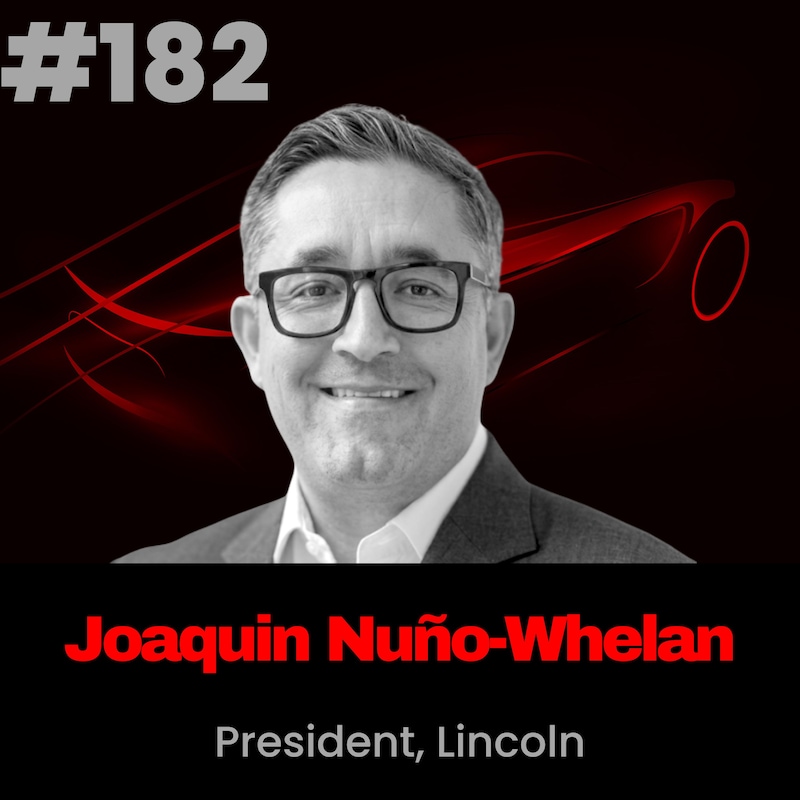
In this episode, Jan Griffiths sits down with Joaquin Nuño-Whelan, President of Lincoln, live from Newlab at Michigan Central. This is not a conversation about cars. This is about leadership, culture, and what it really takes to transform a legacy brand from the inside out.
Joaquin shares how he’s doing exactly that. Building a team-first culture rooted in trust. Reframing Lincoln’s identity around “quiet luxury” and Gravitas. And leading in a way that rejects the old command-and-control model in favor of authenticity, clarity, and ownership.
But this conversation goes beyond the brand. Joaquin opens up about something deeper, his commitment to developing people. From empowering his teams inside Lincoln to investing his time in education and nonprofit work, he is actively shaping the next generation of talent entering the industry.
That belief becomes real when you hear from Diego Vargas, a student at Detroit Cristo Rey. His voice brings a grounded, honest perspective on opportunity, growth, and what young people need from today’s leaders. It’s a powerful reminder that the future of this industry will be defined by the leaders we develop now.
This episode hits at the core of AutoCulture 2.0: leadership, trust, and the courage to do things differently.
Themes Discussed in this Episode
- Why momentum is the most underrated leadership force inside legacy organizations
- The connection between leadership DNA and brand identity
- What “quiet luxury” really means and why it matters now
- How to lead authentically inside a command-and-control culture
- The power of trusting teams to unlock ownership and performance
- Why legacy OEMs must think like startups to stay relevant
- The role of education and early talent in shaping the future workforce
- Bridging industry leadership with student opportunity through programs like FIRST
🎥 Watch the full episode on YouTube:
https://www.youtube.com/@jangriffithsautomotiveleaders
This episode is sponsored by Lockton, click here to learn more
Featured Guest: Joaquin Nuño-Whelan, President, Lincoln
Joaquin is the president of Lincoln, effective May 1, 2025, where he leads the brand’s global operations and drives its continued evolution as a world-class luxury brand, advancing its global product portfolio and delivering differentiated, connected customer experiences worldwide; he reports to Lisa Materazzo, Ford’s CMO, with dual reporting to Andrew Frick, president of Ford Blue and Model e and interim head of Ford Pro, and brings more than 25 years of global experience in vehicle and technology development with a strong focus on luxury and premium vehicles, having joined Ford in 2024 as Vehicle Program Director for full-size utilities after serving as senior vehicle line director for new programs at Rivian and holding multiple leadership roles over a 20-plus-year career at General Motors, and he holds a bachelor’s degree in mechanical engineering from the University of Detroit Mercy and a Master of Science degree from Rensselaer Polytechnic Institute.
Featured Guest: Diego Vargas, Student, Detroit Cristo Rey
Diego represents the next generation of automotive talent. As a student at Detroit Cristo Rey, he brings a fresh, grounded perspective on opportunity, education, and what young people need from today’s leaders and organizations.
About Your Host – Jan Griffiths
Jan Griffiths is the champion for culture change and the host of the Automotive Leaders Podcast. A former automotive executive with a rebellious spirit, Jan is known for challenging outdated norms and inspiring leaders to ditch command and control. She brings honesty, energy, and courage to every conversation, proving that authentic, human-centered leadership is the future of the automotive industry.
Episode Highlights
[02:30] Who are you as a leader?: Joaquin defines his leadership through one word: momentum, built by trusting people, removing friction, and creating ownership so teams can move with purpose and pride.
[03:55] Leading inside a legacy OEM: Jan challenges the reality of driving change inside a legacy system, and Joaquin explains how aligning leadership, culture, and timing created the conditions for transformation at Ford and Lincoln.
[06:45] The inflection point: Why Lincoln, why now: Joaquin shares how Lincoln sits at a rare moment of strength, where industry shifts, brand heritage, and leadership freedom collide to create a bold opportunity.
[08:05] Thinking like a 100-year-old startup: Lincoln’s mission becomes clear: operate with startup energy inside a legacy structure, moving fast while honoring a century of brand equity.
[09:45] Rediscovering Lincoln’s DNA: A visit to the Lincoln Motor Heritage Museum sparks a deeper understanding of the brand’s roots, reshaping how the team thinks about its future.
[11:20] What “quiet luxury” really means: Joaquin reframes quiet luxury as gravitas, a confident, grounded presence that doesn’t need to shout but commands attention through authenticity.
[13:00] Evolving the brand with emotion and edge: Lincoln isn’t staying still; the strategy is to layer emotional connection and subtle fierceness onto its foundation of elegance and restraint.
[15:10] Leadership DNA meets brand DNA: Joaquin connects his personal leadership style to the Lincoln brand, grounded, intentional, and built on listening before acting.
[17:00] Rejecting the loud, disruptive leader stereotype: Instead of flipping tables, Joaquin leads by learning first, then acting decisively, reinforcing a culture of respect and trust.
[19:00] The shift to authentic leadership: A candid discussion on moving away from command-and-control toward leading from the heart, where vulnerability and clarity drive better outcomes.
[21:30] Letting go of the leadership “mold”: Joaquin reflects on the moment he stopped trying to fit expectations and started leading with conviction, unlocking freedom and mental clarity.
[24:00] Confidence, vulnerability, and risk: Authentic leadership requires all three, and Joaquin shares how embracing them creates stronger teams and better decisions.
[27:00] Advice for the next generation: From students to future leaders, the message is clear: believe in something, go after it, and don’t wait for permission to lead.
[30:30] Final reflections on leadership and legacy: As the conversation closes, the focus returns to impact, building teams, shaping culture, and creating something that lasts beyond the individual.
Top Quotes
[02:35] Joaquin Nuño-Whelan: “ What I try to do as a leader is create positive momentum and you'll see it in the way I work with the team, in the way I report things out, in the way I drive the culture of the team.”
[10:48] Joaquin Nuño-Whelan: “When a Lincoln pulls up, it should have this sense of Gravitas So, what that means for us as a brand is we're doubling down on all of that goodness from the past, but we're going to add some more emotion, more emotional connection, more a little bit of underlying fierceness that is 'when you need it, it's there' kind of thing.”
[14:30] Joaquin Nuño-Whelan: “Believe in something and go after it. When I stopped worrying about what everyone thought so much, and I think everyone kind of goes through that journey as they're getting older. And then, it is a risk because you have to be vulnerable, you have to speak from the heart, but it's actually the most liberating feeling.”
About Detroit Cristo Rey
Detroit Cristo Rey is a coed Catholic high school for those of all faiths. Our students receive a high-quality, college preparatory education and professional work experience – all at an affordable cost. Grounded in faith, morals and service, our curriculum provides students with the building blocks to make a difference in their families, the community and the world.
If this episode resonated, share it with a fellow automotive leader and subscribe to The Automotive Leaders Podcast, where we’re shaping the future of authentic leadership in the automotive industry.
This podcast episode is also available on YouTube. Check out our YouTube channel at Jangriffithsautomotiveleaders
Send us your feedback or questions — email Jan at [email protected].
Transcripts
[Transcript]
[:Stay true to yourself, be you and lead with gravitas, the hallmark of authentic leadership. Let's dive in.
This episode is brought to you by Lockton. Rising benefit costs aren't inevitable for you or your employees when you break through the status quo. Independence matters, it means Lockton can bring you creative, tailored solutions that truly serve your business and your people. At Lockton, clients, associates, and communities come first, not margins and not mediocrity. Meet the moment with Lockton.
Branding is so important these days. We talk about product brands all day long, but sometimes what we neglect to understand is the brand of the leader that's running that organization. How much of that leader's brand DNA needs to line up with the brand of the product? I think a lot. I think it goes right to the heart of culture, and that's why today I am thrilled to bring onto the show Joaquin Nuño-Whelan. He is the president of Lincoln, and that is an iconic brand that's going through massive transformation. And today we are here at Newlab in Detroit, part of Michigan Central to talk directly to Joaquin. Joaquin, welcome to the show.
[:[00:02:24] Jan Griffiths: Great to have you.
[:[00:02:26] Jan Griffiths: So, let's go straight in and ask you the question, who are you as a leader?
[:And then, I think a lot of times that like, people's pride swells up a little bit. They get moving, they get this sense of ownership, this sense of loving what they do and then bringing that together in a really strong team. Like I'm all about the team all the time.
And so, with that moving, then it's like, okay, now we've got the inertia. We're over the inertia, we're moving in a positive direction. And almost one year into the job here, I think we're really starting to feel it. And that's where how I try to lead, that's what I am most inspired by from leaders that I work with, so that's probably who I am as a leader.
[:[00:03:56] Joaquin Nuño-Whelan: Mm-hmm.
[:[00:04:10] Joaquin Nuño-Whelan: Yeah. I mean, I'll take it back to three years ago, sitting in this building, we had a strategy retreat for one of the nonprofits I'm on the board of, and it was like, what do we do coming out of COVID? How do we get things back? What's going on in Detroit? What's going on in the industry? And we sat back and we're like, we just gotta get back to what we were doing before COVID, when we had this amazing system set up of how the nonprofit was operating. And I personally was being pulled in a lot of directions like at the time I was working for Rivian, and it was very clear that if that was gonna continue, we needed to move to California.
I love Detroit. I love everything about what's going on in Detroit. I love everything about what's going on right now in this space. And I sat back, and in that moment, I decided like, no, we're staying in Michigan. And two days later, literally two days later, recruiters from Ford reached out and said, would you be interested in talking about some leadership opportunities at Ford? And I was like, wow, that was perfect timing. My teenage daughter said I manifested it, right? Like it was exactly what we needed to hear.
And so, I started having conversations with people at Ford, and I was blown away by the timing, the structure, the people around the opportunity where it was like I was looking for positive leadership. I was looking for a place where I could come in and bring the experience I had in both OEM and startups, and that's probably why they reached out to me. And then, I was looking for positive leadership and I met some amazing people. And so, the starting point was this like perfect storm of aligning of these things that is like transformation, positive leadership, the ability to come in and be bold in making things happen in a new way at an OEM that has this amazing history, this amazing legacy, this amazing family behind it. And so, it was like, I was blown unbelievable that it was all happening in that way.
And then, the Lincoln thing happened. So, I didn't come in initially to run Lincoln. Lincoln happened eight months into the Ford job. And so, with Lincoln it's like that times a million. Like it's this amazing inflection point with the brand where we're actually coming from a position of strength just in the way decisions have played out over the last few years.
We've had the way the industry's gone with big swing to EV, big swing away from EV. Where luxury is going, what is luxury? What is the future of luxury? What's happening globally? What's happening with the industry in China? What's happening with where you grow as an automotive brand? And then, a brand with unbelievable heritage. And we can talk more about that, but that's one of the things that I've just been enamored with.
And so, the opportunity to come in now and my remit is, go bold in making something new happen. And what we get to do is essentially act like a hundred year old startup inside of an OEM, but we've been given the task to go do it. And that's like, I mean, I wake up every day excited as heck to go do that, so it's perfect.
[:[00:07:45] Joaquin Nuño-Whelan: Mm-hmm. So, one of the first things I did is, I said, let's get all the team together and go to the Henry Ford and look at the history and get the archives out and look at that. And somebody raised their hand on my team and said, you know, we have a Lincoln Museum. And I was like, okay, great. It must be in Dearborn. And we put together a field trip for the whole team and it's two hours away in North of Kalamazoo at the Gilmore Auto Museum.
[:[00:08:12] Joaquin Nuño-Whelan: And there's a beautiful Lincoln Museum that talks about all the heritage of. And has cars from almost every year. Our team was so blown away by that. The entire design team went and stayed longer. I joined the board of that Lincoln Motor Heritage Museum, and have since been at a couple of the events and we may be hosting an event in the summer. Stay tuned here, but there is so much history that goes with what Lincoln stands for.
And I have: A. been inspired by it, B. I didn't realize all of it, and C. it's really driving the work we're doing. And so, when you say quiet luxury, you go back to the founding, so like when Henry Ford bought Lincoln, and Henry Ford was one of the people who started Cadillac and then that went and did its own thing, and then Ford bought Lincoln and his son Edsel was given the task of running it. And Edsel was way different from the starting generation of the auto industry, right? So he was about elegance and style and luxury but he did that in a way that was what we would call in today's vernacular, quiet luxury, which is also very important and very popular.
So, we've actually done a lot of research there. We've actually had brand workshops at Edsel and Eleanor Ford's house to really get into the essence of what this is all about. So we bring our creative teams in, we bring the whole team in. We have workshops there, we do tours, we had receptions there.
So, that's been an amazing part of this journey is I get to come in and question everything, but then understanding the history and then deciding that is something we're gonna really lean into. And so, quiet luxury, or the way I describe it is showing up in an authentic way where you don't have to like boast, but you have a sense of, and I think this word is gonna come up a lot today, a sense of gravitas when you enter, right? So..
[:[00:10:09] Joaquin Nuño-Whelan: When a Lincoln pulls up, it should have this sense of Gravitas that's like, wow, that's something, but it doesn't have to like scream it or yell it or like be over the top. And a lot of times, that's actually the person who is more, a lot of times more successful, but more grounded, doing things beyond just the like, look at me, you know, I drive a lot of blink.
So, what that means for us as a brand is we're doubling down on all of that goodness from the past, but we're gonna add some more emotion, more emotional connection, more a little bit of underlying fierceness that is like 'when you need it, it's there' kind of thing. And I think that's the direction that we're taking it, and that's the exciting part about it. And a lot of the reason I'm in this job is because I'm a product guy, so you'll start to see that come out in the future products as well.
[:Now, how does your leadership style align with that brand? From what you've just said, I think I could probably answer that, but I wanna hear it out of your mouth. How does your leadership DNA really feed this brand?
[:[00:12:33] Jan Griffiths: When did you really understand what authentic leadership was? And the reason I ask you that question is because, I could articulate it, but the term authentic leadership didn't exist when I was growing my career and progressing my career in the auto industry, and it was very much a command and control model. And if you weren't at the head of the table, it's your meeting, banging the table, you need results. It's all about numbers. Nothing else mattered. And if you didn't perform, you were out.
So, this idea of authentic leadership, all of that command and control never felt right to me. So, I was starting to think about giving myself permission to lead in a more authentic way and lead from the heart and recognize that there would be judgment, people would judge me, but to really hold true to those values and lead in line with those values, it took me a long time to figure that out.
When did that happen for you? Because what's really fascinating about you is you started in legacy automotive, you started with General Motors, you have experience with May mobility, you have experience with Rivian, and now you're coming back to Ford. So, you've really got such a well-rounded background for this, but I wanna know, how did you give yourself permission to lead authentically?
[:[00:14:06] Jan Griffiths: Yes.
[:And it's advice I give to students. It's advice I give to my kids. It's like believe in something and go after it, you know? Like I think when I stopped worrying about what everyone thought so much, and I think everyone kind of goes through that journey as they're getting older. And then, it is a risk because you have to be vulnerable, you have to speak from the heart, but it's actually like, it is the most liberating feeling because I have way more mental clarity when I'm just like letting this flow, right? Versus thinking, what if I say this wrong? What if I say this wrong? What if? I don't think about that.
And I think it goes all the way back to like the greatest gift my mother gave me was the feeling that I could do anything I want, like confidence, right? And so, it takes a level of confidence, it takes a level of vulnerability, it takes a level of not caring, right? And just going after what you believe in.
And some of those moves, like when I left GM, people thought I was nuts because I had one of the best jobs in the auto industry. I was running full-size SUVs for probably the biggest money maker in the history of the auto industry.
[:[00:15:37] Joaquin Nuño-Whelan: And when they offered buyouts, I raised my hand and everyone was like, what is going on? I wanted to see the startup world. I wanted to understand like what is different out there after having been at GM 20 years, starting when I was 19. So, it does take a level of like, you gotta be willing to make some, take some risks and jump out there, but I've learned so much. And I think, the other part of it is the global assignments, I've been able to do lot.
[:[00:16:04] Joaquin Nuño-Whelan: It totally changes your perspective and understanding and you get to see things that you don't understand when you just go on vacation, like, I remember in being in Korea and we were at these 7:00 AM launch meetings in the plant, and there'd be an American guy, bluster, just being a complete jerk.
[:[00:16:25] Joaquin Nuño-Whelan: And then, he'd turn around to us and be like, I gotta get some R & R, I can't stand this place, like he was doing it all wrong. And then, I just listened and listened and went and talked to people. And then, when I did speak and then I delivered on what I said I was gonna do, it changed the game. It changed who I was as a leader, like it was those kinds of experiences are really important.
[:[00:16:54] Joaquin Nuño-Whelan: Yeah.
[:[00:16:59] Joaquin Nuño-Whelan: Yeah.
[:This episode is sponsored by UHY.
see what's really changed in:Download your copy. There's a link in the show notes.
[:And it's not just like saying those things and then like trying to do that in your next meeting, but the way you talk about conceptual diversity, I think that is so important because there are norms and rigidness and things that are baked into some of these systems because they are large systems, large companies, large programs, those kinds of things. And peeking around that or pulling information that is different, that is where you find some of the best ideas. So, if I had to think of two, I think it's Respect and Listening, but the idea of getting cultural or conceptual diversity out onto the table, and then what you do with that.
But the summation of all of that into Gravitas and Leading with Gravitas, that's aligned with me. It's aligned with what we're doing with the Lincoln brand. It's aligned with what I think Lincoln has been about for a hundred years. So yeah, I'm really excited about this conversation.
[:[00:19:03] Joaquin Nuño-Whelan: Yeah.
[:[00:19:14] Joaquin Nuño-Whelan: Yeah.
[:[00:19:21] Joaquin Nuño-Whelan: Yeah.
[:[00:19:30] Joaquin Nuño-Whelan: Yeah.
[:[00:19:32] Joaquin Nuño-Whelan: Yeah.
[:[00:20:18] Joaquin Nuño-Whelan: Yeah, so we have an amazing team to begin with. I love our team. We have a team of really strong professionals that really get their space. And that has been a really great part of joining the team here. And one of the ways I describe it coming from the startup world back to an OEM or to a company like Ford is. It's like being back in the big leagues, there's a level of professionalism, there's a level of like, we can spread out and play our positions and everyone knows what to do and we can make things happen.
A lot of times that comes with its own inertia. So if you just get that moving, it can be 10x more powerful than a startup, right? And so, that's the overlying thing. For me though, community is very important. And so, this idea, and I've lived it very closely of like the automotive world is shifting. So, first, it's like Detroit, and then you gotta go to the west coast, and everyone tries to do things on the West Coast. And there are things there that needed to happen or have happened.
But Detroit is still Detroit, like to make cars happen, you gotta be here. And then, it's like Detroit versus the world, and then everything that's happening in China. And I've seen it very firsthand over the last few years. I saw Asia being in South Korea, which is the Koreans are an amazing force in on their own, and then everything that's happening with China. And to that, I kind of say like, let's go learn from it, but also bring it, like Detroit is still Detroit. We still got what it takes to make it happen.
And so, as I thought about everything, questioned everything, where do we wanna be? And having experienced it very deeply, I'm all in back on Detroit and the community. And so, moving the Lincoln team to the train station, to Michigan Central, and being here, being next to this at Newlab, being next to the startup ecosystems that are happening, being next to mobility ecosystems was very intentional, because I want this whole community to come up together and like this Detroitness of it all to happen again, right?
And so, for me, that goes then to if you have a championship football club in Europe or if you have a championship high school baseball team, those organizations are investing in little League T-ball and five-year-old soccer programs, right?
[:[00:22:39] Joaquin Nuño-Whelan: And so, we need to do the same.
[:[00:22:41] Joaquin Nuño-Whelan: And so, by the time those students are graduating from high school, it's already known where they're gonna play or where they're gonna work or what they're gonna do, right? A little bit is like going back to German apprenticeship model or the way Detroit was like.
[:[00:22:56] Joaquin Nuño-Whelan: My family all went to Cass Tech. My mom and all of her siblings went to Cass Tech. They did high school internships. So, for me, we invest in that. My family invest in that. My wife is a teacher at Holy Redeemer Grade school in Detroit. She teaches coding to first graders through fifth graders and starts them on this path. They have pathways from elementary school into STEM and engineering, and they have pathways into the medical profession. And so, that's the starting point.
So then, we invest from there into the high school. So, one of the biggest things I'm interested in is these pathways, these pipelines of students that are doing internships, getting mentoring, getting the exposure to all of these different careers so that when they get into college and then through college, they're actually ahead of the curve ready to go into the workforce here. And the best part of that is the connection to employers and employees at those companies that become mentors that help the students get to where they need to be.
[:[00:24:15] Joaquin Nuño-Whelan: Yeah. So, I was introduced to Detroit Cristo Rey in 2014, so 12 years ago. We started a robotics team there. And I had an, on an assignment in Mexico, I started a high school robotics team in Mexico City, and it was the first one in the country. And that has since grown into one of the biggest networks of robotics teams throughout the country. It's amazing story.
Somebody knew about that when I got back from an assignment, an international assignment, and introduced me to a couple people in Detroit. So, we started a team at Detroit Cristo Rey and they've gone on to be one of the best robotics teams in the state and they mentor a bunch of other teams, so it's this amazing role model system.
I was also blown away by the model. So think about education in Detroit 15 years ago, a school that had a hundred percent college acceptance and continues to every single year. And the students from the time they're in 9th grade through 12th grade, they work one day a week. So they go to school four days a week and they work one day a week. That is a game changing model in education. And so, I was like, I gotta know more about this. I wanna understand. Joined the board and eventually became the Board Chair.
And we now have students from that pipeline working as engineers at GM, at Ford, at a bunch of tier ones. And that, to me, that model is a beautiful example of how to change the game and do something really meaningful. So, that's why I'm involved.
[:[00:26:01] Joaquin Nuño-Whelan: Love it.
[:[00:26:06] Diego Vargas: Yeah.
[:[00:26:09] Diego Vargas: Yes, I am. Thank you for having me.
[:[00:26:14] Diego Vargas: Well, like he mentioned, Holy Redeemer, I started in Holy Redeemer. I went to middle school through the first year coming out of COVID. So, we still had to wear masks. It was kind of tough for me as a transferring student. I came from a full Spanish-speaking family, so it was kind of a language barrier. And then we had masks, so then I can only speak through my facial expressions, and I kind of didn't, it was just a challenge for me. And my elementary school was also fully Spanish, so then I was probably a very strong Spanish-speaking student coming into an all-English school, so it was kind of a challenge.
But then I was introduced to Detroit Cristo Rey in my eighth grade year. I had a brother that was going to Cristo Rey at the time when I was in eighth grade. I shadowed and I just knew a lot of people. Many of my friends that were older that kind of helped me connect and introduce myself into that community. And then, I knew about the Corporate Work Study Program going to work once a week, and I thought it was, it wasn't for me because I just had come out of a language barrier, and I was just nervous.
[:[00:27:32] Diego Vargas: Yeah. I didn't wanna step out of my bubble. And I just thought that being a kid, a freshman, going over and speaking to important people at big companies wasn't gonna be for me, but my parents had a strong influence and going to Cristo Rey and also my sibling, and I just gave it a try. And I didn't have a job in the beginning of the year, I still had to take my classes kind of get introduced in the working experience, how to speak, my hand gestures, just being myself. And I got a job at Adient, at an IT kind of area, and there wasn't a lot of people or coworkers there, but it was still like a work experience for me. I just saw it as like a planted seed that was able to be being grown into myself.
[:[00:28:23] Diego Vargas: And for me, what made it just good at Cristo Rey was being part of like the soccer team, the coaches, the staff there, they're amazing, they're welcoming, and very and all that. I think that's just like a community surrounding that kind of creates a home, a welcoming environment for you. And I think Cristo Rey, Cristo Rey's work experience, it's just something that is an amazing experience, gets you set for a college, gives you amazing work experience of what you wanna do in the future. As myself, I never thought about college as being a pathway, I just wanted to play soccer. I wanted to play my sport, but now, as a sophomore, I have a little bit of an idea of where I want to go.
[:[00:29:37] Joaquin Nuño-Whelan: Oh yeah, I've seen this repeated over and over with every class that comes in as a 9th grader, and then the transformation through senior year. Quite frankly, when you walked in, we all thought you were a senior, right? Like you already have this way of carrying yourself, and you mentioned you didn't know how to do that at the beginning. So, the best way to do it is just to throw yourself into that environment, into those things that are hard, into those things that challenge you. And I think you get it from a sports perspective, but now you're also getting it from a professional perspective. And so, then when things come up like, what normal pathways, when it's like hard in college, you'll already be like, ah, I already know how to do that. And so, your level of confidence is already like on a much faster trajectory than other people. So, that's the beauty of the moment.
[:[00:30:31] Diego Vargas: Thank you.
[:[00:30:41] Diego Vargas: My second year.
[:[00:30:56] Diego Vargas: I thought that it was gonna be a little bit more kind of strict.
[:[00:31:01] Diego Vargas: It's a little bit more free or just being, they let you be yourself, in a way. For me, what helped me a lot was having lunch with kind of like the big, the bosses, the important people. They're just like one of us in just an important role. And they just told me how, be yourself, speak, what you know, what you wanna say. Just let the words just come out of your mouth, whatever you wanna say. And be yourself during the work, that we are reaching out meeting new people, there I saw his personality and this other person's personality, and I just understood how everybody's their self, themselves, and that just helps each other, each person drive themselves forward. And for me, I'm a person who like, loves to speak, mostly, in Spanish. I'm just an outgoing person. It mostly comes from my dad. My dad just taught me to be formal, have a sense of being professional, having respect for others, and speaking with bold, confident. Speaking with chest in a way, being bold, and that's what helped me the most going into a work environment, but just being free, being myself, having that freedom is kind of what was like a page turn for me, kind of easier.
[:[00:32:46] Diego Vargas: I kind of like his response where he said, like listening and respect.
[:[00:32:50] Diego Vargas: Like he said speaks leadership. And respect is also a word that I like to stick to because of my parents, they've taught me respect them, respect the elder, respect whoever's older than me. Also in school, respecting the upperclassmen because they kind of won or just deserve their spot that they're in. It's also kind of like everyday, everyday challenge to be able to get prepared to be where they are right now. Some of the students that are seniors, juniors, they're prepared for going out there to the college area. And I just see myself as hopefully being ready every day as a sense of respect and a challenge, to be prepared to be where they're at. Hopefully, I'm also an example for a freshman. Maybe some of them look up to me as I look up to some of the seniors, but just listening and respect kind of going off of what is responsible is.
[:[00:33:54] Diego Vargas: Speaking from a Hispanic background family, we like to listen to others' perspective than what they have to say. A person that's flexible and that understands the situation and reacts depending on what the team needs. Myself, as a captain of my soccer, the soccer team, I like to be kind of a funny jokester person, but I also see the situation.
If nobody laughs at my joke or they just think that I'm being a little bit annoying, then I just react to that kind of begin to tone down and just get to the point of the situation that I have to be in, like a slave for your team is also important.
I think that most of the time when a boss or like a captain or a leader is being himself is also kind of shows character to the team, and then the team can build off of what the boss gives or what the team or the captain gives. And I think that's really important to being a good boss or a good captain.
[:Then, recently, with the basketball, now this is where I'm really in foreign territory here, but I read something the other day and they talked about the coach for U of M, who's very much that more supportive, positive leadership style. And the other team, which I don't even know who was the other, what was the other team? I don't even know on the basketball
[:[00:35:29] Jan Griffiths: UConn, thank you. Very much more the command and control, typical blustered, shouting, yelling, kind of leadership, and look who won.
[:[00:35:38] Jan Griffiths: Right.
[:[00:36:10] Jan Griffiths: And mean it. And mean it.
[:[00:36:17] Jan Griffiths: Yeah, that is leadership, and that is a great culture that we all wanna be part of. Well, today we have heard from a truly authentic leader with Joaquin. Thank you.
[:[00:36:29] Jan Griffiths: And a truly who possesses the quality of Gravitas, not only in himself as a leader, but apparently for the product. I see gravitas in the Lincoln brand coming out also, and we've also seen authentic leadership coming from a student. So, thank you both for sharing your thoughts with me today.
[:[00:36:56] Jan Griffiths: Thank you for listening to the Automotive Leaders Podcast. Click the listen link in the show notes to subscribe for free on your platform of choice, and don't forget to download the 21 Traits of Authentic Leadership PDF by clicking on the link below and remember. Stay true to yourself, be you, and lead with gravitas, the hallmark of authentic leadership.



