Shownotes
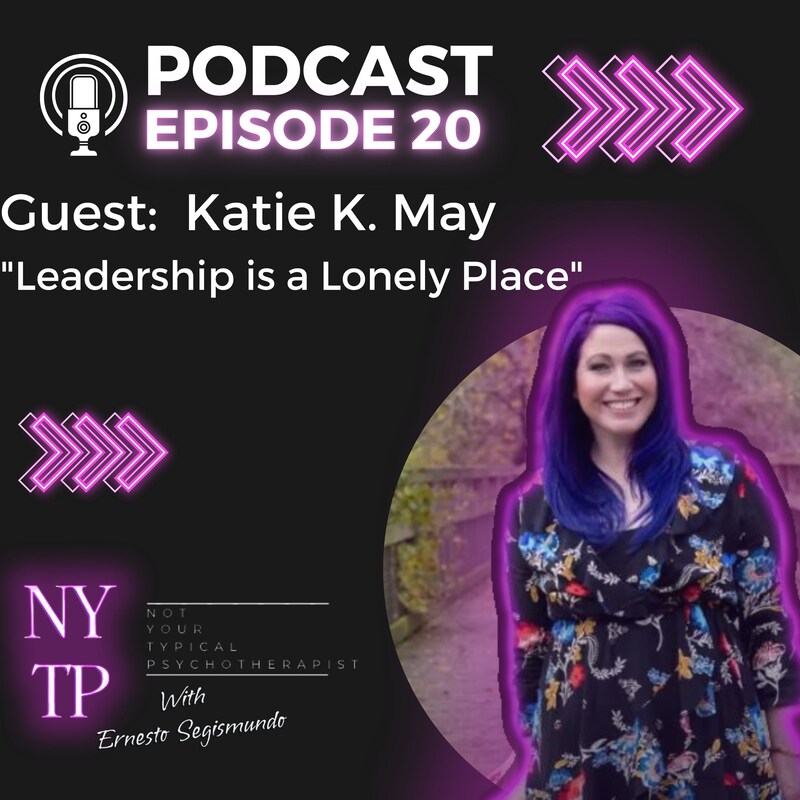
20 Episode 20 Katie K. May "Leadership is a Lonely Place"
In this week's episode of the "Not Your Typical Psychotherapist" podcast, Ernesto is joined by the esteemed guest Katie K May, LPC, DBT-LBC, as they delve into the fascinating realm of group practice and the importance of finding the right support for effective leadership. "Leadership is a Lonely Place," is a thought-provoking conversation that explores the challenges faced by leaders in the field of psychotherapy and the often isolating nature of their roles. Ernesto and Katie delve into the intricacies of building a successful group practice, discussing strategies for creating appropriate boundaries for a supportive, nurturing environment for leadership, therapists and clients. Listeners can expect to gain valuable insights and practical advice on how to navigate the complexities of leadership while fostering a sense of connection and community within the practice. Come listen to see what makes Katie Not Your Typical Psychotherapist.
Katie's Private Practice Website
Productive Group Practice Summit Website
If you want to see video of this episode please like, subscribe and join us here:
YouTube NYTP Podcast: https://www.youtube.com/@nytppodcast
Transcripts
Ernesto: Before we move on, Katie, why don't you turn your microphone the other way?
So so Katie actually dropped her microphone. Is it better now? There it is. Okay. Boom. Wow.This sounds better. Brilliant.
(music intro)
Ernesto: Yes. Hello. Hi.My goodness, Katie. I mean, we've we've gone a long ways.
Katie: We have. You know what? I was redoing parts of my website and I found a video from us. We were both, like, just coming up in the coaching field. It was called show up and shine.I don't know what the hell we were talking about, but we were, like, Yay. Show up. Do your thing. And we're still kinda doing that right, really.
Ernesto: So, you know, Katie, I wanted you on and we're gonna talk about, you know, You we actually I you actually don't know what we're gonna be talking about, but in the area right? It's the area of good practice.
Katie: Okay.
Ernesto: Let's let's talk about the triumph and the challenges and the success and all that kind of stuff.
Katie: So my name is Katie K. May. I am a DPT therapist and group practice owner. I have three locations, twenty employees in the Greater Philadelphia area. And so do you... It's all good.And I also have a consulting business that is now called the visionary therapist where I help therapists, market fill, and run groups, but also optimize their group practices so they can stabilize and scale and continue to enjoy the fruits of their labor without all of the stress and the other things that come with managing a bunch of people.
Ernesto: Wow. That's amazing. So for those of you who are listening who have a group practice or starting off, I'm gonna have a lot of information about Katie's services because, you know, this is the age of group practices. Right? I mean, it it helped us become successful.It helped us to leverage things. And for those of you who love to travel, group practice is the way to go. Right?
Katie: Totally. I mean, I always say it's the most it's the best passive income decision that I've ever made. I think that there's a lot of, like, talk out there about how coaching and courses can be quote unquote, pass of income, but there's so much of that that is still like the face of me and the work of me, whereas I can go away to one or all of your summits or Ernesto. And my I'm still generating income because all of my employees are still working and still making an impact on helping people.
Ernesto: That's a good point. Our friend, Uriah Gilford,
Katie: He's alright.
Ernesto: Yeah. He's alright. Yeah. We don't we're dropping names here. Yeah.So one of the things that he brought to my attention was like, Ernesto, you just upped and left California where your group practice is in California, and now you're living in Vegas. You're buying properties in Vegas? And do you know that your group practice is still running? You know, even though that you're not there, so you make a really good point and it's really validating to know that oh my goodness. With a group practice, when you run it systematically, when you when when you have all the systems in place and the right people in place, you can actually step away.I didn't even notice that I just abruptly left and stepped away. But of of course, that comes with a lot of consequences as well.
Katie: Of course.
Ernesto: But at the same time, he made me realize that, yes, if and when I pay attention to my group practice and create the systems, I can't walk away. Right?
Katie: Definitely. Sorry. I'm dropping things every day. Yeah. Yeah.Yeah.
Ernesto: Her microphone fell, everyone.
Katie: So I think everything you set a spot on, like, yes, you can step away and you need the right systems in place and the right people managing those systems and the right mindset to give yourself permission to walk away because some people I see a lot of group practice when they're still struggling with that. Like, what am I gonna tell them if I'm not in the building?
Ernesto: And so
Katie: I think there's a lot of components that you need to build and, like, stabilize before you can actually walk away and the whole thing doesn't burn to the ground?
Ernesto: Yes. When you do it right, you can actually step away and sometimes we create this co dependency with our with our group practice. Right? That somehow and I struggled with this as well too. Where we make our group practice so dependent on us that we can't walk away from it.Right?
Katie: Well, I'm glad you use that word co-dependent because I really think that, like, nails what happens, especially when you're growing your practice. And here's the experience that I had where, like, we started, like, small and scrappy and the people that I hired, we were doing interviews, sitting on the floor, and building furniture together. And it really felt like they were a part of something that was growing. And they knew me at a time when I wasn't, like, a boss bitch, empowered, like, group practice owner. I was still learning as I was going, so they were growing with me.And then when I got to the point where I was ready to step away, those were the people that were the hardest to step away from because they were used to having me around and in the mix for everything. And the relationship was different. Like, new people coming in, new me as Katie, the the clinical director, but old people knew me as, like, Katie, the person who was there every day and we were all seeing clients and, like, finding mice in the building and, you know, fixing toilets together. And so it just felt codependent. Like, they needed me there.And so it was a lie. I was telling myself, but it very much stemmed from the the relationship that we built as we built together.
Ernesto: Yeah. And it's so interesting that you mentioned that piece because that's the hardest piece to walk away from or at least try to have some boundaries with because our attachment styles really reflect on our group practice.
Katie: Totally. I think that your business is only as healthy as you are.
Ernesto: Oh. Uh-oh.
Katie: So if you're noticing and here's a perfect example in Ernesto, you and I've talked about this recently, but if you're noticing yourself getting agitated about employees being entitled. Right? Like, there's a part of that that is I don't want them to be entitled because what it brings up in me is that I have to step up and set boundaries, and I don't wanna do that.
Ernesto: Exactly. Exactly. That is so freaking true. You know, and and let's go into that conversation. And then many mental health professionals don't know that their businesses are moving towards what they're trying to create in their own personal life.Right? Yeah. Sometimes we have we we don't have those boundaries to explain a little bit more of how this may look in your group practice.
Katie: So it's how do I explain it? When I'm explaining it in therapy, we call it the transactional model, which is very much the same as like system therapy like what you do influences me, what I do influences you. And so if you're noticing behaviors in your employees such as them acting a title, trying to take advantage of you, pushing limits, not meeting expectations, and you are getting mad, frustrated, upset, burnout, disappointed, what I would say is start looking at those employees as a mirror for like, what am I doing or not doing that's enabling, reinforcing this behavior? And how do I step up, step in and act differently so that this changes? So that step one is like, who am I?And why is this happening in my business instead of shifting blame to the people. The children in the family that are thing like children do and I don't say that in a diminishing way, but like they're employees for a reason because they want boundaries and structure and a place to go to work and know what they need to do and then clock out and go home. So, you know, when I hear group practice owners or business owners say things like, we're all adults. We should be able to x y z. That's your own cognitive distortion.Right? Because, like, yes, they should be able to do this, but they need you to hold that limit and maintain consistency for them. That's why they work for you.
Ernesto: That's right. Because, you know, as a leader, as a group practice owner, we set the tone. Right? We set the tone. And so, unconsciously, we let people treat us the way that we have set the tone for ourselves as well.Right?
Katie: Exactly. Health of the leader, health of the team, like it's all on you for better or worse. So the way that you communicate, the way that you show up, I have an example way back when I started my practice, and you know I run a lot of groups. And so our groups are open and ongoing enrollment and we have people come in and then they graduate out. And one of our group leaders at that time used to get really anxious with changes And so it got to the point, I'll call her Jane, so we're not outing her on a podcast.But it got to the point where our practice manager was, like, Jane's not gonna like it, another person is joining group. And I started to notice myself being like, what am I doing? Why do I have this energy of fear and anxiety about new clients coming into our practice? And so I talked to Tracy, who's like a shining star in my office manager. And I said, like, we're not gonna we're not gonna have that energy.We're not gonna have that conversation anymore. It is the point that we're getting new group clients and we're gonna have them keep coming in and we're not gonna fragileize this person who who has anxiety about it. So again, that, like, back and forth of what shows up in us when we notice some kind of feelings or behavior in the people that we support.
Ernesto: I like that, Katie. Where you trust your own instinct, call it out, see what's happening. You explore it from a different perspective. And then you inform your next behavior towards that because sometimes we don't talk about it. You know, it's like, wait a minute.I should not be feeling this way. Why am I feeling this way? And then we don't talk about it. Right? But what you're what I'm hearing from you is that you're informing whatever it is that you feel in your body within yourself to go, you know what, why is this happening?You know, that co dependent person in me is showing up. And let me figure out what's happening here because if I don't do that now, it's going to affect me negatively my business.
Katie: Exactly. And, like, it doesn't come naturally to me, so let's not pretend that that is easy. My natural instinct is to be very emotional about things that aren't working well. And then to go to the other end, I wanna be like, well, fuck everyone. Here's a new rule in policy and here's a limit and here's how it's gonna be done.But I know that's not effective and that's not aligned with my values, that's just my emotions showing up. When I get scared, then I wanna go to the other end and, like, create rigid boundaries. So then I find myself in the middle before I actually present those to other people. And it's kind of the same as like somebody who and I think it is very aligned with like a past a person or a person who has difficulty setting boundaries, like, when they try to be assertive and then they overshoot it and they become aggressive and you're like, oh, you missed that mark. Like, that's that's the boomerang that happens for me before I can be effective and actually implement what I'm trying to do.Howard Bauchner:
Ernesto: Yeah, so as a leader, in a group practice setting, there's a fine balance of honoring what you're feeling. Right? But at the same time, noticing where each individual your employees your independent contractors, where they're at emotionally and psychologically. I have a a leadership of that I've been reading. And one of the things that is very interesting to that that this book notice, and I I'll have it in the show notes, is that you look at it from a hierarchy perspective.Where one employee is looking for recognition, maybe the other is looking for meaning, maybe the other is looking for their voice to be heard in the context of a business. So there are some who are just coming in for the paycheck, but there are some that's on the other spectrum that they want to be part of a bigger picture, a bigger higher goal. So as business owners, right, as group practice owners, we kinda have to be aware of where each individuals are at so that we as leaders can adjust. Howard Bauchner:
Katie: Yeah, I mean, knowing what motivates people and why they're there is super important. And I think not being hurt by somebody who is just there for a paycheck. Like, I think there's this irrational expectation that everyone needs to have the same level of investment in your business as you do, but, like, they don't and that's okay. And it can still be mutually beneficial and it can still be a great employee and just collect their paycheck, clock out, but do great work when they're there. So, yeah,
Ernesto: Yeah. I I I saw on, you know, Facebook can be Facebook groups can such a shit show. Right? And Totally. I I've seen some group practice owners complaining that their employees or independent contractors don't have the same level of vision, same level of drive and passion that they do.And I'm like, why should they?
Katie: Yeah. Why would they?
Ernesto: Why what in the world? This is your business. They're just coming in. What what is that?
Katie: Well, I think there's, like, it's a both and. As is everything, I think when I think about it, but, like, what I do in my practice is we hold quarterly state of the companies where I share here's what we've worked on, here's what we've accomplished, here's what's projected ahead in the next quarter, and here's our big one, three, five, ten year goal Maybe not all of them, but, like, we're looking into the future. Right? And when I'm doing that, I am getting their buy in for, like, yes, we want the same thing as you. Maybe not the same, like, percentage profit.I'm not talking to them about that, but, like, here's the impact that we wanna make. Here are the communities that we wanna serve. Here are the projects working on for the betterment of the practice and the greater good. And I want people on my team that align with that because I want people to my metaphor of, like, we're all in the same boat. I want people that are rowing to the destination with me and not like stalling the hour poking holes in the boat because those people gotta go.I have no time or energy for that drama. But, like, you want them on board, but they're never gonna have the same level of investment that you do because they literally don't have the same level of investment that you do so, why would they?
Ernesto: Yeah. Yeah. And again, that's looking internally. Right? What is it that we are wanting from all of our clinicians and having them be a family, you know, is is the worst thing you could say to a group practice that you are running.Right?
Katie: Well, And all of the research like books and TikToks because that's research. Right? Like TikToks?
Ernesto: It takes about two hours. Of course.
Katie: All of the research I've done says that calling your business a family is creating a toxic culture at work. And that makes sense considering, like, how fucked up all of our families are, first of all. That's right. That's right. Right.The expectations or demand that you're placing on somebody considering, like, oh, we're a family. Like, everyone, whatever. It's, yeah, it's not accurate to what a workplace environment should be.
Ernesto: Howard Bauchner: Yeah, absolutely. And so all of these things as far as the culture goes, understanding yourself. From your perspective, what are some of the things that is the most important that group practice owners need to look at? For the health and betterment of their group practice.
Katie: I think number one, certainty in themselves and what they want and to stop seeking approval or validation from the people that they pay.
Ernesto: Mhmm.
Katie: Because there's always going to be somebody that has a complete, is unhappy, wants something done another way, and you're not their friend. You can be friendly with them, but you also pay them and manage them. And so I find that especially as practices are growing, there's like this experience of loss that happens. We're not as close as we used to be. People are unhappy with me.And so I think in order to run and effective and healthy business, especially one that's growing. You need to be okay with people not being okay with you. And that requires a certain level of certainty in yourself and what you're moving towards.
Ernesto: That's amazing advice. That's a really good way to look at it because again, you know, our own insecurities will be reflected on if we don't work on it in the group practice, in your group practice. And it can create a lot of toxic environment. Right? And we wanna look at the leaders, but at the same time, we wanna look at the action and the responses that they have within the system of their business.Right? We talked a little bit about adjusting But when I say adjusting, it's you're responding. You're now reacting. Right? You you wanna have those boundaries just because you you have these different relationships with your clinicians, there's also some boundaries involved in that, yes?
Katie: I think so. It's making me think about when I was growing my leadership team. And now I have five solid people in different positions on my leadership team, but my first take at this was just people who had been at the company for a long time. And I was like, great. They're great therapists.They can be great leaders. Well, I was dead wrong about that because great therapists don't always make great leaders. But my point that relates to what you're saying is that I found myself in a lot of tension especially with one of these people where She wasn't in a position where she could show up as her best self and shine. She, in fact, didn't want to manage people, and we were getting very gridlocked. And I was showing up very emotionally and reactively, and then she was being defensive and reactive, and then all of our leadership meetings became about our our interpersonal issues with each other and it was messy.Ultimately, she stepped down from that position with my encouraging for her to go back to a position where she was in a good place. But, like, yeah, I forget what you were saying. Yes. Like, we need to be able to communicate well and from a place of health and not reactivity with with our team or it's just not gonna work and it's gonna fall apart.
Ernesto: Yeah. And I know that from personal experience too. I mean, I always tell people that I'm a somewhat recovering co dependent. And people pleaser and all of those things and it's not it wasn't until I realized that that was a toxic way to relate And the thing is I blanketed I blanketed that reaction, that response, that attitude to everyone in my group practice. Oh.Yeah. And then financially, it really bit me in the butt. Right? So now I've got like, with you, I've got solid team who are doing checks and balances. You know, I've got one who is hey, look, we're gonna collect this.We're gonna do a, b, and c, and this is it. I don't care if they hate me or whatever because for me, that's good for me. Right? Mhmm. And I can find myself overstepping her boundaries and go, well, maybe you you know, now I learned to step back and go, you know what, you do your thing because you're getting the revenue in.And for me, it's like, I can find myself defending the employees. Right? Even if she wants something done, she needs it to to be turned in. And I come in like that passive bother and go -- Sure.
Speaker 0: --
Ernesto: about, you know, I want you to kinda just say it this way so that they're not offended or they're not And I'm like, oh my gosh. That's my dad.
Katie: I love that you're catching yourself in that. One thing you said, I think really important. I'm gonna I'm gonna do some therapy on you. And that's
Ernesto: the case, please.
Katie: Because you said even if they hate me and I wanted to highlight that because it is a fear of a lot of business owners. And you know, my husband is also a business owner, and he's going through this process like two years behind me and having those same kinds of thoughts like everyone hates me. Everyone's upset with me because I'm making these changes and holding accountability. But the truth is, like, That's your job to hold them accountable and it's also the employee's job to question the authority. You know what I mean?It's the power dynamic and so that's another piece of like being comfortable in a position of leadership means being comfortable knowing your role in that power dynamic and that people under power are always gonna question or buck up against power, and that doesn't mean they hate you as a person.
Ernesto: Yeah. Yeah. Absolutely. No. You're absolutely right.These are some of the fears that I still that still comes up, you know, when I
Katie: Yeah.
Ernesto: But but now I learned to manage them and to, you know, one of the things before was when an employee would come to me and go I'm putting my notice to to go to another to do another business or work at a more stable job. Because at that time, we were collecting private pay. Right? We're and and in California, it was really tough to do that, but he had to go somewhere. But the story that I created in my mind was, oh my gosh, I gotta do better with my relationship with my employees and my business is not running the way the the culture is not running the way that I wanted to and how can I keep this person?You know, those are the stories that come up in my mind. And I thought to myself, stop.
Katie: It's hard not to take that personally. I do think that at this point I'm at a place where we have really good exit systems and even exit transparency of, like, everyone in my company knows what it looks like if they want to resign and what it looks like for their caseload and all of those other things. And systems, I think, the objectivity of that tape some of the emotionality out of it and makes it easier. And I think I've now prepared myself for, like, my statement is we rent our employees, we own own them, so we know that they're gonna move on at some point. So I own my systems, but I don't own my employees.But as I was going through the process, accountability and systems and stabilization. We had eight people turnover in two years in the middle of pandemic and you know my depression story that came from that and we've popped each of us, you, me, like, eight other therapists that I've spoken to, where suicidal thoughts were a part of that process. And, like, the pressure on us is practice owners and the difficulty in not taking that out personally as somebody's leaving. So it's definitely a process to get to the side of, like, being okay with it, and it's hard not to personalize it because your business, your baby, your your livelihood. Right?Like, it's hard to see someone walk away from that.
Ernesto: Yeah, absolutely. And, you know, for those of you who listen to the first episode episode of the podcast. I mean, right off the bat, the first episode of my the not typical psychotherapist podcast was to talk a little bit more about my journey and what I found in my group practice and how I felt so unaligned, so ashamed So, I mean, it really brought up a lot of stuff. Right? And just just to recap of that experience was you know, at the end of fourth quarter of twenty twenty two, I found out that my group practice wasn't billing, wasn't collecting insurance, And I I thousands and thousands of dollars later when my executive team was like, oh, no.So you need to look at this and look at the numbers, and we started seeing the data. And I'm like, what the freaking hell? You know. And so that caused me to go into not only some occasional panic attacks, but also some depression. It's like You know, people look at me and so we'd look at us on social media.I think, oh, wow. They're very successful. And then when they bring that up, like, well, we wanna be like, you, successful, like, you and, like, No. I don't think so.
Katie: Well, I think it it all it's all part of the package, and you and I both shared transparently about that and, you know, don't hide behind a curtain of everything as sunshine and rainbows. For me, that moment was mid pandemic when people were leaving and people were mad. People were signing on to be a part of company that was private pay and then mad at me telling me I wasn't being accessible enough. I wasn't doing enough. I wasn't giving enough.When, meanwhile, I'm suffering with my own depression and dealing with a child with depression, having two business owners trying to keep businesses alive and keep people employed and I wanted to burn it all down and I wanted to die. And that was it. And like, I got through it and I know how to get through that and thank you therapist. Because, like, you know, that's how we get through things as friend therapists and actual therapists. But, like, it's hard.Yeah. And I don't think Any of us should pretend that it's easy?
Ernesto: Yeah, absolutely. I'll I I still remember that post that you when I wanna I think along the lines of, I wanna burn it all down. Oh my gosh. At that time, I was like, yes. I wanna burn everything down right now because that's a natural tendency to feel when things are not going away or when you perceive In reality or not, people are calling you out, not liking you and their silence.You read into their silence. Right? Rose.
Katie: Hard not to feed into that shame. Also, I hope one of my buildings never burns down because I've said that so many times, I feel like I would get control arsen or something. Oh, you're welcome. So many people have heard me say, I just wanna burn it all down. Like, it's a problem.
Ernesto: Alright. Do you heard to hear folks? The number one, she says that it's only a figure of the speech. That's it. That's it.Not real at all. Not real at all. Well, you know, for for the group practice owner who are listening right now, Katie, what what what are some parting words that you'd like for them to to know?
Katie: I think one of the most important things is to find yourself a support system of other people who are doing what you do. Ernesto, you know, Shailene, Shailene kite. I'll call her out here. She is a friend that I connected with over the pandemic just on Facebook and then through text. And now we become friends.Now we're running a program together. She's speaking at the conference. And so, like, find yourself someone who does something like what you do, where you can text back and forth, where you can say, like, I'm holding the match, talk me down figuratively, of course. Yes. Or, like, you know, this is the thought that I'm having that everyone's upset with me today because I did this.Because I think we need to normalize the triumphs and the struggles that come with being a group practice owner. And if you're doing that alone, again remembering that like your employees are not your support system, you're supporting them, you need someone to support you. So that would be my biggest piece of advice is find that person, whether it's a coach or friend, a group, whatever, but you need something for you because leadership is a really lonely place.
Ernesto: Absolutely. Absolutely. And since we're dropping names, my my my man is Yuriah Gilford. Oh, yeah. Right?I we text back and forth and, you know, I I in reality, I talking about all the things that's going on and he knows so you're absolutely right. It it feels good not to hide because when you keep hiding, Shane starts seeping in. Right?
Katie: Right. Well, Shane thrives in in hiding. Right? So if we opposite action that, if we instead say it and share it and know that we're not alone and that we belong, that's actually how we reduce shame.
Ernesto: Wow. That's awesome. Well, Katie, thank you so much for being on. And as you know, I I love that you you keep showing up on social media and A lot of people are eating it up, and we need that. We need that.So thank you.
Katie: Thank you.
Ernesto: Awesome. So I will have the show notes, the website, everything with Katie, and I'll also do a plug here on a a summit that we're doing in Anaheim, California next year. I will have that in the show note as well too. And Katie is gonna be one of the speakers there. And in fact, it's gonna be so much fun.In fact, the first notch typical psychotherapist, Katie's Katie was actually one of the OG's
Katie: This is true. I was there. What
Ernesto: what it's when was that? Twenty eighteen? Seventeen.
Katie: Twenty nineteen maybe.
Ernesto: Okay. Okay.
Katie: I don't know. It was back then. It was a free pandemic.
Ernesto: That was a time when I was like, you know what? Let me just throw this together. And all of us we're, you know, we we're all in harmony and we were all in one room. We're gonna do the same style of -- Yeah.
Speaker 0: --
Ernesto: Summit in a conference. We're gonna go back to that in Anaheim, California right across Disneyland, my friends. So come and see Katie speak and rocket on the stage.
Katie: Speak and implement if I may add. So we're talking about where inspiration meets implementation. So not only are you gonna get, like, strategy and idea, but we're actually gonna help you bring it to the ground and put it into action in real time so you walk away with things done strategies in place You you walk away with more than you came with.
Ernesto: Yeah. Absolutely. And so how it's gonna go is that Katie's gonna be teaching, but we're gonna do some experiential things. We're gonna work in real time in your group practice. It's gonna be a a huge group setting, but you're going to be walking away with a lot of things.All the speakers are positioned not only to talk, but also to implement some ideas for you. So we're gonna be working in real time. We're gonna be walking around, making sure that you are working. So it's gonna be a different way to approach a summit in a conference because we're gonna be hands on. Right, Katie?
Katie: Exactly.
Ernesto: Alright, everybody. Thank you so much for listening in, and I will have on the show notes, the website, and how to register for this conference at this summit in Anaheim next year, my friends. Thank you again, Katie.
Katie: Thank you, Bye!
(outro music)


