Shownotes
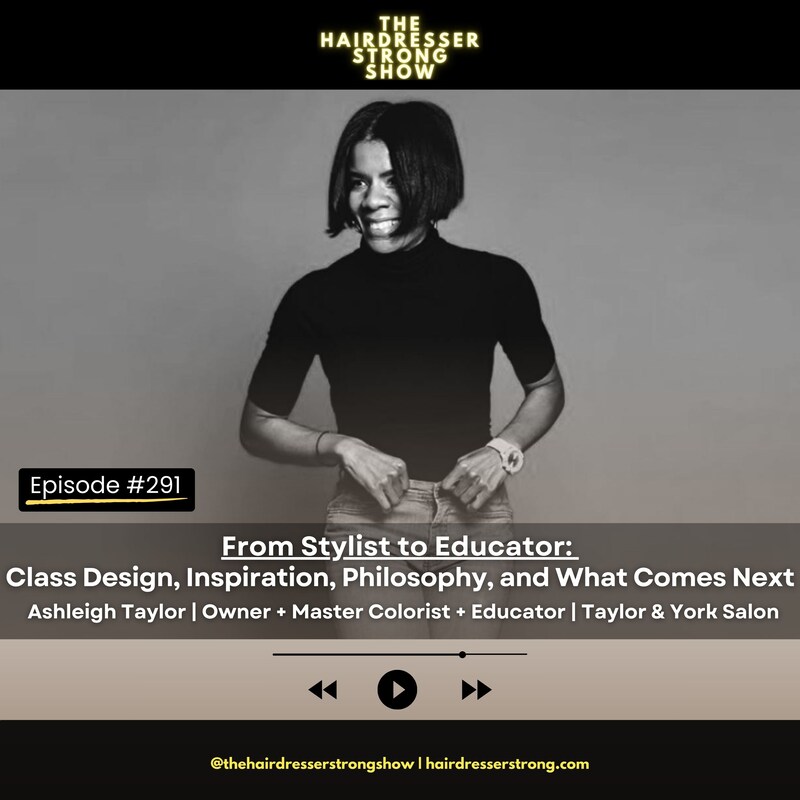
In this episode, Ashleigh Taylor of Taylor & York Salon reflects on her Signature Blowout Mastery class and the process behind teaching textured hair techniques while stepping into the role of educator. She explains how preparation, product knowledge, and intentional class design shape both the learning experience and the results behind the chair.
Follow/subscribe to be the first to know when new episodes are released. Like what you hear? Leave us a review!
Key Takeaways:
🔅Education starts with action – Inspiration alone doesn’t create opportunities. Turning ideas into structured learning experiences is what moves educators forward.
🔅Great classes require thoughtful design – A strong class isn’t just a demonstration. It includes context, discussion, technique breakdown, and real problem-solving.
🔅Preparation determines the final result – Cleansing, conditioning, and proper treatment create the foundation for a smooth, healthy finish.
🔅Product knowledge creates confidence – Knowing what products do and how they interact with different hair types allows stylists to work with intention instead of guesswork.
🔅Technique evolves through repetition – Mastery develops over time through consistent practice and refinement of movement, timing, and rhythm.
🔅Teaching reinforces your own craft – Explaining your process to others deepens your understanding of why techniques work.
🔅Education helps elevate the industry – When stylists share knowledge openly, the overall standard of the craft improves.
🔅Creative careers require courage – Leaning into your gifts and stepping into education means trusting your experience and being willing to share it.
RELATED LINKS
📸Follow Ashleigh on Instagram -https://www.instagram.com/ashleighbtaylor/
📸Follow Taylor & York on Instagram -https://www.instagram.com/taylorandyorksalon/
If you're interested in collaborating with Hairdresser Strong to develop, produce, and promote an educational class, reach out by DM or email ([email protected])
The Hairdresser Strong Show is all about Salon Owners, Rising Stylists, and Seasoned Stylists sharing their experiences, successes, failures, and advice to inform, educate, and empower their Fellow Hairdresser. We won’t stop until we are all: Hairdresser Strong.
CONNECT WITH US
📬 Subscribe to our free newsletter
The views and opinions of our guests are theirs and important to hear. Each guest's views and opinions are their own and we aim to bring you diverse perspectives, career paths and thoughts about the craft and industry so you can become Hairdresser Strong! They do not necessarily reflect the positions of HairdresserStrong.com
Transcripts
Buddy, I am your host of the Hair Just Strong show.
Speaker A:My name is Robert Hughes, and we are going live with Ashley Taylor from Taylor York Salon.
Speaker A:And tell us a little recap of the class, and we're gonna get the chance to hear what's in store and what we should expect to see in the future.
Speaker A:So if you missed the class with Natural Texture Bullet, it was.
Speaker A:The name of the class was Signature Blowout Mastery, the art of the Lustrius.
Speaker A:Finished.
Speaker A:It was on March 2, and it was incredible.
Speaker A:So we are going to get Ashley Taylor on right now.
Speaker A:And so while we're waiting for her, what I'm.
Speaker A:Oh, there she is.
Speaker A:Hey, what's up?
Speaker A:So, okay, so we are talking about the class that you did on March 2nd called Signature Blowout Mastery, the Art of Illustrious.
Speaker A:Finished.
Speaker A:Tell us, give us, like, a recap of that, of that class.
Speaker A:Like, tell us your vibe behind it and.
Speaker A:And like, give us a little bit of like.
Speaker A:Like what.
Speaker A:What people experienced and it.
Speaker A:For anybody who wasn't there.
Speaker B:Yeah.
Speaker B:So I think it was back in October.
Speaker B:I don't know why October is sticking out to me.
Speaker B:But we were on one of the.
Speaker B:One of our calls, one of our industry calls.
Speaker B:When I say we, I mean Robert and the group that we're in.
Speaker B:And you pitched.
Speaker B:Call it a pitch, but basically put it out.
Speaker B:If anybody wants to, you know, collaborate with the class, say something.
Speaker B:You didn't say that exactly, but, you know, say something.
Speaker B:And I was really.
Speaker B:I was in my mind, just really trying to push.
Speaker B:Push myself to do the things, because I think we get to the.
Speaker B:To the space where we're so inspired.
Speaker B:But how much more inspiration do you need before you actually act on what is inspiring you?
Speaker B:And I didn't know what I wanted.
Speaker B:I didn't know what I wanted to begin with.
Speaker B:I thought it was color.
Speaker B:And then, you know, after I said yes, I wanted to collaborate with the class, and you were like, well, hey, you know, let's start with.
Speaker B:Let's start with texture.
Speaker B:Let's start with the blowout, because there are people that would be interested in it, are not really clamoring for that.
Speaker B:And after months, literally months of planning, finally on March 2nd.
Speaker B:So let me even backtrack just the.
Speaker B:I knew I wanted to get my.
Speaker B:Wanted to get my feet wet in terms of really structuring a class and what that would look like from beginning to end.
Speaker B:And if you've ever maybe not have done a class, but have maybe planned a party or hosted a party, like, there's always something that is going to go awry.
Speaker B:So.
Speaker B:So you do that a couple of times and you kind of plan for that.
Speaker B:So I kind of went into it with that mindset, like, something let me do something maybe 45 minutes earlier, because somebody inevitably is going to be late.
Speaker B:Traffic is inevitably going to happen.
Speaker B:And I think it probably did snow that day.
Speaker A:It did, but.
Speaker B:Right.
Speaker B:Crazy.
Speaker B:But it's like, okay, this was going to happen, but for me actually being in the class, so in the moment, it's almost like an outer body experience where you're sitting.
Speaker B:So the fact that the class sold out one was
Speaker A:in a week.
Speaker B:That part, the fact that it sold out in a couple of days, I was like, okay, wait a minute, this is okay.
Speaker B:And if you're anything like me, like, when you put yourself out there in your head, the narrative is all the worst things that could possibly happen.
Speaker B:Like, all of a sudden, nobody's going to want to be educated by me.
Speaker B:No one's going to like what I do, and I'm just going to have to be talking to a room of one.
Speaker B:So then when the text message came to me, like, hey, Ash, you got one ticket left.
Speaker B:I was like, wait a minute, what?
Speaker B:Completely went against what I was saying.
Speaker B:So that allowed the space for me to really pivot my thinking.
Speaker B:Like, okay, well, wait a minute.
Speaker B:People are actually interested.
Speaker B:So that brought on some more excitement that I wanted to give.
Speaker B:So even in the class and just looking out at the people, I had to remind myself to stay focused because it was like, oh, this is what.
Speaker B:This has really come together.
Speaker B:People are really definitely absorbing what I wanted, what I want to say and what I have to offer.
Speaker B:But they.
Speaker B:They want it.
Speaker B:Even in the conversations that I was having before and after, they really, I would say, appreciate it.
Speaker B:But something that comes so naturally to me is almost nuanced to other people.
Speaker B:And I have to keep reminding myself that.
Speaker B:And I think that's what makes educators, like the really good ones, Underscores how special the gift is.
Speaker B:And you have to remind yourself, like, you know what?
Speaker B:What I'm doing is pretty damn good.
Speaker B:Like, you really do need to pat yourself on the back.
Speaker B:And it's okay.
Speaker B:It's okay.
Speaker B:It's not like, hi, everybody, I'm the shit.
Speaker B:Give me all of your money.
Speaker B:It's not.
Speaker B:It's not that.
Speaker B:And I know certain.
Speaker B:I'm learning to really lean into the gifts that I have.
Speaker B:And I think if you don't use them, my theology, my.
Speaker B:My theory is that if you don't use your Gift.
Speaker B:The sin in that is you will be watching other people doing what you know how to do even better.
Speaker B:And you're just stuck with that feeling like, damn, I could have done that, I could have done that.
Speaker B:So yeah, it was, it was good.
Speaker B:I'm still kind of riding on the, the energy from it.
Speaker A:That's awesome.
Speaker A:So for those of you who are listening or watching and you were not at the class, do you want to give them a play by play or do you want me to go over the agenda?
Speaker B:Well, let's do a little bit of both.
Speaker A:Okay, so how about I do, I, I, I'll share the agenda pieces and you add the context and you kind of tell us.
Speaker A:Okay.
Speaker A:So we, we started off with like coffee and mingling and you gave people an opportunity to, to arrive and get situated and chit chat and stuff, which I loved.
Speaker A:And then, and then you went into a Fireside chat with where you sat and you talked to folks about different stuff.
Speaker A:And would you share what some of the stuff that you were talking about?
Speaker B:Yeah.
Speaker B:So I'm glad we are doing it like this because now it's like, oh yeah, I remember there was the little mingle hour and that was good.
Speaker B:So I was standing and just seeing people.
Speaker B:Well, if you've been to the salon, there's, you don't know who's coming up the steps until they're there.
Speaker B:So there's always this anticipate anticipating like who it's going to be.
Speaker B:And these are people and friends, like the Instagram community and you build these relationships with people that you've actually never seen before.
Speaker B:So some of them that were coming, it was like, oh my goodness, you're my friend, I've never seen you before.
Speaker B:So it was good to actually lay hands on some people and just, and really share the energy of being in the same space with them.
Speaker B:When we did start the Fireside chat, I wanted to talk about what some of the pain points are in everybody's experience because it is different what their approach to textured hair is, how long they've been in it.
Speaker B:And I shared my experience from just graduating school and thinking that I knew everything, didn't know anything, and where I started.
Speaker B:Natural Motion Salon, we're talking the 90s.
Speaker B:And even how textured hair and the adoration that everyone has for it now.
Speaker B:It was very different.
Speaker B:It was very, very different back then.
Speaker B:So yeah, we talked a little bit about, I remember people wanted to tap into some round brushing.
Speaker A:Yeah, yeah, I, I, I love the, the conversation.
Speaker A:And Sammy and I were reflecting on it for a couple days after about all the different, like, listening to people talk about, like, all of their different experiences and the different types of places that do different types of techniques and use different types of products.
Speaker A:Sammy's giggling in the background.
Speaker A:It was.
Speaker A:It was so good.
Speaker A:Like, it was so cool to, like, have that.
Speaker A:Be there and have that experience and.
Speaker A:And hear, like, it really add a lot of context.
Speaker A:And then.
Speaker A:And then after that, you went through a process of cleansing and treating the hair before you started.
Speaker A:You want to.
Speaker A:Do you want to say anything?
Speaker A:Oh, yeah.
Speaker A:And then Sammy wants to mention the Diane brush that.
Speaker B:So there's this brush.
Speaker B:I'm not going to name what it is, but you can if you'd like.
Speaker B:Looks very similar to the Diane brush and the brush that I used to use.
Speaker B:I. I think that they've changed it.
Speaker B:So the level of heat that I'm using on the brush I didn't have, it would literally disintegrate.
Speaker B:It would.
Speaker A:I'm gonna pull up a picture of it.
Speaker A:So for some people watching.
Speaker B:Yeah.
Speaker B:Orange would just be.
Speaker B:Would be falling.
Speaker B:And the brushes are not cheap.
Speaker B:They're almost $20 now.
Speaker B:And I couldn't.
Speaker B:I couldn't.
Speaker B:Is that the brush?
Speaker A:Yeah, those are the brushes.
Speaker B:Yes.
Speaker A:Yeah.
Speaker B:So I found something at Paul's beauty supply store, the Diet.
Speaker B:It's the Diane brush.
Speaker B:The name is.
Speaker B:The company is Diane, and I hope people really get that.
Speaker B:And we joked about it, like, watch the price go up.
Speaker B:I buy boxes of them, and they last for a long time, very long time.
Speaker B:But we talked and joked about that and how important.
Speaker B:It really speaks to how important the tools that you are working with really make a difference in the finish.
Speaker B:So after we talked about that, we went back to the bowl and talked about different cleansing conditioners and why cleansing conditioners are important in.
Speaker B:In what I do in part of the signature blowout, because it's laying the foundation for a lustrous finish.
Speaker B:You.
Speaker B:You need that.
Speaker B:From the masks that we were using, from the.
Speaker B:The direction that I'm applying and working with the.
Speaker B:The shampoos and the cleansers and the conditioners working.
Speaker B:Working it down and lay that cuticle down, sectioning what type of detangling brushes that you're using and that.
Speaker B:I think it's a step that a lot of people miss, how important it is to cleanse this nape area in the back even before you get to the shampoo bowl.
Speaker B:Maybe using a CRE shampoo, you can do at the chair or at the bowl to Ensure that the.
Speaker B:The soap, if you will, is getting on the scalp, and it allows you to kind of lift all of the dirt and the buildup that is on the hair, get that lifted, and it allows for.
Speaker B:You want that hair to be clean because again, it will affect the end result of your.
Speaker B:Of your finish.
Speaker B:And all of that.
Speaker B:All of that plays a huge part.
Speaker A:And you had folks kind of cycling through that hair treatment and cleansing area so that they could kind of like check you out, ask questions.
Speaker A:And then once you were done, you brought your model back up to the front and you executed the signature blowout that you do.
Speaker A:So you want to kind of give a little insight into that little, Little, Little preview.
Speaker B:Yeah, so we did.
Speaker B:So mind you, we were about maybe an hour and a half in with everything, but.
Speaker B:And it's kind of on it.
Speaker B:It reminded me of when, on times when I do have assistants with me, especially in the beginning, how I'm talking through every step.
Speaker B:Because again, I have to remind myself, not everybody knows this.
Speaker B:They're not teaching this in hair school.
Speaker B:At least I don't.
Speaker B:I don't think they are.
Speaker B:Or spending as much time on it.
Speaker B:And true, every technique you're not going to use, say, for instance, all the 10 steps, you're not going to use 1 through 10 the same way on everybody.
Speaker B:But there's something that you can take away.
Speaker B:I'm very much a eat the meat, spit out the bone person.
Speaker B:I think that's how we learn and how we build what is our, you know, what is your personal signature?
Speaker B:So by the time we got back to the chair, I'm talking about what products we're using for detangling, leave in conditioners and showing you how I am sectioning the hair, how I am still using a plastic cap on the hair that's not being combed out.
Speaker B:Why?
Speaker B:Because you still want the hair to be wet and moisturized while you're combing out or while you're detangling the hair.
Speaker B:Because the moment that hair begins to dry, it is almost.
Speaker B:It's like it's going to be petrified into stuff like this.
Speaker B:So if you're trying to comb those dry curls out, that invites breakage.
Speaker B:It invites an uncomfortable experience for your client.
Speaker B:So it was little.
Speaker B:It was a couple of tips and tricks of the trade that I used.
Speaker B:Then I went into the blow drive from how we are depending on what the comfort level.
Speaker B:And I tried to show different levels.
Speaker B:Some people, depending on their experience, can go right into it.
Speaker B:And what right into it is where you're starting from corner to opposite corner.
Speaker B:Have a magazine corner to opposite corner, so you're going opposite direction and you keep going all the way around, just counterclockwise from end to end.
Speaker B:And how the different layers of heat, how the nozzle is on the hair, and the Diane brush, how that helps facilitate just a smooth glide through.
Speaker B:And it's something like I even mentioned to them, like, you're not going to get this overnight.
Speaker B:It's going to be practice.
Speaker B:I didn't get it overnight, like, when I first saw it, and I studied under Bill Lawrence Salon and Bogart.
Speaker B:And I would just watch and of course get frustrated, like, oh, why am I not getting it?
Speaker B:But once you get your rhythm, it's like a dance.
Speaker B:And then that's where some of the comments afterwards, which I appreciated, where people were able to see.
Speaker B:They saw me as an artist performing.
Speaker B:And that resonated with me.
Speaker B:Where I can.
Speaker B:I've been doing this for almost 30 years, but where I can just.
Speaker B:It's like watching somebody dance.
Speaker B:Just do it.
Speaker B:I can do it in my sleep.
Speaker B:And that's what you want to.
Speaker B:That's some of the foundation that I wanted to lay so others can eventually get to that point, too.
Speaker A:That was so good.
Speaker A:It was so good.
Speaker A:And my biggest.
Speaker A:My biggest learning experience, having like, zero experience with natural texture was.
Speaker A:Was the.
Speaker A:The treating and the cleansing part.
Speaker A:Like, the, like the importance of prepping the hair before going into it.
Speaker A:It was such a bigger emphasis on that.
Speaker A:And it feels like there's a huge product knowledge learning curve that, that anybody that's getting into it would.
Speaker A:It.
Speaker A:That's what my takeaway was.
Speaker A:I don't know if that's true, but, like, it seemed like I need to.
Speaker A:I would need to learn about, like, all the different types of products that are good and bad and.
Speaker A:And how to use them.
Speaker A:And like, this whole process, like, that was my biggest takeaway.
Speaker A:Like, your, Your method.
Speaker A:I feel like.
Speaker A:I feel like I'm a. I'm like a monkey see, monkey do.
Speaker A:Like, I can do.
Speaker A:I can do whatever you do, like, with the hand motions.
Speaker A:I don't know why I'm doing it, but I might be able to repeat your motions.
Speaker A:But it was like some of the technical stuff, like the size of the sections.
Speaker A:I remember I asked that question, like, how big are the sections that you're taking when you're doing the ironing and you're.
Speaker A:You're setting it.
Speaker A:But the thing that I didn't really.
Speaker A:I.
Speaker A:Because I didn't go into the room.
Speaker A:But, like, because, like, all the attendees were into the room where you were treating and prepping the hair.
Speaker A:Like, that seemed to me like you.
Speaker A:It did look like magic.
Speaker A:It like.
Speaker A:Like, it did look like artistic work.
Speaker A:Like you were able to take this hair and smooth it down and what I thought to be really quickly and.
Speaker A:But you spent way more time prepping and cleansing the hair than I ever would have thought that.
Speaker A:That you should have.
Speaker B:Yes.
Speaker B:And Gabby, who was my model, has a lot of hair, and a lot is a.
Speaker B:Is an understatement.
Speaker B:She has a lot of hair, and I chose her specifically so you could really see the transformation.
Speaker B:When she came in, her hair was.
Speaker B:Her hair was straight.
Speaker B:She'd had a style probably that was about three weeks old.
Speaker B:And then when you wet it, it just starts to.
Speaker B:To swell and get bigger and bigger, and that can be intimidating for some.
Speaker B:I remember my first couple times when someone would come into the salon and you think, like, oh, I got it.
Speaker B:I'm good.
Speaker B:I'll be finished this in an hour.
Speaker B:Then the water hits it, and that could be on any degree of texture.
Speaker B:Like, you think that you can see somebody's hair, and you think you know it, but once the water hits it, the diameter, it changes.
Speaker B:All of it changes.
Speaker B:So with her hair, it is going to take.
Speaker B:I think we spent a good maybe 30 minutes at least.
Speaker A:Yeah.
Speaker B:Yeah.
Speaker B:Back there.
Speaker B:Because there's sectioning, and at the same time, you want the client to be comfortable.
Speaker B:So if I'm sitting you up, making sure there's a pillow on your back, making sure the water's not dripping in your face, all of those things.
Speaker B:And those are some of the things that I talked about, too, because you do want to create a good experience for your client, and that goes into pricing.
Speaker B:Like, all.
Speaker B:We talked about, all of that, too, how all of that goes into.
Speaker B:What are you charging for something like this, as to where you're not breaking your back, you're not feeling unseen or used or taken advantage of because something that comes so easily for us, like, no, you're providing an experience.
Speaker B:They're coming to you because you're providing an experience.
Speaker B:And all of that goes into all of it.
Speaker A:This is.
Speaker A:It was amazing.
Speaker A:Thank you for coming on and going live with us to do this little recap.
Speaker A:I feel like it's such a great opportunity to kind of look back and think about what we learned and, like, relive the experience.
Speaker A:So let's just to like to wrap up here.
Speaker A:Why Tell us what you're Thinking about for the future.
Speaker B:I am definitely.
Speaker B:So the next class will be color period.
Speaker B:I've had.
Speaker B:So the thing about me with.
Speaker B:With energy, something has definitely been ignited, but it's.
Speaker B:It's also an allowance and permission to really move forward.
Speaker B:And for us creatives, it can be a little challenging sometimes to really walk in your gift.
Speaker B:But I think when you put energy out there or put volume to an emotion, what that means is you begin to talk about it.
Speaker B:One, there's accountability because you don't want to have the reputation like, oh, he or she is always saying that they're going to do something, but they never do.
Speaker B:Oh, yeah, he said that before, but nothing ever really happens.
Speaker B:I never wanted to fall into that category.
Speaker B:So I don't talk about a lot of things.
Speaker B:It's just like, hey, something's coming up and, you know, set date.
Speaker B:But with this, it's definitely going to be hair color.
Speaker B:I think I like what the foundation this has laid, but it's allowed me to really go back and to plan.
Speaker B:Plan and create.
Speaker B:Plan something and create an experience, an educational experience, a learning experience for people who.
Speaker B:Who think like hairdressers think.
Speaker B:We are a very unique bunch of.
Speaker A:Yes.
Speaker B:Differently.
Speaker B:And it's rare that other people outside of the industry understand it and pick up on it.
Speaker B:So we have a language that we speak to each other.
Speaker B:So that's.
Speaker B:That's what's in.
Speaker B:That's what's in store.
Speaker A:Awesome.
Speaker A:I'm so excited.
Speaker A:Well, I can't wait to hear when the next class is.
Speaker A:And it was such a pleasure to be part of it.
Speaker A:And I.
Speaker A:And I thank you for taking the time to come on and.
Speaker A:And chat with everybody.
Speaker B:Of course.
Speaker B:Of course, of course.
Speaker B:Oh, goodness.
Speaker B:I'm reading some of the.
Speaker A:Yes.
Speaker B:Yeah, this is good.
Speaker B:This is what I mean.
Speaker B:This is great.
Speaker B:I love it.
Speaker B:And Rob, thank you.
Speaker B:Thank you, you very much.
Speaker B:You started the domino.
Speaker B:Domino effect.
Speaker A:Yes.
Speaker A:Yes.
Speaker A:I can't wait to see what you do next.
Speaker B:Thanks so much, Rob.
Speaker A:Absolutely.
Speaker A:Absolutely.
Speaker A:All right, well, until next time.
Speaker A:I'll see you later.
Speaker A:Bye, everybody.
Speaker A:Thank you, Ashley.
Speaker B:Of course.
Speaker B:You're welcome.
Speaker A:All right, take care.
Speaker A:Have a good night, too.
Speaker B:You too.

