Shownotes
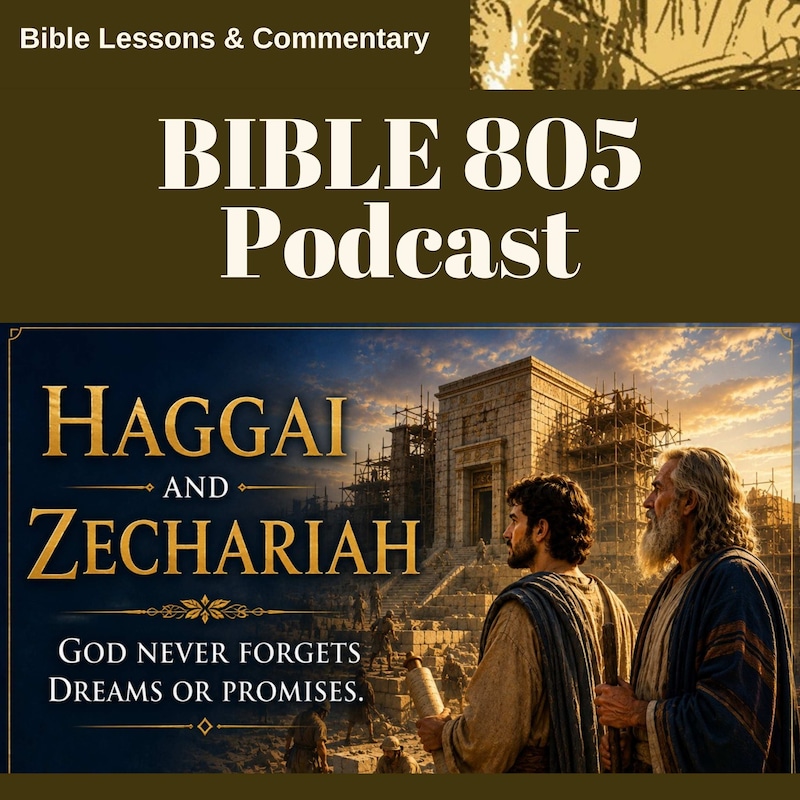
Today, we're diving into the messages of the prophets Haggai and Zechariah, who remind us that God never forgets the dreams or promises He has for us. After the Babylonian exile, the Israelites returned to their land, faced with challenges like rebuilding the temple. Haggai gets right to the point, urging the people to stop making excuses about timing and to prioritize God’s work over their own comforts. Meanwhile, Zechariah brings a fresh perspective, using vivid imagery to inspire and challenge the people from God’s viewpoint. Together, these prophets call us to reflect on our motivations in serving God and the importance of acting on our faith today.
Takeaways:
- The Bible serves as a comprehensive guide for finding purpose, peace, and forgiveness in life.
- Haggai and Zechariah, two key prophets, spoke to the Israelites post-exile, emphasizing God's promises.
- Haggai's practical approach challenged the Israelites' excuses for delaying temple rebuilding amidst personal comforts.
- Zechariah used vivid imagery to convey God's eternal perspective, urging the people to fulfill their calling.
- Their messages highlight the importance of aligning religious actions with genuine intentions and motives.
- The overall takeaway is that obedience to God is essential, regardless of immediate outcomes or challenges faced.
Links referenced in this episode:
Transcripts
The transcript for this podcast is A.I. generated and though it has all the content, it sometimes has odd breaks, spelling, and spacing.
For an almost exact copy of the text, go to the www.Bible805.com site for downloadable NOTES or to the www.Bible805Academy.com for downloadable and editable Notes, Discussion Guide, Audio and Video files, plus the original PowerPoints—for your personal study or all you need to teach the lesson.
**************
Hi, I'm Yvon Prehn from Bible 805 and I truly believe the Bible has everything you need to find meaning and purpose, love and peace in this life, and it is a source for forgiveness of sins and eternal salvation.
I want to tell you about it by making sometimes complex bio Bible topics understandable.
Let's do that today with our podcast topic, which is Prophets Haggai and Zechariah.
God never forgets dreams or promises we're at the end of our study of ancient prophets, modern messages. We're now looking at the prophets Haggai and Zechariah, who along with Malachi, spoke during the historical books of Ezra, Nehemiah and Esther.
The Babylonian exile is over and the people have been allowed to return to their land, though not all of this is the final grouping of prophets before the 400 silent years.
And though God didn't write any words at that time, he was doing a lot to prepare for the Messiah, which a later lesson of Bible 805 will tell you about.
There are a couple of charts included with the notes that go into more detail on the dating, if you're interested in looking at that, but a few more details on the setting of Haggai and Zechariah. They were Both written about 14 to 16 years. The Jews went back to the land after their captivity. It was a glorious work of God.
There were challenges when the surrounding people tried to stop them from building the temple as God wanted them to. But God intervened, protected them. Even when they were forced to stop rebuilding, the troubles in rebuilding didn't last.
The Israelites had seen God conquer and give victory in much greater problems, and he took care of this situation. Also, they got permission from the king to continue building, but they didn't. They quit building the temple and turned to building their homes.
God then sent two prophets to them. Now this was something new. They were sent to the same audience and their messages are all within one year's time.
Now note too, in the books it talks about, one spoke during this month and one the next month, and they kind of go back and forth, but they preach at approximately the same time, but in very different ways. Traditionally, Haggai is older, Zechariah is younger. Haggai is very practical and he talks about what they need to do.
Now he starts, then Zechariah continues and it kind of goes back and forth between the two books. But Zechariah is really interesting, as many prophets have done, and Isaiah is one of the most similar.
He jumps into the mind of God and challenges the people from God's viewpoint, using God's language of dreams and visions from the view of eternity, which we' talk about in detail a little later. But first let's look at Haggai. He challenges the people as to why did the work stop.
The people didn't tell themselves they were actually quitting on working the temple, or that they were afraid to do the work. Here's what they actually said. These people say the time has not yet come to rebuild the Lord's house.
But they had time for other things, and Haggai challenged them about that. Is it a time for you yourselves to be living paneled houses while this house remains a ruin? Here was their excuse.
Well, it's not yet time to do the Lord's work. That's a common and dangerous excuse, and it's been used throughout Bible times. And for us, it doesn't seem like outright rebellion.
We deceive ourselves into thinking we'll obey sometime, but just not now. There's many other examples in the New Testament. Felix, when confronted by Paul, says, send for you when it's a more convenient time.
St. Augustine famously said, Lord, make me chaste, just not yet.
We don't want to flagrantly disobey God or tell him we have no intention of doing something we know he wants us to do in an action, a habit or a ministry. So we lie to ourselves and to God that the timing just isn't right. I'll do it or obey or change or whatever, but just not now.
Haggai wouldn't have any of it. Look at what's happening to you, he said. You planted much but harvest little. You eat but are not satisfied. You drink but are still thirsty.
You put on clothes but cannot keep warm. Your wages disappear as though you are putting them in pockets filled with holes. His words were not simply an idle observation.
They are a reminder of what God had said would happen if they did not follow through on obeying his covenant.
God previously told them, and Haggai was repeating it when he reminded them in Deuteronomy 28, where it prophesied what would happen if they did not obey. Where it said, you will sow much but reap little, for the locusts will eat your crops. You will plant vineyards and care for them.
But you won't eat the grapes or drink the wine, for worms will destroy the vines.
Olive trees will be growing everywhere, but there won't be enough olive oil to anoint yourselves for the trees will drop their fruit before it's matured. God keeps his word in both good and bad consequences. Now the problems clarified. They weren't doing what God wanted them to do. The challenge is given.
But now what? We often need additional motivation to actually get going and doing what what we know we should.
Usually that involves more than simply a factual listing of what we've done wrong and what we need to do. Here's where Zechariah comes in, Haggai's partner in ministry Again, we haven't really seen this before.
Two prophets preaching at the same time to the same audience. One's very practical, the other speaks in images. Let's talk about this method of speaking in images first before we get into the content.
Now, overall about the use of images in the Bible, Sometimes it takes more than simply words to communicate. A picture's worth. A thousand words is often quoted to emphasize this, to which I always reply, but which thousand?
We need words to clarify the meaning of images and often images to inspire our words. This combination is what makes appearing of Haggai and Zechariah so powerful. Haggai's concrete words were based on the prior covenant with God.
Now what then, though, are Zachariah's images all about? First, we need to remember they come from the eternal view of God, who sees the past, present and future. They need it.
And we need to always put ourselves into our eternal destiny to sometimes have the strength or the courage to do what needs to be done today and to communicate that information. It sometimes helps to have images to do that. The Bible does this a lot, reminding us that this present time is not all there is.
Words often aren't enough. We need images to see what isn't concrete.
The point of this shift in perspective is Here's a quote that talks about it where a gentleman named William Orr said, life is not concerned with time alone. There is an overruling power which works in time to prepare for eternity.
Now here's why images are needed to communicate a view other than what's right in front of us. An image can contain volumes of backstory and meaning when no words are expressed.
The challenge is you need to understand the meaning of the backstory. Some are more understandable than others in our culture. And here is a key thing. The power of all images lies in their cultural base.
If you don't have that same cultural base, the images will not have the same meaning for you. But in America right now, that's the audience I'm speaking to. Primarily here. If you Want to describe the perfect superhero?
A sterling example of strength, integrity, leadership and self giving. You could list these characteristics in minute dictionary detail, or you can simply say Captain America.
The books of the Old Testament and Zachariah is one of the main ones that does this. Use imagery in much the same way. The backstory of an image can be very complex. Now, I showed in my class, I actually have this T shirt.
It has a four men walking in the fiery furnace, and it has the overall title, May the Fourth F o u R T H Be with youh. Now this T shirt is kind of complicated because some people will look at it and go, wow, that is so cool. And others will go, what? I don't get it.
What you need though, for this image, this T shirt to make sense, Let me just go through it for you.
So you can see the complexity of images, the image itself, the four men in the fire, if you know the story and it has it in Daniel 3:17, story of Daniel's three friends. They were thrown into the fiery furnace. They wouldn't obey and bow down to an idol statue.
The king who did that saw not only three of them alive, but a fourth, like the son of God, which of course we interpret as being Jesus with him. And we're reminded that Jesus said he would be with us always. And then we make the application that Jesus is with us in our trials.
So we see, of course, the fourth person is Jesus. But then what makes the heading of this shirt so fun?
If you know what you know, if you know, you know, is if you're a Star wars fan, you know, from Star wars, many of you, of course, are familiar with the saying, may the force F o r c e be with you. But then fans took that saying and made May 4th a celebration of all things Star Wars.
And so based on these allusions, references, tongue in cheek humor, you combine it all into this marvelous T shirt that says may the 4th be with you. But of course, Christians look at that as Jesus and all that kind of stuff. I hope that made sense.
If it does and you're into Star wars, you're thinking, oh, that is just too cool. If you aren't, again, it's really eye roll time.
One more thing about images, we can think, we understand what they mean and they may have a special meaning to us, but the same image can have a totally different meaning to a person with a different upbringing, background, or current experience. The American flag is an example of this.
It means very positive things to many of us, but to people in different parts of the world, the meaning may be very different.
So we need to remember that when we use images, it's even more complicated in the Bible because our feelings, personal background or experience are not the only thing that determines the meaning of an image.
We have little of that to rely on when we go to interpret an image of something in the Bible, particularly, particularly in the Old Testament, because the images that they refer to are so far from our personal experience. So what should we do?
Many commentators simply say something like, to understand prophecy, you need to understand how the image was used in the Old Testament. That's true. So what do we do first?
Regardless of understanding the specific images, you need to get a good sense of how God works over all in the Bible and in the Old Testament. And repeated reading and study of it will give that to you. But the complexity of the images in Zachariah, well, let's look at them.
Literally at first, I actually queried an AI program to illustrate all of the images in Zachariah.
And for those of you watching the YouTube video, and I encourage you to check it out if you haven't seen it yet, here are the images that it came up with it now it's kind of interesting. A lot of them are, you know, sort of there, but not quite Woman in a basket. They made it a metal basket. I think I would have made a woven one.
But on the horns here, they have like musical horns. But in the Old Testament that always refers to like a power source, like a horn off of a bull or something like that. So it was a little bit odd.
But anyway, you see there's just a whole bunch of different ones and some of them are very good. The lampstand, the olive trees, reclothing Joshua in clean clothes. A lot of these are very. But doesn't help us understand them.
Now overall, these images Got Questions has a good summary of them where it says they're primarily a series of eight night visions and the coronation of Joshua, the high priest, in order to encourage the nation that he God is not finished with them, that God still has plans for them and will fight for them, bless them, take away their sins and enable them to build the temple, bring true worship and unite them if they will repent and obey him. You can continue to look at various Old Testament references to each of the images and what they mean initially, how they apply at this time.
You can do huge studies on those things or you can query AI today and I want to show you some of the results. Now you can go to again, either Bible 805 or the Bible 805 Academy and you can download the notes and I have all of these charts for you.
I also included for those of you that are interested in working with AI, my prompt that I use to tell AI what to do. And this is simply what I told the program.
Now I use Chat GTP for one version and I used a Microsoft Copilot for another, but this is the prompt that I use for both. Following are images from the Old Testament prophecies and I listed each one of them with their biblical reference in a downloadable chart form.
Give me a summary with verse citations of what these images represented previously in the Old Testament, pair with the verses in Zechariah today and the meaning of them in the book according to respected conservative Bible commentaries. And I got some really good resources back.
Now I had to tweak it, you know, kind of modify my prompt a little bit, but you can go to the notes and see the two really complete and good charts that they gave me on listing the image, the Old Testament background with all of the verse citations and then quotes from different commentators. So AI is not something to be afraid of. It can be something that can be very useful if you give it very carefully controlled prompts.
And that's a subject for something else entirely. But do check this out in the notes.
Here though is the important point on all apocalyptic and end time visions for the setting of Haggai and Zechariah. They give us a future and a hope, an eternal context of comfort and strength for what might be difficult now.
But the future is not yet, and it's not to be our sole focus. As the saying goes, we ought not to be so heavenly minded. We're no earthly good. There's work to be done now.
Our work has a purpose, and as we work towards it, we must do very tangible things. And to do those things in the light of their eternal calling. Here's what they were supposed to do. From the national to the personal.
The primary thing was to get to work to the people as a whole. Haggai said, be strong all you people of the land, declares the Lord and work for I am with you, declares the Lord Almighty.
This is what I covenanted with you when you came out of Egypt, and my spirit remains among you. Do not fear. Often doing God's will is intensely practical. Help build something, give to something, spend time helping with something.
We might feel too weak or too old or too tired or too overwhelmed.
But if God calls us to do something, no matter all these things, he can help us finish it as it shows in this very personal application to one man, Zerubbabel was the leader of the people. He had come back with them to the land. He was the heir of David. And he for some reason allowed them to bail out and not do any work for 16 years.
But then it's wonderful where God says, the hands of Zerubbabel have laid the foundation of this temple. His hands will also complete it. Then you will know that the Lord Almighty has sent me to you. Who dares despise the day of small things.
What an incredible promise. And it came true. He started. Zerubbabel started the project approximately 16 years earlier, and then he abandoned it.
But God did not give up on him, and years later made it possible for him to fulfill his calling. Don't give up on dreams of what you can do for God. It's never too late. Then the broader applications.
They were prompted by a series of questions about religious observances. After this first set of visions, the people came to Zechariah and said, should we mourn and fast in the fifth month, as we've done so for many years?
This was observing the exile which was now over.
Then the word of the Lord came to me, to Zachariah, and he said, ask the people of the land and the priests, when you fasted and mourned in the fifth and seventh months for the past 70 years, was it really for me that you fasted? And when you were eating and drinking, were you not just feasting for yourselves? An important application here.
Always evaluate your motive for any religious action. God was not pleased with theirs religious actions without doing what they were supposed to do. He goes on to tell them what to do.
In Zechariah 8, 16 and 17. In the message translation, it says, now here's what I want you to do. Tell the truth, the whole truth. When you speak.
Do the right thing by one another, both personally and in your courts. Don't cook up plans to take unfair advantage of others. Don't do or say what isn't so. I hate all that stuff. Keep your lives simple and honest.
This is a decree of God. Tell the truth, don't lie. God hates that. In the New Testament, Ephesians reminds us of the same thing. Stop lying to each other. Tell the truth.
We're parts of each other, and when we lie to each other, we're hurting ourselves. Don't use bad language. Say only what is good and helpful to those you're talking to and what will give them a blessing.
What we say is a big Reflection of who we belong to. And we need to be consistent and truthful with our words. After this, the visions and sermons, they finally got to work.
However, some did it, complaining that the temple wasn't as great as the old one. But Haggai told them its glory would be greater because it was the temple that Jesus would come to.
Application Our standards of greatness are often not the same as the Lord's. It isn't the outward appearance that is most important, but who's there? Is Jesus there or not?
An important overall application for the books and a Bible interpretation guideline. Here's the question.
If we work hard for God, shouldn't we be protected from difficulties and loss if things aren't going well for us, if we do just a little bit of work around the church, like Zachariah said, you know, you. You build things up, you do whatever. Does that mean everything will get better? That's what these books seem to teach.
Does God punish us here and now if we don't do what he wants and bless us with goodies if we do? Many teach this is the case. Health and wealth. Preachers invariably quote Old Testament passages and out of context to prove that's how things work.
We know it isn't like that, but what is the reality of what we can expect in this and other apparent examples in the Old Testament? Now, here's some guidelines in determining what is true and applicable for all time with what we read in the Bible.
First, we need to look at the whole counsel of God before we get into specific applications. This means we need to be clear about what the whole Bible teaches in various areas. It takes work and time to develop that.
In so doing, we need to look for principles, not just specific proof texts.
The overall principle of these books, the overwhelming lesson of the entire Bible, is that God and doing his will is what is supposed to be the priority of our lives, regardless of the results. For example, that is what was required of Daniel, Jeremiah and Zerubbabel. Now, three very different outcomes.
Daniel was basically simply, you know, kind of a boring administrator almost all his life. He really didn't do anything all that exciting except for the, you know, lion's den thing at the very end of his life. But he just kind of went along.
He was in a very privileged, comfortable position. That was his life. Jeremiah, as near as I can tell, never had a good day. Zerubbabel started out well. Then he takes a vacation from serving God.
But he ended well in that God didn't forget what he'd called him to do, and Zerubbabel takes up the task and finishes the work on the temple.
Many commentators have said that these books of Haggai and Zechariah in the Old Testament are really a great illustration of Matthew 6:33, where it says, seek. Seek the kingdom of God above all else and live righteously, and he God will give you everything you need.
Of course, even if you try to do this seeking the kingdom first, it's sometimes hard to determine what's truly a need in our lives. And even if we think we've got it figured out, we have no promises of the timing of how and when God will act.
We also must be aware of the reality that God dealt deals with his people differently in the Old and New Testament. And that's not always easy to sort out.
It was very clearly stated in Deuteronomy 27 and 29 that if the people will do certain things, that the consequences are that he will bless them and if they don't, they will suffer bad consequences.
There was a direct, tangible correlation in the Old Testament between when the people of God obeyed him and his direct response and when they obeyed, they were blessed in this life and for the nation over all. When they disobeyed, he disciplined them, which primarily meant a loss of material blessings. We've seen that throughout these weeks of study.
But it isn't like that anymore. We don't have specific promises like that today that apply so directly in this life. They were under the Old Covenant, the Old Testament.
We're under the New Covenant, the New Testament. And how we are shown that we're pleasing to God in the New Testament is really different today.
There's no guarantee of earthly blessings if you follow God. If anything, the most blessed of God now sometimes seem to have the hardest time in life.
will have tribulation in John:He said that in Matthew 5:11, and that was the consequence of a holy life.
He didn't say, you know, if you do all these things that he's just listed in the Beatitudes, that life is going to be wonderful and peaceful and all that sort of thing. He says, no, you know, persecution might come.
The life story too, that we need to always be reminded of is of the Apostle Paul, who is arguably one of the most godly and certainly one of the most productive of all New Testament characters for what he did for the Kingdom of God. And here's how he sums up his life.
I've worked much harder, been in prison more frequently, been flogged more severely, been exposed to death again and again.
Five times I received from the Jews of 40 lashes, minus one three times I was beaten with rods, once I was pelted with stones, three times I was shipwrecked. I spent a night and a day in the open sea. I've been constantly on the move.
I've been in danger from rivers, in danger from bandits, in danger from my fellow Jews, in danger from the Gentiles, in danger in the city, in danger in the country, in danger at sea, in danger from false believers. I've labored and toiled and have often gone without sleep. I've known hunger and thirst and have often gone without food. I've been cold and naked.
Besides everything else, I face daily the pressure of my concern for all the churches. Jesus too, we need to remember, was a homeless preacher and he died a criminal's death.
And though the promises aren't always, for now the challenges are even harder. Because God doesn't want just outer holiness, that we don't worship a big idol or whatever, but he wants inner holiness.
As he reminds us on the Sermon of the Mount numerous times he said, you've heard it said doing various things, but I say to you about holiness, concerning lust, anger. And he goes on to set an even higher standard, summarized in the statement by this Everyone will know you're my disciples if you love one another.
Love defined by Jesus and not current emotional standards, but shown by serving as Jesus did, a life of service and at the end worshiping the disciples feet, it showed servant leadership. Serving those we love over all is not a nice suggestion, but a key evidence of belonging to Jesus.
Many of the things we've talked about not complaining, giving thanks in all things sometimes when life is most difficult, praising God in spite of is the greatest testimony of how we are to live, not just the evidence of earthly blessings. And what really matters isn't always obvious, but one day it will be.
After Jesus commended the people for the little things that they did remember at the end of time in his Picture In Matthew 25 he says the righteous will answer him, lord, when did we see you hungry and feed you or thirsty and give you something to drink? When did we see you a stranger and invite you in, or needing clothes and clothe you? When did we see you sick or in prison and go visit you?
I think they were truly surprised. But the king replies, I'll tell you, whatever you did for one of the least of these brothers and sisters of mine, you did for me.
Care for those in prison, the hungry, the aliens, strangers, those in need, in addition to telling the truth, suffering without complaining, and the many things the Bible challenges to do that seem so countercultural and not evidence of a blessed life, doing these things are essential characteristics of those who belong to Jesus. We may or may not be rewarded now for those acts of kindness done in faith, but we will be.
And this is finally truly the modern message of the prophets based on the goodness of our God. We ought to work hard to reflect him in our day to day lives and in our care for others. That's all for now.
Please check out the show notes, a complete downloadable transcript, graphics mention and related materials at www.bible805.com until next time, I'm Yvonne Prynn, your fellow pilgrim, writer and teacher for Jesus, and I'd like to close with this benediction.
May you know the invitation of God to move from confusion to clarity, from wandering to rest, from loneliness to knowing you are loved, from turmoil to peace, from wherever you are in your spiritual journey to a growing knowledge of God's Word and in your personal relationship with the Father, Son and Holy Spirit. Amen.

