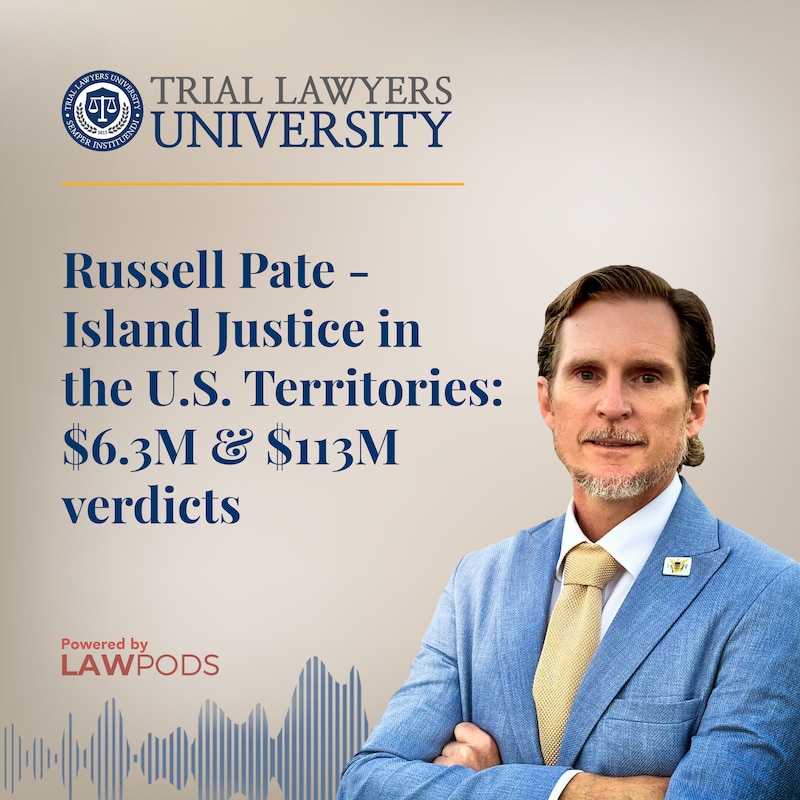
Shownotes
Little island. Big cases. Bigger verdicts. Russ Pate is a solo plaintiff lawyer in St. Croix whose career has included a combined $113 million verdict in two consolidated tobacco cases and $6.3 million verdict in a premises liability trial. He also worked with the Virgin Islands’ attorney general to pursue civil claims against the Jeffrey Epstein estate using the Virgin Islands' unique tax credit program. Taking a break from the TLU ski bootcamp in Big Sky, Montana, Russ sits down with host Dan Ambrose to reflect on his journey from that first roach-infested, $500-a-month office in St. Croix.
Train and Connect with the Titans
☑️ Russ Pate
☑️ TLU On Demand Instant access to live lectures, case analysis, and skills training videos
☑️ TLU on X | Facebook | Instagram | LinkedIn
☑️ Subscribe Apple Podcasts | Spotify | YouTube
2026 Programming
☑️ Training Witnesses to Transport Themselves and the Jury, April 17-18, Hermos Beach, CA
☑️ TLU Trial Skills Training, April 21- 25, Hermosa Beach, CA
☑️ Witness Preparation & Direct Examination, May 8 - 9, Hermosa Beach, CA
☑️ Dark Arts Trial Craft Bootcamp, May 27 - June 2, Huntington Beach, CA
☑️ TLU Beach, June 3-6, Huntington Beach, CA
Episode Snapshot
- At Chapel Hill (UNC) law school, Russ missed the first week, had no idea what a study group was, and received some of his worst grades in torts. As he says, “To be a plaintiff trial lawyer, you don't have to graduate from Harvard and be top of the class.”
- After law school, Russ landed a federal public defender clerkship placement in Dallas, where he worked as second chair on Ponzi scheme fraud and child pornography collection cases.
- Russ launched his solo practice in St. Thomas in a $500-a-month office with moldy carpet, A.C. units held together with rocks, and cockroaches that ate the bindings off his law books. His first client was a murder defendant appointed by the court the same week he opened.
- Russ worked with the Virgin Islands’ attorney general to pursue civil claims against the Jeffrey Epstein estate using the Virgin Islands' unique tax credit program, resulting in approximately $135 million in a victims' fund — the only state or territory to create a fund for Epstein's victims outside the private civil justice system.
- Russ filed his first tobacco cases in 2010, saw them delayed by two hurricanes in 2017, and finally tried them in 2018 with two juries simultaneously — one returned $31 million and the other $83 million for a combined $113 million.
- In his most recent premises liability trial, Russell represented a client who had fallen over a low railing at a hillside restaurant with a 0.22 blood alcohol and made a remarkable recovery. He countered the defense's paid medical experts by leaning on three lay witnesses who were present that night, leading to a $7 million verdict (reduced to $6.3 million at 10% fault).
- When the defense attacks his client on damages, Russell embraces it. He calls it “tightening the bow”: The harder they pull back, the farther the arrow of damages will fly when they finally let go.
Produced and Powered by LawPods
Transcripts
The most dangerous place you can be as a trial lawyer is to think you've got it figured out.
(:I'm still trying to get better. I still have the passion for it. I believe in it.
(:Everyone can learn to do what I do. And yet there's a group here that continues to get extraordinary verdicts. Trial Lawyers University is revolutionizing, educating lawyers to be better trial lawyers. It's been invaluable to me.
(:Trial Lawyers University, where the Titans come to train. Produced and powered by LawPods.
Dan Ambrose (:We got Russell Pate here from the US Virgin Islands. Is that right?
Russell Pate (:From the Big Island of St. Croix.
Dan Ambrose (:The big island of St. Croix. And we are here at the Big Easy Lodge in Big Sky, Montana. And Nick Raleigh was kind enough to let us use his place so that we could do our ski camp and raise a little money to help defeat Uber who's trying to destroy our civil justice system. So Russ, this is your second bootcamp and you were there last year in Tahoe with us. And in the meantime, he went home and amongst other things of living his life, went home and got himself a big jury trial verdict. And so that's one of the things we're going to talk about. And Rust is also an enigma because he ... First of all, he lives in the US version. He lives in St. Croix, right? So anybody can live on an islands in enigma, but he also likes to get involved in litigation that lasts more than 10 years and put all this life savings and wait and wait and wait.
(:So he's an enigma of patience too. So Russ, how did ... Well, first of all, Russ, what's
Russell Pate (:Your favorite part of ski camps since this is your second time? Oh, favorite part of ski camp? Well, I mean, you're having some fun and you're learning. And then it's also the team that you're meeting. I mean, if you're not out there every day trying to learn and better yourself, then you've already peaked. I mean, you're the best you're ever going to be. So I mean, Dan, you bring together the top people to learn from. I mean, you're standing on the shoulders of giants with the attorneys winning these big verdicts and being willing to teach. So I mean, I'm just here to be at the altar of trial law learning.
Dan Ambrose (:Yeah. And I appreciate that, but that's mostly what I think the bigger conference is, like TLU Hunting Beach and your first conference was the Vegas conference at Caesars Palace where it's like we have Huntington Beach, we got five lecture tracks, seven workshop tracks. And so we really do have a collection of the greatest lawyers coming in from around from all parts of the country, all different areas of law between personal injury, medical malpractice, employment law, civil rights, trucking, subspecialties. And people that have been just out there in the trenches, trying cases, trying new stuff, being innovative, seeing what works, see what doesn't work, utilizing different types of focus groups to figure these cases out. But this here at ski camp, or my bootcamps, is really about training the physical skills of being a trial lawyer. That really trains the intellectual skills because most of it sitting and watching, not all of it because we have the workshops where we do the physical skills and we even teach the stuff that we teach here, the cross-examination skills, the witness prepping, the performance skills, which are opening statement and closing argument, and of course the voir dire skills, which I really, I consider to be kind of four separate subsets of being a trial lawyer, but all related.
(:And really the connection, the relation is each one of these skills when we find is all about helping the trial lawyer connect with first their client because you have to get the client's story from them. If you don't get the client's real story, then you're just making shit up. And maybe it's right, maybe it's not. But if it's not, then the client feels very disconnected with the lawyer and the story because it's not their story. So he's telling a story about you and you're like, wait a minute, that's not the way it happened. It's like you were there, but that's not what happened. Let me tell you what happened. And that's, I think, part of our job, part of our calling is to be maybe the oracle or obviously the voice for the client because they're so typically traumatized. The last thing they want to do is talk about what happened to them.
Russell Pate (:Well, I mean, we represent people at their worst. I mean, most people who are injured are going to be ... They've got their family, they've got their job, they're a working person, and you've caught them at their worst and they've never ... They're not a person who's been able to speak in front of public. They don't know these legal concepts. So you are truly the medieval knight. You're coming in to help the little village against the hoard. And to go back to your bootcamp, yes, this bootcamp I think is so important for almost every lawyer to experience because 99% of your practice, you're sitting in front of the computer, you're drafting motions, you might be doing some depositions, you're being very lawyerly. And your bootcamp here, and I'll try to summarize it, it teaches you to actually, before you speak, have a warm, happy face.
(:And that's something I still very struggle with. I come off too serious. And before I stand up, even to question or give opening or closing direct, I think warm face, warm face. And from that, it prompts the rest of the training that you're making the eye connection with each of your jurors. And so you're training ... If you have a six person jury, you have two alternates maybe, maybe three, depending on the trial. Maybe you're in a state that has 12 and you've got a long trial, three months, you may have six or seven alternates. So you're needing to look at almost 18 people and to make that eye contact and then coordinate your movements synchronized with your eye contact, your speaking, your breathing, your warm face. And all of that, you can't do that. You can't be thrown into a baseball game and hit a hundred mile an hour fastball if you hadn't been practicing all these smaller skills.
(:And that's what the training does. And it's so important. Even if you only come once, it's going to be in your mind that you're going to, as you say, Dan, you practice it at the grocery store, you practice it with your friends. So once you at least have the concepts and the vocabulary, and this is what always amazes me about lawyers that are like not learning, they've peaked already. But if you're constantly learning, then you're constantly improving. And everything you do, you can improve an area of law, whether you're being more human when you relate to people or you're being more technical on knowing more of your rules of procedure or tricks of depositions and everything else. And that's you bring together the giants. And so every person who comes in that's one of these big verdicts, they have something to show you at some level that you can incorporate.
Dan Ambrose (:And this training, and I've heard this expression once, I can't remember. I said all of learning is pattern recognition. And so when you train and you repeat the same patterns over and over so that you can do them just like swinging a golf club without thinking, well, then you really understand pattern recognition. And then when you interact with others or you're listening to somebody tell you a story from their life, you will see all of these, everything that we learn here is like when they're telling a story from their own life, you'll see their eyes go avert into their head, access the image, their faces changed to match whatever, to be congruent with every story. They'd be like, "This guy comes in and he doesn't have to say, You're not going to believe this because his face, his emotional congruence is telling you, you're not going to believe this.
(:" And so as you train every day, every conversation, you're watching people and you're seeing all the patterns. There's an expression that the trained mind sees patterns where the untrained mind only saw randomness. And that's what the effect of training is and whatever it is that we're training. Here, we're training trial performance skills and it doesn't matter, it's the purpose of training.
Russell Pate (:Absolutely. I mean, the next thing too is vocabulary. Anybody who's an expert, they generate vocabulary that's expert vocabulary. Why? Because you can't communicate with other people in your class of expertise if you don't have a vocabulary for everything. So you'll meet lawyers that they haven't had your trial skills or these understandings. They'll say, "Oh, I did this at trial and I did this and I got this verdict." And you're like, "Don't you understand what you were doing? You were creating a binary choice." "What? ""Oh, you were polarizing." "Oh, I was what? "I'm like, " Oh, don't you understand you were establishing credibility there? "And they don't have the vocabulary to understand what they did. It's like a baseball player, it's always like somebody who grew up, it was always been easy. They've just been a star of their high school team and their college team.
(:And then you get in the pros and you just think that it's always happened. But at the pro level, at the highest level, you've got to have that understanding of vocabulary. And when you get in with these other lawyers, and that's what you're doing by creating a process, we have words for certain things, for concepts and ideas, and then you're able to implement them with an educated understanding.
Dan Ambrose (:TLU Huntington Beach is going to be the greatest event of 2026. There's going to be four lecture tracks, eight workshop tracks with the top trial lawyers in the country. On Tuesday, June 2nd, there's going to be a golf outing and also a pickleball outing. That night, we're going to have a dinner at the L'Oreal. We're going to buy it out so everybody gets a chance to meet each other beforehand. And then during the conference, of course, we do a full breakfast, full lunch, and theme parties every night. This year we're going to be utilizing the pool area and the restaurant for more of the parties, and we're going to have an adult swim right one night, a Satche Oliver party on Friday night, and the last theme party's going to be a 80s run DMC Adida jumpsuit. It's going to be the greatest. And last year we had over 800 people.
(:This year it's going to be over a thousand. So if you want to be part of it all and you want to stay at the Paseo Hotel, don't delay because it sells out fast and then you're going to be in the overflow. Can't wait to see you there. TLU Beach.
(:So Russell, how did you, because I know that you don't come from a long family tradition of lawyers like I do because my dad was a lawyer and two of my older brothers and my sister were all lawyers. So how did you get into this or decide you wanted to be a lawyer?
Russell Pate (:Okay. Yeah, I come from a family of doctors. So my mom's father was a doctor and my dad's father was a doctor. And then my dad was a doctor with his brothers. And so I mean, my dad was pretty much the smartest person I ever knew. He skipped two years in high school and he got a scholarship to Tulane that was like a half scholarship. So I said," Well, I'll just do all my classes in two years. "And so I mean, this was back before you had caps on your hours. So he just took like 30 hours each semester and literally rented out his dorm room to somebody else, sold his meal plan and crushed it through college. I don't think he actually graduated high school or college, but he got into medical school at essentially like Doogie Houser, like 18. And he applied to these medical schools and only one medical school, they're all like, " You're too young.
(:"One of the deans said to him," You a gunner. I want you. "And so he gets in and he's the smartest. I mean, he has like a photographic memory. So growing up the whole time, I thought there's no way, if you have to be this smart to be a doctor, there's no way I can do that. But I mean, I used to go, he'd take me into the hospital back in the 90s and I'd see him operate. I'd be in the room with him. You'd see the terrible stuff because he's the guy you wanted when you had a horrible crash on the road and you were mangled, like he's putting you back together, putting your intestines back in, pumping your heart, I mean all that stuff. And I just thought, I don't think I'm smart enough to do that. I
Dan Ambrose (:Don't think I'm stomach for it. I remember my dad wanted me to be a doctor. And so I just remember taking a look at my first chemistry class and smelling that stuff and then having to take care of all these human stuff that my blood and shit and all that like
Russell Pate (:... The smells are the worst. In surgery, you have a cauterizer. It's instead of a scalpel and olden days, the knife, it's actually like a electric burner and you can cut people open with it and actually burn the skin back. And that smell just gave me such nausea. But the blood was fine. I mean, we were standing in the blood all across the floor, blood shooting. I mean, I got spurted from an aorta. I mean, that was okay, but he could do math in his head. I'd pull a calculator out and he'd be like, " What do you need a calculator for?
Dan Ambrose (:"So we established you're not smart enough to be a doctor and you don't have a stomach for it. So this lawyer thing though. Yeah.
Russell Pate (:There was a lot
Dan Ambrose (:Of other things you could.You could be an engineer, you could be accountant.
Russell Pate (:You didn't
Dan Ambrose (:Have to be a lawyer.
Russell Pate (:No, I didn't have the math. My dad was always telling me, we were in Texas at that time, and this is before kind of the tort caps. So he'd been telling me these stories about Joe Jamal and his Texaco verdict, RaceHorse Haines, Marvin Bellai. And at this point with medicine, it was getting more restricted where insurance companies are running medicine, lawyers are running hospitals. So my dad would, let's say there was like a breast cancer. He would cut the breast cancer out and instead of just leaving the breast for a plastic surgeon, he'd like fix the woman's breast nicely. And then if she had a hernia, he'd like fix the hernia. Or if there's a big mole on the person's neck, he'd take it off and he would do that all in one surgery. And then the bureaucracy became where they'd say," Oh, you can't do all those at once.
(:You have to put them back down so we can bill it again. "And he's like, " I'm not doing that. That's not good for the patient. "So he would do these things and just not get paid for all the extra work. And he was fine with it. And then finally it came a day where you can't do it at all. It's not unethical, but against our protocols. And I mean, it was just him trying to treat the patient versus the bureaucracy of the hospital. And he just said," It's not worth to go in medicine anymore. You're constrained.
Dan Ambrose (:"Okay. So law, but how has he decided to become a lawyer? I think that was it.
Russell Pate (:I looked at it as my dad always was fighting for the underdog. He was a very non-materialistic guy. So I mean, he was going to do a surgery on a homeless guy. And my dad had a pair of boots that pretty much he nailed back together and duct taped. Even as a doctor, he wouldn't let him go. And the homeless guy goes," Doc, I can't pay you. "He said," Oh, don't worry. Don't worry. You don't have to pay me. This is free. "And the homeless guy says," Well, Doc, I want you to take my boots because they're better than yours. "So he always stuck up for the underdog and I kind of thought I'd be interested in that. But my grades weren't really that good. I'd always thought a college is, it's more about the learning and not much about the grades. It's more the discovery process.
(:So coming out, my dad had told me this story," Son, you can apply to any college you want, but the only school I'm going to pay for is Chapel Hill. "And that's because it was the state school. I mean, it was like three grand a year. And then when I wanted to apply to law school, he looked at me and said," Son, you can apply to any law school you want to and you can pay for it. "So then it really hits you hard. I've been looking at all these law schools and you find out, oh God, not that I could ever get into Duke, but you're like, " Duke, 50,000 a year, University of Chicago, 50 grand. "So I look back at Chapel Hill and I'm like, " Oh my God, I got to get in there. "But my grades weren't that good. So I mean, I just went down every day to the admissions lady.
(:I was head of the pre-law at that time for undergrad. So I'd figure out something that I could go talk to her about it, bring her a little gift. She was pregnant and there's a lot to be said when you're starting out to kiss some butt. You really need to-
Dan Ambrose (:Be a smoother.
Russell Pate (:Yeah, smooth, kiss but make connections and people want to work, just like you say, people want to work and refer to other people that they like and they're friends with, and that's social dynamics. What's wrong with that? It's evolution throughout history tribe.
Dan Ambrose (:So you go to Chapel Hill, North Carolina for law school and you get through law school. Did you do anything in law school that kind of ... Did you do trial ad or moot court and that kind of stuff?
Russell Pate (:Yeah. What I did in law school was probably do everything wrong. So I mean, it started with, I was dating a girl in undergrad and so she ends up ... I'm like, " Oh, well, when does college start for her? "And I go up to school with her and it turns out I missed the first week of law school. And so I missed," Oh, you're supposed to have a study group. Oh, you're supposed to answer the exams through this thing called like Iraq issue, rule, analysis, conclusion. "I had no clue. I was just thinking this is the greatest, you're learning all this stuff, but I didn't know what an appellate opinion was. We read these case opinions. I have no concept that it's like an appeal. I didn't know what a motion to dismiss or summary judgment standard was. It was clueless. So my first semester exams, they were horrible.
(:I mean, I don't know if I was last in the class, but it was low. It was really bad. Well, must be good to finally got through it all. I mean, and it's the classic thing, my worst grades were in torts. I mean, it's like a humorous example of a good thing that to be a plaintiff trial lawyer, you don't have to graduate from Harvard and be top of the class. No.
Dan Ambrose (:In fact, they'd probably be detrimental,
Russell Pate (:Too
Dan Ambrose (:Intellectual, not enough humanity. But after you get out of law school, where do you land your first job?
Russell Pate (:Well, in law school, I didn't go through the ... You're supposed to do these interviews and all this stuff, and I didn't have the grades for that. And then the one time that I go to an interview, the guy says," Well, I took your interview only because I'm going to be a friend to you. It's not trail law, it's trial law. "And I'd had a spelling mistake on that. I'm like, " God, this is not working. "So my one interview was the guy just to be like ... And actually, you feel so hurt on that, but he was doing me such a favor to tell me, " Look, you even have spelling errors on your resume. "So I thought," I'll just apply to a million different places and I'll go to these conferences. I'll go to the AAJ conference, I'll go to the ABA, I'll meet lawyers and they'll see how hungry I am.
(:"And again, and I sent out like a thousand letters to work at places. And I got a stack back of like 300 like, thank you, we received your thing, no thanks. But I did the ABA meeting in New York and then I went to Brussels and Belgium and that's where I met a lawyer from the United Nations who just got hired by Simmons Cooper, the biggest bestest firm, now it's Simmons, Hanley Conroy. And at that point, they're trying to do some work in South Africa and I said," I'll be happy to do some legal research. "And so I just kind of was doing legal research for them in law school and got to pass that work up and it helped. I won from a legal research paper I did for kind of helping that firm, I then published it and I find out like six months later I made three grand.
(:The Texas State Bar Journal said," Oh, you're the law student publishing. You got first place. "And so I got three grand out of it and then ended up going to work for them for my second year summer. And then I thought," Hey, I'm cruising through this. I did it my way and I'm going to end up working at a plaintiff firm after I graduate law school my 30 year and right into my spring semester, I get a call from the attorney that I was working for and says, I've been fired or let go or whatever. "And so when I called Simon Scooper, they're like, " Who are you? "So at that point I'm like, " I don't have a job and everybody else is locked in. "And so of course that gives you a lot of heartburn and at that point your world is falling apart.
(:So I applied for a LLM at California Western and it was on trial ad. And so I ended up going out to California Western and they did a one semester training program out there in San Diego. And then the second semester they place you into like a public defender's office, federal. So I asked to be placed in Dallas because I had some family there. And so I got placed into the Dallas Federal Public Defender's Office and it was great experience. They had me match up as a second chair with kind of one of the attorneys there. I might miss it, but I think it was Sam Ogden. And he had classic like Texas handlebar mustache and he was an old pro at what he was doing. And so we did one Ponzi scheme fraud case defense and like three child porn. And when I say child porn, it's like collection of these guys that sit in their mom or grandma's basement and just collect porn.
Dan Ambrose (:Join us April 15th and 16th in Hermosa Beach, California at the TLU Beach House. We are doing a two-day witness prep and direct examination workshop. The witness prep will teach you not only how to get your clients to remember their stories, but to relive them, and then the direct examination so the jury just doesn't hear the story, but they experience it, they witness it. And this is right before Nick Riley's Trial by Human in West Hollywood, April 17th through 19th. So come for the witness prep, stay for trial by human. We'll see you there. Sounds like inspirational work there. So after, how long does that stint last for?
Russell Pate (:Well, I'm doing that for the semester, so about five months and you do some of the motion practice. I mean, you're the lowest person on the totem pole and you're working as an internship for free, but it got you into the courtroom. And I mean, the big issue on that, you always try to rationalize how are you helping? And at that point, the federal government, the US Attorney's office, I mean, they were asking for like 20 years for these guys that just collected ... They didn't just collect child porn. They collected all sorts of porn. I mean, it was every midget to horse to midget the horse to whatever you can think about. And the worst part is you had to review the little thumbnail, the really small one to just make sure that it was terrible. But be like, okay, that's not child porn, that's like a horse.
(:And then you'd be like, there's only 200 images to like rebut on the government. But they were getting 20 years. And at the same time in Texas, somebody would go out and really like rape somebody and they'd get seven years. So you could rationalize your defense as a part of justice that the punishment is just disproportionate to the harm. But after that, the public defender there, amazing guy, Richard Anderson, told me, "Hey, you guys did a great job." And I'm like, "Did a great job? We lost every one of our cases, the guys got slammed." And he's like, "I know, but the US attorney there is now giving us better plea offers.That's a win." And I think that really helped me as an attorney to realize that the win is not what you think. There's clients that you get low settlements for and they're very happy.
(:And there's clients you knock it out of the park and they're unhappy. So it's really client expectation. You have your internal drive, but you're judged on the expectation of your clients or your boss. And so the boss said, "Well, you did great. We want to send you up to Amarillo in the Northern District of Texas because that US attorney up there is all in on this now and he's wanting to do these child porn cases." So at that point, I wasn't really enjoying the big city. I'd always been kind of a small town guy and I thought, "All right, I'm really not liking Dallas and I really don't know if I want to go out to the middle of the Panhandle."
Dan Ambrose (:It would have been a small town that you were looking for.
Russell Pate (:Well, Amarillo is actually, it's a pretty big place actually compared to little towns of like 10,000 people. I don't know what Amarillo is now, but I think it's over a quarter million. And so at that point, I just was like one last ditch. I sent out again like a million resumes. I mean, I feel like I sent them one to American Samoa and the North Mariana Islands and Palau and the Channel Islands. And my mom's from Aruba, so I sent some resumes down to the Caribbean, to the Virgin Islands. And I had a call back from an attorney, I mean on St. Thomas, that's our cruise ship island. And he was interested in me because I'd done some asbestos work and it was an insurance defense firm and there's a big refinery on St. Croix. It was actually the largest refinery in the Western hemisphere, the Hesaw refinery.
(:And he said, "Hey, I'm interested in this. We do some refinery litigation defense work, but in the Virgin Islands, it's not just an interview. I need you to come down for three weeks and I got to give you a test run because a lot of people can't hack it down here." So I said, "Okay, I'll fly down and do my tour of duty." And that's when I ended up flying down in April or May of 2008. So it was a
Dan Ambrose (:Thriving time to come out and look for a job?
Russell Pate (:Yeah, that was the great recession. So no surprise that all of the things I sent out, that there was no offers back. So I'm doing my three week trial run and seeing I'm not getting any offers back. And I said, "Okay, I think that this Virgin Islands might be the place. At least I've got a steady job and it's litigation work."
Dan Ambrose (:And so how long do you stay with this fellow or this defense for?
Russell Pate (:So I was there not quite two years at about a year and a half, they'd lost a big insurance client. So I got kind of a nice farewell that said, "Hey, you can keep working here, but you're going to run out of hours and so you're going to start making less and less because you're not able to bill on this stuff." And my boss had said, "I can write you a letter of recommendation for a clerkship." Because the Virgin Islands actually all judges have clerks. The trial court judges have clerks. We follow the federal model. So all of them write these giant memorandum opinions. I mean, you get full published opinions at the state level. And I probably should have clerked. I just was too naive at that time and I didn't really want to switch to a defense firm. I actually didn't really like law because it was so boring that year and a half, I mean, you're just doing what defense firms do, like objecting to discovery responses, moving to compel, filing motions to dismiss, just anything you can do to stop the train to trial.
(:So I called my dad up and I said, "Dad, I hate law. This has been terrible. I want to go travel from South Africa to Sweden and maybe I'll figure some stuff out to do that's law related while I'm traveling." There's a pause on the side of the phone, "Son, there was a time and a place for that. " It's called college. That's over. You need to work, get a job. I'm like, "Well, dad, I mean, if I start an office, I have no clients. I don't really have any money. I mean, it's really expensive. I'll probably go into a huge amount of debt. I'll be bankrupt. I mean, I'll have credit card companies chasing me, kind of a little pause again. Well, son, then you can run to Africa and they probably won't find you there." I'm like, "Okay, well..." And that was the thing, I went out and was like, "Okay, how am I going to do this?
(:" And I looked around for office space and you look at the first place and, "Oh, 5,000 a month." And I'm like, "Oh my God." And then you go to another place, 3,000 a month, oh my God. And the next place, 1,500 a month. And I'm like, "Oh, that's still even more than my rent for my little apartment." And so finally, I find the cheapest seats in one of the oldest buildings in downtown St. Thomas, and they say 500 a month. And I'm like, "Okay, I think I can do that. I think I can do that. " But I mean, I had a hard time watching Better Call Saul because my office was a little bit on par with his little office at the back of the nail salon. You walked up these very sketchy back, rotten, wooden steps, which you couldn't ever bring a client there that's injured.
(:And then you walk out and you go in this third floor shed and the carpet's moldy and the walls have stuff growing on them and AC units with rocks in them and that's not even talking about the army of cockroaches.
Dan Ambrose (:So you find your new office and then tell us about how you start to get clients and what you start looking for.
Russell Pate (:A lot of times you have to have a certain level of naivety and hope that anybody else just says, this is idiotic and you kind of persevere. It's kind of like the young adventurer that leaves the hometown for glory and you have no real sword, you have no real shield.You don't have a horse, you have like a donkey. And so I mean, the newspaper had just had like a new deal on advertising. So I'd sat down and I'd made my little manifesto for my office.
Dan Ambrose (:So Russell, you start advertising for the cases that are your target dream cases, the asbestos, The tobacco, the class actions. And obviously those are all big picture, long-term projects. And of course you have to pay the bills. And so you start doing some form, what we call in the law business, street law.
Russell Pate (:Absolutely.
Dan Ambrose (:If it walks enough the street and you can handle it, you do it. So what kind of cases were you handling as a street lawyer before you started to be able to move the asbestos cases and stuff forward?
Russell Pate (:Oh, it's just a crazy mix. I mean, we have a wrongful discharge statute, kind of like a labor employment statute, maybe like California. So I did some labor, some wrongful discharge. For some reason, it must have been a dog bite epidemic in the Virgin Islands. I had dog bite cases out the wazoo. The issue there is finding a homeowner's insurance policy. That's difficult. And I even had an iguana bite case. So I haven't found another lawyer that's handled an iguana bite case.
Dan Ambrose (:And I haven't met him to let another lawyers handle water. I knew when I met you, I was like, "This guy's special. Didn't know why, but it's the Iguana Bite case."
Russell Pate (:Yeah. And then ended up having, you had a lot of different premises liability. Our car insurance insurance is so low. It's just 10, 20 policies. Still? Still. So I mean, the saddest thing here is if you actually have somebody that has serious injuries, you cannot make them happy. You can't actually take the case. If they need a $50,000 surgery and there's a $10,000 policy and the person has no assets, what are you going to do for them? Taking the case, actually, you become the bad guy. You will be blamed because there's no outlet for the person who's hurt.
Dan Ambrose (:How
Russell Pate (:About
Dan Ambrose (:Criminal law? Any criminal law?
Russell Pate (:Oh yeah. Oh, goodness. Well, thank you for bringing that up, Dan. So we're talking about me starting my office and I think I finished with all the roaches. But while I'm sitting ... There were so many roaches they ate my lawbooks that I put in my new office. I came in and the bindings were all eaten out. And I learned that, okay, roaches actually eat glue and they will destroy your books. And so I bug bomb it. I come back in the week after it's bug bombed, clean out two giant garbage bags of roaches from my office, sit down at my desk. And I'm like, "Okay, what am I going to do now? I'm here, but when's the phone going? " And you're almost roach free. So that's a big start. And while I'm sitting there being like, "How do I get the phone to ring?" I get a phone call and the court clerk says, "Is this Russell Pate?" "Yes.
(:""We've been trying to reach you at your last office." "Okay. Yeah, I moved this is my new office. I just started it. ""Well, you need to hurry down to court. You've just been appointed a murder case." And I'm like, "Oh." It's like, "Yeah, he's in lockup right now and they're going to have advice or rights soon." And I'm like, "Okay." I put on my suit and tie and walk down to court. And that was my first client, Joe. Was that
Dan Ambrose (:Your first criminal case?
Russell Pate (:Me as a first chair, yeah. I mean, I had done some of that. We had those- In
Dan Ambrose (:The public defender's office.
Russell Pate (:Four cases where I'm second chair. But yeah, it's funny because in the Virgin Islands, every member of the bar can be appointed a criminal case and there's actually a high per capita murder rate and rate of violence. I mean, we're at or above downtown Chicago or New Orleans. So people think, "Oh, it's paradise. It's paradise." But it's a confluence of the drug trade and personal grievances and everybody knowing everybody. And so I get my murder case appointed and you would think when you tell the judges, "Well, I've never done..." I come in and meet with the judge the first time and I'm like, "Your Honor, I've never done a criminal case before and this is a murder case." And the judge just looks at you and goes, "Well, you're young and you're ambitious." And I found out that the young new lawyers do a whole lot better job.
(:They do more detailed work than the older lawyers that are jaded on this. And I'm like, "Okay."
Dan Ambrose (:So much for getting yourself out of that murder case.
Russell Pate (:And I mean, over time I've had, I think it's eight murder appointments, well, maybe two attempted murders and six other murder cases. And we've tried, I remember specifically trying two cases and having kind of a mixed verdict. So it was a lesser included. And it was nice to be in the courtroom, but I prefer civil law because I like ... It's a small community that you're living in down there. And already we have a high crime rate and I enjoy taking and helping the person who was the family man who went to work every day and then something bad happened to them and they were doing their part and now you're being their champion. And I just feel like that's- They
Dan Ambrose (:Felt better than trying to save a very bad person from 30 years and maybe get them 10 years and they're still a very bad person.
Russell Pate (:Yeah. I mean, the thing is most of the time, by the time you represent the criminal defendant, they're very nice to you. So I mean, when you meet them and you're their champion, I've never had an issue where any of the criminal defendants I was appointed were bad or mean to me. They're very interested in winning their case. Oh
Dan Ambrose (:No, absolutely. Not that they're bad or mean. It's just that I did criminal defense for 17 years, like zealously, religiously. It was my life. And let me just tell you or anybody that's like, it's a hard life. It is the most stressful job and it's even worse when they're innocent. Nothing worse than an innocent man to make you lose sleep, lose your appetite, lose everything, and all you do is focus on them. And it's so detrimental for your business too, because you don't think about making money if you have somebody's life in your hands. All you're just trying to do is work your ass off. And then if you truly believe in somebody and things don't go your way in a trial and you see that person let out of the courtroom in handcuffs and you know they're going to be in prison for 10 or 15 years because you weren't good enough, man, I know why people, a lot of these lawyers drink so much because it's a lot to deal with.
Russell Pate (:Dan, I will one up you on that for what's worse than that criminal defense.
Dan Ambrose (:Divorce work.
Russell Pate (:That's the most dangerous for lawyers if you're going to get threatened or shot is usually divorce work or child custody work. But you've now made me remember I had a court appointment that was guardian ad litem to a, I think an 11, 10 month or nine month old that a man, boyfriend or whatever had grabbed by the legs and slammed against a concrete wall. And so I went into the hospital and the baby had a giant hematoma off its head and you kind of repress those. And that is something that is just so horrible and I'm representing the interests of the baby in kind of this criminal custody issue. It was a huge family court mess. And I realized I never want to see that again. And we know what we do, you think of the doctors that see that every day and the court system, you have to get numb to it.
(:Like you said, doctors that are lawyers that become drinkers.
Dan Ambrose (:April 21st through 25th in Hermosa Beach, California, we're hosting a bootcamp where you will train in the fundamental skills of trial, witness prep and direct, cross-examination, performance skills, which are opening statement and closing argument and jury selection or voir dire, depending on where you live. You're going to focus on eye contact, voice control, emotional state control, hand and body movement, glance control, creating space amongst other skills. And then once you learn these skills, we're going to apply them to your case. So at the end of the day, it's an investment and a case expense. This program will fundamentally change your life. So you eventually get your cases going that you want to do, the mass torts that asbestos. So how do you go about ... Because one of the things that fascinates me about you is the fact that you just figure shit out like Epstein.
(:I mean, one of the most prolific, horrible human beings ever, but that's one thing. But what did you ... You're down there in that neighborhood. His little island was somewhere near you. So when all this started happening in 2018, what did you do?
Russell Pate (:So that's interesting. So between ... I had done my asbestos and tobacco cases, and I remember all this Epstein stuff happening in the news. And a lot of lawyers in the Virgin Islands that handle tax credit work, it's a small pond. So they had dealings with Jeffrey Epstein on the either real estate or charity giving or tax credits and stuff like that. But I'm a poor person lawyer. I'm like a normal person lawyer, so I never had any of those dealings. But my dad had called me up when Epstein was arrested and he's like, "That bastard guy, you need to figure out a way to sue him. This is what you do. " He lives down there half the time. Can't you figure out a way to sue him? And I told my dad, I said, "Look, I don't have any clients. You need to have a victim." And these lawyers in the states all have victims.
(:And a little bit later, and depending on what conspiracy theory you believe, Jeffrey Epstein committed suicide in prison. And at that point, I'm like, "All right, so it's his estate now." And the estate was being opened up in the Virgin Islands. And I just really try to think of creative ways. And I'm like, "This dude was using all these tax credits to essentially for misuse." We have a tax credit program in the Virgin Islands that people can come down there and create business and do local hires and give to charity and kind of like grow your business there and have some tax credits. And he was using them to facilitate his trafficking that he did between Florida and New Mexico, Europe, and New York. So that was one of these things that I worked with the local attorney general's office to figure out, from my knowledge of kind of civil practice and complex litigation, that you don't really have that experience in these criminal offices, the complex civil litigation.
(:And you see all these states now, when they do a big complex case, if they're suing opioids or Johnson & Johnson or Big Pharma or even the tobacco companies, you bring in the best of the best on the civil side. So I worked with Motley Rice and the AG, I mean, she's a hero, Denise George. And I'm really proud of that work because if you look back, Florida had the most abuse for the girls. I mean, Epstein had 400 something teenage girls in high school that he'd bring them in on massages and pay them cash and then from there do the molestation. And that's the epicenter in Florida. New York was his second place because he had his penthouse off of Central Park and he had a whole condo owned by his brother that he would lodge his girls there and chauffeur them over to his house.
(:And he had a set of doctors that could give them gynecological appointments and birth control and abortions. And then you had New Mexico where he had his ranch out there, and then he'd go over to France. And if you look at all these other states and even the federal government, the jurisdictions, Florida botched his prosecution. I mean, they gave him the biggest sweetheart deal imaginable. The Feds took that over and it was Alex Acosta who's the US attorney, get him sweetheart deal. And it was only the Southern District in New York that ended up trying to take up the Epstein prosecution years later and then the Ghislaine Maxwell prosecution. And I mean, if you don't look outside of that, you had the heroes, the civil lawyers, particularly like Brad Edwards who, I mean, read his book by relentless pursuit by Brad Edwards and see what Jeffrey Epstein tried to do to a civil lawyer.
(:I mean, this man went through 10 years of Epstein trying to tar and feather and bankrupt him, and he stayed the course. My life is easy compared to what Brad Edwards did for these victims. But on our side, I try to tout what the Virgin Islands did because through our case, we're the only jurisdiction to make a pot of money for the victims. And I can't remember now, but I mean, I think it was like 135 million that was put together as a victim's fund and like a hundred, I can't remember exactly, but over ... There are some numbers on this, but over a hundred women were able to have claims on that. And outside of the civil justice system, private civil justice system, the Virgin Islands is the only thing, the only state or territory to do anything for the victims.
Dan Ambrose (:And so you get involved with that and now that litigation's concluded that only took a few years.
Russell Pate (:Yes. I mean, there's tangential. JP Morgan was brought in on kind of its lack of oversight with Jeffrey Epstein using their bank accounts for paying settlements to the victims. Leon Black had paid a settlement. So there's other civil litigation and who knows? I mean, I still think of, in my mind, there's still, I believe, legal theories and liability out there potentially. But I think people feel like it's run its course, but I'm kind of like, I guess, a West Texas oilman where I think, well, well, it looks like it's right, but if we frack it, you can find some more if you just are creative and come from a different angle.
Dan Ambrose (:Well, just backing up again, I got sidetracked there because you're asbestos and tobacco litigation. So from the time you started filing those, when did you get your first asbestos cases?
Russell Pate (:So if you come out of law school, I mean, law school teaches you nothing. I mean, don't even draft a complaint.
Dan Ambrose (:Everybody knows that. So teach you how to pass a bar, if that.
Russell Pate (:And- The
Dan Ambrose (:Rest of it, terrible waste of time.
Russell Pate (:And I'm just amazed on your ... You really want to mentor people, and it's pretty much charity. You tell law students, "You can come to my events, help work, and you can see the real practice of civil law." And even at your bootcamp here, you had a law student. I'm amazed. I mean, it's a kid in law school here learning some of the skills. And my talking to him is, "Listen, they're not going to teach you in law school if you want to be a plaintiff lawyer. You need two things. You need the ability to get clients, plaintiffs, and that's super difficult because you've got these giant billboards, you've got TV commercials, you've got social media, and these firms are putting in millions of dollars a year and they're sucking it all up." So I mean, you're not taught how do you find clients and you don't understand anything about referral fees and how you're losing all this money because you get a client and you already owe somebody else 50% of your recovery, up to 50%.
(:And then the next thing is, where's your war chest? I feel terrible. Your kids come out of law school and you're like, "Oh, I want to do plaintiff law." I'm like, "Do you have $300,000 in the bank? Is your family wealthy?" No, no, no. Well, how are you going to fund your cases? How can you look at a client and say, "I can help you when you don't have the 50 to 100 to 150 grand to get a personal injury case to trial." And that was the problem. You have to have this naivety. And that was me starting my own office. I had so much naivety that I just assumed somehow, some way I'm going to be able to do it. And I thought, "Well, if I don't have the money, I'll get the clients." It's kind of like Field of Dreams. If you
Dan Ambrose (:Build it, they
Russell Pate (:Will come. They will come. So I started advertising, I started keeping my database of the potential tobacco clients and my potential asbestos clients, and I pulled off the plaintiff's hot 100 and every day I'd sit down and I'd make five phone calls and I'd call the firm and I'd give my pitch. "Here's the tobacco cases, here's the asbestos cases, here's prior verdicts in the Virgin Islands, here's prior verdicts in Florida, here's the potential, here's the benefits of our jurisdiction. "And guess what? I got a lot of no's. I mean, I think I went through the whole list and some. So I had 150 phone calls. No, no, no, no, no, no. And at that point I went," Okay, let me go one more time, but this time I'm going to ask them, can they recommend anybody? "And so I did the whole calling again. And at that point, each person, I tried to get like just one or two recommendations.
(:And then I called those law firms and I was able to get my asbestos cases back. It took eight or nine months of doing the calls. And then for my tobacco cases, I mean, this is just serendipity. I had already filed one of my cases where the plaintiff had told me he had given free cigarettes. He'd grown up in the Virgin Islands. His father was killed in the military. And so his mother sent him up to his grandmother's in the Bronx and he's like nine years old and he talked about coming home from school and they would put little four packs on the doorknobs. And he was on a five-story walkup, so four rooms on each floor. So there was 20 packs of cigarettes, four packs. And it was happening like once a week or once every two weeks for over a year. And so he'd come home to his little housing project and he'd see that.
(:And as a nine-year-old, he's super excited. He'd collect them all and then go hide them down in the basement boiler room. And they got him popular at school and he started smoking. And I thought, this is crazy. They're giving away free cigarettes. And at that time I type it into whatever Google and it turns out there's a trial in Massachusetts, the first tobacco case ever in Massachusetts. And the story is woman who grew up in the projects in Boston, same thing. They put four packs on their doorknobs. So I call them up and they're like, " Hey, we're in trial right now. "And I said," Well, look, I've got a witness that could testify to the four packs. "And they're like, " Well, he's not on our witness list, so we couldn't do it in trial. "I'm like, " Well, what about rebuttal? I'll fly him up there if you need us for rebuttal.
(:"When I say fly, I'm like, " I have no money at that time. So I mean, this is like just more credit card expense, but I knew I was going to do it and get up there and do whatever it took. They didn't need it, but it turned ... It was the Marie Evans case and they had a huge verdict. And the guy who did it was just like me, but he was an older lawyer. He was doing kind of just boutique litigation in a midsize firm that did plaintiff and defense, and he'd taken this for kind of a malpractice case and put tobacco companies in it because she smoked. And it was, again, kind of serendipity, just kind of naivety, but passionate determination, like never giving up. And it was Michael Weisman who opened up Massachusetts now. And that's really the epicenter of tobacco cases.
(:And I have to give one shout out too to Professor Dick Dainerd. He's the godfather of tobacco litigation. And from the early 70s, Dick Dainer after that backed my cases in the Virgin Islands, which you asked me, I filed those in 210. We didn't get them tried until after our two cat ... We had two cat five hurricanes in 2017, Irma and Maria. We call them a Cat 10, Irmaria. So 2018, we finally had the trial on those two cases, and I really compliment the judge, Judge Michael Dunston. He was very creative. We'd asked to consolidate the cases and have two plaintiffs in one trial. And the defense, I mean, they object, they hate that. I mean, they object out the wazoo, even though consolidation is used all across the country in asbestos and products liability, tobacco is like, "Oh, well, we're unique. We're so unique.
(:You can't possibly do this. " And the judge said, "Well, how about this? " When you're talking about general causation and things like addiction, we'll have both juries seated. And then when you're talking about the injuries for one person, then we'll seat one jury. And so we actually had two juries and 80% of the case is the same stuff. So two juries set 80% of the time. And then when we went into individual injuries, one jury had a day off and it came back, the two juries came back with their verdicts and one jury was 31 million and the other jury was 83 million, so 113 total. And of course it's appealed. And in 2022, we finally got paid. The verdicts were cut down some, but it still was a huge win.
Dan Ambrose (:12 years later, is that
Russell Pate (:Right? It feels like yesterday,
Dan Ambrose (:But yes. Time flies when you have a plan.
Russell Pate (:How
Dan Ambrose (:About
Russell Pate (:Asbestos?
(:So same thing on that. The refinery in the Virgin Islands is kind of a study on ... I don't think there's any other way to put it at that point in time, a study on- Mass poisoning. ... class and racism. And I mean, the reason it's built in the Virgin Islands somewhat is that it's as far away as possible from kind of the EPA and OSHA and IMSHA that you could be. And it was packed with asbestos when they built that in the late '60s and then they would bring in labor from ... There wasn't enough labor in the Virgin Islands to support it. So they had a very liberal policy of importing labor from down Island, all the other islands below us, St. Lucia, Trinidad, Dominica. And these guys that came to work it were very excited. They're very motivated, but they weren't educated.
(:I mean, they grew up with their parents being farmers and kind of like fruit or banana plantations, and they were brought in on what's called bond. So they weren't American citizens. And when you were fired, they pretty much were like, "You're out of here. 48 hours, grab your stuff, you're out. " So these guys were really, I mean, absolute yes, men. Whatever they were told to do, they did it. It didn't matter how dirty, how dangerous, climb that tower a hundred feet with no harness, dig something out of the top of it, they did it. And they'd have families in the Virgin Island. So they'd end up marrying a woman having American citizens as their children with this threat hanging over their head any second that if they said no to a supervisor, that they'd get their pink slip and they had to get out back to St. Lucia in 48 hours and never see their family again.
(:And they were never told about, they were never told about the asbestos, what they were doing. And we built a pretty damning evidentiary evidence out of this for trial. So we actually have never tried one of the asbestos cases. It takes forever to get a trial. Just the courts are kind of slow in the Virgin Islands and you get closer and then you get a segue pulled over here or this or something happens, you have a hurricane or the power goes out or just something happens. And then when we finally can get a trial and we can hold a trial date, there's that come to Jesus moment from the defense where you settle the weekend before trial.
Dan Ambrose (:But our mutual friend, Scott Frost, he tries a lot of cases. He tries to three, four abest cases a year, which is like, and he tells me it's such a hard job because every one of his clients has got a death sentence basically. So emotionally draining stuff.
Russell Pate (:Well, I always say, plaintiffs really are your heroes because anybody that you're picking up that's already dying, they're not only at their worst, I mean, physically, mentally, they are trained and you're asking them now, "I need you to remember all of this stuff. And then I need you to endure the cross-examination, the punishment that the defendants are going to give you. " When most people are just like, "I would like to die in peace." So I mean, they're not ... And the whole issue of civil law is that you're trying to make a safer world for the future. It's deterrence. You can't say full compensation for somebody who is going to die a horrible, painful death means othelioma. There is no amount of money. You can give them a billion dollars and they're going to say, "No, thank you. I would like to not die this horrible death." So it has to be deterrence that, "Hey, my children and grandchildren will live in a safer world if I bring this case." And Nick Riley had talked about that in one of his books where he talks about that courts have stopped using deterrence and it's like, "Oh, it's just a full trade for all harms caused.
(:It's fair and reasonable compensation to make the plaintiff whole." Okay, but that's only like one pedal on the bicycle. And so in Nick Riley's book, he had a bunch of Iowa case law that if you go back 200 years ago, the judges are all like, "No, it's not only full paying full compensation, but if you are forced to pay full compensation, then all these bad actors will be deterred from doing it again." And so I have briefing on that. I'm always happy to share it. And I've sent it out. I know I sent it back to Nick Riley and his team, but I've got a lot of briefing that I go through old case law from all 50 states and it's old. I mean, you were in 50s, the 1920s, the 1800s, but it exists where the courts are like, yes, civil compensatory damages have a deterrence effect and we got to get that back into our jury instructions.
(:So I know you'll have my email in your podcast-
Dan Ambrose (:I was going to say, I still want to talk about the final things I want to talk to you about are the trial that you recently did down in your home island there, but if people want to get ahold of you because I know you're working with my buddy Kimball Jones on tobacco cases in Las Vegas. Las Vegas. And you're always looking for new wrongs that are out there that for just like this, who else is bringing ... Not many other people are bringing these cases or putting these cases together.
Russell Pate (:Yeah. Tobacco cases, they can be done in a lot of states. I mean, California can be revived. I don't want to go into the technical details on this, on this podcast, because I mean, this is ...
Dan Ambrose (:We have a whole nother podcast just on tobacco litigation. So anybody that's interested in tobacco litigation, we'll get you a whole new podcast so that you understand the roadmap and how Russ goes about putting these things together, which is just like, you may not be as smart as your dad, but you're definitely smart and have the ability to focus more than most people that I know. Join me and my mentor, David Clark, May 27th through June 2nd in Huntington Beach, California for a dark arts bootcamp. This program will change your life. Dave will teach you about neural linguistic programming, conversational hypnosis, embedding stories in the unconscious mind. He changed my life and he'll change yours, and I'll coach you on your witness prep and direct, cross-examination, performance skills for opening statement and closing argument and voir dire. These days will change your life. Come for the bootcamp, stay for TLU Beach, the greatest conference ever.
(:So how do people get ahold of you?
Russell Pate (:So the cell phone 340 Virgin Islands area code 690. That's the old school cell phone number intro. 7283. So 7283, that's my last name, P-A-T-E. So send me a text. And then the email is Pate, P-A-T-E, @sun, S-U-N, law, L-A-W, VI for Virgin Islands, [email protected].
Dan Ambrose (:All right. So you mentioned Nick Riley. And your first TLU big conference was Caesars Palace 2024. First of all, how did you find TLU?
Russell Pate (:I don't know. I mean, I always want to learn. So first, I mean, now that I've been practicing longer, I work with different stateside councils as co-counsel. And the first thing I do is I find out who their associates are on the team and I send them my five books. It's like the Old Testament Pentouche or whatever. These are the basic books you got to know. You got to know Rules of the Road by Friedman. You've got to know Advanced Depositions. You got to know Polarizing the Case, the 30 by Mark- Kosrowski. Kosarotski. Just call them Koz. And then David Ball on damages. And I mean, that is your Bible for starting out. Advanced
Dan Ambrose (:Deposition. Is that Philip Miller?
Russell Pate (:Yeah. And these are the giants. The mousetrap. Yeah. Philip Miller, you've got to know the mousetrap. And kids that are out of law school, I would be like, if you have a law firm right now and you are hiring anybody, you need to assign one book every semester. Every quarter, they need to be reading those five books. Absolutely. Bar none, basic education. And I mean, if they don't know the boxing end, the mousetrap, how to polarize, because most people are terrified on their cases like, "Oh, they're beating up on my plaintiff and they're making them look so horrible." When you understand polarizing the case, you are happy about that. You are very happy they are attacking your plaintiff and you keep pushing that, pushing them out on that scale, out on that cliff as far as you can. And I call it tightening the bow.
(:They're pulling that bow back that when they finally let go, you're going to shoot that arrow of damages so far. That's where you take little cases and get big damages from is because the defense is just rabid dog against you with no rationality. It's all lost and you need to embrace that. Don't fear it. But TLU, yes. I don't know how that ... I know I found it because I always want to get better. And at that point I came out to Vegas. It's a little overwhelming for me. The Virgin Islands is a very small place. We don't have our tallest building, maybe three stories. It's a small town and you're living in a little place of like, it's 50,000 people, but it feels like 10 in St. Croix. So I come to Vegas and you have brought in the top talent from everywhere. You can learn every ... There's no bad session to go to.
(:And I really appreciate it. There was a session on voir dire or voir dire and you had Nick Raley and Arash Amanpour. And I love the juxtaposition that was there because Arash Amanpour is, I mean, just the most powerf ... Polished, just classically trained jury selection. And if you're starting out, you learn that. If you could do what he do, oh my God, it was amazing. And then Nick is like, he's pushing the envelope. I mean, he is doing things that you really can't do. And I like to push the envelope. I've definitely done it, but you can't push the envelope until you've mastered the basics, like how to do it right. And then I mean, you've got just amazing people. I think Michael Hill talks about nobody, he has done nursing home cases and he's like, nobody cares about the injury. No one cares.
(:It's the why. It's the systemic failure. If this is not stopped, your children are ... How to get into the jury box. If this conduct, this systemic failure is not stopped, one of your family members will be injured. So it's not about how hurt your client is. And that's the same thing back to doctors and everybody else. They see people crushed all the time. Whatever. And you look at ... There's just so many great people you've brought together. I like Kirk Zehner lately because he talked about his loss. If you're not losing, then you're not trying enough cases. And I mean, my first couple cases that I did try in the Virgin Islands were losses or like low verdicts, very disappointing, like below settlement value. And they're crushing. You're like, oh, just like you said, your ego gets crushed. But I think if there's anything in life, it's just never give up.
(:It's the most simple thing ever. And I tell that to my son a lot. He's two and a half. And the most pride I ever had lately was he looked at me and said, "Debta, I did this. I didn't give up. I didn't give up." And I'm like, "Oh my God." I'm almost crying like, "There it is. Don't give up."
Dan Ambrose (:Resilience.
Russell Pate (:Yeah. Just keep going.
Dan Ambrose (:Resilience is so critical because there's going to be ... I was at Panish's conference. He has his own little PSR conference. And honestly, it was great because it was in a beautiful place, Ohio, but they're like the firm that operates across the board at the highest level. And he brought the speaker in and I'm not really big on motivational speakers because if you're not motivated, nobody's going to help you. But this guy's like, "To be successful, you need three things. You need focus. So you got to figure out what the hell do you want? That's focus. And then the next thing is passion. How badly do you want it? Because that'll dictate how hard you work on it. If you want to get there in 10 years, well, you're going to work at a little different pace than if you got to get there in six months.
(:And then finally is resilience or mental toughness. Because on the road to greatness, on the road of success, there's going to be setbacks. And if you can't handle setbacks, if they actually set you back, you'll never get there. And so you got to be mentally tough. You got to be resilient. And I mean, you, resilience, just doing the type of cases you do besides the persistence. But speaking of the cases, so you just recently, because I know you just called me about, was it maybe two weeks ago,
(:Because you just finished your trial.
Russell Pate (:Yeah. I mean, you call it a slip and fall, but it was a fall over a low railing. So in St. Thomas, it's a very mountainous island. And so there's a lot of buildings on the side of the hill. It's a restaurant overlooks the bay, the harbor. And to get in and out, there's a main nice rock stairway. And the building is old from the 50s and it had a very low wall and handrail. And so the client had been walking up that stairway and some children had come around on the top. He'd stepped to the side and tripped over and fallen over the railing and fell and would have died. I mean, he was urgently taken to the hospital and airlifted off, but he'd burst fractured his L1 and had a spinal fusion and then had a basal skull fracture. So when the case came in, the case came in as spinal fusion and that a premises liability case.
(:And this is why it's important to be always training because you have to always be doing more work. You are your advocate for your client. So on this, when I brought the case in, I went, "I need to look at this from a TBI angle." I mean, he hit his head, brain injury, but our client, I mean, he made the most remarkable recovery. Every doctor was like, "This is a one in a thousand recovery." He'd had his spine surgery. He'd been up in the States. He came back, he started work again, kind of office worker and got back to ... He did all this physical rehab and therapy and was back in the gym, out walking. He was in his early 60s. So it was a strange case where you have this amazing, amazing recovery. And you do want that for your clients. I mean, attorneys get a bad name when you're like, "Oh, you want the people the most messed up." No, every case that comes in, you want the best for your client and to do the best you can for them.
(:And so we ended up making a policy limit demand on that and a couple times. And of course the offers were extremely low. What
Dan Ambrose (:Was the policy?
Russell Pate (:Two million.
Dan Ambrose (:And what was the highest offer prior to trial?
Russell Pate (:Until the bad faith comes out, let's just say very low. Okay. Yeah.
Dan Ambrose (:All right. Very low. Nothing you could consider.
Russell Pate (:Yeah. And you got to realize for anybody trying a case, people are always, "Oh, this case has all these flaws." Well, if your case is going to trial, it obviously has problems. So there is no case ever that's going to trial that doesn't have warts and flaws. That's why you're the lawyer. You have to figure out how to frame it. That's where the rubber hits the road. So if you're talking with other lawyers that are like, "Oh, my case has all these problems and I'm so worried." Yes, that's why your case is going to trial. That's why you need to be learning from other people. That's how you need to be evaluating the angles, how you're going to frame it. So our case had a ton of problems. I mean, he was at a bar. He was drinking. When he was taken to the hospital, he had a 0.22 blood alcohol.
(:He'd also been an insurance representative who'd evaluated that property for structural earth, wind, fire, water, hurricane damage. And the defense then are like, "Well, he also looked at liability and it became a contested issue." We had a very difficult Dram Shop Act. The Virgin Islands adopted back 10 or 12, 13 years ago, Florida's dram shop law, which is pretty much you can get people as drunk as you want and you have no liability. You just send people out hammered into the world and whatever happens then is not your fault. So we really were, when you're trying that case, it's a very thin line that we can't talk about overservice of alcohol at all even though the bartender and the restaurant had served him four glasses of wine, a tequila shot, and topped up his wine glasses. It had to be the dangerous condition itself. So there was just a bunch of things that you have to overcome and a lot of that is how you frame it.
(:And so for the alcohol, we ended up framing it from the perspective of the lay witnesses. And this is what's so important. I mean, this is what you learn from TLU, that everybody's going to have their medical experts. But if you can pull in the lay witnesses, even if it's such a short bit of testimony, you have people who have no interest in the case and a short testimony, and this is Satchel Oliver on depositions or trial, you get these little vignettes. And so we work very ... We had the bartender testify and she'd known him before that he looked just fine and that he at the bar and when he went up and he forgot his credit card and came back down the steps and we went, we didn't even know exactly what she was going to say because she still isn't kind of our witness, but we had a feeling that if we ask her if somebody looked intoxicated, would you not let them drive?
(:What would you do? And so this was a calculated open-ended question. And we ask if somebody looked like that they were too intoxicated to drive or whatever else, what would you do? Well, I would get my manager or I would call a taxi. She gave like two or three things and that's looped into closing later. He had a friend there who was actually his boss at the bar and that knows him. And it's like, you know, your employee, your friend, did he seem intoxicated to you that he couldn't walk or that he couldn't drive? No. And then there was another person who was down on her honeymoon and really had no connection except that she'd talk with my client while they were having like appetizers and drinking. And it was a bit to find this woman, but the defense ended up finding her before the trial and doing a deposition.
(:And our questioning of the deposition, which was read at trial later, was did he look like he couldn't walk or that he was extremely inebriated or that he couldn't drive? And this person, this woman's like, "No, he seemed fine to me. " And so the defense, all they had was their medical experts, their paid medical experts that they flew down from the States to say, "Well, he was a 0.22, that's extremely intoxicated." And so your cross, we didn't cross them very hard. We just crossed them back, "Well, isn't it true that alcohol affects people differently and that some people with more resistance who maybe are their social drinkers and we admitted our client was a social drinker when he finished work, he would go have a few." That's his routine with friends. Okay.
Dan Ambrose (:Russ, 0.22, social drinker. He's very social because I used to do a lot of DUI defense in 0.22 and I used to test myself on like a breathalyzer just from my understanding, but like that's a lot. That's not like a couple glasses of wine. Yeah,
Russell Pate (:But that's when you're leaning in on that yes, you're admitting the fact because, and you have people that are on the ground there that know him and they're like, "No, he looked fine."
(:And so we're leaning in on the lay witnesses while theirs are just like, "This is this number." And you're using a gentle crossback to be like, "Well, some people have higher alcohol resistance, correct? Some people are lower." And you just get that out and then you're able to put it back into your closing to say, "Look, we have three people with eyes on the ground that night who were there. They were there. They saw it with their own eyes. They came in here and testified to you honestly and truthfully and they've flown down the defense and you frame it, the restaurant has a name, but you want to use the corporate name. That's what I always refer to in the trial by the corporate name, Bowline Hospitality three, LLC." They flew down these doctors and I'm sure they're great doctors and they had to shut down their practices and they probably cost a ton of money to shut their practices down.
(:And they came all the way down here to sit in this chair and tell you that he had 0.22, but we know that they didn't see him. They don't know anything. They didn't listen to the testimony of the witnesses that were there.
Dan Ambrose (:And what's exciting, Russ, is that after you came to Caesars Palace, you were in Huntington Beach last summer. So for people that maybe been to Caesars Palace or have been to my Vegas conference, because I've done a few of them there, and hadn't been to the beach, how would you compare the Huntington Beach experience to the Las Base experience?
Russell Pate (:Well, what you do at ... Huntington Beach is such a special location there. It just has that California holistic feel that it's just like a much more human environment. It's smaller. You've just created just a vibe that just feels so Southern California.
Dan Ambrose (:And we buy out the whole hotel. So everybody in the hotel is with us. So it makes it more like a college dorm experience and the food's fantastic. And I think because of the interactions and it's being smaller, it just feels so much more connected. Plus you get fresh air every break, every breakfast is outside, and the food's fantastic on the ocean lawn, and then the lunches. And just ... I mean, I love, this is our fifth year in that same location, and people are going to change it up. You need a bigger place. You have all these people. I'm like, I don't need a bigger place. I need a place that this is perfect, because there's room for so much more people than the 250 rooms in the hotel. And that's why we got the Hilton and I think the Marriott right next door and nearby.
(:So those are the overflows. Those are beautiful hotels. You just don't have the vibe of just being almost back in college with a bunch of college friends. You're on the elevated people. It's easier to say, "Hey, where are you from?" Or you might even recognize them too because with the workshops and stuff and people doing Zoom meet-ups ahead of time and my idea too is to create little brain trusts for folks. So like Joe Fried and Joe Cameron Lang are teaching a one day specialized day and not just trucking, but on trucking versus Amazon and FedEx, these carriers that subtract out, subcontract out and try not to take responsibility and avoid accountability for it. So just doing one day on that or like Michael Hill, somebody's really focused on ... So anybody that's in that group though, the 30 or 40 lawyers in that group, they're going to have their little micro brain trust on how to litigate these things at the highest level because these fellows are doing it.
(:And same thing with Michael Hill, like on the nursery home stuff or Dale Galipo on civil rights. These people have figured out their lane at the highest level and then willing to share it because I think since COVID, people are much more open in sharing than they used to be. I don't know why. I think because you realize we all need each other. I mean, this is a tough business and a lonely world.
Russell Pate (:If we can't, I mean, that should be our advantage. We're smaller, plaintiff lawyers, we're small shops and the defense lawyers are very jealous. They jealously guard their big clients.
Dan Ambrose (:Of each other.
Russell Pate (:And here for us, it should be a rising tide lifts all boats. And you've really put together ... I mean, this is the ... I think of the dream team from the '90s. I mean, you got Michael Jordan. I mean, it's like you're being taught by LeBron James. These people are the best. And even like Ben Rabinowitz, I did his classes and-
Dan Ambrose (:Oh, last year?
Russell Pate (:Yeah. And he- He signed up
Dan Ambrose (:Again for this
Russell Pate (:Year. I' signed up for this year too. With
Dan Ambrose (:Mike Kelly and Ben.
Russell Pate (:And his closings are great because he uses rhetorical questions.
(:And it's a rhetorical question to the jury where their mind is screaming back the answer, yes. You've never told them anything. What world do you want to live in? A world where everyone is safe where no one is safe. You never had to say anything. I mean, who's choosing number two? But he does it in ... I mean, no one wants to feel that anything is forced upon them, particularly the jury. And I mean, I have such a hard time. I am too direct on the jury. And after doing that session with Ben Rabinowitz, I tried really hard this last trial to tone it back and end with a few rhetorical questions. And that's how I started the closing. I used to think it's so trite to get up and thank the jury, but it's not. So I start now, you get up and you give the jury a thank you to their importance.
(:You saw them taking notes, you saw them actively engaged, you saw them really thinking and watching the witnesses and their demeanor. And that matters because my client only has one chance. He never gets to come back here again, one chance for the rest of his life, and you're taking this seriously, and I can never give you enough thanks for that. And we just had a big, what they call state of the union, but state of the territory. So just behind our courthouse is like the legislative body. And when we were Monday picking a jury, the governor gives his big speech. So I referred to the Senate or legislative body. I said, "On Monday when you're getting picked for jury, the governor spoke to all the senators, all the judges, all the important people on the Virgin Islands." And I said, "But what you're doing here, is it more important than all those people over there?" And then you go onto the binary choice because you've got, this is the polarizing and I stand over ... My client was actually not in the courtroom for the closing, and I'll tell you why later, but I stand over by our desk and say, "You are having a choice whether safety exists in the Virgin Islands for everyone." And then I walk toward the defense side where there's no safety for no one.
Dan Ambrose (:We're starting off the summer right, May 8th and 9th in Hermosa Beach, California at the TLU Beach House. We're doing a two-day witness prep and direct examination workshop. You will learn how to prepare your clients so they just don't remember their stories, but they relive them. And then we transition that to direct examination so the jury just doesn't hear the story, but they relive them, they experience them, they witness them. We'll see you there.
Russell Pate (:And that's it. That's your choice. You answer A or B, there's no middle ground.
Dan Ambrose (:Well, the great news is, Russ, is that in TLU Huntington Beach, June 2nd through 6th, it says three through six, but you've come on the 2nd. You go to surf camp or you can go play pickleball and we're having a dinner that night buying out the restaurant. Forget how many people. 300. There's 300. There was a movie made about 300 warriors that saved civilization. That's the group that shows up there that night. But you're going to give a one hour live case analysis about this trial, which I'm very stoked about. And the great thing too is like everything's recorded at Travelers University, all these different tracks. So when these people come in and give their brilliance, whether it's Panish, whether it's Raleigh, whether it's Fried or Mitnick or McGinn, it's preserved for and accessible through TLU on demand, which is critical because I always think if I was coming there or something, do more workshops, do things that are interactive, get on your feet, meet people, take a risk, get outside of your comfort zone.
(:All the stuff that you can learn from a lecture, you could watch on a video and get the same knowledge. Obviously don't have the interaction with the speaker or with the other students who are learning the same thing. So that is amiss, but there's nothing like being in the small groups with an instructor like Michael Hill or Joe Fried that's actually ... It's not just that they're teaching in a small group, but it by its very nature attracts that nucleus of really focused people, almost like I say, a brain trust is what my goal is to do. Well, you give
Russell Pate (:Them a choice. I mean, that's the best thing. You have a choice of doing the lecture tracks or getting your hands dirty. And I think it's a combination, you need to have a little bit of both. And I'm excited on ... The case analysis, one of the things I'll talk about is what I call, I give the Lady Liberty closing and I don't know if anybody else quite does it, but I walk through the symbolism of ... I didn't say it. I said Lady Labor, Lady Justice, Lady Justice closing. And you tell the jury, "You are Lady Justice." And she has her blindfold and I use a little bit of how voir dire or voir dire, that that's the blindfold that everybody who came in is coming in blindfolded. And we don't have attorney-led questioning. So I have questions I submit to the judge. She doesn't answer all of them, but one important question is, is there any person in the jury that would have a cap on their damages?
(:So I bring that up at the beginning of the trial after I give them a thank you, I kind of give the empowerment, I go to the binary choice and then I say, "You have a job to do. " And I mean, this is all TLU, you empower the jurors. They have a job, a very important job. And I go, "And you know what? It's not a job that any human being has done this job. You are from your collective experience, which is probably 300 years of collective experience in this jury box, Lady Justice is going to show you how to do it and you're Lady Justice." So you go to the blindfold and I come back with the questioning because I couldn't use it earlier. It's the judge doing it and people are just so tired, they raise their card. I go, the judge asks you and just like you're practicing here at bootcamp, your movements are very deliberate.
(:So when I say the judge, I'm looking over, I'm moving my arm, it's congruent, I'm making eye contact with the judge. And everybody
Dan Ambrose (:Looks at the judge?
Russell Pate (:They all look at the judge. You're empowering that jury that it's not just you saying that this law or this rule, this is the judge, the court. And I go, and that judge asked you, "Does anybody have a cap on damages?" And all of you on this jury said, "No, you put on the blindfolded justice." And if you go back in your jury room and somebody says, "Well, I just couldn't award that much." You remind them, they took an oath as a juror to follow the law and they said there was no cap. And if they still say that, you need to write a note to the judge. So you need to empower the other judges to wrangle in your bad jurors. And then I go through, we go down to the scales of justice and you explain that with Lady Justice and that it's not a criminal case, it's not beyond a reasonable doubt.
(:And usually I use a glass of orange juice that the orange juice you can see is a little over full. And I go, "This orange juice has proved its case. It's just a little overfull. That's all it needed to prove that it's orange juice." I use a football field or a soccer field on the 51st yard line. I don't have to take the ball in the end zone. When I got to 51, we've won the case. And then you go down to, usually Lady Justice has a snake, she's got her foot on the book and there's a snake and she's crushing the snake. And I talk about that as the snake is lies, deceit, falsehoods. And you as a jury, as normal human beings, you've been doing this your whole life, ferreting out people who are truthful and people who are liars and now you're doing it in this case and you know how to do it.
(:You've got to crush that snake. And then I like using Nick Rowley's righteous justice because this is righteous justice. And then you get to the book and that's going to be your jury instructions. You're going to follow that book and then you bring it to the sword because you got to swing that sword and you can't swing that sword until you've got your blindfold on. You've weighed the scales of justice, you've crushed the snake, you've followed the law and five out of 60, you have to pick up that sword. It takes five out of six and you're going to swing it and you're going to either swing it at my client and name your client or you're going to swing it at the defendant, Acme Corporation three, LLC, but you can't not swing it.
Dan Ambrose (:Russ, here's my question that nobody knows the answer to. What
Russell Pate (:Was the verdict?
(:It was seven million with 10% fault, so 6.3 million. And a big deal on damages, again, I'll give Nick Riley a shout out on this. Our instructions in the Virgin Islands are damages should be fair and reasonable. And what I always think is it's supposed to be, you hear in law school and everything, it's supposed to be a full trade for all harms cause. So I definitely give a whole kind of- Full trade value. Education. Yeah. That it's got to be a full trade for all harms caused. So if it's not a full trade, then how can it be fair? And if it's not fair, how can it be reasonable? And I usually look at a juror and you just say, "So if you gave someone a hundred dollars and they gave you 90 back, well, that's not full, is it? " So it's not fair, so it's not reasonable.
(:Right? So here we're looking at a full trade for all harms caused. And then I used the briefcase example and then at the end I bring back righteous justice because I really think people want to come out of there. And I used a little bit of, this verdict is going to last for all time, that your grandchildren can come here and open up this verdict and say, look, my grandmother stood for safety in the Virgin Islands, not just safety here, but safety for every person, young, old, tourist, local, sober, maybe intoxicated, everyone.
Dan Ambrose (:And the great news, Russ, is that anybody that can't make your case analysis, well, they can watch it on TLU want to demand because it's going to be recorded. But with that, we have to just finish this with one rhetorical question. You know what that is? If you're not at TLU Beach, you just have to ask yourself one question. You know what that is? Why the fuck not?
Russell Pate (:I was going to end with, if anybody wants any travel advice for the Virgin Islands, my little favorites, then send me a text or an email. I'm always happy to-
Dan Ambrose (:That's a way to end too.
Russell Pate (:... give you some advice because you need to enjoy life too. I mean, you've got a hard life already, but if you're not plugging in and staying human and staying healthy, you've got to have your brain and body working.
Dan Ambrose (:That's why I'm moving from Vegas to Hermosa Beach because I got to take care of my brain and the sunshine and ocean is going to be much better than the desert and isolation for sure. And if you don't have TLU on demand and you want to test it out, shoot me a text or email and I'll shoot you a complimentary access code so you can, because we collect all the pleadings, transcripts and PowerPoints for all these cases and all these presentations as an app for your phone, which means you can learn anytime, anywhere, and never stop learning, which is very important.
Russell Pate (:And speaking of sharing stuff, I've also got a whole brief on asking for damages at trial. There's some states like Philadelphia, Pennsylvania, you can't ask for some certain. So I put that all together because I reversed the law on the Virgin Islands. Oh
Dan Ambrose (:Yeah,
Russell Pate (:Because
Dan Ambrose (:I forgot to mention, this guy's a politician too. I mean- I'm trying. It's crazy. He's like, "You got to take the discipline because you're making a lot of money and set all that money making time aside and go do public service and be part of the legislature and be part of the people protecting the community." Is that right? Yes.
Russell Pate (:Yes. I mean, if you were a plaintiff lawyer at some point, the laws are only as good as they are. You have to get into the local legislature. And if you're doing really well, it's going to be a pay cut. So if you're a big firm, then I hope you can find one person in your firm that has the political leanings and fund them, but we're going to lose it. At some point, if they take away all of our tools, and this goes back to we're in Nick Rowley's house right now, just because we've donated to the fund against Uber. So what Uber is trying to do, and I hate this, this is caps on attorney's fees. So New Jersey has like a 33% cap. So it makes it very hard for me to bring tobacco cases in New Jersey because the cases are so risky and intensive and take so long, why would somebody fight for somebody at such a low rate when the risk is so great?
(:And I think if we could get more, I think we need law students writing about this. What defendants are doing by plaintiff attorney caps is to take away the champions of the people. So just think of it this way. Imagine if plaintiff lawyers went and said, "We want to put a cap through every state legislature that defense attorneys can only charge $100." That's it. I don't care if you're Microsoft, Google, Exxon, Chevron, your general counsel can't be paid with stock benefits. They can't be paid with options. They can't be paid $20 million a year. They can only make $100 an hour. And your Skadden Arps, your Kirkland and Ellis lawyers that are billing $2,500 an hour, they can only make $100 an hour. That's what they're trying, that's what Uber is trying to do to plaintiff lawyers because right now corporations are kings. They are the kings of old Europe.
(:And when the king needs an army, how do you get an army to fight? You pay them. You pay your army. You feed them and you pay them. And if the servants and the peasants and the yeoman and the farmers, who's their army? They don't have money. So your champion who's coming out has to fund his horse and his sword and his shield. And the only way he can do that is if he can recover in that fight, he can recover in that fight against injustice something because we live in a society that the whole idea of capitalism is, hey, not only can you do good, you can go out and use hard work and your ideas and you can make the world a better place. And guess what? People will pay you to do that because you did such a great service. It's a valuable service.
(:And the idea of capping attorney's fees on the plaintiff's side is the idea of ending service for the poor, the disenfranchised, the widow, the orphan, the injured. It's insidious, but that's the back way to cut our feet out because when you have justice on your side, you can go to court and win and actually then win and make enough money that you can go do it again for somebody else who's hurt because all lawyers, you have a war chest. You're putting the money together for your client. Every successful plaintiff lawyer has to have a war chest. You're funding the war for your poor, your huddled masses. And once the defendants can take away the war chest, they've won the war with never firing a shot.
Dan Ambrose (:Well, Russ, that's not going to happen because we recognize the fight and we're taking the fight to them.
Russell Pate (:And we got to get more lawyers, plaintiff lawyers in the legislature, lawyers for the people. That's it.
Dan Ambrose (:All right. Thanks, Russ. Let time to go skiing now.
Russell Pate (:Let's ski.
Dan Ambrose (:Big Sky. Here we come.
Voice over (:Ready to train with the Titans and set records with your verdicts? Register for our live conferences and bootcamps at triallawyersuniversity.com. Start getting your reps in before the big event by going to tluondemand.com to gain instant access to live lectures, case analysis, and skills training videos from the trial lawyer champions you love and respect, as well as pleadings, transcripts, PowerPoints, and notes. For a roadmap to visit Victory. Join the group that continues to get extraordinary results. Trial Lawyers University, produced and powered by LawPods.




