Shownotes
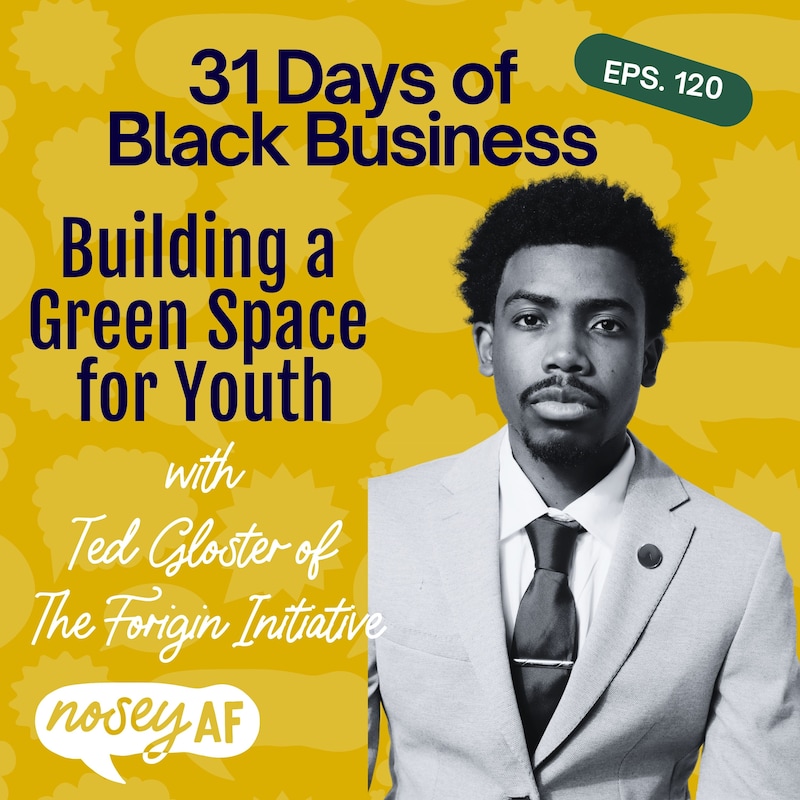
Ep #120 — Building a Green Space for Youth with Ted Gloster of The Forgin Initiative
Part of noseyAF's 31 Days of Black Business series 🖤
What happens when you come home during a pandemic and realize the community that raised you is stuck in survival mode?
Ted Gloster left Detroit's District 2 in 2018 and came back during the pandemic — and instead of leaving again, he built The Forgin Initiative, a green space and after-school program teaching young people economic literacy, civic engagement, and emotional intelligence. This is a conversation about healing yourself before you can lead anyone else, and what it actually takes to build something from nothing.
What We Talk About
- Why coming home during the pandemic forced Ted to confront generational poverty, financial illiteracy, and a disconnect from ancestral history in his own community
- How he built the Forgin Initiative from a 2017 idea into a physical green space and after-school program with three pillars: economic literacy, civic engagement, and emotional intelligence
- The unexpected turn: Ted's raw account of the personal breakdown that led him to therapy, prayer, and healing — and why he believes leaders can't pour into a community without doing that inner work first
If you love origin stories that don't skip the scary parts, this episode is for you.
Chapters:
- 00:07 - Introduction to Black Business Month
- 04:35 - Understanding Community and Identity
- 13:10 - Healing and Growth: A Journey to Self-Discovery
- 25:01 - Challenges of Building Community Programs
- 33:40 - Understanding Leadership and Community Building
All about Ted Gloster
Ted is our new best friend(he never confirmed this though LOL) he's a multidisciplinary entrepreneur: investor, lifestyle brand designer, mentor, and opportunity economist, among other things. He's in year three of running The Forgin Initiative, and what sets the program apart isn't just its diverse, hands-on approach to teaching economics — it's that it stays youth-led, holding both the organization and the young people it serves accountable to that principle.
Things We Mentioned
- The Forgin Initiative — theforgin.org (application for fall after-school programming opening soon)
- The Forgin Neighborhood Coalition green space — 15720 Alden St, Detroit, MI 48238
- Sevir — Ted's clothing brand
This series is supported by Off the Grid, a podcast + resource for small business owners who want to leave social media without losing their clients. Find them at offthegrid.fun 🖤
Connect with Ted Gloster
- IG: @theforgininitiative or @theforgin_nc
- Website: theforgin.org
Stay Connected
📬 Get the noseyAF Dispatch → Subscribe here
🏡 Grab the Good Neighbor Playbook → Download it free
More ways to connect
- Email: [email protected]
- Follow on IG: @stephaniegraham
- Listen to more episodes: noseyaf.com
Support & Feedback
noseyAF is listener-supported; thank you for being here. 💛🫶🏾
⭐ Rate & Review the Show📣 Share noseyAF with a friend who needs to hear this
Episode Credits
Produced, Hosted, and Edited by Stephanie Graham
Lyrics: Queen Lex
Instrumental: Freddie Bam Fam
Cover Art: Emma McGoldrick
Transcripts
Hey, friends, welcome. And welcome back to noseyAF conversations about art, activism and social change.
I am your host and friend, Stephanie Graham, and it is Black Business Month, which means that all throughout the month of August over here at noseyAF, I will be sharing a conversation with a. Well, black business owner. Yup. All throughout the month. So whether you are a business owner.
Stephanie Graham:An entrepreneur, creative, however you see it,.
Stephanie Graham: in:And instead of leaving again, he got to work.
He runs the Forge In Initiative, a green space and after school program for young people built on economic literacy, civic engagement, and emotional intelligence. A dream.
Guys, we are going to play my loving theme music that I love so much, and then we're gonna get into the conversation with Mr. Ted from the forging initiative.
Stephanie Graham:Gotta get up, get up to the whole world. You will win a winner. Vision of a star with a mission in the cause. What you're doing, how you doing, what you're doing and who you are.
Flex yourself and press yourself Check yourself, don't wreck yourself. If you know me then you know that I'll be knowing what's up. Hey, Stephanie Graham is not.
Stephanie Graham:Ted. Welcome to noseyAF.
Ted Gloster:Thank you for having me here.
Stephanie Graham:I'm so excited to talk to you about The Forigin Initiative. Did I say it right?
Ted Gloster:Yep. You got it right. Yep.
Stephanie Graham: in:What was the moment that made you feel unavoidable to act instead of just observe?
Ted Gloster:Right into it. I love it.
Stephanie Graham:Yeah.
Ted Gloster:So when I left the city, you know, District 2 in Detroit, Michigan, and I came back during the pandemic, I think it was reliving some of my trauma. Right?
I think, yeah, it was definitely reliving some of the things that I didn't like seeing growing up, being forced to be back around people and things that I thought I. I wouldn't have to be around for another couple years or not at all again. Right.
Because the pandemic had everybody locked in and I reconnected with some family and, you know, it was seeing the bad habits of, you know, some people from my community, some people from my family, the drinking, the illiteracy, the financial illiteracy, the eagerness to go out and turn up and have fun. We had A whole pandemic going on outside and people still doing things that are putting them further into a hole.
It made me realize the priorities were just messed up. But also, it's not just the priorities, it's the things that led to those messed up priorities, which is poverty. Right.
And poverty isn't always just a financial thing or a physical thing. It's a mental and spiritual thing, too. And then also a lack of identity. You know, I feel like.
Well, I knew, like back then, if our people really knew our true history of our ancestors and where we come from, our history didn't start in slavery. Right. Our people go back to the early 19, the earliest my family has gone back or other my friends families or people in my community's families.
When we get to these tables and talk, you know, we get to play the dominoes and spades and we talking about.
Stephanie Graham:Right.
Ted Gloster: g going back further than the:Right? Our community's history didn't start there. Your family history didn't start there. There's so much more to it.
And I think when our people, when we describe our own history, it's degrading. And I don't like that. And I didn't like that.
So poverty and poverty and the lack of understanding of our history, identity, those are two things that really sparked me. And it was. It was so there was.
is plan for a nonprofit since: Stephanie Graham:Okay.
Ted Gloster: ow what? During the pandemic,: I'm gonna do it, you know, in: Stephanie Graham:I think so. Because tell us more about District 2. Like. Yeah, yeah. So District 2 is in Detroit and whatos.
Ted Gloster:Yeah, so there's many districts in Detroit. But I say. I said District 2 because that was a lot of my stumble grounds growing up. Okay.
The period I'm going to take out the districts now, I'm going to say the streets. So from Puritan, Linwood was my mom's side, and Linwood and Dre Rose, my dad's side. So for those of y' all who from the city, what up, though? Right?
n the early, you know, in the:How that area was and how rough it was and, you know, to even be able to be able to maneuver as a young kid, young teenager walking around, you gotta know how to carry yourself a certain kind of way. But anyways, off that, that's home, right? Pearson Lynwood is home. Linwood and Dre Road is home.
So, you know, I spent a lot of time on Puritanson Linwood. Right. So I chose to start here. You know, I have a lot of history here. We used to ride bikes through the neighborhoods.
We used to play baseball in some of the fields, even bust out a window. Oh, my gosh, not too far away, bust out a window to a house and ran. And, you know, oh, we gonna get in trouble.
Like, oh, you know, the paranoid kids think somebody about to come after us trying to chase the girls off on Puritan and Wildermere. Right? Like, just being kids, you know? You know, just, you know, not wanting to be in the house. We all had our own things going on at home.
So outside was our escape.
Stephanie Graham:Yeah.
Ted Gloster:Oh, that was our fun. That was our peace. We were each other's peace in a village. So, yeah, I took outside for granted. I really did. Cause things aren't.
I'm not gonna say things aren't the same. I'm sounding like an old person, but, you know, technology has changed things. A lot of kids aren't outside.
They inside playing games, playing games a lot, making videos, you know, which is not a bad thing. You know, those things are assets if they know how to turn them into assets. Right.
But just growing up to have a healthy body, healthy mind, healthy spirit, we're humans, right? We're our biological makeup. We need the sun. We need to touch grass.
We need to eat natural food, organic foods, and we need to touch some mud so our body can tell the difference between a good bacteria and bad bacteria. Right? That's how we grow as healthy, functioning human beings. I definitely took it for granted.
Stephanie Graham:Yeah.
I think what's so cool about your program and the work that you're doing, it's like, I feel like it's so easy to just, like, be somebody who would, like, receive these benefits of your program. Like, to just be like, man, we need to, like, you know, just complain about it and not actually, like, take initiative and do something about it.
Ted Gloster:Yeah.
Stephanie Graham:Where do you think that comes from?
Because you could just say, like, well, like, you could just do something with just like, your friends, you know, and just like, leave it at that versus having, like a community wide program.
Ted Gloster:Yeah, that. That part you hear. It's not easy. I'll say that. It's not easy. That's me being real. Right. I'm not going to be this leader who gets on camera and.
And la de la dehes.
Stephanie Graham:No.
Ted Gloster:But I'm also not going to sell y' all a lie. I don't want to sell y'.
Stephanie Graham:All.
Ted Gloster:I don't want to sell your perfection because none of us are perfect. I know plenty of leaders who put these masks on, and they're not. Oh, yeah, definitely. You know, plenty of them. Right. That's.
Not to throw shade, but it's just. I want to be truthful right now. Yeah, it's not easy. It takes a lot.
I did, like, I started doing the work with friends in the community, and my two little cousins had worked with me. They helped. One of my little cousins did photography. My little cousin was a secretary for the organization. But even in that.
Do you know how they say you can't bring family into business?
Stephanie Graham:Yeah.
Ted Gloster:But you can. Right? And I want to correct myself real quick before I get into this. You can bring family into business, but you have to have things structured.
Structured. They have to be organized. Right. But I realized I had to get out of my comfort zone in order to truly make an impact. Yeah. I could have, you know.
You know, I could have. I could have kept, you know, kept it as just me and friends and me and family.
me. And this was in summer of:You know, when it was nothing, really, when it was just from the ground up, just a small seed. So shout out to y'.
Stephanie Graham:All.
Ted Gloster:But I had to get out of my comfort zone and reach out to the community and reach out to strangers. Cause I realized the sense of community, the love. Right. There's love out there. And I was active from a place of scarcity.
Stephanie Graham:Mm.
Ted Gloster:Yeah. That's what I'm trying to get to. I was active from a place of scarcity.
Being afraid to reach out because I felt like it just wasn't a lot of love out there. And I'M trying to. There's so much I could say about that time and just that it's this question. Yeah. I was acting from a place of scarcity.
I didn't believe that there was a lot of love out in the world outside of those I was comfortable with. But even those I was comfortable with, I was still acting from a place of scarcity, not trusting people.
Stephanie Graham:Yeah.
Ted Gloster:So I had to heal. I had to do a lot of healing. I had to do a lot of inner work. A lot of inner work. Man, I had to learn how to.
I had to learn how to express my emotions with myself because I. I'm always lecturing po. I'm always. I was always tired to lecture, like, do this, do that. You got this. But I'm not even taking my own advice.
So I had to do a lot of inner work. And after I did that inner work, after I did that healing, I was able to go out and get.
I got my mind right, and I was able to go out and connect with people and be open with people. And with me now, being able to be open with people, you know, it's helped things grow, and it's helped that accessibility that you mentioned.
It's made the accessibility to the resources a lot simpler because we're community driven. This isn't a gatekeeping organization to where if we. In person now. All right, wait, bro. We can set up a meeting next week or two weeks.
No, the person you want to talk to is literally right over there. Go talk to them. I'm not the expert in that. Go talk to them. You know what I'm saying? That's what we do at the Green Space.
And even with the summer program, we have people come in and talk to the kids and if they want to. It depends on if it's middle school or high school, but depending on which, like, the resources are there.
If you ever need a resource, like, we have that. That. That mentor that. That public figure. I ain't gonna say public figure, but we have that leader in.
In that professional in the set on call, and we can connect the families with that professional so they can get the youth the resources that they need. And, you know, moving forward, you know, the goal is to really have people who are really. Who are ready to be on call. Cause, you know, we.
We've had some people on call, but I want to have more of that. I want to have less. Less barriers. I want to bring around people who have less. Not in the sense of trying to bombard the lax.
I know life is busy but man, if you're gonna be serious about helping the youth. Right. Be serious about helping, right? Yeah. A form of love is, you know, inconveniencing ourselves sometimes.
Like my godmom, she's inconvenienced herself for me plenty of times. So I'm more than willing to be to if she ever asked me something, I'm more than willing to and convenience myself for her. Right.
Stephanie Graham:Yeah, that's really nice.
Ted Gloster:Right. So I wanna bring more love into the program, if that makes sense.
More love and keep, and keep making that the resources accessible, keep making the environments welcoming and keep creating healing energy for the youth and the community.
Stephanie Graham:Yeah, that's really nice. You know when you said that you were healing yourself, like, how were you doing it? Was it through journaling? Were you in therapy?
Like, what did that look like? Okay. He said, sign me up. What's available to me?
Ted Gloster:Yeah. So I. Man, what does that look like? So I'm pretty open about things now.
It's men who need to hear this because a lot of us going through things and we put on acts and we gain this ego to protect ourselves, which is nothing but ego. It's nothing but something. A mask that protects insecurity. Guys, take my word for it. Look, do the work, you'll begin to see.
But, you know, in: So I graduated in December of:But yeah, I sacrificed a life of comfort for a life of purpose.
Stephanie Graham:That's hard.
Speaker C:Duh.
Ted Gloster:Yeah. The woman I thought I was gonna marry, you know, me and her didn't end up working out. You know, coming back, you know, around family.
I was, I was triggered by my mom, you know, something, you know, my mom had some struggles and she was struggling with something at the time, at the time. And I saw her in that moment, you know, having to help her move and things, having to make calls to help my family. I was triggered.
And that was in June of:And I don't think I've ever been triggered in my life until that moment. Cause I hated seeing my mom like that growing up.
Stephanie Graham:Yeah.
Ted Gloster:And I hated seeing that it hurt it so bad. Seeing my mom like that. Growing up and being triggered, I felt like I had no control over my emotions. Right.
All of the walls, all the barriers I put up just came down.
Stephanie Graham:Yeah.
Ted Gloster:I froze up. I got quiet. I was stuck. I was in a trauma freeze. And I spiraled out a little bit mentally and tried to get the girl, the girl back.
That didn't work out. So I realized I had to be alone.
appened in between that. June:And I started going to therapy in, I believe, July that summer, because I realized I needed to talk to somebody.
Stephanie Graham:Yeah.
Ted Gloster:Because mentally I just wasn't. I was. I just wasn't there. So I went to therapy.
I did that for about a month or two, you know, and then I realized that I need to connect with my people more. My people more. So another form of healing, it's these methods I've used. Therapy.
Then once I realized I had to connect with my loved ones, people who actually love me and me not seeing that from being in survival mode because this is a period of me transitioning from survival to thriving to becoming. Right. So me learning how to thrive, me learning how to heal and then thrive, I realized I wasn't connecting with the ones who truly love me.
There's a few people, like my godmom, my stepmom, my best friend, you know, my best friend, Dominic, New World Productions, you know, just talking to my people more and being more open with them. That's just a few people to name, right? But my siblings, of course, right. Spending more time with my siblings. My babies. My babies, man, my babies.
But spending more time with them. And in doing that, I began to feel a new sense of love coming out of a state of survival.
Stephanie Graham:Yeah.
Ted Gloster:And that helped me on a level of understanding that I have what I need and not just in others, but within myself. So I started journaling more as my body and my nervous system began to calm down from being in survival. I was tired a lot, too.
I didn't realize how much survival mode, when you healing and you always on go, when your nervous system begin to calm down, you get tired a lot. It's because your body's healing itself. But I started journaling more, praying where I found God around that time, too.
Praying heavy every day, a couple times a day, asking for forgiveness. Repenting.
Cause I did a lot of things in my life that I didn't feel like I didn't truly repent for, you know, growing up, you know, in the area and, you know, having to do certain things, you know, a lot of. And, you know, just. Not even just straight stuff, but just women, you know, from my past, friends or people I might have treated badly.
Not saying I'm just a shitty person, but I'm sensitive to how I treat people, you know, And I remember and I remembered these things, so I felt bad about those moments in my life. So I repented, asked for forgiveness, started meditating, more breathing techniques.
I believe the Sophie technique, the 2 in 2 n went off almost daily to help clear my mind. And it's led me to a higher point. So those are the methods I used. Wow, that was a big explanation.
Stephanie Graham:I love it.
Ted Gloster:But those are some of the things I use outside of working out as well and boxing, but those are some of the things I've used. And, you know, the backstory is why is what led me to using those things. So.
Stephanie Graham:Yeah, that's amazing. Thank you for sharing all of that. It's like a full workbook you just gave us, which I really appreciate a guide.
Ted Gloster:My pleasure. Man, y' all need to hear this. Ladies, I think I feel like the ladies got. Y' all know how to cry and learning how to cry. I had to learn how to cry.
I'm okay with that, right? You know, here go my ego. Yeah. I can still fight and do these things, y', all, but okay, still cry. You know what I'm saying?
I still know how to cry, right? But I had to learn how to cry, too. But I feel like women, y' all have that being able to, like, cry and express yourselves right?
And this is the balance between the masculine and feminine, you know, whichever y' all believe in, right? People watching, but y' all have that so well down packed. And, man, we bottle things up. We bottle things up a lot.
So, fellas, I hope y' all took that to, you know, to heart and women, if y' all need that. Whatever I just said, I hope y' all take it to heart. It's important.
Stephanie Graham:Yeah, that is important. Yeah. I appreciate you sharing all of that, you know, with you, you know, working with the youth. Are they receptive?
Like, what's it like working with the youth? I feel like I personally am not always around kids.
I have, like, my neighbors that are riding their bikes, you know, that I say hey to, but never really, like, it's been a Long time since I've had to like, be in a class with the youth.
Ted Gloster:Yeah, they are. And a lot of times it depends on the school we're at or the environment that we're in.
Because every child, every group of youth have a different lived experience. So every environment brings a different personality of youth, a different set of youth who are receptive to different things.
I think for the most part, though, most of our youth have been receptive. They have wanted to continue the learning. They wanted to continue to be a part of the program.
Especially with us bringing an emotional intelligence piece to it. We have three pillars, which is economic literacy, civic engagement, and emotional intelligence.
And a lot of times we start with the emotional intelligence because like I said, you know, just talking about healing and those things, you know, in that time, I made bad decisions, right. Financially, even though even me knowing better, but I still made bad financial decisions because my mental wasn't right.
Spending more than what I should have. So I knew better. But because my mental and my heart wasn't right and my soul wasn't right, I still made bad decisions.
My emotional intelligence was shocked. Shocked. So being them, us having like tough conversations with them because youth aren't always taught.
And I'm not gonna just say in our community, it's everywhere in the world. Yeah, I'm trying to break that bias too.
But it's everywhere in the world, but with them not always being taught by parents on how to express themselves, being okay with addressing a problem, being okay with crying. Right. Not uncontrollably, but crying to let out, to let. To let it out. And then getting back to your daily program. Right?
Yeah, they are very receptive to it. Cause we tap into something deeper than just how to file a llc, how to get money. Right. Detroit is getting money City. Right. So we know that part.
Why is every. Why everybody's still in survival mode. Why is everybody still overstimulated. Why is everybody. You know, why hasn't our. Why. Why is our city.
Why is our city being gentrified to the way that. To the point that it is? And everybody's still complaining even though we are getting money City. You know what I'm saying?
Stephanie Graham:Yeah. Yeah.
Ted Gloster:Emotional.
Stephanie Graham:It's true. Yeah. How does someone work with Foragin Initiative?
Ted Gloster:Yes. So we have. We're actually getting ready to Europe for fall. Fall after school programming.
So we're going to be putting out a application on our website, www.foraging. That's f O-R-I g I n dot org.
Stephanie Graham:Perfect. We'll put that in the show notes, too.
Ted Gloster:Thank you. So, yeah, we're gonna have the application on the website. We're gonna post on LinkedIn as well, and Instagram, and we also have a.
And that'll be up actually within the next. Within the next week or two. And then we have a volunteer form on our website as well that people can sign to become a volunteer.
We try to get our volunteers heavily involved with our work. So sometimes some volunteers want to come into the classrooms. They may become instructors, or they may just become a ta, Like a teacher assistant.
Stephanie Graham:Right.
Ted Gloster:Depending on, you know, age, of course, and things like that. But volunteering is a big way to get involved with foraging. Coming out to the green space as well. It's always a great time, and it's always.
The green space is. So that's called the Foraging Neighborhood Coalition.
Stephanie Graham:Okay.
Ted Gloster: That's located at:But if y' all follow us on social media at the Forgin Initiative or the Forage in nc, you'll see a lot of the work and building we've been doing.
Stephanie Graham:Man, that's really exciting that you have, like, a physical space that people can come to.
Ted Gloster:Thank you. It's a blessing, honestly. It's a blessing.
Stephanie Graham:Yeah. If you're a kid that's homeschooled, can you be a part of foraging?
Ted Gloster:Absolutely.
Stephanie Graham:Yeah.
Ted Gloster:You know, I'm big on experiential learning. Heavy on that. And that's why, you know, we're working on getting more funding to give kids more field trips to get them outside more.
But experiential learning is very important.
We would love to get more youth who are homeschooled into the program to get them around other youth, not just in the classroom, but coming outside to the green space building outside, you know, doing activities outside, workshops outside.
Stephanie Graham:Right.
Ted Gloster:Touching grass and still hunting.
Stephanie Graham:Yeah. Somebody to ride your bike with.
Ted Gloster:Yeah, yeah. Ride your bike with. Exactly.
Stephanie Graham:So, yeah, with the structure of running this business, this program, like, what is something that is a challenge? Like, just like, organizationally, you think.
Ted Gloster:Yeah, you know, we're still. This is year three for us.
Stephanie Graham:Okay.
Ted Gloster:But year one and two were. It was. Year one was really starting from scratch, starting from the ground up. Year two was. It was like a seed. It was like a sprout.
It was like a sprout. And then on year three, we're still in that Sprouting area, phase stage. Um, but to grow out a little bit more. Right.
So the biggest challenge, you know, is just finding quality help without the proper funding.
Stephanie Graham:Yeah.
Ted Gloster:You know, cause it's, it's tough times. Right. And I'm not, I'm not expecting people to, you know, give their life for free. Right.
Stephanie Graham:Yeah.
Ted Gloster:Do give stipends to the people who help with the work. But the goal now is to get the six figure funding, to get hopefully seven figure funding. But six figure funding right now within the next six months.
That's the hopes to be able to pay people properly, maybe part time, to be instructors, to be garden stores of the green space, to be. To help with outreach, to help with marketing. Right. Cause a lot of these things, you know, a lot of these things I, you know, I did myself.
Now I have a volunteer coordinator, I have a, A storyteller, a volunteer storyteller, outreach person. Shout out to Tayshawn, shout out to Arie. Right. You know, a media photographer.
Shout out to New World Productions, my best friend Dominic, you know, so I have people who are willing to help. Like I said, I do try to make sure I get them paid. So the goal is to just get more funding.
And that's been the challenging part at the moment is looking for that funding, especially with federal regular, you know, things that have been going on on a federal level.
It's, you know, it's changed a lot versus when I first got in because I knew people who were in here in this game from maybe two years or a year you know, ahead of me. And access to funding was a lot easier, which is not a bad, you know, it's just timing. Right. God's timing. But so things have changed a lot.
So getting the funding to pay to put people on payroll, that's the biggest challenge right now. And even, you know, sometimes it can be outreach. Right. Getting in contact with, you know, new partners at times intentional partners. Right.
We like to build intentional relationships and not, you know, be politicking and you know, just, just the politic and using the space for pictures.
Speaker C:Right.
Ted Gloster:But yeah.
Stephanie Graham:Really?
Ted Gloster:Yeah, for real. So, you know, those are the two main. The two main things. But other than that, everything else is picking up.
But I think once that the funding that we hoping comes in within the next six months comes, it'll make a lot of other things smoother.
Stephanie Graham:Yeah. What kind of advice would you give to someone who's like, okay, I really like what Ted's doing. I want to do something for my community.
What would you tell them besides Their own healing like step one might be.
Ted Gloster:Aside from healing, I would say ask questions, move around. Network. When I say network, don't just, you know, be careful. I'm being very careful with that word, network. Build relationships.
Yeah, let me say that. Build relationships, ask questions and take action, right? The big at.
At the end of the day, you can have all the conversations in the world, you can have all the mentors in the world, but if you're not taking action, it means nothing.
Stephanie Graham:Yeah. Seriously.
Ted Gloster:Yeah. Like you can't expect people to hold your hand and cause my big. That was my biggest thing, you know, starting out. I took action.
No, I didn't have a, you know, I have a background in youth development, being a mentor to youth. I have a finance background. But so far as running a non profit or running a board, I haven't run these things before.
But I learned as I, as I went along. So don't be afraid to learn as you go. Don't let these, you know, don't let these bougie people, right? I say bougie. Don't let egotistic people.
Because I guess going back to ego, ego is nothing but a mask that protects insecurity. So don't let egotistical people or quote unquote, bougie people, right? However y' all think about bougie, right?
But don't let those folks make you feel like it has to be perfect starting off.
Because now the same people who told me I shouldn't be doing such and such or you know, people who stood on the stands watching me, a lot of them, they want to become a part, a part of the work now, which I'm not allowing some people to come in now. Cause your heart posture just ain't right.
Stephanie Graham:Yeah.
Ted Gloster:So be okay with taking action. Be okay with asking questions. Be okay with not looking good.
Look, be okay with I ain't gonna say embarrassment, but be okay with not looking good with everything that you do. Your questions might not be perfect, but you still ask the question. Your action might not be perfect, but you still took action.
But guess what's after that? A lesson. You're going to learn something every single time. And so be okay with bumping your head.
And don't let, like I said, don't let the people in the outside noise make you feel bad for looking, you know, for look for not looking perfect. Right? I don't want to say dumb, I don't like saying that type of stuff.
But don't let the outside world make you feel bad for bumping your Head, because some of the smartest people in the world bump their head many times.
And I'm speaking specifically in regards to rpa, because of the positions we've been put in over the years to have to be very resourceful with lack of funding. Right. We still found a way. Right. And not to say, you know, it's so many things with the funding part, because I can't even intermingle funds.
You know, I run other businesses outside of my nonprofit. So you have. Some things have to be structured straight to the nonprofit.
But, yeah, y' all be okay with making mistakes, be okay with bumping your head, be okay with asking questions and take action. So that's what I'll say to them. And know your why, what you want to do. Right? Know what you want to do. Don't just come in. Just. Just.
I'm gonna do this, I'm gonna do that, I'm gonna do that. Know exactly what you want to do as well, because then you'll start spreading yourself too thin, and now you're all over the place.
So figure out what exactly you want to do, but even before that, figure out why you want to do it.
Stephanie Graham:So, yeah, no, that's really good.
That coming back to the why part especially, there is a neighborhood here that I'm always, like, interested in doing things in, and people always like, why? Like, nobody's there anymore. Like, it's blighted, like, all of this. You know, they're just so easy to shut it down.
To me, Like, I guess they want me to be like, oh, you want to work over there? It's terrible. So I should be like, oh, okay. I didn't realize it was terrible. Let me just not go over there and, like, do stuff.
But it's like, yeah, you do have to just, like, not pay attention to them and just stay focused to your why.
Ted Gloster:Yep, that part.
Stephanie Graham:Yeah.
Ted Gloster:Yeah, you can't. Yeah, you gotta. It's like tunnel vision, you know? Don't be arrogant. You know, you ain't gotta be arrogant. You ain't gotta be.
You ain't gotta be egotistic. Right. Cause that's sometimes. That's how ego was built. I'm big on the difference between ego and confidence. Right?
Confidence is being in tune with self. The ego is being out of touch with self in order to protect self. Right. But that's how egos are built, too. You know, we. We.
We begin to let the negative noise get to us. We begin to feel hurt, you know, by the outside world. And we. Now we gotta put on this mask and become a robot, become a machine.
And now here we go, repeating the cycle, you know.
Stephanie Graham:Yeah, yeah, I know that you are an entrepreneur. What are your other businesses?
Ted Gloster:Yeah, so I have a funding company. You know, my two other partners that I work with, we help people find funding, you know, for whatever purpose they may need.
Business funding, personal funding.
I have a clothing brand name called Sever S E V I R. And also, you know, do some, I do some trainings with people, people that want me to train them on the side. Fitness, being an athlete and things like that.
So those are my, my three, my three other focuses outside of foraging and some other stuff, you know, coming along. So it's serial entrepreneurs is the way to put it right now.
Stephanie Graham:Yeah, you like, you like to keep busy.
Ted Gloster:Yeah, keep, keep busy, but also stay progressive, right?
Stephanie Graham:Yeah.
Ted Gloster:You know, I said not, not to. I wanna, I don't wanna spread myself too thin. Of course I'm learning to have partners, right?
Have people that I work with, allowing people to take charge. Like the clothing brand, My little brother, you know, putting him in charge shortly of, you know, the marketing and media side.
You go ahead and be the face. I don't wanna be the face no more. I got other things I'm running. You do that?
Stephanie Graham:Yeah.
Ted Gloster:You know, just understanding. Not spreading myself too thin, but understanding what true leadership is. And that's putting other people in position, which is perfectly fine.
Stephanie Graham:Yeah, that's so nice and generous and not gatekeepy. So that's awesome.
Ted Gloster:Yeah. Thank you.
Stephanie Graham:Yeah. Last question. Your ideal volunteer for foraging, what do they look like?
Ted Gloster:Passionate, dedicated, selfless and passionate, dedicated, selfless, loving.
Stephanie Graham:Yeah.
Ted Gloster:Loving spirits, but also loyal.
Stephanie Graham:Okay.
Ted Gloster:Not saying, you know, you don't have to volunteer to just keep coming back because that's not what volunteering is always for. But you know, we want to build a village where we actually are building a village. We are building a family around everything we're doing.
Like the, the volunteers that have been coming out to the green space and to the afterschool program. We're tight, we have good relationships and that's the culture that I want to keep building for foraging. So that loyalty piece is important.
Cause we want to build how can we help you as well. Right? That's the motto. Like allow other people to help themselves while helping foraging.
Stephanie Graham:So yeah, I love that. That's awesome.
And then like, even though what's like a time commitment, I know you said that you don't expect folks to be there all the time, but even like in an ideal setup, like what would it be?
Ted Gloster:So, like, for the green space, we do volunteer days, like every two weeks.
Stephanie Graham:Okay.
Ted Gloster:So that's like a four hour commitment. Or you can stay there. You can stay there for about an hour.
Speaker C:Right.
Ted Gloster:You have an hour of your time. Right. Like an hour a week. Right. Coming out, helping out, move stuff around.
If you gotta go do your thing after school programming, that's usually two hours after school. So, you know, if you want to come in and just help, be an assistant that day, that'll look like you being there for about an hour or two every day.
Nope, only two days. Well, it's three days per week this year. Okay. But so three days per week, you know, you don't have to be there every single day.
Maybe it could be one day. Right. One day minimum. So one hour minimum, one day minimum a week. So, you know, I just don't want to ask for too much.
I know people have lives, but that's why we say passion, dedication. Right. Because also understand what it takes to run an organization to like, out of everything I'm doing, this has. Foraging is picking up the most.
Stephanie Graham:Okay.
Ted Gloster:Yeah, it's picking up the most. And you know, all ego aside, see, I feel my ego kicking in, like everything aside, you know, we need help.
Stephanie Graham:Yeah.
Ted Gloster:Not saying like, you know, waving the white flag or like, you know, not looking for nobody to save us, but this is the truth. No organization can run without help. Elon Musk cannot run without help. I use him as an example because people tend to always use him as an example.
But Obama couldn't be president without help. Right. There's so many great leaders, but, yeah, we. Help is needed.
Stephanie Graham:Yeah, dope.
Stephanie Graham:Well, Ted, thank you so much for talking to me today on noseyAF.
Ted Gloster:No, thank you for having me. This was great. I love progressive conversations. So thank you.
Stephanie Graham:Yeah. And thanks for thinking of me as progressive. I feel very, very bougie about it now.
Stephanie Graham:That concludes another episode of nosy AF31 Days of Black Business. I'm your host and friend, Stephanie Graham. I hope you took something away from today's conversation and had a good time hanging with us.
Be sure to check out the show notes to learn more about today's guest and consider supporting their work. You know how it goes, whether you're making a purchase, hiring them, or simply spreading the word. Listen, who doesn't love a referral?
It truly all makes the difference. Quick thank yous go out to Queen Lex and Freddie Bam Bam for the nosy AF theme music.
And Emma McGorick, who, who hooked me up with the COVID art and branding. Shout out to the partners and supporters for this series. You could check them out in the show notes as well. Super grateful for a partner. Hello.
That's the show Friends until tomorrow. Stay curious and take care. Bye.