Shownotes
Audio • Season 1 • Episode 8 • Series 1 Episode 8 - John Knox and the Presbyterian Offensive.
© 20 26 The Rise of the Protestants., Author, Shaughan Holt.
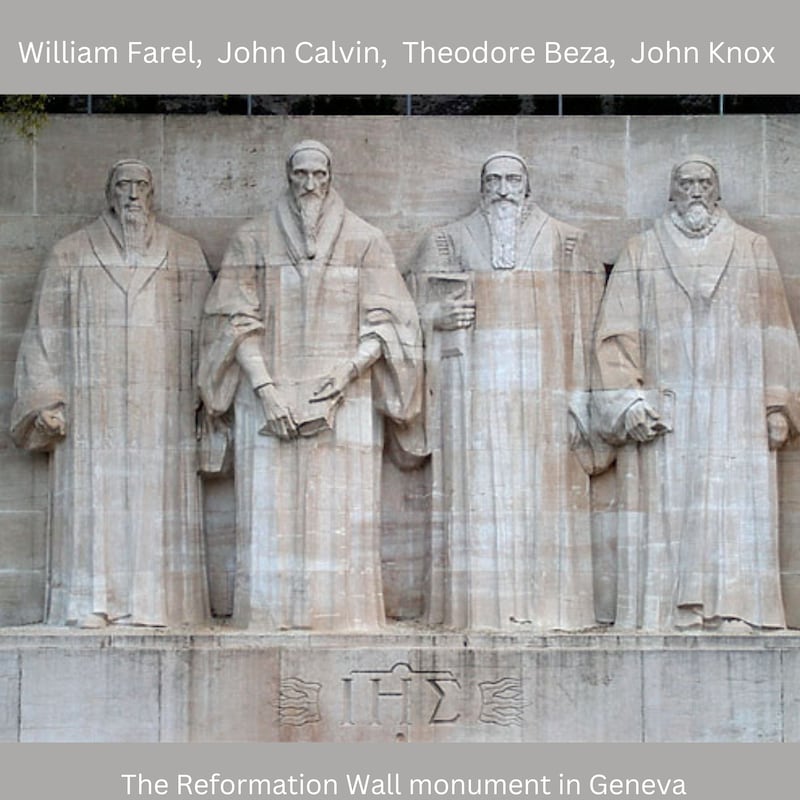
Artwork • The International Monument to the Reformation, usually known as the Reformation Wall, was inaugurated in 1909 in Geneva, Switzerland.
The Wall, stands within the premises of the University of Geneva, honouring the legacy of John Calvin, its founder.
At the centre of the monument, (from left to right) four 5 metre-tall statues of Calvinism's main proponents are depicted:
William Farel (1489–1565), John Calvin (1509–1564), Theodore Beza (1519–1605), John Knox (c.1513–1572).
To the left of the central statues are 3 metre-tall statues of:
Frederick William of Brandenburg (1620–1688). William the Silent (1533–1584), Gaspard de Coligny (1519–1572).
To the right are 3 metre-tall statues of:
Roger Williams (1603–1684), Oliver Cromwell (1599–1658), Stephen Bocskai (1557–1606).
Along the wall, to either side of the central statues, is engraved the motto of both the Reformation and Geneva:
Post Tenebras Lux (Latin for After darkness, light). On the central statues' pedestal is engraved a Christogram: ΙΗΣ.
The Wall is in the grounds of the University of Geneva, which was founded by John Calvin, and was built to commemorate the 400th anniversary of Calvin's birth and the 350th anniversary of the university's establishment.
It is built into the old city walls, and the monument's location there is designed to represent the integral importance of the fortifications, and therefore of the city of Geneva, to the Reformation.
Music 1 • Why Fum'th In Fight. (Third Psalm Tune for Archbishop Parker's Psalter of 1567). Psalm 2:1. Composer Thomas Tallis. Masterworks Gallery.
Music 2 • Psalm 91. (Scottish Metrical Psalms) Stevenston High Kirk
Music 3 • Why Fum'th In Fight.
© 20 26 The Rise of the Protestants., Author, Shaughan Holt.
"All rights reserved. No part of this podcast may be reproduced, translated, distributed, or transmitted in any form or by any means, including photocopying, recording, or other electronic or mechanical methods, without the prior written permission of the copyright holder, except in the case of brief quotations embodied in critical reviews and certain other non-commercial uses permitted by copyright law".
Requests regarding translation, licensing, or republication should be directed to: [email protected]
Your feedback matters, send me an email at [email protected], with any comments, suggestions, or criticisms.I read every message.
Transcripts
© 20 26 The Rise of the Protestants., Author, Shaughan Holt.
"All rights reserved. No part of this podcast may be reproduced, translated, distributed, or transmitted in any form or by any means, including photocopying, recording, or other electronic or mechanical methods, without the prior written permission of the copyright holder, except in the case of brief quotations embodied in critical reviews and certain other non-commercial uses permitted by copyright law".
Requests regarding translation, licensing, or republication should be directed to: [email protected]
Your feedback matters, send me an email at [email protected], with any comments, suggestions, or criticisms.I read every message.
Series 1.
Episode 8.
John Knox and the Presbyterian Offensive.
The year is 15 65.
During this part of Queen Elizabeth’s reign, Thomas Cartwright became more active in the Reform movement, enhancing and refining the Puritan perspective on church ceremonies and organisational structures.
However, due to his activism, he encountered difficulties with the authorities and decided to relocate to Ireland for two years.
While in Ireland, he served as a personal chaplain to Adam Loftus, the Archbishop of Armagh.
This environment was more welcoming to Puritans like Cartwright, in stark contrast to the situation in England.
William Brewster, son of William Brewster and Mary Prudence, was born about 15 65 in the village of Scrooby, on north Nottinghamshire's border with Yorkshire.
His father, who lived in Scrooby, married Mary Simkinson née Smythe, a widow who had previously been married to John Simkinson of Doncaster.
From his mother's side, Brewster came from a literate family that contained local ministers, civic members and the successful Smythe family of merchants, based on the nearby Humber estuary.
Brewster's birthplace, Scrooby Manor, was owned by the York Archbishops and rented to Sir Samuel, son of Edwin Sandys.
Brewster's father, was Postmaster, or Manor Bailiff, a role assigned by Archbishop Edmund Grindal, Sandys' predecessor.
The post, came with the title of Postmaster, and held the principal responsibility for the Stage Coach horses, that carried mail on the Great North Road.
In 15 65, the authorities of Norwich invited Protestant refugees from the Spanish Netherlands, to settle in the town in an attempt to improve and develop their textile industry.
Thirty weaving families, consisting of twenty-four Flemish and six French-speaking Walloons, accepted the invitation and embarked on their transformative journey from Flanders.
Identified as 'Strangers,' they sought political refuge in England, because their Spanish overlords did not embrace their Calvinist convictions, or their desire for political independence.
The Walloons, are recognised as a unique ethnic group originating from Wallonia, which is currently known as the French-speaking region of southern Belgium.
This also includes adjacent regions in France Germany Luxembourg, and the Netherlands.
The year is 15 66.
Archbishop Parker, continued to work on his Book of Ecclesiastical Articles, which Cecil had previously rejected in 15 65.
On 28 March 15 66, he finally resubmitted the work to Cecil, and received approval to publish it under the title "Advertisements".
The publication was intended to help manage public prayers, sacred rites, and religious attire.
However, Elizabeth continued to withhold her formal permission, and support for the book, eventually informing the bishops that they must exercise their legal authority and make their own judgements.
The Queen, sought to protect herself from potential repercussions, ensuring that the bishops would be held accountable, for any problems that would arise.
Finally, Archbishop Parker was able to issue the documents, under the title "Advertisements" without obtaining royal sanction or authority.
Acknowledging the difficulties of donning the cope during the communion ceremony, the Advertisements, agreed to insist on, only using the surplice.
As a result, the surplice became the designated clerical attire for all services in parish churches, while the cope was reserved solely for communion services in cathedral churches.
Parker's decision, to enforce conformity during the Easter of 15 66, sparked uproar in London.
His enforcement of conformity, under the threat of deprivation, led to violent disputes that would sour Archbishop Matthew Parker's final years, resulting in the first open separation of Nonconformists, from the Church of England.
As a result, he had no choice but to suspend thirty-seven ministers who refused to wear the surplice, leaving many parishes without a minister for their Easter services.
Ultimately, a total of fourteen ministers were dismissed by the authorities.
In an action that revived the London Underground Church, some of the most radical clerics started leading illegal services.
This resurgence of an underground church was one of the earliest examples of the emergence of Puritan separatism.
One member, John Smith, later shared his thoughts.
"When we arrived at the moment when your law had banned all our preachers... and as we contemplated our next step, we remembered that during Queen Mary's reign, we had a congregation, right here in this very city”.
The London Underground church, had previously been disbanded, shortly after Elizabeth ascended to the throne in 15 58.
Upon her accession, she banned the Catholic Church in England Wales and Ireland, and reinstated the Church of England as the state's religion.
Despite her actions, the Queen's inclination towards Anglo-Catholicism, and her decision to mandate traditional vestments, for Anglican clergy, sparked the emergence of Puritanism.
A movement which aimed to purify the Anglican Communion, by removing all pre-Reformation customs and traditions.
The year is 15 67.
The London Underground Church, originated as a radical fringe of the Church of England.
Over time, during the reigns of Elizabeth and James I, it would be transformed into a covert Puritan collective, operating outside the law.
Various factions began to emerge, identifying themselves as Separatists, eventually deciding to separate from the Church of England, by aligning with the Brownist or Puritan movements.
Leaders of this Underground Movement included Ministers Richard Fitz, John Browne, Mr. Pattenson, William Bonham and Nicholas Crane and the layman William White.
On 16 June 15 67, law enforcement found a congregation, of a hundred individuals worshipping illegally at the Plumbers' Hall in Anchor Lane, detaining and arresting seventeen of their leaders.
Edmund Grindal, the Anglican Bishop of London, meticulously interrogated all those involved, and diligently documented the details of their discussions.
Later, other arrests would occur off Pudding Lane, in the house of James Tynne, a goldsmith, and the dwelling place of Bishop Grindal's servant.
Pudding Lane, a small London Street between Eastcheap and Thames Street, got its name from the butchers of Eastcheap Market, who used it to transport "Pudding" or offal as it was then known, down to the river to be taken away by waste barges.
In 16 66, Pudding Lane became notorious, when a devastating fire broke out at Thomas Farriner's bakery.
The fire engulfed medieval London, and would ultimately consume 85% of the city.
The Duke of Alva's increasing religious persecutions, caused a rise in Protestant refugees from the Spanish-controlled Dutch regions, who sought sanctuary in Norwich starting in 15 67.
At their peak, these refugees, known locally as "strangers", comprised more than a third of Norwich's population.
The diverse skills of these strangers greatly enhanced the textile industry, as Elizabethan England lagged technologically behind its European counterparts.
Although Sir William Cecil had suspicions about many of the refugees, viewing their claims of religious persecution with scepticism, the government was generally receptive towards these asylum seekers.
The government prioritised their economic contributions, though they also felt some sympathy for their fellow Protestants facing persecution.
The year is 15 68.
In 15 68, with William Cecil's agreement, leading members of the Underground Movement set off for Scotland, intending to relocate their church.
However, on arrival, they were disheartened to discover that John Knox would not endorse their departure from the Church of England, forcing them to revise their original plans.
By the end of the 15 60s, the movement faced internal divisions, with a breakaway faction led by Richard Fitz.
Over time, the group's numbers dwindled from a thousand residents in London to just a handful, due to persecution and internal strife.
Nonetheless, the 'Fitz church' endured well into the 15 80s.
In 15 68, John Field, a prominent leader of the early Elizabethan Puritan movement, secured positions as a lecturer, curate, and schoolmaster in his native City of London.
As an effective administrator, he was positioned at the heart of the Elizabethan Puritan Movement.
Field, who was also a writer, believed strongly in the power of print.
He was born in 15 45 and was a British Puritan clergyman and controversialist.
After being ordained by Edmund Grindal in 15 66 at the age of twenty-one, he was already a Bachelor of Arts student at Christ Church Oxford.
Field's early ordination was noteworthy, as the canonical age for ordination in the English Church was typically, no younger than twenty-four.
James Brewster, the brother of the separatist William Brewster, was born in 15 68 in Scrooby Nottinghamshire.
Unfortunately, during this period, their mother, Mary Brewster, passed away at around 43 years old, likely due to complications from childbirth.
The year is 15 69.
Following his appointment in Ireland, Thomas Cartwright returned to England at the age of 34, and took up the position, of Lady Margaret Professor of Divinity, at Cambridge.
In November 15 66, Henry Barrow enrolled at Clare Hall Cambridge, where he earned his Bachelor of Arts degree three years later.
The Barrow family had strong connections to Nicholas Bacon, father of the philosopher and statesman Sir Francis Bacon, making it highly likely that they were linked to John Aylmer the Bishop of London.
Born in Norfolk around 15 49, Henry Barrow lived a life of indulgence in his youth, often gambling.
Beginning in 15 76, he held a membership at Gray's Inn for a couple of years, although he was never called to the bar.
The year is 15 70.
On 25 February 15 70, Pope Pius V, issued the papal bull titled "Regnans in Excelsis" or Reigning on High, which excommunicated Queen Elizabeth the First of England, and branded her a heretic.
The Pope also freed her subjects, including those who had sworn oaths of loyalty, from their allegiance to her, threatening excommunication for anyone who chose to follow her commands.
Following Queen Mary's death, a reign that had reinstated the Church of England and Ireland under Papal authority, Elizabeth’s Parliament took a notable step in 15 59 by declaring its independence from the Pope's rule.
The papacy’s response had been delayed for 11 years, largely due to royal Catholic suitors, who were eager to marry Elizabeth, and her willingness to allow private Catholic worship.
Pope Pius V issued the decree, after the failed Northern Rebellion of 15 69, and Ireland's first Desmond Rebellion.
These uprisings, led by Catholic aristocrats, aimed to dethrone Queen Elizabeth and replace her with Mary, Queen of Scots.
The decree prompted the English government to impose stricter measures against the Jesuits, whom they suspected of supporting Spain and the Pope.
In 15 80, Pope Gregory XIII provided clarification at the Jesuits' request, allowing English Catholics to obey the queen in civil matters until a suitable opportunity arose to challenge her rule.
However, in 15 88, Pope Sixtus the Fifth, reissued the ex-communication of Queen Elizabeth for her execution of Mary Queen of Scots and various offences against Catholicism.
In 15 70, Queen Elizabeth hand-picked Edmund Grindall to be Archbishop of York, a city with little Puritan influence.
It was primarily, therefore, the Roman Catholics, who would face force and intimidation under his administration.
English School, 15 80
Portrait of Edmund Grindall (circa 15 19-15 83), Archbishop of Canterbury
Oil on panel
The Presbyterian offensive began in early 15 70.
Shortly after being elected to the prestigious Lady Margaret professorship at Cambridge, Thomas Cartwright, a long-time opponent of vestments would introduce the full scope of Presbyterian discipline to English theologians.
In a series of lectures, based on the Book of Acts, he declared that every congregation should be free to elect its ministers.
He proposed that the church's control, should reside in a local hierarchy, composed of the minister and the congregation's elders.
Cartwright further asserted that the authority held by archbishops and bishops, had no basis in the Bible, and was therefore unacceptable.
He claimed that the structure of the Church of England was contrary to that prescribed by Scripture, and that Calvin had established the correct model in Geneva.
He argued that the guiding principle should be to model the church after the practices that existed during apostolic times.
If implemented, this principle would have inevitably led to the complete abolition of the diocesan episcopacy, and the establishment of Presbyterianism.
Cartwright's definition, elevated the Puritan movement, beyond its focus on minor details, and presented a challenge, that the established church could not ignore.
Even the usually tolerant Edmund Grindall, Archbishop of York, felt compelled to write to Secretary of State William Cecil, about the importance of holding discussions regarding Cartwright's message.
In his letter, he stated:
There is a man named Cartwright, a Bachelor of Divinity and the reader of my Lady Margaret's Divinity Lecture, who, I have been reliably informed, is using daily abusive and reproachful language in his lectures.
Many young individuals from the University eagerly gather to listen to him, risking being led astray--a situation that could only harm the church.
Although his ideas were not entirely new, Cartwright's thoughts continued to gain considerable popularity among the younger generation of Cambridge scholars.
This sparked a great intellectual passion across the University, posing a significant challenge to the established foundations of the Elizabethan church.
The conservative Dons of Cambridge, felt compelled to respond swiftly, to Cartwright's challenge to the Episcopal system.
They sought assistance from William Cecil, the Chancellor of the University, to discipline their outspoken scholar.
Although Cecil was preoccupied, still dealing with the aftermath of the 15 69 Northern Rebellion, during which there was an attempt to place Mary Stuart on the English throne, he granted the Dons permission, to manage Cartwright, as they saw fit.
Consequently, John Whitgift, the Master of Trinity College and recently elected Vice-Chancellor of Cambridge, was tasked with addressing the situation involving Cartwright.
Cecil supported Whitgift in promptly revising the University's constitutional framework, shifting overall authority onto the more moderate college leaders.
John Whitgift.
John Whitgift was a controversial figure, during the religious unrest of the Reformation era.
He was born in Grimsby in the 15 30s, and a blue plaque, marks its location, on what is now Bethlehem Street.
His father Henry was a merchant, and John was the eldest of six sons.
John Whitgift Foundation
Cartwright needed more support from influential college leaders; without their backing, a negative outcome was inevitable.
Thomas Cartwright lost the position of Lady Margaret Professor of Divinity, because he had failed to undergo priestly ordination, within the five years, required by his Fellowship appointment.
Cartwright's, actions whether regarded as using or misusing his positions, had led to all this.
He strongly criticised the structure and constitution of the Anglican Church, arguing that bishops did not have such significant authority, in the early Christian church.
Presbyterianism is a branch of Protestant Christianity, which follows the Calvinist theological tradition.
Its roots can be traced back to Great Britain, particularly Scotland.
It organises its congregations using a Presbyterian polity, which stems from the Reformed tradition within Protestantism.
Presbyterianism is a system of church governance that relies on representative assemblies of elders.
The word Presbyterian, comes from the Greek word "Presbyteros”; - meaning Elder.
Many Reformed churches, also adopt this organisational structure.
Presbyterian theology typically emphasises God's sovereignty, the authority of the Scriptures, and the necessity of grace, through faith in Christ.
The Acts of Union of:Most Presbyterians in England, can trace their roots back to Scotland.
The denomination was also brought to North America, primarily by Scots and Scots-Irish immigrants.
The Presbyterian denominations in Scotland adhere to the Reformed theology of John Calvin and his immediate successors, although contemporary Presbyterianism has a diversity of theological views.
Local congregations that follow Presbyterian polity are governed by sessions composed of representatives from the congregation, known as elders.
This conciliar approach is also reflected at other decision-making levels, including the presbytery, synod, and general assembly.
The global Presbyterian population is approximately 75 million.
The National Cemetery Administration, of the United States Department of Veterans Affairs, uses a version of the Presbyterian or Celtic cross as its emblem.
The Puritans were dismayed, when the bishops combined the Vestiarian controversy with the requirement that clergy adhere to the 39 Articles.
From that point on, the bishops required the clergy to pledge allegiance to the Articles while also mandating an oath affirming that their use of the Book of Common Prayer and vestments conformed to Scripture.
This requirement angered many Puritan clergy, who proposed an alternative bill for Parliament to consider.
The bill, aimed to allow deviations from the Book of Common Prayer, in situations where its content conflicted with the individual clergy's conscience.
However, Parliament rejected the bill in the subsequent session.
The Puritans did not accept the Pope or the English Monarch as having religious authority, beside or above Scripture.
In their early years, the Puritans were strongly influenced, by the Calvinist doctrine of predestination.
This belief emphasises, that salvation relies entirely on God's grace, placing individuals solely in His hands.
By the late 16th century, Puritanism had transformed into a significant grassroots movement, advocating for change.
However, it was often driven underground, as it was seen as a threat to the clergy and the King of England.
Despite these obstacles, the Puritans saw themselves not as separatists, but as reformers committed to fostering positive change.
The year is 15 71.
After the upheavals at Cambridge, and his expulsion by John Whitgift, Thomas Cartwright chose to travel to Geneva.
In Geneva, he lectured at the Academy, where he met Beza and observed Beza's Presbyterian governance closely.
Despite Cartwright's expulsion from England, Puritan pressure did not diminish; as he had only articulated what many were already thinking.
During his time away from Cambridge, the London Puritans continued to be inspired by the Calvinist churches, formed by congregations overseas.
Theodore Beza was born in Burgundy, France, on 24 June 15 19.
He was a French Reformed Protestant theologian and scholar, often regarded as the successor to John Calvin.
Beza played a crucial role in the Reformation.
A portrait of Beza, created when he was 24, is in the Museum of the Reformation - in Geneva.
In 15 59, Beza and Calvin had founded the new Geneva Academy, which served as a training ground for promoting Calvinist doctrines.
As a strong advocate for all Reformed congregations, Beza travelled extensively throughout Europe.
As a result, he had been absent from Geneva for twenty-two months.
However, due to Calvin's illness and inability to work, Beza had to return home and take on the vacant positions, in both the academy school and the church.
16th century Portrait anon. Theodore de Beza aged 24 Genève, museum of the Reformation.
Public Domain,
Initially, Calvin and Beza had agreed to alternate their responsibilities weekly.
Unfortunately, Calvin's untimely death on 27 May 15 64, cut their arrangement short.
As a result, Beza stepped in, taking over Calvin's respected position.
Beza moderated the Company of Pastors and became the true heart of that renowned learning institution in Geneva until 15 80.
Protestant youth flocked to his lecture room for nearly twenty years to hear his theological teachings, captivated by his presentation of the purest form of Calvinistic doctrine.
Theodore Beza succeeded John Calvin and became the spiritual leader of the Republic of Geneva.
He died peacefully in Geneva on 13 October 16 05, aged 86.
Unlike Calvin, who was laid to rest in the general cemetery at Plainpalais, he wasn’t buried there, due to threats from the Savoyards, who threatened to steal his body and take it to Rome.
Instead, the magistrates decided on burial at Saint-Pierre Cathedral.
Saint Pierre Cathedral, located in Geneva Switzerland, serves as the principal church of the Reformed Protestant Church of Geneva.
Originally, it was a Roman Catholic cathedral until its conversion in 15 35.
The cathedral is notable for being the adopted home church of John Calvin, a prominent figure in the Protestant Reformation.
Inside the church, there remains a wooden chair that was used by Calvin.
John Field quickly gained recognition in London for his lectures and teachings, eventually becoming a leading figure in the most revolutionary faction of the Puritan movement.
He passionately advocated for revising the Act of Uniformity, aiming to remove what he viewed as Roman Catholic influences, in English religious customs.
Field was consistently vocal in his critiques of the Church of England and was barred from preaching for eight years, starting in 15 71.
On 25 February 15 71, Queen Elizabeth promoted William Cecil to the peerage, granting him the title of 1st Baron Burghley.
This was a pivotal moment in his life, as for him, honour and dignity held great significance.
He was committed to upholding traditional codes of conduct.
After his elevation, Cecil continued to serve as Secretary of State, highlighting the Queen's increasing importance she now attached to the office.
Although the Puritans did not dispute Elizabeth’s right to rule, or have any ties to a foreign entity, they still posed a considerable threat, due to their wealth and influence as Parliamentarians.
One of Elizabeth’s first significant challenges, occurred in 15 71, when Walter Strickland, a prominent Puritan Member of Parliament, proposed a bill in the House of Commons.
The bill, proposed an amendment to the Prayer Book, to incorporate Puritan values.
In response, Elizabeth quickly dissolved Parliament, preventing the House of Commons from discussing any legislation related to religion.
Her actions laid the groundwork for future unrest, as many Puritan Members of Parliament, would later challenge Elizabeth, regarding their right to freedom of speech.
At the core of their concerns, was the desire to discuss Elizabeth’s religious policies, without fear of repercussions.
The year is 15 72.
In 15 72, Robert Browne completed his Bachelor of Arts, at Corpus Christi College Cambridge.
After graduating, he dedicated several years to teaching, as a schoolmaster in Oundle, Stamford, and Bury Saint Edmunds.
Robert Browne had enrolled at Corpus Christi College aged about 20.
Born circa 15 50, he came from a noble family in Rutland and had a distant connection to William Cecil, who would later become the 1st Baron Burghley.
Browne was significantly indebted to those who had provided for him.
Robert Harrison enrolled at St John's College Cambridge in 15 64, and obtained his Master of Arts degree from Corpus Christi College in 15 67.
In 15 72, he was also awarded his Bachelor of Arts degree from Corpus Christi College.
Thomas Cartwright's Calvinistic-style lectures, at the pro-Puritan Cambridge University, would have significantly impacted, both Robert Browne and Robert Harrison.
Picture of Corpus Christi College old court, University of Cambridge, England. c. 16th Century.
During the 15 60s, England's return to Protestantism was still tentative, with many individuals still committed to Catholicism, and advocating for its return.
However, two significant events during this time would ultimately reinforce Protestantism in England.
The first event was the Rising of the North in 15 69, also known as the Revolt of the Northern Earls or the Northern Rebellion.
Catholic nobles from Northern England unsuccessfully attempted to depose Queen Elizabeth, and replace her with Mary Queen of Scots.
The second event was the Ridolfi Plot.
This failed Spanish invasion, intended to place Mary Stuart, Queen of Scots, on the throne, led to the execution of Thomas Howard, the fourth Duke of Norfolk, in 15 72.
In Queen Elizabeth’s eyes, the attempt had discredited both Mary Stuart, and her pro-Spanish supporters.
Scotland's primary religion, Protestantism, can be partly attributed to the dedicated efforts of preachers like George Wishart and John Knox.
They fervently attracted and inspired, the most prestigious and influential sectors of Scottish society, to take up the Protestant mission.
The Catholic Church's failure to recognise, and effectively address, the rising threat of Protestantism, also played a significant role in this shift.
The uprisings and revolutions were as much about politics as they were about spirituality; in the late 15 50s, the aristocrats led them against Mary of Guise, the mother of Queen Mary and Regent of Scotland.
They aimed to alter, Scotland's diplomatic alignment, from its long-standing association with Catholic France.
This alliance, threatened Scotland's sovereignty during the 15 50s, as the underage queen married Francois, France's Crown Prince.
George Wishart was born around 15 13, and was a Scottish Protestant Reformer, and one of the early Protestant martyrs, burned at the stake for heresy.
He studied at the University of Aberdeen, before travelling across Europe, where he likely first encountered Reformed doctrines.
The University of Aberdeen was founded in 14 95, when William Elphinstone, Bishop of Aberdeen, petitioned Pope Alexander VI on behalf of James IV, to establish King's College.
As one of the four-original universities in Scotland, it is the fifth-oldest university in the English-speaking world.
While teaching Greek in Montrose, the Bishop of Brechin, investigated Wishart, on charges of heresy.
In 15 38, he fled to England, and the following year, Thomas Cromwell brought a similar charge against him in Bristol.
However, after Archbishop Thomas Cranmer examined him, he recanted some of his declarations.
He likely visited Germany and Switzerland in 15 39 or 15 40, but by 15 42, he had entered Corpus Christi College Cambridge, where he studied and taught.
In 15 43, he returned to Scotland, as part of a delegation that had travelled to London, to explore the possibility of a marriage pact, between Prince Edward, and the young Mary Queen of Scots.
Afterwards, he returned to Montrose, where he continued to teach Scripture.
His career as an itinerant preacher began in 15 44, travelling across Scotland from east to west.
His disciple John Knox later recounted his story.
"He tirelessly journeyed from one place to another, passionately delivering sermons in churches in Montrose, Dundee, Ayr, Perth, Edinburgh, Leith, Haddington, and many others".
"Risking his life, he openly criticised the mistakes and misconduct of the Papacy".
This ultimately, led to his capture and tragic betrayal, by the Earl of Bothwell.
Wishart was arrested in Ormiston on 16 January, and Bothwell promised to protect him there.
Instead, Bothwell, on the order of the Privy Council, agreed to deliver his prisoner into the governor's custody.
Thirty-three-year-old George Wishart was taken captive to the town of St. Andrews, where a clerical Assembly tried him, found him guilty, and condemned him as an obstinate heretic.
The following day, on 1 March, he was executed, hanged on a gibbet, his body burned on the Castle Green at St. Andrews.
His persecutor, Cardinal David Beaton, looked at the scene from the windows of the castle, where he would be assassinated within three months.
The Martyrs Memorial at St Andrews was erected to honour George Wishart, Patrick Hamilton, and other martyrs of the Reformation era.
John Knox was the leading figure of the Scottish Reformation, playing a crucial role in establishing the strict moral framework of the Church of Scotland and influencing the democratic structure it would adopt.
He was significantly influenced by George Wishart, who was executed for heresy in 15 46.
Knox emerged as the prominent spokesperson for the Reformation in Scotland the following year.
In 15 59, after experiencing periods of imprisonment, and exile in England and Europe, he returned to Scotland, where he oversaw the development of the Reformed Church's constitution and liturgy.
Knox's writings and determination to advocate for a Protestant Scotland, permanently transformed the nation and its identity.
His most notable literary contribution was "The History of the Reformation in Scotland".
John Knox returned home for the last time in late 15 72, after inducting James Lawson of Aberdeen as the minister of St. Giles in Edinburgh, marking the end of an era.
Gathering his friends and some of the most prominent Scottish lords around him, Knox asked them to read passages from his Bible aloud.
On his final day, 24 November 15 72, at just 58, his young wife, Margaret, read to him from Paul's first letter to the Corinthians.
In this letter, Paul warns against divisions within the Church, and emphasises the importance of unity among its members.
He cautions against sexual immorality, teaches that the body is a temple of the Holy Spirit, and encourages self-discipline.
James Douglas, the newly elected regent of Scotland, delivered a powerful testimony about Knox at his graveside in the churchyard of St. Giles'.
Remarking: - "Here lies one, - who never feared any flesh".
John Knox died on 24 November 15 72 and was buried in an unmarked grave, in St. Giles' Cemetery.
It is believed to be located, a little west, of the statue of Charles II, in Parliament Close.
A stone in the road, is engraved with "J K 15 72”.
The meagre inheritance, Knox could leave to his family, would have plunged them into dire poverty, indicating that he had not profited from his work within the Kirk.
Lord Morton, the Regent, deserves credit for ensuring that Knox's widow received his stipend for one year after his death.
This thoughtful gesture, guaranteed that Knox's dependents, would receive adequate support even in his absence.
Knox's influence on the Puritan movement in England was significant; some even called John Knox the first Puritan.
When John Knox died in 15 72, the Scottish Reformation remained incomplete.
At that time, Scotland was ruled by a Scottish Protestant King, James VI, the son of Mary Stuart, Queen of Scots.
He would later inherit the Crown of England, becoming King James I of England, and uniting both countries under Protestantism.
Today, Scotland's national religion remains Protestant, demonstrating that the Scottish Reformation, initiated by Knox in 15 60, has had a lasting impact.
The International Monument to the Reformation, usually known as the Reformation Wall, was inaugurated in 19 09 in Geneva, Switzerland.
The Wall stands within the premises of the University of Geneva, honouring the legacy of John Calvin, its founder.
It was constructed to celebrate both Calvin's 400th birthday and the 350th anniversary of the university's establishment.
At the centre of the monument, ordered from left to right, are four, 5 metre-tall statues of Calvinism's main advocates; William Farel (14 89–15 65), John Calvin (15 09–15 64), Theodore Beza (15 19–16 05) and John Knox (c.15 13–15 72).
