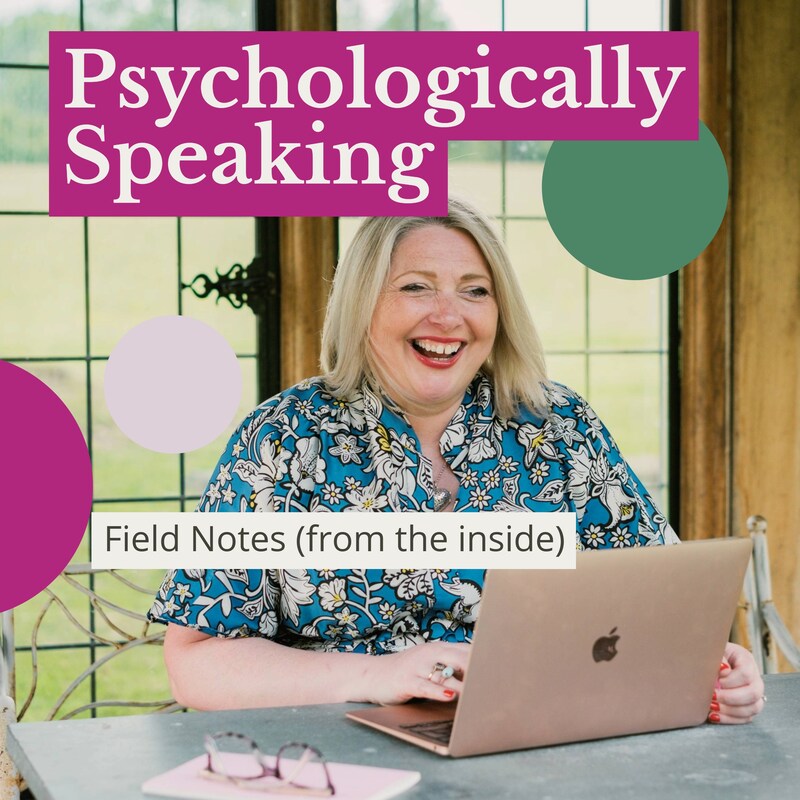
Hi, I’m Leila, and I’m currently doing a PhD exploring the experiences of women who are independent workers, including entrepreneurs, freelancers, and the self-employed, who use online communities as part of their working lives.
My first study is collecting data through a series of interviews with women and community hosts across two online communities where I’m also a paying member. These are spaces I didn’t join as a researcher, but as someone looking for connection, support, and belonging in independent work.
Alongside the research itself, I’ll be keeping a series of blog posts as part of my reflexivity practice. These posts will sit under a little series I’m calling Field Notes (from the Inside) reflections on researching communities I belong to, in real time.
Transcripts
Speaker:
Everything we know is shaped by where we stand in the world.
2
:
Field notes from the inside.
3
:
our bodies, our histories, our relationships, access to power, safety, time, and
resources.
4
:
None of us observe life from a neutral platform.
5
:
And the feminist scholar Donna Haraway called this a situated knowledge.
6
:
She argued that there's no view from nowhere.
7
:
And what we call objectivity is always shaped by perspective, even when that perspective
has learned to pass itself off as universal.
8
:
So she said this in the 1980s, a time when science and technology were widely imagined as
neutral and detached and value free.
9
:
But she insisted that knowledge is always produced from somewhere.
10
:
So I found myself thinking about her work because I'm researching communities that I
belong to.
11
:
And if all knowledge is situated, then the question is not whether I am involved, but how
I account for that involvement.
12
:
In psychology, especially in the qualitative type of research that I'm doing at the
moment, we don't pretend that um as a researcher, we're some kind of neutral observer
13
:
hovering around the data.
14
:
We know that we're in it and we're asking questions.
15
:
We're building interpretations.
16
:
We're deciding what feels meaningful.
17
:
Reflexivity is basically the practice of turning the lens back on ourselves and asking,
well, why did that comment stand out for me?
18
:
And what does this tell me?
19
:
Why is it so compelling?
20
:
What am I bringing to this conversation because of my experiences?
21
:
And where might I be filling in gaps because something feels familiar?
22
:
It certainly isn't about beating yourself up as a researcher for having a perspective
23
:
or trying to be perfectly unbiased, which is impossible.
24
:
It's about holding things up, turning them around and really inspecting them.
25
:
And it becomes especially important when you're researching spaces you belong to.
26
:
When the language is shared or when someone describes something and part of you
instinctively says, of course, that's just how it is.
27
:
One thing that's been really useful though, is thinking about
28
:
my reflexive notes that I took last time I did insider research as part of my master's
degree.
29
:
Reading them has been a nice reminder to notice those of course moments and how they
showed up in my thinking and how I slowed down my analysis to question them.
30
:
There is one quote from my master's where one of the participants described online spaces
as smoke and mirrors.
31
:
Now this was
32
:
research around imposter phenomenon and I remember immediately understanding what that
person meant and even noting that reaction in a transcript as a reflexive moment.
33
:
And at the time that instant recognition probably felt like an insider moment but that's
where reflexivity asks you to pause because smoke and mirrors isn't just about that
34
:
appearance of polished social media.
35
:
It was actually uh
36
:
know, fear of exposure, self-censorship, blurred audiences, and deciding what can be
shared safely.
37
:
It was about navigating visibility in spaces where reward, well, spaces that reward
performance, but don't always show the full reality.
38
:
So it asked me to think about my own visibility at the same time.
39
:
if everything does feel like an illusion in online spaces, where does that leave the way I
share?
40
:
Am I part of this performance too?
41
:
My familiarity with the Communities and Researching can be a real gift.
42
:
It'll allow me to hear nuance, understand context, perhaps even read between the lines,
but it can also smooth over things that deserve much closer attention.
43
:
For me, it's less about trying to eliminate my own involvement and just be more honest
about it.
44
:
because if all knowledge is situated, as Haraway suggests, then the work isn't to pretend
I'm standing outside of these communities, it's to be very clear where I'm standing while
45
:
I study them.
46
:
Hi, I'm Leila and I'm currently doing a PhD exploring the experiences of women who are
independent workers, including entrepreneurs, freelancers and the self-employed, who use
47
:
mixed-gender online communities as part of their working lives.
48
:
My first study is collecting data through a series of interviews with women and community
hosts across two online communities.
49
:
But I'm also a paying member in these spaces and I didn't join as a researcher, but as
somebody many years ago looking for connection, support and belonging in independent work.
50
:
Alongside the research itself, I'll be keeping a series of blog posts on my reflexivity
practice.
51
:
And these posts will sit under a little series called Field Notes from the Inside.
52
:
And they're just reflections on research in the communities that I'm a member of in real
time.
53
:
If you're joining me today, it's possible that you have taken part in one of my interviews
and I just want to say a final thank you for being part of such valuable research and for
54
:
sharing your experiences with me in our shared context.