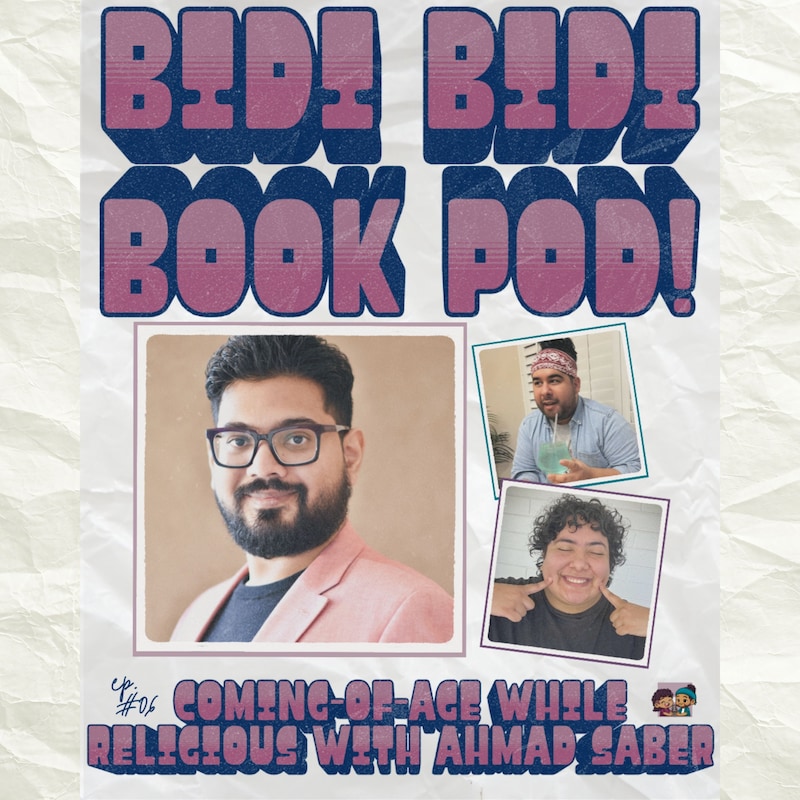
Shownotes
We had such a blast talking with Ahmad Saber on this episode, from his journey to publication to deep dives into spirituality and queerness, and even coming up with a new book idea together!
Links:
Ramin Abbas Has Major Questions
Devout by David Archuleta
Transcripts
Hello and welcome to the Bidi Bidi Book Pod, a bookish podcast committed to celebrating queer and trans BIPOC stories and storytellers and sharing our experiences within the publishing industry and what it is to exist as a queer trans BIPOC creative today.
novels and romances including: Sonido:And my name is Sonido Reyes, bestselling and award winning author of the Lesbiana's Guide to Catholic School, the Luis Ortega Survival Club, The Broposal, the Golden Boys's Guide to Bipolar and the forthcoming to Our Untamed Core.
And together we're so excited to spend some time with you, with friends and in community to chat chismear and make that TBR pile bigger and more diverse.
Today we are joined by Ahmed Saber, a debut young adult author whose very first book release from Ramin Abbas has Major Questions just came out in March.
Today we talked about being a debut author Ahmed's original story as a traditionally published author and had a very engaging conversation about writing, religion and culture as a queer BIPOC storyteller.
Jonny:But before we bring Ahmed in, let's start with a platica, a moment to catch up with each other and with y'all, bring you into our lives as authors and what we're working on and maybe overshare a little bit. So Soni, what's going on with you? What are you working on? What are you doing? What's happening?
Sonido:What's going on with me is chaos. Currently, I am finally getting back into writing. This is, this is being recorded like way in advance.
So as of right now, I, I just took like a pretty long break and I was just like so burned out. But I'm, I'm getting back in the swing of things slowly and I also started playing Persona 5 Royale, which I'm a royal, Royal Arroyo, I don't know.
So good. I like it and that's been like distracting me from all of the horrors. So. Yeah, what about you?
Jonny:Love that! Well, at the time of recording this, I just got back from Love Y' all Fest in Atlanta, Georgia, which was a super fun time. Incredible. Would go back, definitely used all of my social battery there. But that's fine. That's what, that's what I love.
And yeah, getting back to revisions on my new adult book, I sort of left. I was having like a really productive like I really, whenever, like I, I, I get to like the midpoint and I'm doing so well and then like I'm seeing that like third act, like nasty stuff that has to happen in romance novels and I'm like, I don't like that. Like it just kind of like I always slow down whenever I have to.
Sonido:Yeah, yeah, it's like the hardest part to get through.
Jonny:But like I'm getting a lot of clarity about like how that should look and a lot of ideas on like revising it. And so that's been really great and hopefully will help me just get into it.
I've also like fallen in love with like a couple of side characters as I'm revising this. And so I'm like, I might need to write two more books in this like fraternity world. I, you know, who knows?
Sonido:But I feel like you have such a vast amount of characters to choose from for spin offs.
Jonny:Yeah.
Sonido:Like all your characters are so fun.
Jonny:Yeah. And I feel like what new adult romance doesn't have eight books?
Sonido:Right
Jonny:So you know, if, if like our self pub siblings have taught us anything is that when you write one book you can write seven more.
Sonido:Mm-hmm
Jonny:Like just like have an side character with a little bit of lore and you're, you're good to go.
Sonido:And if anyone like looks at the side character and is like, "hmm," that's all you need.
Jonny:They're giving a little gay like boom, like we got it. That's kind of been my journey with that so far. Um, but yeah, love that for us. Incredible.
Sonido:Now we're so thrilled to have the chance to chat with Ahmed Saber. Thanks so much for joining us.
Jonny:Yay.
Ahmad:Thank you for having me. Thanks for having me.
Jonny:Of course. We're so, so happy to have you here. And I think first of all, huge congratulations on your debut.
We're like in the future now where like it's come out and we can like clap and be like, oh my gosh, this is incredible.
And, and for those of those readers, listeners here who maybe haven't gotten a chance to pick up your book yet, can you tell us a little bit about Ramin Abbas has Major Questions.
Ahmad:Absolutely. Yeah. Thank you again for having me. I just can't believe I'm here. So big, big thank you to both of you.
My debut is called Ramin Abbas Has Major Questions and it is a young adult contemporary novel about Ramin Abbas, a senior at a private Muslim high school who has to join the school soccer team because he's missing the PE credits he needs to graduate. And that puts him in forced proximity to his crush, who is the Handsome, captain of the soccer team, aptly named Captain Handsome.
But he has bigger problems to worry about than that because this is a time where he's thrust into a time of turmoil in his life where he has to figure out whether he can be both gay and Muslim. So ultimately the book is about his major question. Can you be. Can you be gay and still not be smitten by Allah?
Sonido:I am obsessed with this book. Just for anyone who maybe at this time has not yet purchased it, go buy it. It's so good. Yes, I blurbed it.
Jonny:Yeah. Having the chance to read it right now, I. Yeah, I'm falling in love with it. And like, I, I feel like I remember we were trying to figure out names that people were going to invite and I had saw this book on like LGBTQ reads or somewhere and I was like, oh, like, this sounds so good, but also like, I love it because it felt just so reminiscent of like Soni's and mine's own, like, first book. And my, my debut book was like a senior at a faith based high school who was a soccer player. And I was like, oh, like these are, these are cousins.
Like these, this is family here. And Sonia was like, oh, this is already on the list. And I was like, oh, okay, cool. Perfect.
Ahmad:I'm so happy.
Jonny:Our minds were of one of one mind at that point.
Ahmad:Yeah. Well, the fun fact is that when we were pitching it to editors, we used Soni's book, the Lesbiana's Guide to Catholicism.
Sonido:That's so cool.
Ahmad:And then when it came time to blurb, they gracefully accepted to blurb it. And I just have a quick excerpt from here. Equal parts heart wrenching and endlessly hopeful. So those were coming from Soni. I mean, a lot. Thank you.
Yes.
Sonido:Those were my words. And it's so true. I. Oh my gosh. Yes. I'm so happy you asked me.
And that was like, honestly, one of my kind of like, author dreams of like, when I started writing of like, oh, how cool would it be if like years from now another author uses my books as like a comp title. That's so cool. So thank you.
Ahmad:Yeah, no, thank you.
Jonny:And I think we, all of us listening, would love to hear a little bit about like, your own origin story and what led you to writing.
Ahmad:Yeah, absolutely. So, so, so writing was kind of within me, but I just didn't realize that it was within me.
And it, it always wanted to come out, but it took me a while to actually sit down and say, okay, hey, this is what it is. So what I mean by that is there was always this kind of creative side to me that felt very unexpressed and kind of suppressed.
I was your typical, you know, pre med gunner, you know, very nerdy in high school. My prior life, actually, I was born and raised in Pakistan. So I was, I was 16 when I came to, to, to Canada.
So, you know, that was a big transition time in my life as well. But I just put all my blinders on and went straight in with all of the academics and, you know, did well and all of that.
But I knew that deep inside there is a, a story that needs telling or some sort of creative energy that's building up. The exact moment came to me actually on my, in my final year of medical training.
So I should just say I'm also a doctor by day trade, you know, but the, the, the passion and the dream is wr.
You know, with, with the last year of my residency training, I was sitting in this lecture and they were going through some very dense kind of medical stuff. And I just had that moment where I was like, okay, I really need to get out of here. You know, I appreciate this. I'm glad that we're learning this.
I can learn this later. Let me just get out of here. And I just. This was a conference taking place in a hotel.
And I remember just walking out with my laptop and going to a empty room next door, which was kind of like a ballroom. There was like a chandelier and empty chairs. And it just felt very inspirational for some reason.
And I just whipped up my laptop and started writing this kind of crazy horror novel about a gay boy trapped in the mountains, you know, with some ghost haunting him. And then it became this.
Sonido:Oh, wow.
Ahmad:I don't know how it became this story, you know, from that. But.
Sonido:Wait, so this story like started as that or that was like a different book?
Ahmad:No, no, it started like
Sonido:Oh, my God.
Jonny:Yeah.
Ahmad:But yeah, it started off as like a weird horror novel. Was like, no, I don't think I'm ready to write horror yet.
Jonny:Yeah.
Sonido:Well, I hope one day that sounds really good too.
Ahmad:Oh, I would love to. I would love to. I mean, Stephen King is one of my faves, so I would love to write a horror novel.
I was absolutely, like, obsessed with misery when, when I read that. So something akin to misery. Like it would be a dream to write that.
But yeah, then I just kind of went with it and, and to be honest, I just kind of like taught myself with trial and error and just kept revising and revising and revising and just, got there to some at some day. I was there and. And an agent liked it. So, yeah, that was the brief story of writing.
Jonny:That's gorgeous. I love that. Like, when just something just kind of clicks and you follow through, I think. Yeah.
Like, I for sure did not grow up thinking I was going to be a writer, but I did feel like there was some sort of, like, story always in my head. I just never was who had a composition book writing it down.
And I feel like it just sometimes takes that moment where you realize that you can just go sit down and start doing it, that it happens. And that's for listeners out there. I think that's a great thing to also take in.
Sonido:Yeah. Like, it doesn't have to be like, you're, you know, one thing. Yeah, I love that.
Jonny:I used to always, like, I did not come out of the womb with, like, a composition notebook and Microsoft Word open. And, like, you don't have to have done that to be a writer. And I think that. Yeah, I think that resonates for a lot of people.
Sonido:Yeah, I actually. Sorry.
Jonny:No, you go ahead. You go ahead.
Sonido:Just like, bouncing off of that. I. I used to actually, like, literally hate reading and writing. Like, growing up, I thought it was the worst because I felt so, like, like, dumb.
Because that's how I felt. Like, people saw me because, like, with, like, I'm.
I'm autistic, but I didn't know it back then, so I was just, like, you know the label, like, stupid or whatever because, like, I would, like, not be able to, like, form the words or, like, you get called on reading out loud and you're just, like, stumbling. So I, like, associated it with, like, the shame of, like, feeling not smart enough.
So, yeah, another little PSA for anyone who's like, oh, I don't think I'm, like, smart enough to be, like, a writer or even, just, like, read books for fun. Like, it can still be very, very fun.
And, like, you know, I've won awards and stuff, so I feel like, definitely, it's never too late to, like, rekindle that.
Ahmad:Exactly. I just want to add, like, you know, I. You know, knowing that backstory now, Soni, I can't believe how beautiful, like, you know, the book.
The prose is delicious, and it's kind of a testament to the fact that. That, you know, you were made to feel like that, but you were capable of all of this, you know?
And the second point I quickly wanted to add was, like, you know, people maybe sometimes wait, like, okay, I'm going to learn this and then get better at it. Or I need equipment. You know, like, you know, like something creative. Like, you need. Okay, I need paints or I need a camera to film.
But writing is so accessible if anybody's thinking of doing it, because all you really need is pen and paper or a laptop to just get started and learn. So
Sonido:Yeah, even I know people who, like, write their books on their phones and stuff. Like, there's really no right or wrong way to start.
Jonny:Yeah, absolutely.
And I think, like, Soni and I both are curious, too, about your experience with getting into traditional publishing, because we kind of discussed in our first episode how it feels like the entire methodology for finding an agent and getting published and even, like, finding community has sort of changed and then changed again since we were first writing our debut books, like, seven and a half years ago. Maybe at this point, if I did math correctly, which I may not have,.
Sonido:I don't like that.
Jonny:You know, it's so weird. So, like, what did. What did that timeline look like for you? Is this.
I mean, we've already got, like, this is the first book you've ever written, but, like, from that point, like, what was your sort of journey in acquiring an agent and. And getting it ready to send to editors and all of that?
Ahmad: . In the lecture, that was in: And the book is coming out:And you could infinitely make a book, you know, better. And it's like a asymptote, you know, the thing that reaches infinity and then it just, like, never touches it.
Sonido:Yeah, yeah.
Ahmad:But for me, you know, it was really challenging in the beginning, and I expected that as well, because obviously, first was like, I didn't have the skill. Actually. I. When at the time I started querying, I had a finished draft of 45,000 words, which is too short for a YA novel.
So looking back, I wasn't even ready when I started querying. But what I did know is there were little signals that would pop up, like little bits of feedback. Obviously, the rejections were unrelenting.
I would wake up every morning. It was a Morning routine to check the Gmail app on my phone and then just kind of feel sad for the rest of the day.
So if that brings PTSD for someone, I'm sorry.
Jonny:The trauma. Flashbacks of being so terrified every time I heard my Gmail notification go off.
Ahmad:Yeah, yeah, exactly. And.
And it was just like, you know, I. I just want to quickly put that in there that I hope anybody in query trenches is not taking that as a reflection of self worth because I actually confused the two and I would just take it as a personal failure, but it's not really, you know.
Jonny:That's huge. That's huge.
Sonido:Yeah, I. I used. I.
People might hate me for, like, for this, but this helped me so much when I was querying of, like, the first rejection, like, celebrated as a milestone. Like, you. You have to get one before you can get. I mean, unless you're a freaking unicorn.
But most people are going to get many rejections before they get, like, any requests or an offer. But, like, I actually gave myself a little, like, treat every five rejections because I was like, oh, that's five.
Okay, now I can treat myself because, like, I deserve it. Like, I went through five rejections, you know, so, like, I don't know. And this can go for, like, I think anything.
Not just querying, but like, yeah, like, give yourself, like, treats for not just your accomplishments, but also for, like, the steps that it takes to get to the accomplishment. So, like, every five rejections or like, whatever it is for you, like, that helped so much with my mental health during query.
Ahmad:Yeah, yeah, no, that's. That. Absolutely. You have to kind of check in with yourself during that phase.
But with the unrelenting rejection, there would be little glimmers of hope. They would be like, okay, you know, we like this joke you did, or we like this part of the voice or something.
So I knew to just kind of follow that as a lead and then revise and improve on that. Obviously, beta readers helped immensely. Right. We all have to rely on our beta readers.
But the first sort of break came when I was offered a revise and resubmit by a different agent than I signed with. But he was very gracious. He wrote me a, like, three page word document with all of the things he thought could be improved.
And I saw that as a sign of potential in the story. I did revise and then I resubmitted.
And unfortunately, it was still a rejection, but still I knew that there is something, you know, that that could be worked into shape. The next real big break came with my signing agent, wonderful, wonderful agent Dan Lazar. If you're listening to this, shout out to Dan.
What really, I think I got lucky with. And also perhaps with the strength of the story about, you know, authenticity, was that Dan had a personal connection with this.
So without going into any of his personal details, he felt like it resonated and reflected his own experience, and he became a champion for the story. And that really, I think, was the key for me to getting my foot into the industry because. Because he. He. He dedicated so much time, and he.
He is so busy. Like, he has so many projects he's working on, but he. He saw something in it, and he asked me to. To revise it resubmit, and his assistant.
Assistant helped with that. I revised again, and unfortunately, he still passed on it. And. And he said, okay, you know what? Like, just, you know, for now, I'll pass on it.
But he didn't say, like, don't come back. Right? And I was like, okay, you know what? I. This is the first time I felt like somebody actually really kind of tried to understand the story.
I could do more.
And so at this point, I shifted my strategy, and after revision, I actually went with smaller publishers directly with submissions who didn't require an agent and met this wonderful editor at Holiday House. Alex Aceves.
Jonny:Yes.
Ahmad:Oh, my God, she was just a godsend. She. Again, shout out, Alex, like, if you're listening to this, you helped me so much than you'll ever know. But she basically.
It took like, a whole month to. To basically give me a free editorial letter.
It was like a full editorial letter, like, eight, nine pages of, like, detailed feedback, plot, character, this and that. And. And I revised again and. And submitted to Alex and Dan again. But Dan, at this point felt like he wanted to go in a very different direction.
He said, this is very beautiful, but it's a little bit too idealistic, you know, a little bit too fantastical. We want to ground in reality where Alex was on board with my vision. So I had a very tough choice to. To revise for Dan again or to go with.
Well, Alex had said, I will take it to. To acquisitions next week, but you need to let me know. So there was a big, massive decision.
I was very stressed with that, but after a lot of thinking, I went with Dan's vision for the story, and I said, okay, I'm going to give it one more revision. And Alex was super gracious. She said, okay, you can just submit to me through Dan if he accepts you, and then I'll take A look again.
So then Dan read the revised manuscript and finally he was like, wow, you did amazing, you know, and I'm gonna try it.
Sonido:Yay! Oh, my gosh. Wow. Yeah, that is a certainly unique story because you got three separate, revise and resubmit.
Jonny:Yeah, that just shows, like, yeah, like. Like you said, like a champion of this idea.
Like, that just really goes to show, like, how Dan really saw something in this story that, like, wasn't just something that he saw as narratively sellable, but something that really struck him personally. And yeah, like, I felt the same way with. Whenever I had Claire Draper, my current agent, like, offer me.
And I had two different agents offer representation and the other one was. Was incredible too.
mentioning little scenes from:And it really is important, I think, for especially queer BIPOC authors to have someone in your corner as an agent who is going to like, quote, unquote, trademark champion your work.
Sonido:Yeah, 100%. I feel the same way about I. While we're giving our agents shout outs. Allie Levick, my agent, love her so freaking much.
But yeah, it's the revision stuff that, like, I don't think, especially as a debut, like, none of us really know how to revise to be a publication ready or to like, be submission ready even.
So, like, that is just so helpful to, like, have someone with that eye to go in and there's like, so much more work that needs to be done when you think your book is done and it's like, oh, yeah, like you said, it could go infinitely. But there's like a point where it's just like, okay, well, is it.
Is it getting the better enough to justify a whole other revision, or is it like, should we just go now?
Ahmad:Exactly. I mean, that's just what I told you half the story. I won't go into the details, but then we had to go into editing with my lovely editor, Caitlyn.
Shout out to Caitlyn. But we spent like close to three years, you know, round after round after round.
So I just want anyone who's interested in writing to know that, you know, editing is going to be a part of it. Open your heart to it, embrace it. That's where the magic happens. Yes, there is such thing as over editing and editing into oblivion.
But hopefully there will come a time when you. You. You reach that point where it's, like, you know, edited into the reasonably good shape, ready for your reader.
You know, ultimately, I love how John Green puts it, and he says that you're making a gift for a reader. Right. And that helped me so much. It's just like, you want the present to be pretty in its best shape. Right. That's the best writing advice, actually.
I've heard this.
Sonido:Yeah, I. Sorry.
Ahmad:I'm done. I'm done.
Sonido:Oh, I was just gonna say, actually, like, you made me think of a question that we didn't actually plan to ask, but I'm gonna. I'm gonna just ask, if that's okay. It was like, we're talking about editing and. Oh, my God, I already forgot the question that, like, came and went.
Oh, my God, that's so funny.
Jonny:Should we, like, move. Should we just move on? And if you. If you think of it, you can just shout it at that. At that exact moment.
Sonido:I was just like, interrupt. Like, I remember.
Jonny:Yeah, exactly. Exactly. Yeah, perfect.
Sonido:Hopefully, I actually do remember, but we'll see.
Jonny:Yeah, I want to hear it now, but until that happens, while we're recording this episode. Now, like we said, it's a couple weeks before your book hits bookshelves, and this episode will be coming out a few weeks after that.
So imagine with us, if you will, like, for this question of how do you feel now that your book is out in the world and maybe, like, what sort of hopes are you putting out into the universe for your book as readers get introduced to Rami?
Ahmad:Oh, yeah, that's such a great question. I mean, the feeling is. Let me keep it 100% real. It's just kind of a mix of exhilaration and anticlimactic feeling. Like, it's just like.
Yeah, like, with all the milestones in my life, you know, getting into medical school and, you know, getting into the residency of my choice, it's always like this, you know, and I kind of tied back into greater existential themes, which I won't get into. But, you know, it's almost like you're on a journey and you're observing things, and you.
You really want something, but when you get it, the feeling is there of fulfillment and. And achievement and pride. But at the same time, you're like, you know, I'm still a person without this as well.
You know, I guess I got this moment where I'm like, you know, even if I didn't have that, I should Be happy, you know, so it always ties back to that, and that creates this kind of anticlimactic feeling.
But with this book, I mean, of course I'm very, very excited for readers to finally be able to read it personally, because I have spent six years with it and editing. And editing. I. I don't think I can read it again.
Sonido:Oh, yeah, like other people will. Will read it for you.
Jonny:Take a break. Take a break from it for a while.
Ahmad:Right, right, right. But I can't wait for the readers to. To. To dig in and. And kind of explore this world. So for that reason, I'm definitely super thrilled and excited.
It's been a dream come true moment. In fact, one of my dreams was to. To go to New York and buy a copy in like, the, the Barnes and Noble in, in Times Square.
Because when I was there for the first time, you know, as a tourist, I was like, wouldn't be cool to see my book here, you know. And so that moment is about to come true. It's very exciting. I have a trip booked for that. There's gonna be a small launch event in, In.
In New York as well, and my dad wanted to be there, so it's kind of very special.
Jonny:That's so cute.
Sonido:Oh, my god, I love that. Oh my gosh. And that's going to be at Books of Wonder, right?
Ahmad:At Books of Wonder, yeah.
Sonido:If you're anyone in New York. Well, actually, this is after the fact. Just kidding. Everybody in New York who already went.
Ahmad:Yeah.
Jonny:Comment, and tell us. Comment. Tell us how great it was for those of us that had to miss it.
Ahmad:Yeah. And thank you for coming. So. Yeah, so definitely a lot of exhilaration. But my hope and dream really is, you know, I.
The way I like to put it is, you know, some people might consider it as too niche of a book. Right. Like, you know, it's. It's kind of very, very specific audience, but the themes are universal.
And my hope is that the readership at large, YA readership at large. Will connect with the story.
And the reason for that is actually quite peculiar because I feel like if it gets a little bit more recognition and visibility, then the kids who really need it might actually find it, because otherwise, if it's very quiet, then they may not get to it.
My whole goal is really for kids like Ramin and my teenage self, who was very much like Ramin, also very different, but very much like Ramin in some ways would have loved this book, but how would they find it? So. But that's my hope is really ultimately for it to get into kids who have, may have shared the experience.
And by the way, it applies to all religions, not just Islam, but anybody, you know, with a religious upbringing and, and are queer or questioning.
I hope that the book, the book goes to them and gets to them and it's just one of those things which kind of again, tying back into my existential, chronic existential crisis.
But that would, I think, be meaningful, you know, something meaningful to, to, to look back on as you're leaving planet Earth, you know, and look back and see somebody shared your, your experience and, and found themselves reflected in the story. So that's the big hope. Anything above that I count as bonus.
You know, if anything, you know, like, like, you know, the, the reviews and stuff and, and, and trade reviews and stuff. I see it as a big, huge bonus. Like, I welcome it. But ultimately the goal is to, to get the, the, the book to kids like Rami.
Sonido:Right.
Jonny:Yeah, I, I'm sorry. So I'll go first, I guess. But like, yeah, I, I, I mean I have so many thoughts.
Like I love all of that, but like I, I like the day before my book came out, I was doing some like, random online interview in the midst of the pandemic and like one of the questions was like, what do you have to say to readers who are going to pick up your book and like, find and see themselves in Jules and all of his struggles and, and all of those things and in his journey? And I feel like for the first time, like before that it was like, yeah, like book, fun book, great.
But that moment was like, wow, like this is actually going to mean something to someone. And like, I had often felt that like, when other people certainly like the Cishet White readers call books like ours like quote unquote important.
I don't necessarily like that a lot, but I do love it whenever we get to call our books important and we get to say for ourselves that there is meaning in our storytelling.
And it really just hit me in that moment that like there is meaning in what we've worked so hard to do and, and, and I, and I do feel like, you know, especially in that sort of like niche writing.
And that was definitely a way in which I had thought about my own writing too and realizing that like those small parts that are so specifically to us and to the people specifically the young readers that we're writing for is going to find that universality amongst all readers is such a cool thing and like being able to like have, have the opportunity to speak on universality within super niche or cultural sort of perspectives in YA writing. Like, that's always the most fun for me is to even read a book that, like, I don't necessarily relate to the character.
But why, why must we relate to the main character? Why can't we find those universalities that make the story fun and beautiful and worth reading?
And so, yeah, I'm really excited for just everyone to read your book.
So it finds those readers who are like Ramin, who are like the Yami and the Jules, who all really need this book and will find a place in their heart for it, and the ones who will see themselves in the friends and in the side characters and just in this universe and know a person like that and be able to share it with them.
Sonido:Yes, that's kind of like almost exactly what I was going to say. So, but just kind of also adding on. Like you said, it was kind of like, oh, it's like a niche audience. Right.
But at the same time, like, yeah, there's a very specific identity, a very specific story here.
But whenever we tell stories that are very specific, I feel like, because it's not a story that we often see represented, everyone who doesn't see themselves represented very often is going to feel that connection. So it almost feels like because there's so many people who are like, starved for seeing something else, you know, than.
Than what we're used to or like even like, yeah, we all want to see ourselves, but like, we also like, want to see each other and like something different. And I feel like that is just going to reach so many people, even though it might feel like it's a very specific experience or a very specific person.
Person who like is. Is exactly Ramin, the person who is going to feel like so, so seen.
But I have faith that it will reach that person because there's so many other people who are going to also feel seen because they're also on the margins, if that makes sense.
Ahmad:Yeah, yeah, no, exactly. And that's, that's exactly the hope is, you know, connection with, with audiences on universal teams and then very.
For the more specific exact experience experience like Ramin's, there will be, of course, statistically speaking, fewer people, but they, the hope is that they also then find it and see themselves reflected. So.
Sonido:Right.
Jonny:And I think too, like, I, I really was struck with like, the anticlimactic, like, sense of mind too, like, especially as a debut author because it's like, yeah, this is thrilling and exciting and like, very few people in the entire world get to experience this specific experience that you get to do now.
But then it's like, I know a lot of my like author friends and even myself have experienced just like it happens and then it's sort of okay, that was just like another Tuesday in the world. And like, you know, and now, okay, now my editors expect, or someone is expecting a book two, if not an editor or an agent.
Like I've got to work on a book two if I'm going to have another Tuesday like this.
And so like there, there really is that sort of almost like mentally draining sort of idea about debuting because like everyone's sort of building this up as this huge thing, which it is. But then it just kind of happens and we all, we go on and be.
And because we have to like live under capitalism, we have to just continue doing it and sort of forget about these characters unless we're pitching it to someone. Because now we're working on brand new characters and a brand new story.
And yeah, like, I think it's really important to really identify that like there is that, that kind of anticlimactic frame of being, especially once it comes out.
And, and how to still maintain your happiness and that sort of sense of accomplishment even through that I think is super important for debut authors.
Sonido:Yeah, 100%. Speaking of debut authors, all three of our debut novels, you kind of mentioned it before, Jonny.
Like we all wrote a debut with like a queer kid at a rel school.
And while that experience like you said, is like very niche or like can feel so isolating for me about this book, there the relationships were like my favorite part. Just so healing like from the sibling bond to like platonic friends romance.
Can you tell us what you find so special about these like support systems in books like this and how you strike the balance between that and when every relationship isn't necessarily going to be a supportive one?
Ahmad:Yeah, so yeah, so it's a two part question. I'll ask you to repeat the second part later. But yes, I got you.
Yeah, so I think, I think for anyone, but more specifically for, for queer kids, I think it's, it's massively important to, to, to, to have a support network and that could look like, you know, that could look like different things for different people.
Whether that's one or two close friends or whether that's cousins or maybe supportive uncles or aunties if, if it's not always the parents, unfortunately or you know, even siblings. Right. So supportive siblings is a huge blessing. I just think it is one of those things that's, that's, that's hugely important.
And I, I hope that we can, we can remind, you know, through our work and our storytelling, we can remind any, any closeted queer kids that, that, that is possible for them as well, because it really can make all the difference. We are as a species wired for, for connection and, and, you know, getting through stuff together.
I think one of the worst things you could do is self isolate. If it happens because of circumstances, that's different. But choosing to self isolate could really put somebody in a dark place.
So, yeah, I don't think that the importance of those kind of connections and relations can be overstated. Now, in terms of the second part. Could you repeat the second part of the question?
Sonido:Yes, so sorry. A very long question. So how do you strike the balance when not every relationship is going to be supportive?
Ahmad:Yeah. So I think part of that is also going to come with, with maturity. And maturity doesn't have a direct correlation with age, really.
You could, you could have maturity at any stage.
But I think that's part of being human and growing up really is to recognize that sometimes you can't change people and you can't make choices for them, but you can make choices for yourself. And you deserve to find connection and shared human experience. If that happens to not be with a family member, that's very tragic. That's sad.
And we can grieve about that. We should grieve about that. But that shouldn't stop us from seeking it elsewhere.
You know, like, like I said earlier, whether that's siblings or extended family or found family, you know, close friends. But yeah, striking the balance would really, I think would really come.
Would really come from a place of acceptance, really, you know, accepting things the way they are. If you don't have a supportive close family member, like a parent or a parent figure.
Yeah, that, that, that deserves acknowledgment and a processing of sadness and grieving there.
But at the same time, you know, opening yourself up to seeking that connection elsewhere would be super important because I think without that, again, like, personally speaking from my own experience as well, could put you in a very, very isolated, dark place. And that's, that's not somewhere you, you want to find yourself, you know, all alone.
Yeah, I think acceptance has a huge part of it, like, like in my own life as well. Like, you know, speaking with my experience, with my parents. And then, you know, hope is the other part of it. Right.
You know, there comes a point where, where you kind of gain enough maturity that you start having compassion for yourself first and foremost. But also for others and their perspective. And then you try to open up a dialogue. Now there's one exception to that.
If someone is unfortunately, you know, how can I say has a, I'll just say has a personality disorder or some sort of a thing that really blocks, blocks that kind of conversation. That's different.
But I think most people, especially if it's a parent figure, there might come a point where you can have conversations and try to, try to, to share some of your experience and see if that would help somewhat. Because I find oftentimes it's ignorance at the base of it. It's ignorance of the queer experience, it's ignorance of what it actually means.
It's fear based as well for some parent figures like, okay, you know, my kid is going to have a hard time in the world now that they're queer, so maybe they should hide it. But if there is that point where you can have conversation, there might be hope for them to expand their perspective as well.
I'm incredibly proud of my dad, you know, how much progress he has made in that regard. You know, he was very, very anti queer and anti gay mostly because of his religious upbringing.
But then when I shared my experience, now he's at a point where he is like don't ask, don't tell kind of phase. But you could tell he actually really, really has, has a root of care and love for his son and he doesn't want to, to let go of that.
So him even quietly coming along on a queer book launch event in New York, it's a huge step for him. I'm actually quite proud of him. So there's always that hope as well.
You know, if, if you see that, you know, it, it might be, it might improve those kind of, you know, non approving figures might change their stance. And actually this brings me back to, to, to, to the Lesbiana's Guide to Catholic School. I love the mom's, the mom's transition by the end, right.
Like that was such a beautiful message of hope and, and it was actually quite surprising as well because, because I actually, when I was reading I thought the dad was going to be supportive. Right.
I thought that was gonna be like a surprise element where Yami can get that, you know, that what, what she really needs from, from, from father's side. But so it always goes on to tell, you know, people can surprise you.
Sonido:Yeah, exactly. I think that's like moral of the story is like your support is not always going to come from where you think it's going to come from.
And I really, really love, too, like, when we see that in books, because I think a lot of the time we do crave it from specific people. But it can be really beautiful when it comes from someone you're not expecting it from or when you don't get it at first, but you can see.
And I remembered a question that is not the question that I forgot before, but another question that I thought of and then forgot again also. And now I'm remembering that one.
Jonny:What a journey.
Sonido:I know it's been. I've been going through it over here, like, while I'm on mute while y' all are talking, but. Oh, my God, no, I talked too long.
Jonny:Oh, no.
Sonido:Oh, my God. Okay, wait, wait, wait. No, I can do this. I can. I can get it back. Okay. What was.
Jonny:We were talking about Yami and her mom and also her dad and surprises.
Sonido:I was so mad at myself. Oh, my God. This is gonna be an embarrassing episode for me.
Jonny:I'm for sure putting all of us at the beginning. Those little blooper clips that we've been starting it with. Yeah, okay.
Sonido:Okay. It was something about, like, support. We can frick. Oh, my God. This is embarrassing.
Ahmad:Support coming from elsewhere, right? Not necessarily from those we are expecting it from.
Sonido:Yeah, man. It was a really good question too. I remembered my other question was about editing, but it's like, honestly, like, we don't even. Like, we have.
So we still have other questions that are better than that one, so that's fair. I'll interrupt with this question. When I remember it again. Oh, my God, that's so annoying. I'm so sorry.
Well, anyways, I want to give a little warning to our listeners because I would really love to have a nuanced conversation about religion in YA novels. And I know the topic of religion can be really uncomfortable for a lot of people. Like, it's uncomfortable for me sometimes.
So I just wanted to give a little heads up on that before we dive in. But yeah, onto the controversy. Since religion is such a sensitive topic for so many people.
How did you go about walking that line between delving into the real struggles that a lot of queer religious kids face while also showing that there's a lot of nuance in spirituality and how it doesn't always look the same way even within the same religion?
Ahmad:Yeah, that is. Yeah, that is a very important question. Thank you for that. So I would like to start off by saying that, you know, the. The. The.
The view a teenager might have at that.
It's a very specific time in their life when they're still under the influence of the mosque or the church, church or the synagogue they were raised with and their parents and their worldviews. Right. So they're still forming their worldview, but they haven't fully formed it yet.
And that part, that particular part or stage in a teenager's life, not always, by the way. Some teens are way more mature, beyond the earth and they've already reached their own conclusions.
But, but that's not a stage where, where a teenager might necessarily be willing to listen to a story about rejecting faith. Right. Because they still feel so ingrained and so enmeshed with the religion and that informs their worldview. Otherwise everything falls apart.
Everything they know falls apart. So for that reason, I knew from the beginning that I didn't want to tell a story of outright rejection.
I could have, you know, and I think that story has also been explored in literature. But at the same time, maybe not all teenagers would be, would be ready for a story like that.
What was more realistic to me is, is a kid trying to make sense of it all and kind of first of all questioning it, which is the theme of questions questioning their sexuality and coming to terms with their own sexuality, saying, no, this is not actually just a phase. This is not just gonna go away. And then also like, is there room for me in this religion? So where was I going with this?
Basically what I'm trying to get at is even if, even if this kid, Ramin or a similar kid ends up rejecting their faith maybe five, ten years down the road, that's a completely different story than what they're going through right now.
And I wanted to tell a story of hope where they can still we, despite all the odds, weave together a sense of identity for themselves because, because it's so important. That feeling of having to choose is just incredibly suffocating from my own personal experience.
And if we can tell a story of reconciliation and hope there, I think that can lay the groundwork for a healthier development of sense of self through teenagers and beyond. Now, going forward, out of that phase, when you're on your own, college and working, yes, you might evolve your views on religion.
Some people might become overly religious, people might become less religious. Some people might find said the nuance in spirituality, and I think that's a wonderful thing to be able to experience.
But the base, still the base question, if you, if you start shattering it through that very formative time in your life, that I think could, could potentially, potentially do long term damage if you were forced to hide one side right, right off Your identity?
Sonido:Yeah, especially because, and this actually ties directly into my next question, which is that for a lot of like BIPOC people, our religions are not so easily separated from like, culture and from like our identities.
Like, I've had a lot of conversations with some of my like queer white friends about religion and it seems like a lot of them see it as like something that is like black and white only has caused them harm, which is like they're not wrong in their experience. Right. But for me, and for, I think a lot of, a lot of like BIPOC are, it's a very cultural thing as well.
So like, it's hard to kind of untangle like what comes from, you know, your culture, the stuff that you wouldn't want to let go of.
And then what comes from, you know, like a religion that maybe is something you are questioning or that you don't necessarily agree with everything about. So yeah, I guess let's talk about it. That's not really a question, but.
Ahmad:Yeah, no, I, I, I think that's, that's spot on. Yeah. So for, for, for, for Muslims and Islam, it's really intimately tied into the culture, right?
Because the culture is really informed by, by the religion.
Fun fact, you know, that's how the, the, the Muslim identity within Indian subcontinent began to differentiate itself from the rest of the, from the rest of India basically. Right. Which was a predominantly Hindu part of the world.
And so that's why religion really shaped that culture and kind of trying to carve out an identity and a separate niche for themselves within that. So definitely it informs the culture very intimately.
And some things that are very secular are still, could be considered very secular still still have got, you know, religious roots.
And even if you were, let's say, even if you rejected Islam within a brown, like Pakistani Indian family, there's still some things that you just couldn't divorce from because they're so ingrained in, in, in the religion. So for example, one thing would be, let's, let's take for example, like Ramadan, right? Like it's a family time, you know, people sitting down.
Actually tomorrow is the first day of Ramadan, but we're in the future now, so never mind. But it's a time when family sits together and has a meal basically every day, right. For the rest, for 30 days you have a family meal.
So it's really a time of bonding.
And even if somebody wasn't fasting and didn't, you know, follow the religious part of it, they would still be sitting together there having that family dinner. Right. You couldn't suddenly reject that and said, no, this is a religious thing. I cannot. I cannot do this.
Sonido:Yeah.
Ahmad:So. So I absolutely agree with you.
There's so much nuance when you are a person of color, you know, growing up with. With religion that is so intimately tied in with your culture that you. You outright rejection might not be an option. Right, right.
At least might not be an option right now.
Sonido:It's a lot more. It's a lot more complicated.
Ahmad:It's more complicated. Exactly, exactly. It's really difficult to like, unentangle it or disentangle. I don't know what the word is, but.
Sonido:But yeah, especially
Jonny:I think. I want. I want to hear your point. I want to hear your point.
Sonido:Oh, okay. Before I forget.
Jonny:Before you forget.
Sonido:Yeah. Like, I feel like, especially, like there's also an extra layer of like, untangling when you add.
And this is like, from my experience and, And Jonny, perhaps you can relate.
I. I don't know your background with this, but for my experience with, like, Mexican Catholicism specifically, it feels so different from like, when I have, you know, gone to church, you know, on the other side of the border, versus going to, like, the white Catholic church that I went to here in the US. It's a different culture. It's not even the same religion, it feels like. It's so different.
And so just knowing, like, that, that a lot of the Mexican Catholic culture or like, the culture around Catholicism in my family specifically and in a lot of. A lot of Mexican Catholic families is just that it's so ingrained with like, a lot of indigenous spirituality as well.
Like, even like, historically it goes like. So when you add like, colonization onto, like, a religion that is very much, much tied to a people of a place, it just. It extra complicates it.
So, like, there's certain things that even in recent years I have been doing a lot of digging and research into, like, the origins of this, but. And we can cut this out if it's like, not relevant at all, but, like, maybe we keep it in. I don't know.
But just like, so interesting how like, even certain symbols, like, you know, the cross had been used by like, like Mexica back in the day to like, as a.
As a secret way of continuing their worship of like, you know, the four, you know, so, so, so even in the Catholic imagery that we see all the time, there is a history outside of it that's like, tied together with it that now, after so many generations, it's, like, impossible to untangle. So yeah, I don't know.
I have a lot of feelings about it and I have, I have gone through like grief for like losing my faith and kind of reclaiming spirituality and all that. And I'm gonna bring it back to your book now because. Oh, actually, no, I want to hear what Jonny said.
Jonny:Oh, yeah, no, I, I mean to bring it back to the book and like, I think just in general, like queer BIPOC stories that have an element of religion and main characters who are religious or practicing religion. I, I do. And connecting to the cultural aspect too.
Like, I think in reading those stories there's often sometimes something so idealistic and inspirational because, you know, for a young queer person of any sort of not white status, to be able to one figure out where their place is in a religion also has to deal with finding their place in their culture and like what it is to have to do both of those things when I think, you know, and not to just generalize like white, white growing up and adolescence. But maybe that doesn't necessarily. They don't have to navigate both. They don't have to find their space in both.
And I think that's where I really, even as someone who doesn't practice Catholicism anymore, like, that's really something that I find very inspirational about seeing young people in fiction, say like seeing the terrible parts about a religion or seeing the terrible parts about their culture and how those two things seem so intimately connected and say I also see the beautiful parts of the religion and I see the beautiful parts of the culture culture and I choose to identify with those and I choose to fight for those and I choose to belong to those unabashedly.
You know, something that like I didn't get to talk about a lot in my debut book was the fact that like Jules, as a Catholic young person doesn't leave Catholicism just because his dad is a, a shitty machismo Catholic, but he also sees like his grandfather being a great source of like Catholicism and he sees the ways in which, which it can still be a beautiful part of his identity.
And I see, I saw that especially in Soni's books and, and as I'm reading your book and like Anna Mariano, who's another author, like, adds a lot of like faith things and their books too.
And so like I think that that's something so deeply impactful because especially in a time like this when like Christian faith in general, I think are so just claimed by conservative thought and ideology, like we should be able to also see what it means to have a progressive faith ideology and what it means to, to go forward in a faith that is truly based on love and acceptance and like what that can look like.
Sonido:Yes.
Ahmad:Absolutely. I, I, I'm doing a. Applause. That, that was mic drop.
Sonido:Yes. Sorry. Oh my God, I glitched again.
But, but that just kind of like, I feel like that goes right into like the, like the deconstructing and kind of reconstructing and then reclaiming spirituality or making it your own or rejecting. And I feel like there's like so many different paths that people can take.
And in YA books I do feel like it's a very, very, it's a, it's a, it's a big responsibility to be talking about this stuff, especially because it's going to be parents who are picking up the books, most likely.
And a lot of the parents, if they see something that is like faith based, you know, like Lesbiana's Guide to Catholic School, I'm either going to get people picking up that book who are like devout Catholics or that are ex Catholics and very anti Catholic. Right. So it's kind of like a lot of responsibility to kind of like talk about these subjects with nuance and.
Yeah, and I think in this book it was one of my favorite like depictions of that like deconstructing and reconstructing and reclaiming like his spirituality for himself.
So yeah, I want to know why, in your opinion or like how do you feel about the importance of like YA novels having characters who question and who like, you know, it is the, the titular, what is that? The tit, the titular word. Like questioning. Right. So what is so important about questioning?
And that was like a really long way to just give that basic question.
Ahmad:Yeah, I think with, with regards to, to, to the idea of questioning, it really ties back into our earlier discussion about, you know, being ready to engage with, with religion at a different capacity or are you still in a phase where you really need comfort and, and that feels familiar, but you're evolving within that or whether it's the other end of the spectrum where you actually, I'm reading just a quick side diversion. I want to make book Devout by David Archuleta.
Sonido:I love David Archuleta.
Ahmad:You know, David. Oh my God. So this book is just amazing.
Okay, so, so he, he talks about his experience with Mormonism and he actually swung in the different, in the complete opposite direction where he became scrupulous. I, I heard there was a word called scrupulosity, which is like hyper religiosity as a, probably as a coping mechanism.
And, and, and so any of those things can happen.
But what we wanted to anchor on and, and my agent Dan and I had a discussion about this is the idea of just simply asking questions, you know, not not finding answers.
That's not what we, we, we necessarily are able to do at this phase in our life or what we want to do or you know, completely following along blindly and ignoring and suppressing your own authenticity, self expression, in this case sexuality, but simply to be curious about yourself. Right. And, and that's where really the root of the, the questioning ideas took place.
So I think it's super important just to be curious about oneself and the world around them. And I think that is the key that then might lead to, to personal growth right in the future, maybe in a few years, maybe in a decade.
Whenever it is, the timeline isn't necessarily relevant.
But the idea of, of, of questioning and not just blindly following, you know, human made concepts about whether that's, you know, sexuality or rejecting sexuality or faith, you know, not just blindly following that.
And I specifically said human made because earlier I was talking about acceptance and by acceptance I mean, you know, you accept nature and the way nature runs through the world. It's very Buddhist. Like, you know, that part I think is different.
You know, accepting the nature of life, the nature of humans, the nature of, you know, trees and all of that. But, but when it comes to human made concepts like okay, sexuality, you know, has to be rejected or not, or faith, you know, is this true or not?
I think that's where questioning can really open up an avenue for, for personal growth.
Sonido:Right.
And I feel like if you don't question the things that you believe in, then you're not really like I feel like, at least for me, like I feel like my faith when I did not feel like I could question anything, like when I just had to accept it and like not, not ask anything and not like say how like if I have a hesitation about something, I can't voice it. Like my faith was not strong back then. It was very fear based.
It was very like I was not and had, did not have a good relationship with my faith.
And it wasn't until I kind of allowed myself to like, you know, deconstruct and ask all these questions and, and I haven't figured out like any of the answers.
But I do know how I feel about a lot of these things now and it's not until after that that I was able to kind of like make like reclaim spirituality as something that doesn't just like trigger me because of religious trauma. So yeah, I feel like you're.
If, if you are going into it with the idea of like, wanting your faith to be strong, like, questioning is, is in support of that. I think.
Jonny:Yeah.
And I think, like, to that point and to even just like the, the titular premise of the story, like, I, I always think of, like, the most important thing I learned in high school was in my freshman theology class when my teacher told us, like, you will never be an adult in your faith until you spend time questioning.
If you never question the things that you are taught, you will always simply be a child in your faith as a human, as a thinking creature, you will just always be a child.
And you need to allow yourself to consider the what ifs about everything you were taught, about everything your parents believe, about everything that we're teaching you. And even if you come back to the same point, like, that's totally fine.
Just the fact that you spent time allowing yourself to consider and to question is what separates, in his, in his perspective, the children from the adults.
Ahmad:Wow. I'm actually, yeah. I'm actually quite impressed with this teacher's approach because.
Jonny:Yeah. I, you know. Yeah.
Ahmad:Yeah. The central tension really, with, with dogmatism and doctrine is, you know, shutting off critical thinking. Right.
We're going to think for you or God has thought everything through for you and that. That central tension to then come in and use your own critical thinking and criticizing that. I'm actually surprised by this teacher.
Jonny:Yeah.
Growing up in small, conservative southeast Texas, going to a small conservative Catholic school, and that being, like, day one, thing that he wanted to impart on us was like, oh, like, everything that I might learn here that I might have to hear from my classmates, like, sure, that's a thing.
But, like, I can at least carry with me that, like, this person is giving me permission to, to think about myself and my identity and where I fall in the world and, and believe that that's okay.
Sonido:Yeah, I like that teacher.
Jonny:Yeah. He honestly sounded and looked like how one might envision God. During, like, our plays and stuff, he would always be like, the voice of God if we needed a voice of God in our little religious plays.
Sonido:Was your teacher God? Like.
Jonny:He kind of gave, like, if Jesus grew to be like 50 something and was like, like Eastern European, Czech or Central European, like, I think he might have looked like that.
Sonido:Someone write this book like, God is undercover as a Catholic school teacher.
Ahmad:Oh, my God.
Sonido:As a scripture teacher, trying to try to get people to get it right.
Jonny:As a Central European man teaching high school theology.
Sonido:That's so funny. Oh, my God.
Ahmad:Right. Oh, my Goodness. And nobody realizes the reincarnation has happened.
Jonny:Yeah.
Sonido:I am obsessed with that idea.
Jonny:I. I actually genuinely loved this conversation. Oh, my gosh.
Sonido:Me too.
Jonny:But, yeah, I. Do you. Do you have any other. Before we pivot? Soni, do you have any other questions in your head that need.
Sonido:That I forgot. that need answering? You know, I'm sure I'll remember as soon as we stop the recording.
Jonny:Perfect. Okay. Then we are going to move on to our lightning round, which we do for every guest. We do have a couple bonus ones for you.
But just to preface, because this has sort of been how these have gone lightning round. You don't. Don't worry about it being lightning speed or not. We've kind of been going at a BIPOC. Melanated kind of pace with this.
If it ends up being like the 20 seconds after the lightning strikes and the thunder is heard, that's okay.
Sonido:Yeah. The lightning was miles away.
Jonny:This is our podcast, and our lightning goes as quick as we want it to go. So with that. With that being said, our. Our questions for you are, what are your favorite and least favorite tropes in your genre?
Ahmad:Oh, I'm a slow thinker.
Sonido:That's okay that's why we said that at the beginning.
Ahmad:Favorite trope for me is a. A person who changes from, like, a negative character to someone who learns something and becomes like a, you know, like a positive character.
Sonido:Ah, redemption.
Jonny:Okay. Love a redemption arc.
Ahmad:I love a good redemption arc. Least favorite, I would have to say.
Least favorite would be, you know, and this is coming from a personal space because I'm so TMI, but I'm so jaded about, like, love right now.
Sonido:There's no TMI on this podcast.
Ahmad:So I guess least favorite right now would be when there's like, a very kind of, like, predictable, you know, insta love. And then this. It all is, like, happy ending because. Yeah, love doesn't look like that. Like, you know, it's been overdone in movies and books I think.
Sonido:You want to be hurt.
Ahmad:It doesn't look like that.
Jonny:You know, sometimes I. Sometimes I need a break from romances. Like, I. Yeah, I completely agree. Great.
Sonido:I will be standing alone over here.
Jonny:No, I remember, like, I. I was getting so tired of reading romances last year that I just pivoted into, like, Chain Gang All Stars, which is an incredible book.
Sonido:What a pivot.
Jonny:But not a romance. But I needed that to come back to romance, so I get it.
Ahmad:Yeah. I mean, I. I do love a good romance book, but it has to have nuance. You know, it has, like, actual growth in there.
And actual realistic depiction of love.
Because I feel like one of the things we can really do as storytellers is kind of not reset, but like kind of contribute to the idea of love for someone who's growing up. Because when I grew up I had a very, very idealistic view of it and it's not like that in real life.
Jonny:Yeah, for sure. And so we know you mentioned David Archuleta already, but are you.
Do you have anything else that you are currently reading or in your like, get to eventually pile?
Ahmad:Oh, well, I have a very long tbr. So, yeah, currently I'm reading Devout by David Archuleta. I actually, I have a tbr. Let's just take a quick look here.
Jonny:Yeah, Any, any shout outs?
Ahmad:Oh my tbr right now. The next, the first one is I kissed Shara Wheeler, which is.
Jonny:Oh, okay.
Ahmad:It came out a while ago, but like I still haven't caught up to that. So.
Jonny:Yeah, love Casey.
Ahmad:I love a Casey McQuiston book.
Jonny:Yeah, love Casey. Another perfect answer. Who is your favorite character from your book?
Ahmad:100%. It's Zayn, the little brother.
Sonido:Oh, same.
Ahmad:100%. Yeah, I just, Yeah, I, I just love Zayne.
Jonny:Incredible. Will we be getting like a, a spin off of like, of, of Zayn?
Ahmad:You know, I actually have thought about that. I actually have. Yeah. Just might happen. Right now I need a break from this whole world.
Jonny:Yeah, yeah, absolutely.
Sonido:Right.
Ahmad:But yeah, it might just happen.
Jonny:Oh, I love that. And then. Oh, okay. We can also reshout out David, unless you have another one.
But what's a book by a queer or trans BIPOC author that you would recommend to our listeners?
Sonido:I think David's white though, right? David Archuleta.
Jonny:I thought it was Latino.
Sonido:Is he? I don't know, I don't know anything.
Ahmad:He's half Latino. Yeah, his dad is, is a white Mormon from Utah and his mom is, I think Honduras actually.
Sonido:Oh, I stand corrected. I'm sorry. David Archuleta.
Ahmad:Yeah, yeah, so. So David Archuleta is obviously right now. I'm just so in love with this book, but I think I do want to give a different pick as well.
Well, well, it's kind of cliche though. But I, I really liked the Call Me By Your Name book.
Not because of the, not necessarily because of the more darker stuff, but because it just, it created this kind of spell on me and the spell of obsession that I felt it, it's not love, it's really limerence. And I don't think like any other author caught has, has captured limerence quite in that way. So I definitely enjoyed that book.
And then obviously one of the classic ones is. Is Simon. You know, Simon Versus. One of the first books I've read.
Jonny:You know, Becky Albertalli is my president. Like down.
Ahmad:Amazing.
Jonny:And a couple, are you.
I know you mentioned about like the querying and stuff, but one piece of advice maybe additionally that you would give to aspiring queer BIPOC writers wanting to enter the traditional publishing space.
Ahmad:Yeah. I would say believe in yourself and the power of our stories. There is an audience out there for it. They will find your book.
It is just a matter of persistence and confidence and leading in with that. And also the second part to that has to be please don't tie in your self worth with that.
Sonido:Yes, that.
Ahmad:I made that mistake.
And you know, you're still a different complete person even in without being an author, you know, so.
Jonny:Yeah.
Ahmad:So just don't confuse that with self worth.
Jonny:Those are both phenomenal. Yeah. And one that we got from Soni is since Ramin loves music so much, can you introduce us to some of the main cast using which song best represents them? And it can be musical numbers since, I Ramin loves musicals especially.
Ahmad:Yeah, so. So a few of the cast members, you want me to give them a song? Is that right?
Sonido:Yeah, like theme song for you. Like what is their like Darth Vader theme music.
Jonny:Like when they walk into a room.
Sonido:Yeah, like what song is that?
Jonny:Yeah, they're like baseball walk on song.
Sonido:Yeah.
Ahmad:Oh, okay. Well, I have to think about this a little bit.
Sonido:We can edit out the thinking parts.
Ahmad:Yeah, you can edit out the thinking part. So. So for. For Ramin, it. It definitely has to be something to do with Wicked.
Sonido:Defying Gravity, right?
Ahmad:Defying Gravity, probably. Yeah. Like I could imagine him like exploring his. His inner theater kid and then just like belting that out. So for Ramin, it's Defying Gravity.
For Omar, one of my favorite characters in the book, it would be actually the song he. That's in the book as well. So it would be Gravity by Sara Bareilles. He's a very kind of gentle soul. Gentle, deep soul.
A little bit melancholic, you know, that he doesn't ever let anybody see.
Sonido:Yes.
Ahmad:But yeah, I think Gravity for. For. For Omar and.
Sonido:And how fitting the gravity songs.
Ahmad:Yeah, yeah. For. For Zayne. I mean, for Zayne, it'll probably be like something to do with money. Maybe. Maybe Price Tag. Maybe Price Tag by Jessie J.
Is it Jesse J.
Jonny:Oh, my God. I love Jessie J.
Sonido:Excellent. I have like a whole money motivation playlist. I feel like that's his playlist.
Ahmad:Yeah, but.
But I love how it is kind of like, you know, that, that kind of dual meaning where he's like, it's not about the money, but for Zayne it is all about the money. But, but really it isn't like, it's kind of like I think captures his vibe.
And then I guess for, for Fahad it would be something to do with like, you know, some, some boring, like, rap song. I guess. Like, you take your pick.
I mean, yeah, he would be, he's probably that stereotypical, you know, teenager jock, you know, stereotype in a school. I mean, I, my school certainly had a lot of them and all of those kids would listen to, you know, some sort of rap at that time.
I think it was probably Drake was big at that time. But yeah, something, something Drake. I guess that
Jonny:That says a lot about a character for sure.
Sonido:I was drinking my water. You made me almost spit.
Ahmad:Yeah, so I guess those are the main casts. I don't think the, the Imam would have a song.
Jonny:And then tying to that. As someone who has a Selena song that like represents each of my books. Do you have a theme song for your book as a whole?
Ahmad:Oh, like a Selena Gomez song?
Jonny:No, the, the Selena Quintanilla.
Ahmad:Oh, sorry. Oh, goodness. The podcast is called Bidi Bidi Book Pod, it's a pun on Bidi Bidi Bom Bom.
Okay. Oh, okay. Well, I have to apologize because I actually don't know much about.
Jonny:Oh, no, you're good, you're good. Yeah, but like, it doesn't have to be Selena for sure. But like, do you have, Is there a song to you that represents your book, like as a whole?
If you had to like comp your book to a song.
Ahmad:Yes, yes, yes. Okay. So actually I do have a, a Latin song, actually a Spanish song. There is the, and it was on my inspiration list.
So there is a movie from Argentina called Mi Mejor Amigo. It's one of the best queer movies I've ever seen. It's very subtle, very, very low key. And in there, there was a song.
Let me just quickly Google it. We can edit out this part. I just want to remember the name properly. Oh, it's called Tal Ves. I just remembered it.
I will find who the, the composer or the singer is going to need.
Jonny:I'm going to need to look into this movie.
Ahmad:It's so good. Oh my God. I, I, if I can do you a service in this life, it would be to make you watch that movie.
Jonny:I will be googling how to stream this immediately after we're done.
Ahmad:Yeah, so I think it's Mariano Barela. Yeah. Tal Ves. It's called Tal Ves and it's. The movie is called Mi Mejor Amigo. That definitely captures the entire essence of the book. The.
The subtle tension the whole movie is about, like, the settled tension between. Between boys where you don't really figure out is this attraction or is this bonding? Is this brotherhood or is this, like, what is this?
You know, and there's a lot of that in this book. So definitely I would. I would pick that as a theme song.
Sonido:That kind of questioning.
Jonny:I know it feels almost even like Darius the Great is not okay sort of vibe where, like, in that book, you don't necessarily leave wondering if they're gonna like him and that his friend he meets in Iran is like, are they going to get together? Do they even like each other? Are they just, like, friends? Yeah, once. It makes you, like, want more of that stories. Yeah.
Ahmad:Exactly. Exactly. Yeah. Or I guess on that note, even. What's the book? Aristotle and Dante.
I mean, for the longest time, I was like, they were probably just gonna end up as friends.
Jonny:Benjamin certainly took us on a slow burn with that one.
Ahmad:Yes, a slow burn. Oh, God, yes. Oh, I love. I love, love, love.
Sonido:Okay, so another question that we want to ask everybody, and it's my favorite question is, what is your biggest author dream? Like this. The rules are of this question is, like, you can't be humble. You cannot think small. Like, whatever your.
Whatever you think your author dream is, like, imagine you've achieved it, and then what's your author dream after that?
Ahmad:Yeah. Oh, okay. I'm not gonna keep it humble then. Okay.
Sonido:No humbleness allowed.
Ahmad:All right. The author dream would be that I am sitting. I am sitting in a.
A mini, you know, cute kind of like. I guess it's not. You can't have such thing as mini chateau, but, like, you know. You know what I mean?
Like that French kind of, you know, country house, you know, sitting somewhere in the suburbs of Paris, you know, and I have, like, the whole day to write, and I have made it, and I could afford, you know, this beautiful writing space with, like, croissants everywhere and. And, you know, like a. Like a proper, you know, big screen to.
To write on, and then, you know, all the soundtracks are playing, and basically, I don't need to worry about, you know, I don't need to worry about, you know, basically doing a day job. You know, it's. I've made it as an author, so the author is my job, and it makes me enough to. To make for a living.
Yeah, that would be the big author dream. And where it could go from there. I think it could go from there. Do you know about the. The Indian author, Arundhati Arundhati Roy.
So she's an Indian author from I believe from, from Bengal area. But anyways, she wrote this book called the the God of Small Things and it won a Booker Prize and everything.
But she has become a force in the, in the political discourse.
Now she's considered very controversial as well in India because a lot of things she says has offended some of the Indian nationalist sentiment as well. So there's nuance there and I think I certainly respect that.
But she has really become from an author to now a voice, a voice for anti fascism in particular, in the world throughout. But she also focuses on her work within India.
So it'd be really cool to get to a point where you, where you can start, you can start, you know, you can start to influence the narrative and you can start to add to the story beyond just yourself. Right?
Sonido:Oh, I love that.
Ahmad:Yeah, yeah, she.
So basically she said that book basically took care of all of her, her worries about, you know, you know, working and stuff like, like it made her financially successful enough that she could then just focus on writing. And then from that she actually evolved into quite a bit of more than that. Right. So more, more of an activist you would say.
So that would be very cool to then to kind of become, become a voice, a voice in the narrative of where what we want humanity to look like. Right.
Sonido:Yeah. Influencing the narrative. I love that.
Jonny:While also getting like Parisian baguette.
Sonido:Yeah, croissant.
Ahmad:Yeah.
Jonny:This, that was, this is such a good answer. Like that was holistically such a good answer.
Sonido:Yes, and for that book and every other book we mentioned on this episode and all of our episodes, we'll have it in our bookshop store so people can buy whatever books you recommended. And your book of course is also going to be on there.
Ahmad:Thank you.
Sonido:So we can support you. And then messiest question here and then we just have like one final like Patreon only question. But I really deeply, truly love mess.
And I just need to know like what is the messiest thing you could possibly share? So any like juicy hot, piping hot tea, any beef that you have, one sided or two, unpopular opinions, hot takes, red flags you have, anything.
We can bleep stuff out or we can take stuff. We can take it out if it's just for us. We can put it for our patrons if you want people to pay for it or we can leave it for the podcast, if it, if, if you allow us to.
Ahmad:Okay. I actually have one. I just thought.
Jonny:Yay, yay.
Ahmad:I don't know if I should say this, but I'm gonna say this, okay. If I regret it, I'll write to you later.
Jonny:Yeah, yeah. You have a while until it's out, so we can.
Sonido:How funny would it be if you're like, yeah, I'm just gonna say it. And then it's bleeped and we're like actually.
Jonny:I mean, that would be. That would be really hilarious.
Ahmad:Yeah, probably. I'm not going to change, but I think the person in question, I doubt they're ever going to listen to this podcast because of the person they are.
But I had this boss from hell in medicine and medical training, in my residency training. And this is basically imagine Miranda Priestly, but in medicine and like 10 times worse, probably.
So she made my life a living hell basically in a lot of ways than she actually realizes. She generally probably thinks she's. She's doing a great job, but the impact she had on me as when I was training was clueless.
Like, if I'm being honest, like, I was basically at one point straight up called into a room and straight up bullied right to my face.
And so all that pent up resentment and anger, I wanted to put it in a villain character and, and, and that came out as the principal character in the book.
Jonny:I love this.
Ahmad:They may or may not share the name.
Sonido:Oh my God. Incredible.
Ahmad:Look, I'm not admitting they may or may not. Okay. Yeah, it's ambiguous.
Jonny:Who's to say?
Sonido:I was like, so here for you, just like sharing your work beef. And that would have been totally fine with me, but for it to go as far as to like make it into your book.
Jonny:Yeah, the way it tied, the way it tied into this was perfect.
Sonido:The gasping.
Ahmad:Yeah. But honestly, honestly, the, the, the principal character started off a lot more mean and nefarious, you know, like, but.
And I was like, okay, that doesn't make sense. You know, I don't think, you know, that would.
So for plot reasons and for stuff, you know, the principal character underwent his own development and his own kind of like not a redemption arc, but kind of like you can understand where he's coming from. He's never going to change his mind on things. Right. But it really had roots in this work beef so.
Sonido:I love that.
Jonny:That's a great one. Oh, that's so great.
Sonido:I mean, do you do. Would you feel satisfaction if this person were to hear about this or would.
Ahmad:Mhm.
Sonido:Let's leave it on the podcast.
Ahmad:Look, I'm all about people seeing themselves in books.
Jonny:Right.
Sonido:Excellent, excellent forced shadow work. Let's do it.
Ahmad:Forced shadow work. Love that.
Jonny:And lastly, this will be being cut off for our patrons, so. Right. It'll on the actual episode, they're just gonna hear a weird sound.
But do you have any exciting things that you're not able to talk about, like, super publicly yet? Like, any works in progress that you're working on? Any sort of, like, ideas in your head that you've been like.
Like stewing on that you maybe want to start, like, putting into words at some point? You know, the fun stuff that, like, not even, like, your editor has been updated on yet.
Ahmad:Okay. I love this question. Okay, well, I do have one.
Jonny:We're back now, if you aren't part of our Patreon, you missed out on a really great book idea. But until then, Soni.
Sonido:Yeah. So thank you so much for hanging out with us. This was so freaking fun. I for one was a huge fan of this conversation.
And then just right before we go, do you have anything that you want to drop for our listeners, like, any. Where they can find you? Any events you're going to be at? This will be published in.
Jonny:Mid April. Yeah.
Sonido:Yes. So any. Anything that you have coming after that or just anything that you want to say to the listeners before we go?
Ahmad:Yeah. Well, first of all, I absolutely had a blast on this podcast. Thank you so much for having me.
This feels like I was having a conversation with, like, friends and people we're meeting for the first time virtually, but it flew so naturally. So thank you for having me and amazing questions there, especially that last one. So definitely check out the Patreon. Okay.
Because you missed out on that. But, yeah, you know, I have just found out today that I'm. I've been invited to Y'All West Book Festival.
Jonny:Oh, incredible.
Sonido:Oh, my God.
Ahmad:Yeah. So Y'all West. I believe it's gonna be the last week of April in Santa Monica. And then I've also been invited to bookcon, which I've accepted. So.
Bookcon. Yeah, bookcon in Y'allWest for now, but I think the timeline won't fit because of the podcast coming out in. In April. So I won't talk about the, the launch event, which we already talked about earlier at Books of Wonder.
Jonny:Yeah.
Sonido:Right.
Ahmad:And then Winter Institute, if anybody happens to, you know, this is going to be in the future, but if anybody happens to have run across, run into me there. Thank you for coming. Yeah, Winter Institute is the other one.
Jonny:I have so much fun at Y'all West. Have a blast.
Sonido:Yes. Oh, my gosh.
Ahmad:Oh, and you can find me on Instagram at theahmadsaber So the Ahmed Saber. So it's my first and last name with a the.
Jonny:Perfect.
Sonido:Excellent. Awesome. Thank you so much. I'm giving a thumbs up for anyone who cares.
Ahmad:Thank you so much for having me.
Sonido:Yay.
Jonny:Thank you so much to all of our listeners for tuning in to another episode of the Bidi Bidi Book Pod. Stay tuned for our next episode where we'll be joined by our special guest, Adib Karam. Until next time. Bye y'all.
