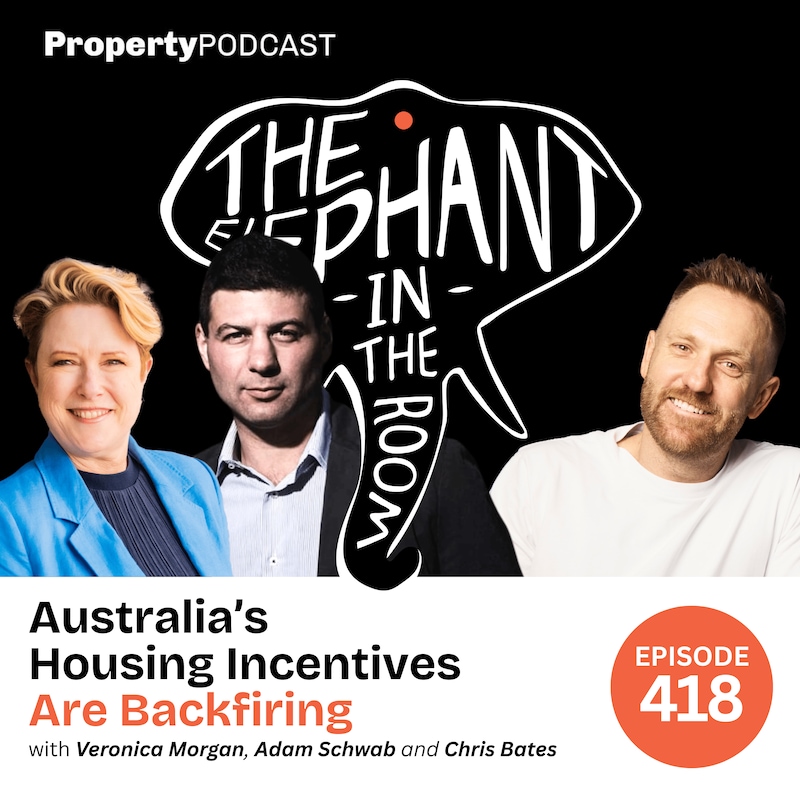
Shownotes
Australian property prices are often treated as a national scoreboard—up means success, down means failure.
But what if that assumption is wrong? In this episode, we interrogate one of the most polarising ideas in housing today: that Australia’s obsession with ever-rising property prices is doing more harm than good.
Joining Veronica and Chris is Adam Schwab, founder of Luxury Escapes and a sharp, outspoken commentator on economics, inflation, and corporate behaviour. Coming from outside the property industry, Adam brings a contrarian lens to housing—questioning whether property has become an unproductive asset, how easy credit and government incentives have distorted prices, and why policies like 5% deposit schemes may be helping vendors more than buyers.
The conversation digs deep into rental yields versus capital growth, the role of the RBA in inflating asset prices, and why high house prices don’t actually benefit most owner-occupiers. Adam challenges the idea that owning property equals success, arguing that Australia’s fixation on housing is crowding out productive investment, innovation, and long-term economic resilience.
This is a robust, sometimes uncomfortable discussion about incentives, risk, and who really wins when property prices keep climbing. If you care about affordability, fairness, and the future of Australia’s economy — not just short-term price movements—this episode will force you to rethink what “good” housing policy actually looks like.
Episode Highlights
00:00 — Introduction to the Episode and Guest
00:56 — Adam Schwab's Contrarian Views on Property
01:37 — Debating Property Prices and Investment
02:49 — Renting vs. Buying: A Financial Analysis
05:43 — The Impact of High Property Prices on Society
19:02 — Monetary Policy and Housing Market
26:50 — Reverse Mortgages and Their Implications
27:32 — The 40-50 Year Loan Debate
28:31 — Government Policies and Housing Market
29:09 — Economic Logic vs. Political Motives
29:33 — Risks of New Property Incentives
31:22 — Banking System and Housing Bubble
33:41 — Immigration and Housing Affordability
35:28 — Leveraging and Property Investment
42:20 — Comparing Property to Other Investments
47:53 — Global Talent and Property Prices
49:51 — Concluding Thoughts on Property Market
About the Guest
Adam Schwab is the co-founder of Luxury Escapes, one of Australia’s most successful global travel businesses, which he helped scale into a billion-dollar brand. Beyond entrepreneurship, Adam has built a parallel career as a respected financial journalist and commentator, known for his sharp critiques of corporate behaviour, economic policy, and market incentives.
He is also the co-host of The Contrarians podcast, where he regularly challenges mainstream narratives on markets, inflation, and government intervention. Unafraid to question sacred cows — including Australian property — Adam brings an outsider’s perspective grounded in economic fundamentals rather than industry orthodoxy.
In this episode, Adam applies that contrarian mindset to housing, offering candid insights into why Australia’s property system rewards asset inflation over productivity, how easy credit fuels bubbles, and why policy settings may be entrenching inequality rather than solving it.
Connect with Adam
- Adam’s LinkedIn
- Adam’s Instagram
- Luxury Escape's Website
- Luxury Escape’s Facebook
- Luxury Escape’s Instagram
- Luxury Escape’s YouTube
- Luxury Escape’s TikTok
Resources
- Visit our website: https://www.theelephantintheroom.com.au
- If you have any questions or would like to be featured on our show, contact us at:
- The Elephant in the Room Property Podcast - questions@theelephantintheroom.com.au
- Looking for a Sydney Buyers Agent? https://www.gooddeeds.com.au
- Work with Veronica: https://www.veronicamorgan.com.au
- Looking for a Mortgage Broker? alcove.com.au
- Work with Chris: chrisbates@alcove.com.au
Enjoyed the podcast? Don't miss out on what's yet to come! Hit that subscription button, spread the word, and join us for more insightful discussions in real estate. Your journey starts now!
- Subscribe on YouTube: https://www.youtube.com/@theelephantintheroom-podcast
- Subscribe on Apple Podcasts: https://podcasts.apple.com/ph/podcast/the-elephant-in-the-room-property-podcast/id1384822719
- Subscribe on Spotify: https://open.spotify.com/show/3r0nnJrLUu3t1GpO7X3j6E
If you enjoyed today’s podcast, don’t forget to subscribe, rate, and share the show! There’s more to come, so we hope to have you along with us on this journey!
See you on the inside,
Veronica & Chris
Transcripts
TEITR 418 Adam Schwab
===
Veronica: [:Veronica: Under scrutiny, we explore his critiques of the RBA inflation management and government market interventions, like the 5% deposit schemes, and what these policies actually do to prices, incentives, and long-term affordability. For listeners who appreciate robust debate, this one promises to be lively. We have no doubt.
Veronica: [:Adam: Thanks. That was a amazing intro. I don't think I've had a intro that long.~ ~
CB: ~um, um,~ Adam, thanks for coming on. I mean, ~um, ~you know, I have looked at some of your content and, and you know, it's not that I don't disagree with it. ~Um, uh, ~and I think. You know, just let's start there.
CB: With property being the devil, I mean, why, why do you think that? I mean, '~ uh,~ 'cause you know, there's definitely a side you can take.
Adam: actually, I was probably being provocative. I actually don't really think it's the devil, but I think there's some elements to property that are. Certainly very troubling in Australia especially, and Australia's not the only jurisdiction, but if you look at our property prices and when you look at prices in absolute terms, forget that it's, it's relative to incomes, which is really how you, judge property prices.
Adam: I think outside of Hong Kong and Monaco, like tax havens maybe to buy and remember, tax havens are different. 'cause tax havens inevitably lead the higher property prices because that's where the tax gets capitalized. We're the highest in the world and Sydney is absolutely the highest in the world. So you've got the most expensive property.
esting in property, but that [:Adam: We bought a bunch of apartments as part of that where we had very little capital, and we were able to parlay that into a great windfall. So at the right time in the right conditions, property is an incredible investment. I just haven't seen those conditions for probably 15 years. That said, you would've made a fortune ignoring me for 15 years.
lt for new people to get in, [:Veronica: That. People say, oh look in Sydney's unaffordable, because how could anyone possibly afford, how could any first home buyer possibly afford a $2 million house, for example? But most people buying $2 million houses aren't first home buyers, or they're in some way funded by existing property holdings. So that's sort of, you call it a Ponzi scheme 'cause of all that, I guess you could as well.
Veronica: But, that's an important part of it, don't you think?
Adam: less of a Ponzi. ~Uh, ~you actually made some. A bunch of really interesting observations there. ~Um, ~lemme try and pick a few. You talked about price and value and you use them interchangeably, and I think that's the core of the problem here. Price and value aren't the same thing that, as Benjamin Graham said in the short term, the markets a voting machine.
Adam: The long term, it's a waiting machine. We've had a lot of voting machine dynamics around the property market, essentially. Okay, you, you're right. And the income isn't the only metric can use. Another one is, is look at the gross yield or the net yield even, better. So look at what yield am I getting as I can rent a property or I can buy a property.
ing a property. There's also [:Adam: Well, that's changed a little bit in Victoria lately. I think if you boil down to rental yields, like you're getting a gross yield of what, two, 2.5% in most cities. Yeah. Regions. Maybe you can get a bit more here and there, but let's say you're getting a 2% gross yield, you're probably getting a barely 0.1% net yield depending on the, the state of the, of the property That's what you gotta base the va. The value of an asset is the present value of future cash flows And as, as I said, the, the problem with bubbles is it makes morons look smart. and your point on 5% of property changing hands is the point to make. You can have 5% of the population being morons and continually bidding up the price of this asset. And then you've got more on banks lending to them who are basically insolvent and you've got this perpetual. Stupidity
Veronica: Flywheel.
ut it's a ridiculous, it's a [:Adam: So that's essentially the problem we've had for 15 years in that we've, so we've lost so much touch with rationality that people just forget about any kind of rational metrics. Let's ignore rents because that rent sold to me is, is what you earn from property. Let's forget about rents. Let's just say, oh, someone else is willing to pay $4 million for a one bedroom in, darling point.
Adam: So that's what it's worth. Well, that's not what it's worth. That's what some moron's willing to pay. There's a
Adam: big
Veronica: we are not, we are not all investors, like, you know, 70% are owner occupiers, so the yield doesn't matter to them. You know, the
Adam: No, but it does matter because you can rent or you can buy, like it's, you are assuming that there's some other great value in buying and
Adam: Yeah, but other assets have capital growth. So you're, you're, you're, you're not getting the cash and, and putting it on your bed and levy.
r. A lot of people. ~Uh, ~so [: er financial result if you in:Adam: You can live in. Doesn't mean that it is or isn't undervalued, but for reasons that I just said, property could continue to be overvalued forever. Like it's not. It's not, it's not unthinkable.
CB: Yeah, I mean the, if I guess the whole rent versus buy thing, I think if there's this real liquid. Rental market, you can get longer leases. You know, there's all, if you get kicked out, that's fine. I can move somewhere else. If you didn't have school zones, if you didn't have, you know, want community and want to have stability with your neighbors.
CB: And so it's kind of like the system's structurally broken from a rental point of view. And then that forces, and that's been really, the valve's been lifted on that post COVID, you know, and it's gonna get worse. Right? 'cause a lot of new investors are going. Where the old investors aren't investors. They used to buy the capital cities, now they're buying Townsville or Bendigo or et cetera.
ilt a business, you've taken [:Adam: Oh, that's a good, great question. Lemme just talk about the renting versus buying thing. Just quickly just show how out of whack it is. So we're, we're renovating our place. ~Uh, ~so we're renting as well as obviously renovate and renting a place called Middle Park in, in Melbourne, which is a pretty nice suburb.
grand a year. Or you [:Adam: Maybe best case, a hundred K. And that's not really including property depreciation. That's been bit generous, say a hundred k. That's 250 K difference a year after tax. This is not, or okay, it's not quite a tax 'cause you've got capital gains. It's not principle, but caught two 50 k after most tax,~ uh,~ by renting.
Adam: That's a massive difference. What can you do with that two 50 KA
Veronica: I guess I would argue though the person who owns a house you are living in, it's unlikely that they bought that with the intention of just holding it as an investment property. There. There's very few investors are buying that type of asset now. They probably owned it for a long time. ~Um, ~they may well have lived in it before.
trying to. Find something to [:Veronica: But if you compared it, say you had a three bedroom apartment that was bought with that pure intention, and you would see a bunch of different metrics. I agree with you though, you'd, if you're buying an apart any property just for yield, well you are a moron. Personally, I mean, I'll use your word there, right?
Veronica: So I think that, and we don't,~ uh,~ encourage that, anyway, we can go on about that. We don't need to go on about that. All our audience knows what we think about that sort of thing. But that's cherry picking a really bad example.
million house versus [:Adam: Yeah, no, you're,~ ~
Adam: ~um, Uh, ~think you're right. My house is an unusual example for sure. ~Uh, ~but my point was that there is, even if you're looking at a two bedroom house, it's still significantly cheaper to rent than buy, and there's some disadvantages of renting. But, so what you're essentially saying, and there's some truth in that, that, okay, well break even off the property and we'll use as inflation hedge, which I have some sympathy for, but I think they're also better inflation hedges than property.
CB: I think you're right that there's a lot of people that don't really think about rent. Versus buying, right? And then they'll go and sign up to it, particularly in Melbourne or Brisbane. They've got sell off the plant apartment, or, you know, first home buyers are getting stitched up by this all the time.
CB: It's like, hang on a sec. Interest is dead. Money rent's dead money. You know, if this asset doesn't, when you add in all the costs on top of interest,~ uh,~ and it's easy to rent those things, right? Because there's heaps of apartments. If you get kicked outta one, you just go around to another. It's not a. So unless this thing goes up in value, then you're actually gonna be, you know, you're just tying yourself up.
duty, you might pay selling [:CB: They're, like you say, they're just being more on, they're following just what the system they're going on. But, um,~ um,~ I mean the bigger issue, which I think. You're in a well place to answer is that sort of the danger of just this ever, you know, increasing property values and just our wealth just constantly flowing back into resi, back into resi.
CB: ~Um, ~you know, you do well in business, you put it back into resi, you know, like, so what's that really gonna cause us down the line where, you know, we're basically gonna re really reduce a lot of risk in our economy, right? And it's gonna productivity issues and you might have more, right? Obviously.
Adam: Yeah, I think that's a really good point. So my, my view is housing is an unproductive asset, and people might take the counter view to that, but,~ uh,~ I think overall compared to investing in, business, it's, highly unproductive. So you're not creating, you're not improving productivity in the economy.
mprove. Which is two things. [:Adam: So I think you're totally right. Like it's not productive. And Australia's sort of survived on the back of increased government spending. Really loose monetary policies and a lot of luck with things like iron ore and coal prices going through the roof for the last 20 years. But take out that extraordinary luck we've had, we've got a bit of a Dutch disease at the moment, but take out extraordinary luck.
Adam: And we've got governments, both state and federal level who are addicted to running deficits, are addicted to paying bribing voters with young people and future generations savings because this debt has to be repaid in somewhere, either gets inflated or repaid, either way destroys living standards. and a big reason for that is the way the tax system, and again, this is an argument in favor of buying property, is the tax system is so biased in favor of property, especially principal residents, but even not even investment as well, that, uh,~ uh,~ gerrymanders investment into an unproductive asset away from productive assets, which is just insane.
ight. I mean, they will lend [:CB: You go, oh, no, no, no, I don't wanna rent. Right? Because renting's not secure and I don't wanna not own, because I don't wanna be get to retirement without owning any property. And that's usually a good ' cause I can leverage it five, you know, 20 times. Why would I try to risk that going in, starting a business and I'm worried about renting, my rent's gone through the roof.
CB: I'd need that security. I've been booted out a few times. Why would I risk starting a business? when I can potentially leverage it 20 times into property, like, and that's. Unfortunately what people think like, well, why would I leave a, you know, a high paying job that I'm, you know, I'm doing really well, I've invested in my career, but I've got a big mortgage.
CB: ~Um, ~if I leave the job, start a business and fail, I don't just lose my job, I lose my house and my family and might get a divorce. And so I think there's like a, there's all these other bet like issues. does it frustrate you, I guess, does it, these are the
Adam: I think [:Adam: That's probably the alternative to, purchasing a house. What can you do with that equity? like, I think if you look at even as well as property has done, the market has, has out, certainly the market with dividends reinvested, has outperformed property. Gold's absolutely outperformed property obviously. Crypto has, but forget that. ~Um, ~so property is as good as an asset. It's been in the last 20 years has generally been outperformed by the other big asset classes. ~Uh, ~I think your own business is a tricky one because for 90% plus of people, maybe they shouldn't start their own business. 'cause it's hard. And as you said, I felt like, great Chris, it's risky. You can lose everything. It's not for everyone. Obviously the upside's great, but the downside's real. ~Um,~
Adam: but it's sort of.
w, they've, they, they, they [:CB: They've got stuck in a corporate job earning good income because they can't take the risk of study business. 'cause they've got, they've tied themselves up with a mortgage
Veronica: Isn't the issue more that really it's about what we invest in. I mean, I don't think we should be encouraging too many people to set their own businesses up. I mean, there's a high proportion that fail. I'm in the buyer's agent space. Everybody wants to be their entrepreneur and it's a screwing up the whole industry to be quite frank. So let's talk about what else you could invest in. 'cause I think that's really what would in, you know, investing existing businesses to grow existing businesses. I mean, isn't that really the missed opportunity?
Adam: So there's two questions. There's one is the call, the general economic question, like how much are we as a country suffering from this Dutch disease of just investing our windfalls in property? I think that's totally right. The other question is, what should you invest in the two quite separate questions?
f Bitcoin to fund it. So his [:Adam: Don't, don't try and outperform. You're not gonna outperform the index almost certainly. And you with much lower fees, you just buy an ETF and be done. ~Um, ~or, or buy a index fund be done. So that's, I think what the comparison is. And you can lever, you can pretty easily leverage ETFs as well. So buy a leverage.
Adam: ETF got the similar leverage you're getting in property. You'd probably make a better return. ~Um, ~but you don't have the security of having your place, but you're also not having to rebuild it every 30 years. So there's sort of pro pros and cons on both sides. ~Uh, ~the biggest problem with Australia is leaving aside the massive unfairness in our sort of monetary and fi fiscal systems, is there's this great terrible view that unless you own your property and senior kids to private schools, you failed in this country, which is like the worst possible view because both, neither are good.
t thing we should be judging [:Adam: So that's sort of order problem is we've got the wrong priorities in this country, which then leads to politicians favoring housing as an asset over pretty much anything else which leads to this bubble. So it's sort of a cycle of ill effects have led to where we are.
Veronica: It's interesting too 'cause I anecdotally know a lot of people who really dig into the equity of their home in order to pay for those private school fees as well. So then they get even doubly bogged down with, you know, bigger repayments over a longer period of time. But you, talk a lot about inflation and the RBAs role in fueling asset,~ uh,~ bubbles. Where do you think monetary policy has fundamentally misfired.
ust over zero. Obviously hit [:Veronica: Well, that was COVID. Yeah. Yeah.
Adam: in COVID. But even before COVID were pretty large.
Adam: I think we were like 1.75 or 2% pre COVID. Ridiculously low and unnecessarily low because it, but all, basically what happened is as soon as property prices started stagnating, the RBA would drop rates. And it was if, if the RBA sole role in Glen Stevens and then feel lower running, it was how do we maintain this housing bubble?
Adam: And that was all they cared about. And then, so you saw during COVID, the whole,~ um,~ ridiculousness of inflation is transitory when clearly it wasn't. Then we had everything got outta hand. They had to start hiking rates. We saw rates being hiked to. What to five, five ish, not even 5%, 4.75% or 4.5% or whatever it was.
Adam: And that was considered high. It wasn't high, it was historically low. Yet then this, the first site of, house prices plateauing or dropping suddenly the dropping rates again, which has caused another house bubble. So, so it'll rein favor the house bubble to record level. So you've had 15 years of monetary policy.
. That's someone who doesn't [:CB: ~um, ~obviously that, wouldn't be the reason they were saying the RBA, right? They were saying, you know, unemployment's a bit too high, you know, our GDP growth, you know, not really taking off. It was plateauing, right. ~Um. ~Obviously, but you've got GDP per capital, right? Like, you know, like we can't import more people.
CB: We, you know, if we wanna keep growing the economy, we're already so, like, you know, and obviously it was a global problem, right? Every country around the world had low interest rates and there's issues with, you know, exchange rates as well. So like, it would've been really hard for them to just sort of have a much higher rate as well.
CB: And, you know, they're obviously, they're judged on such short term basis. The politicians,~ um,~ and their votes are, are driven by often property prices as well, plus so, so. Do you think that they should have just had a much higher rate through that period?
es having high inflation and [: endors grant, and I'd said in: basically entering a life, a [: irst incentive was I think in:Adam: I think Rudd may have doubled it. That's right. I think he
e gearing that Howard, well, [:Veronica: And at that exact point is when prices started taking off. You could argue if you're gonna pin it down to one thing, maybe it was the first home, first home buyer Incentive we also have it at the same time. I mean, there's obviously a lot of things that have conspired to continue this, crazy growth.
Veronica: and we can see, or let's not call it crazy. It's wonderful if you're in the market. Um.~ Um.~
Adam: Well, I actually challenge you on that. I think there's this. Great myth that high prices are great, and it's certainly great if you're an investor with multiple properties, no doubt, because your asset is going up. But unless you own at least one investment property, I'd argue that high prices are bad.
Adam: So.
le get in because we are not [:Veronica: All we have to do is deal with helping you get in some way.
Adam: I think at the end of the day. Policy is also a vote, a voting machine, weighing machine. So I think in the end, bad policy eventually gets where you'd hope gets flushed outta the system. But you're right, it's been a bad policy for 23 years now. So who knows how that, I think when I talk about high house price being bad, clearly it's very bad for that social contract, which you talk about. I think it's also bad if you own a house. If I own a house, it's. $5 million and the house goes to $7 million. Well, big deal. I've gotta buy a new house in the same market anyway. I'm paying more stamp due. I'm paying more everything. I'm paying more like everything's percentage based, more Asian fees, and then my kids can't afford to buy in.
Adam: So like how is high house prices helping anybody but investors? It's all, it helps.
CB: Well, I think there's been, if, if you have done quite well, right? You get to your sixties, your kids have moved out,~ um,~ you know, you've got into the housing market, right? Not the apartment market. Right? you know, you've bought with something that's quite scarce, you know, inflation's written your debt away.
put it all in the bank. You [:Adam: Well, the problem is when you downsize, like a lot of people downsize from a house to a townhouse or an apartment, they're paying basically the same. Maybe you downsize from an $8 million house to a $6 million apartment, or I think more. people should be doing reverse mortgages, but nobody ever does or very rarely do.
Adam: I think that actually does make sense. ~Um,~
Adam: but the other problem is.
CB: the last thing we want though? Right? Like, because. ~ um,~ what we'll see, and, and this is happening, so reverse mortgages, the government's even got a reverse mortgage. Like they've got a, and at it's super ridiculous rates. It's like super, so. The governments have got their own.
CB: Then there's all these new lenders coming in. 'cause this is my sort of space. And what you'll always do is just slow down people downsizing. 'cause like I don't need that equity. I can just pull it out. And that'll just reduce the turnover rate of property, right? And so more and more people will stay in their homes.
of dwellings, it's amount of [:Veronica: problems in aged care because then people have less money to actually fund their own aged care. So there's, there's knock on effects of reverse mortgages.
Adam: But you can only reverse mortgage up to a certain point. They're relatively strict rules
Adam: on how much you can reverse. ~ ~
CB: ~um, ~they were, they got tight, all the banks pulled out of it, right? ~Uh, ~Brian Harts killed it at Westpac and they all pulled out like, this is not, and now they're like, hang on a sec. We need to keep increasing credit growth. Actually, we can't do these things.
CB: Oh, why don't we go back full circle and start offering these reers. Now the banks aren't doing, non-banks are doing it and self-manage super fund loans are in here. And I think that's a. It's one of those things, right. Naturally will come. So with 40 year loans, I mean, they're already started the last few years there'll be, there's
Adam: Oh, I think 40 50 loans are way worse than reverse mortgage. Reverse mortgage is a wages to get equity outta the house. Effectively spending inheritance earlier, call it what, what it is versus 40 or 50 li year loans, which are a horrendous lifetime of a jail of debt for someone for their entire life.
e're gonna, we're gotta lump [:Adam: Like, that's it, it's kind of a side issue. I don't think it's even worth sort of dwelling on. ~Um, ~but more my point was like, even if my pri my property goes from 5 million to 10 million or whatever, like, it sounds like I've won the lottery. Well, my kids can't afford to buy a house, so what's the point?
Adam: Like I gotta sell it and give to them to let other, you want your kids living with you for your whole life. So I'm just not sure anybody benefits a, from higher property o other than the the investor class.
Veronica: Yeah, I agree. On that one. You know, you argue that government centers, we talked about that, you know, the 5% deposit scheme that has been increased in its,~ uh, um,~ availability, shall we say,~ um,~ um, make things worse rather than better. And we've already talked about that, but like, what's your, I guess, you know, we get the economic logic behind that view.
Veronica: We've, spoken about it here, but what's the counter argument you think that policy,~ uh, uh, ~makers are ignoring?
Adam: As in what argument are they making to justify the schemes?
Veronica: like other than pure votes, like, I mean.
re's no, there's no economic [:Veronica: oh, I have to add something here, that the taxpayer is gonna fund the shortfall for people who do default on their loans and the property's worth.
Adam: It.~ ~
Veronica: ~Um, ~but also, you know, there is a lot of, and there has been for. Long time incentives to get first home buyers into brand new properties as well, which statistically is evidence abounding about the riskiest asset you can buy in in terms of property, highest proportion of loss, making resales, all that sort of stuff.
to be completely, they blind [:CB: Well, I think they've, the good thing is they're not doing just new property. Right? So that's the, they used to do that. They used, that would've been worse. Right? And then you would've all these first time buyers stitch, start buying new apartments, buying new townhouses, and then funding our development industry, creating jobs, which is great.
CB: But then stitching up the people leased afford making a property loss. The big issue with this 5% is they've just expanded the scheme to basically anyone. And that it means that when you're someone who's got access to intergenerational wealth, who's got on a high income is likely to be okay financially.
CB: It's just getting a massive kick up rather than the person who's probably on a key worker job. You know, there's no family wealth. They're, they're struggling. ~Um, ~and saving a 20% deposit and playing LMI would've been really hard for them and Renting's really hard and they've got kids so like it was targeted I feel, to the right.
price so he can cash out but [:CB: They're all votes. The people, whether you're buying or whether you own property,~ um,~ property prices going up is still in your mind. Good thing, right?
Adam: If you saw, I'm sure you guys would've, maybe three weeks ago, APA announced the tightening rules and the banks got annoyed and the rules essentially regarded, like the income ratios I think they were talking about predominantly. ~Um, ~which whatever like could be that has made like. The biggest issue isn't so much the income ratio. Like ultimately, funny enough, I went, when I went to get a mortgage for Reno, I was doing like, I, I really struggled to get a mortgage and my income's pretty low. And obviously we, we have dividends or whatever here because tax wise doesn't make sense to get paid a big salary and the banks didn't care about that.
Adam: All they care about is my income. So I, I actually found it hard to get a loan on a really low LVR. Which is fine. So that's up to the banks. ~Um, ~but if I was earning a million bucks a year as a lawyer like I used to be, I could get a massive loan. I could borrow 3 million or 4 million, whatever it is,~ uh,~ and no, questions asked.
nding is, effectively higher [:CB: What's your thoughts on that? Unfortunately. Economy still has to run, right? So you've got banking system, that's property,~ um,~ you've got a property system, you know, ~um, ~just people with build builders, trades, you know, et cetera. ~Um, ~you know, developers, there's so many people that are invested in the property market,~ um,~ who, and you know, our economy's not that big really in terms of the diversity.
CB: ~Um, ~and then we've got. You know, the,~ uh,~ private schools,~ um,~ a lot of consumer and retails build off more people. Right. You know, if you wanna sell more Woolies, you need more people. Right. So what's, what's your thoughts about the Australian economy when you break it down? I mean, even your business is sort of wrapped up in this as well, right?
Like, we're just stuck on a [:CB: There's not a viable option because it's so hard to just shift an economy,~ um,~ at all really.
Adam: I'm generally pro-immigration, preferably skilled, but, I'm historically in pro-immigration, which does lead to obviously higher JP per capita. But higher property prices inevitably 'cause you, you getting more demand. But I'm less like, clearly there are issues on the supply side of property, like the council restrictiveness and so there, there clearly are issues there and I hate the whole Nimbyism stuff and so that I take that as rare.
oblem around this economy is [: a bunch of bank. We saw it in: , I started as broker back in: up across different banks, I [:CB: The banks have all been shut down over the last couple of months on that. 'cause that was becoming a real issue,~ um,~ where people could just keep on lending. Basically, if you had the deposit, you could just, and even people were doing dodgy stuff around that. But generally speaking, our lending's getting tight.
CB: I mean, over in the UK it was, say, four and a half times your income and, you know, we were just so much higher. But I don't know, I, I just don't think there's, and when you look at the LVR, right, so like the housing markets worth 12 trillion. The debt in the system, say two and a half trillion. So the, you know, if they have a, and, and the arrears rate's like under 2%.
CB: So like, [:CB: And so the banks haven't got this. Margin call because whenever finance someone struggles, they're like, I've lost my job, can't afford my mortgage. ~Um, ~in arrears I'll just sell. ~Um, ~so what's, what's your sort of thought
Adam: I agree with, I agree with you on. One at the first point that clearly the absolute cowboy days of pro GFC have, have thankfully been past us. So it's, it's not that bad. That doesn't mean it's not bad, it just means it's less bad. So yes, I do agree with you, but it can still, but I think so your scenario of people losing, essentially losing jobs and having to sell their house.
s say we had unemployment of [:Adam: Let's say we went to 10% unemployment, genuine unemployment. Then you've got house prices potentially down 20, 30, 40%. Suddenly you've got bank balance sheets being smashed.
CB: What would interest rates be though in that scenario?
Adam: Who knows, like it happens if inflation peaks up and they can't drop interest rates. So like you could have stagflation like in the seventies.
Adam: So we've lived in this great moderation of 25 years. We've been able to just drop rates and be able to be pumping up property prices as much as we can. But there is a world where. You can't do that. And where unemployment spikes up and where house prices are adjust from 13 times income to six times or five times income, suddenly everybody's price has been, house has been hit cut in half.
Adam: I'm not saying this is likely to happen, but it, I'm not saying it's, there's a non-zero chance this happens and then suddenly you've got banks with, far more liabilities and assets on their books and they're insolvent. So like the notion that's impossible. It's clearly not right. Really. It's unlikely.
GFC was never gonna happen in:CB: yeah. Is the biggest danger though. Betting on that scenario, that's not likely. You know, like if you think about,~ um,~ Martin North, good friend of ours, right? one of the, you know, very well known property bear in Australia. ~Um, ~and you know, just recently he's, he came on here, we've, we've, I've been on his podcast like seven, eight years or whatever.
CB: ~Um, ~and you know, he kind. Waved his little,~ uh,~ white sort of flag and said, look, you know, I just, just didn't misunderstood how invested the government is, how whenever things are looking like and all the cards are gonna fall down. ~Um, ~and you know, you think about everyone who's been listening to Martin, and this is Martin.
CB: If you're listening to this, it's nothing towards you. But everyone's been listening to Martin for the last 10 years, right? Who have delayed their property decisions, delayed, their life decisions, have, you know, and have, have basically jumped off, have really hurt themselves, right? Because. They basically have it and they've just avoided and then they've ended up gonna having to buy a house anyway, right?
, 'cause there's always a, a [:CB: And just play a little bit and hedge it. It's just like you're either gotta be in with a big mortgage and, and with all your cash or you gotta be out. It's, it's, it's like you can't short and get in at the same time.
Adam: ~Uh, ~I think, I'm not saying that every bank's gonna. Be destroyed tomorrow. I'm saying there's a chance this could happen. ~Uh, ~and ultimately I think like Martin could well be proven right in, in 1, 2, 3, 4, 5 years, like the, the famous saying, the market stays irrational longer. You can say solvent. So I'm not stressing every go and short the property market.
continues printing money and [:Adam: Okay. I think gold property does better, but I think property does. Okay. So I'm not sitting here as like a permit property. Like it can never, you never do well from property. I'm saying property is a generational highs and this is a bad thing.
Henry: I'm on a personal mission to help more people make better property decisions. You know, most people don't realize that they can cost themselves hundreds of thousands of dollars over the medium to long term when they make property decisions without all of the information that they need. And what I do is help people with tricky real estate problems, which offer masqueraders simple questions like, should I sell my investment property because the interest re payments are hurting, or should I buy before I sell?
Henry: Or the other way around. You could connect with me and access all of the tools that I've created to help you make better property decisions at Veronica Morgan dot com au. And there you'll find resources for first home buyers, details about my buyer's agent mentoring program. You could connect with my Sydney based property management and buyer's agency teams, Australia wide vendor advocacy.
or introduction to the small [:Henry: Please go to cove.com au to reach out.
CB: we a hundred percent like agree. We, we can see that there's issues. It's just when you've got people, Australians making decisions with their own lives, right? Like so, you know, they've, they've got jobs, they've got families and they're just getting this, they get, unfortunately, the alternative strategy of not buying and renting and buying other assets classes is just really hard to, to justify and you kind of have to just.
CB: I'm not gonna do that because I don't believe in it. And then, okay. The, the second strategy of just saving, renting, you know, putting it into an ETF,~ um,~ and if, if property gets a certain type of, even a small return, unfortunately, just 'cause of the leverage in the system, they, they, it's very hard to outrun.
and I think this just causes [:Adam: I think where you're right is in the, the ability to easily use leverage,~ uh,~ and that that's where property can win. ~Uh, ~but if you look at shares gold. Crypto have all significantly outperformed. And I'm not saying, I'm not saying invest in crypto. I've, I've never bought crypto in my life, but all those three asset classes have significantly outperformed property in the last 20 years, notwithstanding the dream run properties had.
Adam: So, and this is after, this is on a net basis. This is after your property costs and after your dividends with shares and everything. So it's, the problem is, and where I. I agree with you is for a lot of people it's not practical. It's not practical to lever up gold. It's not practical. You don't wanna lever up crypto, it's too risky.
Adam: And yeah, it's actually a bit easier to lever up an ETF 'cause you get two and three Xs. But like there is a safety around property in that it's not mar, you're not being margin called. It's a great form of force saving if you can buy in a not super, like a not overly bubbly suburb. It's less bad.
bably places you can buy and [:Adam: Like it just, it completely irrational to, I don't live in Sydney, but it's completely, it's completely irrational, really hard to justify versus a, and you guys know much more about the disease, but versus even a, just a Melbourne for
Adam: me, which
~Um, ~it's like the rent ERs [:Veronica: And I do talk to a lot of people about if you can actually afford to buy into Sydney now, you know, we've decoupled from the rest of the country. And so like, do you wanna miss out on that opportunity? So it is definitely a market. So you've gotta have these conversations. At the same time you're sort of thinking about investment fundamentals and talking from that lens. And then you're also thinking. this, and that's where the value comes in. You know what I mean? That's the, that's the, in you talk about value versus price. I mean, there's value in those other things as well. So how do you price the
Adam: [:Adam: That's the, that's a lot of earnings,~ uh,~ that I can then use to invest in a property at that time or something else. ~Um, ~but yeah, there's clearly, there's, there's benefit in not being booted out. As a renter, there's benefit in effectively being able to do stuff like you. You can't do stuff to your house if you're a renter.
Adam: On the flip side, and there's obviously benefit in in principal capital gains tax exemption, which is the biggest one. But on flip side properties, like how many horror property stories have you heard where someone's got termites and you have to rebuild a house and gotta spend a four, so. There's, good and bad.
Adam: Like there's, I'll pay $15,000 in, in rates a year. Like, that's not body court. That's actual rates to accounts or for taking my rubbish away. That's a lot of, that's a lot of cash. That's after tax. That's 30 grand before tax. So like, yes, there's definitely benefits of, of owning a property, but there's, there's detriments as well.
Adam: ~Uh, ~
ow, you can, the rates are a [:Adam: everything's got, everything's got a price. Like you can say, oh, you want to,~ uh,~ avoid being booted out. We'll take a longer lease and pay a premium to the owner. Every o like, you'll be able, you'll be able to, everybody's got a price. If I give the owner a 50% Kiger on rent, they'll, they'll, they'll agree to a five year lease for sure.
Adam: Maybe in takes a 20, but like. You can negotiate that. You can negotiate stuff or every, everything's got a price in this world. So the question is what that price is. So you can pro, you can, most of those risks can be negotiated. No, very few people do. Initially, we, my first business, our first business was we sublease departments and rented them out to backpackers and corporates. And we would, that was our business. We would take risks and part and absorb those risks and make a margin. So we, we sort of under, we rented 200 properties. We bought a bunch of, we understand, you said I wasn't in the property. I'm, I'm not now, but I was. As much as anyone, sort of when I was 26, 27,~ um,~ and we bought six properties with 5% down.
year [:CB: Adam, I want to hit with a property Dumbo, but just, you've got a business,~ um,~ you got a lot of staff. ~Um, ~Lot of talent to grow businesses. Right. ~Um, ~what's your thoughts on, you know, we, we, we we're competing for global talent. Right. You know, like you know, whether it's tech or whether it's, whatever it might be, right.
CB: It might, that might not be in Australia. Right. And we do want that to talent, you know, like you said, qualified to move to Australia. Do you think that. Just the issues with a high property price right. Doesn't make it attractive. Right. You know, hard to rent. So are you seeing issues in terms of that? I mean, obviously the prices around property have actually gone up a lot of places around the world.
CB: This isn't just an Australian problem. You could easily go look at global property values and, and it's, it's similar story to be honest. So, I mean, but do you think that's an issue that Australia's just maybe gotta be careful on, right, because if talent can't afford to live here. Then they won't move here.
CB: And so I, I think we've gotta be a little bit concerned
CB: about that
s like ultimately, 'cause we [:Adam: People who
CB: owning. They, they want to sort of move
CB: here and they'll kind of wanna
CB: own,
Adam: don't think people are thinking about that, to be honest. I think,~ uh,~ I think in the short term, you think, can I get a rental? Like, and rentals are pretty relatively cheap, certainly compared to
CB: particularly in Melbourne. Yeah.
Adam: Well, compared to New York, London, like it's cheap. Like people say rentals are high and it's easy for me to say my privileged position. But real globally speaking, our rents are super cheap to the, so the global cities, Tokyo, Hong Kong, Singapore, Melbourne, sorry, Singapore, London, New York we're really cheap.
Adam: ~Um, ~and transport's cheap. And like London, you pay 50 bucks a day to. Get the track. So we we're, I think in that sense, that's not, I think the issue with immigration is government policy doesn't necessarily favor immigrate like certainty. Like, great for, if you're a uni student, great. If you're a hairdresser, not great if you're, if I wanna bring in a technologist.
Adam: So we focus on bringing in the wrong types of migrants,~ uh,~ which would be focusing on skilled migrants and less on, less skilled migrants, less beholden to the university sector. That's a whole nother argument. ~Um, ~I don't think. Property prices are necessarily a barrier there in the short term anyway.
estination. I think a lot of [:CB: For us a story, we could just have a bit of a laugh at the end.
rote two chapters in probably: I wrote a book on the. GFC in:Adam: So I'm not shorting the property market. I own a property. So like I, I sort of speak against my own interests in this sense.
Veronica: And you're invest. Because you're renovating it.
Adam: Yeah, absolutely. And it'd be a chunk of my net wealth,~ uh,~ at the end of this. ~Um, ~but ultimately I'm lucky enough to have a business that spins off cash and all that kind of stuff.
rpaid a couple million bucks [:Adam: ~Uh, ~or at the time, it wasn't that impactful to me. And it's probably whatever in price since then, but doesn't, I still think it was overvalued versus what I paid for it, even though it was doubled since then. But ultimately,~ um,~ again, I've, I've been wrong for a long time and hopefully for everyone's sake, including mine, I stay wrong.~ ~
CB: ~um,~ one of the other issues right now is that you can't, I mean. The big tech stocks, are they overvalued? Is gold overvalued? Is crypto overvalued? Like, is it, you know, like, ~um, ~it is just the, the story right now, just due to that inflation of the money supply has not just gone into resi, it's gone into lots of other.
% gross, it's [:CB: Adam, it's been a good chat.
Veronica: Lovely chat. Really appreciate you coming on and,~ uh,~ I love a lively chat and I know our listeners will too. So thank you again for your time today.
Adam: Thanks for having me, guys. Been
Henry: If you have a question that you'd like us to answer in an upcoming q and a episode, you can send us a voicemail or written question via the website. The elephant in the room.com au. Or you can email us directly at questions at the elephant in the room.com
Henry: au.
Henry: If you like what you're hearing, please share this episode with others you feel would benefit. And while you're at it, why not leave us an iTunes review? Five stars would be great. I know that sounds a bit cringey, but we have it on good old authority that every review helps make it easier for other people to find out about us and hear what our amazing guests have to say.