Shownotes
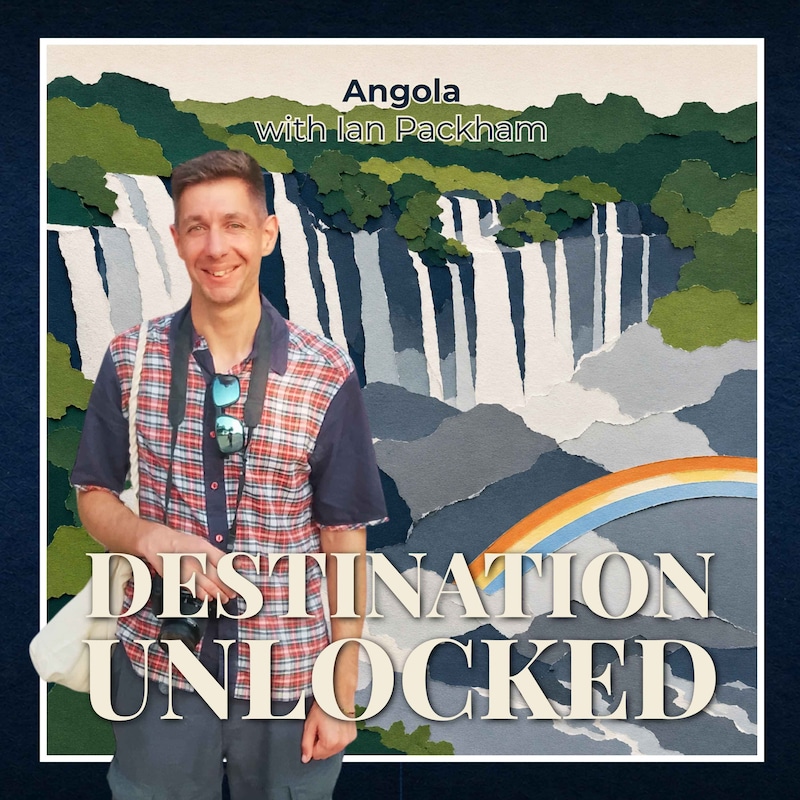
Africa specialist and travel writer, Ian Packham, joins Daniel ahead of the updated Bradt Guide to Angola.
Ian discusses first visiting during a 13-month, 31-country public-transport journey around Africa and returning to research guidebooks, describing Angola as a large, under-visited country often associated with civil war but rich in geographic diversity, coastline, wildlife, and culture. Highlights include Luanda’s Portuguese influence, food and climate, Kalandula Falls, beaches near Luanda, the Miradouro da Lua, the Museu Nacional da Escravatura, Kissama National Park, and the Benguela Railway. He covers practicalities such as using coaches and minibuses, cash use and currency exchange, driving cautions, limited but trustworthy tours, Portuguese as the main language, SIM connectivity, tipping norms, best season (dry season, May–July), books to read, and suggested souvenirs like northern wood carvings.
Transcripts
This is Destination Unlocked with me, Daniel Edward, just now ready to depart.
Speaker B:Please make sure your seat belt is.
Speaker A:My fast and do make yourself comfortable.
Speaker A:Hi, welcome back to Destination Unlocked.
Speaker A:This episode we are going to Africa.
Speaker A:We're going in the company of an expert, the travel writer Ian Pacum, who encircled Africa on his first big trip to the continent.
Speaker A:And he did it all using public transport.
Speaker A:Quite the adventure that turned into a narrative travel book.
Speaker A:And then off the back of that and through other adventures, he has become the guidebook writer for various countries on the continent.
Speaker A:And today we're talking about Angola ahead of the release of the latest edition of of the Brat Guide to Angola written by Ian Packham.
Speaker A:Enjoy.
Speaker A:So, Ian, where are you unlocking for us today?
Speaker B: e civil war that erupted from: Speaker B:But it's very much a burgeoning destination in southwest Africa.
Speaker A:It's a huge country.
Speaker A:I was amazed by how big it is.
Speaker A:And when we're talking about tourism, it's one of the hardest sells.
Speaker A:I feel whether that's fair or unfair we'll get onto in this conversation, but people don't often know where it is and then if they've heard of it, they've heard of it for a negative reason.
Speaker A:And so there's a lot going into it now to make people realize how much beauty is there.
Speaker A:What first brought you to Angola?
Speaker B:Well, a long time ago now, I went on this kind of epic trip around the coast of Africa.
Speaker B:It took me 13 months between jobs before I was even a travel writer.
Speaker B:And given Angola's on the coast, I went through Angola just as a tourist and kind of experienced as much as I could in that short time I was there.
Speaker B:And from that time onwards, really I've kind of continued this interest in this country, which, as you say, doesn't really get a fair shout compared to other countries in the region.
Speaker A:And on that big trip, I think it's an amazing trip.
Speaker A:You went to 31 countries, but this one seems to have stood out in your memory.
Speaker A:And then you end up going back a few times.
Speaker A:Is there a reason why?
Speaker B:I think I'm always interested in heading beyond the headlines, which is a little bit of a cliche in itself, but when you just hear in the media this continuous bad news about a place, whether it's Angola or Sierra Leone, which is another country I adore, I just have this desire to explore a bit more and to delve deeper.
Speaker B:And actually you tend to realize that pretty much everyone in the world is the same and they all want the same things.
Speaker B:And wherever you are, there are these really interesting stories of people either getting on with their lives as.
Speaker B:As normal, or just trying to push their country forward and give it a better reputation.
Speaker A:Let's go through a highlights package.
Speaker A:If somebody is tempted to go beyond the headlines, to go somewhere where their friends probably haven't been and, let's be honest, probably won't go, what must they see when they get there?
Speaker B:Well, what's fantastic about Angola, which, again, isn't very well known about, is how diverse it is.
Speaker B:To give you an example of size, it's about five times the size of the uk, but within that, you've got some of the most varied diversity for geography and habitat anywhere in Africa, rivaling South Africa for that diversity.
Speaker B:You've got forests in the far north, you've got desert in the far south, and pretty much everything in between, from mangroves where you can find manatees, to savannah where there are elephants.
Speaker B:There's a species of antelope, the giant sable antelope, the.
Speaker B:That you can't find anywhere else in the world.
Speaker B:It only lives in Angola.
Speaker B:1600 Kilometers of coastline to lie on or to surf on, waterfalls that you wouldn't even know were there until you turn the corner.
Speaker B:Weird geographical formations.
Speaker B:So really there's a huge amount of things to see and do, and that's before I even mention the culture and the people in the big cities, like the capital, Luanda.
Speaker A:Luanda is where you're going to fly into if you do visit by plane, which I would imagine is the most typical way to arrive.
Speaker A:Is it worth spending some time in the city, then?
Speaker B:It definitely is.
Speaker B:It's huge and it's sprawling, but right in the heart, as with most capitals, there's kind of this bit where everything connects, where you've got some decent hotels, some stuff to see and do, places to eat.
Speaker B:It's on the Atlantic coast, so there's this really nice strip called the Marginal, which is where all the kind of fancy the hotels and restaurants and government buildings are, but you've got some little museums dotted about there.
Speaker B:But really, I think Luanda is about just wandering around the streets, absorbing this culture, which is kind of part African, part Portuguese, part everything, really, because it absorbs people from all over the world and just kind of suck it up and enjoy the climate, both, you know, the physical climate and also just the climate of the city.
Speaker A:And Luanda is the place where you're going to feel that Portuguese influence the most, Is it because this was a Portuguese colony for nearly 500 years?
Speaker B:Yeah, that's right.
Speaker B:Almost 500 years of certainly Portuguese influence, if not a formal colony.
Speaker B:One of the earliest places Europeans landed and decided to occupy, as was their want.
Speaker B: 's this fort from sort of the: Speaker B:Lots of old colonial buildings.
Speaker B:And just like in Portugal, all of these kind of government buildings are painted pink so you can kind of instantly recognize them.
Speaker B:And there is this kind of strange European vibe to the place, despite obviously the African side of it with the markets and everything else that goes on there.
Speaker A:And is that also reflected in the food that you'll find there?
Speaker A:Is it quite varied?
Speaker A:Is it quite European?
Speaker B:There is a lot of Portuguese influence in the food, in the cuisine.
Speaker B:You'll always see kind of the classic Portuguese dishes on restaurant menus.
Speaker B:And then in addition to that, you'll have local stuff on the coast.
Speaker B:Obviously the fish is incredible.
Speaker B:They're quite big on sort of tripe and gizzards and things like that in Angola.
Speaker B:And they're very big on soup as well.
Speaker B:For some strange reason, the big thing to have for, for lunch is the daily soup special.
Speaker A:That is the last thing I would have guessed.
Speaker B:Yeah, it's strange, but it's true.
Speaker A:Go to Africa, have a hot soup.
Speaker B:Exactly.
Speaker A:And it is sub Saharan.
Speaker A:It does get pretty hot, especially in the South.
Speaker A:Right.
Speaker B:It's hotter than the uk, but actually for traveling, for wandering around, it's quite an easy temperature.
Speaker B:It doesn't get so hot that you have to hide away in an air conditioned room.
Speaker B:So I'd say on average across the year, the high 20s is what you're looking at.
Speaker B:So you can still get out and about all day and, you know, not be worrying about endlessly filling yourself with water.
Speaker A:And that's perfect for getting out and enjoying the nature side of things.
Speaker A:Because I mean, the waterfalls, I've only seen pictures of them, but they look astounding.
Speaker B:There are some really cool waterfalls.
Speaker B:The biggest is called Calendula Falls.
Speaker B:And I think it says a lot about Angola as a whole that no one can quite decide how big it is.
Speaker B:It's one of the biggest in Africa, but no one can really decide how big, you know, and whether that's by width or by volume of water.
Speaker B:But it's pretty impressive.
Speaker B:It's thought of as kind of a mini Victoria Falls.
Speaker B:And even during the dry season, when it's not tumbling with huge amounts of water, it is still just a staggering thing to stand.
Speaker B:And unlike other waterfalls, you can just stand at the base of it, no railings, no security, no tourists bother, and just admire this incredible feat of nature.
Speaker A:And are you on your own there?
Speaker A:I assume it's not overcrowded with tourists.
Speaker B:You're pretty much going to be on your own.
Speaker B:If you go on the weekend, you might find a few locals who've popped from the nearest city, but pretty much on your own.
Speaker B:There are no souvenir stalls, no snack stalls, nothing like that.
Speaker B:It's just raw nature as it was.
Speaker A:Intended to be, which is getting rarer and rarer.
Speaker B:Yeah.
Speaker B:And I think generally Angola is one of those places where you can still come across the unexpected.
Speaker B:There are still towns without surfaced roads that rarely has people visiting.
Speaker B:It's got various kind of geographical formations which are just there, as it were.
Speaker B:They've not been bigged up as these must see bucket list attractions which then kind of detract from them.
Speaker A:How do you get around the country as a tourist?
Speaker B:Like almost all of my trips, I use public transport, which is a combination of coach companies with European style coaches.
Speaker B:Stick to a schedule, you basically know how long it's going to take you to get there.
Speaker B: was traveling for a month in: Speaker B:The first time around, the transport infrastructure is much improved, the roads are much improved, and there's not the surprise that I would be wanting to travel like perhaps there was the first time around.
Speaker A:And so if somebody wants to emulate the way that you do it, do they need a certain amount of cash on them for that?
Speaker A:And are there set prices or do you find out from the driver when you get there what they're feeling like on the day?
Speaker B:First thing to say is Angola is very much a cash society.
Speaker B:So everything you do, apart from if you're booking a five star hotel, you're going to be paying in cash.
Speaker B:So you're going to want to take dollars with you and then change those into the local Kwanzaa when you get there.
Speaker A:And is it important to take dollars or.
Speaker A:Or you could take pounds or euros,.
Speaker B:They like dollars, they like euros to a certain extent.
Speaker B:In the big cities you're fine with pounds, but increasingly that's unrecognized as much, obviously the Euros because Portugal uses the euro and the US dollar because everyone uses the US dollar when it comes to transport pretty much there are set prices.
Speaker B:Whatever bus company you use, the price will be within a small amount the same.
Speaker B:You might pay a bit more for a more luxurious coach, but it's all around about the same price.
Speaker B:And if I'm in doubt, I always ask a local what the price is.
Speaker B:But it's so rare that I'm overcharged that I never really worry too much.
Speaker A:And if somebody wanted to hire a car and do a road trip for themselves, is that safe?
Speaker B:It's safe.
Speaker B:I wouldn't say it's easy.
Speaker B:You certainly need off road experience, unless you're just driving up the main highways.
Speaker B:There are higher companies though, and there are the European brands that we know at the international airport.
Speaker B:But driving standards probably not great, don't match our standards, with speeding being probably one of the worst things.
Speaker B:Alongside no lights at night, both industry and cars don't tend to put their lights on to save the battery power, I think.
Speaker B:So it's always recommended not to drive at night.
Speaker B:And of course it gets dark around about six o' clock at night, so you're potentially losing a lot of travel time.
Speaker B:And to be honest, I just wouldn't think it'd be worth the stress.
Speaker A:And if somebody is that half, half intrepid traveller, the sort of adventurer who wants to go somewhere off the beaten track that people don't go to, but also wants to go in the comfort of being guided, doing so are there tour companies that you can pick up in Luanda that will take you out to some of the highlights and then drop you back at your hotel?
Speaker B:There aren't a huge number, but there are some very trustworthy tour operators.
Speaker B:Some of them have been running for sort of 30 years, very well known, can do basically anything you tell them, they will sort it out for you.
Speaker B:Or you can be a little bit more sporadic, if you want to use that term.
Speaker B:And just.
Speaker B:I pitched up at a beach resort called Caboredo, had a couple of days on the beach and exactly what I hoped would happen happened with a guide came up to me and said, do you want to go to Kusama national park and go on safari?
Speaker B:It's like, yeah, that's exactly what I want to do.
Speaker B:And the great thing about somewhere like Angola is it doesn't take two weeks of organizing.
Speaker B:We chatted the night before he met me exactly on time at 8 o' clock the next morning and then we were away.
Speaker B:Simple as that.
Speaker A:That comes down to trust and instinct because obviously you are a seasoned traveler.
Speaker A:You know what you're doing.
Speaker A:Or did they have ID that they presented to.
Speaker A:I am an official tour guide.
Speaker A:Or you were just like, yeah, I'm getting a good feel about you.
Speaker B:It's a little bit of everything.
Speaker B:And I think after wherever you've been traveling for a week or two, you can feel abandon from a long way off.
Speaker B:But Angola still very much works on trust generally in society and on personal connection.
Speaker B:That's kind of how stuff gets done in somewhere like Angola.
Speaker A:What's a standout tour that you have taken in Angola?
Speaker A:Or experience if you went independently?
Speaker B:There are so many, obviously.
Speaker B:I did love the beach at Caballero.
Speaker B:It's just, you know, kind of golden sands.
Speaker B:You get turtles coming ashore at certain times of year.
Speaker B:It's a bit of a, I say a surf hotspot that the three people who surf in Angola will go to Caballero and it's not too far from Luanda, so you can kind of do it as a couple of days from Luanda and then head back to the capital.
Speaker B:But for me, it's always just about just the traveling, actually.
Speaker B:The sitting on the coach, maybe chatting to somebody, seeing these huge like baobabs passing you as you head along the road and that kind of thing.
Speaker A:For me, I've never thought of heading to Africa for a beach break.
Speaker A:But a few people have mentioned this to me now, and I've looked at pictures of the beaches and they look amazing, these Atlantic coast beaches.
Speaker A:Long stretches of beautiful white sand, great waves, Less crowded than the European, certainly less crowded than the Mediterranean beaches that you see.
Speaker A:Do you think there is a future in African beach resorts becoming the place that Europeans go to?
Speaker A:It's almost on the same time zone.
Speaker B:Yes, the kind of jet lag free element is potentially a big thing.
Speaker B:And there probably is a future.
Speaker B:There was a past, actually.
Speaker B: In the: Speaker B:That's obviously a little bit closer than Angola.
Speaker B:Of course, people head to South Africa for the beaches and Angola's got very similar coastline to South Africa.
Speaker B:So I think, yes, potentially an alternative to, say, the Caribbean.
Speaker B:You've got the wet season, but there's no hurricane season on the west coast of Africa.
Speaker B:And whether it's Sierra Leone, Ghana, Angola, there are incredible stretches of beach and they are pristine stretches.
Speaker B:No tourist hats, no.
Speaker B:No stress, no worry.
Speaker B:They're just a beach.
Speaker A:The other thing that's coming back, I feel, given that you said that sort of history was repeating itself.
Speaker A:Train travel is making a huge return and Africa has some wonderful historic train lines, heritage train tracks which are still in use.
Speaker A:And there is one at least that runs in Angola.
Speaker B:Yes, officially, Angola has three railway lines.
Speaker B:They all basically run east, west, west, east because they were designed to take Stu to the coast.
Speaker B:The most famous of that and the one which is running most regularly is the Benguela railway, which heads basically halfway through the country from north to south.
Speaker B:It runs across the country to the port of Benguela.
Speaker B:I did a stretch.
Speaker B:I can't remember how long it was supposed to be, but it was something like a 12 hour stretch across the country, passing through nothing really, just open, semi arid land.
Speaker B:And if anyone can do that, it's a great experience from a cultural point of view.
Speaker B:And actually the road in that area is not great, so it's one of the best ways to get that way anyway.
Speaker A:What is the train travel experience like in terms of grabbing your tickets and then getting off at the other end?
Speaker A:Do you or did you just turn around?
Speaker B:In some ways it's so like any other train, it's quite boring.
Speaker B:You go to the station the day before, buy your ticket.
Speaker B:I'd recommend probably first class or second class because you've got a guaranteed seat.
Speaker B:Then third class is just chaos really.
Speaker B:And then you get on the legrooms.
Speaker B:Probably better than a UK train.
Speaker B:You have hawkers wandering up and down selling basic food and drink, but you probably want to get something else with you.
Speaker B:And then the other thing to say is it's very, very slow.
Speaker B:You're kind of doing 20 km an hour.
Speaker B:So it's not the fastest way to get from A to B, but it is just this great experience.
Speaker B:And as I say, if you're heading across that part of the country, it's the best way to travel that way anyway.
Speaker A:Gently trundling along.
Speaker A:I love the feel of being on tracks.
Speaker A:I just think there is something special about train travel.
Speaker A:Public transport is your thing.
Speaker A:It's amazing how much of the world you've seen just relying on public transport.
Speaker A:What got you into traveling in that way?
Speaker B:To be honest, it's the really boring answer that I really don't like driving.
Speaker B:So I was like, I don't trust myself to drive.
Speaker B:So it's like I will just see how far I can get almost with public transport.
Speaker B:And even when the guidebook will say there is no public transport to this place, there will be something, with the exception of maybe the big national parks, because obviously there is no reason for public transport to head there.
Speaker B:Town to town, however small that town or village is, there will be transport and you get in it and you have this painful but amazing time because you become this kind of transient community of people.
Speaker B:You're all experiencing the same thing, the same troubles, the same joys.
Speaker B:It doesn't seem to matter that I'm a foreigner.
Speaker B:The fact that I'm sharing that space and not in this fancy 4x4 driving around, I think really helps just enjoy that experience with everyone else.
Speaker A:And is that how you pick up local tips and secrets?
Speaker B:A lot of it is just pounding the streets, whether that's in the vehicle or on my feet, is just wandering the streets going, oh, look, that looks interesting.
Speaker B:I'll go over there and see what it is.
Speaker B:And then it's some amazing tidbit of information for the guidebooks I write or people invariably will talk to you because tourists aren't that common still.
Speaker B:And they will tell you all sorts of things without even realizing it.
Speaker B:You know, oh, are you going to the beach over there?
Speaker B:And you go, okay, there's a beach over there, I'll go and check that out.
Speaker A:So you did that trip, which has ended up being dubbed encircle Africa, that 13 month, 31 country public transport trip of 25,000 miles.
Speaker A:It's an incredible adventure.
Speaker A:You started that before you were a travel writer.
Speaker A:Did that trip transform what you were thinking of doing professionally?
Speaker B:Yeah, so at the time I was a medical researcher, so I was in the lab playing around with petri dishes, wearing a white coat.
Speaker B:And I'd always enjoyed traveling and David Attenborough docking documentaries, Michael Palin programs.
Speaker B:And I dabbled a little bit in travel writing.
Speaker B:I'd had a couple of things published, but it was really this trip that pushed me eventually into becoming a full time travel writer in the sense that I met a couple of travel writers and guidebook writers along the way and they were all saying, you know, what you're writing is really good and what you're doing is really interesting, so stick with it.
Speaker B:So that kind of gave me the impetus to keep going with it.
Speaker B:But you know, travel writing is not one of those things you're told you can do in a school careers meeting.
Speaker B:It takes a while to pluck up the courage for me to go down that route.
Speaker A:And so out of the trip that you did around Africa, you wrote a travel log called Encircle Africa.
Speaker A:That's very much Narrative travel.
Speaker A:It's your story.
Speaker A:It's the story of the people that you meet, the places that you go through.
Speaker A:And then you end up looking into guidebook writing as well.
Speaker A:A different sort of travel writing.
Speaker A:This is now very factual based.
Speaker A:It's less on the opinion side, much more on the structure.
Speaker A:How did you find that change?
Speaker B:That's a great question.
Speaker B:Guidebooking for me is quite a new element of my writing.
Speaker B: te the first one, I think, in: Speaker B:I think what's great is I do most of my guidebook writing for brat who are well known for their African destinations.
Speaker B:And they're very big on the history, the culture.
Speaker B:So they do allow you to put a little bit of opinion and a little bit of your own thoughts into that.
Speaker B:So that helps.
Speaker B:But in some ways, having a structure helps you head to a destination, you know exactly what you need to tick off for the guidebook, and then it's just a matter of wrapping your head around it and struggling through and pounding out the words until you get somewhere.
Speaker A:It's such an interesting part of the travel writing industry because whether you realize it or not, you've been on holiday with a lot of people.
Speaker A:Because so many people, before they go somewhere, especially before they go somewhere as unknown and unvisited as Angola or other spots in Africa where people are going there and they haven't got that personal recommendation, so they're going to somebody who they trust and is experienced to then put it down in the form of a guidebook.
Speaker A:So for somebody who's gone on holiday with you via their guidebook, what is the experience for you as the guidebook writer who goes without the guidebook and then starts piecing all together?
Speaker B:That's the one thing I always joke.
Speaker B:The trouble about writing a guidebook is you don't have a guidebook.
Speaker B:It's quite difficult in some ways.
Speaker B:Some particularly smaller towns and cities, you might end up there.
Speaker B:You know, you don't have a map, you have no idea what's there.
Speaker B:And there's always that fear that you're going to miss some major site that people absolutely have to visit when they're there.
Speaker B:So it's a combination of doing what research you can for and on the ground by talking to people.
Speaker B:People will invariably, if you're in a very small town with one attraction, they'll invariably say, oh, are you here to visit, you know, the ethnographic museum like in Dundo in Angola?
Speaker B:And then it's just a process of Spending enough time in a place that you can be confident not only that you've spotted everything you want to spot, but that the information you've got is accurate.
Speaker B:Because that thing you talked about, trust is incredibly important.
Speaker B:I don't want a situation where somebody is stuck in the middle of the bush because I've said the bus is running three times a week and it's not running.
Speaker B:That fear and that care you have in your head of, this isn't for me just traveling around.
Speaker B:This is for other people to be able to follow in my footsteps in one way or another and be able to trust this guide they've paid money for.
Speaker A:And how long, if somebody's on a guidebook commission, how long do they tend to spend actually out on the ground in the country that they're writing about?
Speaker B:That fundamentally depend on how big the country is and how much there is to see.
Speaker B:Ghana, which was my first guidebook for Bratz.
Speaker B:I was there for nine weeks every day doing guidebook research.
Speaker B:No day off for 63 days straight.
Speaker B:Went slightly loopy, but that's what it took to do a good job for that guidebook.
Speaker B:I was in Angola for five weeks and most recently in Cameroon for just over a month.
Speaker A:And when you're doing those big trips out there, have you planned out an itinerary for yourself before you get there, or are you very much going with the winds as they change?
Speaker A:And so you might have booked a week ahead and then just see where things go.
Speaker B:I have basically an Excel sheet with where I need to be when, just to make sure that I can get round everywhere I want to see in the time I've allotted myself.
Speaker B:And then from then, the only thing pretty much I'll have booked is the flight to and from, because you generally need them for your visa.
Speaker B:I'll have my visa sorted and I might have the first night's hotel booked.
Speaker B:Everything else is doing it as I go, which means if I get delayed somewhere, there's no domino effect.
Speaker B:And it also means if there's less to see in the place than I thought there was, I can wrap it up and move on quicker.
Speaker B:It's always a nice feeling when you're a day ahead of your plan because you can just relax.
Speaker B:The big fear for me is always coming down with bad food poisoning or something and being laid in bed for two days, and then that just ruins the whole rest of the itinerary I've got in my head.
Speaker A:The logistical side of it is amazing.
Speaker A:People know about the writing side because that's the bit that they see, they read your words and they get the information from it.
Speaker A:But I don't think people realize how much planning, but fleet footed planning.
Speaker A:You have to be really able to adapt to situations and then quickly work out what's the new plan going to be and how am I going to get the most out of this ever changing situation.
Speaker A:It's not just about being a skilled writer.
Speaker A:It's being a skilled logistics planner.
Speaker B:Yeah.
Speaker B:The logistics can, to be honest, be a total nightmare.
Speaker B:And I would say there's as much work that goes into the planning of a trip as there is actually writing the guidebook after you've been on the trip.
Speaker B:For instance, when I was looking at how I was going to get around Angola creating that itinerary, I had this lovely route planned.
Speaker B:And then it turned out one of the routes I was going to take there wasn't actually a road there.
Speaker B:It was an erroneous addition to a map.
Speaker B:So I had to kind of completely replan two weeks worth of trip to get to all the cities along that route without actually using this road that didn't exist.
Speaker A:Wowzer.
Speaker A:Do you tell people what you're doing when you're there?
Speaker B:I don't for two reasons.
Speaker B:The first is if you say you're a travel writer, travel journalist, sometimes that can trigger the wrong response, particularly in officials.
Speaker B:But the most important thing is I want to be treated like a normal traveler.
Speaker B:I don't want special dispensation because what they do might go into this book I'm writing.
Speaker B:That's really important.
Speaker A:Yeah.
Speaker A:That is the ethical side of it.
Speaker A:Which builds trust with the person who takes your book and uses it to guide them through an experience.
Speaker A:If somebody is listening to this thinking, I really would like to do that.
Speaker A:Not only am I a sort of an intrepid traveler, I like to go out there and see places that are maybe a bit less visited than the mainstream destinations.
Speaker A:But I do want to write about, I want to share that experience.
Speaker A:What's a piece of advice you would share with them?
Speaker B:Read.
Speaker B:A lot of writing is actually reading and anything.
Speaker B:You know, the cereal box in the morning is a really good example actually because they pack in an awful lot of information about how wonderful the cereal is in the shortest paragraphs you've ever seen.
Speaker B:Or tabloid newspapers.
Speaker B:They're really good at getting a point across.
Speaker B:Bang.
Speaker B:Paragraph 1.
Speaker B:Long form travel writing.
Speaker B:I'm a big fan of people like Jan Morris.
Speaker B:Really good at pouring out the kind of evocative side of a place and then the other thing to do is put pen to paper or finger the keyboard and actually put some words down.
Speaker B:And that's quite a scary thing.
Speaker B:But even if you're just doing it for yourself.
Speaker B:For many years, I kept travel diaries just for myself.
Speaker A:I've got so many notebooks, the same, all of my personal travel journals that were for nobody apart from me.
Speaker A:And then I realized reading them, I was like, I'm enjoying reading these.
Speaker A:And then I thought, well, maybe somebody else might enjoy reading it.
Speaker A:Not necessarily my travel diary, but that was what made me think, maybe I should give this a go.
Speaker A:But you never get told you can do it.
Speaker B:You don't.
Speaker B:Not by, you know, proper people.
Speaker B:As I say, those travel writers I met when I was traveling who had read, because I had a blog going at the time, and they'd read a couple of entries and said, you know, you have the skill to write and you're doing something interesting, but you never get told.
Speaker B:I wasn't even ever told I was any good at English.
Speaker B:At school it was, oh, you like biology?
Speaker B:Do biology.
Speaker B:And that was the end of the conversation.
Speaker A:So if people do want to find your writing, what's out there, what can they find?
Speaker B:The best place to find it would be my website, encircleafrica.org or just search for my name and I will come up.
Speaker B:Probably 80% of my writing is about Africa in one way or another.
Speaker B:I don't only do guidebook stuff, but I write, you know, big, juicy destination features for the Eye and the Travel Africa and other publications.
Speaker B:And then there's a little bit of my writing about where I live in Sheffield in the Peak District, and then anywhere else in the world where I find an interesting story.
Speaker A:And there are stories all over this world, back to Angola.
Speaker A:The main language, the official language, is Portuguese.
Speaker A:Is that the consistent language that you're going to experience as you make your way around, or do you need to have any other language up your sleeve?
Speaker B:Very much.
Speaker B:Portuguese is kind of the lingua franca, ironically enough.
Speaker B:But don't worry if you don't speak Portuguese.
Speaker B:I did 28 Days of Duolingo before I went and I survived and came back.
Speaker B:It's amazing what you can do by just pointing at things.
Speaker B:But if you go into the far north, then there's a little bit of French spoken, so that can be quite useful.
Speaker B:And right in the far south, there's a bit of English spoken because you've got Namibia next door, which speaks English.
Speaker B:Just a few words of Portuguese, like, hello.
Speaker B:Thank you.
Speaker B:I Would like can get you an incredibly long way.
Speaker B:And I think if you're headed out far into the bush in Angola, you might find towns where the main language is something else.
Speaker B:But there will be a Portuguese speaker who can help you out.
Speaker B:A schoolteacher is a great person to find because they will speak several languages.
Speaker A:Generally, the language thing in Africa is fascinating for me because obviously there are historic tribal languages, there are ethnic languages, and then there are languages which generally European languages, which demonstrate how the borders of African countries are very fluid and over the last few centuries have not been these sort of set lines that we assume that they've been.
Speaker A:The fact that you can speak French in the northern part of Angola speaks very much to what the French were doing in the Congo area.
Speaker A:The fact that you can speak English further south speaks to ocelot in Namibia.
Speaker A:It's a very interesting patchwork of linguistic history.
Speaker B:It is.
Speaker B:And there's something like a thousand different languages spoken in Africa.
Speaker B:It's one of the most diverse linguistic parts of the world.
Speaker B:And as you say, yes, very often tribes straddle international borders because they had no say in how these international borders were put together.
Speaker B:And even today, if you're a local, these international borders probably don't mean very much to you.
Speaker B:And you wander in and out through maybe Namibia and Angola without a passport, without worrying about this, because there's almost no concept of it.
Speaker B:If you're in this small town on one of those borders, it's only poor folks like me who have to deal with all the paperwork and the passports and everything.
Speaker A:Talking of paperwork passports, I've got a couple of logistical questions.
Speaker A:Is there phone signal out there, and is it important to have, let's say, an ESIM product that will keep you connected, or do you not need to worry about it?
Speaker B:There is signal, I think everywhere I went, I had no problem with signal.
Speaker B:I had a local SIM that I slotted into my phone, which worked very, very well for Internet and for calls and everything.
Speaker B:I don't think There are any ESIMs covering Angola right now.
Speaker B:But combination of.
Speaker B:If you don't want to get a local sim, go into the bar of a fancy hotel and use the free WI fi for a bit that is, you know, ever growing.
Speaker A:Another logistical, certainly local customs question comes down to tipping.
Speaker A:What's the custom in Angola?
Speaker B:Well, the great news is tipping is not a massive thing in Angola.
Speaker B:As a tourist, you will be expected to tip, but to give 10% in the restaurant would be really generous.
Speaker B:Generally what I was doing was rounding up the price to the nearest kind of whole note, which is also quite useful to do because small change is very difficult to come by.
Speaker B:So it just saves everyone a little bit of time.
Speaker B:And we're not talking about very much money.
Speaker B:When I first started traveling and I was a student and didn't have very much money, I'd almost find ways to not tip people.
Speaker B:But actually it forms quite an important part of somebody's take home pay.
Speaker B:These guys don't get paid a lot necessarily.
Speaker B:So if you're determined not to tip, I would suggest you think about maybe going somewhere else.
Speaker B:Go to Switzerland where they absolutely hate tipping and don't do it at all.
Speaker A:But they charge you six times the price because of it.
Speaker A:Well, there is that, but you won't have to tip.
Speaker A:What would you say is the best day trip option if somebody wants one base, probably Luanda, and take a couple of days in the city, go to the museums, maybe go up the road to the beach.
Speaker A:But then a couple of day trips to make the trip really special.
Speaker A:If you only had to pick a couple, what would you pull out?
Speaker B:First point I think is Angola is huge.
Speaker B:I think we referenced that at the beginning.
Speaker B:But it's well worth stressing if you're talking about going to the next town.
Speaker B:That might take you 12 hours, potentially.
Speaker B:From Luanda there is a strip of coast.
Speaker B:If you head south, the first thing you'll hear is this viewpoint which I think is called the Miradora de Lua.
Speaker B:It's this kind of geographical forms where the water has eroded the rocks over centuries and it kind of looks like a moonscape and that's really cool.
Speaker B:And you can do that on the way to Kisama national park, which is doable.
Speaker B:Day trip from Luanda, though you'd probably want to stay the night in the lodge there just to get the most out of your trip.
Speaker B:Keep going a bit further on, then you hit the beach and there are various kind of less impressive beaches even closer to Luanda.
Speaker B:And there's also the.
Speaker B:I think they called the Masolo Islands or it's almost an island, might be connected at the.
Speaker B:At the base, which is kind of like where the more well to do Luandans go for a long weekend.
Speaker B:So there's beaches, there's cafes and restaurants.
Speaker B:And there's also an important national museum of slavery there, which is one of the main museums that talk about the transatlantic slave trade from Angola.
Speaker B:It's not often known that millions and millions of people were shipped from Angola predominantly to Brazil because of the Portuguese Connection.
Speaker B:And that's kind of a forgotten part of the transatlantic slave trade sometimes times.
Speaker A:And it's very interesting if you then end up going to Brazil, particularly around Salvador, because you really feel that connection.
Speaker A:The culture definitely made its way across the Atlantic and is still represented here and there in customs, especially around that sort of Salvador area of Brazil.
Speaker B:There are lots of influences in the dance.
Speaker B:So samba is actually an Angolan dance.
Speaker B:There is some kind of smaller religions that combine Christianity with kind of spiritualism and animism which come from Angola.
Speaker B:And of course, millions and millions of people.
Speaker B:As we said,.
Speaker A:The wrap up roundup Quickfire finish is now ready for boarding.
Speaker A:What would you say is the top thing to see or do in Angona?
Speaker B:It gets mixed reviews, but I don't think you can go to Angola without going to Kusama National Park.
Speaker B:Don't expect the wildlife of South Africa or Kenya, but there are decent herds of elephant.
Speaker B:You've got zebra, Angolan giraffe, wildebeest.
Speaker B:A really interesting kind of landscape which is a mix of savannah and kind of thicket and bush.
Speaker B:And then you've got Kwanzaa river, which is the longest river that runs solely through Angola as kind of the northern border.
Speaker B:So you can get all that kind of the bird life there, the monkeys that you would associate with the river.
Speaker A:What's a tourist trap to avoid?
Speaker B:That's really difficult when you're talking about Angela.
Speaker B:I'm not sure if there is one, to be honest.
Speaker B:Probably just there are certain restaurants that are clearly aimed at the foreign expats more than tourists because there are so few tourists, but basically serving up the same food that you'll find elsewhere but for four times the price.
Speaker A:What's your favorite time of year to visit Angola?
Speaker B:I went in June, which is kind of the beginning of.
Speaker B:I'm not going to say high season because that would suggest there's huge numbers of people traveling, but it's beginning of kind of the dry season, the good season to travel.
Speaker B:And you certainly want to go during the dry season because traveling in the wet season is difficult with some of the unsurfaced roads.
Speaker B:And it's just going to be a bit miserable.
Speaker B:So I'd say June is an excellent time of year.
Speaker B:May, June into July.
Speaker A:Do you have any book recommendations that people can dip into to get them inspired?
Speaker B:Well, obviously I'm going to point you to the brand new Brat Guide to Angola, which comes out in July, which covers pretty much everywhere you can possibly think of going to in Angola, as well as it's really big on the history.
Speaker B:But there's a book called Blue Dahlia Black Gold by Daniel Metcalfe, which was.
Speaker B:I think that's his name, which was released a few years ago now, which is all about basically the oil boom that happened in Angola about 10 years ago, but had a huge impact on the country, for good and bad.
Speaker B:And that book really kind of captures what it's like to be and to travel in Angola.
Speaker A:And that's something we didn't really mention, but Angola sits on one of the biggest oil reserves in Africa.
Speaker A:And also a lot of diamonds.
Speaker B:Yes.
Speaker B:So diamonds deep towards kind of the inland areas.
Speaker B:They've got huge open cast mines.
Speaker B:Oil off the coast, particularly off Binda, which is this kind of breakaway enclave which is separate from the rest of the country and kind of is fighting for independence.
Speaker B:So it's not always safe to go to.
Speaker B:And it's very, very small.
Speaker B:But that's.
Speaker B:If you're into gorillas and chimpanzees, you want to try and get to Cabinda as well.
Speaker A:It could end up being Africa's smallest country.
Speaker B:It could.
Speaker B:And they call it the Kuwait of Africa because it's basically just oil.
Speaker B:That's what it's there for.
Speaker A:What would you say is the top food or drink to try whilst somebody's in Angola?
Speaker B:The food is routinely fantastic.
Speaker B:If you're on the coast and somebody offers you some fish, I would go for that.
Speaker B:They're really big on prawns and shrimps.
Speaker B:And as long as they're cooked properly, then that's all fine.
Speaker B:There's some very decent beers produced in Angola.
Speaker B:The easiest to find is probably one called Kuka.
Speaker B:And they also, believe it or not, there's a vineyard in southern Angola which produces a really good red wine.
Speaker B:So look out for that in the supermarkets or in the airport on the way home.
Speaker A:And golden wine, who'd a thunk it?
Speaker A:Talking of things to take home, is there a really nice authentic souvenir that people could keep an eye out for whilst they're on their trip?
Speaker B:Souvenirs are quite hard to come by.
Speaker B:There's just not the number of travelers to make it worthwhile in some ways.
Speaker B:So don't expect museum shops with fancy goods or anything.
Speaker B:But there are in the big cities.
Speaker B:So in Luanda, in Benguela, in other big cities, there are people who set up little souvenir stalls, particularly in the north, where the Chokwe people are the main people of the area.
Speaker B:They're famed for the quality of their wood carving to the point that museums keep getting raided by people stealing the stuff to sell it on the black market.
Speaker B:Look out for anything from carving point of view, particularly in that area, and then some nice kind of beadwork very, very occasionally.
Speaker B:And that's pretty much it, I think, from a souvenir point of view.
Speaker A:Ian Packham, travel writer specializing in Africa, thank you so much for unlocking Angola for us today.
Speaker B:Thank you.
Speaker A:Well, thank you once again to Ian Packham for unlocking Angola for us.
Speaker A:Very interesting sounding place and definitely one of those countries for you if you like going somewhere that your friends probably haven't been yet.
Speaker A:If you're the person in your friendship group or in your family who's always regaling the others with stories of adventures of far fung places that they would love to visit, then I think Angola should be on your list.
Speaker A:From the sounds of things, Ian's latest version of the Brat Guide to Angola is out now, so if you would like to check it out, head online and order yourself a copy.
Speaker A:Or indeed go to your local bookshop and ask them to get one in stock for you.
Speaker A:Before you head off today, do make sure you are free following the Destination Unlocked podcast wherever you're currently listening, and that way you'll be able to easily find your way back here the next time you want to go armchair traveling somewhere.
Speaker A:Fantastic.
Speaker A:I'll see you then.
Speaker A:Bye bye.




