Transcripts
Welcome to Live With The Pricing Lady.
Speaker:I'm Janene, your hostess.
Speaker:This show is all about helping you build a sustainably profitable
Speaker:business while making an unbelievable impact on your world.
Speaker:Learn from my 20 years of experience and from my guests as we discuss their pricing
Speaker:challenges, failures, and successes.
Speaker:Pricing is a way of being or behaving in your business.
Speaker:My mission is to help you confidently charge for the value you deliver.
Speaker:Pricing is either hurting or helping your business.
Speaker:Let's make sure it's helping you reach your dreams.
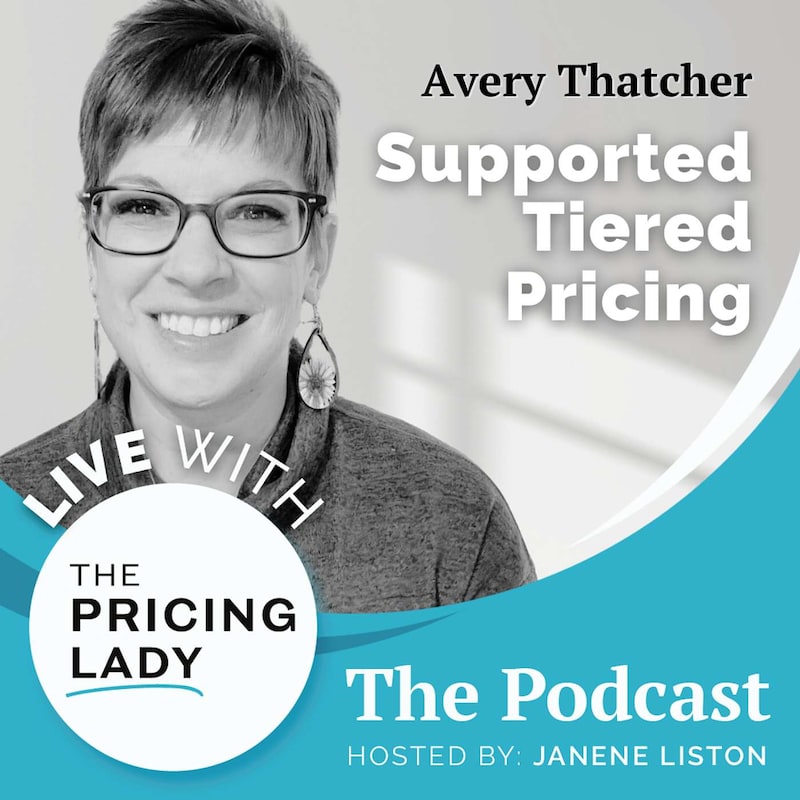
Speaker:Hello everyone, welcome, and also welcome to today's guest, Avery Thatcher.
Speaker:Hi Avery.
Speaker:Hello, I'm so excited to be here.
Speaker:I'm really happy to have you here today.
Speaker:I'm excited about our conversation.
Speaker:So, Avery, why don't we start with a few questions.
Speaker:And the first one is, where are you joining us from today?
Speaker:I am joining you from Calgary, Alberta, Canada.
Speaker:And it's still winter here, but I'm loving it.
Speaker:We were just talking about the weather before we got on
Speaker:the, got on the call here.
Speaker:And, uh, so winter is,
Speaker:how cold is it there now?
Speaker:Well, today is a warmer day cause we get things that are called Chinook.
Speaker:So like warm gusts of weather coming off the mountains.
Speaker:Um, but it's supposed to snow another 20 to 30 centimeters in a couple of days.
Speaker:So.
Speaker:Oh, wow.
Speaker:Amazing.
Speaker:Beautiful.
Speaker:Yeah, I was just sharing with Avery that we're expecting like 27 degrees
Speaker:over the weekend, Celsius that is.
Speaker:So it's going to get quite warm for a couple days over here.
Speaker:Cool.
Speaker:Excellent.
Speaker:Well, thank you for joining us and getting up bright and early this morning.
Speaker:Avery, what would you describe as your superpower?
Speaker:My superpower is to be able to see to the heart of a situation.
Speaker:So someone can say, Oh, I've got this and this and this and this on my plate.
Speaker:I'll be like, How about this?
Speaker:And they're like, Oh yeah, that's what I need to talk about.
Speaker:So yeah, I feel like that's my superpower.
Speaker:That's an excellent superpower to have.
Speaker:Yeah.
Speaker:I mean, especially in this day and age when we try to
Speaker:do, often try to do too much.
Speaker:Um, it's, it's a real.
Speaker:asset to be able to see through that fray and get to the heart of the problem.
Speaker:Super.
Speaker:What's one interesting thing that most people don't know about you
Speaker:that you'd like to share with us?
Speaker:So one of the things that I think surprised a lot of people is
Speaker:that I actually changed my first name a couple years ago, because
Speaker:I did not feel like Heather.
Speaker:And so much had changed in my life, literally overnight, and I felt like
Speaker:I needed to grieve her and let her go.
Speaker:So I became Avery.
Speaker:And I felt at home in my body again.
Speaker:It was totally worth it.
Speaker:Okay.
Speaker:That's really interesting.
Speaker:Maybe we'll hear more about that in the intro as well, because
Speaker:it's tied to the business day.
Speaker:Okay.
Speaker:Actually, that's really cool.
Speaker:So why don't we get into this?
Speaker:And I'm curious about what inspired you to start your business and how did
Speaker:you, how'd you go about doing that?
Speaker:Yeah, sure.
Speaker:So I was working as a registered nurse in various intensive
Speaker:care units across Canada.
Speaker:And I noticed really early on that the number one reason why adults
Speaker:found themselves in the ICU were because of illnesses and diseases that
Speaker:could be linked to chronic stress.
Speaker:So in 2015, I started building my business talking about stress management.
Speaker:And I was talking about all of those things that have tons of research
Speaker:behind them, the mindfulness, the yoga, the journaling, um, Uh, Breathwork.
Speaker:All of the things that had a lot of benefit for stress.
Speaker:And then in 2018, I experienced a very epic burnout that has left me with
Speaker:a chronic illness and a disability.
Speaker:And I was so frustrated because I felt like I was doing everything
Speaker:"right", but I still burnt out.
Speaker:So then I went back into the research because I'm a super nerd and just loved
Speaker:everything which I was reading and I found the missing pieces of the puzzle.
Speaker:So now instead of just focusing on stress, we focus on burnout.
Speaker:And it's really interesting because a lot of people think that burnout is
Speaker:a stress management issue, but it's actually an energy management issue.
Speaker:So when we look at it through that lens, it changes everything.
Speaker:So yeah, that's kind of my journey of where I came from and how I got here.
Speaker:Oh wow, that's fascinating.
Speaker:So when you, when you made that shift from being a nurse to
Speaker:starting your own business, what was that transition like for you?
Speaker:It was rough.
Speaker:The learning curve was like, because I would show up at my patient's
Speaker:bedside and they were there.
Speaker:I did not have to do anything to market or bring them in or tell
Speaker:them that you should trust me.
Speaker:I just showed up and they're just like, great.
Speaker:So learning how to run a business, how to market, how to talk about
Speaker:myself in a way that didn't feel icky.
Speaker:All of those things were huge learning curves.
Speaker:And then I also found that a lot of What was taught online was very much
Speaker:from a B2B model, so like a business to business, not so much a business to
Speaker:consumer, and so the pricing, for one, was not a good fit for the audience that I'm
Speaker:working with, and a lot of the marketing strategies also were not a good fit, so
Speaker:I really had to bring things back to my roots as a nurse and look at how I can
Speaker:incorporate some of the medical models, like the trans theoretical model of
Speaker:change, into things like messaging and social media, because, yeah, social media
Speaker:was also a foreign landscape for me.
Speaker:I didn't have a single account on any platform, and I was just like, oh, shoot.
Speaker:And I did not understand hashtags at the time.
Speaker:It was rough, but yeah.
Speaker:Now, sometimes I feel like I still don't, right.
Speaker:Okay.
Speaker:That's really interesting.
Speaker:And what was it like for you the first time that you sat down and had
Speaker:to set a price for your first offer?
Speaker:So, I was actually working with a coach at the time.
Speaker:And so they had to help me decide the price of it.
Speaker:And it was, I think it was 1, 400, something in that sort
Speaker:of range, 1, 400, 1, 500.
Speaker:And I was really uncomfortable saying that value out loud.
Speaker:And so they actually had me walk around my house and say,
Speaker:1, 500 bananas, 1, 500 pots.
Speaker:And just so I could get used to saying that word.
Speaker:And then I remember the first time I was on a sales call with
Speaker:it, I was like, it's 1, 500.
Speaker:It was so uncomfortable.
Speaker:And I just realized at that moment that, even though that was a good price for
Speaker:some B2B marketing, for sure, When I look at the amount of time that you'd
Speaker:get spending face to face with me and how much I would have charged as a
Speaker:private practice registered nurse, or how much you'd pay a psychologist with
Speaker:their PhD, that I want to be more in alignment with that kind of pricing.
Speaker:And so that's where things kind of settled in for me.
Speaker:And so that was a kind of coaching package or
Speaker:Yeah, yeah, it was a Six session, 12 week coaching package.
Speaker:Okay.
Speaker:Super interesting.
Speaker:You know, I, of course, as I go about my business and meet new people, sometimes
Speaker:I, you know, we get into conversations, of course, about pricing and I'll ask
Speaker:them, you know, what do you charge?
Speaker:And a lot of times, especially more often from women, let's say
Speaker:than, than from men, but I'll, you know, they'll answer with a, 1500?
Speaker:You know, like, you're asking me the question, Yes.
Speaker:And I always find it very interesting that, you know, the communication
Speaker:around pricing because that little intonation is so telling.
Speaker:Um, and, you know, of course any I, I recognize it in a different way that,
Speaker:you know, a normal customer might, but a normal customer also recognizes
Speaker:and feels that insecurity, they just may not be able to identify it in
Speaker:the same way that, you know, someone, someone like me can, who kind of
Speaker:looks out for those kinds of things.
Speaker:Absolutely.
Speaker:And that's where I feel like.
Speaker:Absolutely, you need to charge what you're worth and own what you're charging, but
Speaker:you also have to feel comfortable with it and not feel like you're undercharging.
Speaker:I definitely did that for a little while.
Speaker:But then I started to resent all of the sessions that I was doing
Speaker:because I didn't feel like my value was being compensated for.
Speaker:So, it's really when I kept experimenting and found the sweet spot, then on sales
Speaker:calls, literally have no problem saying what I charge because it just fits.
Speaker:It just fit.
Speaker:So why don't you tell us a little bit more about that experimenting that you did?
Speaker:Because I think that's really important.
Speaker:A lot of people feel pressure when it comes to their pricing because they
Speaker:think they have to get it right now.
Speaker:Yes.
Speaker:so one of the most important things I think any entrepreneur can do,
Speaker:especially when it comes to their pricing is embrace curiosity.
Speaker:So you go through your launch process of an offer or you go through sales calls.
Speaker:And again, I've already admitted that I'm a super nerd, so you don't
Speaker:have to do it to the degree that I do it, but I always look at some of
Speaker:those metrics and just track things to see what's working, what's not.
Speaker:I do market research to see, what's there?
Speaker:And of course you don't want to be the like, big box store that sells
Speaker:everything at a discount you want to be that specialist, but yeah, it's
Speaker:just really embracing that curiosity.
Speaker:Every launch, whether it brought in someone or no one.
Speaker:I always went back to see okay, so what was it about this?
Speaker:Could I interview some people in a focus group after and offer them a free session?
Speaker:Just to be able to get more info.
Speaker:when you don't take it personally, and when you decide, okay, I'll
Speaker:get there eventually, I just need to find the sweet spot, then it
Speaker:just changes the journey, really.
Speaker:Like you're now open to continuing and seeing what happens.
Speaker:Right, right.
Speaker:I like that.
Speaker:I like that a lot.
Speaker:Let me look, I had some other things that I wanted to talk to you.
Speaker:So one of the things that you, you shared with me was that you moved to a tier
Speaker:pricing, tiered pricing system, let's say.
Speaker:What was it you were doing before and what prompted that shift to tiered pricing?
Speaker:So, I think like most people, before I was doing like a singular price for my
Speaker:offers, and I had a number of emails from people saying, I really want to do this,
Speaker:I'm super invested, I can't afford that.
Speaker:And I'm not the kind of person that's like, you should go into debt for it.
Speaker:I just don't feel like that creates a space of safety, and
Speaker:that obviously creates a lot of stress, so it's not what I'm about.
Speaker:So I started to evaluate and just look, and especially when I became disabled,
Speaker:the perspective just shifted, and that there are some communities that are
Speaker:disadvantaged and oppressed, and there's just no other way to look at it right now.
Speaker:That's just a fact.
Speaker:So by going to the tiered model, I offer " a choose your own
Speaker:adventure" kind of pricing.
Speaker:I give three different options.
Speaker:They're all within a similar range and they're all prices that I'm comfortable
Speaker:charging, but then people can choose a price that fits within their budget.
Speaker:Since I did that, sales went way up, even for the middle tier pricing, which
Speaker:is what we want most people to go into.
Speaker:So it just really works super well across the board.
Speaker:It's been received super well.
Speaker:so well, and it allows me to really work with the communities that experience
Speaker:the greatest amount of stress and the greatest amount of burnout.
Speaker:So, even though, on paper, it seems strange to be like, choose your own
Speaker:pricing adventure, and everyone's just gonna choose the lowest one?
Speaker:Most people don't.
Speaker:Most people go for the middle, and I actually get a number of people
Speaker:in the higher one, because they know that they can, and they want to be
Speaker:able to support people that can't.
Speaker:So it actually is just this really beautiful makes you believe in humanity
Speaker:again kind of Very interesting.
Speaker:Yeah, I mean, it's true from a psychology perspective, not always, but usually
Speaker:people tend to go with the middle price.
Speaker:It's one way to, let's say, position things, and make it that attractive.
Speaker:But I think what's really lovely about it is that it, it gives people
Speaker:who really can't, or don't have the means currently, it gives them the
Speaker:opportunity to still participate.
Speaker:And I think that that's, that's amazing.
Speaker:Yeah.
Speaker:I really like it.
Speaker:And I think one of the important pieces, just to clarify here,
Speaker:is that no matter what price you pay, you get the exact same thing.
Speaker:It's not like, if you pay more, you get this extra bonus of something.
Speaker:It's like, no, everybody's the same.
Speaker:Right.
Speaker:Right.
Speaker:Which also, I think it is a really important because it fosters a different
Speaker:spirit within the context of the program.
Speaker:You know, people don't feel left out, um, as they may in, in other types.
Speaker:I mean, there's, there's strategies that go in the other direction as well.
Speaker:And no, they work in some instances, you know, some markets
Speaker:they work very effectively.
Speaker:, Especially for you.
Speaker:I hear from a lot of therapists that they struggle with, when their own challenges
Speaker:into mentally and, you know, not being able to serve everyone, let's say.
Speaker:And then often also sometimes feedback from people.
Speaker:Well, you know, you shouldn't, you know, charge so much because,
Speaker:because I can't afford it.
Speaker:Right.
Speaker:And I don't necessarily agree with that criticism, but I understand
Speaker:from a therapist point of view, how hard it can be to sometimes hear
Speaker:that, and how it can play with, your mindset, your emotions around pricing.
Speaker:Absolutely.
Speaker:And so that's why I built the app that I have because I know that not everybody
Speaker:can afford to work with me one on one and I know that I'm not willing to decrease
Speaker:that price because when I do that then I start to feel resentful and they
Speaker:don't deserve me showing up that way.
Speaker:So the app itself allows for similar kinds of supports, but
Speaker:just with No face to face time.
Speaker:And it just, again, still allows me to feel like I can help more people
Speaker:because also I'm only one person.
Speaker:So bringing people into an app allows me to help more, but also it just,
Speaker:yeah, it gives option to people.
Speaker:Right.
Speaker:So the tiered offering is like for your group program, which I'm
Speaker:guessing is online and partially live.
Speaker:Is that, is that correct?
Speaker:Uh, yes.
Speaker:And it's also for the app.
Speaker:So in the app there's the tiered option.
Speaker:Okay.
Speaker:So
Speaker:I was curious if you do that for just specific parts of what you offer, if you
Speaker:do that for, quote unquote everything.
Speaker:Uh, so everything except for the one on one.
Speaker:That being said, I do offer scholarship options for the one on one, which it
Speaker:comes out as a pay what you can, and if you can't pay anything at all, I don't
Speaker:know, because somebody else manages that.
Speaker:And so it's, uh, still an option, but, yeah, it just, again, allows
Speaker:people that are really committed to what they want to work on to
Speaker:still get the help that they need.
Speaker:I mean, yeah, it's beautiful.
Speaker:Love it.
Speaker:Absolutely love it.
Speaker:So I'm curious, I'm looking again at my notes here.
Speaker:Yes.
Speaker:What's the biggest challenge that you found when it came
Speaker:to pricing in your business?
Speaker:Um, being patient, because I knew that what I had was good and I had
Speaker:tested it with some people and I knew that it was good, but it was
Speaker:just finding the right messaging, the right sticker to put on that and
Speaker:combining that with the right price.
Speaker:Because when you price things too low, as I'm sure you talk about here a lot, People
Speaker:join and they don't really commit to it because they haven't put enough into it.
Speaker:But when you price things too high, then again, you like marginalize some
Speaker:people and really keep some people out.
Speaker:Or even the people that can afford it need it, but they're like, oh no, they just
Speaker:don't see the equation of value there.
Speaker:So yeah, I think it's really just being patient enough to keep being
Speaker:curious and just to keep being like, okay, When's next time?
Speaker:What are we going to do next time?
Speaker:And even though we've had this now successful app, and then all of my
Speaker:programs and group coaching and one, one on one coaching, we still treat
Speaker:every launch as if it was the same.
Speaker:Cause we still like, okay, so here is our new baseline.
Speaker:Where are we going from here?
Speaker:How can we tweak it from here?
Speaker:So it's really just totally embracing that curiosity.
Speaker:It's the way to go.
Speaker:Yeah, yeah, I love it.
Speaker:Now, one thing that you've also shared with me is that you really rely on,
Speaker:on data, but also understanding the importance of understanding customers.
Speaker:I'd really like to hear what you have to say about that, because I think
Speaker:that that's a really important message.
Speaker:Yes.
Speaker:So, um, I think also one of the things that I learned in the steep learning curve
Speaker:of transitioning from a registered nurse into a business owner was that it's really
Speaker:important to make sure that your offers are meeting your clients where they're at.
Speaker:And so the app itself is kind of an introductory offer.
Speaker:It helps people when they're kind of, Preparing to make those bigger changes,
Speaker:but they're not quite there yet.
Speaker:They still need to trust you, they need to trust in themselves.
Speaker:It's about slowly building that trust over time, and also making
Speaker:sure that you're marketing to those people in the right space.
Speaker:So one of the clearest examples of this, I'm not a health
Speaker:coach, so I don't do this.
Speaker:But if somebody was marketing as a weight loss coach, and they're just
Speaker:like, all you need is more self love.
Speaker:And we all know that that's what you need.
Speaker:need, but people just want to lose 20 pounds.
Speaker:So making sure that you're giving people the right resources at the
Speaker:right time that create the gap.
Speaker:So that way they realize that the pile that they're standing in is not
Speaker:something that they want to stay in.
Speaker:So when we look at marketing, you want to think of it in those tiers
Speaker:and also with your offers can meet people in those tiers as well.
Speaker:Oh, that's brilliant.
Speaker:Yeah.
Speaker:I mean, to me, you know, a lot of people come to me.
Speaker:I was just talking to this young lady yesterday and she's like,
Speaker:I think there's just no need.
Speaker:And I'm like, well, is there really, you know, cause when I looked at, you know,
Speaker:what they were doing, um, they, you know, cast a really wide net to get to everyone.
Speaker:And my first instinct was, I can see that this wide net that they've cast in the
Speaker:way the copy is written and the way that they've done things, but I can imagine,
Speaker:you know, as a customer, that that feels like How do you connect with that?
Speaker:There's too much information there.
Speaker:There's too many bullet points and it's hard to really see, you know,
Speaker:how something that's, you know, like a one size fits all t shirt,
Speaker:metaphorically speaking, right, can really attract customers.
Speaker:Definitely.
Speaker:And I think.
Speaker:Like, again, if you're thinking about more what they need versus what they want,
Speaker:then that really widens your net because, sure, you could help everybody if you're
Speaker:a health coach that helps people with self love, but really narrowing down first to
Speaker:that introductory offer that helps people as they're preparing to realize that they
Speaker:need more self love, like, I think that's just, because when we think of niching,
Speaker:I think a lot of us get scared because we're just like, oh, but I could help so
Speaker:many more people if I don't niche, but.
Speaker:Really, the more That you just really target in on that first niche topic.
Speaker:That allows you then to start bringing business that way.
Speaker:And once you got all those funnels set up, because you still have your main
Speaker:higher level offer that multiple people can benefit from picking a new niche to
Speaker:start marketing to with new channels and still bring them through because they can
Speaker:all come in through to that top offer.
Speaker:So picking a niche does not.
Speaker:really limit you.
Speaker:It's just your first point of focus.
Speaker:It's, I was gonna say, it's like, it's like, , binoculars.
Speaker:It's just like bringing the target into the focus.
Speaker:Right.
Speaker:And it doesn't mean that there aren't going to be other people who are
Speaker:interested in what you do, or, you know, or who see the value in it.
Speaker:It just means that you can actually align things in your business much better.
Speaker:From sales to marketing to pricing to whatever, you know, it is that you
Speaker:need, you can align it much better if you're focused on one at a time.
Speaker:Absolutely.
Speaker:And I actually have a really clear example of how niching doesn't eliminate anybody
Speaker:because I was doing an entrepreneur mentorship thing for a couple of years
Speaker:and I really enjoyed it, but it was also just taking away from the burnout thing.
Speaker:So I decided to close that arm of my business down.
Speaker:But before I did, And when I first started marketing, I decided that I only
Speaker:wanted to work with women, and I only wanted to work with people that were
Speaker:in the mental health or physical health space, because I knew that space really
Speaker:well and how to market to that space.
Speaker:So I had flowers and pink on everything because I was just
Speaker:like, girls only, please.
Speaker:And I had probably 40 percent men reaching out because they liked what I was saying.
Speaker:And I was just like, So I had to change all of the marketing because I
Speaker:realized that working with men was not the worst and they were drawn to how I
Speaker:was teaching, so I needed to make sure that that was still inclusive to them.
Speaker:But even though I was going super hard into the women in business side,
Speaker:men still were very drawn to it.
Speaker:Yeah,
Speaker:it shows the power of the message that you were that you were sitting out there.
Speaker:It overcame the branding.
Speaker:It overcame the pink fluffy flowers.
Speaker:Yes.
Speaker:I am not a pink girl.
Speaker:So it was well,
Speaker:which is also, you know, it's funny how you think you have to do things
Speaker:to just match your customers.
Speaker:But I think it's also important to, you know, take your own
Speaker:values and sense of things.
Speaker:I know when I started my business, because, you know,
Speaker:most people, when they I think.
Speaker:Pricing consultants or consultants in general, they think of very buttoned
Speaker:up people and navy blue suits and okay, got the spectacles and the
Speaker:gray hair, but you know, there's a certain, you know, demeanor to them.
Speaker:And I'm a little bit more Let's say casual and a little bit more like when I talk
Speaker:about this topic, which can be a very serious topic, I try to bring it to people
Speaker:at the level that they are and in a way that makes it more interesting and fun.
Speaker:And I felt really nervous about, about doing that.
Speaker:Yeah, fair.
Speaker:But it's your approachability, Janene.
Speaker:That approachability drives people.
Speaker:That's the exact word.
Speaker:The lady who I worked with on the branding, she told me I
Speaker:wasn't allowed to use the word.
Speaker:Fun.
Speaker:And Approachability was the word that we came up with instead.
Speaker:Absolutely.
Speaker:So brilliant.
Speaker:So Avery, what is next for you?
Speaker:What is next for becoming Avery or your Creating Calm app?
Speaker:Yeah.
Speaker:So this year we're really digging into corporate speaking because
Speaker:burnout is prevalent everywhere.
Speaker:So I've done a couple already this year, just with corporate speaking.
Speaker:Both the leadership team and the team, so we're really branching out
Speaker:into that and then also licensing the app to corporations that want
Speaker:to expand their benefit package.
Speaker:So again, learning curve, it's rough, but, it's been a really fun journey and I am
Speaker:so grateful to have a team behind me to help support me because otherwise I would
Speaker:be running around with, like, a chicken.
Speaker:Like, blah!
Speaker:Yeah.
Speaker:Yeah.
Speaker:Yeah.
Speaker:But that's, I mean, us holding on to the integrity of, you know, behind what you do
Speaker:and the values in your business as well.
Speaker:Right.
Speaker:So you don't want to end up back where you were in the past burnout.
Speaker:So it's important to manage that going forward.
Speaker:Absolutely.
Speaker:So why don't we start wrapping this up?
Speaker:What's one thing you'd like people to remember from our conversation today?
Speaker:That the most important skill you can develop is to be curious, because when
Speaker:we start to take it personally or think it's about us, then it makes it so
Speaker:much harder to continue moving forward.
Speaker:So, curiosity.
Speaker:Yes.
Speaker:Curiosity is the way forward.
Speaker:I love that.
Speaker:Thank you.
Speaker:Is there a book or a tool that you'd like to share with the entrepreneurs
Speaker:who are listening as well?
Speaker:today that have helped them.
Speaker:Yes.
Speaker:So my favorite business book is called Storyworthy and it's by Matthew Dix.
Speaker:And a friend of mine, also from Your Corner of The World, sent it to me and
Speaker:it is That's the most clear way to how to break down a really impactful story.
Speaker:So from all business owners, we need to learn how to tell our story
Speaker:and other stories really well.
Speaker:Fantastic book.
Speaker:Highly recommend.
Speaker:Okay.
Speaker:It's one I haven't read.
Speaker:I'll have to check it out.
Speaker:Excellent.
Speaker:And the last question.
Speaker:Where can people reach out if they are curious to find out
Speaker:more about working with you?
Speaker:I would recommend you go to my website, BecomingAvery.
Speaker:com.
Speaker:There are Buckets of free resources there, including a quiz for how to discover
Speaker:your self sabotage style and then what to do with it once you know what it is.
Speaker:So you can definitely go and check out all of the things there.
Speaker:Okay, cool.
Speaker:I'll have to check that out as well.
Speaker:So we'll put that in the show notes as well as, Avery's links on social media
Speaker:so that you can reach out to her as well.
Speaker:Avery, thank you so much for joining me on the show today.
Speaker:I really enjoyed our conversation.
Speaker:And I think we, we talked about some things that are really
Speaker:important and going to help people out there who are listening to us.
Speaker:Oh, I'm really glad.
Speaker:Yes.
Speaker:I really enjoyed this conversation as well.
Speaker:Super.
Speaker:And to all of those of you who are out there listening, thank
Speaker:you so much for joining us today.
Speaker:If you have any questions, reach out and book a call with
Speaker:me until next time, everyone.
Speaker:I wish you a great day and as always enjoy pricing.
Speaker:Thank you for listening to this episode of Live with The Pricing Lady, the podcast.
Speaker:If you enjoyed the episode, rate, review, and subscribe to it, then share
Speaker:it with your friends and colleagues.
Speaker:I love hearing back from you listeners.
Speaker:If you've got comments, questions, or topic ideas, go on over to thepricinglady.
Speaker:com and contact me there.
Speaker:Not sure where to start when it comes to improving pricing and profits?
Speaker:At ThePricingLady.
Speaker:com you can download a copy of my Self Assessment Pricing Scorecard.
Speaker:Find out where it's going well and where you can begin improving.
Speaker:Or just simply book a discovery call with me.
Speaker:There we can discuss what's up with pricing in your business and
Speaker:how I might be able to help you.
Speaker:Thanks once again for joining.
Speaker:Remember, pricing can hurt or help your business.
Speaker:Let's make sure it's helping you reach your dreams.
Speaker:See you next time and as always, enjoy pricing.