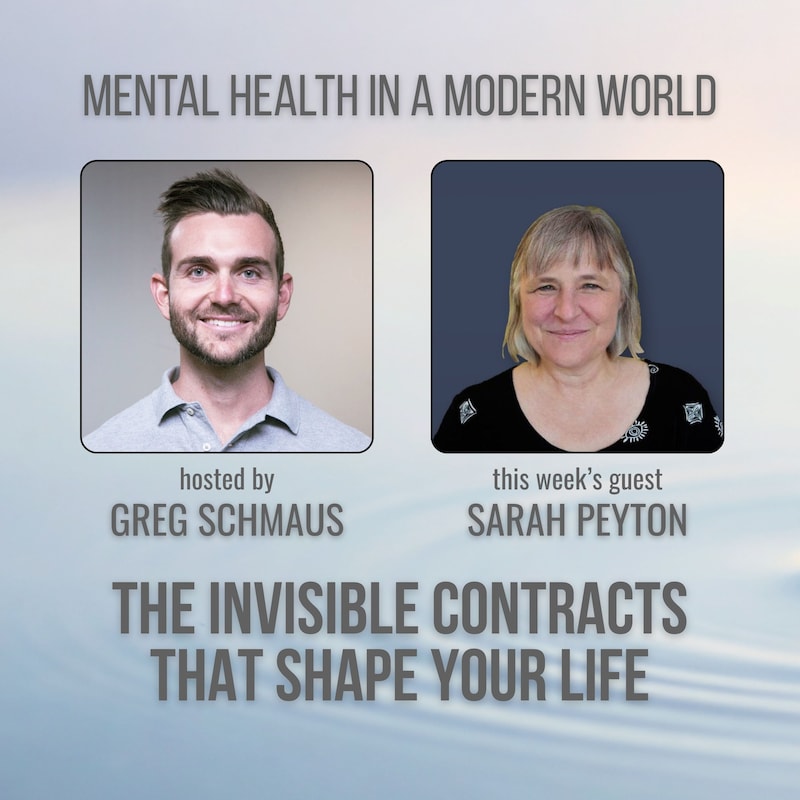
Shownotes
📺 Watch on YouTube and Spotify
“We are metaphor, that we're made of metaphor. And so the issues that we have and the problems that we have with people are metaphors for the places where our brains are tied in knots and need to be untied and untangled so that we can become whoever it was brains were meant to be— in their snowflake, completely unique incarnation in the world.” says Sarah Peyton, researcher, teacher, and author specializing in relational neuroscience and nonviolent communication, who joins Mental Health in a Modern World for an unforgettable exploration of healing, trauma, and the forces shaping who we become.
Sarah Peyton draws on revolutionary findings in neuroscience, family constellation work, and her own lived experience to explain why so many of our struggles are rooted in inherited patterns, unconscious contracts, and a deep need for resonance and accompaniment—rather than advice or “fixes.” In this conversation, Greg Schmaus invites Sarah Peyton to unpack the science and soul of how trauma disrupts our natural capacity for connection, why metaphor is a biological language of the brain, and how precision and warmth together create the conditions for transformation.
Discover how the roles played by our earliest caregivers, unacknowledged grief, and “sabotaging” habits all point to what the nervous system has done to ensure our survival—and what’s truly required for lasting change. Listen to learn why we unconsciously replicate our family dynamics throughout life, how to uncover hidden “carrots” underlying self-sabotage, and what it really means to become the unique person your brain was always meant to be.
5 Key Takeaways
Discover transformative tools for healing, growth, and self-awareness from this episode. Start implementing these actionable steps in your own journey today:
- Cultivate Resonance: Practice offering others both precision and warmth in your communication to foster emotional connection and relaxation in the body 05:53.
- Embrace Metaphor: Use and notice metaphor in your language as a way to better understand yourself and create deeper connection with others 10:11.
- Prioritize Accompaniment over Advice: When supporting others, focus on being present and attuned rather than jumping straight to advice-giving 11:28.
- Identify and Update Unconscious Contracts: Reflect on self-sabotaging or restrictive patterns in your life, discover the hidden commitments driving them, and consciously choose healthier, updated behaviors 27:24.
- Recognize and Heal Family and Ancestral Patterns: Notice how family imprints and constellations shape your actions, and work to untangle and release what no longer serves you 54:38.
Take your next step—choose one actionable point, practice it this week, and witness meaningful change in your life.
Memorable Quotes
"We are made of metaphor. The issues and problems we have with people are metaphors for the places where our brains are tied in knots and need to be untied, so we can become who our brains were meant to be in their snowflake, completely unique incarnation in the world."
"When the correct word is given to an emotion that a human is feeling, that person's body relaxes. It's like the message has been received, and they get to move on to whatever's next."
"If there's accompaniment and resonance, we don't actually have to make these contracts. If somebody were with me, going, 'Yes, of course this would be kind of scary sometimes,' then I don't have to make that contract to be closed; I can just be with what is."
Connect with Sarah
Website - https://sarahpeyton.com/
Facebook - https://www.facebook.com/empathybrain
YouTube - https://www.youtube.com/sarahpeyton
Instagram - https://www.instagram.com/sarahpeytonauthor/
Resources Mentioned
W.W. Norton Publishing - https://wwnorton.com/
Connect with Greg
Website - https://www.healing4d.com/
Instagram - https://www.instagram.com/4d_healing/
YouTube - https://www.youtube.com/@gregschmaus
LinkedIn - https://www.linkedin.com/in/greg-schmaus-22929589/
🎙️🎙️🎙️
Podcast Production & Marketing by FullCast: https://fullcast.co
Discover the best podcast services in the world at The Podosphere: https://www.thepodosphere.com/
Mentioned in this episode:
Embark on The HTM Journey
Embark on The HTM Journey
Transcripts
We are metaphor, that we're made of metaphor. And
Speaker:so the issues that we have and the problems that
Speaker:we have with people are metaphors
Speaker:for the places where our brains are tied
Speaker:in knots and need to be untied and untangled
Speaker:so that we can become whoever it was brains
Speaker:were meant to be. In their snowflake, completely unique
Speaker:incarnation in the world. In a world moving faster than our minds were designed
Speaker:to handle, mental health is becoming one of the defining challenges of our time.
Speaker:Welcome to Mental Health in a Modern World with holistic health
Speaker:practitioner Greg Schmauss. After overcoming severe anxiety and
Speaker:OCD in his own life, Greg dedicated the past decade to
Speaker:helping others heal through a fully integrated approach to mental health,
Speaker:combining lifestyle coaching, psycho emotional healing,
Speaker:mindfulness, and archetypal work. Over the years, he's facilitated
Speaker:thousands of sessions guiding people back to peace, clarity,
Speaker:and a deeper connection with themselves. Each week, Greg shares
Speaker:powerful solo insights, conversations with leading voices in holistic
Speaker:healing, and immersive live coaching sessions that take you inside the
Speaker:healing process itself. New episodes every Friday follow
Speaker:the show and start reclaiming sovereignty over your mind in a modern world.
Speaker:Here's Greg. Sarah, welcome to the podcast.
Speaker:Oh, great. Thank you for having me. Yeah, it's such an honor to have
Speaker:you. You've been such a huge influence on my personal healing and my
Speaker:professional career. So it's really just an honor for me to have you on
Speaker:the show. So I'd love to just start
Speaker:just to give people a little bit of a background of your journey, of
Speaker:your work, because you have such a diverse
Speaker:area of expertise. So I'd love to just start with a brief little background,
Speaker:if that's okay. Yes, of course.
Speaker:My. My background is that I
Speaker:became intensely interested in neuroscience
Speaker:when I was starting to study nonviolent communication back in the
Speaker:2000s. I had this transformative experience
Speaker:with nonviolent communication. And then because I'm always like, how did that
Speaker:happen? What was that? I went out and started looking at
Speaker:the new research that was coming out from the decade of the brain,
Speaker:from the world of fmris, being used to
Speaker:look at how relationships are constructed and how we
Speaker:affect one another. I think probably it was
Speaker:incredibly healing because my mom, in the
Speaker:aftermath of the trauma that formed her when she was a tiny little person,
Speaker:sort of was adamant in insisting that she had no effect on me.
Speaker:So I was like, look, we have an effect on each other. I was so
Speaker:excited. Although I had no neuroscience background, I just
Speaker:became an absolute, like, diving in person
Speaker:and ended up publishing a book with Norton. Now
Speaker:three books with Norton Publishing, W.W. norton. Despite
Speaker:the fact that I have no neuroscience degree. So, so,
Speaker:so. All hail the amateurs. Those lovers of.
Speaker:Those passionate lovers of subjects who can dive
Speaker:in and actually begin to tease things apart and make them
Speaker:usable for the common person outside of the lab. That's my
Speaker:world and my life. And the two modalities that I am most
Speaker:interested in. I love healing trauma. I love healing trauma
Speaker:because I would have loved for my mom's trauma to be healed and my
Speaker:dad's trauma. Everybody that I love. But
Speaker:I also love change. I deeply love
Speaker:experiencing my own brain changing and
Speaker:supporting other people to have their brains change. So the two
Speaker:modalities that I work in that are healing modalities are resonant
Speaker:language and resonant healing, which I developed based on
Speaker:relational neuroscience, and constellation work,
Speaker:which I love because it provides this
Speaker:absolutely gorgeous social metaphor for people
Speaker:to begin to have a sense that their experience is
Speaker:captured and reflected by other humans.
Speaker:And can you share with us what is resonance? How would you
Speaker:define resonance? I remember in one of our
Speaker:constellation courses, you defined it so beautifully. So I'd love for you to touch on
Speaker:that for a moment. I wish I could touch the past beauty.
Speaker:I'm like, what did I say? So resonance
Speaker:is the way that human bodies vibrate
Speaker:with one another and the way that we can kind
Speaker:of capture and ride and augment and
Speaker:be with those waves of
Speaker:energy that move between us, which are our emotions. How
Speaker:do we. How are we with them? How do we sit with them? How do
Speaker:we reflect them in words? And what
Speaker:neuroscience shows us is that the more that we have a sense
Speaker:that another human gets us, the more
Speaker:our bodies relax and change and reach for.
Speaker:I kind of see our human brains as.
Speaker:As having been born to do something,
Speaker:something beautiful. Each person. Each person's brain is
Speaker:completely unique. Just like snow, just like snowflakes.
Speaker:We are blocked by trauma and by a lack of
Speaker:accompaniment. And when we begin to allow ourselves to
Speaker:resonate with one another instead of shutting it down in order
Speaker:to make it through a difficult world, then all of a sudden,
Speaker:all kinds of very interesting and important things start to happen.
Speaker:Yeah. I remember what you said in the
Speaker:emergent constellation training. You said that
Speaker:resonance is the balance of precision
Speaker:and warmth. Oh, that's beautiful. Yes, it
Speaker:is. I'm wondering, could you expand on that a little bit? Because what I.
Speaker:After that class, I remember exploring
Speaker:where. Where I've experienced that, but also where I've experienced
Speaker:precision without warmth or warmth without
Speaker:precision. Yeah. So I'd love For you to just unpack
Speaker:that a little bit. Yeah.
Speaker:Our human brains
Speaker:do not naturally give words to human emotions.
Speaker:They. They have to be in relationships where
Speaker:other people are giving words to human emotions. I mean, I think this can happen
Speaker:through art as well, like reading books and certain kinds of
Speaker:music and paintings. But
Speaker:when. When the correct word is given to an emotion that a
Speaker:human is feeling, that person's body relaxes
Speaker:and it's like the message has been received and they get to move on to
Speaker:whatever's next. And there are
Speaker:both. There are non specific words for emotion that people
Speaker:use all the time because it dials the intensity down.
Speaker:Words like worry or
Speaker:troubled, or saying things like this is
Speaker:problematic or that's a dilemma, or I feel
Speaker:a little upset about this. All of these are words that we
Speaker:use constantly that don't actually have a
Speaker:clear emotional tone. If you think about the primary
Speaker:colors in a crayon box, you know,
Speaker:in the crayon box of emotions, the primary colors are
Speaker:fear, sadness, and a sense of
Speaker:a need for connection,
Speaker:anger and disgust. And
Speaker:then we get some happiness and joy. But
Speaker:if we don't actually get into the words are
Speaker:connected to those primary colors. Like sorrow is a word that's really
Speaker:connected to one of those primary colors. Or rage is a word
Speaker:that's connected to a primary color. Terror is a word that's connected to a
Speaker:primary color. Those are kind of high volume emotions.
Speaker:If we turn it way back down, then, you know,
Speaker:anger, frustration, annoyance, and then
Speaker:like, so as we begin to capture the.
Speaker:With precision, what area of the brain, because
Speaker:these emotions actually happen in different areas of the brains and have different
Speaker:neurotransmitters that run them. Then the body gets even
Speaker:more calm and even more and takes
Speaker:bigger steps. I'm a person who loved fairy tales. And in fairy
Speaker:tales, when I was little, there were seven league boots that you could put on
Speaker:and you'd take one step and it would carry you seven league.
Speaker:And I kind of have the sense that that's what
Speaker:resonance does when we're actually being both
Speaker:warm and precise. So I love it that you had the experience of thinking about
Speaker:warmth without precision. Oh, honey, oh my
Speaker:darling. Yeah. Of course she would feel this
Speaker:way, you know, just like not much there. Right. And.
Speaker:And then precision without warmth. Would you like some acknowledgment of
Speaker:anger? You know, like,
Speaker:there's a person, we need a person.
Speaker:So yeah, that's really beautiful. And
Speaker:one of the things that I notice when you're offering resonance
Speaker:is the use of a lot of metaphor.
Speaker:Oh, metaphor. We are just. We are bodies built of metaphor.
Speaker:And is that what creates the relaxation
Speaker:in the body when someone's nervous system feels
Speaker:understood through metaphor? Is that what's happening? Well, if you
Speaker:look closely at whatever metaphor that you're offering, it's
Speaker:offering feelings, energies and needs, energies
Speaker:in a nice little package that also carries the
Speaker:flavor of that other person in relationship to us. You know,
Speaker:we really get to have the experience of them
Speaker:stepping into a relational space
Speaker:where they're using their imagination to wonder about
Speaker:what things are like for us. The researchers say that we
Speaker:use a metaphor once every six words when we're
Speaker:talking. Just generally that it is. The
Speaker:metaphor is the unseen ocean that we are always
Speaker:swimming in. Yeah. Beautiful. The other components that
Speaker:you mentioned is accompaniment. And you know, as
Speaker:someone who for 10 plus years
Speaker:has been in the coaching world, there's a
Speaker:huge desire to be the advice giver.
Speaker:Oh. And so one of the things that I've really
Speaker:learned from you and learned through nonviolent communication
Speaker:is some of the dangers of advice giving,
Speaker:especially without consent, and how
Speaker:accompaniment is really kind of what the nervous
Speaker:system's looking for rather than a solution,
Speaker:advice, or a fix. Can you explain why that's the case and what's
Speaker:happening kind of like under the surface when someone's
Speaker:receiving accompaniment versus advice? What a great
Speaker:question. We're sort of sold a bill of goods about
Speaker:being individuals. We're given like, lots
Speaker:of messages that we're supposed to be independent and do things on our own.
Speaker:We're supposed to tie our shoes on our own early. We're supposed to be able
Speaker:to cross the street by ourselves responsibly early. We're supposed
Speaker:to be able to figure out the answers on our math
Speaker:test by ourselves. It's like every. All kinds of
Speaker:messages that we have that we are
Speaker:individuals and not social animals.
Speaker:But in fact, humans are exquisitely social.
Speaker:For example, we have particular neurons in
Speaker:our skin that are devoted to feeling
Speaker:particular nerves that are devoted in our skin to
Speaker:feeling other people's body heat. Like, these
Speaker:are nerves that do not Register temperatures
Speaker:over 105 degrees and do not Fahrenheit and do not
Speaker:register under 80, 82
Speaker:degrees Fahrenheit. You know, it's like they only light
Speaker:up at those temperatures. If we're sitting next to a hot stove, those
Speaker:neurons do not. Those nerves do not light up. If we're sitting next to
Speaker:a warm rock in the summer sun, unless it's the right
Speaker:temperature, those neurons do not light up. So
Speaker:we have A knowing about whether or not there are beings who
Speaker:are close to us and the companion animals who are
Speaker:most important to us. Cats and dogs have
Speaker:body temperatures that are right in that same area as well. And
Speaker:there's something immensely comforting about their presence as well.
Speaker:But we're made to be in community. We're made
Speaker:for our brains to work with other brains
Speaker:and have a shared load experience.
Speaker:So I don't think it's any accident that
Speaker:the main neurotransmitter
Speaker:for stress is cortisol. And cortisol
Speaker:is the main neurotransmitter for what it's like for us to be alarmed.
Speaker:So with this, keeping this in mind
Speaker:that we are immensely social,
Speaker:we relax when we have a sense that there's somebody with
Speaker:us and we can begin
Speaker:in a shared load situation. We can begin
Speaker:to brainstorm and discover
Speaker:exactly the best path for us, given the
Speaker:resources and limitations of our present experience and the resources and
Speaker:limitations of the other people in the experience. It's like we
Speaker:move into solution once accompaniment
Speaker:is present and we can really feel, oh, there's somebody with me
Speaker:with advice. We're not stepping into that territory. You know,
Speaker:we're trying to get to the good stuff, which is the brainstorming and the
Speaker:solutions and the really great strategies, without
Speaker:going through the emotional labor
Speaker:of self regulation and
Speaker:attuning to somebody else, allowing ourselves to make them the center of our
Speaker:attention. Because when we allow ourselves to make the other person the center of our
Speaker:attention, our nervous system starts to
Speaker:resonate with their nervous system, our heartbeat starts to
Speaker:align, our heart rate variability starts to align, our blood pressure
Speaker:starts to align everything. And our
Speaker:brains start to create the same patterning
Speaker:and use patterning and brainwave patterning.
Speaker:It's not the thing we're taught to do.
Speaker:We're not taught to stop and resonate with
Speaker:somebody else. We're not taught to stop and attune and make the other person
Speaker:the center of our emotional attention.
Speaker:So then what happens when we step over the part
Speaker:that's deeply relational is that we get a spike of
Speaker:cortisol when somebody gives us solicited
Speaker:emote advice, unsolicited advice,
Speaker:spike of cortisol. The thing is also true if somebody
Speaker:doesn't want to go into that territory and we go in there,
Speaker:they can also have some stress and be like, what are you doing? I
Speaker:don't, I only want advice. I don't want to talk about emotion. And then
Speaker:we get to listen to them. You know, I mean, it's always with consent that
Speaker:we're moving consent and co creation. Like,
Speaker:would you like. So would you like a metaphor? Guess. Is it okay if I
Speaker:attune to you? It's okay if I make you the center of my attention for
Speaker:a moment? You know, is it okay if I talk about emotions
Speaker:or ask about emotions? Because that territory
Speaker:in between problem and advice is
Speaker:an unfamiliar territory. The territory accompaniment is not
Speaker:a familiar territory for most of us. And we
Speaker:got to know what it's like and we're like, where can I find more of
Speaker:this? Why aren't people beautiful?
Speaker:Beautiful. What was coming up for me when you were sharing is when we're in
Speaker:that stressed state or state of pain,
Speaker:when someone comes in and kind of like skips the step of
Speaker:accompaniment or resonance and goes right to advice. It's kind of
Speaker:like trying to pull someone out of their
Speaker:state rather than meet them where they're at in their experience.
Speaker:And so is that what's creating like the. Almost like that stress
Speaker:response or the stress hormones? Yes. I think it's that we're
Speaker:getting that clear information that somebody has left us.
Speaker:You know, it's like, I'm not, no, I'm not gonna, I'm not going to attune
Speaker:to you. I'm not gonna resonate with you. I'm going right over, I'm stepping right
Speaker:over this area. You're here, but I'm gonna go over here and
Speaker:tell you what I think you should do. Yeah. Beautiful.
Speaker:And you. You know, last year when I had
Speaker:participated in your emergent constellation program, which
Speaker:was really incredible. You know, up until that point,
Speaker:you know, I had been coaching people for, for 10 plus years.
Speaker:And up until that point, it was always this sense of I'm working with an
Speaker:individual. And now
Speaker:since taking a lot of your training, you're working
Speaker:with way more than an individual. Yes. You're working with
Speaker:a whole field and a whole constellation. So can you
Speaker:unpack that a little bit? The transition from this perception of
Speaker:I'm working with this singular entity of one person
Speaker:to I'm really working with a greater whole here. Yeah,
Speaker:that's such a great thing. Well,
Speaker:it kind of takes us back to this idea that we're, that we're
Speaker:socialized to believe that we are alone.
Speaker:We're not socialized to not go, oh, I'm walking through the world.
Speaker:And my mom and my grandparents and my ancestors and my dad and his.
Speaker:And his ancestors are all behind me
Speaker:and are contributing to the epigenetic profile
Speaker:around my DNA. You know,
Speaker:we're just not used to thinking about ourselves as like
Speaker:that Each individual is a convergence point
Speaker:for their own past, present and future. Their
Speaker:family's past, present and future, and their
Speaker:society's past, present and future. Each of us
Speaker:are carrying, just as in a family system, we
Speaker:carry a different role. Somebody's the golden child, somebody's the
Speaker:rebel. In society, we carry these different
Speaker:roles that once we get a sense of
Speaker:any unconscious commitment we've
Speaker:made to only being that role, we can
Speaker:begin to kind of loosen. I have an image of, you know,
Speaker:the drills that you
Speaker:can turn backwards and they become unscrewers. You know, the
Speaker:unscrewing drills that we can start to take off the plate
Speaker:that's been screwed down by our society or our family
Speaker:or our culture. And we can begin to say, oh yeah, look at me, look
Speaker:at me there, I'm carrying the rebel responsibility. What
Speaker:happens if I just acknowledge that, yeah, that's something
Speaker:I carry, something I love. And what if I'm bigger than that?
Speaker:Beautiful. One of the things that I really appreciated
Speaker:that had a huge imprint in some of the training
Speaker:that we had done together is the impact
Speaker:and the imprint of the mother and the father and the
Speaker:different imprints that they carry in terms of the mother
Speaker:and more of our inner world, the father, and more of the world outside
Speaker:of us. Can you touch on that a little bit? Yeah.
Speaker:Well, first of all, the research shows that it doesn't matter what
Speaker:gender a person is. What matters is what role they're playing in a baby's
Speaker:life. Right. And if there's just one parent, then they're playing both roles. But
Speaker:if we have two parents, then the first
Speaker:parent, the one that's primary for the babies,
Speaker:for responding to the baby most of the time,
Speaker:that is the mother person, the mothering person, the mother. The
Speaker:mother can be male, the mother can be non binary,
Speaker:and then we've got the second parent who we call the father.
Speaker:But the father can be female, the father can be non binary. It does
Speaker:not matter at all what gender people are. What matters is
Speaker:what role they play. So with the mother, the mother's
Speaker:creating the way that the child learns to
Speaker:regulate themselves and
Speaker:whether or not the child can expect to be
Speaker:met in a sweet way in
Speaker:interpersonal relationships and how
Speaker:to learning how to care for the self, learning, care for others.
Speaker:Lots of stuff about the care circuit and the sweetness of
Speaker:connection and relationship or the lack
Speaker:of sweetness in relationship and the conviction that we're bad. Yes,
Speaker:Those things also come with mothers. As I mentioned, my mom
Speaker:was immensely traumatized so all kinds of strange things came
Speaker:with trauma. Then you've got the father, the second
Speaker:parent, that person's responsibilities, if we're lucky,
Speaker:is playing in an entirely different way
Speaker:with the baby. And they are so important for this.
Speaker:When a father or second parent plays with the baby,
Speaker:then the baby experiences peaks of
Speaker:delight, just, you know, peals of laughter that come
Speaker:when babies are playing and how they giggle and giggle and giggle,
Speaker:you know, and that experience of being brought into
Speaker:peak delight and then, you know,
Speaker:gently being accompanied in a, in a calming and
Speaker:then a peak delight and then a calming. That's the essence of
Speaker:play. And
Speaker:I'm just thinking of not just my husband, but
Speaker:my first son, adopted when he was 15. He,
Speaker:he was, he actually came to the hospital when
Speaker:my, when my second son, my birth son was born. So he was
Speaker:there from the very beginning of his baby. He was
Speaker:the first person outside the people who were in the birth room to see the
Speaker:baby. And, and he played, he would play with the baby. He
Speaker:would Nick's little fist and he would make him
Speaker:punch him in the, in the. And then he would follow
Speaker:quick giggle and giggle and giggle and then he would get up again.
Speaker:So it was a whole experience of being able to watch this,
Speaker:this really beautiful play unfold.
Speaker:As you listen, you can hear the nervous system of the baby
Speaker:making waves and kind of on a
Speaker:wave. That's just such an
Speaker:important piece of having
Speaker:delight in the world, being resistant to
Speaker:depression, having a sense of meaning and
Speaker:not being spun out by high energy.
Speaker:As if nobody ever plays with a baby, then they don't get to know how
Speaker:to manage high energy. And then there's all
Speaker:kinds of nervous system impacts of just
Speaker:like anxiety just because there's no way to integrate and manage
Speaker:what's happening. Cool that
Speaker:fathers, second parents are responsible for play, for
Speaker:provision and for protection.
Speaker:And so the father, would you say it relates
Speaker:to our sense of safety in the world and how
Speaker:we maybe find value in the world,
Speaker:like how we find worth, how we engage,
Speaker:how we bring our energies to engage with the outer world,
Speaker:with community, with group, with the workplace.
Speaker:It's almost like I'm thinking now of gears and the
Speaker:way that you have a transmission and it, it helps energy to move from one
Speaker:direction to another. Father, with their
Speaker:responsiveness and their play is creating a transmission
Speaker:within the child that allows their life energy
Speaker:to be changed, to be transmuted into
Speaker:forward motion in whatever way the child wants
Speaker:to be moving in the world or this particular human wants
Speaker:to. Beautiful. I remember when,
Speaker:when we were going through these modules. It was so clear to me how
Speaker:that was showing up in my own life. For example, like,
Speaker:you know, my mother was someone who is very loving, but
Speaker:also sometimes a little smothering.
Speaker:And so I realized that over the course of
Speaker:my life, whenever things showed up in my body, like symptoms in my
Speaker:body, I noticed my attention almost like smothering
Speaker:it. Oh, wow. Like, what do I have to do to fix it or to
Speaker:get rid of it or to almost like a micromanagement of the
Speaker:body. And I was kind of like a little bit of the loving,
Speaker:smothering mother to my body. And then my
Speaker:father, who is very intellectual,
Speaker:he came from like Austrian lineage, like very
Speaker:mind, very intellectual. And so I remember when I would
Speaker:go out into the world, it was always like, how can
Speaker:I share my knowledge? How can I share my intellect? Not
Speaker:my emotion, not my heart, but the power of my mind?
Speaker:And when you were teaching, you know, these imprints, it just made
Speaker:so much sense to me of like, how I engaged my
Speaker:inner worlds and how I anticipated
Speaker:being received by the outer world and how I needed to present myself.
Speaker:And so really, really powerful and so
Speaker:interesting in terms of what you've been talking about with your coaching journey,
Speaker:that sense that those first 10 years were like, how
Speaker:can I give you my knowledge? This is the thing I have to give.
Speaker:Right, right.
Speaker:And so within these constellations,
Speaker:we have what you call unconscious contracts.
Speaker:Can you share with us what an unconscious contract is? And also,
Speaker:I love the way they're worded. It's almost like they feel
Speaker:encoded in a way that is very
Speaker:specific, very precise. When we're up against
Speaker:something, some kind of issue, something we
Speaker:can't do, or a pattern that we've noticed that's self destructive
Speaker:or self sabotaging, we may very well be up
Speaker:against what I call an unconscious contract. And
Speaker:this is an agreement that we have made with ourselves
Speaker:to do things in a certain way that
Speaker:allows us to accomplish really deeply important,
Speaker:but not conscious relational goals.
Speaker:I think of conscious contract a bit like a carrot.
Speaker:You can see the carrot green. A carrot that's growing in the
Speaker:earth. You can see the carrot green. But you don't know
Speaker:what kind of shape the carrot has until you pull it out.
Speaker:It's got an individual shape. And so we
Speaker:walk around in a field full of carrot greens where we see what we're doing,
Speaker:but we don't know what the shape of the carrots are underneath the
Speaker:ground, for example. What have I been up against
Speaker:lately?
Speaker:Yeah, so I have a Husband who's quite ill.
Speaker:And so all of my contracts about
Speaker:both. All of the agreements that I've made
Speaker:about how to care for somebody else and whether or
Speaker:not I get any care in such a situation
Speaker:are at play. That's the carrot field that I'm walking
Speaker:in is. I can see all of these waving greens of the
Speaker:ways that I care for my husband, the way that I don't care
Speaker:for him, the way that I don't care for myself, the way I do care
Speaker:for myself. How is all of this happening?
Speaker:You know, we all live within
Speaker:the safety zone of our unconscious contracts which
Speaker:have been made, which have been. It's almost
Speaker:like they've been learned rather than made. They've been
Speaker:developed and learned because they were the best possible way of
Speaker:dealing with our family of origin. So we look
Speaker:at what we're doing. I, Sarah, solemnly swear to my essential self that
Speaker:I will both put my husband
Speaker:first, but also
Speaker:keep from fully connecting with him. Like
Speaker:hair contract is something like a
Speaker:closed fist kind of
Speaker:moving. Moving an open hand
Speaker:towards somebody. You know, there's a kind of this way that I tighten down
Speaker:because agony is more than I can bear. So I get
Speaker:to say, I, Sarah, solemnly swear to my essential
Speaker:self. Then these are the words that. This
Speaker:is the formulation that Greg was talking about. I, Sarah,
Speaker:solemnly swear to my essential self I will care for my
Speaker:husband while withholding my full heart.
Speaker:And we do the. In order to. Now when we say the words
Speaker:in order to, we're alerting our brain to the idea that
Speaker:there's a carrot underneath the earth. We're like, oh, shoot,
Speaker:there's a carrot there. I never thought of that. I just thought this was something
Speaker:I did, that I would just. That this was who I was. My personality.
Speaker:I would kind of give with a closed fist, not
Speaker:violently, not like hitting somebody, but just like, here, you can have
Speaker:this. And so now I get to say, how did this
Speaker:behavior save me or
Speaker:save my mom or save my dad?
Speaker:And for me, it's like, I will do
Speaker:this in order to. In order
Speaker:to be able to take as
Speaker:much care of my mother as I can without
Speaker:being vulnerable to the vibrations of her insanity.
Speaker:So I will keep my body very tight and closed
Speaker:at the same time that I'm very aware of and taken care of
Speaker:in order not to be pulled into the screaming chaos
Speaker:of incoherence that
Speaker:was at the core of my mother due to very
Speaker:early childhood trauma. So now, all of a sudden, I
Speaker:know something new about myself. Like, I knew that I was doing the
Speaker:carrying with a closed fist what the
Speaker:carrot was. So now I've pulled the carrot out of the earth. And
Speaker:in fact, what we're doing with our brains is that we make
Speaker:these contracts non verbally. So they live in the basal ganglia, they
Speaker:live in procedural memory. It's just like when you're
Speaker:riding a bike and you're a little kid and you learn to ride a bike
Speaker:that has a foot brake. And then when you want to stop, you pedal
Speaker:backwards. And then you get to be a grownup and they give you a big
Speaker:bike with handbrakes and you get on it for the
Speaker:first time and you're going down a hill and you start pedaling backwards, but it
Speaker:doesn't work. So this is kind of where we are with these
Speaker:contracts. We're all pedaling backwards, downhills, going,
Speaker:where the heck are the brakes? I don't have no idea. So we need to
Speaker:be able to update our procedural memory. And
Speaker:we can do that by actually giving words to the
Speaker:experience. Because when it's on the
Speaker:ground, we can't see its shape and we can't decide whether or not we want
Speaker:to eat it. So we pull it out and we go, oh, Sarah, how do
Speaker:you like this contract? And I go, wow, that was a very good
Speaker:contract when I was a little girl. It is not so helpful for
Speaker:my sweet husband now. Now
Speaker:what's interesting is that so often when we pull these
Speaker:carrots out and we go, yeah, that's an expired contract. That's a carrot I don't
Speaker:need in this field anymore. But what will
Speaker:I do instead? So now we need
Speaker:the blessing because my body's like, sure, I don't really want
Speaker:this, but no, I do.
Speaker:So now we begin to offer something new and we
Speaker:say, I release this contract, I revoke this vow
Speaker:and I give you my blessing instead, Sarah. It's
Speaker:almost like that closed fist let me rest
Speaker:while giving. It kept me safe while giving. So now I'm
Speaker:going to invite myself to give
Speaker:fully and to rest fully
Speaker:and to give fully just to explore. It's like we can do
Speaker:a gentle exploration invitation. I invite you, Sarah,
Speaker:to explore. Opening
Speaker:fully and closing gently and fully and opening
Speaker:fully and closing gently. And then I check
Speaker:and see whether my body likes it, what's the
Speaker:experience? And my body is like, yeah, I like this.
Speaker:There's probably more here because I can feel like an opening in the front of
Speaker:my chest, but kind of still some closeness in the back of my chest
Speaker:needs. And then towards my back just needs more holding.
Speaker:But that's an example of the way that the unconscious contract
Speaker:work and an example of the wording. I swear to
Speaker:myself that I will do this thing in order to
Speaker:no matter the customer. Do I want this contract?
Speaker:No, not so much. I release this contract. I revoke
Speaker:thou. I give myself the blessing. Some people like the word invitation.
Speaker:Give us invitation. Give
Speaker:Beautiful. And sometimes people are like, that's very white, Sarah.
Speaker:That's very white. And it's very legal. I am going to say, fuck this
Speaker:shit. And they do, they say it and it works perfectly well.
Speaker:So that also is a possibility. I love that, you know,
Speaker:when you were sharing one of the things and thank you for sharing an example
Speaker:from your own life. I really appreciate that. A few things that were coming
Speaker:up for me. Number one is it seems like these unconscious
Speaker:contracts are once upon a time, our adaptive
Speaker:strategies. They're how we survived,
Speaker:how we survived alone in a world where we're not supposed to be alone. Right,
Speaker:right. And it seems as though these
Speaker:contracts that once insured our
Speaker:life can eventually become
Speaker:the biggest threat to our life. Oh, that's so true.
Speaker:And it's kind of like there's this arc that these
Speaker:contracts take of like benefit, benefit, benefit,
Speaker:benefit, and then cost, cost, cost, cost, cost, cost, cost.
Speaker:Because that's why I was really curious about the encoding of it.
Speaker:I will do X, Y or Z in order to achieve this benefit,
Speaker:no matter the cost. And it's almost like, is there like
Speaker:a cost benefit ratio that you're kind of
Speaker:like playing with? And once the scales tip, then
Speaker:the contract needs to change. With the initial contract
Speaker:we're managing without enough resonance,
Speaker:we're making a contract to compensate. There
Speaker:being no accompaniment and no residence. If there's
Speaker:accompaniment and resonance, we don't actually have to make these
Speaker:contracts. If somebody were with me
Speaker:with my mom being crazy, somebody were with me going, yeah,
Speaker:you know, of course this would be kind of scary sometimes.
Speaker:Would you like some acknowledgment of confusing days? Then I don't
Speaker:have to make that contract to be closed. I'm just like,
Speaker:oh, yeah, my mom's basically,
Speaker:you know, instead of sort of trying to make her
Speaker:sane, which is what I did for the first 18 years of my life,
Speaker:trying to find the way in which she was sane. And I was
Speaker:part of what we're seeing is child is
Speaker:in a nervous system unit with their mom or
Speaker:dad and as
Speaker:grow into being their own person in a
Speaker:nervous system unit without an with the mom or dad
Speaker:as they grow out being in
Speaker:that Nervous system communion or
Speaker:this kind of full joining, merging state, then
Speaker:the environment changes. And as the environment changes, the
Speaker:contract becomes more self sabotaging.
Speaker:But if we were, people who are still living with
Speaker:their moms in their 60s are going to have contracts
Speaker:that still work really well in terms of staying
Speaker:closed in people who've never had any resonance. Most often
Speaker:as people begin to learn resonant healing and step into this
Speaker:experience of being changed, then the contract,
Speaker:the invitation becomes, I give you my invitation or my blessing
Speaker:to know that you have new norms that you
Speaker:don't. That you don't have to compensate for there being no, no neurons
Speaker:anymore. That you get to, you get to mourn, you get to mourn that your
Speaker:mom is saying, and you get to mourn. And
Speaker:you don't have to fight it, you just get to be with it. And because
Speaker:you've got more neurons, it's possible it wasn't
Speaker:possible when those
Speaker:contracts. Yeah. Beautiful.
Speaker:And you know, in. In some of my study and training in
Speaker:archetypes Based on Caroline Mrs. Work,
Speaker:we have these four survival archetypes that
Speaker:kind of are really the foundation, almost
Speaker:like the root chakra, like the foundation of survival and safety and security.
Speaker:And one of them is the saboteur. And how we learn to
Speaker:sabotage ourselves for our own survival. And
Speaker:going into the coaching world for many years
Speaker:and a lot of like, personal development and self help. And
Speaker:there's such an emphasis on habit change
Speaker:and taking these sabotaging
Speaker:behaviors that we perceive to be bad
Speaker:for me or negative or coming at a cost
Speaker:and trying to coach myself into a more positive behavior
Speaker:into a more positive choice. There's benefit to that.
Speaker:There's, you know, it's great intention, but one thing that I
Speaker:found is you can try and make
Speaker:behavior changes or habit changes,
Speaker:and a lot of times we end up failing, we end up sabotaging,
Speaker:and we start beating ourselves up over it.
Speaker:You know, it comes with shame. It comes with feeding this inner
Speaker:critic. Yeah, of course. But when we identify these
Speaker:contracts, we see the hidden benefits of like, oh,
Speaker:this negative sabotaging behavior. Once
Speaker:I can see the benefit of it. I can see
Speaker:the unmet needs and I can have compassion.
Speaker:Yeah. And so I wonder, and I love your
Speaker:perspective on this. Before we try and make habit
Speaker:change, is it really essential to understand
Speaker:the hidden benefits of our sabotaging behaviors
Speaker:before trying to change them too quickly? Yeah. I'm getting
Speaker:the image of like, you know, you've got your little carrot garden and you're
Speaker:telling the greens, go that way. Greens Grow that way
Speaker:without ever getting the carrot out of the ground and looking to see if it's
Speaker:carrot that you want in your garden or not. So
Speaker:kind of delights me, this idea delights me that, that we, that if we take
Speaker:the carrot out, we get to do some really interesting discovery
Speaker:and self connection. Another really interesting
Speaker:piece of this puzzle of habit change and even addiction
Speaker:is that again, we are not the
Speaker:individuals that we think we are. We are
Speaker:extraordinarily interconnected not just with the
Speaker:people in our world, but with the substances
Speaker:and activities in our world.
Speaker:So when you get in your car,
Speaker:your brain expands your, your
Speaker:body map to include your car. Which
Speaker:is why it can be, you know, if you get in an unfamiliar car, you
Speaker:can end up bumping into things that you wouldn't normally bump into. Your
Speaker:integrated body is, hasn't quite updated to the new car.
Speaker:Or people who play the violin or the cello. There's a
Speaker:cello in the back of my room. When they
Speaker:start to play their instrument, any instrument, just stringed instruments, that
Speaker:it becomes a part of the integrated body.
Speaker:And so also with
Speaker:like substances and behaviors, they become a part of
Speaker:us. So we want to know not
Speaker:just what's our carrot,
Speaker:but what's the carrot of the, of
Speaker:the substance or behavior. So I've been thinking about this with
Speaker:sugar lately. A new piece of research came out about sugar.
Speaker:That sugar molecules are, are supposed to make
Speaker:fat. If we have enough abundance in our environment
Speaker:to be having sugar, then we should be storing up for
Speaker:what's coming next. So
Speaker:then sugar has a contract
Speaker:to do that. That's what sugar does. If
Speaker:sugar is a part of me, as it has been a
Speaker:regulating part of me in a world without resonance,
Speaker:then that thing that sugar does,
Speaker:I also is a part of me. We
Speaker:and look and see sort of both our, the
Speaker:contracts that cause us to do the thing, whatever the
Speaker:habit is. But we also get to look at
Speaker:like the neurobiology of whatever the habit is
Speaker:or whatever non habit is. Because there can be so many
Speaker:interesting things like where we get to
Speaker:acknowledge not just
Speaker:deep need that we're meeting by doing this habit. Like for
Speaker:Sarah to acknowledge not just the deep need that's being met
Speaker:with relaxation, comfort and ease
Speaker:when I get to have something sweet, but also like there's this
Speaker:whole other cascade of things that's happening
Speaker:that an unconscious
Speaker:part of that whole. Do you want to name a particular habit that you're thinking
Speaker:of? And then we can kind of take this apart or I,
Speaker:I, I thought of sugar for myself. But I don't know, something that would make
Speaker:it more. Something people often get coached about. I was
Speaker:thinking about one for myself. You know, one that comes up for me
Speaker:is actually similar to one that you had shared for yourself is
Speaker:caretaking or showing up for others
Speaker:at the expense of myself. Oh,
Speaker:so that might be one that. Yeah, that comes up. So if we've got
Speaker:a beautiful, fat, lovely carrot under the
Speaker:ground that is saying, I will do this in order
Speaker:to. Maybe something like, in order to care
Speaker:for my mother. But, like, even bigger,
Speaker:the image I get is of water finding the
Speaker:level like that. For example, your integrity is such
Speaker:that. That you can't just raise your water.
Speaker:It doesn't. It's. It's not even physically possible for
Speaker:you to just raise your water. You're connected to all the other
Speaker:waters. So the. The power and the strength needs to
Speaker:go, and the care needs to go to the lower
Speaker:level so that everybody's water can come up.
Speaker:What happens for you with that? Guess you get to just take it and say,
Speaker:my in order to is. My in order to is
Speaker:I will care for others at the expense of myself in
Speaker:order to secure my value,
Speaker:in order to
Speaker:protect myself from guilt. I think
Speaker:that's a big one. In order to
Speaker:not be the target of someone else's pain,
Speaker:no matter the cost to myself.
Speaker:And do you need a little acknowledgment that indeed you work?
Speaker:Absolutely, yeah. So what a
Speaker:fabulous vow this was. Yeah. And then
Speaker:now that you've named it, what we want to know is
Speaker:whether your body got involved. And so how,
Speaker:may I ask, how does your body do when you say those words?
Speaker:There's definitely a vibration of tris.
Speaker:Like the. The contract is true, and
Speaker:it. It brought me relief at times,
Speaker:so I can definitely feel just the truth of the contract in my
Speaker:body. So then we get to say
Speaker:essential self of Greg. So this is our central, most
Speaker:untraumatized self that wants the best for us. How do you like
Speaker:this contract? Do you want to keep it?
Speaker:No, I. I don't want to keep it because I
Speaker:could really feel the. The cost of it starting to.
Speaker:Starting to increase over time. So then you get to
Speaker:say, I release you from this contract. I revoke this vow. Or you get to
Speaker:say this,
Speaker:this. This contract. I release it.
Speaker:And instead of this contract, I
Speaker:offer myself the blessing of self
Speaker:care and
Speaker:spaciousness to attend to
Speaker:my needs. Give me a deep breath. How
Speaker:does it do for you? There's a nice
Speaker:exhale. Yeah.
Speaker:So thank you for taking me through that Briefly,
Speaker:just I think it was really beautiful for the listeners to get to
Speaker:experience that in real time.
Speaker:Beautiful. The other thing that came up for me when you were talking
Speaker:about sugar is one
Speaker:of the most common challenges
Speaker:in my family has been sugar addiction going back
Speaker:like a few generations, like my mother and even
Speaker:siblings or family members. And so
Speaker:some addictive patterning. And one of the things that really
Speaker:struck a chord for me in the emergent constellation training
Speaker:was when you talked about these contracts. When
Speaker:the flow of attunement between parent
Speaker:and child reverses, where the child has
Speaker:a contract to almost become the caretaker of the parent. And the
Speaker:flow of energy, you know, reverses instead of parent to child,
Speaker:goes from child to parent. And what that does in the brain
Speaker:with like the prefrontal cortex and the amygdala. And
Speaker:I'm curious if. Cause I've. I've seen this a lot with
Speaker:clients ever since I learned this from you. If
Speaker:that reversal can really open up the
Speaker:door for addiction, I'd love for you to expand
Speaker:on that a little bit. Yeah. Our addictions
Speaker:speak to us about how deeply we are connected
Speaker:with this world. So
Speaker:each different addiction addresses
Speaker:relational deficit.
Speaker:The thing that sugar does more than anything else, supply a sense
Speaker:of warmth and well being. A flow of
Speaker:oxytocin, endogenous opioids, sugar,
Speaker:salt and fat all do this. And
Speaker:we have the experience of a mother who
Speaker:needs care and a child who realizes the mother
Speaker:needs care. And the child, instead of being able to turn
Speaker:toward their life, turns towards the mother to
Speaker:try to care for, but the child still needs to be receiving
Speaker:from. And if the child discovers that
Speaker:they can receive from sugar and be able to
Speaker:maintain sort of backward flow
Speaker:of love to their mother, then make
Speaker:solutions. And then that
Speaker:of course can continue on. And then when we're working
Speaker:with. With substances, we can even look at the contracts.
Speaker:Ahab to take care of us then. Because
Speaker:remember how a car becomes a part of us, sugar becomes a part
Speaker:of it. And whatever becomes a part of us can
Speaker:have a contract. And so
Speaker:the sugar then has a contract. I, sugar, solemnly swear that I will take few
Speaker:of Greg's family in order to
Speaker:make up for the flow of
Speaker:love that couldn't travel from generation to generation, but got
Speaker:turned and is trying to go the wrong way. The
Speaker:sugar is like. It's like supporting the whole family to have this
Speaker:different orientation that doesn't let the children
Speaker:turn towards the outer world. And the
Speaker:sugar can do this because it's part of our world.
Speaker:It's not something Foreign. It's not something strange
Speaker:part of us. It's a part of our extended
Speaker:body in relationship with the plant.
Speaker:What we can begin to do is both work with contracts
Speaker:that Sugar has to take care of us and see if we want to really
Speaker:release those, because those are. I, Sugar, solemnly swear that I will
Speaker:take care of you no matter. In order to make for
Speaker:there being no flow of love to the children, no matter
Speaker:the cost to you, says Sugar.
Speaker:It always makes me laugh. And then so
Speaker:ruthless. And so
Speaker:then we can say, oh, yes, Sugar, I release you from this contract. I revoke
Speaker:this vow. Sugar can step down and not be such a part of the family
Speaker:system. People can begin to
Speaker:the client, whoever the client is operating for their family as a
Speaker:whole in a way gets to begin to turn towards their own life
Speaker:instead of being turned towards them. Their
Speaker:beautiful, beautiful. I love how you
Speaker:brought in the contract that Sugar has. And
Speaker:it reminds me of. I've spent many years kind of
Speaker:exploring the realm of shamanism. And in
Speaker:shamanism, everything carries a spirit. So the
Speaker:spirit of sugar, the spirit of tobacco. So there
Speaker:are these spirits, this consciousness of Sugar
Speaker:that carries a contract just like we carry contracts. It just
Speaker:makes everything so alive. Yes. Which is really beautiful.
Speaker:As I travel this path, it only takes me deeper and deeper into
Speaker:animism. It's
Speaker:wonderful and excruciating. Absolutely.
Speaker:So the last stop that I'd love to kind of take on our
Speaker:journey together, which has been an area of
Speaker:real fascination for me because of my own personal journey,
Speaker:which is how we have these constellations,
Speaker:especially going back to our family of origin
Speaker:and how much we unconsciously replicate them.
Speaker:Oh, yes. Well into adulthood. Oh,
Speaker:well into until we die. Yeah. And
Speaker:so it reminds me of, I think it was a quote from Carl
Speaker:Jung, that something around until you make the unconscious
Speaker:conscious, it will direct your life and you'll call it fate.
Speaker:And it really taking the emergent constellation
Speaker:training with you really just highlighted how much
Speaker:we replicate our constellations. Just the names and faces change.
Speaker:And so I'd love for you to touch on why we do that, how we
Speaker:do that, and what the maybe hidden
Speaker:opportunities are in really recognizing that.
Speaker:What a wonderful question. This is where the area that I've
Speaker:been working in for the past couple of days, I had a friend
Speaker:who got really mad at me and dissolved the friendship. And I was
Speaker:describing it to another friend of mine and he said, sarah,
Speaker:that's all bro. That's all mother stuff.
Speaker:That your friend is mad at you because you aren't a good Enough, mother.
Speaker:And that means that they're not doing their work to be able
Speaker:to claim their own power and
Speaker:responsibility. And I was like, oh, I can see that.
Speaker:And so I carried that in my pocket. That was like two or three years
Speaker:ago. That friend said that we've been carrying that around in my pocket.
Speaker:And then just recently, I had the opportunity
Speaker:to think about an old relationship that I had forgotten about.
Speaker:And I thought, oh, I'm. I've been so irritated with that
Speaker:person for not
Speaker:coming into my emotional world,
Speaker:for never having an imagination about my emotional world,
Speaker:which of course was my mother.
Speaker:So I thought, I've been thinking. I was sitting at breakfast this morning and I
Speaker:was like, oh, my God. I have all these friendships that I've made
Speaker:where I get irritated because they're not thinking about me.
Speaker:And the more love we
Speaker:are, this is this. I made those friendships.
Speaker:Those are people that I chose to be with. Those people don't have a relational
Speaker:imagination. Just not there.
Speaker:And I was like. I was like. I was being self responsible and I was
Speaker:just like. And look at me, creating these friendships. And. And
Speaker:then, you know, three, five years in going,
Speaker:there's a kind of a release, you know, that happens as we begin
Speaker:to see that the way in which we're.
Speaker:We're replicating what we
Speaker:knew when we were little. I mean, this comes back to this idea that we
Speaker:are a metaphor, that we're made of metaphors. Metaphor. And
Speaker:so the issues that we have and the problems
Speaker:that we have with people are metaphors
Speaker:for the places where.
Speaker:Where our brains are tied in knots and need to be untied and
Speaker:untangled so that we can become
Speaker:whoever it was brains were meant to be in their
Speaker:snowflake, completely unique incarnation in the
Speaker:world. Beautiful. When you were
Speaker:sharing that. The image that I was having is
Speaker:just all of us walking around and we
Speaker:have these invisible fields that contain
Speaker:our constellations, our ancestors, our contracts.
Speaker:And these fields almost like are
Speaker:communicating with each other beyond our conscious
Speaker:awareness. And if
Speaker:my field and your field have something
Speaker:within them that almost fit together like a glove
Speaker:that is there, like almost like an unconscious
Speaker:magnetism. Absolutely. That kind of pulls them together.
Speaker:Is that. Is that what's happening? Yeah. And I love
Speaker:that the word familiar has the word family.
Speaker:Right. Right? Yes. We find what feels right.
Speaker:Of course. We find those matches of what
Speaker:our unconscious contract, you know, make easy for us. I'm
Speaker:thinking that I probably have a contract not to exist. I
Speaker:swear to myself that I will not exist
Speaker:relationally for others. Maybe I will believe it's impossible for me
Speaker:to in order just myself from heartbreak. From
Speaker:the heartbreak and loneliness of being my mama's daughter.
Speaker:Yeah. Yeah. Beautiful.
Speaker:Well, Sarah, this was such a wonderful conversation and
Speaker:I thank you so much for all of your work and all of your
Speaker:love and wisdom and everything that you're, you know, sharing with the
Speaker:world. It's. It's touched my life and those around me in such a profound
Speaker:way. So I just wanted to personally thank you for that.
Speaker:Oh, Greg, thank you so much. It's just a pleasure to be here with you.
Speaker:What a wonderful conversation. And if people would
Speaker:like to learn more about your work, take some of your courses, attend some
Speaker:of your workshops, where would you like to direct people? Sure.
Speaker:Well, with my husband so ill, I've been mostly working online and don't get
Speaker:out and teach in the world so very much right now. But
Speaker:so mostly you can find me online, which sort of wonderful because people can work
Speaker:with me from all over the world. The only problem is time zones,
Speaker:of course. And you can find [email protected]
Speaker:and it shows you kind of the unfolding classes.
Speaker:There are classes in constellations, and there are classes in
Speaker:relational neuroscience and mesonic language. As you get involved in
Speaker:one or the other, then sort of the other one starts to stir and
Speaker:come farther forward because there's something. So
Speaker:we are so interestingly
Speaker:integrated with the world. Bodies are part of the
Speaker:world. And so we need both to be able to look
Speaker:very specifically, warmly and precisely, and we also need to be able
Speaker:to look systemically and interwovenly.
Speaker:Beautiful. Sarah, thank you so much for coming on the show today. Thank you,
Speaker:Craig.




